FACULTAD de FILOSOFÍA Y LETRAS
DEPARTAMENTO de FILOLOGÍA INGLESA
Grado en Estudios Ingleses
TRABAJO DE FIN DE GRADO
THE CODE-SWITCHING PHENOMENON IN EARLY ENGLISH-
GERMAN BILINGUALS. LANGUAGE DOMINANCE AND GENDER
CONCORD REFLECTION IN LEXICAL FUNCTIONAL MIXED DPS.
Sofía Arranz Ortega
Tutor: Enrique Cámara Arenas
Abstract
The increase of bilingualism has risen varied linguistic phenomena characterized by the blend of languages. This dissertation explores the code-switching phenomenon reflected in English-German switched Determiner Phrases (DPs). The data under analysis result from successive English-German bilinguals between 7 and 10 years of age. The participants, living in Dublin, are enrolled in a German curricular stream and they are asked to judge switched utterances in an acquisition jugdement task (AJT). The purpose is to determine their preference to form the switched DPs. Furthermore, we pay special attention to the acceptability of the gender values in German Det. + English noun DPs, following the analogical criretion or the masculine as default option strategy. Results reveal the languages and German gender values representation in the mind of these bilinguals.
Language acquisition, Determiner Phrase, Code-switching, English-German
bilinguals, Language dominance, Gender concord.
Resumen
El aumento del bilingüismo ha dado lugar a diversos fenómenos lingüísticos
caracteriza-dos por la mezcla de idiomas. Este trabajo de fin de grado explora el fenómeno de la alternancia de código reflejado en los sintagmas determinantes mixtos inglés/alemán. Los datos analizados provienen de bilingües secuenciales de inglés-alemán, con edades com-prendidas entre los 7 y los 10 años. Los participantes, que viven en Dublín, están matri-culados en un sistema de educación alemán y se les pide que juzguen este tipo de enun-ciados en una tarea de juicios de aceptabilidad. La finalidad es determinar su preferencia para formar los sintagmas determinantes mixtos. Además, prestamos especial atención a la aceptabilidad de los valores de género en sintagmas con determinante en alemán y sustantivo inglés, siguiendo la estrategia del criterio analógico o la del género masculino por defecto. Los resultados revelan la representación de los idiomas y los valores del género en alemán en la mente de estos bilingües.
Adquisición del lenguaje, sintagma determinante, alternancia de código,
Table of Contents:
Abstract………..1
Introduction………... 5
Theoretical Background……… 6
Code-Switching: A cross-linguistic phenomenon………...6
Grammatical Properties of the Target Systems………...…...9
Directionality in the agreement of the CS DPs……….12
Language Dominance Hypothesis………13
Grammatical Features Spell-Out Hypothesis………...14
Gender Concord in German-English DPs………14
Hypotheses………...15
Methodology………16
Participants……….. 16
Data Elicitation Procedure………... 18
Acceptability Judgement Task……….19
Results………. 22
Language Dominance Hypothesis………... 22
Analogical Criterion……… 23
Masculine Default Gender………... 24
Discussion………26
Conclusion………...28
References………... 29
Appendices I. Call for Volunteers……….33
II. Consent Form……….34
III. Language Background………...36
1. Introduction
Bilingualism or multilingualism rates have increased in recent decades. Nowadays, being or becoming bilingual seems to be a popular objective within a modern society heavily influenced by the globalization process. Sometimes in the presence of two or more co-existing languages, a word from language A is used within the context of lan-guage B, also known as the matrix lanlan-guage. This style of speech is called Code-Switch-ing (CS) and appears to be especially frequent in children durCode-Switch-ing the early stage of lan-guage acquisition. Furthermore, CS is the central issue for many researchers of bilingual-ism and language acquisition from different perspectives (e.g. sociolinguistics). The pre-sent undergraduate dissertation deals with the grammatical aspects of CS in determiner phrases (DPs).
MacSwan’s proposal (1999, 2000) states that code-switching is the result of mixing
two lexicons/grammatical rules of the languages involved. Following this assumption, linguistic scholars, such as Fernandez-Fuertes et al. (2011), Jorschick et al. (2010), Can-tone & Müller (2008), or Kupisch & Bernardini (2007) have carried out excellent research dealing with the perception of switched DPs and the relevance of gender features.
Therefore, the present study aims to investigate how successive bilinguals1 at
dif-ferent ages deal with switched DPs in English and German. In particular, this study con-centrates on two main questions: firstly, how language dominance infers in the acceptance of the switched DP structure. That is, if the dominant language affects the plausibility towards a certain DP pattern.
a. German Det. English Noun.
b. English Det. German Noun.
And secondly, providing the German Det. English Noun. structure, we want to
analyse if these bilinguals prefer DPs according to the Analogical Criterion [AC] hypoth-esis, and if they have any preference for any of the gender values (i.e. Masculine as default option).
(1) Der train / der suitcase
[ masc. German Det. + English N.] [the train / the suitcase]
(2) Die cup / die strawberry
[ fem. German Det. + English N.] [the cup / the strawberry]
(3) Das car / das water
[ neut. German Det. + English N.] [the car / the water]
To carry out this investigation experimental data was collected from 26 English-German sequential bilingual children between 7 and 10 years of age; being all participants immersed in a co-educational program at the German school of Dublin.
In section 2 we present an overview of previous studies on code-switching as a branch in bilingualism. Then, we analyse the grammatical properties of the target sys-tems, including the agreement and concord features within the switched DPs. Section 3 covers several hypotheses towards switched DPs. Following this, section 4 fully details the methodological procedure to carry out the investigation. Section 5 presents the results obtained. Section 6 includes a discussion on the results, seeking confirmation of the hy-potheses previously predicted. It leads us to draw some conclusions in section 7, together with some suggestions for further research. Throughout this study we have made allusions to other authors and researchers; thus, they are referenced at the end in the final section of this dissertation.
2. Theoretical Background 2.1 Code-switching: a cross-linguistic phenomenon
Code-switching occurs as a result of language contact, particularly in bilingual communities on a large scale. Before the 1940s many scholars considered the code-switching phenomenon to be a deficient or inferior use of language. Bilinguals performed
this speech style within their community however they represented the less esteemed
group within the overall society. According to Grosjean (2010, p.179), bilingualism was considered an impairment that decelerated the children’s development by forcing them to
increase in the last four decades, due to continual migration movements, children being raised by parents of different languages, and new educational systems promoting lan-guage learning. However, the term “bilingual” does not only denote those people who are able to speak two or more languages at a native level. Although there is not a fixed cate-gorization, Himmer (2014) offers a typology of bilinguals based on their language acqui-sition processes. In her categorization, bilinguals are classified in 4 subsets: The age of the speaker, their skills, their mind representation or their cultural affinities. However, this study is focused on the classification of bilinguals in accordance with age. Grosjean (2010, p.178) defines early bilinguals as children who are acquiring their second or more languages either in a simultaneous – from birth – or a successive/sequential way – con-secutively –. Besides, Hammer (1999, p.17) also points out that early bilinguals can also be referred to as “successive bilinguals” whenever they have acquired their L2 between 4-5 and 11-12 years old.
Regardless of the multiple varieties in the classification of bilinguals, the evolu-tion of our society keeps on drawing a promising and gradual increase of bilingualism from the past few decades onwards. Thus, code-switching happens to be a likely, up-to-date and arising phenomenon under study. “Perhaps the central issue in bilingualism
re-search is code-switching” Milroy & Muysken (1995, p.7)
According to Cantone & Müller (2008), “Code-Switching (CS) is the ability of the bilingual speaker to use both languages within a discourse, or within an utterance according to grammatical and socio-linguistic constraints”. That is, code-switching is the ability of a multilingual speaker to move back and forth between two or more languages depending on the context of a conversation. Depending on the location of the switched
element/s, there are three types of code-switching: “tag-switching”, when a fixed set of phrases from one language are inserted into the context of another language. Some
exam-ples of tags in German – with their translation equivalents between brackets- would be: oder? (right?), also (I mean), weisst du (you know). If the switched elements are placed within the sentence, we can speak of ‘Intrasentencial CS’; whereas‘extrasentencial or
intersentencial CS’ encompass a broader context. In this later type, the switching between
languages from one clause to another hinders the possibility of identifying a matrix lan-guage. Examples (4), (5a) and (5b) illustrate this phenomenon:
(4) I love that Kleid (Cantone, 2007, p.58)
(5a) I: ah, noch ’n bisschen Salz und Pfeffer (Albrecht, 2006, p.173) [ah, a little more of salt and pepper]
Lou (4;4): nein, keine Pfeffer. She don’t like pepper.
[no, no pepper. She doesn’t like pepper]
(5b) “There was a guy, you know, que [that] he se montó [got up]. He started playing with congas, you know, and se montó y empezó a brincar [got up and started to jump] and all that shit. “ (Winford, 2003, p. 105)
When a pair of languages come into contact several phenomena (e.g. code-switch-ing, lexical borrowcode-switch-ing, pidgins or creoles, etc.) arise. Although they share the same origin, code-switching differs from the other language-contact phenomena in the sense that it affects individual utterances, and it occurs when the speakers master a language. On the other hand, lexical borrowing is less demanding. It only implies the incorporation of lexical items from other languages due to cultural transference and/or because they have no correspondence in the matrix language (Anderson & Toribio, 2007). Especially with the universalization of English as a global language, it is popular to talk in “Denglish” within most multicultural societies by mixing or borrowing plenty of
angli-cisms. Denglish or Denglisch is defined in the Macmillan Dictionary as “a variety of German featuring a large number of borrowings from English”. For example,
down-loaden (download) or “Coffee to go” –rather than “Kaffee zum mitnehmen”–.
Unlike lexical borrowing, code-switching has been a topic of dispute among lin-guists. Even though it seems to be an indicator in bilingual communities around the world, it did not receive much academic attention from scholars until four decades ago. At first, researchers were particularly interested in determining the reasons why this phenomenon occurs, and any grammatical aspects followed by the bilingual speakers. Poplack (1980, 2013) carried out an empirical investigation on a Puerto Rican community and concluded that not only was this phenomenon a result of bilingualism but also that it was regulated by some of those specific grammatical constraints. Following this idea, several authors
(e.g. Sankoff & Poplack, 1981) have postulated some constraints (i.e. Government Con-straint, Equivalence ConCon-straint, Head Selection ConCon-straint, etc.) in order to explain the
In recent times, MacSwan (1999, 2000, 2010), following Chosmky’s Minimalist Program (1995) has denied the possibility that one such Third Grammar exists, as well as the specific constraints previously developed. In the Minimalist Program, Chomsky attempts to answer two main questions related to the architecture of the mind and its im-plications for language acquisition. This approach proposes a dual model in which the mind would be split in the lexicon (L) and the computational system for human language (CHL). The former includes the specific information of a language, that is, it varies from
one language to another; whereas the latter is the fixed structure which selects the infor-mation through derivational processes.
Hence, the architecture of the bilingual mind would consist on two separate lexi-cons, each inner language with their specific phonological components, and a computa-tional system processing the information as in a monolingual mind. Following this theory, MacSwan (2000) states that requirements for the grammars of the mixed languages are the unique constraints for code-switching. With this in mind, we can consider a proper code-switched DP structure as long as all the features (i.e. number, gender) within the phrase match. That is to say the grammatical structure must be shared even though the languages differ. In order to reject confusion, the following example aims to show how the functional-lexical items must match. German: Das Pferd [neuter, singular] + English: the horse [singular], the resulting DP would be (6) das horse [ neuter, singular]. Das matches Pferd, substituted by horse.
Bearing in mind the dual model of the bilingual mind proposed by Chomsky (1995) and MacSwan (2000), the following sections will show the main characteristics of
the structure under investigation: the code-switching within the DP.
2.2 Grammatical properties of DPs in the target systems
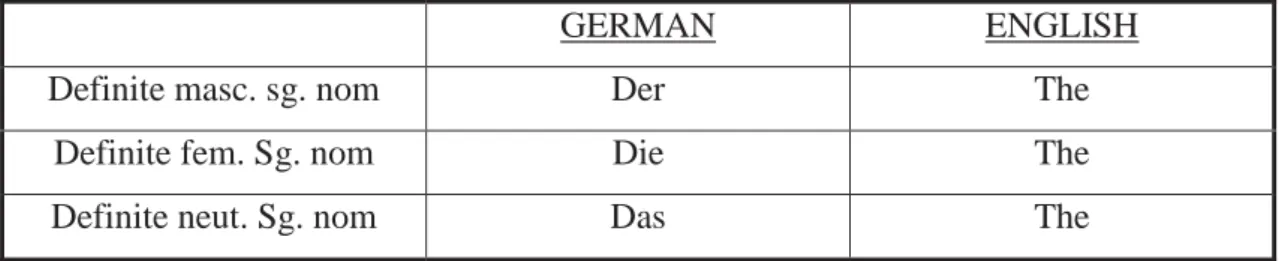
Comparing our pair of languages, the gender features in German determiners are more complex than in English. The focus of this paper will be on the definite article, which is the most common determiner, and nouns. German definite articles encode num-ber, gender and case; features that lack in the English equivalent.
The definite article in English the is non-variable and it is used in all grammatical situations. Its German equivalent is more complex since it has three forms: der, die and das, which vary their form depending on the number, gender and case of the head of the NP it accompanies. In other words, in German the definite article of a noun agrees with the gender and number of that noun.
Table 1: Definite articles in the target languages.
GERMAN ENGLISH
Definite masc. sg. nom Der The
Definite fem. Sg. nom Die The
Definite neut. Sg. nom Das The
None of our languages owns phono-prosodic properties2 in their articles to facil-itate these determiners acquisition. So, only the morphological properties can help to sort English or German for acquisition purposes. Therefore, English seems to be the language that most facilitates the acquisition of these functional categories, in contrast to the Ger-man morphological properties which may hamper acquisition of determiners on bilingual speakers.
Chomsky’s Minimalist Program (1995) proposes that the determiner is the head of the DP, and embeds the NP. As a result, the determiner carries the process of transferring the gender and number features to the noun so that they match.
In contrast to the English definite article the, the gender value can be distinguished in nouns. Regarding English nouns, they code gender depending on the animate of non-animate features. Animate nouns classify gender considering the sexual condition of the referent it denotes. They can denote sex by adding lexical devices – such as pre-modifiers, suffixes, etc. – (e.g. lion / lioness), or through derivation (e.g. father /mother). In this way we are able to make a classification of nouns using sex as a covert gender feature –
2According to Kupisch and Bernardini (2007) “the phono-prosodic property is that the vocalic endings in the majority of cases harmonize with the noun ending (e.g. la ragazza, le ragazze, i
visible at a morphological level –. On the contrary, non-animate nouns in English usually are un-marked for gender; that is, a native speaker of English might have difficulties to classify book or helicopter into masculine or feminine. Finally, apart from the mentioned suffixes, English nouns generally include endings in only two situations: to form the pos-sessive case and to form plurals.
On the other hand, in German, all nouns must be declined depending on the gen-der, case and number. German nouns are classified into five declensions. Additionally, nouns in German belong to one of three genders: masculine –der-, feminine –die-, or neuter –das. A total of 98.7% of the German nouns have only one gender; less than a 1.3% can be used with two genders; 0.02% can be used with all three genders. Out of the 98% of the nouns using a single gender form, 46% are feminine, 34% masculine, and 20% neuter. From this we can see that every noun in German is classified in at least one of these three categories. Taking these figures into consideration the possibilities of choosing the feminine gender as default would be higher than the other two options. How-ever, it is possible to recognize noun gender by observing their morphological form, es-pecially with attention to their suffixes. Table 2 shows the overt canonical suffixes that might indicate the gender of the noun, and yet it concords with the gender of the definite article.
Table 2: Gender related suffixes in German nouns.
DER DIE DAS
- ling
- tor
- ör
- loge - ist
- ant
- är
- et
- eur
- ismus - iker
- ung
- keit - heit - schaft
- ion
- enz
- ir - ¨t - unft - ther - erei
- ade
- ine
- ive
- sis
- ur
- ie
- chen - lein - ment
- um
- tum
Some animate nouns, as in the English language, classify gender through the sex-ual condition of the referent it denotes. For example, nouns denoting a person, such as die Frau (woman) or der Mann (man). So, most of the time, the gender of the noun matches with the sex condition of the referent that the noun denotes. However, there is also a minority of exceptions or non-canonical endings. Since the diminutive suffixes, such as -chen or –lein, assign neuter gender, animate nouns formed with these suffixes are neuter. For example, das Fräulein (miss). Moreover, whilst the suffix –e is likely to be feminine
it assigns masculine gender when referred to people or some animals. For example: die Lampe (the lamp) versus der Junge (the boy).
Nevertheless, as with many other gendered languages (i.e. Spanish), the German unmarked gender is masculine, whose forms are usually the least marked. In addition to this, Kopcke (1982, p.45) confirms that in terms of frequency “masculine gender occurs nearly five times as often as feminine and three times as often as neuter gender with one-syllable words in German. In multi-one-syllable words the ratio between the genders is about equal.” (quoted from Delisle, 1985)
When comparing both grammatical gender systems, the complexity of the Ger-man system is clearly noticeable. As seen above, this complexity corresponds to the in-teraction of the grammatical (i.e. masculine, feminine, neuter), semantic (i.e. male or fe-male) and morphological (i.e. prefixes, suffixes) properties.
2.3 Directionality in the agreement of CS DPs
Concord and agreement structures have been the central point of study for plenty scholars. The DP internal agreement or concord is the operation by which definite articles
and adjectives agree with the noun in gender and number. Thus, the sameφ- features3 appear on more than one head within the same DP (Danon, 2010, p.8). For example:
(7) Die [fem. sing.] hübsche [fem. sing.] Frau [fem. sing] (8) The [sing.] pretty [fem. sing.] woman [fem. sing.] (9) Die [fem. Sing.] pretty [fem. sing.] woman [fem. sing.]
Fem. = feminine; sing.= singular
3“We take phi-features to be those involved in predicate−argument agreement, typically person,
As we can observe in the previous examples, all the features within the DP inner structure match in both English and German. Following Chomsky’s Minimalist Approach (1995), matching is the basic premise on this type of structure. Since the determiner is the head of the DP, it is the one which transfers the φ- features – number and gender – to the NP. Following this minimalist theory, Cantone & Müller (2008, p.812) state that “as long as the language specific features are respected in the course of the derivation, mixing should be allowed”. Moreover, Klassen et al. (2013, p.1) affirm that the structure of the switched DPs can shed light on the gender representation in the mind of bilingual speak-ers; “they make possible to determine whether bilinguals whose dominant language does
not classify nouns according to grammatical gender do, in fact, assign these nouns the gender of their ‘translation equivalents’ in the gender-marked language.”
Since both languages share the same DP structure – embedding functional cate-gories (determiners) and lexical catecate-gories (nouns) – code-switching must be possible and grammatically correct. Blending the languages under study, two possible combinations would result: a) English Det. German N. and b) German Det. and English N. In the first combination, the functional category is provided in English (10), whereas the second is provided in German (11).
(10)The Frau. (11) Die woman.
2.3.1 Language Dominance Hypothesis.
Grosjean (1982) refers to language dominance in bilinguals as the language with greater proficiency and the language that is significantly more frequently used. The fact
that an early bilingual child is more proficient in one language affects the patterns in which the switched utterances occur in code-switching. In order to demonstrate this idea,
2.3.2 Grammatical Features Spell-Out Hypothesis.
As seen in section 2.2., English does not mark gender in determiners, nor in non-animate nouns, while German does. According to the Grammatical Features Spell-Out Hypothesis (GFSH) proposed by Fernández-Fuertes et al. (2005), bilinguals’ preferences in code-switching are going to be favoured by the higher grammaticalized language; that is the language which embeds more uninterpretable φ- features. Then, it will be the Ger-man language which is more likely to contribute to the functional category and transfer the gender features to the lexical category through concord. On the contrary, English de-terminers would not transfer the φ- features to the noun, leaving it ungendered. Taking this hypothesis into consideration, English-German bilinguals would rather prefer (11) – because the functional category is provided in the most grammaticalized language –, ra-ther than (10) – since English determiners are not marked for gender –.
2.4 Gender concord in German-English DPs.
When the determiner is marked for uninterpretable φ- features in switched-DPs, the functional category matches the gender features with the correspondent noun of the same language, and secondly, the lexical category is substituted by its translation equiv-alent. As a result, we obtain a CS DP in which the gender features of the functional and lexical categories match. In these cases, Liceras et al. (2008) have demonstrated that bi-linguals stand for the “analogical criterion” [+AC] (Otheguy & Lapidus, 2005). That is, there is a clear preference on gender-matching DPs compared to non-matching struc-tures. (quoted in Klassen et al. 2013, p.1).
Therefore, in German Det and English Noun DPs, as in (12), the English noun
would receive the feminine and singular φ- features from the German article die; taking into account that the German equivalent for strawberry is Erdbeere, a feminine singular
noun. Thus, it can be predicted that bilinguals would favour matching gender structures [+AC] , as the example (12), over non-matching ones [-AC]. For instance, (13a) or (13b).
(12) die strawberry [FF] [+AC]
DIE matches ERDBEERE substituted by STRAWBERRY
(13a) *der strawberry [MF] [-AC]
Additionally, with regard to Liceras et al.’s experimental data, whenever the se-quential bilinguals´ L1 is non-marked for gender in the functional category, they would follow whether the analogical criterion [+AC] or the masculine gender value as the de-fault option.
Taking together the previous theoretical framework, the following section will show some proposals to be further analysed in English- German bilinguals.
3. Hypotheses
In the studies on code-switching previously overviewed the grammatical gender pair systems vary. Ungendered vs. two-gendered systems (i.e. Spanish-English, or Eng-lish-Swedish-Italian) from Liceras et al. (2008) and Kupisch & Bernardini (2007); two-gendered vs. three-two-gendered system (i.e. Italian-German) from Cantone & Müller (2008). Notwithstanding, we want to check if the previous proposals also apply for English-Ger-man bilingual children.
As seen in section 2. by following the Minimalist Approach (1995), since the de-terminer is the head of the DP, the dede-terminer transfers the φ- features – number and gender- to the noun. Whenever all the features match, code-switching is highly plausible in bilingual speakers. When seeking the directionality of the two possible combinations in English-German DPs, such as (10) and (11), two possible theories apply: the language dominance hypothesis and the grammatical features spell-out hypothesis.
[#Hypothesis 1:] The prevalence of the Language Dominant Hypothesis over the Grammatical Features Spell-Out Hypothesis is expected in bilinguals whose L1 has less uninterpretable features.
When faced English det.+ German noun DPs and German det.+ English noun DPs, English bilinguals will show preference for the former structure.
When analysing gender concord in German det. + English noun DPs, two main theories apply: the analogical criterion and the masculine as default gender value.
[#Hypothesis 3:] In case they have not yet fully acquired the Analogical Criterion, English dominant English-German bilinguals may favour the default masculine gender in German determiners. Since German is a triple gendered system, our guess is that the sec-ond most preferred gender would be neuter, instead of the feminine; my proposal is based on the fact that it would be the neuter German equivalent for the English article the.
Therefore, in a triple gendered language as German, if bilinguals face a German det. + English noun DP and they do not follow the analogical criterion to match the φ- features, their preference is expected to be the masculine option. Moreover, two gender values could also be chosen. Our hypothesis determines that English bilinguals would secondly prefer the neuter gender value rather than the feminine one.
These hypotheses will be tested using an acceptability judgement task (AJT). Out of this method we will extract the data corresponding to the participants’ acceptance or
rejection of the code-switched structures. The process, participants and the task itself will be explained in the upcoming section.
4. Methodology 4.1 Participants
The participants tested in this investigation are classified as early successive bi-linguals, according to Hammer (1999, p.17). Children who started acquiring their L2 from the age of three/four, to eleven/twelve years of age. Taking this into account, this work is placed within the research field of Bilingual Second Language Acquisition (BSLA). (De Houwer, 1995, p.223)
The data comes from 26 bilingual English/German children studying at St. Kilians
Deutsche Schule Dublin4. This is a co-educational German / English-Irish school located in the capital of Ireland. All the participants are enrolled in the German Curricular Stream
(Gymnasialer Bildungszweig) and, apart from German language, they are taught Mathe-matics (3 periods/week) and Biology (2 periods/week) in German. This type of education is defined by Marsh (2012)as C.L.I.L. or Content and Language Integrated Language. In other words, subjects are taught through an L2, but the specific focus does not directly lie on the language of instruction, i.e. Biology taught in German.
Since we are dealing with an upbringing foreign language education at an immer-sion school we can also talk of “heritage speakers”.
Polinsky et al. (2007) defines heritage speakers as following:
“Heritage speakers are people raised in a home where one language is spoken who subsequently
switch to another dominant language. The version of the home language that they have not
com-pletely acquired – heritage language – has only recently been given the attention it deserves from
linguists and language instructors.” (p.368).
They all live in Ireland, therefore the dominant language is going to be English in everyday life due to social factors, even though they can also enjoy an academic instruc-tion in German. Consequently, German is largely restricted to an academic context, and in some cases to a home context too.
The group of participants, including both boys and girls, were divided into two groups classified by their age and educational level. To do so, a previous language back-ground test (see Appendix III) was used. Through this test, parents or tutors provided us the personal language information of each participant. They were asked questions regard-ing the child such as name, age, first language spoken at home durregard-ing early childhood, first language spoken at home now, the total number of languages spoken, the ranking of languages spoken according to comfortability and questions regarding the academic year. Additionally, a fully detailed description of each of the languages spoken considering the age the child started learning/speaking the language, the location where the child started
to speak the language, if the child has ever lived in a country where this language is native one, the frequency and context of use and the fluency in 3 main skills: listening, reading
and speaking. Considering their age and the purpose of this study, information on any writing skills was omitted. Since all the children were aged under 18, together with the language background questionnaire, all the parents were given some written consent for-mulae (see Appendix II) to be signed by the school, the parents and myself.
and 2nd class -following the Irish Primary School Curriculum-. Group 2 consisted of 14 children between 9 and 10 years of age, in 3rd and 4th class respectively.
4.2 Data Elicitation Procedure
As soon as the school ethics committee accepted our proposal to carry out this investigation, an advertisement call for recruiting the participants (see Appendix I) was made with the collaboration of my former tutor, Qianting Yuan, and the UVALAL (Uni-versity of Valladolid Language Acquisition Lab). Once a sufficient number of volunteers were obtained the school sent the parents the language background test (Appendix III) and the consent formulae (Appendix II).
The compilation of the data was undertaken in February 2017 and lasted two days/sessions. Each session lasted about 50 minutes and was carried out in the classroom with all the participants sitting down around a table, not individually. All the participants were capable of reading by themselves so no extra help or time was required.
Before undertaking the task and following the concepts of Lobov (1975) (in Can-tone 2007), we made a training example for the bilingual participants. This task purpose intends that children do not respond randomly or according to other criteria not related to the linguistic competence. The children were told that sometimes, when people know several languages, they might insert some words from one language into another. Then, some German-English speakers could either say (1) or (2), indifferently:
(14) Das rabbit frisst kleinen Karotten.
(15) The Kaninchen eats little carrots.
Both sentences were explained as two separated linear puzzles in order to show
code-switching through a simple and practical example. In this way, each of the puzzle pieces belonged to an element of the sentence and differed in their colour. When
produc-ing code-switchproduc-ing in these examples we asked the participants to individually rate their acceptance level towards the “new” sentence.
Das
rabbit
frisst
kleinen
Karotten.
By doing this training example before the test, we tried to make the children un-derstand the phenomenon of intra-sentential code-switching within DPs while avoiding making it too obvious. Once this was completed the students were given the acceptability judgement task which will be described in detail in section 4.2.1.
4.3 Acceptability Judgement Task
This Acceptability Judgement Task (subsequently AJT) deals with functional-lex-ical code-switched DPs. That is, concord structures within a sentence in which the deter-miner and the noun differ in language -sometimes the deterdeter-miners are in German and the noun in English, or vice versa-. The aim of this task is to evaluate the children´s accepta-bility of different switched DPs as bilingual speakers.
The task was structured in a table of 40 items and all of them were shown ran-domly to the participants. Each item was formed by 3 parts: in the first column, a cartoon image connected to the DP meaning they had to judge was presented. In the second col-umn, the sentences presented as a question-answer dialogue contained the switched DPs. All the mixed DPs were placed within the answer. Finally, the third column included four emoticon faces -very sad, sad, happy, very happy-. In statistics, it is called a “Likert scale”5 and it was the tool for the participants to rate their acceptability of the previous
information. Their purpose in this task was to cross just one face per sentence, showing how the switched phrases sounded to them. The scale had 4 categories of response:
1.“very sad / very bad”
2. “bad” – as intermediate value – 3. “good” – as intermediate value – 4. “very happy / very good”
Concerning the inner organization of the task, there were 40 items in total
includ-ing 36 experimental items and 4 distractors. The distractors were sentences with the same dialogue structure as the experimental items but without any element code-switched. On the other hand, the 36 experimental items belonged to two classifications with different analytical purposes: Section A and Section B.
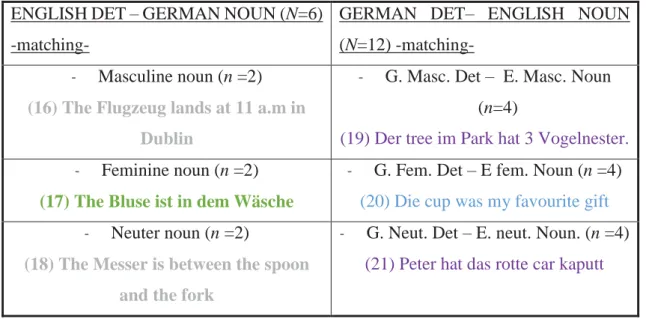
Section A embeds 18 in total (n=18): 6 English Det - German noun items vs. 12 German Det – English noun ones. This section aims to see which of the two possible structures is better accepted by the participants.
Table 3: Two possible code-switched DPs (n=18). ENGLISH DET – GERMAN NOUN (N=6)
-matching-GERMAN DET– ENGLISH NOUN
(N=12) -matching-
- Masculine noun (n =2)
(16) The Flugzeug lands at 11 a.m in
Dublin
- G. Masc. Det – E. Masc. Noun (n=4)
(19) Der tree im Park hat 3 Vogelnester.
- Feminine noun (n =2) (17) The Bluse ist in dem Wäsche
- G. Fem. Det – E fem. Noun (n =4) (20) Die cup was my favourite gift
- Neuter noun (n =2)
(18) The Messer is between the spoon
and the fork
- G. Neut. Det – E. neut. Noun. (n =4) (21) Peter hat das rotte car kaputt
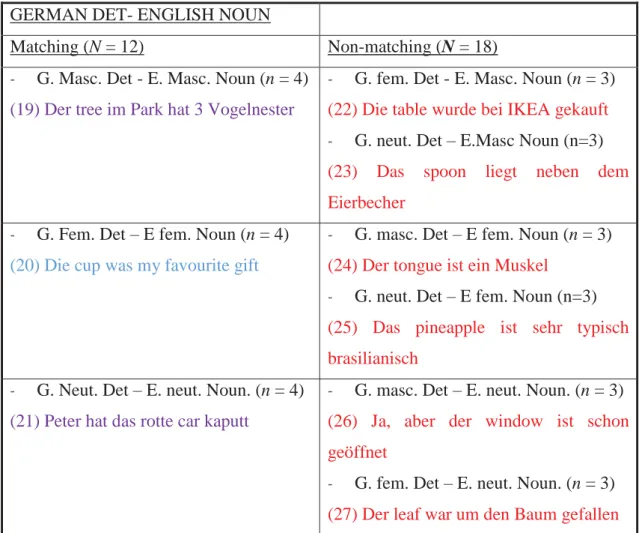
Section B deals with gender concordance in German – English code switched DPs. Considering that English is a non-gendered language, the pattern of the DPs will remain fixed. Therefore, we will analyse the acceptability of correct and incorrect German determiners with an English NP. It is formed by 30 items (n=30), 12 of them. Since Ger-man has 3 genders, the provided DPs were formed by the 9 possible combinations be-tween the 3 correct / matching DPs – 4 sentences each (n=12)-, and the 6 incorrect / non-matching combinations -3 sentences each (n=18)-. “Correct agreement/matching” hap-pened when the gender and the number of the German equivalent was assigned to the English noun, as seen in (6): der [“the” masc, sing] tree [ “Baum” is masc, sing]. “Incor-rect Agreement” was coded when the determiner and the gender of the English equivalent
did not agree, as in (13): Der [masc, sing] window [Fenster: [neuter, sing]. Finally, all the DPs were in nominative case to avoid confusion with the accusative, dative, or genitive German declensions.
Table 4: The analogical criterion in (mis)matching DPs (n=30). GERMAN DET- ENGLISH NOUN
Matching (N = 12) Non-matching (N = 18)
- G. Masc. Det - E. Masc. Noun (n = 4) (19) Der tree im Park hat 3 Vogelnester
- G. fem. Det - E. Masc. Noun (n = 3) (22) Die table wurde bei IKEA gekauft
- G. neut. Det – E.Masc Noun (n=3) (23) Das spoon liegt neben dem
Eierbecher
- G. Fem. Det – E fem. Noun (n = 4) (20) Die cup was my favourite gift
- G. masc. Det – E fem. Noun (n = 3) (24) Der tongue ist ein Muskel
- G. neut. Det – E fem. Noun (n=3) (25) Das pineapple ist sehr typisch
brasilianisch
- G. Neut. Det – E. neut. Noun. (n = 4) (21) Peter hat das rotte car kaputt
- G. masc. Det – E. neut. Noun. (n = 3) (26) Ja, aber der window ist schon
geöffnet
- G. fem. Det – E. neut. Noun. (n = 3) (27) Der leaf war um den Baum gefallen
The present test was designed jointly with my former tutor, Qianting Yuan. As it can be observed in the upper tables, the matrix language of the sentences varies between English and German. This phenomenon was made to simulate a bidirectional switching situation – which does not negatively affect the results – and for the possible further usage of this test in the German dominant target group, in order to contrast the results. The vocabulary used as heads of the NPs was suitable for the participants’ level according to
the ages and the educational curriculum followed. NPs in which the noun could evoke ambiguity between English and German (e.g. house/ Haus, bear/ Bär), as well as “Denglish words”, were excluded. The cartoons depicting the nouns were chosen
metic-ulously, so that the images would not influence the participants’ answers. Moreover, the clear majority of the items were non-animated nouns; In other words, no external factors nor associations would interfere in any gender classification, as seen in section 2.2.
Once the participants sat the AJT, both groups’ answers were classified and
5. Results
The experimental data collected from the 26 participants has been presented in two groups: group 1 (7-8 years old) and group 2 (9-10 years old). For the sake of simplic-ity, all the given responses in the AJT have been classified as good – values 3 and 4 – or bad – values 1 and 2 –. Finally, the data obtained have been classified according to our three hypotheses: language dominance hypothesis (dealing with the directionality in the agreement of the CS DPs), the analogical criterion and the masculine gender value as the default option (dealing with gender concord in German det.+ English noun DPs).
5.1 Language Dominance Hypothesis
This section shows the analysis of the data begins in terms of the directionality of the two types of code-switched DPs: English Det. German Noun vs German Det. English Noun.
Figure 1: Acceptability of DPs structures.
Figure 1 shows the acceptability of both groups towards different DP code-switched structures. As we can observe, the acceptability towards the code-switching phe-nomenon in DPs is very significant (≈50%). Nevertheless, there are some differences considering the directionality of the DP inner structure, that is, the language that provides the determiner. Both structures matched the φ- features, however they differed with re-gard to the language providing the functional category. For example, the buch
corre-55.03
51.95
44.96 48.05
GROUP 1 GROUP 2
sponds to the green bar and der train belongs to the orange bar. There is a clear accepta-bility when the Det. is provided in English. Group 1 assigns this structure a 55.03%. This percentage seems to be reduced in group 2 (51.95%), since the bilinguals are older and have acquired greater dominance in the L2 German. Meanwhile the percentages depicting the English determiner decrease from group 1 to group 2 and the values of German as the head of the DP gradually increase from group 1 to group 2.
5.2 Analogical criterion [± AC]
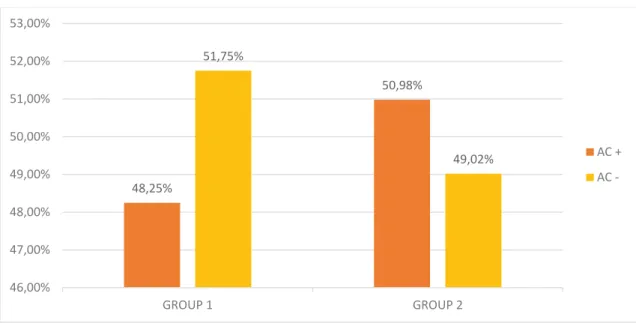
Focusing on the German determiner English noun DPS, we are going to deal with both groups’ reactions in the AJT towards gender-matching [+AC] and
non-gender-matching [-AC] DPs. as seen in table 4. The results are displayed in figure 2.
On a previous step, we take a look at the mean, standard deviation6 and mode values. First, we are going to deal with the mean values. This results oscillate between 2,56 and 2,79 for matching DPs. As for non-matching DPs the values wave between 2,51 and 2,87. These results show that the children accept the code-switching phenomenon in this type of DPs. In a scale of 4 points, they mark all the utterances as good ones but not perfect. Once shown the mean values, we calculate to the general standard deviation of the AJT. In our study the standard deviation is 0.99. This means that adding all the results together, the value of dispersion from the resulted mean oscillates in a frame of almost one point. So, the results are barely distorted. Finally, we want to know which values -out of our Likert scale of four points- occurred with the highest frequency. In general, for both groups and both [± AC] DPs, the mode data reflected a clear tendency for the 3-4 values. Namely, the so-called “good responses.”
6Following the concept introduced by Karl Pearson (1893), the Standard Deviation is the measure of
Figure 2: Analogical Criterion Acceptability in the AJT.
Figure 2 rates the percentages, of both groups, for gender matching [+AC] and gender non-matching [-AC] DPs with English Det. English N. Gender matching DPs are formed by MM, FF, NN structures. Whereas the non-matching ones embed *NM, *FM, *MF, *NF, *MN, *FN determiner phrases.
As we can observe, Group 1 shows preference for non-matching DPs (51,75%) contrasting to the matching structures (48,25%). They do not favour [+AC] structures due to a wider influence of the English language which does not code gender. However, Group 2 changes this preference to the opposite. Their acceptability towards matching DPs (50,98%) slightly overcomes that of non-matching DPs (49,02%). This contrast might result in the increasing influence of German in the latter bilinguals.
5.3 Masculine default gender
The last hypothesis stated in this study deals with the masculine gender as the default option; in other words, the option which would be considered unspecified in terms of gender. Considering this property, masculine would be the most preferred value out of the three possible ones in the German language. However, we wanted to also analyse which would be the preceding value in this triple gender system. The results obtained are shown in figure 3 displayed below.
48,25%
50,98% 51,75%
49,02%
46,00% 47,00% 48,00% 49,00% 50,00% 51,00% 52,00% 53,00%
GROUP 1 GROUP 2
AC +
-Figure 3: Gender ranking of the German gender system according to the AJT.
Figure 3 presents the overall results for DPs in which the functional category – det.- was provided in German. The analysis focuses on both matching and non-matching determiners. Therefore, they were only classified in terms of the type of determiner. The values correspond to those utterances of the AJT, given the masculine DP (i.e. MM, *MN, *MF), feminine DP (i.e. FF, *FM, *FN) and neuter DP (i.e. NN, *NM, *NF). In order to avoid confusion, the gender of the noun will be omitted. Thus, the present classification deals with other type of acronyms: M-, F-, N-.
As we can observe, both groups rated the masculine DPs on first place. Next on this scale, it is surprising that also group 1 and group 2 share their preferences towards the other two genders, feminine and neuter, even though both groups have a clear sensi-bility for the masculine gender, being the most rated. Both groups also prefer the neuter gender on the second plane over the feminine gender –even though, as we mentioned in section 2.2., the majority of the German nouns are classified within the feminine gender (98%).
Scale 1:10 GROUP 1 GROUP 2
M - 6,1 7,2
N - 5,2 6
F - 5,6 6,6
0 1 2 3 4 5 6 7 8
G R O U P 1 G R O U P 2
M-
F-6. Discussion
Having analysed the results obtained from the Acquisition Judgement Task (AJT) from the two groups of English-German sequential bilinguals, this section will show their relation with the predictions posted in section 3. Thus, section 6 allows us to support or reject the hypotheses.
Firstly, Chomsky’s Minimalist Program (1995) proposes that the determiner is the head of the DP and embeds the NP. As a result, the determiner is the one which transfers the φ- features – number and gender- to the NP. Complementizing this minimalist theory, others authors such as MacSwan (2000) and Cantone and Müller (2008) point out that the determiner carries the process of transferring the gender and number features to the noun so that they all match, even in switched DPs. Consequently, two possible switched structures embedding the English and German languages were proposed in the AJT in order to see our participants’ preferences: a) English det. + German noun DPs and b)
German det. + English noun DPs. In order to determine the directionality of the two possible switched DP structures, two hypotheses were considered: the language dominance hypothesis determines the more dominant language as the one providing the functional category of the switched DP. So bilinguals’ preferences would deal with the first structure. In contrast, according to the Grammatical Features Spell-Out Hypothesis, bilinguals’ preferences in code-switching are going to be favoured by the higher
grammaticalized language (i.e. German).
The first hypothesis predicted that since our participants are dominant English, English-German early bilinguals, they would rather prefer the language dominance hypothesis over the grammatical features spell-out one. So, they would favour those structures in which the head of the DP is in English. As can be seen with structures like (10) instead of (11); This preference was regardless of the higher grammaticalization of
German determiners. This situation would be led by the fact that the participants have not yet acquired the gender system that the German language requires. The results shown in
Figure 1 clearly support this hypothesis at this stage.
even predict that the GFSH will be confirmed in the near future when these sequential bilinguals’ L2 equals or surpasses their L1.
The second hypothesis focuses only on the German determiner English noun structure -even though we took into account that they are more English dominant sequen-tial bilinguals-. This hypothesis expected that the canonical features of the German trans-lation equivalent for English Nouns would be relevant when accepting its correspondent determiner. That is, providing the lexical category in German, bilinguals would prefer utterances in which the determiner gender would correspond to the one assigned by the English noun translation equivalent. For example, they are expected to favour DPs stand-ing for the positive analogical criterion, such as (12); rather than (13a) or (13b) which follow the contrary analogical criterion. The results show both groups’ reactions in the AJT towards gender-matching [+AC] and non-gender-matching [-AC] DPs. As depicted in figure 2, this hypothesis is rejected by the results obtained in Group 1, however on the contrary it is confirmed by the results of Group 2, which is formed by older participants whose German dominance happens to be increased. Thus, Group 2 agrees with our ex-pectations and, by their choices, displays a slightly greater sensibility towards gender matching utterances.
Finally, considering that our participants’ L1 features do not code gender, it pro-posed that they would prefer the masculine gender as the default option. Yet, masculine would be considered the unspecified value (Delisle, 1985) in terms of gender. However, German codes three possible values for gender; masculine, feminine and neuter. Meeting the previous expectations, masculine would be ranked as the first option; nevertheless, we wondered how this gender raking would continue in the remaining values: feminine and neuter. To do so, both matching and non-matching DPs from the AJT (M-, F-, N-)
were analysed. Results confirmed the hypothesis in which the masculine is the most pre-ferred value for our English dominant bilinguals. These results are in line with other
7. Conclusion
This dissertation has dealt with code-switching phenomenon which occurs when blending two languages in the same utterance. Specifically, it was narrowed to the intra-sentential type of code-switching, focusing on the DP structure and two particular lan-guages: English and German. In order to carry out this research, two groups of successive bilingual children participated on an acquisition judgement task. The results obtained have come to either reject or support the proposed hypotheses. Firstly, the English domi-nant, English-German bilinguals have accomplished the language dominance hypothesis at this stage. They have shown preference for structures in which the head of the DP was provided by the less grammaticalized language. However, there is a clear tendency that GFSH will be accomplished when the more transparent language – German – increases in dominance. Secondly, it has been shown that Group 2 has more sensibility towards the analogical criterion hypothesis. This means they have a preference for utterances in which gender agrees with the canonical markers of the German translation equivalent noun. Fi-nally, regardless of the gender matching feature of code-switched DPs, the participants have confirmed their preference towards the masculine as the default option in the Ger-man gender system. Moreover, both groups have rated the neuter as the second preferred gender over the feminine.
So, on the basis of the obtained results we have a particular proposal for further research. It would be of utmost interest to analyse the stages by which learners start de-veloping the German gender system. If at first it is assigned by unconscious decision and then it acquires more lexical relevance, or if it follows any other pattern different to the
References
Albrecht, E. (2006). I can speak German - und Deutsch: the development and use of code-switching among simultaneous and successive English-German bilingual children.
Anderson, T., & Toribio, J. (2007). Attitudes towards lexical borrowing and intrasenten-tial code- switching among Spanish-English bilinguals. Spanish in Context, 4, 217-240.
Cantone, K. F. (2007). Code-switching in bilingual children. Springer Science & Busi-ness Media.
Cantone, K.F., & Müller, N. (2008). Un Nase or una Nase? What gender marking within switched DPs reveals about the architecture of the bilingual language fac-ulty. Lingua, 118, 810–826.
Chomsky, N. (1995). The minimalist program. MIT Press, Cambridge, MA.
Danon, G. (2010). Agreement and DP-internal feature distribution. Syntax, 14(4), 297-317.
De Houwer, A. (1995) Bilingual Language Acquisition. The Handbook of Child Lan-guage. Oxford: Blackwell.
Delisle, H. (1985). The acquisition of gender by American students of German. The Modern Language Journal, 69(1), 55–63.
Denglish. (n.d.). In MacMillan Dictionary Online. Retrieved from http://www.macmil-landictionary.com/buzzword/entries/Denglish.html
Fernández-Fuertes, R. Liceras, J.M. & Spradlin K. (2005). Bilingual early functional-lexical mixing and the activation of formal features. International journal of
Bilin-gualism. Volume 9. No.2.
Fernández-Fuertes, R. Liceras, J.M. & Bel, A. (2011). Functional-lexical
code-switch-ing in simultaneous and sequential child bilcode-switch-ingualism. International Symposium of Bilingualism (ISB-8), 15-18 University of Oslo, Norway.
Grosjean, F. (1982). Life with two languages: an introduction to bilingualism. Cam-brigde, Mass.: Harvard University Press.
Grosjean, F. (1998). Studying bilinguals: Methodological and conceptual issues. Bilin-gualism: Language and Cognition, 1, 131-149. Oxford, England: Blackwell. Grosjean, F. (2001). The bilingual's language modes. One Mind, Two Languages:
Grosjean, F. (2010). Bilingual: life and reality. Cambridge, Mass.:Harvard University Press.
Hammer, M. (1999). Zweisprachige Kindererziehnung. Diplomatarbeit zur Erlangung des Akademischen Grades einer Magistra der Philosophie. Karl-Franzens-Univer-sität, Graz.
Himmer, K. (2014). 3 Children –3 “Genglisches”: a linguistic case study with bilingual children. Anchor Academic Publishing. Hamburg.
Jorschick, L., Quick, A. E., Glässer, D., Lieven, E., & Tomasello, M. (2010). German– English-speaking children’s mixed NPs with “correct” agreement. Bilingualism: Language and Cognition, 14(2), 173–183.
Klassen, R., Landa-Buil, M., & Liceras, J. M. (2013). Feature valuation in concord and agreement structures: one or two puzzles? University of Ottawa, University of the West Indies, 2–3.
Kupisch, T., & Bernardini, P. (2007). Determiner Use in Swedish and Italian-German Children: Do Swedish and Italian-German Represent the Same Parameter Set-ting? Nordlyd, 34(3), 209–229.
Liceras, J. M., Fernández Fuertes, R., Perales, S., Pérez-Tattam, R., & Spradlin, K. T. (2008). Gender and gender agreement in bilingual native and non-native gram-mars: A view from child and adult functional-lexical mixings. Lingua, 118(6), 827–851.
Liceras, J.M., Fernández-Fuertes, R. & Klassen, R. (2008, in press.) Language Domi-nance and Language Nativeness: The View From English- Spanish Code-switch-ing. Spanish-English Codeswitching in the Caribean and the U.S. Amsterdam:
John Benjamins.
MacSwan, J. (1999). A minimalist approach to intrasentential code switching. New
York: Garland Press.
MacSwan, J. (2000). The architecture of the bilingual language faculty: Evidence from codeswitching. Bilingualism: Language and Cognition, 3(1), 37-54.
Macswan, J., & Mcalister, K. T. (2010). Naturalistic and Elicited Data in Grammatical Studies of Codeswitching. Studies in Hispanic and Lusophone Linguistics, 3(2). Marsh, D. (2012). Content and Language Integrated Learning (CLIL) A Development
Meisel, J.M. (2001). The simultaneous acquisition of two first languages: Early differ-entiation and subsequent development of grammars. John Benjamins Publishing Company, Amsterdam, Philadelphia.
Milroy, L & Muysken, P. (1995) One Speaker, Two Languages: Cross-Disciplinary Per-spectives on Code-Switching, Cambridge UP, Cambridge.
Petersen, J. (1998). Word-internal code-switching constraints in a bilingual chid’s gram-mar. Linguistics 26, 479-493.
Polinsky et al. (2007). Heritage languages: In the 'wild' and in the classroom. Language and Linguistics Compass: 368–395.
Poplack, S. (1980). Sometimes I’ll start a sentence in Spanish y termino en español: to-ward a typology of code-switching. Linguistics 18, 7/8. 581-618.
Poplack, S. (2013). Foreword to "sometimes I’ll start a sentence in Spanish y termino en español": toward a typology of code-switching. Linguistics 1980, Volume 18, issue 7. 581-618. Linguistics 51 (Jubilee issue). 11-14.
Quirk et al. (1985). A comprehensive grammar of the English language.London: Long-man.
Valenzuela et al. (2012). Gender and Heritage Spanish Bilingual Grammars: A Study of code-mixed Determiner Phrases and Copula Constructions. Hispania.
Sankoff, D. & Poplack, S. (1981). A formal grammar for code-switching. Papers in Lin-guistics 14, 1. 3-46.
APPENDICES Appendix. (I): Call for volunteers.
Volunteer participants needed: February 2017
L2 German acquisition: child L2 German acquisition in Dublin
DOES YOUR CHILD SPEAK GERMAN AS HIS/HER
SECOND LANGUAGE?
We are an undergraduate student and a university professor from the University of Val-ladolid (Spain). We are examining the contact between English (as a child’s first lan-guage) and German (as a child’s second lanlan-guage) and what lies behind children’s intui-tions as L2 German speakers.
No specialized knowledge is required to participate in this experiment.
So if your child is between 6 and 10 years old and
x speak English as his/her first language
x have been studying German as his/her second language since the age of 3 or 4
We invite your child to be part of our research.
The study lasts for approximately 30 minutes in a single day.
Please send us an e-mail so we can give you more information and answer any questions you may have.
THANK YOU AND WE HOPE TO SEE YOU SOON!
Contact
Sofía Arraz Ortega (University of Valladolid, Spain):
Appendix (II): Consent Form.
Language Acquisition Laboratory University of Valladolid
http://www.uva.es/uvalal
CONSENT FORM
PROJECT DIRECTOR
Raquel Fernández Fuertes ([email protected])
RESEARCH TEAM Esther Álvarez de la Fuente Sonja Mujcinovic
Qianting Yuan Sofía Arranz Ortega
Department of English University of Valladolid
Plaza del Campus Universitario s/n 47011 Valladolid, Spain
UVALAL: http://www.uva.es/uvalal/
Whenever a research project is conducted by the University of Valladolid (Spain), the Research Ethics Board requires all researchers to obtain written and clear consent from their participants. This does not mean that the research project involves any risk or dis-comfort to the participants. The written consent simply confirms that the participants take part in the experiment willingly and voluntarily.
The experiment for which your child has volunteered is part of a research project on the second language acquisition of German. It is carried out by the research team UVALAL from the University of Valladolid (Spain) directed by Raquel Fernández Fuertes.
This experiment will consist of a single session which will last about 30 minutes, which will take place in St. Kilian's German School Dublin. During the session your child will be asked to rate a group of structures in German. Our aim is not to evaluate your child’s proficiency in this language but rather to find out what lies behind his/her intuitions as an L2 speaker. No specialized knowledge is required to participate in this experiment. This test involves no risk or deception.
GIR
uva
LAL
uva
LALAll the information you share will remain strictly confidential. Your child’s name will not be revealed to anyone and your child will never be identified by his/her test results.
You and your child can, of course, withdraw from the research experiment at any time without consequence.
You and your child will not receive any compensation for your participation, although your child’s participation will ultimately help us better understand language processing.
Finally, we will be happy to answer any questions you may have regarding this experi-ment. If you have other questions afterwards, do not hesitate to contact Sofía Arranz Or-tega ([email protected]). All questions regarding your child’s rights as a participant in a research experiment can be addressed to Mr. José Ramón López López ([email protected]), vice-rector of research and scientific policy of the University of Valladolid and president of the Research Ethics Board of the University of Valladolid (Spain).
I, _____________________________________________________________ (tutor´s name and surname), hereby accept the information presented above and agree to have my
son/daughter
_______________________________________________________________ (participant´s name and surname) participate in this experiment. I understand that I and my son/daughter may
refuse to participate or withdraw from the experiment at any time. A duly-signed copy of this consent form will be sent to me if I require so.
______________________ (tutor´s signature)
_______________ _____________________________________
(place) (date)
Name and signature of the director of the educational institution (if appropriate)
__________________________________________________
Researcher’s name and signature
Appendix (III): Language Background
Language Acquisition Laboratory University of Valladolid
http://www.uva.es/uvalal
The information below refers to the child
1 Name: 2 Age:
3 Gender: M______ F_______ 4 Occupation: N/A
5 What language(s) did he/she first spoke at home during his/her first years?: 6 What language(s) does he/she speak at home now?:
7 What languages does he/she speak (including his/her first language(s))?:
Language 1:____________ Language 2: ____________ Language 3: ______________ Language 4: __________
Language 1:
At what age did he/she start
learning/speak-ing this language?:
Where did he/she start learning this language
(e.g. home, primary school, etc.)
How often and in which context does he/she
speak this language?:
Has he/she ever lived in a country where they
speak this language? If so, where and for how
long?:
What do you consider to be his/her fluency
level in this language?: (please circle one)
Listening comprehension:
beginner intermediate advanced near-native native
Speaking:
beginner intermediate advanced near-native native
GIR
uv
LA
uva
LALReading:
beginner intermediate advanced near-native native
Language 2:
At what age did he/she start
learning/speak-ing this language?:
Where did he/she start learning this language
(e.g. home, primary school, etc.)
How often and in which context does he/she
speak this language?:
Has he/she ever lived in a country where they
speak this language? If so, where and for how
long?:
What do you consider to be his/her fluency
level in this language?: (please circle one)
Listening comprehension:
beginner intermediate advanced near-native native
Speaking:
beginner intermediate advanced near-native native
Reading:
beginner intermediate advanced near-native native
Language 3:
At what age did he/she start
learning/speak-ing this language?:
Where did he/she start learning this language
(e.g. home, primary school, etc.)
How often and in which context does he/she
speak this language?:
Has he/she ever lived in a country where they
speak this language? If so, where and for how
long?:
What do you consider to be his/her fluency
level in this language?: (please circle one)
Listening comprehension:
beginner intermediate advanced near-native native
Speaking:
Reading:
beginner intermediate advanced near-native native
Language 4:
At what age did he/she start
learning/speak-ing this language?:
Where did he/she start learning this language
(e.g. home, primary school, etc.)
How often and in which context oes he/she
speak this language?:
Has he/she ever lived in a country where they
speak this language? If so, where and for how
long?:
What do you consider to be his/her fluency
level in this language?: (please circle one)
Listening comprehension:
beginner intermediate advanced near-native native
Speaking:
beginner intermediate advanced near-native native
Reading:
beginner intermediate advanced near-native native 8 Rank the languages that your child knows in
the order in which you think they feel most comfortable using, including his/her first lan-guage(s)
(1= most comfortable):
1 ______________________ 2 ______________________ 3 ______________________ 4 ______________________
Appendix (IV): AJT sample.
Wo ist das Buch? The buch ist an der Regal
Wo ist die Erdbeere für den Kuchen? Die strawberry ist im Obstkorb
When does the plane land? The Flugzeug lands at 11 a.m in Dublin
What was your favourite present? Die cup was my favourite gift
Wie alt ist der Hamster? Der Hamster ist 3 Jahre alt.
Wann fahren wir? Der train fährt um 10 Uhr ab
Wo ist der Löffel?