FACULTAD DE EDUCACIÓN DE PALENCIA UNIVERSIDAD DE VALLADOLID
THINKING SKILLS AS A METHOD TO ACQUIRE
A FOREIGN LANGUAGE IN EARLY YEARS
LAS HABILIDADES DE PENSAMIENTO COMO MÉTODO PARA ADQUIRIR UNA LENGUA EXTRANJERA EN EDADES TEMPRANAS
TRABAJO FIN DE GRADO EN EDUCACIÓN INFANTIL
AUTORA: VICTORIA CASADO CASADO
TUTORA: ILDA LAORGA SÁNCHEZ
1
As the ground, however rich, cannot bear fruit if not grown; the mind without cultivating cannot produce.
2
ABSTRACT
The next project main objective is to encourage the learnings of a foreign
language working with the curricula contents through the Thinking Skills at early ages.
Researches of different authors like Gardner, Schwartz, Vygotsky or McGuiness, will
be the basis to develop an English teaching proposal in a school context. Having in
mind the different motivations and pupils needs, it will encourage the cooperative work
to develop the activities.
RESUMEN
El principal objetivo del siguiente trabajo es animar el aprendizaje de una lengua
extranjera, trabajando con los contenidos establecidos por el currículo, a través de las
habilidades de pensamiento en edades tempranas. Las investigaciones de diferentes
autores como Gardner, Schwartz, Vygotsky o McGuiness, serán la base para desarrollar
una propuesta de enseñanza del inglés en un contexto escolar. Teniendo en cuenta las
diferentes motivaciones y necesidades de los alumnos, se fomentará el trabajo
cooperativo para desarrollar las actividades.
KEYWORDS
Thinking Skills, effective thinking, cognitive development, scaffolding, multiple
intelligences, foreign language, and cooperative work.
PALABRAS CLAVE
Habilidades de pensamiento, pensamiento eficaz, desarrollo cognitivo, andamiaje,
3
INDEX
1. INTRODUCTION ... page 4
2. OBJECTIVES ... page 6
3. JUSTIFICATION ... page 7
4. THEORETICAL FOUNDATION ... page 9
4.1. Multiples Intelligences ... page 9
4.2. Effective thinking ... page 13
4.3. Development of social language ... page 14
4.4. Thinking Skills ... page 16
5. PROPOSAL ... page 18
5.1. Methodology ... page 18
5.2. School context ... page 19
5.3. Class ... page 21
5.4. Pupils ... page 21
5.5. Organization ... page 21
5.6. Topics ... page 22
5.7. Design ... page 23
6. ANALYSIS OF THE RESULTS ... page 29
7. CONCLUSION ... page 34
8. REFERENCES ... page 35
4
1.
INTRODUCTION
Nowadays, the society is constantly changing and people who live in it, have to
adapt to this change. Education gets involved at the same time. Teachers have to find
and acquire new theories, methodologies, approaches and resources to transmit the
knowledge to the pupils. They are part of an increasingly diverse society. The
communication between different parts of the world is necessary and the common
language to communicate is the English.
It will be key the development of multiples intelligences in the classroom because they
are a specific part by which children can acquire the different content. At the same time,
it is necessary promoting competences in foreign languages that help to get being
successful people in this society. The way in which these competences are acquired by
pupils is the main point of this work.
In the school chosen to carry out a proposal, the inclusion of a second language is
introduced from 3 to 5 years, but that period is not considered a bilingual section. Since
early ages, it is introduced a foreign language, such as English so that children can
develop competences in a bilingual and bicultural context. It means teaching the content
established in the general curriculum in both, the mother tongue and a foreign language.
The environment has many aspects as the culture, the familiar context, the adults, the
instruments that they use, etc., what are very important for each child creates her own
learning. That is, the social language does an essential part of this teaching method
because pupils can acquire new information for using it in the future.
Besides, presently teachers must give pupils different means so they can create their
own knowledge and develop the ability of thinking, encouraging children to produce
their ideas. It is possible create an environment where it can be acquired the curricula
content and pupils can learn to think. Thinking can be considered as something internal,
of oneself and what is impossible to access from the outside, therefore not for educators.
However, it can be done involving our students in situations where it is encouraged the
action of thinking. Thus students can integrate structures of thought and content, using
them in different daily contexts. For instance in the school, family and social life.
Based on the Ley Orgánica 2/2006, de 3 de mayo, in which is established the modules
5
specific skills at the end of this period. With the development of this work, it is
expected that the author’s project will be able to acquire and show: to recognise the
linguistic and educational foundations, psycholinguistic, sociolinguistic learning of
languages and be able to assess their development and communicative competence; to
be able to transmit the children the functional learning a foreign language; to be able to
face situations of language learning in multilingual and multicultural contexts and
ability to know promoting the acquisition of habits about autonomy, freedom, curiosity,
observation, experimentation, imitation, acceptance of rules and limits, symbolic and
heuristic play.
In agreement with 'The CLIL teacher’s competences grid', it has been selected some
competences to acquire and show by the author’s project during the development of this
work: Integrating CLIL into the curriculum (can describe how CLIL links to the
national or regional curriculum); designing a course (can adapt course syllabus so that it
includes language, content and learning skills outcomes, and can select learning
materials, structuring them or otherwise adapting them as needed); building constructive relationships with students (believes in each student’s capacity to learn and avoids
labelling students).
Therefore, taking into account all of the above, it has wanted to design a proposal to
encourage learning of a foreign language while it is developed a new way to organise
6
2.
OBJECTIVES
According to the design of a proposal based on learning a second language at
early years through thinking skills method, they have selected for this final project, the
following objectives:
- To guide early years children to apply a new way to organise their knowledge by
the methodology 'Thinking Skills' at the same time that learning the curricula
content.
- To introduce a new way to acquire a foreign language in early ages encouraging
a bilingual background.
- To encourage the cooperative work as a good way for getting and creating
learnings together.
- To develop the 'focusing attention' technique to discriminate, associate, compare
and establish connections between concepts at early ages.
- To encourage children to centre his attention in the context challenges while it
7
3.
JUSTIFICATION
They are many the contents, objectives, criteria and competencies developed
throughout the whole degree so it is very difficult to select one of them to be the main
point into this work. Based on the different knowledge acquired until this day, it has
wanted to focus on the learning of a foreign language, in this case the English, in a
different way in the classroom. Therefore, the main theme of this final work is learning
of a foreign language through Thinking Skills.
The interest for Thinking Skills starts because it is a methodology developed, by the
tutor of the classroom, in the subject Practicum II.
Robert Schwartz in his research about 'Thought Based Learning' (TBL) defined it as a
new teaching methodology in which Thinking Skills is introduced in the curriculum
content. In this way teachers encourage students to use these forms of higher thinking to
explore in depth what they are learning in the general curriculum.
Infant Education has as its primary objective the physical, emotional, social, moral and
intellectual development of children. This development must be carried out
individually, but also in a social way, connecting with the environment. In this way
children are increasingly aware of the diversity world around them. It is defined such as
multiculturalism. Nowadays different countries and cultures have become integrated.
The term multiculturalism, reflects the existence in the same habitat of different
cultures. Also, this term is related with the presence in a close environment, of different
languages, what it is call multilingualism. These two concepts are immersed in our
society today, they are also visible in the reality of our classrooms, needing a common
way of communication in society. English is used universally in all areas of professional
life, science and education. Therefore knowledge of this language in the education
system is necessary, and should be included within the competences acquired at the end
of each educational stage. English becomes an instrument of social approach and of
course, a necessary learning for future.
Referring to the legislative grid, language teaching has become a central issue within the
priorities of the curriculum marked from the European Union. The European
Commission wants that in Europe, its citizens are able to speak several languages,
8
society, new language methods are in development to improve quality. In 2003, a
method was introduced from the European Union: ''Promoting language learning and
linguistic diversity '' (Plan of Action of the European Commission 2004-2006).
Focused on a little more in our community, Castilla - León and in regard to infant
education, teaching a foreign language at an early age, is increasingly present in the
official documents. These, guide the education in our country, as the application of this in a real way into classroom. ‘Decreto 122/2007, de 27 diciembre 2007’, shows that the
teaching of English in schools will begin in the second cycle of Infant Education with
children between 3 to 6 years old.
The integrated English curriculum is proposed for the 'collaboration agreement
Ministerio de Educación, Cultura y Deporte - British Council' which integrates both
Spanish and English curriculum. This document created for teaching through bilingual
education in our schools, is based on learning English by our pupils in a different way.
This new project, besides the learning of English for certain content, also it is closer the
educational reality integrating both cultures, creating a bilingual environment in the
classroom.
The teaching of English language or another foreign language is acquired through
contexts with different topics. It is where teachers give pupils information, means and
resources to create their own knowledge in a real environment. At the same time they
can establish connections between prior knowledge and new information. Therefore,
thinking skills is a good way to organise these learnings.
In short, learning English through Thinking Skills, gives a great context in which
working with the knowledge of the different curricular areas provide a new line for
pupils where: to acquire their knowledge and understanding of the world, to learn new
concepts in a meaningful context to develop socially, emotionally, physically and
9
4.
THEORETICAL FOUNDATION
According to many authors and his theories where have established different
methodologies, approaches, strategies and techniques, it has been selected information
related to 'Thinking Skills' and 'Learning English in Early Ages' for designing of a
proposal to acquire a foreign language in a different way.
4.1.
MULTIPLE INTELLIGENCES
The professionals of the field of education, must ask themselves about the
intelligence. According to Amparo Escamilla (2014):
The intelligence is a biological and psychological potential that identifies, in every human being, the ability to capture, process, represent and communicate information through different formats and working with different contents, so that allows you to plan and solve problems, create effective products, forging projects, make decisions and build new knowledge.
Working in a classroom as a teacher means trying to develop the most intelligences of
our students. These intelligences are also needed outside of the background of school.
So when they are developed in class, they must prepare students to face society. These
intelligences can be identified in the multiple intelligences theory of Howard Gardner.
There are a number of significant features that are implicit in the concept of
intelligence. In agreement with Gardner (1994, 1995, 1998, 2004, 2012a and 2012b),
Antunes (2000), Prieto and Ferrándiz (2001), Ferrándiz (2005), Perez and Beltran
(2006), Ander-egg (2006) and Armstrong (2012), the following statements are
understood as intelligence features:
Potential (energies) biopsychological. As potential intensity may change depending on multiplicity of factors.
Formats with its own symbols (words, numbers, musical notes, gestures, and
graphics) that enable different types of operations.
Complex / paradoxical: relatively independent, but interrelated in acting. Morally neutral: they must be oriented either through appropriate targets.
To achieve different types of purposes: to pose and solve problems, make
10
The intelligence development, or using the right expression, the intelligences
development in the classroom is done through means that teacher facilitate to pupils.
These ways provide to our students so that they are able to reach final conclusions or
new information.
To get to know the true origin of multiple intelligences, we must go back to 1967. The
arts education was the basis of the research of Gardner and Goodman. Their discoveries
were very important helping to know and form the basis of the thinking of our students
nowadays. One of this discoveries was the different types of signs that are handled in
the left cerebral hemisphere (digital character symbols, numbers and words), and the
others in the right cerebral hemisphere (holistic or analogy, as that appear on art).
Over the years there are many contributions that have been made by different authors to
form the theory of multiple intelligences. In relation with the characteristics of this
theory, as stated by Gardner (1994, 1995, 1998, 2004, 2012a and 2012b), Prieto and
Ferrándiz (2001), Ferrándiz (2005), Perez and Beltran (2016), Ander-Egg (2006) and
Armstrong (2012), which define this theory is:
It is a model for understanding the structure and functioning of the mind. Rejects the '' one-dimensional '' or monolithic conception of intelligence and
a unique way of evaluating (psychometric tests)
Involves an explanation of human cognition. Intelligences provide a new
definition of human nature, cognitively speaking '' the human beings are
organisms that have a core set of intelligences.
Develops his studies to determinate and accept the existence of every
intelligence from a foundation in eight neuroscientist’ term related to
biology, experimental psychology, evolutionary psychology and logical
analysis are determined criteria. This means reaching investigate, among
others, aspects such as the manifestations of intelligence in different stages
of development and evolution of the human being, impaired cognitive
abilities after brain damage, the study of special people (prodigies, talents,
wise with difficulties, autism).
Recognizes, at presently of the investigations, and following the support of
studies in compliance with the eight criteria, the existence of eight
11
Understand that each of the intelligences is neurologically relatively autonomous and independent, but are linked when they are applied. They function as a
system.
The intelligences are potential to be developed or not, depending on the person,
its evolution and experiences related to the environment.
Each person shows an only one combination of intelligences, with different
levels of development in them and different specific ways to be smart person in
each.
Having in mind these characteristics about intelligence, Howard Gardner's research has
identified and defined up to eight different types of intelligence. Then, it will be explain
with more detail each of the intelligences proposed by the theory of multiple
intelligences by Gardner.
Linguistic intelligence
It is defined as; the potential to capture, understand, organize and use the verbal
language orally and writing (Amparo Escamilla, 2014). This intelligence permits us
introduce into the world of words in reading, writing and communication. Therefore,
focusing on the main objective of our work, the development of this intelligence gives
us the ability to use the mother tongue and foreign languages in order to communicate
the thought.
Logical mathematical intelligence
It is defined as; the potential to capture, understand and establish relationships, to use
numbers and operations effectively, to set out and solve problematic situations and to
develop schemes and logical reasoning (Amparo Escamilla, 2014). Referring to this
work, this intelligence will be into the proposal where it will be developed content
related to the mathematic such as the polygons. Pupils will be motivated with different
logical activities to develop strategic thinking.
Musical intelligence
It is defined as; the potential to recognize, appreciate, interpret and compose different
types of rhythms, melodies and musical structures (Amparo Escamilla, 2014). This
12
included as a way to develop the contents into the proposal of this work. But since early
ages, musical intelligence take an important part into the development of children and it
is a good way to acquiring foreign language contents.
Visuospatial intelligence
It is understood as the potential to recognize, decode, and encode graphic and visual
information, and to interpret, cope and organize in the space, remembering, explaining
and placing objects, distances, routes and paths (Amparo Escamilla, 2014). This
intelligence is not developed as the main aim into the proposal. But, it will be necessary
to recognise some graphic and visual information that children have worked as a
Spanish content and now they will be developed as an English content.
Bodily-kinaesthetic intelligence
It is defined as the potential to use the whole body and the parts and segments to
promote thought and expression of ideas and feelings and to manipulate, transform and
create objects and materials (Amparo Escamilla, 2014). In this section is necessary to
highlight the importance of non-verbal language. This language allows us to
communicate in a different way than verbal language. Bodily-kinaesthetic intelligence
is not developed depth in this proposal, but it is necessary to acquire a foreign language.
The verbal language plus paralanguage and non-verbal language are necessary to
communication between people.
Naturalist intelligence
It is defined as the potential to capture, distinguish, interpret and communicate
information concerning the human being (body, food, health) and nature (landscape,
sky, earth, animals, plants, atmospheric phenomena) and also to select, classify and
appropriately use elements and materials of nature, products and objects (Amparo
Escamilla, 2014). Through this proposal, this intelligence is developed with content
such as the classification between food, fruit, vegetables and drink. In keeping with
Gardner (2004, p.54); the ability to differentiate brands entity automobiles, airplanes,
etc., is based on the ability to discriminate guidelines that, in the past, were used to
13 Interpersonal intelligence
It defined as the potential to capture and understand the intentions, motivations,
emotions and desires of others and interact effectively with them (Amparo Escamilla,
2014). Such intelligence is studied within the personal intelligences, along with another
called intrapersonal intelligence. Both have to do with the relationships established
between people. From the point of view of this work, this intelligence is developed
through one of the most productive ways of working nowadays, such as is the
cooperative work.
Intrapersonal intelligence
It is defined as the potential to capture, reflect, understand, communicate all information
related to oneself with the own abilities and difficulties with the development of
attitudes of effort and perseverance, and preparing to make decisions, identifying and
selecting the ways and valuing its consequences (Amparo Escamilla, 2014).
Intrapersonal intelligence is one of the bases that helps to develop this proposal. In order
that at an early age it is essential to encourage children getting to know themselves and
getting confidence.
4.2.
EFFECTIVE THINKING
It is necessary to teach our students think? With this question one of the members
of the National Centre for Teaching Thinking, Javier Bahón, begin the justification
about the importance of learning and teaching thinking. The thinking can be done in
explicitly way, involving our students in situations where it has encouraged the action
of thinking. That is, teachers must facilitate methods, systematization and guidelines
that can help guiding them in their own thinking. Arthur Costa (2000b) says these habits
of mind are necessary to develop in the future any task in a successfully way.
In agreement with authors such as Perkins, Gardner, Swartz, Ritchhart, Costa or
Feuerstein, the final goal of this method is the real learning. That is, the deep and
significant learning which it can be used in many situations of everyday life.
According to Robert Swartz (2008), Learning Based Thought (TBL) is a new teaching
14
encourage students to explore in depth their thought and they can use it to learn in the
general curriculum.
Effective thinking refers to the application of competent and strategic thinking skills
and habits of mind that allow us productive perform thoughtful acts of thinking,
decision-making, argue and other analytical actions. People who are able to think
efficiently, can use these skills and habits on their own initiative, and they are able to
control their use when they need. Teachers must integrate the teaching of that content
where this form of teaching is very useful to be better students and better citizens.
Effective thinking can help our students to achieve the highest levels of knowledge and
understanding of the world around us. It must be considered as the main objective; to
improve the effective thought of students through the acquisition of the contents of the
curricula. In early ages teachers has to keep in mind the personal image of pupils, their
thinking, their needs, interests and motivations. This is the objective that education has
as central priority.
4.3.
DEVELOPMENT OF SOCIAL LANGUAGE
The importance of language and thinking are very important in early ages. In
accordance to Vygotsky (1987), there are three forms of language: the social language,
communication between different people; the private language that is the cognitive part;
and finally the inner language.
This line is in which children get more learning through the verbal languages,
non-verbal languages, and signs. When children create relationships with other people and
get a social communication in the background where they are, they create their own
learning.
The social language has many aspects as the culture, the familiar context, the adults, the
instruments that they use, etc., that are very important to create the learning of each
child. In short, the thinking line in the pupils has three moments to acquire a knowledge;
first establishing a communication, then internalizing information and finally using this
new information established in the mind.
In this process is involved the cognitive development where language is an important
part. It helps in how the child will learn to think because they way in which children
show their new knowledge is through the words (Murray Thomas, 1993). According to
15
and language, that it is necessary for the development of cognitive level. It means the
zone of proximal development is the difference between a child's ability to solve
problems yourself without help, and your ability to help solve them. The link that there
is between thinking and language does effect into our mind and when children develop
the language by himself, they show the cognitive development.
On the other hand, another author who explains that the language modifies the
development of thought, is Brunner. Bruner (1960) says that students are active learners
who construct their own knowledge Along with Vygotsky, Bruner (1966) thinks that
language serves to mediate between environmental stimuli and the individual's
response. Also, Bruner (1966) in his discoveries on the cognitive development of
children proposed three modes of representation: enactive representation (action-based),
iconic representation (image-based) and symbolic representation (language-based). As
in the zone of proximal development of Vygotsky theory, in the process of scaffolding,
according to Bruner (1978) refers to the steps taken to reduce the degrees of freedom in
carrying out some task so that the child can concentrate on the difficult skill she is in the
process of acquiring. It is when adult and child are involved in a same situation where
the main aim is to help child getting and specific objective.
In the field of education, the zone of proximal development of Vygotsky or the process
of scaffolding by Bruner, has many applications into the social life. The cooperation
between students is a way to develop and establish some thinking structures. Therefore,
the aim of education should be to create autonomous learners ‘learning to learn’.
Nowadays, in our classrooms, is very important to encourage the cooperation work. It
help pupils to take part into the same background and establish social situations.
Conforming to a foreign languages acquisition takes all these points are essential. In
line with Vygotsky's sociocultural theory, through social interaction in the same
environment for learning a foreign language, students can acquire the foreign language
competences.
All the different means in which is possible the communication among people, are a
good line to know, understand and apply a foreign languages. The teacher take part into
the dynamic to guide pupils to find the content, and the verbal language, non-verbal
language and the paralanguage to make easier the acquisition of a foreign language. In
16
4.4.
THINKING SKILLS
Thinking skills is a theory to develop the mind structures of our students, and in
this way they build their own knowledge. In the previous paragraphs, it talked about the
different intelligences, effective thinking and development of social language. All these
things are necessary to encourage languages and the ability to think. It is possible to
train thought at the same time to promote introducing a foreign language.
Usually in Pre-school education there is not a bilingual section to develop the curricular
contents in both languages. But, it is true that increasingly in this period of the school
stage is included some aspect related with a foreign language, in this case English. It
help student to prepare to the next courses where English is introduced more.
However, as English teacher must create in our class background a place where both
languages coexist. That is, two cultures. When teachers train pupils in these kind of
method, it can get students become better thinkers while they focus in learning different
contents in two languages. It is possible because in this age the brain has a great
plasticity, allowing faster assimilate an unconsciously and effectively knowledge.
Children are more ready to acquire some structures to help going beyond borders.
Teachers must be careful when introducing the activities, encouraging thought and
foreign language at the same time. Thinking are connected with the cognitive level and
the activity should be understood while it is created challenges, but do not mean that
student are not able to get a high level. If we encourage them and work with their
interest, it can be done.
On the other hand, encouraging to work between children, for instance cooperative
work, does that they be able to communicate with the rest of the people. Therefore, it is
not only necessary verbal language. Besides, non-verbal language and paralanguage
take an important part into this process. Teachers help to build this positive and
beneficial context.
As it was said in the effective thinking section in this work, it is true that thinking
ability can be learnt. In keeping with Carol McGuinness (1999), learning thinking
works well when supported by the teacher who has a really important task. Our students
should be free to think in order to produce their own ideas. The result produced by the
17
used to follow creating thought. Indeed, pupils must not be afraid to make mistake
because this is the base of the learning process.
In consequence, it must keep in mind these last ideas to encourage a positive
background where pupils show their interests and motivations, for creating a new way
18
5.
PROPOSAL
According to the different theories seen in the previous part it has been designed a
proposal to develop in a school context.
All researches must be focused on a particular background where some important points
will be taken into account like the pupils’ needs, their interests or their previous
knowledge. These points must be our guide to organise the proposal.
Besides along with the theory and practice, there are aspects that must be had in mind
for getting a good developing of the objectives.
When it was designed the proposal, it was read some books such as ‘Teaching Young
Learners to think'. As it was a new routine in the class, it have to keep in mind some
premises and a good organization. The activities were prepared to develop in big group
because it is the better way to introduce a new routine. All children do the same roles
and acquire the new information preparing them for the final task where pupils should
show their abilities.
5.1.
METHODOLOGY
Focused on the development of this proposal, it has kept in mind different
methodologies to carry out into the classroom. They help teachers showing different
ways to get the contents and so, pupils can acquire that knowledge and achieve
objectives.
The first one that nowadays it is necessary to know for developing a foreign language,
such as the English, is the CLIL. 'Content and Language Integrated Learning' (CLIL) is
an educational approach which is centred on teaching an additional language and the
acquisition of different curriculum contents. The main topics developed with this
proposal are related with the curricula content established in the school syllabus, that is,
according to the curriculum of the second cycle of Infant Education. So, one of
important point of the development of this design, it will be focused on acquire the
curricula contents through the English as the foreign language.
Within the approach CLIL, it is included the scaffolding methodology by Bruner and it
19
activities or strategies with which teachers provide support for students can create their
own knowledge. They should be given to help both the content and for language. In this
way, these activities are related and their level of difficulty is increased along the time.
With this project, first of all, pupils acquire information with the activities and they
transform this information to create their own knowledge in big group. Finally, they will
do a final task where they must be able to show their own learnings by themselves in
small groups. It is a progressive learnings.
To support these means by which pupils can develop their own learnings, it take an
important part such as the non-verbal language methodology. Teaching a new additional
language, it is necessary to use supporting signs and gestures that help creating a
positive bilingual context to acquire meaningful learnings. In this project, this
methodology is carried out through a performance where teacher will create a
background connected with the topics using different meaningful resources. It means,
showing what we want to say while it is done a support. For example: 'Yes, I do.
Yummy!’ to say this word, put the hand in the stomach and move in circles, it is a good
way to express 'I like this food'.
In addition, to develop these meaningful knowledge, it is essential using the cooperative
work methodology. It means, to create answers among different people, having in mind
many points of view. In this way, children can achieve objectives through the
interaction between pupils or with the teacher. In the project, this methodology is
developed in the final tasks. Pupils will do two previous activities in big group where
they will acquire new learnings to connect with the own knowledge. Then, they will
have to show their knowledge to develop the final task in teams. This way to work,
helps to achieve and establish learnings among different pupils.
5.2.
SCHOOL CONTEXT
In order to do a new research about ‘’Thinking Skills’’ in an environment where it
has not been developed this theory before, it has been designed a proposal for a
bilingual school. This proposal is adapted to Infant Education level.
The school where it will be developed this proposal will be located in Valladolid. This
is a private school and it is included in an English section. This idea is thought because
20
means. These means must facilitate the communication among people of different
cultures,and language is an important part into this communication.
The learning of a second language, in early ages, makes an environment where two
cultures are mixed. If a foreign language is introduced since early periods of the school,
it is good way to expand it through the different curricular areas. Pupils would get
progressively language skills in the new language and at the same time they learn some
new things about a new culture.
As it was said before, according to many authors, in this age period it is where better a
language is acquired, because the brain is prepared to acquire and strengthen those
connections that favour him/her and break those that do not. Although in this school has
not as such a bilingual section at this stage, there are goals that they expect to be
developed since early ages. So as to prepare the pupil for future addition to bilingualism
in primary education, and his adaptation for day to day society.
The objectives planned in early ages, included in the Educational Project of this school,
for learning a second language, such as English, are:
o To develop a positive attitude towards learning a new language
o To recognise simple oral instructions
o To get familiar the children with the sounds, rhythm and pitch of the
English language.
o To be able to follow sense of simple oral texts with the help of visual and
audio props, gestures, facial expressions, etc.
o To produce simple oral messages.
o To be aware and use the most common and simple linguistic
conventions.
According to the last objectives established, this proposal will keep in mind three of
them; to develop a positive attitude towards learning a new language, recognising
simple oral instructions and producing simple oral messages
This school works about ''Thinking Skills'' in Infant Education in Spanish section. This
is why it has wanted to introduce this teaching in a new way as a method for learning a
21
5.3.
CLASS
In the middle of the class is the assembly and the whiteboard corner. All these
places have different materials and resources to motivate and attract the attention of
pupils. They help to develop a positive background. The assembly will be the place
chosen to develop the activities designed. Also, there are five hexagonal tables with six
chairs where usually children do the both individual and team activities. But the two
final tasks will be realised in the team tables and in the assembly too, when pupils has to
show their works.
5.4.
PUPILS
Regarding to the pupils for whom this proposal is designed, they are five years old
children. The class belong to third level of Infant Education, it has got 25 children
between 5 and 6 years old. It has been chosen this stage because it is a good period to
work with this type of methodology in the acquiring of English language. Usually,
''Thinking Skills'' is a methodology which is developed with Primary Education children
and this proposal has been adapted each and one of the activities for early year levels.
5.5.
ORGANIZATION
The main objective marked, is to develop the Thinking Skills of our pupils while
they acquire some meaningful language practise. From the book Teaching Young
Learners to think written by Herbert Puchta and Marion Williams in collaboration with
others authors, there were selected four activities for children between 6 to 10 years old.
These activities have been adapted to 5 years old children. At the same time, having in
mind their necessities and interests.
Based on the different techniques of Thinking Skills it will be focused in two of them:
categorising and focus attention. It has been chosen these techniques because, as it was
said before, this kind of methodology is mostly developed with Primary Education
children. Categorising and focus attention are easy techniques for working in early ages.
Besides, in this period the categorising, as a content, is established in the curriculum of
the second cycle of Infant Education (content 3, part 1.1, block 1, area of knowledge of
environment) in the Community of Castilla-Leon. At the same time 'focus attention' is
22
attention in class which usually is very necessary to control their behaviour. Also, the
activities chosen, they have been related with the content that was developed during the
Spanish and English lessons.
The proposal is divided into six sessions as detailed below. Each of them will last 20-30
minutes. These sessions will be worked in three weeks, two sessions in each one.
During the sessions the teacher will introduce and work on some concepts with the
children; the first three sessions will be focused on the fruit content and the others three
will be centred on the polygons. Therefore, there are two parts with two sessions and a
final task in each one. The way in which it was introduced the final task was as a game
where children can see the activity as a challenge. Categorising is the technique chosen
to develop the first content; the fruit, and focusing attention is the other one to develop
the content: the polygons. About the first two sessions in each technique, it will be
develop the content and recognise the used technique. The class organization will be in
a big group in the assembly because always this routine is used to introduce a new
dynamic; this is an appropriate way. In the final sessions children should be able to do the different activities by themselves. In this case, the pupils’ organization will be
divided in a small groups or teams in order to be able of helping each other. This
method is cooperative work.
5.6. TOPICS
The contents developed through this proposal, are related with the English unit ‘Yummy yummy’ and the Spanish project ‘ABN’ (ABN algorithm) which is about
mathematic contents. Therefore they must be considered the previous knowledge of the
children.
Referring to the first topic ‘Yummy yummy’ the main vocabulary are some vegetables,
drinks, foods and fruits.
- Vegetables: carrots, lettuce, cabbage, potato, tomato, peas, pepper and onion.
- Drinks: milk, soup, water, soft-drink, milkshake and juice.
- Foods: cheese, fish, chips, cake, chicken, chocolate, yoghurt, eggs, pizza,
hamburger, sandwich, cookie and ice cream.
- Fruit: pear, melon, pineapple, peach, orange, kiwi, lemon, apple, watermelon,
23
Besides are included some short expressions, such as: ‘Do you like…?’’Yes, I do’ ‘No I don’t’ ‘yummy’ ‘yucky’ which take part into dynamic to involve pupils in a real
context. These content have already been developed for the children in previous classes.
For the second part of the proposal about the mathematic contents, the vocabulary is:
- Polygons: circle, triangle and square.
At the same time, it is used another vocabulary, such as the colours and the numbers to
motivate children into the English context and it encourages them to talk in English.
All these different vocabulary is the same that appear into the English syllabus
established by the school. Also, there are some new which are included to increase the
difficulty level of the class, according with the children development in this moment of
the school year. Focused on the learning of pupils, the priority contents will be which
are included within the school English syllabus; fruit, food, drink, vegetables and
polygons. Besides, it is to involve children in a thinking habit using some thinking skill techniques.
5.7.
DESIGN
This proposal will be developed during regular lessons, not specifically in the
English lesson. Looking for the inclusion of both languages, that is to say working with
two cultures. It is the way to develop the same contents in both languages which will
help us for significant and constructive learning. Thus, the main topics of this proposal
will be introduced into the previous English lessons and, at the same time in the Spanish
lessons.
Categorising
Session 1: Market day.
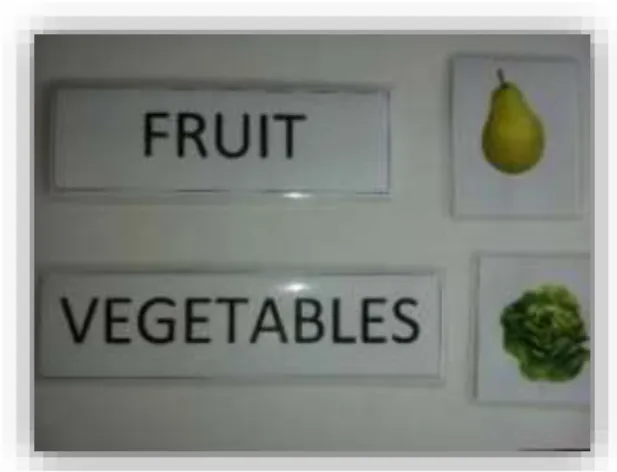
Development: First, it is necessary to design some flashcards with the main fruits, vegetables, drinks and foods. There are thirty – nine flashcard about the topic and four more flashcards with the words ‘fruit’, ‘vegetable’, ‘food’ and ‘ drink’. The main aim
will be classify these different English contents. The categorising will be the technique
24
In the assembly pupils will be sat in a circle. Teacher will have a shopping basket and
she will tell a story about the market to create a real context. The storyis about the main topics ‘fruit’ ‘vegetables’ ‘food’ and ‘drink’ for later doing the categorising activity.
She will show the different flashcards encouraging the pupils to say the words, no
matter if they say them in English or Spanish. Teacher can help them telling the word in
English.
Then, to introduce pupils within the context, teacher ask them one by one, “Do you like…?” and they have to answer 'Yes, I do' or 'No I don't' or 'yummy' and 'yucky'. This
routine is not new for them because they have already worked with this content on
previous years. Then each pupil has a flashcard and the four flashcards ‘fruit’, ‘vegetables’, ‘food’ and ‘drink’ will be in the middle of the circle.
These flashcards will be the same as the ones that appear in the story at the beginning of
the lesson. Each pupil has to say if it is a fruit or a vegetables or another different such
as drink or food. In that way, pupils categorise the different flashcards. Teacher will help each one ‘is this a fruit or a vegetable or another different such as food or drink?
Finally everybody will count how many vegetables/fruits are there and in total.
25 Session 2: Word trees.
Development: In the assembly, children will be in front of the whiteboard. First of all, teacher will tell the story about market again, because it is a way to introduce children
in the same context that the previous day. The principal objective will be to classify the
English content, but in this case in another way. They must categorise the flashcards of
fruit, food, vegetables and food which are mixed.
Then, the flashcards will be face down in the middle of the circle. Using a visual
organizer (simulating a word tree) where it will be written a word fruit, vegetables,
drink or food. Pupils have to take one flashcard and, depends of the picture, stick the flash card in the correct ‘’word tree’’. There will be four kinds of word trees referring to the last topics, ‘vegetables’, drink’, ‘food’ and ‘fruit’. At the beginning, teacher will do
an example where children can observe the dynamic.
Session 3: Final task.
Development: At the beginning of the class, we will review the activities and games done in the previous lessons. Pupils must identify the picture that belongs to the same
category. Then, pupils will be divided in small groups or teams and each one has to do a
different activity.
26
These activities have been developed together in big group in the last lessons, so the
final task consists on children will do the activities by themselves. The activities will be ‘the market day’ or ‘word tree’. In this case, there are two different pictures. For ‘the market day’ the picture will be a shopping cart and for the ‘word tree’ will be the same
visual organizer used in the last session. Each team has different mixed pictures and one
word refers to the main topic to classify. Pupils have to classify the pictures that are
involved in this word (for example, fruit; they have to stick: apple, orange, lemon, but
they do not stick: sandwich, onion, milk).
Teacher will observe and sometimes help them. Finally each group has to present the
rest of the class their work. The main team will be in front of the class and the rest of
the pupils will be sat in a circle. They will say the name of the topic and the contents.
Focusing attention
Session 4: How many are there?
Development: First of all, pupils are sat in a big circle and teacher will show them a different kind of polygons. The main objective will be focus their attention in the
picture to identify the different kind of polygons and how many polygons there are.
The polygons will be square, triangle and circle and they will be showed to the children.
27
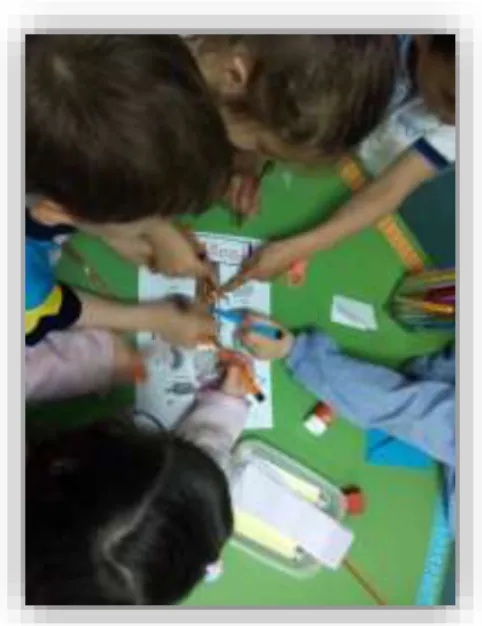
This activity consists in children have to be able to observe a mural. In this mural there
are a lot of polygons mixed.
Teacher does an example, she identifies a polygon and colour it. Teacher asks one by
one if she/he identifies some polygon and pupil has to colour it. Finally, everybody
count how many polygons there are; squares, circles, triangles and in total.
Session 5: Polygons
Development: At the beginning of the class, everybody in a big group will review the different polygons seen in the last class. Pupils must focus their attention to guess how
many polygons there are of each. There will be three different logical pictures where
there are hidden polygons. Each picture with the shape of triangle, square and circle will
28
The teacher will help them to identify all polygons hidden in the picture. She will do an
example first. When someone thinks he/she has identified a figure, she/he has to colour
it with different colours.
Session 6: Final task
Development: At the same way of another final task, children will be divided in small groups or teams and they have to do an activity. In this case pupils must focus their
attention to identify the different polygons by themselves. The activities will be the
same that pupils did in the previous classes. There are two pictures where appear the last
activities done. One picture will be the mural and the other one will be the logical
picture. Three teams will do the logical picture and two the mural. Children must to do
them both by themselves. Sometimes teacher will help them. Finally they have to show
their work to the rest of the class. Pupils will say the name of the polygons and how
29
6.
ANALYSIS OF THE RESULTS
Through this proposal it has tried to apply a methodology in order to encourage
Thinking Skills in Infant Education. Nowadays children must to acquire more than the
objectives, contents and criteria established in the curricula. They must be prepared to
leave the school and to face the world’s challenges. A way to develop as a person, is to
develop their Thinking Skills being aware of accessing new information, understand
and find adequate lines. The importance to work Thinking Skills since early ages, is a
methodology that helps our pupils to be logical and creative people who makes
decisions and solve problems. Yet teacher has not in mind a concrete results or
correctness; they are interested in the way in which their children use the creativity and
logical looking for new answers.
At the beginning in the first session one of the great problems was to control the
attention of each children because it is a new activity but at the same time it is an
advantage, pupils are motivated and interested. But in the next sessions, children felt
more motivated and they looked very interesting at the end of the following six sessions. They did questions such as ‘When will it be the next session?’ It is an
advantage that allows the teacher acquiring more confidence for the following sessions.
Sometimes they were a little bit more active, but it was not an issue. In this situations,
teachers can get to attract their attention and pupils show their own ideas. Related to
contents, there was some troubles with the meaning of ''tomato'' because it could be
consider a fruit or a vegetables. It knew that situation could appear and it was a good
way where we can observe the different answers suggested by the children. The both
two answer were accepted but, in this case, it was considered a vegetable because the most part of the children thought that ‘tomato’ is a vegetable. To encourage the
acquisition of new meaningful language, they were included some new words but they
were not a problem about that because they were showed at the beginning. The first
contact with the thinking skill technique was done. Pupil were able to access, interpret
and solve the new information using in the context. They did a categorising through
relations, it also involves understanding that there are different ways of grouping and
30
In the second session we did a review about last session to recognise the different
topics. The big problem during this time was the class duration. The activity was too
extensive and the way to did it was one by one, so it was a little bit complicated control
the rest of the class. The solution was, children did the activity three by three, so it was
more quickly. Besides, teacher try to focus her attention in the rest of the class,
involving them to participate in the activity when their classmates did it.
Referring to get the objectives marked for the pupils; for a girl who has some hearing
problems, it was difficult understand the objectives. At the beginning when pupils were
identifying the different vocabulary, she had not problems to identify her flashcard and
she said the fruit name in Spanish. But in the following activity to classify, she needed
help and the way to process was with the help of two classmates who gave her some
clues to get do it. The two classmates did the clues in Spanish. The rest of the class got
the objectives without problems. Some of them did the activities with help through
some premises, but the most of them did it in a good way.
In these both sessions the results were very positive, all the pupils understood the main
objective according to the thinking skill; they were able to classify the different fruits,
vegetables, drinks and foods. And referring to the English content, they recognised the
different English words. Sometimes it was necessary using some premises but it is
something normal when doing a new activity.
31
The final categorising task was very successful, pupils were very motivated to do the
activities by themselves and this is very important to get good results. They enjoyed
doing the different tasks. Three teams did the ''market day'' and the others two did ''the
word trees''. This final task allowed pupils to show their abilities which had been
worked in the previous sessions. The line was cooperative work, in this way pupils can
help others and create a big answer together. When they introduced their results to the
rest of the class, they needed help with some vocabulary, but in general it was a great
experience. Pupils needed some help to express their English ideas, but the main
vocabulary such as vegetables or strawberry were said by themselves. They told the
name of this category and the different content included into this classification. They
wanted to show their works to the classmates and they felt proud of themselves as a
team.
The next weeks were dedicated to develop the technique ''focusing attention'' through
the polygons as topic. The first session was interesting for the pupils because the game
was a picture where children have to colour each figure and in this period of the age,
children love drawing. Referring to the contents, it was the first time that they learned
the polygons in English but this project had been deeply developed during the regular
classes. The vocabulary was not too extensive because it is the beginning in this topic.
Children identified the different figures without problems, only they had some troubles
to colour the full polygons. This concept still is a little bit difficult for them.
In the four session, about Thinking Skills, children had to colour the full polygon up and
some children did not colour the whole figure. The polygons were mixed and for the 5
years old children, this concept still is a little bit complicated. As to English concepts,
pupils got to identify the different names in a good way. The girl with hearing problem
got to identify the figure by herself.
At the beginning of the session five, pupils had to identify all of the same polygons
which were hidden in a picture. The English vocabulary was easy, but the content of
Thinking Skills was difficult. Children had to think a lot to guess how many polygons
there were in each picture. Pupils only saw the simple figure but then, with the help of
the teacher, pupils guessed the polygons that were hidden.
The development level for this game had to be high but they answered with a good
32
themselves. It was very useful because they are were involved in a motivating context.
They felt curiosity for the activities.
In the final task, the way to do the different activities was the same of the other final
task; three teams did ''How many are there?'' and the other two ''Logical squares, circles
and triangles''. Children worked in teams doing it through of the cooperative work. As
these activities were especially difficult in some aspects, they could help each other
between them and they got a good result. Teacher helped when it was really necessary.
The results that pupils did by themselves were excellent and pupils introduced their
works successfully. They needed some help but they said the principal content
developed; the different polygons that appear in their works, the number of them and
sometimes the colours used. Children were able to understand the simple oral language
produced by the teacher and they answered in a great way.
According to the objectives established at the beginning of the work, the results have
been very positive. It means that children showed a good attitude during the English
activities because they were interested to know some new things about this language. It
was a new way to work with English in class and they took part into the different
activities. Besides, the vocabulary used, was easy and familiar for them, so pupils were
33
activities. At the same time they were able to performance their own works in a good
way using the different language learnt in the previous tasks.
Referring to the objectives proposed for the development of this work as a teacher, it
has been adapted the different knowledge of theories and methodologies to the context
of this class. It had in mind the motivations, interest and need of pupils. It has
introduced a new way to acquire a foreign language creating a bilingual and bicultural
environment. Besides, while it was developed English language it has been introduced another way to learn such as ‘Thinking Skills’, for teaching to think. At the same time,
it has used the contents established by the school that is the curricula contents. Finally, it has been developed some new The CLIL teacher’s competences, such as ‘can create a reassuring and enriching learning environment’, to follow growing as a future English
34
7.
CONCLUSION
The development of any work, causes new learnings that will be a great resource
in the future as a professional teacher. With this project it has wanted to show the
possibility to teach a foreign language at early ages through thinking skills while
children acquire the curricula contents.
Along the degree, it has been acquired many content that now the author of this work
want to express making a final project. Besides all knowledge that it is in the mind, it is
necessary to organise this thinking, doing a research about different methodologies,
theories and approaches.
There are many topics in Education to do a research, but in this case, it has been
selected something new and innovative into the Infant Education background. Thinking
Skills is a methodology that has been developed many years ago but it has never been
aware of this. This is a new way to show children different contents being they able to
create their own knowledge. But now, teachers know how they can offer different
means to do it and in what they must pay attention, to help pupils. The fundamental
point of a thinking class is to seek best answers, and not always the right answers are so
important.
On the other hand, the importance of a foreign language both in the education as in the
society, it is necessary to become citizens in continuous contact. At early ages is the
best moment of the life to acquire a second language because this one is learnt in the
same way that mother tongue. The environment, that is, the social language is an
important part of the development of children. But not all the children have the same
motivations, interests and needs. The diversity is present within the real context of the
classrooms and this is the meaning of the multiple intelligences. Teachers must have as
main aim getting the higher development of each intelligence into the pupils. Having in
mind that each child is unique.
In the classroom, the teacher must be an assistant serving his pupils. It means, she/he
must encourage pupils to follow finding their knowledge and creating new learnings.
This is why, the teacher can never let to train himself. At the same time that children
must prepare to the society, teachers must know the society. Because as Ana María
35
8.
REFERENCES
Amin, A., Aparajita Dakshy. M., Bradshaw, C., MacDonald, A., Mas, I., Barbara, T.,
Medrano, P., Reilly, T., & Locke, M. (2013) Spanish/English infants integrated curriculum. Ministerio de educación cultura y deporte; CNIIE.
http://www.mecd.gob.es/educacion-mecd/areas-educacion/sistema-educativo/ensenanzas/ensenanza-idiomas/centros-bilingues.html
Bahón, J. (2013/2014) Enfoque inspirado en la teoría de las Inteligencias Múltiples.
SM; Acompaña.
Bahón, J., Swartz, R. J. & Escamilla, A. Aprender a pensar. Madrid: SM
Castilla y León Curriculum for the Second Cycle of Infant Education (DECRETO
122/2007, de 27 de diciembre, por la que se establece el currículo del segundo
ciclo de la Educación Infantil en Castilla y León)
Cole, M., John-steiner, V, Scribner, S & Souberman, E. (1989) El desarrollo de los procesos psicológicos superiores. Barcelona, España: Crítica.
Coyle, D. (2000) Content and Language Integrated Learning. Motivating Learners and Teachers. University Nottingham
Escamilla González, A. (2014). Inteligencias Múltiples; claves y propuestas para su desarrollo en el aula. Barcelona, España: GRAÓ.
Integrated Curriculum for Education Infant and Primary Education (ORDEN de 5 de
abril de 2000, convenio entre el Ministerio de Educación y Cultura y el Consejo
Británico en España)
Marsh, D. Content and Languaje Integrated Learning (CLIL). A Development Trajectory. Servicio de Publicaciones de la Universidad de Córdoba.
Moltó, D. (2015, Marzo, 04) Entrevista Director del National Centre for Teaching
Thinking. El Mundo.
http://www.elmundo.es/comunidad-valenciana/2015/02/10/54d901f7ca474190438b456c.html
36
Sanchidrián, C. & Ruiz Berrio, J. (2010). Historia y perspectiva actual de la educación infantil. Barcelona, España: GRAÓ.
Spanish Curriculum for the Second Cycle of Infant Education (ORDEN ECI/3960/2007,
de 19 de diciembre, por la que se establece el currículo y se regula la ordenación
del segundo ciclo de la Educación Infantil)
Swartz, R. J., Costa, A. L., Beyer, B. K., Reagan, R. & Kallick, B. (2008) El aprendizaje basado en el pensamiento. Ediciones SM
37
ANNEX
39
ANNEX 3: ACTIVITY RESOURCES
Flashcards
Story
“Yesterday, I went to the supermarket with my shopping cart; (what is a supermarket? It
is a place where you can buy food). There, I bought some fruit, vegetables, food and
drinks. I bought: carrots, lettuce, cabbage, potato, tomato, peas, pepper and onion; milk,
soup, water, soft-drink, milkshake and juice; cheese, fish, chips, cake, chicken,
chocolate, yoghurt, eggs, pizza, hamburger, sandwich, cookie and ice cream; pear,
melon, pineapple, peach, orange, kiwi, lemon, apple, watermelon, strawberry, grapes
and banana.