Electronic Journal of Differential Equations, Conference 22 (2015), pp. 79–97. ISSN: 1072-6691. URL: http://ejde.math.txstate.edu or http://ejde.math.unt.edu ftp ejde.math.txstate.edu
MATHEMATICAL MODELING AND NUMERICAL SIMULATION OF TWO-PHASE FLOW PROBLEMS AT PORE SCALE
PAULA LUNA, ARTURO HIDALGO
Abstract. Mathematical modeling and numerical simulation of two-phase
flow through porous media is a very active field of research, because of its relevancy in a wide range of physical and technological applications. Some outstanding applications concern reservoir simulation and oil and gas recovery, fields in which a great effort is being paid in the development of efficient numerical methods. The mathematical model used in this work is written as a system comprising an elliptic equation for pressure and a hyperbolic one for saturation. Our aim is to obtain the numerical solution of this model by combining finite element and finite volume techniques, with a second-order non-oscillatory reconstruction procedure to build the values of the velocities at the cell interfaces of the FV mesh from pointwise values of the pressure at the FE nodes. The numerical results are compared to those obtained using the commercial code ECLIPSE showing an appropriate behavior from a qualitative point of view. The use of this FE-FV procedure is not the usual numerical method in petroleum reservoir simulation, since the techniques most frequently used are based on finite differences, even in standard commercial tools.
1. Introduction
Multiphase flow in porous media is a very active field of research since this type of problems arise in many practical situations in fluid dynamics, many of them linked to groundwater pollution, oil and gas recovery orCO2 storage in geological formations, to name but a few. Because of the interest of multiphase flow in porous media, many relevant works have been developed to this aim, among which some classical references can be mentioned as [1, 5, 10, 23, 22].
The particular context of this work lays on the field of mathematical modeling and numerical simulation of underground flow of oil-water systems. In this con-text, the fluid in motion is usually formed by a mixture of oil, water and gas moving through the porous media due to an existing connected network of pores and also to the presence of fractures in the geological medium. The most common mathemati-cal models that represent this kind of problems are given by a system of parabolic partial differential equations where the unknowns are the pressure and saturation of
2010Mathematics Subject Classification. 35J20, 35J60, 35J70, 47J10, 46E35. Key words and phrases. Reservoir simulation; numerical simulation; saturation profile; finite volume method.
c
2015 Texas State University. Published November 20, 2015.
the different phases involved in the process, namely the Black-Oil model (see [21]). Many of the simulation tools used to obtain the solution of the mathematical mod-els use finite differences, see [15], or finite element methods. Other formulations, based on finite volume methods and combinations of finite element and finite volume methods, are also available in the literature [12]. In this work, we follow a strategy, see [14, 8], where the parabolic system of PDEs is transformed into a system formed by an elliptic equation for the pressure and a hyperbolic equation for the satura-tion. The latter equation is similar to the well-known Buckley-Leverett equation (first introduced in [6]). Theoretical analysis of this kind of formulation have been developed in [9, 17]. An interesting work in this study corresponds to the treatment of the two phase model based on a conversion into an elliptic-hyperbolic system, developing both analytical study and numerical solution is [9]. Also in [9] a numer-ical resolution of a simplified model is performed. In [17] the authors prove local existence and uniqueness of a classical solution for the original hyperbolic-elliptic system arising in the modeling of oil-recovery processes, using the Arzela-Ascoli theorem. Another relevant contribution concerning existence and uniqueness of the solution in models of filtration of immiscible fluids in a porous a media is [4]. The elliptic (pressure) equation and the hyperbolic (saturation) equation are coupled by means of the saturation which appears in both of them, more precisely, in the coefficients of mobility. The numerical scheme developed in this work consists of solving the pressure equation (the elliptic part of the model) by means of a finite element method and solving the saturation equation (the hyperbolic part) via a finite volume scheme. The reason behind the use of these two different techniques in the same problem is that finite element methods have been devised specifically to be used in the context of elliptic (and parabolic) problems, but they fail miserably, at least in its classical formulation, when applied to hyperbolic problems, mainly when discontinuous solutions appear. However, finite volume schemes work quite well in these particular situations since they are able to propagate adequately the discontinuities of the solution. In this work we obtain the solution for the pres-sure at the nodes in which the domain is discretized and, afterwards, these nodes are treated as intercell boundaries for the finite volume scheme. We remark that finite volume scheme is based on integral averages of the solution (saturation in this case). Because we need to know velocities at cell interfaces, and they depend on the gradient of the pressure, according to Darcy’s law, a sort ofreconstruction
must be applied. In this work we use a piecewise linear reconstruction, consider-ing the stencil that minimizes the absolute value of the slope. Time integration for the hyperbolic equation is fulfilled via an explicit Euler scheme. We note that these procedure is different to the classical IMPES method, in which both equa-tions are evolution ones and an implicit scheme is used for pressure and an explicit formulation is use to solve the saturation [15, 11, 24, 7].
We show results of the one-phase case, in which we consider a parabolic equation for the pressure and also results for pressure and saturation are given for the two-phase case. The values of the parameters are realistic and they have been taken from the commercial code ECLIPSE [16] by Schlumberger. The results obtained are compared with those comming from ECLIPSE. In the two-phase case, a qualitative comparison with results obtained from using ECLIPSE is performed.
mathematical models used in this work, both for the single-phase case and for the two-phase case. Section 4 introduces the numerical scheme used to obtain the solution of the single-phase model which is achieved using a finite element method. Section 5 presents a detailed description of the numerical scheme heading to solve the two-phase model, based on a combination of a finite element scheme for the elliptic part and a finite volume scheme for the hyperbolic part. Section 6 deals with discussion of the results obtained in the previous section. The final part of this work is devoted to conclusions and further research.
2. Physical model
A petroleum reservoir is geological formation in which a mixture of oil, water and gas is trapped. Originally, the hydrocarbon reservoir is in equilibrium containing reservoir fluids such as gas, oil and water separated by gravity at no-flow conditions. When a well is drilled reaching the upper reservoir layer this equilibrium state is immediately disturbed, consequently pressure declines at that specific location for being progressively extended through all radial directions from the well zone to the whole reservoir domain. The study of the movement of the fluid throughout the porous media is very complex. Then, certain simplifying assumptions must be introduced. In this work we establish the following hypothesis:
• The flow takes place in one-dimension.
• Fluids are immiscible and their composition is constant over time, therefore there is no mass transfer between phases.
• The fluids are incompressible which means that the density is constant.
• The system is isothermal.
• Capillary pressure is neglected.
• Horizontal flow is assumed, therefore the effect of gravity is neglected.
The Black-oil model. The Black-oil thermodynamic model is one of the most widely used models in petroleum reservoir simulation, see for instance [21]. It as-sumes the hydrocarbon can be described into two components, namely a heavy component (oil) and a light component (gas), for which its composition remains constant in time along with the assumption that no mass transfer is held between the phases, which means that they are immiscible in each other. At reservoir con-ditions, both components may appear completely or partially dissolved depending on the reservoir pressure and temperature regime at the reservoir, to form either one or two phases, namely liquid and gas.
The Black-oil equations consist of:
• Conditions of thermodynamic equilibrium.
• Equation of state which describes a fluid in terms of its fundamental phys-ical properties (constitutive equations).
• Darcy’s law for the volumetric flow rates (conservation of momentum).
• Mass conservation equation for each component.
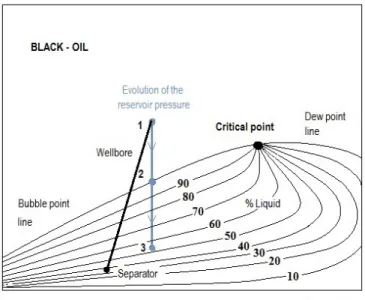
The behavior of the dead oil is represented in Figure 1, where it is described oil at pressures above the bubble point for a constant temperature.
Figure 1. Black-Oil phase diagram
The bubble point pressure (point 2 in the diagram) is a special case of saturation at which the first bubble of gas is formed. For pressures below the bubble point, there are two hydrocarbon phases present in the reservoir, a liquid phase (gas satu-rated oil) and gas phase (libesatu-rated solution gas). Solution gas starts releasing from oil while crossing the bubble point curve during which its concentration remains constant for the whole process. It is considered dead as dissolved gas does not affect its behavior for a constant temperature remaining always below the critical point. For pressures above the bubble point only one hydrocarbon phase is present in the reservoir, that is liquid oil. This oil is called dead oil or undersaturated oil as it will be subjected to states of pressure always evolving above the bubble point and no gas can be released from the oil.
3. Mathematical models
In this work we deal with a two-phase model in one space dimension useful in the field of reservoir simulation and oil recovery. In this model, oil and water are the only active phases in the reservoir. The aim of this model is to describe the immiscible displacement of oil, which will be moving towards the production well by the action of the water injection into the reservoir. Oil and water are immiscible in each other.
behavior of fluid flow in a petroleum reservoir, which are mostly a set of nonlinear PDEs.
The filtration of fluids in porous materials is represented by a set of mass, momen-tum, energy conservation and constitutive equations which arranged all together, comprise what is known as flow equations. Isothermal conditions are assumed for simplicity, thus the formulation will not require an additional equation for the energy conservation. The conservation of momentum is determined by the Navier-Stokes equations for fluid mechanics, though simplified for describing a low velocity flow behavior are actually representing the semi-empirical Darcy’s equation, which in fact is governing the velocity of flow at the pore scale. Denoting with the sub-scriptnthe non-wetting phase, usually oil, and withwthe wetting phase, usually water, the addition of both saturations must be the unity, that is
sw+sn= 1. (3.1)
Another relevant physical magnitude in oil reservoir is the capillary pressure, pc, which depends on water saturation and can be expressed as
pc(sw) =pn−pw, (3.2)
where pn is the pressure of the non-wetting phase and pw is the pressure of the wetting phase. Particularly useful flow in porous media is Darcy’s law, which in the case of multiphase flow reads
vi=−
Kkri µi
∂Pi
∂x, iis the fluid phase. (3.3)
In this case gas is present as an active phase in the reservoir, it would always be considered a non-wetting phase. The variablesis related to saturation,pis the phase pressure andpc stands for the capillary pressure. The relative permeability of phase i is given by kri. K represents the total permeability. In Darcy’s law also the total pressure of the fluid,Piis present. The corresponding PDEs of mass conservation are obtained by the same procedure as single-phase flow equations but without considering a term referring to the rate of accumulation. Otherwise, for obtaining this term, the current volume (φρ), whereφis the mass fraction andρis the density, must be multiplied by the phase saturation because of the presence of more than one phase in the system for this case.
The general equations for two-phase flow (water and oil respectively) read
∂ ∂x
Kkrw
µwBw
∂Pw
∂x
+qw=
∂ ∂t
φsw
Bw
,
∂ ∂x
Kkro µoBo
∂Po
∂x
+qo=
∂ ∂t
φso Bo
,
(3.4)
where µi is the viscosity of phase i and Bi is the volumetric factor for phase i. The volumetric factor represents the relationship between the volume occupied by the phase i at reservoir conditions and the volume at surface conditions, due to the difference in pressures in both cases. In addition, qw and qo are the injec-tion/production rate of water and oil respectively.
solution of this model to perform a comparison with results obtained with the code ECLIPSE.
In this situation, oil is the only active phase in the reservoir and since we are not considering the presence of gas, oil must be undersaturated (dead oil), what means that the reservoir pressure remains higher than the bubble point pressure. In this case, most of the energy retained in the reservoir is due to the fluid and rock compressibility. The pressure declines as fast as fluids are extracted from a subsaturated reservoir until bubble point is reached. Thereafter, solution gas will become the energy source allowing its displacement. This reservoirs are good candidates for water injection, the purpose is to maintain a high pressure and therefore enhance the oil recovery.
When dealing with single-phase flow, nor saturation or relative permeabilities appear in the equations and, therefore, system (3.4) becomes
∂ ∂x
K µB
∂P ∂x
+q= ∂
∂t φ B
. (3.5)
For the special case of an incompressible fluid, porosity of the rock is assumed constant in time, also the incompressibility of the fluid implies its density must be constant in time so the time derivative vanishes obtaining an elliptic equation for the fluid pressure distribution.
The general elliptic equation for an incompressible single phase flow in a hori-zontal domain is
− ∂ ∂x
K µB
∂P ∂x
=q. (3.6)
Radial flow model. In oil reservoir simulation it is very common to work in radial coordinates. The equation describing the flow of an incompressible fluid in radial coordinates because of the presence of a nearby well is
1
r ∂ ∂r
r∂P
∂r
= φµc
K ∂P
∂t (3.7)
where, rstands for the drainage radius of the well andc represents the compress-ibility of the total system, both rock and fluid.
Two-phase flow model. In this work we transform the parabolic system (3.4) into an elliptic-hyperbolic system (see [14, 8, 9] for more details on this way to proceed). In this approach, the elliptic equation models the distribution of pressure whereas the hyperbolic one is used for the evolution of the saturation. The latter one is similar to the well-known Buckley-Leverett model. An important factor when dealing with multi-phase problems is the mobility of the phase i, usually denoted asλi whose expression is:
λi=
kri
µi
, (3.8)
General pressure equation. The general pressure equation in this model reads as follows
− ∇[Kλw∇pw+Kλn∇pn] +crφ
∂p ∂t
−cw∇pwKλw(∇pw)−φsw
∂pw
∂t
−cn∇pnKλw(∇pn)−φsn
∂pn
∂t
= ˜Q,
(3.9)
where λi is the mobility of phasei,cr is the compressibility of the rock,cw is the compressibility of the wetting phase (usually water),cnis the compressibility of the non-wetting phase (usually oil) and ˜Qis a specific volumetric injection/production rate term given by ˜Q= qn
ρn+
qw
ρw.
In the particular case of animmiscible and incompressible flow (cr=cn=cw= 0) and one-space dimension, equation (3.9) becomes
− ∂ ∂x
Kλw
∂pw
∂x +Kλn ∂pn
∂x
= ˜Q. (3.10)
We now express the total velocity as function of the global pressureP
v=−K(λw+λn)
∂P
∂x (3.11)
and introduce the term of total mobilityλ=λw+λn to obtain
− ∂ ∂x Kλ ∂P ∂x
= ˜Q, Q˜ = qn
ρn +qw
ρw
(3.12)
which can be solved for the global pressureP.
General saturation equation. The analysis of the two-phase flow model is assimi-lated to the Buckley-Leverett displacement problem for which saturation profiles are calculated when capillary and gravity effects are not taken into account. In the recent work [2] there is an interesting study, numerical and analytical, of the Buckley-Leverett equation. Considering that there is an expression relating both saturations;sw+sn= 1, it is only necessary to calculate one of them, being com-monly defined for the water saturationsw.
∂φρwsw
∂t =∇(ρwhw∇sw)− ∇(ρw(fwv)) +qw (3.13)
wherehw=−fwKλn∂s∂Pc
w and the fractional flow function fw=λw/(λw+λn).
For the particular case of an incompressible flowφ, ρn, ρware constant, therefore we can write
φ∂sw ∂t +
∂
∂t(fw(sw)v)− ∂ ∂x hw ∂sw ∂x
= qw
ρw
(3.14)
In general, the saturation equation has a parabolic nature. Yet, on the pore scale, term fw(s)v usually dominates the term−∇(hw∇sw), consequently acquiring an hyperbolic character so it needs to be discretized in an alternative way than the pressure equation.
Equations of the two-phase flow model. An immiscible and incompressible flow is considered for this study, as well as capillary forces are neglected for simplicity.
• Pressure equation (diffusive elliptic equation)
− ∂ ∂x Kλw ∂P ∂x
• Saturation equation (diffusive hyperbolic equation)
φ∂sw ∂t +
∂
∂x(fw(sw)v) = qw
ρw
(3.15b)
Both equations are non-linearly coupled through the saturation dependent mobility, as well as the pressure dependent velocity. The unknown variables are the global pressure and the saturation of the non-wetting phase (water). The system (3.15) is equivalent to (3.4). Equation (3.15b) is quasi-linear since the fractional flow function fw depends on the saturation sw, via the mobilities λw, λn. However, this formulation is different to the quasi-linear Buckley-Leverett model, where the fractional flow function fwBL is given by fwBL = s2w/(s2w+α(1−sw)2) (see for instance [18, 13]) where α∈(0,1) to account for the fact that the viscosity of the oil is higher than that of the water. The reason for choosing the model (3.15b) is that it is more realistic in the context of reservoir simulation since it takes into consideration the water/oil mobility ratio, which is a key parameter in determining the efficiency of the water/oil displacement process.
4. Numerical approximation of the single-phase flow model
Formulation of the single-phase flow problem. Previously, in Section 3, it was established the PDE representing the single-phase flow problem was given in (3.5). After some manipulations, see [11], it can be written, with the addition of suitable initial and boundary conditions, as
∂ ∂x K µB ∂P ∂x
= φcr
B ∂P
∂t
I.C. P(x,0) =P0(x)
B.C. Neumann conditions
(x= 0) −KA µB
∂P ∂x
x=0
= 0, no flow boundary
(x=L) −KA µB
∂P ∂x
x=L
=Qo(t), oil production rate,
whereP0(x) is a prescribed initial pressure. In this approach we consider that the viscosity µo and the volumetric factor Bo are pressure-dependent which confers more realism to the problem. In table 1 values of viscosity and volumetric factor are shown for different values of pressure, which have been taken from ECLIPSE and, in this work, they are used to carry out interpolation for the simulated values of the pressure. Because of this nonlinearity, it is necessary to apply a numerical technique to solve the problem. In this case a finite element technique has been implemented, since this type of numerical methods are very convenient when dealing with parabolic problems.
To obtain the weak formulation we multiply the PDE by test functions ϕi(x) (i= 1, . . . , n) and integrate on the domain [0, L] to yield
Z L
0
ϕi(x)
∂ ∂x ˜ D∂P ∂x dx= Z L 0
ϕj(x)˜a
∂P
∂tdx (4.1)
where we have introduced the coefficients
˜
D:= K
µoBo
, ˜a:= φcr
Bo
Both ˜D and ˜aare functions of pressure, according to table 1. After integration by parts and introducing the Neumann boundary conditions we obtain
− Z L
0
∂ϕi(x)
∂x ˜ D∂P ∂x
dx−Qo(t)/A=
Z L
0
ϕj(x)˜a
∂P
∂tdx (4.3)
We can obtain an approximate solution of the weak formulation by introducing the linear combination P(x) = Pn
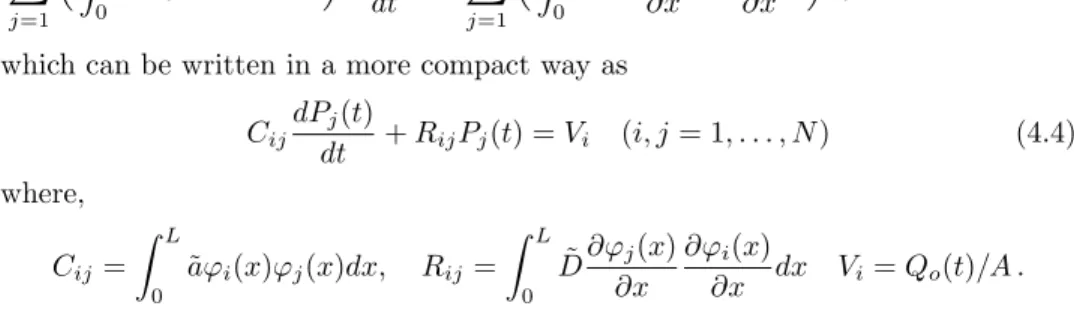
j=1ϕj(x)Pj(t), where Pj(t) are the nodal values of the pressure which vary with time. Therefore, rearranging terms we have
n X j=1 Z L 0 ˜
aϕj(x)ϕi(x)dx
dPj(t) dt + n X j=1 Z L 0 ˜
D∂ϕj(x) ∂x
∂ϕi(x)
∂x
Pj(t)dx=Qo(t)/A
which can be written in a more compact way as
Cij
dPj(t)
dt +RijPj(t) =Vi (i, j= 1, . . . , N) (4.4)
where,
Cij=
Z L
0 ˜
aϕi(x)ϕj(x)dx, Rij=
Z L
0 ˜
D∂ϕj(x) ∂x
∂ϕi(x)
∂x dx Vi=Qo(t)/A .
Table 1. Data of viscosity and volumetric factor for different
val-ues of pressure. Data taken from ECLIPSE code.
P (bar) Bo µo(cp) 180.0 1.2601 1.041 227.0 1.2600 1.042 253.4 1.2555 1.072 281.6 1.2507 1.096 311.1 1.2463 1.118 343.8 1.24173 1.151 373.5 1.2377 1.174 395.5 1.2356 1.2
This system of equations must be solved by means of an appropriate ODE solver. In this work we have used aBackward Euler schemewhich is unconditionally stable, therefore we have the scheme
(Cij+ ∆tRij)Pjn+1 =CijPjn+ ∆tVi(tn+1) (4.5)
Compacting this expression, we obtain the approximate solution of the implicit pressure, computed for each time step by solving the system of equations
AijPjn+1=B n
i, (4.6)
where
Aij =Cij+ ∆tRij, Bin=CijPjn+ ∆tVi(tn+1).
Formulation of the radial flow model. We consider an infinite reservoir (con-stant pressure at the boundaries) at an initial pressure state.
1 r ∂ ∂r r∂P ∂r = φµc K ∂P ∂t
I. C. P = 172.35 bar
B. C. Dirichlet conditions
(r= 0) P = 124.1 bar
(r=L) P = 172.35 bar.
This problem provides a solution to the radial flow example appearing in [3] page 347. Same boundary conditions and initial pressure values have been applied to this model in order to compare the solution obtained with the one corresponding to the example. It is necessary to point out that this model has been solved according to different values for certain parameters, that is viscosity of oilµo, which in this case does not correspond to a constant value but as function of pressure, resulting a more realistic approach (we are solving for real values). The field is producing at a variable rate (in contrast with the constant production rate of the example in [3]) at a stabilized bottom-hole flowing pressure of 124.1 bar.
This problem is solved by the Finite Element method for obtaining an approxi-mate solution of the parabolic equation (3.7).
For the weak formulation, solveP(r, t)∈H1(0, L)/P(0, t) =P
0(t) andP(r,0) =
P0(r), solution of
Z L 0 ∂w ∂r r∂P ∂r dr= Z L 0
w rφµc K
∂P
∂rdr ∀w∈Vh. (4.7)
The approximate solution is expressed as follows: Ph(r, t) ∈ Vh/Ph(0, t) = P0(t) andPh(r,0) =P0(r), solution of
Z L
0
∂w ∂r
r∂Ph ∂r
dr=
Z L
0
w rφµc K
∂Ph
∂r dr, (4.8)
where
Ph(r, t) = N
X
j=1
Pj(t)ϕj(r) (4.9)
wherePj stands for the approximate pressure solution at the nodes andϕj repre-senting the basis functions (piecewise polynomial functions).
Test functions can be chosen as
w(r) =ϕi(r), (i= 1, . . . , N) (4.10)
Using (4.9) and (4.10) in the expression of the approximate solution for the pressure, we obtain N X j=1 Z L 0
rϕ0iϕ0jdr
Pj(t) =
N X j=1 Z L 0 rφµc K ϕiϕjdr
dPj(t)
dt (4.11)
which in fact can be expressed as
RijPj(t) =Cij
dPj(t)
where
Rij =
Z L
0
rϕ0iϕ0jdr, Cij =
Z L
0
rφµc
K ϕiϕjdr . (4.13)
This system of equations is solved by the Backward Euler scheme for time dis-cretization.
(Cij+ ∆tRij)Pjn+1=CijPjn (4.14)
Compacting this equation, we obtain the approximate solution of the implicit pres-sure, computed for each time step by solving the following system of equations,
AijPjn+1=Bi, (4.15)
where
Aij =Cij+ ∆tRij, Bi=CijPjn
5. Numerical approximation of the two-phase flow problem
We consider the two-phase problem
− ∂
∂x(Kλ(s) ∂P ∂x) = ˆQ
φ∂s ∂t +
∂
∂x(fw(s)v) = qw
ρw
I. C. sw=
(
0.044624 (x= 0.04 km)
0 (0.04 km< x≤4 km)
B. C.
(
Dirichlet (x= 0) P(0, t) =P(t) Neumann (x=L) −Kλ ∂P
∂x
x=L= Qn(t)
A , oil production rate.
The general pressureP and the water saturationsw are the unknowns to be solved in each time step. Both equations are non-linearly coupled, as the mobility is a function of water saturation in the pressure equation.
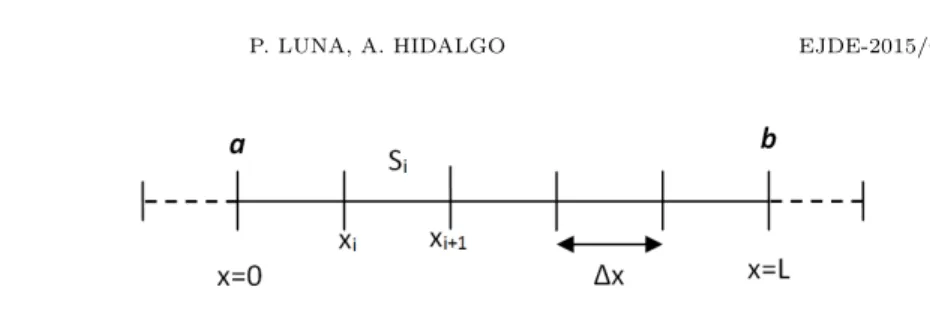
The domain is discretized in several subcellsSi = [xi, xi+1]. These subcells are finite elements when solving the pressure equation by the FEM and control volumes when solving the saturation equation by the FVM.
We first solve the elliptic part, that is the pressure equation, using a finite el-ement scheme similar to that described in the previous section but, in this case, the equation is elliptic. Once the nodal values of the pressure are computed, re-construction is performed to obtain a piecewise polynomial function for calculating the nodal values of the pressurePi. We need to compute also the nodal values of the velocity, since they must be used in the saturation equation. As expressed in equation (3.3), velocities are computed from Darcy’s law via the gradients of the pressure. Considering that we just have point-wise values of the pressure (located at the position of the nodes) it is necessary to perform a reconstruction process, in which ∂Pi
∂x is approximated by a slopemi. Therefore, the velocity can be calculated according to
vi=−
Kkr µ
mi (5.1)
Figure 2. FV mesh. The dashed lines on the left and right
bor-ders are ghost cells, used to impose boundary conditions.
by means of a high order finite volume ADER scheme, although in a different context to that treated in this work. The saturation equation reads
φ∂s ∂t +
∂
∂x(fw(s)v) = qw
ρw
, (5.2)
where
fw(s) =
λw
λw+λn
, v=−K(λw+λn)
∂P ∂x
being Si a general control volume; Si = [xi, xi+1] of the spatial domain [a, b], figure 2. We also introduce ghost cells on both sides of the domain whose aim is to impose boundary conditions, which are represented with dashed lines in figure 2.
We first integrate (5.2) over the control volumeSi
Z xi+1
xi
φ∂s ∂tdx+
Z xi+1
xi
∂
∂x(fw(s)v)dx= Z xi+1
xi
qw
ρw
dx. (5.3)
Dividing by the length of the control volume, ∆x, we have
φ 1
∆x Z xi+1
xi
∂s ∂tdx+
1 ∆x
Z xi+1
xi
∂
∂x(fw(s)v)dx=
1 ∆x
Z xi+1
xi qw ρw dx, φd dt 1 ∆x Z xi+1
xi
sdx+ 1
∆x(fw(si+1)vi+1−fw(si)vi) =
1 ∆x
Z xi+1
xi
qw
ρw
dx,
φdsi dt +
1
∆x(fw(si+1)vi+1−fw(si)vi) = qw
ρw
,
wheresi is the cell average of the saturation within cellSi given by
si = 1 ∆x
Z xi+1
xi
s(x, t)dx. (5.4)
A forward Euler’s scheme is used in this work to perform time discretization:
φs
n+1 i −s
n i
∆t +
1 ∆x(fw(s
n
i+1)vi+1−fw(sni)vi) =
qw
ρw
(5.5)
Solving this equation forsn+1i ,
sn+1i =sni − ∆t φ∆x(fw(s
n
i+1)vi+1−fw(sni)vi) + ∆t
φ qw
ρw
(5.6)
In the previous expression there are together cell averages of the saturation sn i and interface values of the saturation, namelysn
expressed in terms of cell-averages, which are the unknowns of the problem. In this case we choose their values according to theupwind criterion
sni+1=
(
si ifv(xi, tn)>0,
si+1 ifv(xi, tn)<0,
(5.7)
where positive velocity means that flow goes right.
Since the scheme is explicit a (5.6) a restrictivecf lcondition to keep stability of the numerical solution must be applied. Another relevant issue is that saturation depends on the velocity, which is obtained from the pressure equation, as described in the next subsection.
Coupling pressure-saturation. In each time step the pressure equation and saturation equation are solved sequentially, according to the following strategy:
First stage. Starting with an initial profile of the saturation: s(x,0) the pres-sure equation is solved using the FEM considering the intervals [xi, xi+1] as finite elements. After applying the numerical scheme the nodal values of the pressure,
Pin+1, are computed.
Second stage. Values of the velocity at each nodexiare calculated, according to Darcy’s law (3.3). The gradients of the pressure are computed using areconstruction
procedure based, in this work, on obtaining a first degree polynomial, R(x, tn) =
Pn
i +mi(x−xi), for each nodal point whose derivative is used to approximate the gradient of the pressure,
∂P ∂x(xi, t
n)≈m
i (5.8)
This is a second order reconstruction which in principle is non-monotone thus, to avoid oscillations, we resort to a TVD scheme based on choosing the slope according to: |mi| =min(|mi,−1|,|mi,0|,|mi,1|) where mi,−1 = (Pin+1−P
n+1
i−1 )/∆x, mi,0 = (Pi+1n+1−Pi−1n+1)/(2∆x) and mi,1 = (Pi+1n+1−P
n+1
i )/∆xwhere we have considered an equally spaced mesh of size ∆xfor simplicity.
Third stage. Once the nodal values of the velocity are computed by using (5.8) in (3.3) we compute the interface fluxes by introducing the interface velocities in
fw(sni+1)vi+1.
Fourth stage. The interface fluxes calculated in the previous stage are plugged into (5.6) to get the final numerical scheme for the saturation.
After applying the corresponding discretization techniques, a time resolution method is required for solving the problem. In this study we used a sequential IMPES-type method (implicit pressure - explicit saturation).
6. Results and discussion
Single-phase model. The results obtained are depicted in figure 3 where one can notice the evident similarities revealed in the declining tendency of the curves representing the results with SPFLOW and ECLIPSE, also pointing out the decay in pressure always remains above the bubble point, which is set at 180 bar.
Figure 3. Average Reservoir Pressure distribution obtained from
ECLIPSE and the SPFLOW code
Results show the reservoir pressure evolves from an initial value of 393.6 bar (I. C. of the problem) to a final state reaching 294.49 bar; for the SPFLOW code. ECLIPSE is initialized with a pressure of 393.6 bars, ending up with a pressure of 296.73 bar after 540 days.
It is also essential to point out that the data handled for ECLIPSE and so for the SPFLOW, SPFLOW-R and TPFLOW codes is real data. In this way, as an example, ECLIPSE requires a table alluding to the properties of the fluids con-tained, called PVT table, which shows the dependency of the formation volume factor, compressibility and viscosity of the fluids with pressure, for a known tem-perature. For the SPFLOW code, we have used those tables by applying several interpolations of those parameters with its corresponding pressures, so as to match the higher the possible the behavior of the problem analyzed by both tools.
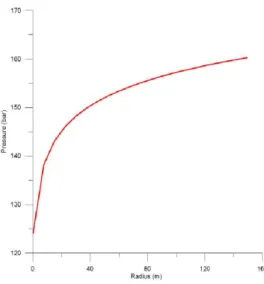
Radial flow model. In figure 4 it is represented the pressure distribution (pressure profile) over the drainage radius. Permeability value used is 120 mD, matching the examples. As indicated in the previous section, viscosity data does not match the corresponding value in [3]. The applied range of variation for viscosityµogoes from 1.041 cp to 1.2 cp, instead of the 2.5 cp constant value used in the example. The drainage radius is 227 m, matching the data in the example.
Figure 4. Pressure profile in radial coordinates for the
single-phase flow model (SPFLOW-R). Output time 540 days.
Figure 5. Pressure profile in radial coordinates for the single-phase flow model (SPFLOW-R) in the wellbore area. Output time 540 days.
Two-Phase model. In figure 7 it is represented the final water saturation profile for the domain after 3600 days of production, obtained by the TPFLOW code. It is actually displaying the saturation profile for each time step until a final saturation profile is reached, corresponding to the outermost part of the colored area.
Table 2. Pressure 1 represents the pressure from the example
analyzed in [3] for a given radius. Pressure 2 represents the corre-sponding pressure values obtained from the SPFLOW-R code for a given radius.
Radius (ft) Radius (m) Pressure 1 (bar) Pressure 2 (bar)
0.25 0.0762 124.11 124.10
1.25 0.381 133.90 132.46
4 1.2192 141.00 139.57
5 1.524 142.31 140.98
19 5.7912 150.44 149.36
20 6.096 150.72 149.68
99 30.1752 160.51 159.70
100 30.48 160.58 159.76
744 226.7712 172.79 172.34
745 227.076 172.80 172.35
Figure 6. Logarithmic trend line to fit the data from table 2. In
blue circles results from [3], in red squares results obtained with SPFLOW-R. Color version on-line
behavior of diffusive problems. ECLIPSE: the saturation front moves up to 0.8 km of the domain extension with a water saturation value of 0.005598.
Capillary pressure has not been considered for this study. On the other hand both cases have been run, that is, with and without considering the capillary pressure effect in ECLIPSE, in order to compare results so to be aware of the influence the capillary pressure has in the distribution of the saturation profiles.
7. Conclusions and further work
Table 3. For a given radius interval, there are represented both,
the pressure drop 1 corresponding to the values of the example from[3] and pressure drop 2 representing the corresponding values obtained from the SPFLOW-R code.
Radius (ft) Radius (m) Press. drop 1 (bar) Press. drop 2 (bar) 0.25 - 1.25 0.0762 - 0.381 9.790555352 8.357534417
4 - 5 1.2192 - 1.524 1.310003885 1.407243027
19 - 20 5.7912 - 6.096 0.275790292 0.321533055
99 - 100 30.1752 - 30.48 0.068947573 0.062983543 744 - 745 226.7712 - 227.076 0.006894757 0.008417394
Figure 7. Water saturation profile for 3600 days of performance;
TPFLOW code
Figure 8. Water saturation profile after 3600 days of
perfor-mance; ECLIPSE code
According to future considerations, it will be interesting to make a study in detail about the effect the capillary pressure has in the global pressure, which in fact has not been considered for this study. In this work porosity φ and permeability K
have been assumed constant, though in real cases this parameters are discontinuous functions. Production flow rates are not constant over time because of the fact that reservoirs contain limited volume of reserves, so a decline in the flow rates will take place during the final stages of production (because of the depletion of reserves), that is why it has been considered a transient source term in the formulation, which is actually an output obtained after running the model in ECLIPSE. The fractional flow formulation has proven to be a good choice in terms of performance and approach to the solution obtained by ECLIPSE. For this case (two-phase flow); the Buckley-Leverett model, has been solved for a variable flow rate instead of a constant rate which in fact is what this formulation is established to work with. Which means it is not correct to mention we are solving for the Buckley-Leverett model strictly.
References
[1] P. M. Adler, H. Brenner;Multiphase flow in porous media, Annual Review of Fluid Mechanics
20(1988), no. 1, 35–59.
[2] B. Adrianov, C. Canc`es; Vanishing capillarity solutions of buckley-leverett equation with gravity in two-rocks medium, Computational Geosciences17(3)(2013), no. 4, 551–572 (eng). [3] T. Ahmed; Reservoir engineering handbook, fourth edition, Gulf Professional Publishing,
2010.
[4] S. N. Antontsev A. V. Kazhikhov, V. N. Monakhov;Boundary value problems in mechanics of nonhomogeneous fluids, Studies in Mathematics and Its Applications, vol. 22, North-Holland, 1990.
[5] J. Bear;Dynamics of fluids in porous media, Dover Civil and Mechanical Engineering Series, Dover, 1988.
[6] S. E. Buckley, M. C. Leverett;Mechanism of fluid displacements in sands., Transactions of the AIME146(1942), 107–116.
[7] J. R. Fanchi;Principles of applied reservoir simulation, Gulf Professional Pub., 2006. [8] H. Friis and S. Evje;Numerical treatment of two-phase flow in capillary heterogeneous porous
media by finite-volume approximations, Int. J. Numer. Anal. Mod.9(2012), no. 3, 505–528. [9] S. Mishra G. Coclite, K. Karlsen, N. Risebro;A hyperbolic-elliptic model of two-phase flow in porous media-existence of entropy solutions., Int. J. Numer. Anal. Mod.9(2012), no. 3, 562–583.
[10] W. Kinzelbach; Groundwater modelling: An introduction with sample programs in basic, Developments in Water Science, Elsevier Science, 1986.
[11] J. Kleppe;Reservoir simulation lecture notes, 2014.
[12] S. Mantica L. Bergamaschi and G. Manzini;A mixed finite element–finite volume formulation of the black-oil model, SIAM Journal on Scientific Computing20(1998), no. 3, 970–997. [13] R. J. LeVeque;Finite volume methods for hyperbolic problems, Cambridge Texts in Applied
Mathematics, Cambridge University Press, 2002.
[14] F. Monkeberg;Finite volume methods for fluid flow in porous media, (2012). [15] D. W. Peaceman;Fundamentals of numerical reservoir simulation, Elsevier, 1977. [16] Schlumberger;Eclipse reference manual 2009.1.
[17] A. Schroll, A. Tveito;Local existence and stability for a hyperbolic-elliptic system modeling two-phase reservoir flow, Electron. J. Differential Equations2000(2000), no. 4, 1–28 (eng). [18] E. F. Toro;Riemann solvers and numerical methods for fluid dynamics, third ed., Springer,
2009.
[19] E. F. Toro;Riemann solvers and numerical methods for fluid dynamics: A practical intro-duction, Springer, 2009.
[21] J. Trangenstein, J. Bell;Mathematical structure of the black-oil model for petroleum reservoir simulation, SIAM Journal on Applied Mathematics49(1989), no. 3, 749–783.
[22] J. L. V´azquez;The porous medium equations. mathematical theory, Oxford Mathematical Monographs, Oxford Science Publications, 2007.
[23] R. A. Wooding, H. J. Morel-Seytoux; Multiphase fluid flow through porous media, Annual Review of Fluid Mechanics8(1976), no. 1, 233–274.
[24] G. Huan Z. Chen, B. Li;An improved impes method for two-phase flow in porous media, Transport in Porous Media54(2004), no. 3, 361–376.
Paula Luna
Escuela T´ecnica Superior de Ingenieros de Minas y Energ´ıa, Universidad Polit´ecnica de Madrid, Madrid, Spain
E-mail address:[email protected]
Arturo Hidalgo
Escuela T´ecnica Superior de Ingenieros de Minas y Energ´ıa, Universidad Polit´ecnica de Madrid, Madrid, Spain

![Table 2. Pressure 1 represents the pressure from the example analyzed in [3] for a given radius](https://thumb-us.123doks.com/thumbv2/123dok_es/6749393.828643/16.918.250.670.253.740/table-pressure-represents-pressure-example-analyzed-given-radius.webp)