POLYPROPYLENE FIBER-REINFORCED SELF-COMPACTING
CONCRETE FOR THE RECONSTRUCTION OF THE CATHEDRAL
OF LA LAGUNA, CANARY ISLAND, SPAIN
A. Pacios-Álvarez
P. Carballosa-de-Miguel (2), J.P. Gutiérrez-Jiménez (2), P. Tanner (2) (1),
(1) Industrial Engineering School, Technical University of Madrid, Spain
(2) Eduardo Torroja Institute for Construction Science, Spanish National Research Council
Abstract
High performance materials are needed for the reconstruction of such a singular building as a cathedral, since in addition to special mechanical properties, high selfcompactability, high durability and high surface quality, are specified. Because of the project’s specifications, the use of polypropylene fiber-reinforced, self-compacting concrete was selected by the engineering office. The low quality of local materials and the lack of experience in applying macro polypropylene fiber for structural reinforcement with these components materials required the development of a pretesting program. To optimize the mix design, performance was evaluated following technical, economical and constructability criteria. Since the addition of fibers reduces concrete self-compactability, many trials were run to determine the optimal mix proportions. The variables introduced were paste volume; the aggregate skeleton of two or three fractions plus limestone filler; fiber type and dosage. Two mix designs were selected from the preliminary results. The first one was used as reference for self-compactability and mechanical properties. The second one was an optimized mix with a reduction in cement content of 20 kg/m3 and fiber dosage of 1 kg/m3. For these mix designs, extended testing was carried out to measure the compression and flexural strength, modulus of elasticity, toughness, and water permeability resistance.
Keywords: residual flexural tension strength, capillary water absorption, structural polypropylene fiber reinforced self-compacting concrete.
1 INTRODUCTION
These synthetic fibers have advantages over steel or other fibers in that they are corrosion-resistant and exhibit a high energy absorption capacity.
The purpose of the present study is to determine the optimum mix design of Polypropylene Fiber Reinforced Self-Compacting Concrete (PFR-SCC) and then to explore experimentally its cracking resistance and post-cracking behavior. The main reasons to consider PFR-SCC are the construction characteristics of the elements to be cast, such as their thickness (between 7 and 10 cm) and high durability (making it difficult to perform maintenance work).
1.1 State of the art
Synthetic fiber has been used to reinforce concrete in applications where steel fiber reinforcement has not been recommended due to durability problems. Although there is experience with vibrated concrete applications, no extensive studies have been found in which reinforcement with polypropylene fiber for structural functions has been used in self-compacting concrete. Table 1 summarizes the most relevant results of the present state of the art. Conventional concrete is reinforced with different dosages and types of fiber [1]. The reference characteristic of the concrete matrix is set by the compressive strength. The characteristics required in Annex 14 of the EHE-08 [2] for a fiber to be considered with a structural function is that the flexural strength fR,1,k be not less than 40% of the limit of proportionality and the fR,3,k be not less than 20% (close to Feq (0 to 0.6) and Feq (0.6 to 3)).
Table 1. Literature review for PFR-SCC [1]
Fiber 1 (l/d) 54/0.069
Fiber 2 (l/d) 44/0.44
Fiber 3 (l/d) 35/0.20
Fiber 4 20/0.20 4 kg/m3 8 kg/m3 4 kg/m3 8 kg/m3 4 kg/m3 8 kg/m3 4 kg/m3
Rcm 28 days 46.30 35.60 35.80 35.60 39.80 34.50 41.60
U(0-0,6) (kN/mm) 3.36 4.42 4.22 5.12 3.59 3.92 2.83
U(0,6-3) (kN/mm) 12.46 21.47 14.21 25.23 9.99 14.63 4.45
Utotal (kN/mm) 15.82 25.89 18.42 30.35 13.58 18.55 7.28
Feq(0-0,6) (N/mm2)
1.55 2.02 1.92 2.34 1.65 1.81 1.28
Feq(0,6-3) (N/mm2)
1.44 2.46 1.62 2.88 1.15 1.69 0.50
Fmax (N/mm2) 3.90 3.52 3.01 3.41 3.73 3.34 3.68
D0 0.40 0.57 0.63 0.68 0.44 0.54 0.35
D1 0.92 1.21 0.83 1.23 0.69 0.93 0.39
The values of U0-0.6 and U0.6-3 represent the energy absorbed up to the values of a crack opening at the specified intervals. Feq (0 to 0.6) and Feq (0.6 to 3) values represent the equivalent resistance calculated for UNI 11039. The values of D0 and D1 represent the Toughness Index for crack openings of 0.6 and 3.0 mm respectively.
1.2 Concrete Specifications
Considering the shape and size of the structure to be executed, and the amount of reinforcement in the joints, the self-compactability class was established as E2, (650 mm < df≤ 750 mm). While a higher self-compacting class is acceptable, a concrete that has high fluidity and low viscosity may not have good fiber distribution and can have a lower surface quality due to entrapped air.
The concrete type was set by the technical office as HAF-35/P-1,5-2/AC-E2/10-45/IIa, where: HAF indicates fiber-reinforced concrete; 35 indicates the characteristic strength in N/mm2; P indicates that the reinforcement is polymeric fibers; 1.5-2 are the numerical values for residual flexural characteristic strength fR,1,k fR,3,k in N/mm2; AC-E2 indicates the class of self-compactability determined from the slump test; 10-45 indicates the maximum aggregate size and the maximum length of fiber, both in mm; and IIa designates the environmental exposition (a minimum cement content of 275 kg/m3 and a maximum w/c ratio of 0.60). The cement content should not exceed an amount of 400 kg/m3 in order to avoid developing secondary defects.
2 EXPERIMENTAL PROGRAM
2.1 Materials
The local materials used were cement (CEM II / A-P 42.5 R) and aggregates (4/10 and 0/4). Due to the small amount of fines in the local aggregates, other materials were selected for incorporation, if needed. They were fine aggregate (0/3 limestone) and filler.
The physical and mechanical properties of component material aggregates are listed in Table 2.
Table 2. Physico-mechanical properties of aggregates
PROPERTIES AGGREGATE SIZE FRACTION
4-10 0-4 0-3
Specific gravity (g/cm3) 2.52 2.67 2.72
Fines content (%) 0.40 0.52 -
Absorption (%) 4.5 2.9 3.5
Sand equivalent - 71 -
Flakiness Index 5 - -
Resistance to wear 21 - -
Admixtures (superplasticizer and polyfuntional) and polypropylene fiber were also components of this concrete (see Tables 3 and 4).
Table 3: Properties of Polypropylene Fiber
Type Length
(mm)
Specific gravity (gr/cm3)
Tensile strength (MPa)
Elongation (%)
Modulus of Elasticity (GPa)
Melting Point (ºC)
Section
Fiber 1 50 0.88-0.92 275 24.4 1.6 165 plane
Table 4: Properties of Admixtures
Type pH 20ºC Density
(gr/cm3)
Solid content (%)
Chloride content (%)
Dosage range (%)
Admixture 1 6.5 ± 1 0.88-0.92 22 ± 1 None 0.2-3
Admixture 2 8.5 ± 1 0.91 39 < 0.1 0.4-1
According to Annex 17 of EHE-08, the limit of fine limestone particles (the amount resulting from the addition of fine aggregate up to φmax of 63 µm and limestone additive present in cement) is 250 kg/m3. This value can be increased with the Work Manager’s agreement.
2.2 Mix design
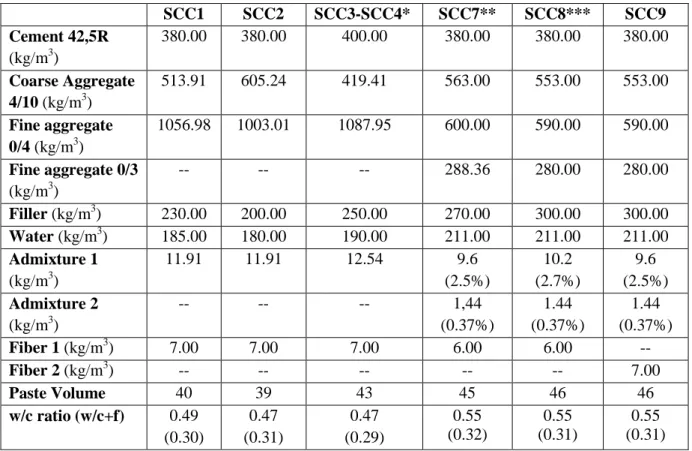
Two fractions of aggregate and filler were used for the initial trial mixture. Later, the granular skeleton was modified by use of an additional fine aggregate in order to obtain a more compact matrix with a higher volume paste. The mixture ingredients for SCC are listed in Table 5.
Table 5: Initial mix design for PFR-SCC
SCC1 SCC2 SCC3-SCC4* SCC7** SCC8*** SCC9
Cement 42,5R (kg/m3)
380.00 380.00 400.00 380.00 380.00 380.00
Coarse Aggregate 4/10 (kg/m3)
513.91 605.24 419.41 563.00 553.00 553.00
Fine aggregate 0/4 (kg/m3)
1056.98 1003.01 1087.95 600.00 590.00 590.00
Fine aggregate 0/3 (kg/m3)
-- -- -- 288.36 280.00 280.00
Filler (kg/m3) 230.00 200.00 250.00 270.00 300.00 300.00
Water (kg/m3) 185.00 180.00 190.00 211.00 211.00 211.00
Admixture 1 (kg/m3)
11.91 11.91 12.54 9.6
(2.5%)
10.2 (2.7%)
9.6 (2.5%) Admixture 2
(kg/m3)
-- -- -- 1,44
(0.37%)
1.44 (0.37%)
1.44 (0.37%)
Fiber 1 (kg/m3) 7.00 7.00 7.00 6.00 6.00 --
Fiber 2 (kg/m3) -- -- -- -- -- 7.00
Paste Volume 40 39 43 45 46 46
w/c ratio (w/c+f) 0.49 (0.30)
0.47 (0.31)
0.47 (0.29)
0.55 (0.32)
0.55 (0.31)
0.55 (0.31)
* fiber is added with moist aggregates in SCC3, and to the final fresh concrete in SCC4 ** fiber is added to the final fresh concrete in SCC7
In another attempt to improve the distribution of fibers, the mixing sequence was studied [3,4] and the mixing time increased. This additional mixing activated the polycarboxylate molecules and improved their orientation, thereby reducing the workability loss.
A total of nine mixtures were tested for self-compactability, although the results of only five are shown here.
2.3 Preliminary testing
Concretes were designed for adjusting self-compactability and residual flexural tension strength after 28 days. Tables 6 and 7 show the results of the trial mix design.
Table 6: Self-compactability properties of PFR-SCC
SCC3 - SCC4 SCC7 SCC8 SCC9
Slump test
Df (mm) 650 625 655 765
T50 (s) 3.41 2.8 2.0 2.0
Tf (s) 12.04 8.0 17.3 15.0
V- Funnel
Tf (s) 11.87 4.0 10.4 9.0
J- Ring
Df (mm) 550 500 500 750
T50 (s) 2,3
Tf (s) 14,35
CBJ (%) 0.49* 0.50* 0.85
*The blocking that occurs is due to the flexibility of the polymer fiber and can be solved
Table 7: Initial Mechanical properties PFR-SCC
SCC3 SCC4 SCC7 SCC8 SCC9
Cement (kg/m3) 400 400 380 380 380
Fiber dosage (Kg/m3) 7 (Fibra1) 7 (Fibra1) 6 (Fibra1) 6 (Fibra1) 7 (Fibra2)
Fiber incorporation initial end End initial end
fR,L (N/mm2) 4.29 - 4.32 4.09 – 5.24 4.61 – 4.46 4.87 – 4.98 5.30 – 5.00 fR,1 (N/mm2) 1.53 – 2.07 1.73 – 2.02 1.67 – 1.70 1.53 – 2.02 1.70 – 1.90 fR,3 (N/mm2) 2.56 – 2.97 2.59 – 2.36 1.87 – 2.02 2.02 – 2.59 2.30 – 2.80
In the preliminary studies, two beam specimens per batch were cast to determine the toughness and residual flexural strength of the concrete. The first observation was that concrete that has a higher cement content (SCC3 and SCC4) does not provide a higher fR,L, as all of fR,L’s are very close, and the critical value is fR,1 (the residual flexural strength for a crack width of 0.5 mm). Although it is not reasonable to draw conclusions from the results of only two specimens, it appears that that there is less dispersion of fR,L when fibers are incorporated with the aggregates, and that, after the peak, fR,1 values are more homogeneous when fibers are incorporated in the fresh concrete.
in the beginning, it was hoped to obtain a better distribution in the specimens. There were no differences in self-compacting or flow. For residual flexural strength, SCC4 and SCC8 give the best results. As a result of the trial batches, it was proposed that SCC4, SCC8 and SCC9 be subjected to further testing to measure the compression and flexural strength, modulus of elasticity, toughness, capillary water absorption and shrinkage. As always, fibers were incorporated in the fresh concrete.
3 FINAL EXPERIMENTAL RESULTS
To be able to manufacture all of the specimens that were used, a higher capacity mixer was employed (180 l). Self-compactability was used as the acceptance criterion and all mix design gave results in the same range as the preliminary testing, except SCC8, (the first batch of SCC8 was influenced by the change of mixer and had a slump flow of 900 mm).
3.2 Mechanical properties
The properties of compression strength, modulus of elasticity, flexural strength and residual flexural tensile strength were evaluated (UNE EN 12390-3; UNE 83316 ; UNE EN 12390-5 ; UNE EN 14651). Even though SCC4 and SCC9 have higher fiber contents than SCC8, their compression strength results are similar. The concrete with the highest number of fibers (SCC9 since the length is 44 mm, instead 50 mm) has the lowest strength and higher results scattering (see Figure 1). At day 1 is the SCC8 mix design with higher values and lowest scattering. All mix designs fulfill the compression strength specifications for concrete.
0 10 20 30 40 50 60
1 4 7 10 13 16 19 22 25 28
Co
m
pr
es
si
on
s
tr
en
gt
h (
M
Pa
)
Age (days)
SCC 4 SCC 8 SCC 9
0 1 2 3 4 5 6 7
1 4 7 10 13 16 19 22 25 28
Fl
ex
ur
al
s
tr
en
gt
h (
M
Pa
)
Age (days)
SCC 4 SCC 8 SCC 9
Figure 1: Compression strength and Figure 2: Flexural strength the Modulus of Elasticity
Figure 2 shows the results for flexural strength. At early ages, SCC8 and SCC9 are the mix designs that have the best values, which are needed to help in the casting of the elements. At 28 days, is SCC4 the mix design with higher flexural strength, due to the contribution of the matrix as well as the contribution of fiber content (UNE EN 14651, instead of UNE EN 12390-5 was used to determine the flexural strength). However the scattering of the values is higher since the distribution of fibers is not so homogeneous.
load-bearing capacity after the matrix cracks due to the effect of fibers. The post-cracking behavior of SCC8 and SCC9 are similar at all CMOD’s (0.05; 0.5 and 2.5). The dispersion of values is greater for SCC8 and is probably due to a non homogeneus fiber distribution (the first batch had a higher slump value than specified). The peak load is larger for the concrete that has a higher cement content. According to EHE-08, only SCC4 has an fr,1 greater than 40% of fr,L.Since the self-compacting specifications for SCC8 were not completely followed, lower residual flexuaral values were obtained than in the preliminary trial.
0 1 2 3 4 5 6 7 1 2 R es id ua l F le xu ra
l S
tr en gt h (M Pa) CMOD (mm) SCC 4 SCC 8 SCC 9 0 1 2 3 4 5 6 7 8
0 0,1 0,2 0,3 0,4 0,5
R es id ua l F le xu ra l S tr en gt h (M Pa) CMOD (mm) SCC 4 SCC 8 SCC 9
Figure 3: Residual Flexural Tensile Strength
3.3 Durability properties
As an indirect control of durability, the penetration of water under pressure, capilarity water absorption and shrinkage, were tested. The penetration of water under preassure did not give any quantitaive result due to the compactness of the material. Figure 4 shows the water absorption of two of the manufactured concretes. It can be seen that, for SCC8, after the initial 50 hours, a constant mass increment was achieved. However, for SCC4, a minimum of 175 hours is needed to obtain the maximun absorption value. Fresh SCC4 has a higher density than SCC8 and a lower air content, and a more refined microstructural pore net is expected due to the different volume of paste and granular skeleton. SCC4 has a K value of9.529E-04 kg/m2min0,5 and SCC8, a K value of 7.282E-04 kg/m2min0,5.
0 50 100 150 200
0 100 200 300
M ass i nc re m en t ( gr ) Time (hours) SCC 4 SCC 8
Figure 4: Capillary water absorption
shrinkage, both at early and large ages, due to the increment of length during curing. As a result, curing is essential to control the variation in length of the elements and avoid early age cracking, especially while tensile strength is being developed.
-0,1 -0,08 -0,06 -0,04 -0,02 0 0,02
0 20 40 60 80 100 120
Le
ng
ht
v
ar
ia
ti
on
(%
)
Age (days)
Dry environmental
SCC 4 SCC 8 SCC 9
-0,1
-0,08 -0,06 -0,04 -0,02 0 0,02
0 20 40 60 80 100 120
Le
ng
ht
v
ar
ia
ti
on
(%
)
Age (days)
7 days wet curing plus dry environmental SCC 4 SCC 8 SCC 9
Figure 5: Shrinkage of PFR-SCC
4 CONCLUSIONS
To optimize PRF-SCC, the mix design must fulfill self-compactability, mechanical and durability specifications. Volume paste regulates the flow and, thus, the fiber distribution. It has been determined that a minimum volume paste of 45% is needed to incorporate the maximum number of fibers. Since durability is also a subject, it is important to select a dense and compact matrix. Thus, the granular skeleton should also be optimized. From the preliminary trials, two mix designs for the same type of fiber were selected. The first was used as a reference for self-compactability and mechanical properties (SCC4). The second one (SCC8) was an optimized mix with a reduction of cement content of 20 kg/m3 and fiber dosage of 1 kg/m3. However, it was observed that, if self-compactability properties are not well controlled, the mechanical properties may differ from those of trial batches. Although SCC8 has very good results for durability specifications, its mechanical properties are lower than the initial ones. This should be taken into account when modifying the scale from laboratory to industrial site, to establish the proper acceptance criteria.
ACKNOWLEDGEMENTS
This work has been partially developed under grant BIA2007-62464 from the Ministry of Science and Innovation and Intramural grant 201060E118 from the High Council for Scientific Research.
REFERENCES
[1] Martin Milla, R.; Fracture Properties of Fiber Reinforced Concrete, Final Project nº 06301640, ETSII, UPM, 2006.
[2] EHE-08 - Anejo 17. Recomendaciones para la utilización del hormigón autocompactante, Ministerio de Fomento, Madrid, 2008.
[3] Bezerra, E.M.; Joaquim, A.P.; Savastano Jr. H., John, V.M.; Agopyan, V. “The effect of different mineral additions and synthetic fibre contents on properties of cement based composites”, Cem Concr Compos 28 (6) (2006) 555–563.
![Table 1. Literature review for PFR-SCC [1]](https://thumb-us.123doks.com/thumbv2/123dok_es/6734628.827412/2.892.98.792.602.885/table-literature-review-for-pfr-scc.webp)