
EXPERIMENTAL RESPONSE OF HIGH-STRENGTH FIBER-REINFORCED CONCRETE SLABS TO BLAST LOADING
Waleed H. Al Hazmi¹*, David A. Cendón1, Francisco Gálvez1, Gonzalo Ruiz2, Xiaoxin Zhang2 and Celia Gómez del Pulgar2
1
ETSI de Caminos, Canales y Puertos, Universidad Politécnica de Madrid. c/ Profesor Aranguren s/n, 28040, Madrid, Spain.
*
E-mail: [email protected]
2
Departamento de Mecánica Aplicada e Ingeniería de Proyectos, E.T.S. de Ingenieros de Caminos, C. y P., Universidad de Castilla-La Mancha, 13071 Ciudad Real, Spain.
RESUMEN
El hormigón reforzado con fibras ha surgido como una buena alternativa para el diseño de edificios y estructuras con resistencia mejorada frente a acciones dinámicas, tales como impactos, terremotos y explosiones. En el caso de estas últimas, estudios recientes han mostrado la influencia de las propiedades mecánicas relacionadas con fractura en el comportamiento global de los elementos estructurales de hormigón frente a explosiones. En este trabajo se presenta una campaña experimental realizada sobre placas de hormigón de alta resistencia reforzado con fibras sometidas a carga explosiva. Con el fin de analizar la influencia del ablandamiento del hormigón, se han diseñado tres dosificaciones distintas de hormigón autocompactante de alta resistencia reforzado con fibras, los tres con la misma matriz pero con niveles de refuerzo crecientes (bajo, intermedio y alto). Los ensayos de caracterización mecánica realizados sobre los hormigones, que incluyeron ensayos de medida de energía de fractura a alta velocidad de deformación, han permitido corroborar los ablandamientos claramente diferenciados obtenidos con las dosificaciones diseñadas. Los tres hormigones han sido sometidos posteriormente a una campaña experimental de carga explosiva, consistente en someter a tres placas (una de cada tipo de hormigón) a una misma carga explosiva. Con el fin de tener un control sobre la dispersión experimental, este procedimiento de ensayo se repitió un total de tres veces, con el fin de contar con un mínimo de tres placas de cada uno de los hormigones sometidas a la misma carga de explosivo. Los resultados preliminares muestran una clara influencia del contenido de fibras en los patrones de fisuración obtenidos tras los ensayos.
ABSTRACT
Fibre reinforced concrete has emerged as a suitable material for the design and building of structures aimed to resist highly dynamic events such as impacts, earthquakes and explosions. In the latter case, recent studies have shown the paramount role played by the mechanical properties related with fracture in the overall behaviour of concrete structural elements when subjected to blast loading. In this work an experimental campaign over high-strength fibre reinforced concrete slabs subjected to blast loading is presented. With the aim of analysing the influence of the softening behaviour in the structural response of the slabs subjected to blast loading, three self-compacting high-strength concretes reinforced with steel fibers have been designed. The three of them shared the same matrix bud had different levels of fiber reinforcement (low, intermediate and high). The mechanical characterization conducted later over the three concretes, including fracture energy measurements at high strain rates, has confirmed the remarkably different softening behaviours achieved with the three mixes designed. These concretes have been subjected to a campaign of blast tests consisting on submitting series of concrete slabs, one of each type of concrete, to the same explosive load. In order to have a control on the experimental scatter of the results, the test is repeated three times with the same explosive load so that results of at least three samples of each concrete are available at the end of the campaign. The preliminary results provided in this paper show a clear influence of the fibre content in the crack patterns registered in the different concrete mixes after the tests.
KEYWORDS:High-performance fiber-reinforced concrete, high strain rates, softening behaviour, blast loading.
1. INTRODUCTION
Recent terrorist attacks in the whole world show great vulnerability of civil and transport infrastructures to this kind of threat. Attacks in airports, railway and subway stations, bridges and governmental buildings have
[3-5]). In the case of concrete structures, good example of this is the use of the fiber-reinforced concretes as a way to increase the structural ductility and, subsequently, to improve the structural resilience.
Among the fibre reinforced concretes, the ones with a high-performance concrete matrix (HPFRC) have emerged recently as the latest development for increasing strength, ductility, and durability compared to normal- and high-performance concrete materials, especially when the material is subjected to impulsive loads [6,7]. HPFRC is a structural material based on the addition of different kind of fibres inside a high-strength concrete matrix. Its favourable mechanical properties are based on the post-cracking residual strength [8] which is affected by many variables such as fibres content, fibres type and geometry, water-cement ratio and maximum aggregate size among others [9].
Although the increased resilience offered by these HPFRCs is expected to improve structural behaviour against impulsive loading, the knowledge of the mechanical behaviour of these cement-based materials under high strain rates is still scarce. Some experimental campaigns have been conducted over structural members made with these materials under blast and impact (see, for example [6,7]), but only a few references focused on the systematic study of the behaviour of HPFRCs under high strain rates at a material level (not structural level) can be found (e.g., see[10]).
This paper shows the preliminary results of research focused on the study of the behaviour of HPFRCs under impulsive loads, namely impact and blast. To that aim, three self-compacting fibre reinforced concretes have been designed, with different softening behaviours. Apart from the standard compressive tests for the determination of the compressive strength, Young modulus and Poisson's ratio, fracture energy tests have been conducted under two different strain rates. Moreover, slabs made of the three mixes were subjected to blast loading, and a clear correspondence between the fibre reinforcement dosage and the resulting crack patterns was found.
2. MATERIALS
2.1. Concrete mixes
Three different concrete mixes aimed at having different softening behaviours were designed in this research. These three concrete types were referred to as A, B and C concretes. The three mixes were made by using the same concrete matrix and different types and proportions of steel fibres. The matrix consisted on CEMI 42.5 R-SR cement, silica fume, filler siliceous, fine sand, coarse sand and water. The mixing proportions of these constituents by weight were 1: 0.12: 0.35: 1.21: 1.27: 0.38, respectively.
As already mentioned, the three concretes differed in the type and proportion of steel fibres. Two different types of fibres were used: straight short fibres and hooked-ends-long fibres. The short fibres were 13.0mm long Bekaert OL 13/.20 fibres, with 0.3mm diameter and an aspect ratio of 65. The long fibres were 30mm long Bekaert RC 80/30 BP hooked end steel fibres, with 0.38 mm diameter and aspect ratio of 80. The quantities and types of fibres used in each concrete type are shown in table 1.
Table 1. Fibre contents.
Concrete type
Short fibre (kg/m3)
Long fibre (kg/m3)
PA 40 -
PB 40 20
PC 40 60
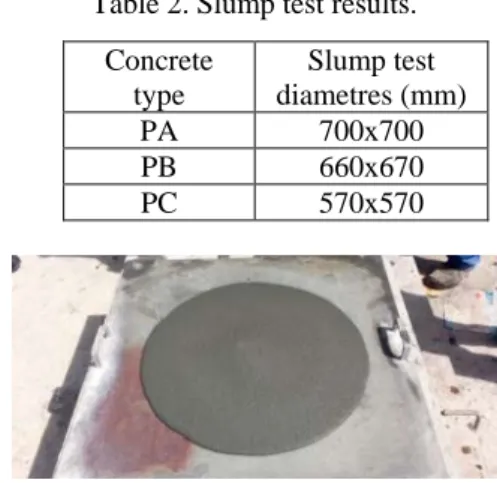
The workability of the fresh mixtures was determined from the self-compacting concrete slump flow measurements using a standard Abrams cone (fig. 1). The slump test results, in terms of the largest diameter in two directions at 90° are gathered in table 2.
Table 2. Slump test results.
Concrete type
Slump test diametres (mm)
PA 700x700
PB 660x670
PC 570x570
Fig. 1. Slump test result.
2.2. Mechanical properties
For each of the three concrete types, the compressive strength, the tensile strength and the specific fracture energy were measured.
Four cylinders of 150mm in diameter and 300mm in height were used for each concrete in order to obtain the quasi-static compressive strength and Young modulus according to ASTM C39 [11].
Table 3 summarizes the mechanical properties measured in the mechanical characterization campaign.
Table 3. Mechanical properties.
Concrete
type (2.2fµtm/s)
ft (22mm/s)
E (GPa)
ѵ (-)
fc (MPa)
A 8.5 11.1 46 0.18 112
B 14.8 18.9 45 0.17 113
C 25.3 31.3 46 0.17 114
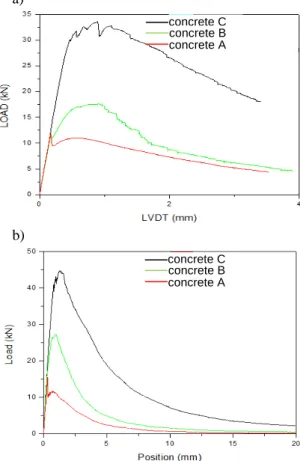
Note that the concrete mixes succeeded in the objective of getting softening behaviours remarkably different. Figure 2 shows representative Load-displacement curves obtained for the three concretes at the two different loading rates used. After the load peak, corresponding with the onset of fracture, the concrete with the lower content of fibre, A, exhibited a progressive decrease of strength as the applied displacement increased (softening). Contrarily, the concrete with the highest amount of steel fibres, C, exhibited higher levels of fracture loads, followed by an increase of strength with the displacement up to a maximum value after which the strength decreased progressively up to complete failure of the sample This hardening behaviour is possible through the increase of fibre content and, especially, due to the use of long fibers in contrast with the A concrete. The behaviour of the concrete with the intermediate content of fibre, B, exhibited a behaviour in between the two abovementioned ones.
For both loading rates, similar behavioural trends were observed but obviously with different values due to the different strain rate testing velocities.
2.3. Blast test specimens
Square slabs with dimensions of 500x500x50mm were casted using the three abovementioned concretes. A total of 6 slabs were casted for each concrete, although only 4 of each concrete type were subjected to the blast test.
3. BLAST TESTS
3.1. General characteristics
The blast tests were conducted by using the same experimental procedure presented in [14]. This procedure is based on the use of an experimental test bench consisting of a square steel frame (figure 3) that allows to test up to 4 concrete slabs with one single detonation, ensuring that the 4 samples are subjected to the same blast load. Due to the steel frame design and dimensions, it can be assumed that the slabs are simply supported at their four corners and that the explosive pressure load is uniformly applied on the slab plane facing the explosive load.
a)
b)
Fig. 2: Load-displacement curves for: a) loading velocity of 2.2µm/s; b) 22mm/s
Fig. 3: General view of the test bench used in the tests.
The dimensions of the steel frame between columns is 3.00m, which implies a 1.50m stand-off from explosive to the slabs. The distance from the centre of the explosive to the ground is 1.70m, avoiding thus undesirable interferences between the direct blast wave acting on the slabs and the wave reflected from the ground. Figure 4 sketches the test bench including its dimensions.
The explosive type used in all detonations was Goma-2 ECO, which is the commercial name of a dynamite class explosive manufactured by Maxam company. This explosive is provided in cylindrical cartridges
concrete C concrete B concrete A
containing 151.5 g. of explosive. The TNT equivalent of this explosive is approximately equal to 0.9535.
Fig. 4: Sketch and dimensions of the test bench.
3.2. Testing procedure
For a better comparison of the performance of the three concretes tested, it was decided to place one slab of each concrete per detonation. Therefore only three slabs were tested with each detonation.
In order to check the data acquisition devices and to have a preliminary measure of the damage caused by the detonations in the concrete slabs, a first test with 17 cartridges of Goma-2 was conducted. Given that the level of damage registered in this preliminary test was limited, it was decided to rise the explosive load to 22 cartridges, making thus 3.322kg of Goma-2. Given the usual experimental scatter associated to concrete samples and explosive testing, this test arrangement was repeated three times in order to have three slabs of each concrete subjected to the same blast load. Table 4 summarizes the explosive loads used during the test campaign.
Table 3. Explosive loads and concrete types tested.
Test #
Number of cartridges
Goma 2 (kg)
TNT eqv. (kg)
A slabs
B slabs
C slabs
1 17 2.58 2.46 1 1 1 2 22 3.33 3.18 1 1 1 3 22 3.33 3.18 1 1 1 4 22 3.33 3.18 1 1 1
3.3. Blast pressure histories
For numerical analyses to be conducted later, the blast pressure histories acting on the plates were registered during the tests (see figure 5). Two PCB Piezotronics 102B piezoelectric pressure gauges were used for that aim. It can be observed that the measured pressure histories were quite consistent in the three tests under 3.33kg of Goma-2 ECO.
4. RESULTS
4.1. Overall behaviour of the slabs
Figure 6 shows a picture of the slabs just after one test, with increasing fiber content from bottom to top. The
preliminary results show a clear influence of the fibre content and length on the fracture patterns as well as on the structural response of the slabs. Generally speaking, while in the case of the concrete with the lowest content of fibre, A, the energy released through the crack patterns was not able to preserve the structural integrity and some concrete fragments were pulled away of the slabs, in the case of the concrete C, with the use of longer fibers and an overall highest content of fibre, crack patterns were hard to see by naked eye in the tensioned face of the slab whereas the other one was apparently undamaged. The slabs made of the concrete with the intermediate content of fibre exhibited also intermediate failure behaviour, with crack patterns clearly visible but still preserving the slab integrity.
4.2. Failure patterns
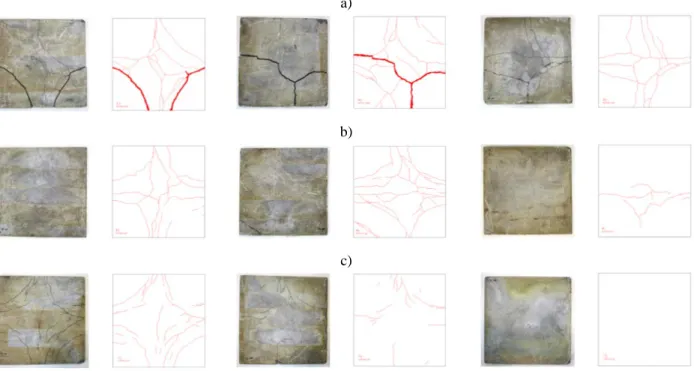
After the tests, the failure patterns were carefully tracked and registered (see figure 7). Generally speaking, a trend towards shear failure (curved cracks surrounding the supports) is dominant in these crack patterns.
Fig. 5: Blast pressure histories registered during the tests.
In contrast with the results achieved in similar experimental campaigns previously conducted by the authors with fiber-reinforced concretes with lower contents of fibres [15] the higher amount of fibres used in the concretes tested here leads to a much more spread cracking pattern. Figure 8 shows a comparison between the crack patterns obtained in [15] and in this experimental campaign. In both experimental campaigns, the blast loads were identical and the slabs tested in both cases were made of self-compacting fibre reinforced concrete. However, in the experimental campaign presented in [15], the reinforcement of the steel fibre reinforced concrete consisted on 0.7kg/m3 of long fibres while in the case of the concretes analyzed here, the minimum amount of fibres started from 40kg/m3. Apart from the obvious differences in the strengths, the increase in fibres content induces a strain-hardening behaviour that redistributes efforts in the slabs, making thus possible the appearance of cracks in wider areas of the slabs.
Actually, by comparing the crack patterns between concretes A and B, it is possible to affirm that the density of cracks in the latter is higher. In the authors' opinion this result is probably due to the more marked hardening behaviour of the B concrete in comparison with the A one (see figure 2a). While both concretes have similar resistance to crack appearance (peak load in the linear branch of the load-displacement curve), the strength of B concrete increases with the prescribed displacement, which is not the case of the A concrete. In the case of the C concrete, it exhibits a higher resistance to crack appearance (see also figure 2a), what justifies
the lower density of cracks registered in the slabs after the blast tests.
This result demonstrates the ability of the concretes studied in this work to dissipate large amounts of energy by crack propagation since, besides the higher levels of specific fracture energies exhibited by these kinds of concretes, the redistribution of efforts creates new crack surfaces, increasing thus the overall amount of energy dissipated.
5. CONCLUSIONS AND FUTURE WORK
In this paper the preliminary results of a research aimed at characterising the behaviour of high-performance self-compacting concrete reinforced with steel fibers subjected to impulsive loading have been presented.
Three different concrete dosages, A, B, and C have been designed, and their basic mechanical properties have been measured, including fracture energy determination under two different strain rates. This mechanical characterization revealed the success achieved in the dosage design, given that the three concretes exhibited post-cracking behaviours remarkably different.
Slabs of these concretes were subjected to blast testing and a clear effect of the fibre shape and content has been observed in the experimental results. Moreover, the post-cracking behaviour of these concretes seems to have a crucial role in the crack patterns developed during the blast tests.
a)
b)
c)
a)
b)
Fig. 8: Crack patterns obtained: a) in the tests conducted in the A concrete tested in the experimental campaign presented in this paper; b) in the experimental campaign presented in [15].
On the way ahead, static and dynamic tests aimed to analyse the residual strength of the tested slabs will be conducted. This residual strength plays a paramount role against progressive collapse, the main cause of human injuries when concrete structures are subjected to explosive attack.
ACKNOWLEDGEMENTS
The authors would like to acknowledge PACADAR-Ecoventia company for the design and casting of the specimens used in this research. Authors would also like to thank the financial support of the Secretary of State for Research, Development and Innovation of the Spanish Ministry of Economy and Competitiveness through the project with references BIA2011-24445 and MAT2012-35416.
REFERENCES
[1] B. Ellingwood, Mitigating Risk from Abnormal Loads and Progressive Collapse, J. Perform.
Constr. Facil. 20, pp. 315–323, 2006.
[2] D.O. Dusenberry, Handbook for Blast Resistant Design of Buildings. John-Wiley & Sons, 2010.
[3] P. Bhargava, U.K. Sharma, S.K. Kaushik. Compressive stress-strain behaviour of small scale steel fiber reinforced high strength concrete cylinders. J Adv Concr Technol, 4 (1) pp. 109– 121, 2006.
[4] J. Dugat, N. Roux, G. Bernier. Mechanical properties of reactive powder concretes. Mater
Struct, 29 (4) pp. 233–240, 1996.
[5] T.T. Garfield, W.D. Richins, T.K. Larson, C.P. Pantelides, J.E. Blakeley. Performance of RC and FRC wall panels reinforced with mild steel and GFRP composites in blast events. Procedia Eng, 10, pp. 3534–3539, 2010.
[6] S. Astarlioglu, T. Krauthammer, Response of normal-strength and ultra-high-performance fiber-reinforced concrete columns to idealized blast loads, Eng. Structures, 61,pp. 1-12, 2014.
[7] S.G. Millard, T.C.K. Molyneaux, S.J. Barnett, X. Gao, Dynamic enhancement of blast-resistant ultra high performance fibre-reinforced concrete under flexural and shear loading, Int. J. of Impact
Engineering, 37, pp. 405-413. 2010.
[8] A. Kaikea, D. Achoura, F. Duplan, L. Rizzuti. Effect of mineral admixtures and Steel fiber volumen contents on the behaviour of high performance fiber reinforced concrete. Material
and Design, 63, pp. 493-499, 2014.
[9] A.A. Shaha, Y. Ribako. Trends in steel fiber high-strength concrete. Materials and Design 32, pp. 4122–4151, 2011.
[10] A.M. Abd Elazim. Loading rate effect on the fracture behaviour of steel fiber-reinforced concrete. Doctoral Thesis. Universidad de Castilla La Mancha, 2013.
[11] ASTM C39-02. Standard test method for compressive strength of cylindrical concrete specimen. Annual Book ASTM Standards, 2002.
[12] RILEM. Test and design methods for steel fiber reinforced concrete-Bending test. Materials and Structures, 18, pp. 285-290, 1985.
[13] X.X. Zhang, G. Ruiz, R.C. Yu and M. Tarifa. Fracture behaviour of high strength concrete at a wide range of loading rates. Int. J. of Impact Eng., 36, pp. 1204-1209, 2009.
[14] G. Morales-Alonso, D.A. Cendón, F. Gálvez, B. Erice, V. Sánchez-Gálvez, Blast Response Analysis of Reinforced Concrete Slabs: Experimental Procedure and Numerical Simulation. J. of App. Mech.78:051010-1-051010-12, 2011.

![Fig. 8: Crack patterns obtained: a) in the tests conducted in the A concrete tested in the experimental campaign presented in this paper; b) in the experimental campaign presented in [15]](https://thumb-us.123doks.com/thumbv2/123dok_es/6755782.829261/6.892.131.766.127.275/patterns-obtained-conducted-experimental-presented-experimental-campaign-presented.webp)