Jonathan Prieto-Cubides Logic and Computation Research Group, Universidad EAFIT, Medellín, Colombia
Abstract. We describe a syntactical proof-reconstruction approach to verify derivations gen-erated byMetisprover to theorems in classical propositional logic. To verify such derivations, we formalise in type theory each inference rule of theMetisreasoning. We developed a tool jointly with two Agda libraries to translate Metis derivations to Agda proof-terms. These developments allowed us to type-check withAgda,Metisderivations step-by-step.
Keywords: proof-reconstruction, type theory, automatic theorem prover, proof-assistant
1
Introduction
An automatic theorem prover (henceforthATP) is a program that intends to prove conjectures from axioms and inference rules of some logical system. In the last decades,ATPsare fast becoming a key instrument in different disciplines and real applications (e. g., verifying a railway interlocking system, an operating-system kernel, or a pseudo-random number generator for cryptography). Since some programming errors have been found in these programs (see, for example, [27,7,17]), researchers and users from academy and industry have shown an increased interest toformallyprove the validity of ATPs’ results.
In order to give confidence to the ATP users many of these systems have started to include in their outputs the full derivations associated to the proved theorems. However, existing research recognizes that in many cases these derivations encode non-trivial reasoning hard to reconstruct and therefore hard to verify [33,27].
Proof-reconstruction addresses this problem. Since manyATPsare poor-documented, this prob-lem becomes in mostly cases a reverse engineering task to verify the prover reasoning. The usual is the reconstruction is made by another and not by the developers of theATP. Therefore, the presen-tation of the derivations generated by the prover plays an important role in proof-reconstruction.
To verify such automatically generated derivation by the prover, it is convenient to have them in a consistent format, that is, a full script describing the derivation step-by-step with exhaustive details and without ambiguities. For example, for classical propositional logic (henceforth CPL) from a list of at least forty ATPs—available from the Web service SystemOnTPTP of the TPTP World1—just few of them show their proofs.
One approach to address the proof-reconstruction problem is proving each deduction of the prover, the source system, with a formalization of the prover reasoning in a proof-assistant, the
targetsystem. The target system is the proofcheckerin charge to verify the source system reasoning for each derivation. These proof-assistants allow us to formalize the logical system used in the proofs, i. e., logical constants, axioms, inference rules, hypotheses, and theorems. A proof-reconstruction tool
1
provides such an integration, translating the derivation generated by the prover into the formalism of the proof-assistant.
Previous studies have reported proof-reconstruction using proof-assistants based on higher-order logic where the development is at a mature stage [32,23,24]. Another approaches has been proposed for proof-reconstructing based on type theory in [5,26,27].
We describe a formal reconstruction of proofs generated by theMetis prover [21]—our source system—in Martin-Löf type theory [30]. We formalize the subset of theMetisinference rules for the propositional logic fragment using a syntactical treatment. TheMetis reasoning was formalized in Agda[43]—our target system—in two libraries [35,37] and we implemented a proof-reconstruction tool named Athena [36] written in Haskell that is able to generate Agda proof-terms for Metis derivations. During writing this document, our formalization helps to report two programming errors in Metis. A bug2 in the printing of the derivation and a soundness bug3 in the stripping of the goal.
This paper has been organized in the following way. In Section 2, some limitations of type theory are discussed from our proof-reconstruction point of view. In Section 3, we introduce the Metis prover. In Section4, we show our approach to reconstructMetis derivations. Related work is described in Section5. Conclusions and suggestions for future work are presented in Section6.
The source code accompanying this paper (programs, libraries, and examples) is available at GitHub:
– TheAthenaprogram that translates proofs generated byMetistoAgdacode:http://github. com/jonaprieto/athena.
– The agda-prop library as a formalization in Agda for classical propositional logic: http:// github.com/jonaprieto/agda-prop.
– The agda-metis library as a formalization in Agda to justify Metis derivations of classical propositional logic:http://github.com/jonaprieto/agda-prop.
The proof-reconstruction tool Athena was tested with GHC 8.2.1. Both libraries, agda-prop and agda-metis were tested with Agda 2.5.3 and Agda standard library 0.14. Athena jointly with agda-prop and agda-metis are able to reconstruct propositional proofs of Metis 2.3 (re-lease 20171021). We successfully reconstruct around eighty theorems in classical propositional logic from the TPTP collection [34] to test the developments and the formalization presented in this research.
2
Type Theory
Type theory is a formalism for the foundation of mathematics, it has became in a key instrument to study logic and proof theory that follows the same basis of constructive mathematics where the witness of a statement iseverything. In that direction, we could say the main actors in type theory are the statements and their proofs.
By following the Curry-Howard correspondence (see, for example, [45]), a formula corresponds to atype, and one proof of that formula is aterm of the correspondent type. Therefore, inhabitants types are such formulas with proofs, they are theorems.
2 Issue No. 2 at
https://github.com/gilith/metis/issues/2 3
Since type theory is a formal system, we have a syntax and a set of derivation rules. These rules enables us to derive a kind of conclusions calledjudgments. A judgment is another way to say that a term has a certain type. Each term has associated a derivation, we refer to this derivation as proof-terms.
Notation. Types are written using small caps. We write the type judgments as a: a to denote that the termais of typea.
We produce derivation trees inside the judgments using the derivation rules. Since type theory can be seen as typed λ-calculus with dependent function types, evaluation ofλ-terms also called
normalization of the proof-terms, is a process of reductions with the system inference rules. Therefore, the proof verification task becomes in type theory as verifying that the proof-term has the correspondent type of the theorem. We know this process as type-checking. This feature of type theory allow us to verify a proof generated by an ATP by reconstructing its proof-term to type-check the proof. For such a purpose, we use a proof-assistant based on type theory like Agdato delegate this task. discussed in [5]. Some limitations from the type theory point of view for proof-reconstruction is described in the following sections.
2.1 Terminating functions
To reconstruct Metis inference rules in type theory, we observed that some rules or their inner functions are implemented bygeneral recursivefunctions.
Functions defined by a general recursion can not be directly translated in type theory since it is not a guarantee they terminate. For that reason, we follow the technique described in [4] to avoid termination problems by modifying the recursive functions to be structurally recursive.
A recursive function is structurally recursive if it calls itself with only structurally smaller arguments [1]. General recursive functions can be rewrote into structurally recursive functions by using for instance, thebounded recursion technique. For a yet another methods, we refer the reader to [12,1,10].
The bounded technique defines a new structural recursive function based on the general recursive function by adding an argument. The new argument is the bound, a natural number given by the function complexity. In other words, the added argument will represent the number of times the function needs to call itself to get the expected outcome.
Notation. We use Propfor the type of propositions. A proposition is an expression of indivisible propositional variables (e. g., symbolsϕ0, ϕ1,· · ·), the logic constants:⊥,>, the binary connectives (∧,∨,⊃,⇔), and the negation (¬). We write the equality using the symbol (≡) as ϕ ≡ ψ, for ϕ, ψ : Prop. For this equality, we assume the reflexivity, symmetry and transitivity properties. The type of natural numbers is called Nat, and it is defined as usual, wherezeroand succare its data constructors. We use names and symbols for the arithmetic operations as usual (e. g., +, −,
∗). We use syntax sugar forzero,succ, succ zero,. . ., with the decimal representation0, 1, 2, . . . as well.
Hence, one approach to define a structural recursive function based on a general recursive functionf : a → bis to formulate a new functionf∗: a → Nat → bwhere all of its recursive calls are done on smaller arguments.
Example 1. Let us consider the following example to show the bounded recursion technique for defining the uh function. This function is used for reconstructing a Metis inference rule in Sec-tion4.2.1.
uh0:Prop→Prop
uh0(ϕ1⊃(ϕ2⊃ϕ3)) =uh0((ϕ1∧ϕ2)⊃ϕ3)
uh0(ϕ1⊃(ϕ2∧ϕ3)) =uh0(ϕ1⊃ϕ2)∧uh0 (ϕ1⊃ϕ3)
uh0ϕ =ϕ.
(1)
In (1), the first two equations call on arguments no structurally smaller. For instance, in the first equation,
uh0(ϕ1⊃(ϕ2⊃ϕ3)) =uh0 ((ϕ1∧ϕ2)⊃ϕ3),
the function uh0 calls on the (ϕ1∧ϕ2)⊃ϕ3 argument in the right-hand side but this formula is not a subformula ofϕ1⊃(ϕ2⊃ϕ3). Therefore, one way to translateuh0to type theory is to define a new function using a bounded recursion.
uh1:Prop→Nat→Prop
uh1(ϕ1⊃(ϕ2⊃ϕ3)) (succn) =uh1 ((ϕ1∧ϕ2)⊃ϕ3)n
uh1(ϕ1⊃(ϕ2∧ϕ3)) (succn) =uh1 (ϕ1⊃ϕ2)n∧uh1 (ϕ1⊃ϕ3)n
uh1ϕ n =ϕ.
(2)
We bounded the recursion calls of theuh0function using its complexity measure.
The complexity measure of a function is the number of steps the function takes to finish. Since theuh0 function is recursive, we can define its complexity measure by defining a recursive function instead of a closed formula for such a number. However, this function must to be structurally recursive as well and can be defined by following the pattern-matching cases of its definition.
Therefore, we define in (3) the complexity measure function ofuh0 by assigning the number of steps to finish for each pattern-matching case. We have used the complexity measure definition for a formula defined in [2] to define other complexity measures in this paper.
uhcm:Prop→Nat
uhcm (ϕ1⊃(ϕ2⊃ϕ3)) =uhcm ϕ3+ 2
uhcm (ϕ1⊃(ϕ2∧ϕ3)) =max(uhcmϕ2) (uhcm ϕ3) + 1
uhcm ϕ = 0.
(3)
Following the technique mentioned above, we define the function uh, the structural recursive definition of the functionuh0.
uh:Prop→Prop
uhϕ =uh1 ϕ(uhcm ϕ).
2.2 Intuitionistic logic
To reconstruct proofs generated by Metis, we have formalized in type theory the classical propositional logic in [35]. A briefly description of it is presented in [13]. In this formalization, we have to assume the principle of excluded middle (henceforth PEM) as an axiom since Metis is a prover for classical logic. AssumingPEM, we can justify refutation proofs by deriving from it the
reductio ad absurdum rule (henceforthRAA). The RAA rule is the formulation of the principle of proof by contradiction, that is, a derivation of a contradiction, ⊥, from the hypothesis¬ ϕ, is a derivation ofϕ.
Notation. TheListtype is the usual inductive and parametric type for lists.
We formalise the syntactical consequence relation of CPL by an inductive family _` _ with two indexes, a set of propositions (the premises) and a proposition (the conclusion), that is,Γ `ϕ represents that there is derivation with conclusionϕ:Propfrom the set of premisesΓ :List Prop. We implemented in [35] the syntactical consequence relation in a similar way as it was presented in [11]. For that reason, we have included structural rules like weaken, formation and elimination rules for connectives and the PEM axiom as the valid inference rules in Fig. 1.
assume Γ, ϕ`ϕ Γ `ϕ weaken Γ, ψ`ϕ >-intro
Γ ` >
Γ ` ⊥ ⊥-elim Γ `ϕ Γ, ϕ` ⊥ ¬-intro Γ ` ¬ϕ Γ ` ¬ϕ Γ `ϕ ¬-elim Γ ` ⊥ Γ `ϕ Γ `ψ ∧-intro Γ `ϕ∧ψ Γ `ϕ∧ψ ∧-proj1 Γ `ϕ Γ `ϕ∧ψ ∧-proj2 Γ `ψ Γ `ϕ ∨-intro1 Γ `ϕ∨ψ Γ `ψ ∨-intro2 Γ `ϕ∨ψ Γ, ϕ`γ Γ, ψ`γ ∨-elim Γ, ϕ∨ψ`γ Γ, ϕ`ψ ⊃-intro Γ `ϕ⊃ψ Γ `ϕ⊃ψ Γ `ϕ ⊃-elim Γ `ψ PEM Γ `ϕ∨ ¬ϕ
Fig. 1.Inference rules for propositional logic.
3
Metis: Language and Proofs
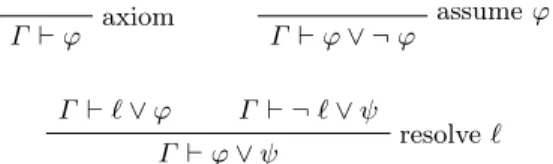
Metis is an automatic theorem prover for first-order logic with equality developed by Hurd [21]. This prover is suitable for proof-reconstruction since it provides well-documented proofs to justify its deduction steps from the basis of only six inference rules for first-order logic (see, for example, [33,16]). For the propositional fragment,Metis has three inference rules, see Fig.2.
3.1 Input language
TheTPTP language is the input language to encode problems used byMetis. It includes the first-order form (denoted by fof) and clause normal form (denoted by cnf) formats [40]. The TPTP syntax4 describes a well-defined grammar to handle annotated formulas with the following form:
4
axiom
Γ `ϕ
assumeϕ Γ `ϕ∨ ¬ϕ
Γ ``∨ϕ Γ ` ¬`∨ψ
resolve` Γ `ϕ∨ψ
Fig. 2.Propositional logic inference rules of theMetisprover.
language(name, role, formula).,
where the language can be fof or cnf. The name serves to identify the formula within the problem. Each formula assumes arole, this could be anaxiom, conjecture, definition, plain or anhypothesis.
The formulas include the constants $true and $false, the negation unary operator (~), and the binary connectives (&, |, =>) to represent (>,⊥,¬,∧,∨, ⊃) respectively.
Example 2. For instance, let us express the problemp ` ¬(p∧ ¬p)∨(q∧ ¬q)inTPTPsyntax. We begin by declaring thepaxiom using theaxiomkeyword. Next, we include the expected conclusion using theconjecture keyword.
fof(h, axiom, p).
fof(goal, conjecture, ~ ((p & ~ p) | (q & ~ q))).
3.2 Output language
The TSTP language is an output language for derivations of ATPs [42]. A TSTP derivation is a directed acyclic graph, a proof tree, where each leaf is a formula from theTPTP input. A node is a formula inferred from the parent formulas. The root is the final derived formula, such a derivation is a list of annotated formulas with the following form:
language(name, role, formula, source [,useful info]).
Thesourcefield is an inference record with the following pattern: inference(rule, useful info, parents).
Therule in the line above stands for the inference name; the other fields are supporting argu-ments or useful information to apply the reasoning step, and list the parents nodes.
Example 3. In the script below, strip is the name of the inference. It has no arguments and derives from one parent node namedgoal. The result of this inference when it applies to thegoal formula isp.
fof(subgoal_0, plain, p, inference(strip, [], [goal])).
Example 4. Let us consider the followingTSTPderivation using the customized TSTPsyntax (see the originalTSTPderivation and customizations in AppendixA).
fof(premise, axiom, p). fof(goal, conjecture, p). fof(s0, p, inf(strip, goal)). fof(neg0, ¬ p, inf(negate, s0)). fof(n0, ¬ p, inf(canonicalize, neg0)). fof(n1, p, inf(canonicalize, premise)). fof(n2, ⊥, inf(simplify, [n0, n1])) cnf(r0, ⊥, inf(canonicalize, n2)).
3.3 Metis Derivations
A derivation generated by Metisencodes a natural deduction proof, Fig. 3 is an example of such kind of proof. With the inference rules in Fig. 1as the only valid deduction steps,Metis attempts to prove conjectures by refutation (i. e.,falsium in the root of theTSTPderivation).
These derivations are directed acyclic graphs, trees of refutations. Each node stands for an application of an inference rule and the leaves in the tree represent formulas in the given problem. Each node is labeled with a name of the inference rule (e. g., canonicalize). Each edge links a premise with one conclusion. The proof graphs have at their root the conclusion ⊥, since Metis derivations are refutations.
negate ¬p
strip ¬p
axiom
p
canonicalize
p
simplify ⊥
canonicalize ⊥
Fig. 3.Metisderivation tree of Example4.
3.4 Inference rules
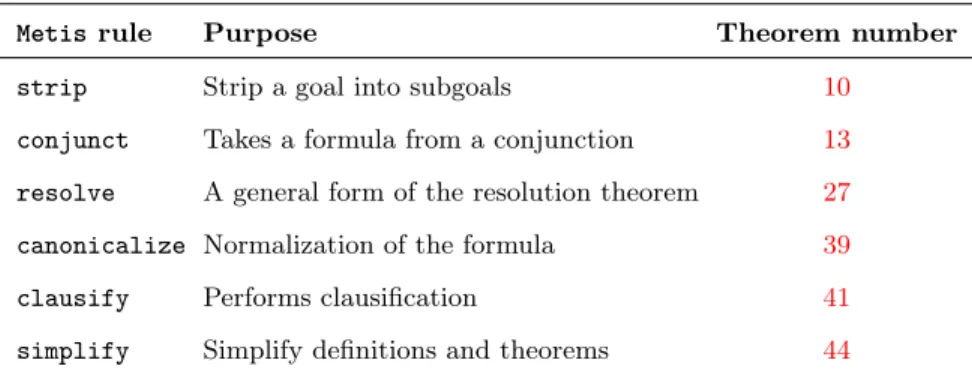
We present the list of inference rules used by Metisin theTSTP derivations for propositional logic in Table 1. We reconstruct these rules in Section4. The reader may notice that the inference rules presented in Fig2diverge from the rules in aforementioned table. The former rules are implemented by the latter rules in theTSTPderivations. For instance, as far as we know, inTSTPderivations, the
Table 1.Metisinference rules.
Metis rule Purpose Theorem number
strip Strip a goal into subgoals 10
conjunct Takes a formula from a conjunction 13
resolve A general form of the resolution theorem 27
canonicalize Normalization of the formula 39
clausify Performs clausification 41
simplify Simplify definitions and theorems 44
4
Proof-Reconstruction
The proof-reconstruction approach proposed consists of a series of steps similar to the workflow presented [39]. This process is a translation from a source system to a target system. In our case, the system of origin, the automatic theorem prover, isMetis; the target system is a proof-assistant, Agda. We choose Agda, but another proof-assistant with the same support of type theory and inductive types could be used.
4.1 Workflow
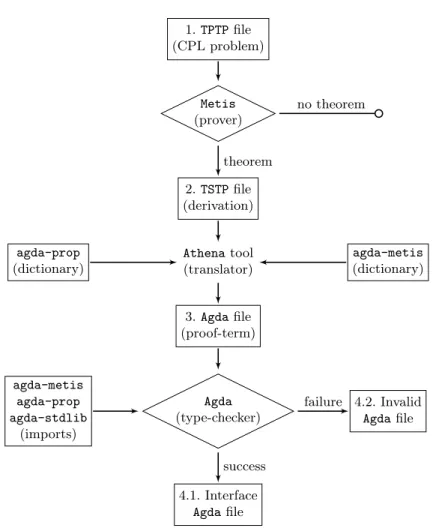
The overview of the proof-reconstruction is presented in Fig.4. The process begins with aTPTPfile that encodes a problem inCPL. We use this file as the input of theMetis prover. If the problem is a theorem,Metisgenerates a derivation of the proof inTSTPformat.
With theTSTP derivation from Step 2, we process the derivation with the Athena translator tool. Athenaparses theTSTPformat, analyzes the derivation and generates a representation of the natural deduction proof using a tree data structure (see the properties of this tree in Section3.3). In the Athenaanalysis, some unnecessary steps that introduce redundancies and some unused input are removed from the proof-tree. As result, we get from Athena an Agda file of the proof with names of functions and theorems from the Agda libraries that accompany this article:agda-prop andagda-metis.
Finally, we type-check theAgda proof-term. If the type-checking success, the TSTP derivation generated by Metis is correct moduleAgda and the proposed formalizations for the propositional logic and for the Metis reasoning. In that case Agda outputs an interface file. Otherwise, when type-checking fails, the failure must be investigated by the user looking at the error in the TSTP derivation by Metis, in the translation by Athena, in theAgdaformalizations mentioned above or in the type-checkerAgda.
In the remainder part of this section, a formal description using type theory is presented to build definitions and theorems of functions necessary to reconstructMetisinference rules.
4.2 Reconstructing Metis inference rules
1.TPTPfile (CPL problem)
Metis (prover)
2.TSTPfile (derivation)
Athenatool (translator) agda-prop
(dictionary)
agda-metis (dictionary)
3.Agdafile (proof-term)
Agda (type-checker) agda-metis
agda-prop agda-stdlib
(imports)
4.1. Interface Agdafile
4.2. Invalid Agdafile theorem
no theorem
success
failure
Fig. 4. Proof-reconstruction overview. The rectangles nodes represent text files. The direct edges in the diagram represent calls to programs where the input file is pointed by the edge entering and the out edge points to the output file. The rhombus nodes represent a process with two possible outcomes.
Notation. The function name written intypewriterfont refers to aMetisinference rule. The same function name written using sans serif font refers to our formalized version to reconstruct the rule and implemented in [37]. We use Premise and Conclusion as synonyms of the Prop type to describe in the function types the role of the arguments.
Example 5. Let metisRule be a Metis inference rule. To reconstruct this rule, we define the functionmetisRulein type theory that follows the pattern:
metisRule:Premise→Conclusion→Prop
metisRuleϕ ψ =
ψ, if the conclusionψcan be derived by applying certain inference rules to the premiseϕ;
To justify all transformations done by themetisRulerule, we prove its soundness with a theorem like the following:
IfΓ `ϕthenΓ `metisRuleϕ ψ, whereψ:Conclusion.
The remainder of this section will be devoted to present a formal description in type theory of each rule presented in Table1using the pattern present in the example above. We follow the same order to present the rules as the table shows.
4.2.1 Strip. To prove a goal, Metissplits the goal into disjoint cases. This process produces a list of new subgoals, the conjunction of these subgoals implies the goal. Then, a proof of the goal becomes, in smaller proofs, one refutation for each subgoal.
Example 6. The subgoals associated to a goal are introduced in the TSTP derivation with the stripinference rule.
fof(goal, conjecture, (p ∧ r) ∧ q)). fof(s1, p, inf(strip, goal)).
fof(s2, p ⊃ r, inf(strip, goal)). fof(s3, (p ∧ r) ⊃ q, inf(strip, goal)).
In this example, the conjecture(p∧r)∧qis stripped into tree subgoals:p,p⊃rand(p∧r)⊃q.
(p∧(p⊃r)∧((p∧r)⊃q))⊃((p∧r)∧q). (4) Metisproves each subgoal in the same order above from left to right in (4). So far, very little attention has been paid to the role of thestriprule inTSTPderivations sinceMetisdoes not make explicit the way it uses the subgoals to prove the conjecture.
We prove the correctness of thestripinference rule in Theorem10. To show that theorem, we need to prove Lemma7and Lemma 8.
Lemma 7. Let n:Natbe the complexity measure of theuh0 function in (1). IfΓ `uh1ϕ nthen Γ `ϕwhereuh1 is the function defined in (2).
Proof. The proof is by induction on the cases defined by the outcome of theuh1 function.
– Ifn= 0, by definition in (2) we concludeΓ `ϕ.
– Forn≥1, we use induction on the structure of the first argument.
• Caseϕ≡ϕ1⊃(ϕ2⊃ϕ3).
Γ `uh1(ϕ1⊃(ϕ2⊃ϕ3)) (succn)
by (2) Γ `uh1 ((ϕ1∧ϕ2)⊃ϕ3)n
by ind. hyp. Γ `(ϕ1 ∧ϕ2)⊃ϕ3
∧⊃-to-⊃⊃
Γ ` ϕ1 ⊃(ϕ2 ⊃ϕ3) using the following theorem proved in [35],
• Caseϕ≡ϕ1⊃(ϕ2∧ϕ3).
(D1)
Γ `uh1(ϕ1⊃(ϕ2∧ϕ3)) (succn)
by (2) Γ `uh1(ϕ1⊃ϕ2)n∧uh1(ϕ1⊃ϕ3)n
∧-proj1 Γ `uh1(ϕ1⊃ϕ2)n
by ind. hyp. Γ `ϕ1⊃ϕ2
(D2)
Γ `uh1(ϕ1⊃(ϕ2∧ϕ3)) (succn)
by (2) Γ `uh1(ϕ1⊃ϕ2)n∧uh1(ϕ1⊃ϕ3)n
∧-proj2 Γ `uh1(ϕ1⊃ϕ3)n
by ind. hyp. Γ `ϕ1⊃ϕ3
Now, using⊃∧⊃-to-⊃∧theorem from [35],
⊃∧⊃-to-⊃∧ : Γ `(ϕ1⊃ϕ2)∧(ϕ1⊃ϕ3)→Γ `ϕ1⊃(ϕ2∧ϕ3),
D1 D2
∧-intro Γ `(ϕ1⊃ϕ2)∧(ϕ1⊃ϕ3)
⊃∧⊃-to-⊃∧
Γ `ϕ1 ⊃(ϕ2 ∧ϕ3)
• Other cases are proved in a similar way.
Thestrip0 function defined in (25) yields the conjunction of subgoals that implies the goal of the problem in theMetis TSTPderivations. Nonetheless, this function is not a structurally recursive function (see more details in AppendixB). Therefore, we present thestrip1 function in (5) as the structurally recursive version of thestrip0function by applying the bounded technique described in Section2.1. We define thestrip1 function based on the reading of theMetissource code.
strip1:Prop→Nat→Prop
strip1(ϕ1∧ϕ2) (succn) =uh (strip1 ϕ1n)∧uh(ϕ1⊃strip1 ϕ2 n) strip1(ϕ1∨ϕ2) (succn) =uh ((¬ϕ1)⊃strip1 ϕ2 n)
strip1(ϕ1⊃ϕ2) (succn) =uh (ϕ1⊃strip1ϕ2 n)
strip1(¬(ϕ1∧ϕ2)) (succn) =uh (ϕ1⊃strip1(¬ϕ2)n)
strip1(¬(ϕ1∨ϕ2)) (succn) =uh (strip1 (¬ϕ1)n)∧uh ((¬ϕ1)⊃strip1 (¬ϕ2)n)
strip1(¬(ϕ1⊃ϕ2)) (succn) =uh (strip1 ϕ1n)∧uh(ϕ1⊃strip1 (¬ϕ2)n)
strip1(¬(¬ϕ1)) (succn) =uh (strip1 ϕ1n)
strip1(¬ ⊥) (succn) =>
strip1(¬ >) (succn) =⊥
strip1ϕ n =ϕ.
(5)
In a similar way as we defineuhcmin (3), we define thestripcm function in AppendixBas the complexity measure for thestrip0 function. Then we define thestripfunction as follows in 6.
strip:Prop→Prop
Lemma 8. Let n:Natbe the complexity measure of thestripfunction defined in (5). IfΓ ` strip1ϕ n thenΓ ` ϕ.
Proof. The proof is by induction on the structure of the formulaϕby following the equations in (5). We present a straightforward case with double negation, the case for conjunctions, and last, the case for a negated disjunction. We refer the reader to [37] for the complete proof inAgda.
•Caseϕ≡ ¬(¬ϕ1).
Γ `strip1(¬(¬ϕ1)) (succn)
by (5) Γ `uh (strip1 ϕ1n)
Lemma7 Γ `strip1 ϕ1 n
by ind. hyp. Γ `ϕ1
• Case ϕ≡ϕ1∧ϕ2. We prove Γ ` ϕ1 and Γ ` ϕ2. From the conjunction ofϕ1 and ϕ2, the expected result follows.
(D)
Γ `strip1 (ϕ1∧ϕ2) (succn)
by (5) Γ `uh(strip1ϕ1 n)∧uh(ϕ1⊃strip1 ϕ2n)
∧-proj1 Γ `uh (strip1 ϕ1 n)
Lemma 7 Γ `strip1ϕ1 n
by ind. hyp. Γ `ϕ1
D
Γ `ϕ1
Γ `strip1(ϕ1∧ϕ2) (succn)
by (5) Γ `uh(strip1ϕ1 n)∧uh (ϕ1⊃strip1 ϕ2n)
∧-proj2 Γ `uh(ϕ1⊃strip1 ϕ2n)
Lemma7 Γ `ϕ1⊃strip1 ϕ2 n
⊃-elim Γ `strip1 ϕ2 n
by ind. hyp. Γ `ϕ2
•Caseϕ≡ ¬(ϕ1∨ϕ2). We proveΓ ` ¬ϕ1and Γ ` ¬ϕ2. From the conjunction of ¬ϕ1 and
¬ϕ2 by applying De Morgan Law and the result follows.
(D)
Γ `strip1(¬(ϕ1∨ϕ2)) (succn)
by (5) Γ `uh (strip1 (¬ϕ1)n)∧uh ((¬ϕ1)⊃strip1 (¬ϕ2)n)
∧-proj1 Γ `uh (strip1 (¬ϕ1)n)
Lemma7 Γ `strip1(¬ϕ1)n
by ind. hyp. Γ ` ¬ϕ1
D
Γ ` ¬ϕ1
Γ `strip1 (¬(ϕ1∨ϕ2)) (succn)
by (5) Γ `uh (strip1 (¬ϕ1)n)∧uh ((¬ϕ1)⊃strip1 (¬ϕ2)n)
∧-proj2 Γ `uh ((¬ϕ1)⊃strip1 (¬ϕ2)n)
Lemma 7 Γ `(¬ϕ1)⊃strip1 (¬ϕ2)n
⊃-elim Γ `strip1(¬ϕ2)n
• Other cases are proved in a similar way, see AppendixC.
The following theorem is convenient to substitute equals by equals in a theorem. Recall the equality (≡) is symmetric and transitive as well. We use these properties without any mention.
Lemma 9. Substitution theorem.
Γ `ϕ ψ≡ϕ subst Γ `ψ
We can now formulate the result that justifies the stripping strategy of Metis to prove goals. For the sake of brevity, we state the following theorem for the strip function when the goal has two subgoals. In other cases, we extend the theorem in the natural way.
Theorem 10. Let n:Natbe the complexity measure of the strip function defined in (5). Lets2 ands3 be the subgoals of the goalϕ, that is,
strip1 ϕ n ≡ s2∧ s3.
IfΓ `s2and Γ `s3 thenΓ `ϕ.
Proof.
Γ `s1 Γ `s2
∧-intro
Γ `s1∧s2 strip1 ϕ n≡s1∧s2 subst Γ `strip1 ϕ n
Lemma 8 Γ `ϕ
SinceMetisproves a conjecture by refutation, to prove each subgoal,Metisassumes the negation of it by using the negaterule after thestripinference application that introduce such a subgoal.
Example 11. In the following TSTP derivation, note that the three subgoals s1, s2 and s3 are assumed by the negaterule inneg1,neg2 andneg3 respectively.
fof(goal, conjecture, p ∧ r ∧ q). fof(s1, p, inf(strip, goal)). fof(s2, p ⊃ r, inf(strip, goal)). fof(s3, (p ∧ r) ⊃ q, inf(strip, goal)). fof(neg1, ¬ p, inf(negate, s1)).
...
fof(neg2, ¬ (p ⊃ r), inf(negate, s2)). ...
4.2.2 Conjunct. Theconjunctrule extracts from a conjunction one of its conjuncts. This rule is a generalization of the projection rules for the conjunction connective as the followingTSTPexcerpt shows.
Example 12.
fof(p1, p ∧ q ∧ (r ∨ ¬ p), ... fof(p2, q, inf(conjunct, p1)).
fof(p3, r ∨ ¬ p, inf(conjunct, p1)).
In the first formula, p∧q∧(r∨ ¬ p), we find a left-associative conjunction named p1. The conjunctrule extractsq from thep1 using a left projection (∧-proj1) follow by a right projection (∧-proj2). After, theconjunctrule extractsr∨ ¬pby using a right projection onp1.
Theorem 13. Letψ:Conclusion. IfΓ `ϕthenΓ `conjunct ϕ ψ, where conjunct:Premise→Conclusion→Prop
conjunctϕ ψ=
ψ, ifϕ≡ψ;
ψ, ifϕ≡ϕ1∧ϕ2 andψ≡conjunctϕ1 ψ; ψ, ifϕ≡ϕ1∧ϕ2 andψ≡conjunctϕ2 ψ;
ϕ, otherwise.
Proof.
• Case ϕ ≡ψ. Γ ` conjunct ϕ ψ normalizes to Γ ` ψ. Then, we get the desire conclusion by applying thesubst lemma.
• Caseϕ≡ϕ1∧ϕ2. If we can getψ≡conjunct ϕi ψ for somei= 1, 2, then, Γ `ϕ1∧ϕ2
∧-proji Γ `ϕi
by ind. hyp.
Γ `conjunctϕi ψ ψ≡conjunct ϕi ψ subst Γ `ψ
• Otherwise, the last case follows from the hypothesis.
4.2.3 Resolve. Logic equivalence between propositions is a major issue to justify prover reasoning steps. Since we left out semantics to treat only the syntax aspects of propositional logic, our approach shows logic equivalence by converting propositions to their conjunctive normal form, and reordering those and the inner disjunctions to match them. Below, we provide Lemma19, Lemma20, Lemma23 to perform such reordering tasks, the omitted proofs can be found in [37].
First, we define the assoc function in (7) to convert a disjunction or a conjunction into its right-associative form. The square symbol () can be the conjunction symbol or the disjunction symbol. We useassoc∧ to convert conjunctions andassoc∨ for disjunctions.
assoc :Prop→Prop
assoc ((ϕ1 ϕ2)ϕ3) =assoc (ϕ1 (ϕ2 ϕ3))
assoc (ϕ1 ϕ2) =ϕ1 assoc ϕ2
assoc ϕ =ϕ.
Lemma 14. IfΓ `ϕthenΓ `assoc ϕ.
Remark. In TPTP syntax, the formulas are in left-associative form by default. Despite of that convention,Metisassumes the formulas to be in right-associative form by default. This is a matter to take into account for the proof-reconstruction.
Thebuild∨ function defined in (8) intends to construct a disjunction from another disjunction, specifically, this function will try to rearrange the disjuncts in the source formula to match with the target disjunction formula.
Lemma 15. IfΓ `ϕandψ:ConclusionthenΓ `build∨ ϕ ψ, where build∨:Premise→Conclusion→Prop
build∨ ϕ ψ =
ψ, ifϕ≡ψ;
ψ, ifψ≡ψ1∨ψ2 andψi≡build∨ ϕ ψi for somei= 1,2; ϕ, otherwise.
(8)
From now on, we assume all propositions to be right-associative unless otherwise stated. Thefactorfunction in (9) simplifies a special case of disjunction, the repeated disjuncts (e. g., factor(ϕ∨ϕ) = ϕ). Notice that other cases likeϕ ∨ (ψ ∨ ϕ)do not reduce toψ ∨ ϕ. We use this function in Lemma 17.
Lemma 16. IfΓ `ϕthenΓ `factorϕ, where factor:Prop→Prop
factorϕ = (
ϕ1, ifϕ≡ϕ1∨ϕ2 andϕ1≡factorϕ2;
ϕ, otherwise.
(9)
To construct a disjunctionψfrom a disjunctionϕ, we have used ideas from the description in [8] to prove equality between nested disjunctions. We define thesbuild∨function in (10) that uses every disjunct from the source formula,ϕ, to build up the target disjunctionψ.
Lemma 17. IfΓ `ϕandψ:ConclusionthenΓ `sbuild∨ϕ ψ, where sbuild∨:Premise→Conclusion→Prop
sbuild∨(ϕ1∨ϕ2)ψ=factor(build∨ ϕ1ψ∨build∨ ϕ2 ψ) sbuild∨ϕ ψ =build∨ ϕ ψ.
(10)
Example 18. We build the disjunction(p∨q)∨rfrom the disjunctionr∨(q∨p)using Lemma17.
(D)
Γ `q
∨-intro2 Γ `p∨q
∨-intro1 Γ `(p∨q)∨r
Γ `p
∨-intro1 Γ `p∨q
∨-intro1 Γ `(p∨q)∨r
∨-elim Γ, q∨p`(p∨q)∨r
Γ `r
∨-intro2 Γ `(p∨q)∨r
D
Γ, q∨p`(p∨q)∨r
∨-elim Γ, r∨(q∨p)`(p∨q)∨r
Remark. Notice that usingsbuild∨ we can build not only a disjunction with the same disjuncts of the source formula but also a complete different disjunction by adding new disjuncts to the source formula via introduction rules for disjunctions.
The following lemma aims to reorder nested disjunctions by forcing the formula to be in right-associative form in order to apply Lemma17.
Lemma 19. IfΓ `ϕandψ:ConclusionthenΓ `reorder∨ ϕ ψ , where reorder∨:Premise→Conclusion→Prop reorder∨ ϕ ψ =sbuild∨(assoc∨ ϕ)ψ.
(11)
Proof. Use Lemma14and Lemma17.
Now, we define thereorder∧ function in (12) to reorder nested conjunctions. This will help us in the end of this section to reorder conjunctive normal forms.
Lemma 20. IfΓ `ϕandψ:ConclusionthenΓ `reorder∧ ϕ ψ, where reorder∧:Premise→Conclusion→Prop
reorder∧ ϕ ψ=
ϕ, ifϕ≡ψ;
ψ1∧ψ2, ifψ≡ψ1∧ψ2,ψ1≡reorder∧ ϕ ψ1; andψ2≡reorder∧ϕ ψ2;
ϕ, ifψ≡ψ1∧ψ2;
conjunctϕ ψ, otherwise.
(12)
Example 21.
reorder∧(p∧q∧r) (r∧q∧p) = (r∧q∧p), reorder∧(p∧q∧r) (r∧r∧p) = (r∧q∧p), reorder∧(p∧q∧r) (k∧q∧p) = (p∧q∧r), reorder∧((p∨q)∧r) ((r∧(q∨p)) = ((p∨q)∧r).
(13)
In the last example in (13), we could not build the conjunction r∧(q∨p) sincep∨q is not syntactical equal toq∨p. We solve this issue in Lemma23by using thedisjfunction defined in (14). The purpose of this function consists of extracting a disjunction from a conjunction, but without matter the order of the inner disjunctions.
Lemma 22. IfΓ `ϕandψ:ConclusionthenΓ `disjϕ ψ, where disj:Premise→Conclusion→Prop
disjϕ ψ=
ψ, ifϕ≡ψ;
ψ, ifψ≡reorder∨ ϕ ψ;
ψ, ifψ≡ψ1∧ψ2, ψ1≡disjϕ ψ1, andψ2≡reorder∨ ϕ ψ2; ψ, ifϕ≡ϕ1∧ϕ2, ψ ≡disjϕ1 ψ;
ψ, ifϕ≡ϕ1∧ϕ2, ψ ≡disjϕ2 ψ; ϕ, otherwise.
We are able now to reorder conjunctive normal forms using thereorder∧∨function defined in (15) by using the previous lemma.
Lemma 23. IfΓ `ϕandψ:ConclusionthenΓ `reorder∧∨ ϕ ψ, where reorder∧∨:Premise→Conclusion→Prop
reorder∧∨ϕ ψ =
ψ, ifϕ≡ψ;
ψ, ifψ≡ψ1∧ψ2, ψ1≡reorder∧∨ ϕ ψ1, andψ2≡reorder∧∨ ϕ ψ2;
ϕ, ifψ≡ψ1∧ψ2;
disjϕ ψ, otherwise.
(15)
Now, we are ready to reconstruct theresolverule using Lemma23. As we see in the following, theresolverule is theMetisversion of the resolution theorem. This rule takes into account, two propositions that contain a positive literal`and its negation¬`respectively. Then, it produces the
resolvent, a disjunction of two propositions: the first proposition after removing the literal ` and the second proposition after removing its negation¬`.
Definition 24. Aliteral is an propositional variable (positive literal) or a negation of an proposi-tional variable (negative literal).
Notation. We useLitas synonym of Prop type to refer literals.
The positive literal ` must occur in the formula from the first derivation and the negative literal¬`must occur in the formula from the second derivation, see the pattern of theresolve rule in Fig.2.
Example 25.
cnf(r4, ¬ r ∨ p ∨ q, ... cnf(r5, p ∨ q ∨ r, ...
cnf(r6, p ∨ q, inf(resolve, r, [r5, r4])).
In the excerpt above, we apply resolution to the first two formulas,¬r∨p∨qandp∨q∨r. The last line tells us the literal used for resolution isr. Syntactically speaking, we can not derive neither the conclusionp∨q in r6 nor apply the resolution theorem with r4 andr5 since the formulas do not fit the pattern required.
If the scenario would have other like replacingr5 by cnf(r5, r ∨ p ∨ q, ...
Theresolverule have could derive(p∨q)∨(p∨q), but again, that is not the expected result. Therefore, we perform a sequence of rearrangements inside the involved formulas to match with the expected pattern by theresolve inference rule in Fig.2.
Lemma 26. IfΓ `ϕthenΓ `rsolϕ, where rsol:Prop→Prop
rsolϕ=
ϕ2, ifϕ≡(ϕ1∨ϕ2)∧(¬ϕ1∨ϕ2);
ϕ2∨ϕ4, ifϕ≡(ϕ1∨ϕ2)∧(¬ϕ1∨ϕ4); ϕ, otherwise.
(16)
Theorem 27. Let ` be a literal, ` : Lit, and ψ : Conclusion. If Γ ` ϕ1 and Γ ` ϕ2 then Γ `resolveϕ1ϕ2 ` ψ, where
resolve:Premise→Premise→Lit→Conclusion→Prop
resolveϕ1ϕ2 ` ψ=rsol(reorder∨ ϕ1(`∨ψ)∧reorder∨ ϕ2(¬`∨ψ)).
(17)
Proof.
Γ `ϕ1
Lemma23 Γ `reorder∨ ϕ1 (`∨ψ)
Γ `ϕ2
Lemma 23 Γ `reorder∨ ϕ2 (¬`∨ψ)
∧-intro Γ `reorder∨ϕ1 (`∨ψ)∧reorder∨ϕ2 (¬`∨ψ)
Lemma 26 Γ `rsol(reorder∨ ϕ1(`∨ψ)∧reorder∨ ϕ2(¬`∨ψ))
by (17) Γ `resolveϕ1 ϕ2` ψ
Example 28. Continuing with the problem presented in Example25, we can use Theorem27 to deriveΓ `p∨q.
Γ `p∨q∨r Γ ` ¬r∨p∨q
Theorem27 Γ `resolve(p∨q∨r) (¬r∨p∨q)r(p∨q)
by (17) Γ `rsol(reorder∨(p∨q∨r) (r∨(p∨q)) ∧ reorder∨ (¬r∨p∨q) (¬r∨(p∨q))
by (11) Γ `rsol((r∨(p∨q))∧(¬r∨(p∨q)))
by (16) Γ `p∨q
4.2.4 Canonicalize. Thecanonicalizerule is an inference that transforms a formula to a its negative normal form or its conjunctive normal form depending on the role that the formula plays in the problem as we will explain in a moment. However, in both cases, this rule removes inside of the formula any redundancy as long as possible (i. e., tautologies or definitions).
Definition 29. The negative normal form of a formula is the logical equivalent version of it in which negations appear only in the literals and the formula does not contain any implications.
Thecanonicalize rule is used by Metis to introduce the subgoals in their refutation proofs but also helps to simplify formulas at intermediate steps in the derivations. As far as we know, the canonicalize rule implements a conjunctive normal form conversion with simplifications of tautologies and definitions. Otherwise, when an axiom, definition or hypothesis is needed to prove some goal, this rule gets the negative normal form of the formula. Thecanonicalize rule jointly with theclausifyrule perform the so-calledclausificationprocess mainly described in [41].
To reconstruct thecanonicalizerule, we adapted some ideas from theMetissource code. The presentation of this reconstruction is as follows. We firstly describe functions to remove redundancies inside of the formula. After, we present the negative normal form conversion in Lemma34and the conjunctive normal form in Lemma36. At the end of this section, we state Theorem39to reconstruct thecanonicalizerule.
Now, we say that there are redundancies in a formula when some of the theorems in Fig.5can be applied inside of it.
Γ `ϕ∨ ⊥
Γ `ϕ
Γ `ϕ∨ >
Γ ` >
Γ `ϕ∨ ¬ϕ Γ ` >
Γ `ϕ∨ϕ Γ `ϕ Γ `ϕ∧ ⊥
Γ ` ⊥
Γ `ϕ∧ >
Γ `ϕ
Γ `ϕ∧ϕ Γ `ϕ
Γ `ϕ∧ ¬ϕ Γ ` ⊥
Fig. 5.Theorems to remove redundancies inside of a formula.
Notation. In a disjunction, ϕ≡ϕ1∨ϕ2∨ · · · ∨ϕn, we say ψ ∈∨ ϕ, if there is somei = 1,· · ·, n such thatψ≡ϕi. Note thatψ∈∨ϕis another representation for the equalityψ≡reorder∨ ϕ ψ.
In right-associative disjunctions we remove the redundancies in Fig. 6 using Lemma 31. We assume the formulas to be right-associative unless otherwise stated.
Γ `ϕ∨ ⊥
Γ `ϕ
Γ `ϕ∨ >
Γ ` >
Γ `ϕ∨ϕ Γ `ϕ
Γ `ϕ∨ ¬ ϕ Γ ` >
Fig. 6.Theorems to remove redundancies inside of a disjunction.
simplify∨:Prop→Prop
simplify∨(⊥ ∨ϕ) =simplify∨ ϕ simplify∨(ϕ∨ ⊥) =simplify∨ ϕ simplify∨(> ∨ϕ) =>
simplify∨(ϕ∨ >) =>
simplify∨(ϕ1∨ϕ2) =
>, ifϕ1≡ ¬ψfor someψ:Propand ψ∈∨ϕ2;
>, if(¬ϕ1)∈∨ϕ2; simplify∨ ϕ2, ifϕ1∈∨ϕ2;
>, ifsimplify∨ϕ2 ≡ >;
ϕ1, ifsimplify∨ϕ2 ≡ ⊥;
ϕ1∨simplify∨ ϕ2, otherwise. simplify∨ϕ =ϕ.
(18)
Example 32. The formulaϕ∨(ψ∨(ϕ∨ϕ))∨ϕin (19) has redundancies. To remove such redun-dancies we first use Lemma14to get the right-associative version of the formula. Then, we can use thesimplify∨ function to get the logical equivalent formulaψ∨ϕ.
Γ `ϕ∨(ψ∨(ϕ∨ϕ))∨ϕ
Lemma 14 Γ `assoc∨ (ϕ∨(ψ∨(ϕ∨ϕ))∨ϕ)
by (7) Γ `ϕ∨(ψ∨(ϕ∨(ϕ∨ϕ)))
Lemma 31 Γ `simplify∨(ϕ∨(ψ∨(ϕ∨(ϕ∨ϕ))))
(18) Γ `ψ∨ϕ
(19)
Now, we have removed redundancies in disjunctions by applying the simplify∨ function. In a similar way, we define thesimplify∧ function to work with conjunctions.
Notation. In a conjunction, ϕ≡ϕ1∧ϕ2∧ · · · ∧ϕn, we say ψ∈∧ ϕ, if there is some i= 1,· · ·, n such thatψ≡ϕi. Note thatψ∈∧ϕis another representation of the equalityψ≡conjunct ϕ ψ.
In right-associative conjunctions we remove the redundancies in Fig.7 using Lemma33.
Γ `ϕ∧ >
Γ `ϕ
Γ `ϕ∧ ⊥
Γ ` ⊥
Γ `ϕ∧ϕ Γ `ϕ
Γ `ϕ∧ ¬ ϕ Γ ` ⊥
Fig. 7.Theorems to remove redundancies inside of a conjunction.
simplify∧:Prop→Prop
simplify∧(⊥ ∧ϕ) =⊥
simplify∧(ϕ∧ ⊥) =⊥
simplify∧(> ∧ϕ) =simplify∧ ϕ simplify∧(ϕ∧ >) =simplify∧ ϕ
simplify∧(ϕ1∧ϕ2) =
⊥, ifϕ1≡ ¬ψfor someψ:Propandψ∈∧ϕ2;
⊥, if(¬ϕ1)∈∧ϕ2; simplify∧ ϕ2, ifϕ1∈∧ϕ2;
ϕ1, ifsimplify∧ϕ2 ≡ >; ⊥, ifsimplify∧ϕ2 ≡ ⊥; ϕ1∧simplify∧ ϕ2, otherwise.
simplify∧ϕ =ϕ.
(20)
Now, we are ready to define the negative normal form of a formula with simplifications by applying to it thennffunction defined in Lemma34(see more details in AppendixD). This definition is mainly based on theMetissource code to normalize formulas. To define such a function in type theory we used bounded recursion as we describe in Section2.1.
nnf1:Prop→Nat→Prop
nnf1(ϕ1∧ϕ2) (succn) =simplify∧ (assoc∧ (nnf1 ϕ1 n∧nnf1 ϕ2n)) nnf1(ϕ1∨ϕ2) (succn) =simplify∨ (assoc∨ (nnf1 ϕ1 n∨nnf1 ϕ2n)) nnf1(ϕ1⊃ϕ2) (succn) =simplify∨ (assoc∨ (nnf1 ((¬ϕ1)∨ϕ2)n)) nnf1(¬(ϕ1∧ϕ2)) (succn) =simplify∨ (assoc∨ (nnf1 ((¬ϕ1)∨(¬ϕ2))n)) nnf1(¬(ϕ1∨ϕ2)) (succn) =simplify∧ (assoc∧ (nnf1 ((¬ϕ1)∧(¬ϕ2))n)) nnf1(¬(ϕ1⊃ϕ2)) (succn) =simplify∧ (assoc∧ (nnf1 ((¬ϕ2)∧ϕ1)n)) nnf1(¬(¬ϕ)) (succn) =nnf1ϕ1 n
nnf1(¬ >) (succn) =⊥
nnf1(¬ ⊥) (succn) =>
nnf1ϕ zero =ϕ
(21)
Lemma 34. IfΓ `ϕthenΓ `nnfϕ, where
nnf:Prop→Prop
nnfϕ=nnf1 ϕ(nnfcm ϕ).
Thennfcm complexity measure function is defined in AppendixD.
Lemma 35. Γ `ϕthenΓ `distϕ, where dist:Prop→Prop
dist(ϕ1∧ϕ2) =dist ϕ1∧distϕ2 dist(ϕ1∨ϕ2) =dist∨(dist ϕ1∨distϕ2)
distϕ =ϕ
and
dist∨:Prop→Prop
dist∨((ϕ1∧ϕ2)∨ϕ3) =dist∨ (ϕ1∨ϕ2)∧dist∨ (ϕ2∨ϕ3) dist∨(ϕ1∨(ϕ2∧ϕ3)) =dist∨ (ϕ1∨ϕ2)∧dist∨ (ϕ1∨ϕ3)
dist∨ϕ =ϕ.
We get the conjunctive normal form by applying thennffunction follow by thedistfunction.
Lemma 36. IfΓ `ϕthenΓ `cnfϕ, where
cnf:Prop→Prop
cnfϕ=dist (nnfϕ).
Proof. Composition of Lemma35and Lemma34.
Since all the transformations in Lemma 34 and Lemma 35 came from logical equivalences in propositional logic, we state the following lemmas used in the reconstruction of thesimplifyrule in Lemma42and in Theorem39for thecanonicalizerule.
Lemma 37. IfΓ `nnfϕthenΓ `ϕ.
Lemma 38. IfΓ `cnfϕthenΓ `ϕ.
Now, we are ready to reconstruct thecanonicalize rule. This inference rule defined in (22) per-forms normalization for a proposition. That is, depending on the role of the formula in the problem, it converts that formula to its negative normal form or its conjunctive normal form. In both cases, canonicalizesimplifies the formula by removing redundancies inside of it as we widely described above for theorems in Fig.5. When the formula plays the axiom or definition role, thecanonicalize rule transforms the source formula to its negative normal form. Otherwise, this rule converts the formula to its conjunctive normal form.
Since this rule mostly consists of dealing with clauses, to reconstruct this rule, our strategy mainly consists of checking the equality of negative normal form between the source and the target formula. If it fails, we try to reorder the conjunctive normal form of the source formula to match with the conjunctive normal form of the target formula. It definition is as follows.
Theorem 39. Letψ:Conclusion. IfΓ `ϕthenΓ ` canonicalize ϕ ψ, where canonicalize:Premise→Conclusion→Prop
canonicalize ϕ ψ=
ψ, ifψ≡ϕ;
ψ, ifψ≡nnfϕ;
ψ, ifcnfψ≡reorder∧∨ (cnfϕ) (cnfψ); ϕ, otherwise.
Proof.
• Caseϕ≡ψ. By substitution theorem we conclude Γ `ψ.
• Caseψ≡nnfϕ.
Γ `ϕ
Lemma 34
Γ ` nnfϕ ψ≡nnfϕ
subst Γ `ψ
• Casecnfψ≡reorder∧∨ (cnfϕ) (cnfψ). Γ `ϕ
Lemma36 Γ `cnfϕ
Lemma23
Γ `reorder∧∨(cnfϕ) (cnfψ) cnfψ ≡ reorder∧∨ (cnfϕ) (cnfψ) subst Γ `cnfψ
Lemma38 Γ `ψ
4.2.5 Clausify. Theclausifyrule is an alternative rule to transform a formula into its clausal normal form but without performing simplifications with tautologies or definitions. Recall, this kind of conversion was addressed by the canonicalize rule. It is important to notice that this kind of conversions between one formula to its clausal normal form are not unique, andMetishas customized approaches to perform that transformations. Therefore, we perform a reordering of the conjunctive normal form given by thecnffunction defined in Lemma36with thereorder∧∨function from Lemma23to the input formula of the rule.
Example 40. In the followingTSTPderivation byMetis, we see how clausifytransforms then0 formula to getn1 formula.
fof(n0, ¬ p ∨ (q ∧ r) ...
fof(n1, (¬ p ∨ q) ∧ (¬ p ∨ r), inf(clausify, n0)).
Theorem 41. Letψ:Conclusion. IfΓ `ϕthenΓ `clausifyϕ ψ, where clausify:Premise→Conclusion→Prop
clausifyϕ ψ= (
ψ, ifϕ≡ψ;
reorder∧∨ (cnfϕ)ψ, otherwise.
Proof. Ifϕ≡ψ,Γ `clausifyϕ ψnormalizes toΓ `ψ. The conclusion follows by applying thesubst
lemma. Otherwise, we use Lemma23and Lemma 36.
4.2.6 Simplify. Thesimplifyrule is an inference that performs simplification of definitions and tautologies. This rule transverses a list of previous derivations by applying Lemma31, Lemma33, among others. This rule works to find a contradiction in the first place, or a new formula (often smaller than its input formulas) to use later in the derivation.
Since the main purpose of thesimplifyrule is simplification of formulas, we have defined the reduce`function to help removing the negation of a given literal` from a input formula.
reduce`:Prop→Lit→Prop
reduce`(ϕ1 ∧ ϕ2) ` =simplify∧ (reduce`ϕ1 ` ∧ reduce` ϕ2 `) reduce`(ϕ1 ∨ ϕ2) ` =simplify∨ (reduce`ϕ1 ` ∨ reduce` ϕ2 `)
reduce`ϕ ` =
(
⊥, ifϕis a literal and`≡nnf(¬ϕ);
ϕ, otherwise.
(23)
Lemma 42. Let` be a literal andϕ:Prop. IfΓ `ϕandΓ ``thenΓ ` reduce` ϕ `.
Proof. This proof is by induction on the structure ofϕ.
•Caseϕ≡ϕ1∧ϕ2. Γ `ϕ1∧ϕ2
∧-proj1
Γ `ϕ1 Γ ``
by ind. hyp. Γ `reduce`ϕ1 `
Γ `ϕ1∧ϕ2
∧-proj2
Γ `ϕ2 Γ ``
by ind. hyp. Γ `reduce` ϕ2 `
∧-intro Γ `reduce` ϕ1` ∧ reduce`ϕ2 `
Lemma33 Γ `simplify∧ (reduce` ϕ1 ` ∧ reduce` ϕ2 `)
•Caseϕ≡ϕ1∨ϕ2.
Γ, ϕ1`ϕ1
Γ ``
weaken Γ, ϕ1``
by ind. hyp. Γ, ϕ1`reduce` ϕ1 `
∨-intro1 Γ, ϕ1`reduce`ϕ1 `∨reduce` ϕ2`
Γ, ϕ2`ϕ2
Γ ``
weaken Γ, ϕ2``
by ind. hyp. Γ, ϕ2`reduce` ϕ2 `
∨-intro2 Γ, ϕ2`reduce` ϕ1`∨reduce`ϕ2 `
(D) ∨-elim
Γ, ϕ1∨ϕ2`reduce` ϕ1 `∨reduce` ϕ2 `
⊃-intro Γ `ϕ1∨ϕ2⊃(reduce` ϕ1 `∨reduce` ϕ2 `)
D Γ `ϕ1∨ϕ2
⊃-elim Γ `reduce` ϕ1`∨reduce` ϕ2 `
Lemma31 Γ `simplify∨ (reduce` ϕ1 `∨reduce` ϕ2 `)
•Caseϕis a literal and`≡nnf(¬ϕ). Γ `` `≡nnf(¬ϕ)
subst Γ `nnf(¬ϕ)
Lemma37
Γ ` ¬ϕ Γ `ϕ
¬-elim Γ ` ⊥
Thesimplify function is defined in (24). If some input formula is equal to the target formula, we derive that formula. If some formula is⊥, we derive the target formula by using the⊥ −elim inference rule. Otherwise, the simplification functions take place if the second input formula is a conjunction or a disjunction. Otherwise, if the second input formula in the sources is a literal, we use thereduce` function and Lemma42.
simplify:Premise→Premise→Conclusion→Prop
simplify ϕ1 ϕ2 ψ=
ψ, ifϕi≡ ⊥ for somei= 1,2;
ψ, ifϕi≡ψfor some i= 1,2;
simplify∧ (simplifyϕ1 ϕ21 ψ)ϕ22ψ, ifϕ2≡ϕ21∧ϕ22; simplify∨ (simplifyϕ1 ϕ21 ψ ∨ simplifyϕ1 ϕ22 ψ) ifϕ2≡ϕ21∨ϕ22;
reduce` ϕ1ϕ2, ifϕ2 is a literal;
ϕ1, otherwise.
(24)
Lemma 43. Letψ:Conclusion. IfΓ `ϕ1andΓ `ϕ2 thenΓ `simplify ϕ1ϕ2.
Proof. This proof is by induction on the structure ofϕ.
•Caseϕi≡ψ for somei= 1,2. Ifϕi≡ψ then by subst lemma sinceΓ `ϕi we deriveΓ `ψ.
•Caseϕi≡ ⊥for somei= 1,2.
Γ `ϕi ϕi≡ ⊥ subst Γ ` ⊥
⊥-elim Γ `ψ
•Caseϕ2≡ϕ21∧ϕ22.
Γ `ϕ1
Γ `ϕ21∧ϕ22
∧-proj1 Γ `ϕ21
by ind. hyp. Γ `simplify ϕ1 ϕ21ψ
Γ `ϕ21∧ϕ22
∧-proj2 Γ `ϕ22
by ind. hyp. Γ `simplify (simplify ϕ1ϕ21ψ)ϕ22 ψ
•Caseϕ2≡ϕ21∨ϕ22.
Γ `ϕ1
weaken
Γ, ϕ21`ϕ1 Γ, ϕ21`ϕ21
by ind. hyp. Γ, ϕ21`simplify ϕ1ϕ21ψ
(D1) ∨-intro1
Γ, ϕ21`simplifyϕ1 ϕ21ψ∨simplifyϕ1 ϕ21ψ
Γ `ϕ1
weaken
Γ, ϕ22`ϕ1 Γ, ϕ22`ϕ22
by ind. hyp. Γ, ϕ22`simplify ϕ1ϕ22ψ
(D2) ∨-intro2
D1 D2
∨-elim Γ, ϕ21∨ϕ22`simplify ϕ1ϕ21ψ∨simplify ϕ1ϕ22ψ
(D3) ⊃-intro
Γ `ϕ21∨ϕ22⊃(simplifyϕ1 ϕ21ψ∨simplifyϕ1 ϕ22ψ)
D3
Γ `ϕ21∨ϕ22⊃(simplify ϕ1ϕ21ψ∨simplify ϕ1ϕ22ψ) Γ `ϕ21∨ϕ22
⊃-elim Γ `simplify ϕ1ϕ21 ψ∨simplify ϕ2ϕ22 ψ
Lemma31 Γ `simplify∨(simplify ϕ1 ϕ21ψ∨simplify ϕ2 ϕ22ψ)
•Caseϕ2is a literal. Use Lemma42withϕ=ϕ1and`=ϕ2.
Theorem 44. Let ψ : Conclusion. Let ϕi : Premise such that Γ ` ϕi for i = 1,· · · , n and n≥2. ThenΓ `simplify γn−1 ϕn ψwhereγ1=ϕ1, andγi≡simplifyγi−1ϕi ψ.
Proof. We prove this theorem by induction onn.
• Casen= 2. Use Lemma43.
•Casen >2. Suppose this theorem is valid forn, that is, fori= 1,· · · , n,Γ `simplifyγn−1 ϕnψ. Let us prove it forn+ 1.
Γ `simplify γn−1 ϕn ψ γn ≡simplify γn−1 ϕn ψ subst
Γ `γn Γ `ϕn+1
by ind. hyp. Γ `simplify γn ϕn+1 ψ
Remark. Besides the fact thatList Prop → Prop is the type that most fit with thesimplify rule, we choose a different option. In the translation fromTSTPtoAgda, we take the list of derivations and we apply the rule by using a left folding (thefoldlfunction in functional programming) with thesimplify function over the list ofϕ1, ϕ2,· · ·, ϕn that avoids us to define a new theorem type to support List Proptype in the conclusion side.
Example 45. Let us review the followingTSTPexcerpt wheresimplifywas used twice. fof(n0, (¬ p ∨ q) ∧ ¬ r ∧ ¬ q ∧ (p ∨ (¬ s ∨ r)), ...
fof(n1, p ∨ (¬ s ∨ r), inf(conjunct, n0)). fof(n2, ¬ p ∨ q, inf(conjunct, n0)). fof(n3, ¬ q, inf(conjunct, n0)). fof(n4, ¬ p, inf(simplify, [n2, n3])). fof(n5, ¬ r, inf(conjunct, n0)).
fof(n6, ⊥, inf(simplify, [n1, n4, n5])).
2. To derive ⊥in n6 we use Theorem44and we get the following proof.
Γ `p∨(¬s∧r) Γ ` ¬p
Theorem 44
Γ ` ¬s∧r Γ ` ¬r
Theorem 44 Γ ` ⊥
We have finished the formalization of every inference rule in aMetisderivation, we are able to justify step-by-step any proof for a problem in propositional logic. For instance, we tested success-fully the translation by Athena jointly with theAgdaformalizations of the rules mentioned above with more than eighty representative theorems in propositional logic. An interested reader can test the problems [34] in theAthenatool repository [36].
5
Related Work
Many approaches have been proposed for proof-reconstruction and some tools have been imple-mented in the last decades. We first mention some tools in type theory and later we listed some proof-reconstruction tools for classical logic.
Kanso in [25,26] presents a proof-reconstruction inAgdafor propositional logic. Its tool support proof-reconstruction for EProver and Z3 ATPs following a similar work-flow as we presented in Section 4.1. Nonetheless, its approach employs semantics for logic equivalences. We have avoided the use of propositions meanings towards a future work to support other logics where a syntactical approach plays an important role (for an example of such logics, we refer the reader to [2]). Foster and Struth [18] describe the proof-reconstruction inAgda forWaldmeister [20], a prover for pure equational logic. As far as we know, no other proof-reconstruction has been carried out neither in Agda nor withMetisprover.
Another important proof-assistant in type theory isCoq[44]. We found theSMTCoq[3,15] tool which provides a certified checker for proof witness coming from the SMT solver veriT [9] and adds a new tactic named verit, that calls veriT on any Coqgoal. Also forCoq, given a fixed but arbitrary first-order signature, Bezem, Hendriks, and Nivelle in [5] transform a proof produced by the first-order automatic theorem proverBliksem[29] in aCoqproof-term.
There are some successful attempts using proof-assistants for classical logic instead of type theory. Let us mention some representative of such tools. This description is mainly based on Sicard-Ramírez and Ospina-Giraldo [38].
6
Conclusions and Future Work
We presented a proof-reconstruction approach in type theory for the propositional fragment of the Metis prover. We provided for each Metis inference rule a formal description in type theory following a syntactical approach. This formalizations are mainly exposed in Section 4.2.
We built the Athena translator tool written in Haskell that generates Agda proof-terms of Metisderivations.Agdafiles generated by this translator importsAgdaformalizations of theMetis reasoning [35,37].
The reconstruction approach in this study was designed to use only syntactical aspects of the logic. This decision was in the beginning a drawback since it demands more detailed proofs, a description of every transformation or deduction step performed by the prover, which is rarely included in the output of these programs, see Section 4.2. Nevertheless, we chose that syntactical treatment instead of using semantics to extend this work towards the support of first-order logic or other non-classical logics. For first-order logic, recall satisfiability is undecidable and its syntactical aspect plays an important role to reconstruct proofs.
One of the main contribution of this study was increasing the trustworthiness of the automatic proverMetis. Justifying a proof by a theorem prover has a real significant impact for these automatic tools. The reverse engineering task to grasp the prover reasoning can reveal important issues or bugs in many parts of these systems (e. g., preprocessing, reasoning, or deduction modules). During this research, we had the opportunity to contribute toMetisby reporting some bugs—see Issues No. 2, No. 4, and commit8a3f11einMetis’ official repository.5Fortunately, all these problems were fixed quickly by Hurd in Metis2.3 (release 20170822).
Future work
Further research directions include, but are not limited to:
– extend the proof-reconstruction presented in this paper to
• supportMetis inference rules with equality (e. g., equality).
• support other ATPsfor propositional logic like EProveror Z3. This development can be carried out by following theEProverdescription on Kanso’s Ph.D. thesis [25].
• supportMetis first-order proofs.
– improve some functions in Section4.2
• by investigating the consequences of removing theclausifyinference rule by thecanonicalize rule.
• by increasing the coverage of thesimplifyrule. Since is fairly complex its implementation in theMetissource code, some cases could be omitted in Section4.2.6.
Acknowledgments. Research on this paper was fully supported by Universidad EAFIT in Medel-lín, Colombia. I would like to thank for this funding and its support for my master studies. This project was a product of the Logic and Computation Research Group at Universidad EAFIT. My special thanks to Andrés Sicard-Ramiréz to give me the opportunity to work on these exciting topics but also for its patience, discussions, and very valuable comments during all this research.
5