There is a growing interest in evaluating scientifi c production in general (Navarrete-Cortés, Fernández-López, López-Baena, Quevedo-Blasco, & Buela-Casal, 2010; Navarrete-Cortés, Quevedo-Blasco, Chaichio-Moreno, Ríos, & Buela-Casal, 2009) and that of journals, both in the area of Psychology (e.g., Quevedo-Blasco & López-López, 2010, 2011; Zych & Quevedo-Quevedo-Blasco, 2011) as in other disciplines (e.g., Ariza, Granados, Ramiro, & Gómez-García, 2011; Gómez-García, Ramiro, Ariza, & Granados, 2012), providing guidelines which help to achieve an improvement in their quality. Analysing the production of the journals indexed in the Web of Science (WoS), along with other indicators (Buela-Casal, Olivas-Ávila, Lechuga, & Zych, 2011; Musi-Lechuga, Olivas-Ávila, & Castro, 2011a, 2011b; Musi-Musi-Lechuga, Olivas-Ávila, Guillén-Riquelme, & Castro, 2011; Olivas-Ávila y Musi-Lechuga, 2012b) has also acquired great importance within
the scientifi c community, given that this database is known for the quality of its publications. The scientifi c production of researchers is also closely linked to the above, and this has also been analysed in the different areas making up Psychology (e.g., Olivas-Ávila & Musi-Lechuga, 2012a; Quevedo-Blasco, Ariza, & Raya, 2012; Quevedo-Blasco, Díaz-Piedra, & Guglielmi, 2010). According to Velasco, Eiros, Pinilla, & San Román (2012) this evaluation is necessary for a correct management of the resources destined to research. However, not only is it necessary to achieve quality in the research activity, but it is also important to attain quality in teaching (García-Berro, Colom, Martínez, Sallarés, & Roca, 2011; García-Berro et al., 2012). The objective is to improve the teaching-learning process, although as stated by Escudero, Pino, & Fernández (2010) this can be a complicated task, as the evaluation of teacher productivity is determined by external factors.
Nowadays, interest in the increase of the Impact Factor (IF) of scientifi c journals has led to the need to conduct bibliometric analyses, from which certain data can be determined, for example, information regarding their internationality (Buela-Casal & Zych, 2012a; Buela-Casal, Zych, Sierra, & Bermúdez, 2007; Zych & Buela-Casal, 2009, 2010) and the type of articles or subjects that are most cited (Buela-Casal, Perakakis, Taylor, & Checa,
Twenty-
fi
ve year history of the journal
Psicothema
Raúl Quevedo-Blasco and Tania Ariza
Universidad de GranadaAbstract
Resumen
Background: There is a growing interest in evaluating the contents of scientifi c Psychology journals and therefore, to mark the twenty-fi fth anniversary of Psicothema, we aim to provide an insight into its historical evolution. The objective of this study was to carry out a bibliometric analysis of the articles published from 1989 to 2012, in order to provide information regarding different parameters related to production and quality. Method: The data analysed were the evolution of the articles throughout the analysed period, languages of publication, index of authorship, countries according to author affi liation, subject matter, the ten most cited articles, Top Ten journals in which Psicothema is most cited, and the evolution of the Impact Factor, amongst others. Results: A total of 2,163 articles were analysed, of which the majority (96.16%) are original articles, published in Spanish (80.07%) and with predominantly two authors (28.34%). The journal has published work by authors from 32 different countries according to their affi liation. Conclusions: The results support the multidisciplinary character of the journal and a positive and constant evolution towards the advance in Psychology.
Keywords: Psicothema, bibliometric analysis, Web of Science, Journal Citation Reports, descriptive study.
Veinticinco años de historia de la revista Psicothema. Antecedentes: existe un creciente interés por evaluar los contenidos de las revistas científi cas de Psicología, por ello, con motivo del veinticinco aniversario de Psicothema,
se pretende conocer su evolución histórica. El objetivo del presente estudio ha sido realizar un análisis bibliométrico de los artículos publicados desde 1989 hasta 2012, con el fi n de proporcionar información sobre diferentes parámetros relacionados con la producción y calidad de la misma. Método: los datos analizados han sido la evolución de los artículos a lo largo del período analizado, idiomas de publicación, índice de autoría, países en función de la fi liación de los autores, las temáticas, los diez artículos más citados, Top Ten de las revistas en las que más se cita a Psicothema y evolución del Factor de Impacto, entre otros. Resultados: se analizaron un total de 2.163 artículos, de los cuales la mayoría (96,16%) son artículos originales, publicados en español (80,07%) y con una autoría predominante de dos autores (28,34%). La revista ha publicado trabajos de autores de 32 países diferentes atendiendo a la fi liación de los mismos. Conclusiones: los resultados apoyan el carácter multidisciplinar de la revista y una evolución positiva y constante a favor del avance de la Psicología.
Palabras clave: Psicothema, análisis bibliométrico, Web of Science, Journal Citation Reports, estudio descriptivo.
Received: October 9, 2012 • Accepted: November 29, 2012 Corresponding author: Raúl Quevedo-Blasco
2006; Buela-Casal et al., 2009; Granados, Ariza, Gómez-García, & Ramiro, 2011). Besides, the publication of articles in journals with a high IF has become a necessity. According to Buela-Casal & Zych (2012b) researchers feel obliged to do so, given the fact that this offers several advantages in terms of hiring, the awarding of grants and professional promotion through the granting of six-year research periods and projects, amongst others. Nevertheless, Villar (2011) maintains that the evaluation of research through the relevance of journals is not the only factor to consider.
On the occasion of the twenty-fi fth anniversary of the journal
Psicothema, we will analyse the features that have characterised
this journal throughout its history and indicators obtained from its inclusion in the WoS (since 1993) and the JCR (since 1995). With this study we will gain an insight into the different aspects within its contents (e.g., languages of publication), such as the top ten
most cited articles and subjects, the evolution of the IF in the JCR and the main journals in which Psicothema has been most cited, amongst others.
Method
Unit of analysis
The articles (empirical and theoretical revisions) published in
Psicothema during the period 1989-2012 were analysed, using the
following indicators (see Table 1).
Materials
The journal Psicothema (ISSN 0214-9915 printed version and ISSN 1886-144X online version) was founded in 1989 and is edited by the Facultad de Psicología de la Universidad de Oviedo
and the Colegio Ofi cial de Psicólogos del Principado de Asturias
(Spain). The periodicity of its publications has varied throughout its history. It published scientifi c articles on a six-monthly basis until 1993. From 1994 until 1998 it published articles every four months and from 1999 there are four issues per year. It occasionally publishes one or two supplements per year. The journal currently accepts theoretical and empirical articles related to all fi elds of
Psychology, written in English, although it sometimes publishes articles in Spanish. Psicothema allows an open access to its contents and it is indexed in highly prestigious databases on a national and international level: Social Sciences Citation Index,
Current Contents - Social and Behavioural Sciences, MEDLINE/
Index Medicus, Index Copernicus, Psychological Abstracts,
PsycLIT, PsycINFO, Family Studies Database, ISOC-Psicología, Redinet, Psicodoc, Scopus, Dialnet, IN-RECS, Latindex, Redalyc,
Google Scholar, European Reference Index For The Humanities
and DOAJ. The editorial committee is made up of professionals from Spanish universities, as well as experts from countries such as Germany, Canada, the United States, Greece, the Netherlands, Portugal and the United Kingdom.
The Web of Knowledge (WoK) is formed, amongst others, by
the Web of Science (WoS), that offers access to the highest quality
articles in the world from any discipline, and the Journal Citation
Reports (JCR), that provides bibliometric data regarding the
performance of the best journals on a global level.
Procedure
It is a descriptive study carried out through the observation and analysis of documents. Hartley’s recommendations (2012) were followed during the writing of the article. The procedure adopted to conduct the study was through a selection of original articles and revisions (theoretical), excluding, amongst other types of documents, the revision of books published in Psicothema
throughout its history (1989-2012). The search was performed from the 23rd September to the 3rd October 2012 and for indicators susceptible to change, specifi cally, those related to citations, the search was performed from the 22nd to the 26th October in order to provide the most up to date information possible. Information was obtained from the online version of the journal, from the WoK from Thomson Reuthers (WoS and JCR). Data analysis was carried out independently by two researchers, in order to achieve the most reliable results.
The articles selected, obtained from the WoS (information from the years prior to being indexed in this database was obtained from the Psicothema web page), were analysed using bibliometric
Table 1
Description of the indicators used for the analysis of Psicothema articles
Indicators Description
Number of documents Distribution of the number of articles published per year (1989-2012)
Language of publication Analysis of articles published according to the language of publication
Top Ten and evolution by country The fiof Spanish contributions in different years (1989-2012) and the number of countries making contributions rst ten countries that have published most work, according to author affi liation. In the historical evolution we took into account the percentage
Index of authorship Total percentage of contributions according to authorship (number of signing authors) in the journal and evolution by year (1989-2012)
Top Ten and evolution of subject matters We analysed the ten most cited article subjects in the history of the journal and the most cited subjects each year since its inclusion in the WoS (1993-2012)
Top Ten citations This refers to the ten most cited articles since the inclusion of the journal in the WoS. We analysed both the total number of citations and the average number of citations of each article per year
Evolution of the Impact Factor (IF) Evolution of the journal’s IF since it was indexed in the WoS (1995-2011)
Top Ten and evolution of citing journals The ten journals in which Psicothema has been most cited (information from the JCR of 2011) and the evolution per year (1997-2011) taking into account the fi rst three journals, according to the number of citations made
indicators such as the distribution of articles per year, the index of authorship, the evolution of the institutional affi liation of authors by country or the language of publication. The WoS, which includes Psicothema contents since 1993, was used to create the citation Top Ten (a list of the journal’s most cited articles was obtained and, using this indicator, the subject matter of the articles that received 13 or more citations in the WoS was attained) and the evolution of the most cited subjects per year. Information regarding the ten journals in which Psicothema is most cited, along with the development of the IF, was obtained from the JCR. In order to gain an insight into the historical evolution of the journals in which
Psicothema is most cited, the fi rst three journals of each year were considered.
Data analysis
In order to analyse the data regarding the journal’s articles published from 1989 to 1992 descriptive statistical techniques
were used. The statistical package SPSS Statistics 19 was used for this. Taking into account that from 1993 the journal is included in the WoS, the analysis of documents from the period 1993-2012 was carried out using this database. The analysis of the contents from the last issue (four) of 2012 was carried out through SPPS, given that the articles were not incorporated in the WoS.
Results
A total of 2,163 articles (1989-2012) were analysed, of which 96.16 % empirical and 3.84% theoretical. Distribution per year can be seen in Figure 1.
Regarding the language of publication of the articles published from 1989 to 2012 (inclusive), the highest percentage of work was published in Spanish (80.07%), followed by English with 18.03%. A small percentage of the articles were written in French (1.57%), German (0.28%) and Italian (0.05%).
While checking the institutional affi liation of all authors published in Psicothema, the results show that there are contributions from more than 30 countries, mainly Spain, followed by the United States and The United Kingdom (made up of Scotland, Wales, England and Northern Ireland) (see Table 2).
Contributions are mainly from Spain in all years analysed, although there are differences between the fi rst two decades and the last years of the journal. In the period from 1989 to 1998 the average percentage of authors affi liated in Spain is 94.03%, and 95.04% between 1999 and 2008. With regard to the issues published between 2009 and 2012 the average percentage of Spanish contributions falls to 87.60%. On the other hand, before the journal was included in the WoS, contributions were limited to four countries including Spain, the United States, the United Kingdom and Canada. In the year 2000 there were publications from 15 different countries, along with the aforementioned, from other European and Latin American countries. The number of contributions from different countries has increased in the
250
200
150
100
50
0
1989 1990 1991 1992 1993 1994 1995 1996 1997 1998 1999 2000 2001 2002 2003 2004 2005 2006 2007 2008 2009 2010 201
1
2012
Figure 1. Number of articles published in Psicothema per year (1989-2012)
Table 2
The fi rst ten countries according to author affi liation
Rank Countries %
1. Spain 86.09
2. United States 03.61
3. United Kingdom 01.39
4. Portugal 01.31
5. Mexico 01.27
6. Chile 00.83
6. Holland 00.83
8. Germany 00.71
8. Belgium 00.71
10. Argentina 00.63
last years, with contributions from more than 12 countries in all volumes from 2006, except in 2007. There is also evidence of publications from other continents, besides Europe and America.
Regarding the index of authorship, there is a higher percentage of articles with two authors (28.34%), followed by work with three authors (26.86%). A lower percentage is formed by articles with one author (12.48%), four authors (15.77%) and fi ve authors (9.25%). Contributions with six or more authors are insignifi cant. The development of the index of authorship per year can be seen in Table 3.
After analysing the journal’s most cited articles, Table 4 shows the most cited subjects from Psicothema articles in the Web of
Science (WoS), where articles regarding “Instruments” stand out.
To see the evolution per year see Table 5.
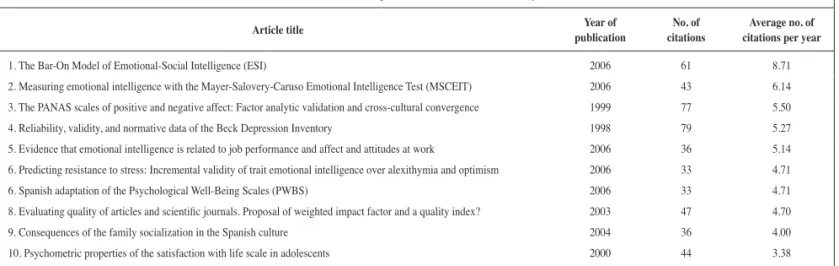
Following we specify the ten most cited articles in the journal in the WoS, where the article with the highest average of citations per year has 8.57 and it is the third article with regard to total number of citations (see Table 6). These articles all have an average higher than that of Psicothema in the WoS, which is 2.88 citations per document (taking into account the Essential Science Indicators).
According to data provided by the Journal Citation Reports
(JCR), information regarding the IF of Psicothema can be seen in Figure 2, from its indexing in JCR (1995), to the current date (2011). The three highest scores in this indicator were obtained in the years 2008 (1.213), 2002 (1.098) and 2006 (1.083).
Finally, the journals in which Psicothema is most cited (according to information from the JCR of 2011), along with the corresponding Impact Factors (IF) are Anales de Psicología (87),
Spanish Journal of Psychology (65) and the International Journal
of Clinical and Health Psychology (45) (Table 7). They are journals
of both a “multidisciplinary” and “Clinical Psychology” nature and from the “Education” fi eld, amongst others, with homogeneous IF (and below one), with the exception of two journals that are over two (International Journal of Clinical and Health Psychology
[2.787] and Revista de Psicodidáctica [2.667]). Of these, 80% are Spanish and 20% Columbian. See Table 8 for the historical evolution of this indicator for each year.
Table 3
Evolution of the index of authorship percentage in Psicothema per year (1989-2012)
Number of authors
1 2 3 4 5 6 or more
1989 72.7 18.2 09.1 00.0 00.0 00.0
1990 31.6 47.4 15.8 05.3 00.0 00.0
1991 25.7 51.4 14.3 08.6 00.0 00.0
1992 33.3 40.5 19.0 02.4 04.8 00.0
1993 10.0 20.0 13.3 30.0 21.7 05.1
1994 04.4 20.0 28.9 13.3 22.2 11.1
1995 06.3 27.1 18.8 25.0 08.3 14.6
1996 01.6 17.7 19.4 19.4 19.4 22.5
1997 03.6 17.9 33.9 21.4 03.6 19.6
1998 05.3 22.8 22.8 22.8 12.3 14.1
1999 12.5 29.2 20.8 09.7 15.3 12.5
2000 03.0 21.1 31.6 19.8 12.7 11.7
2001 02.2 18.9 27.8 27.8 14.4 08.9
2002 04.9 25.2 30.8 21.7 11.9 05.6
2003 07.1 26.3 37.4 13.1 06.1 10.1
2004 09.0 23.0 29.0 23.0 04.0 12.0
2005 08.5 34.9 21.7 14.2 14.2 06.5
2006 11.2 27.0 34.9 14.5 07.9 04.6
2007 13.9 38.6 23.8 10.9 07.9 05.0
2008 19.4 32.6 27.8 12.5 05.6 02.1
2009 10.9 29.7 41.6 10.9 05.0 02.0
2010 16.9 39.6 24.7 09.7 05.8 03.1
2011 26.4 30.2 23.3 14.0 03.9 02.4
2012 36.0 32.0 15.0 07.0 07.0 03.0
Table 4
The ten most cited subjects from Psicothema articles in the Web of Science (WoS)
01. Instruments
02. Bibliometry and scientifi c production 03. Society and culture
04. Emotional intelligence
05. Autoconcept, motivation, self-regulation and learning 06. Personality
07. Violence and aggression 08. Anxiety and stress 09. Methodology and statistics 10. Drug addiction
Note: Subjects are ordered according to the number of citations received, taking into account articles with 13 or more citations. The search was conducted in the period from the 22nd to the 26th October 2012
Table 5
Evolution of the most cited subjects in Psicothema articles in the Web of Science (WoS) per year (1993-2012)
Year Subject No. of citations
1993 Neuropsychology 10
1994 Violence and aggression 08
1995 Neuropsychology 09
1996 Instruments 19
1997 Neuropsychology 27
1998 Instruments* 79
1999 Instruments* 77
2000 Instruments* 44
2001 Drug addiction 19
2002 Bibliometry and scientifi c production 20 2003 Bibliometry and scientifi c production* 47
2004 Society and culture* 36
2005 Bibliometry and scientifi c production 23
2006 Instruments* 61
2007 Instruments 31
2008 Instruments 26
2009 Bibliometry and scientifi c production 13 2010 Bibliometry and scientifi c production 20
2011 Psychopathology 11
2012 Positive psychology 08
Discussion
The objective of the study was to conduct an analysis of the features that have characterised the journal Psicothema throughout its history using a collection of indicators obtained both from the WoS, and the JCR. The results show that most of the articles have been published in Spanish (80.07%). This tendency has recently been modifi ed by the journal so that the scope of the articles increases. Although only articles in English are currently being published in the journal, articles in Spanish could be accepted if their content justifi ed so.
According to the development of author affi liation, there is evidence that the percentage of articles by international authors (non-Spanish) is gradually increasing, going from 5.97 % in the journal’s fi rst decade to 12.40% in the last four years. This is a sign that the journal has gradually started to expand on an international level, which has given room to the publications of authors from countries throughout the world. According to the study by Narin, Stevens, & Whitlow (1991), in Psicothema one of the most cited articles is by researchers from more than one country.
Regarding the index of authorship, in Table 3 we can see that in the year 1989, 72.7% of articles have just one author, and there is no work with four or more authors. This trend changes in the 90s (1990-1999), where work with two authors holds the highest percentage (specifi cally in 1991 where the rate is 51.4%), although overall it is the period where more work is published with six or more authors, compared to other years. From 2000 to 2009 this trend changes once again with more articles signed by three authors, 2009 being the year where this percentage is highest (41.6%). In the last years (2010-2012), work by two authors predominates, as in the 90s. The Narin et al. (1991) clarifi es that articles with multiple authors, by researchers from different countries, receive more citations than articles whose authors are from the same country. However, a high number of citations does not necessarily mean better quality research, according to Gómez & Bordons (1996). These authors maintain that the quality of work is also determined by other factors. In the case of Psicothema, for example, two of the fi ve most cited articles in the WoS have just one author.
Regarding the most cited subjects, if analysed per year (1993-2012), it can be established that in seven years (1996, Table 6
The ten most cited articles of the journal Psicothema in the Web of Science (WoS)
Article title Year of
publication
No. of citations
Average no. of citations per year
1. The Bar-On Model of Emotional-Social Intelligence (ESI) 2006 61 8.71
2. Measuring emotional intelligence with the Mayer-Salovery-Caruso Emotional Intelligence Test (MSCEIT) 2006 43 6.14
3. The PANAS scales of positive and negative affect: Factor analytic validation and cross-cultural convergence 1999 77 5.50
4. Reliability, validity, and normative data of the Beck Depression Inventory 1998 79 5.27
5. Evidence that emotional intelligence is related to job performance and affect and attitudes at work 2006 36 5.14 6. Predicting resistance to stress: Incremental validity of trait emotional intelligence over alexithymia and optimism 2006 33 4.71
6. Spanish adaptation of the Psychological Well-Being Scales (PWBS) 2006 33 4.71
8. Evaluating quality of articles and scientifi c journals. Proposal of weighted impact factor and a quality index? 2003 47 4.70
9. Consequences of the family socialization in the Spanish culture 2004 36 4.00
10. Psychometric properties of the satisfaction with life scale in adolescents 2000 44 3.38
Note: There articles are ordered according to the average number of citations per year. The search was conducted in the period from the 22nd to the 26th October 2012
1995 1996 1997 1998 1999 2000 2001 2002 2003 2004 2005 2006 2007 2008 2009 2010 2011
0 0,2 0,4 0,6 0,8 1 1,2 1,4
Figure 2. Impact Factor of the journal Psicothema since its indexing in the Journal Citation Reports (JCR, 1995-2011)
Table 7
The ten journals in which Psicothema is most cited (JCR 2011)
Rank Journal citationsNo. of Journal’s Impact Factor (2011)
1. Anales de Psicología 87 0.568
2. Spanish Journal of Psychology 65 0.740
3. International Journal of Clinical and Health
Psychology 45 2.787
4. Revista de Psicodidáctica 37 2.667
5. Universitas Psychologica 33 0.395
6. Revista Latinoamericana de Psicología 29 0.642
7. Psicología Conductual 27 0.683
8. Revista de Psicología del Deporte 25 0.543
9. Cultura y Educación 22 0.274
10. Revista de Psicología Social 21 0.500
1998, 1999, 2000, 2006, 2007 and 2008) the most cited article was regarding “Instruments”, followed by “Bibliometry and scientifi c production” (during the years 2002, 2003, 2005, 2009 and 2010) and aspects related to “Neuropsychology” (1993, 1995 and 1997). This illustrates the multidisciplinary character of the journal.
For the analysis of citations, research has also been made according to the type of study. For example, in the work of Buela-Casal et al., (2009) it was established that theoretical articles receive more citations than empirical ones. In the journal
Psicothema, of the total of theoretical articles, almost 80% have
received citations and two of them are amongst the journal’s 30 most cited articles (in the WoS). In this context, in the study by Olivas-Ávila & Musi-Lechuga (2010) it is established that
Psicothema is the fi rst journal in which Spanish Psychology
professors publish. Maybe for this reason, according to the results from this study, the journals in which Psicothema is most cited are Spanish’s (in 2011 the fi rst journal is Anales de Psicología
[87] - see Table 7), evidence of this can be seen from the year 2004 (Table 8).
If we analyse the number of articles published per year and the corresponding IF, we can state that after a certain number of articles, as this amount increases, the IF decreases. More specifi cally, in the year 2000 (the year in which more articles were published in the journal [237]), the IF was 0.473 compared to the rest of the years (see Figures 1 and 2). If we apply this affect to the formula to calculate IF (see note in Table 1), this number of articles (from the year 2000) had a negative effect on the IF of 2001, which dropped to 0.184.
Among the limitations of the present study, it is worth pointing out that the tool that we used (WoS) is a database in constant motion, due to continual update of the data. The JCR is updated every year, around September, so the information analyzed here has been the most updated. Therefore, the results presented are limited to specifi c time ranges. Furthermore, as it occurs in every on-line database, it could include some mistakes. Also, since we did not have all the journal information in the WoS, we had to manually combine the information from the database with the information taken from the journal website (from 1989 to 1992, and the last number [4] of 2012). The present work is a descriptive, bibliometric study focused on the indexes of interest. Therefore, we have to consider the limitations associated to this kind of study. For instance, a causal relation between variables cannot be established.
In conclusion, Psicothema has been the fi rst Spanish journal of Psychology indexed in the WoS (1993). It has shown an increasing evolution since 1995 and it has maintained its position in the last years (Figure 2). This journal typically contains articles with authors affi liated to Spanish institutions. More than 50% of the articles are signed by two or three authors. Given the fact that
Psicothema is a multidisciplinary journal, it has covered a wide
range of topics. However, the most cited papers in this journal are related to “Psychological instruments” and “Bibliometrics/ scientifi c production”. These two fi elds have experienced a constant evolution during the period 1993-2012 (since the journal was indexed in the WoS, to date).
Table 8
Evolution per year of the journals in which Psicothema is most cited
Rank Journals* No. of citations
IF (year of analysis)
2011
1 Anales de Psicología 87 0.568
2 Spanish Journal of Psychology 65 0.740
3 International Journal of Clinical and Health Psychology 45 2.787
2010
1 Spanish Journal of Psychology 63 0.704
2 Anales de Psicología 36 1.338
3 Revista de Psicología del Deporte 31 0.422
2009
1 Spanish Journal of Psychology 55 0.835
2 Anales de Psicología 38 0.244
3 Revista Latinoamericana de Psicología 37 0.388
2008
1 Anales de Psicología 48 –
2 Revista Latinoamericana de Psicología 35 0.435
3 Psicología Conductual 34 –
2007
1 International Journal of Clinical and Health Psychology 36 2.946
2 Spanish Journal of Psychology 22 0.589
3 Revista Latinoamericana de Psicología 20 0.254
2006
1 Revista Latinoamericana de Psicología 22 0.400
2 International Journal of Clinical and Health Psychology 20 –
3 Spanish Journal of Psychology 10 –
2005
1 Revista Latinoamericana de Psicología 35 0.096
2 International Journal of Clinical and Health Psychology 21 –
3 Revista Mexicana de Psicología 9 0.114
2004
1 Revista Latinoamericana de Psicología 8 0.150
2 Aggressive Behavior 6 1.096
3 Journal of Experimental Education 5 0.727
2003
1 Revista Mexicana de Psicología 11 1.250
2 European Psychology 3 –
3 Cognition & Emotion 2 1.682
2002
1 European Journal of Psychological Assessment 4 0.750
1 Revista de Neurología 4 –
3 Aggressive Behavior 3 0.950
2001
1 Nefrología 3 –
2 Journal of Personality and Social Psychology 2 3.611
2 Social Science & Medicine 2 1.840
2000**
1 Journal of Child Psychology and Psychiatry and Allied Disciplines 2 2.940
1 Behavioural Brain Research 2 –
1 Neurochemical Research 2 –
1 Psicología Conductual 2 –
1999
1 Psicología Conductual 11 0.056
2 European Journal of Psychological Assessment 5 0.578
2 Medical Science Research * 5 –
1998
1 Psicología Conductual 3 0.104
1 European Neuropsychopharmacology 3 –
1 Pharmacology Biochemistry & Behavior 3 –
1997
1 Medical Science Research 6 –
2 Journal of Environmental Psychology 3 0.481
2 Pharmacology Biochemistry & Behavior 3 –
Note: IF = Impact Factor of the journals in the corresponding year; JCR = Journal Citation Reports. * Journals coinciding in the number of citations have been ordered according to the corresponding Impact Factor, and in the case that they do not have one, in alphabetical order.
** There are four journals, because all of them have the same number of citations and none can be ruled out by other criteria.
Ariza, T., Granados, M.R., Ramiro, M.T., & Gómez-García, A. (2011). Una década de la Revista Española de Orientación y Psicopedagogía: un análisis bibliométrico de su evolución [A decade of the Revista Española de Orientación y Psicopedagogía: A bibliometric analysis of its development]. Revista Española de Orientación y Psicopedagogía, 22, 38-57.
Buela-Casal, G., Olivas-Ávila, J., Musi-Lechuga, B., & Zych, I. (2011). The h index of the presidents of the American Psychological Association (APA) through journal articles included in the Web of Science.
International Journal of Clinical and Health Psychology, 11, 95-107. Buela-Casal, G., Perakakis, P., Taylor, M., & Checa, P. (2006). Measuring
Internationality: Refl ections and perspectives on academic journals.
Scientometrics, 67, 45-65.
Buela-Casal, G., & Zych, I. (2012a). How to measure the internationality of scientifi c publications. Psicothema, 24, 435-441.
Buela-Casal, G., & Zych, I. (2012b). What do the scientists think about the impact factor? Scientometrics, doi: 10.1007/s11192-012-0676-y. Buela-Casal, G., Zych, I., Medina, Viedma del Jesús, M.I., Lozano, S.,
& Torres, G. (2009). Analysis of the infl uence of the two types of the journal articles; theoretical and empirical on the impact factor of a journal. Scientometrics, 80, 265-282.
Buela-Casal, G., Zych, I., Sierra, J.C., & Bermúdez, M.P (2007). The Internationality Index of the Spanish Psychology journals. International Journal of Clinical and Health Psychology, 7, 899-910.
Escudero, T., Pino, J.L., & Rodríguez, C. (2010). Evaluación del profesorado universitario para incentivos individuales: revisión metaevaluativa [University teacher assessment for individual incentives: Metaevaluative revisión]. Revista de Educación, 351, 513-537.
García-Berro, E., Colom, X., Martínez, E., Sallarés, J., & Roca, S. (2011). La encuesta al alumnado en la evaluación de la actividad docente del profesorado [The student’s questionnaire in the evaluation of the teaching activity of academic staff]. Aula Abierta, 39, 3-14.
García-Berro, E., De la Vega, R., Amblàs, G., Martínez, E., Campeny, L., Bugeda, & Roca, S. (2012). Un caso práctico de meta-evaluación docente: el manual de evaluación de la Universidad Politécnica de Cataluña [A practical case of teaching meta-evaluation: The teaching manual of the Universitat Politècnica de Catalunya]. Aula Abierta, 40, 11-24. Gómez, I., & Bordons, M. (1996). Limitaciones en el uso de los indicadores
bibliométricos para la evaluación científi ca [Limitations on the use of bibliometric indicators for scientifi c evaluation]. Política Científi ca, 46, 21-26. Retrieved August 15, 2012, from http://digital.csic.es/bitstream/ 10261/9813/1/20090122134420909.pdf.
Gómez-García, A., Ramiro, M.T., Ariza, T., & Granados, M.R. (2012). Estudio bibliométrico de Educación XX1 [Bibliometric Study of Educación XX1]. Educación XX1, 15, 17-41.
Granados, M.R., Ariza, T., Gómez-García, A., & Ramiro, M.T. (2011). Estudio bibliométrico de Aula Abierta [Aula Abierta: Bibliometric Study]. Aula Abierta, 39, 97-11.
Hartley, J. (2012). New ways of making academic articles easier to read.
International Journal of Clinical and Health Psychology, 12, 143-160. Musi-Lechuga, B., Olivas-Ávila, J., & Castro, A. (2011a). Productividad
de los programas de doctorado en Psicología con Mención de Calidad en artículos de revistas incluidas en el Journal Citation Reports
[Productivity of doctoral programs in Psychology with Quality Mention in journal articles included in Journal Citation Reports]. Psicothema, 23, 343-348.
Musi-Lechuga, B., Olivas-Ávila, J.A., & Castro, A. (2011b). Productividad en tesis de los programas de doctorado en Psicología con Mención de Calidad[Productivity in doctoral dissertations of doctoral programs in Psychology with Quality Mention]. Revista Mexicana de Psicología, 28, 93-100.
Musi-Lechuga, B., Olivas-Ávila, J.A, Guillén-Riquelme, A., & Castro, A. (2011). Relación entre productividad y efi ciencia de los programas de doctorado en Psicología [Relationship between productivity and efficiency of doctoral programs in Psychology]. Revista Latinoamericana de Psicología, 43, 297-305.
Narin, F., Stevens, K., & Whitlow, E.S. (1991). Scientifi c Co-operation in Europe and the Citation of Multinationally Authored Papers.
Scientometrics, 21, 313-323.
Navarrete-Cortés, J., Fernández-López, J.A., López-Baena, A., Quevedo-Blasco,R., & Buela-Casal, G. (2010). Global psychology: A bibliometric analysis of Web of Science publications. Universitas Psychologica, 9, 553-567.
Navarrete-Cortés, J., Quevedo-Blasco, R., Chaichio-Moreno, J.A., Ríos, C., & Buela-Casal, G. (2009). Análisis cuantitativo por países de la productividad en Psicología de las revistas en la Web of Science [Quantitative analysis by country of psychological material published in journals in the Web of Science]. Revista Mexicana de Psicología, 26, 131-143.
Olivas-Ávila, J.A., & Musi-Lechuga, B. (2010). Análisis de la producción de los profesores funcionarios de Psicología en España en artículos de revistas en la Web of Science [Analysis of the production of psychology professors in Spain in journal articles of the Web of Science].
Psicothema, 22, 909-916.
Olivas-Ávila, J.A., & Musi-Lechuga, B. (2012a). Aprendiendo a buscar en la Web of Science: réplica al estudio de Aluja, Becoña, Botella, Colom, Echeburúa, Forns, Pérez y Vila (2011) [Learning to search on the Web of Science: A reply to the Aluja, Becoña, Botella, Colom, Echeburúa, Forns, Pérez and Vila (2011) study]. Psicothema, 24, 594-602. Olivas-Ávila, J.A., & Musi-Lechuga, B. (2012b). Doctorados con Mención
de Excelencia en Psicología: evidencia en tesis doctorales y artículos en la Web of Science [Psychology doctoral programs whit Excellence Mention: Doctoral theses and Web of Science articles evidence].
International Journal of Clinical and Health Psychology, 12, 503-516. Quevedo-Blasco, R., Ariza, T., & Raya, L. (2012). Análisis de la producción de la Psicología Jurídica en España (1989-2010) [Analysis of the Legal Psychology production in Spain (1989-2010)]. Aula Abierta, 40, 117-128.
Quevedo-Blasco, R., Díaz-Piedra, C., & Guglielmi, O. (2010). Análisis comparativo de las publicaciones sobre drogodependencias en las revistas de Psicología Clínica y Psiquiatría iberoamericanas indexadas en el Journal Citation Reports [Analysis of the Iberoamerican publications on drug dependency in the clinical psychology and psychiatry journals indexed in the Journal Citation Reports]. Salud Mental, 33, 133-143. Quevedo-Blasco, R., & López-López, W. (2010). Análisis bibliométrico de
las revistas multidisciplinares de Psicología recientemente incorporadas en la Web of Science (2008-2009) [Bibliometric Analysis of Selected Multidisciplinary Journals of Psychology Recently Incorporated in the Web of Science (2008-2009)]. Psicologia: Refl exão e Crítica, 23, 384-408.
Quevedo-Blasco, R., & López-López, W. (2011). Situación de las revistas iberoamericanas de Psicología en el Journal Citation Reports de 2010 [Status of iberomerican journals of psychology at the 2010 Journal Citation Reports]. Universitas Psychologica, 10, 937-947.
Velasco, B., Eiros, J.M., Pinilla, J.M., & San Román, J.A. (2012). La utilización de indicadores bibliométricos para evaluar la actividad investigadora [Using bibliometric indicators in research performance assessment]. Aula Abierta, 40, 75-84.
Villar, A. (2011). El “eigenfactor”: un nuevo y potente instrumento bibliométrico para evaluar la investigación [The “eigenfactor”: A new and powerful bibliometric tool]. Aula Abierta, 39, 85-96.
Zych, I., & Buela-Casal, G. (2009). The internationality index: Application to Revista Latinoamericana de Psicología. Revista Latinoamericana de Psicología, 41, 401-412.
Zych, I., & Buela-Casal, G. (2010). Internacionalidad de las revistas de Psicología Multidisciplinar editadas en Iberoamérica e incluidas en la Web of Science [Internationality of the Multidisciplinary Psychology Journals Published in Ibero-America and included in the Web of Science]. Universitas Psychologica, 9, 27-34.
Zych, I., & Quevedo-Blasco, R. (2011). A decade of the International Journal of Clinical and Health Psychology (2001-2010). International Journal of Clinical and Health Psychology, 11, 549-561.