RSC Advances
This is an Accepted Manuscript, which has been through the
Royal Society of Chemistry peer review process and has been
accepted for publication.
Accepted Manuscripts are published online shortly after
acceptance, before technical editing, formatting and proof reading.
Using this free service, authors can make their results available
to the community, in citable form, before we publish the edited
article. This Accepted Manuscript will be replaced by the edited,
formatted and paginated article as soon as this is available.
You can find more information about Accepted Manuscripts in the
Information for Authors.
Please note that technical editing may introduce minor changes
to the text and/or graphics, which may alter content. The journal’s
standard Terms & Conditions and the Ethical guidelines still
apply. In no event shall the Royal Society of Chemistry be held
responsible for any errors or omissions in this Accepted Manuscript
or any consequences arising from the use of any information it
contains.
Journal Name
COMMUNICATION
Received 00th January 20xx, Accepted 00th January 20xx
DOI: 10.1039/x0xx00000x
www.rsc.org/
Gold nanoparticles/silver-bipyridine hybrid nanobelts with tuned
peroxidase-like activity
Abderrahmane Boujakhrout,
aPaula Díez,
aPaloma Martínez-Ruíz,
bAlfredo Sánchez,
*aConcepción
Parrado,
aEloy Povedano,
aPaul Soto,
aJosé M. Pingarrón,
*aReynaldo Villalonga
*aGold nanoparticles-decorated silver-bipyridine coordination polymers with intrinsic peroxidase-like activity are reported. Both morphology and mimetic enzyme activity can be tuned by rational manipulation of the nanohybrid composition. The nanomaterial was used for the electrochemical determination of H2O2 and
glucose.
Enzymes are protein catalysts involved in almost all chemical reactions occurring in living organisms. During decades, enzymes have been largely employed as catalysts in chemical, biotechnological, agricultural, food, and pharmaceutical industries due to their high catalytic efficiency and unique substrate stereo-, regio-, and chemoselectivity.1 In addition, enzymes have demonstrated to be valuable analytical tools, therapeutic agents, cosmetics and laundry active components.2
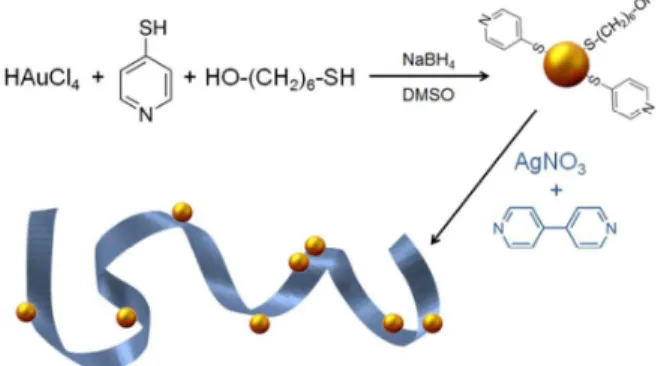
Fig. 1 Schematic display of synthesis of pyridine-coated AuNP/Ag-bypiridine nanobelts.
However, practical application of enzymes is often limited by their intrinsic low stability, which is mainly caused by the complex 3D polypeptide active structure. For this reason, a great variety of strategies for enzyme stabilization have been developed, mainly
based on immobilization on macro- and nanosized supports or covalent modification with water-soluble compounds.3 In addition, many efforts have been devoted to the rational preparation of chemical and nanomaterials-based derivatives with enzyme mimetic activity.4
Fig. 2 Representative FE-SEM images of silver-bipyridine nanohybrid without (A) and with AuNP at 14.7 (B), 29.4 (C), 44.1 (D), 58.8 (E) and 88.2 (F) mg
nanoparticles/g AgNO3.
This communication describes for the first time the preparation of Au nanoparticles (AuNP)-decorated silver-bypiridine hybrid nanomaterials exhibiting remarkable peroxidase-like mimetic activity. These noble metal-based nanomaterials have been selected as building blocks for the assembly of the mimetic enzyme due to the large and attractive use of Au and Ag nanostructures in such as biosensing and biomedical applications.5
RSC
Advances
Accepted
Manuscript
COMMUNICATION
Journal Name
The rational of this synthetic strategy is illustrated in Fig. 1. AuNPs polyfunctionalized with pyridine and hydroxyl residues were prepared by reducing HAuCl4 with NaBH4 in a DMSO solution containing 6-mercapto-1-hexanol and 4-mercaptopyridine in a 3:1 molar ratio (see Supplementary Information).6 These two thiol-derivatives were selected as capping ligands for the nanoparticles to confer the resulting nanomaterial with the desired characteristics. In fact, 6-mercapto-1-hexanol should provide solubility and colloidal stability to the nanoparticles in aqueous solutions, while 4-mercaptopyridine should confer coordination ability with Ag+ ions allowing formation of stable linkages when included into the silver-bipyridine coordination polymer.
Water soluble dark red nanoparticles were obtained by this method. HR-TEM analysis revealed a spherical geometry with an average diameter of 2.6 ± 0.7 nm for the polyfunctionalized nanoparticles (see Fig. 1S in Supplementary Information). This size and size dispersion was similar to those reported for other polyfunctionalized Au nanoparticles prepared by using the same procedure.6,7 In addition, the presence of the capping ligands on the nanoparticles surface was confirmed by FT-IR (Fig. 2S in Supplementary Information).
AuNP-decorated hybrid nanomaterials with different composition were further prepared by mixing different volumes (0, 50, 100, 150, 200 and 300 µL) of a 10 mg/mL polyfunctionalized metal nanospheres aqueous solution with 1 mL AgNO3 (34 mg/mL in
water) and 2 mL 4,4´-bipyridine (16 mg/mL in EtOH) at room temperature. The reaction mixtures were raised to 4 mL final volume with double distilled water and kept under gentle continuous stirring for 10 min. The resulting solid was centrifuged, washed several times with water and ethanol, and finally dispersed in ethanol up to 14 mg/mL final concentration. The Au/Ag molar ratio in these hybrid nanomaterials was determined by X-ray fluorescence spectroscopy (Table 1S in Supplementary Information).
Fig. 2 shows representative FE-SEM images of the nanohybrids. A typical nanobelt-like morphology was observed for the silver-bipyridine nanostructure without AuNP (Fig. 2A).8 Moreover, metal nanoparticles randomly distributed on the nanobelt surface were clearly observed in the nanohybrids containing 14.7 mg AuNP per gram of AgNO3 (Fig. 2B). Larger loadings of AuNP, in the range of 29.4 to 44.1 mg/g AgNO3, caused the formation of metal
nanoparticle clusters at the coordination polymer surface (Fig. 2C, D) without affecting the nanobelt morphology. However, this morphology changed to a fractal-like dendritic structure, highly enriched in metal nanoparticle clusters, by increasing the AuNP content to 58.8 – 88.2 mg/g AgNO3 (Fig. 2E, F).
The peroxidase-like activity of the nanohybrids in solution was evaluated by testing the catalytic oxidation of 2,2'-azino-bis(3-ethylbenzothiazoline-6-sulphonic acid) (ABTS) in the presence of H2O2.
9
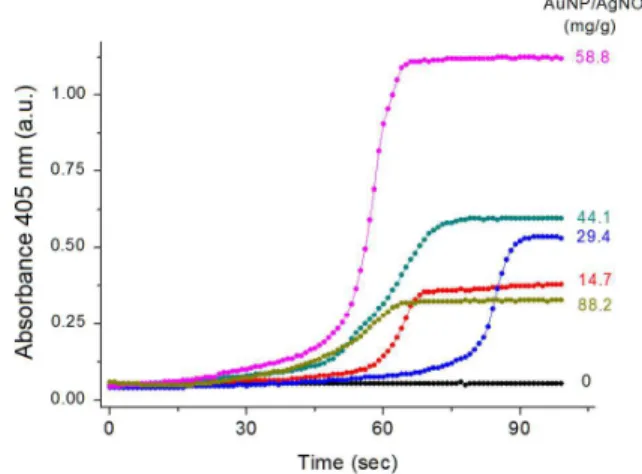
As is illustrated in Fig. 3, no peroxidase mimetic activity was observed for the nanohybrid without AuNPs. However, all AuNP-decorated silver-bipyridine coordination polymers caused a noticeable increase in absorbance at 405 nm, which is related to the oxidation of ABTS with H2O2. This HRP-like activity was clearly modulated by the Au/Ag ratio in the nanohybrids.
Higher absorbance and initial reaction rate (V0) values were
observed for the nanohybrid prepared at a 58.8 mg AuNP/g AgNO3
ratio (Fig. 3S in Supplementary Information). Steady-state kinetics studies were performed to elucidate the mechanism of the high
peroxidase mimetic activity of this nanohybrid. A typical Michaelis-Menten like behaviour was observed in the resulting plots of reaction rate (linear range after the lag phase) vs. ABTS and H2O2 concentration (Fig. 4S in Supplementary Information). The kinetic parameters were estimated from the corresponding Lineweaver-Burk plots. Michaelis constant (KM) and maximum velocity (Vmax)
values for the AuNP-decorated hybrid nanomaterial were 0.44 M and 73.4 × 10⁻² µM/s for ABTS, respectively. In this sense, the apparent affinity of the nanohybrid by ABTS is significantly lower than that reported for the native enzyme.10 On the other hand, the nanomaterial showed KM and Vmax values of 1.9 mM and 82.0 × 10
−2
µM/s for H2O2, respectively.
Fig. 3 Time-dependent absorbance changes at 405 nm of 40 mM sodium phosphate buffer solution, pH 7.0 containing 9 mM ABTS and 3
mM H2O2 in the presence of different silver-bipyridine nanohybrids at 10 µg/mL concentration.
As it is shown in Fig. 3, the reaction catalysed by the AuNP-based nanohybrids showed an initial lag phase. To overcome the difficulties associated with the analytical use of enzymes with such kinetics behaviour, an electrochemical sensing alternative was then evaluated.
In order to do that, glassy carbon electrodes were coated with the nanohybrid and the electrocatalytic activity toward H2O2 was
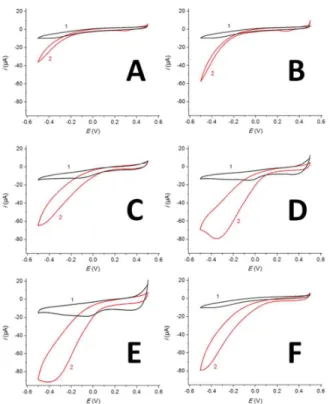
evaluated. Fig. 4 shows that not significant electrochemical transformations were observed at the nanohybrid-modified electrodes in the absence of H2O2. In this sense, only small reduction peaks were appreciated, which could be attributed to the reduction of non-coordinated silver ions in the nanomaterial and dissolved oxygen. On the contrary, large cathodic currents were recorded with all nanohybrid-coated electrodes in the presence of H2O2,suggesting this compound was easily transformed at these
nanostructured surfaces. Interestingly, the electrocatalytic activity of the nanohybrids toward the reduction of H2O2 increased with the
AuNP loading, exhibiting larger cathodic currents and lower potential values. Higher electrocatalytic activity was obtained for the nanohybrid prepared by using 58.8 mg of AuNP per gram of AgNO3.
The electrode coated with this hybrid nanomaterial was employed to construct amperometric sensor devices for H2O2 and D-glucose.
The nanostructured electrode, poised at -100 mV, was able to detect H2O2 in the range of 10 µM to 480 µM with a sensitivity of
503 µA/M (Fig. 5A).
RSC
Advances
Accepted
Manuscript
Published on 03 August 2016. Downloaded by Northern Illinois University on 04/08/2016 14:48:13.
Fig. 4 Cyclic voltammograms recorded with glassy carbon electrodes coated with silver-bipyridine nanohybrid without (A) and with AuNP at
14.7 (B), 29.4 (C), 44.1 (D), 58.8 (E) and 88.2 (F) mg nanoparticles/g AgNO3 in 100 mM sodium phosphate buffer, pH 7.0, in the absence (1)
and the presence (2) of 100 µM H2O2.
The specificity of the AuNP/silver-bipyridine hybrid nanomaterial was studied by recording the amperometric response of the nanostructured electrode toward different compounds at 100 µM final concentration. As is illustrated in Fig. 5S (Supplementary Information), the modified electrode was not able to detect uric acid, D-glucose, L-tyrosine and sucrose. On the other hand, the analytical signal toward H2O2 was only slightly affected (about 8%) by the addition of ascorbic acid, suggesting high specific of the AuNP/silver-bipyridine hybrid to H2O2.
The nanostructure electrode was finally employed to construct a glucose oxidase-based amperometric biosensor. The rational of this biosensor architecture is based on the first glucose oxidase-catalysed conversion of D-glucose to gluconic acid and H2O2, and the further
electrocatalytic transformation of H2O2 at the electrode surface
through the AuNP/silver-bipyridine composite catalysed reaction.
As can be observed in Fig. 5B, the biosensor was able to detect glucose in the range 100 µM to 7.4 mM concentration, with a sensitivity of 85 µA/M.
The stability of these nanomaterials-modified electrodes was evaluated by daily measurement of their analytical response toward 100 µM H2O2 and 2 mM D-glucose, respectively. The electrodes were kept dried at 4ºC after each measurement. The H2O2 sensor and glucose oxidase biosensor retained about 96% and 93% of their initial analytical activity after two week of reuse and storage, suggesting high catalytic stability of the AuNP-doped nanohybrids.
Fig. 5 Calibration curves obtained with the glassy carbon electrode coated with the AuNP-decorated nanohybrid without (A) and with immobilized glucose oxidase (B) toward H2O2 and D-glucose, respectively. Eapp = -100 mV,
stirring condition: 300 rpm.
Conclusions
In summary, we have described here the synthesis of novel pyridine-coated AuNP/silver-bipyridine hybrid nanomaterials. The AuNP-doped nanohybrids showed intrinsic peroxidase-like activity, which can be manipulated by proper combination of AuNP/Agratio. The morphology of these nanomaterials can be also tuned by rational manipulation of their AuNP/Ag composition. This nanomaterials-based artificial enzyme was employed to construct reliable electrochemical sensor devices for H2O2 and glucose. This
approach could be extended to design a great variety of electrochemical biosensors based on other redox enzymes producing H2O2, opening new possibilities to bioanalytical
electrochemistry.
Acknowledgements
Financial support from the Spanish Ministry of Economy and Competitiveness CTQ2014-58989-P, CTQ2015-71936-REDT, CTQ2015-64402-C2-1-R and Comunidad de Madrid S2013/MIT-3029, Programme NANOAVANSENS is gratefully acknowledged.
RSC
Advances
Accepted
Manuscript
COMMUNICATION
Journal Name
Notes and references
a
Departments of Analytical Chemistry and b
Organic Chemistry I, Faculty of Chemistry, Complutense University of Madrid, 28040-Madrid, Spain. Tel: +34 913944315; E-mail: [email protected], [email protected]; [email protected]
† Electronic Supplementary Information (ESI) available: Preparation and characterization of nanomaterials and electrochemical sensor devices. 1 G. Carrea, S. Riva, Angew. Chem. Int. Ed., 2000, 39, 2226; A.
Valdivia, R. Villalonga, P. Di Pierro, Y. Pérez, L. Mariniello, L. Gómez, R. Porta, J. Biotechnol., 2006, 122, 326; J.M. Choi, S.S. Han, H.S. Kim, Biotechnol. Adv., 2015, 33, 1443. 2 L. Vojcic, C. Pitzler, G. Körfer, F. Jakob, R. Martinez, K.H.
Maurer, U. Schwaneberg, New Biotechnol., 2015, 32, 629; R. Villalonga, M.L. Villalonga, P. Díez, J.M. Pingarrón, J. Mat. Chem., 2011, 21, 12858; C. Camacho, J.C. Matías, B. Chico, R. Cao, L. Gómez, B.K. Simpson, R.
Villalonga, Electroanalysis, 2007, 19, 2538; A. Valdivia, Y. Perez, A. Dominguez, J. Caballero, L. Gomez, E.H. Schacht, R. Villalonga, Macromol. Biosci., 2005, 5, 118.
3 H. Liang, S. Jiang, Q. Yuan, G. Li, F. Wang, Z. Zhang, J. Liu,
Nanoscale, 2016, 8, 6071; L. Gómez, H.L. Ramírez, M.L. Villalonga, J. Hernández, R. Villalonga, Enzyme Microb. Technol., 2006, 38, 22; X. Wu, M. Hou, J. Ge, Catal. Sci. Tech., 2015, 5, 5077; M.L. Villalonga, P. Díez, A. Sánchez, M. Gamella, J.M. Pingarrón, R. Villalonga, Chem. Rev., 2014, 114, 4868; M. Fernández, A. Fragoso, R. Cao, M. Baños, M.L. Villalonga, R. Villalonga, Biotechnol. Lett., 2002, 24, 1455. 4 Y. Xiong, S. Chen, F. Ye, L. Su, C. Zhang, S. Shen, S. Zhao,
Chem. Commun., 2015, 51, 4635; K. Fukuhara, K. Nakajima, M. Kitano, S. Hayashi, M. Hara, ChemCatChem, 2015, 7, 3945; J.G. Ferreira, A. Grein-Iankovski, M.A. Oliveira, F.F. Simas-Tosin, I.C. Riegel-Vidotti, E.S. Orth, Chem. Commun., 2015, 51, 6210.
5 E. Boisselier, D. Astruc, Chem. Soc. Rev., 2009, 38, 1759; X.R. Song, N. Goswami, H.H. Yang, J. Xie, Analyst, 2016, 141, 3126; N. Goswami, Q. Yao, Z. Luo, J. Li, T. Chen, J. Xie, ; J. Phys. Chem. Lett., 2016, 7, 962; Q. Yao, X. Yuan, Y, Yu, Y. Yu, J. Xie, J.Y. Lee, J. Am. Chem. Soc., 2015, 137, 2128; M. Eguílaz, R. Villalonga, L. Agüí, P. Yáñez-Sedeño, J.M. Pingarrón, J. Electroanal. Chem., 2011, 661, 171; Q. Yao, Y. Yu, X. Yuan, Y. Yu, D. Zhao, J. Xie, J.Y. Lee, Angew. Chem., 2015, 54, 184; J. Fang, B. Zhang, Q. Yao, Y. Yang, J. Xie, N. Yan, Coord. Chem. Rev., 2016, 322, 1.
6 R. Villalonga, P. Díez, P. Yáñez-Sedeño, J.M. Pingarrón,
Electrochim. Acta, 2011, 56, 4672; R. Villalonga, P. Díez, M. Eguílaz, P. Martínez, J.M. Pingarrón, ACS Appl. Mat. Interfaces, 2012, 4, 4312.
7 S. Li, L. Mao, Y. Tian, J. Wang, N. Zhou, Analyst, 2012, 137, 823; R. Villalonga, P. Díez, S. Casado, M. Eguílaz, P. Yáñez-Sedeño, J.M. Pingarrón, Analyst, 2012, 137, 342. 8 Y. Luo, W. Lu, G. Chang, F. Liao, X. Sun, Electrochim. Acta,
2011, 56, 8371.
9 S. Jiang, M.H. Penner, Anal. Biochem., 2015, 476, 20. 10 J.K. Kamal, D.V. Behere, J. Inorg. Biochem., 2003, 94, 236.
RSC
Advances
Accepted
Manuscript
Published on 03 August 2016. Downloaded by Northern Illinois University on 04/08/2016 14:48:13.
Novel Au nanoparticles-doped silver-bipyridine coordination polymers with fractal morphology
and intrinsic peroxidase-like activity were prepared.
RSC
Advances
Accepted
Manuscript
Table of Contents
353x143mm (96 x 96 DPI)