Evolving Aesthetic Maps for a Real Time
Strategy Game
Ra´
ul Lara-Cabrera, Carlos Cotta, Antonio J. Fern´
andez-Leiva
Department “Lenguajes y Ciencias de la Computaci´
on”
ETSI Inform´
atica, University of M´
alaga
Campus de Teatinos, 29071 M´
alaga – Spain
{raul,ccottap,afdez}@lcc.uma.es
Abstract
This paper presents a procedural content generator method that have been able to generate aesthetic maps for a real-time strategy game. The maps has been characterized based on several of their properties in order to define a similarity function between scenarios. This function has guided a multi-objective evolution strategy during the process of generating and evolving scenarios that are similar to other aesthetic maps while being different to a set of non-aesthetic scenarios. The solutions have been checked using a support-vector machine classifier and a self-organizing map obtaining successful results (generated maps have been classified as aesthetic maps).
1
Introduction
The video-game industry has become one of the most important component in the entertainment business, with a total consumer spent of 24.75 billion US dollars in 2011 [5]. The quality and appealing of video-games used to rely on their graphical quality until the last decade, but now, their attractiveness has fallen on additional features such as the music, the player immersion into the game and interesting story-lines. It is hard to evaluate how much amusing a game is because this evaluation depends on each player, nevertheless there is a relationship between player satisfaction and fun.
PCG techniques during the development of commercial games such as Border-lands,Borderlands 2, Minecraft andSpore.
Search-based procedural content generation [22] (SBPCG) techniques apply a generate and test scheme, that is, the content is firstly generated and then evaluated according to some criteria. This evaluation sets the quality level of the generated content automatically. Then, new content is created based on previous evaluations. This process, which should be automated, is repeated until the content reach a certain quality level, hence making evolutionary algorithms a perfect tool for this process. In this work we have used a SBPCG technique to generate aesthetic maps for a real-time strategy (RTS) game. This method is based on a multi-objective evolution strategy that generate maps which are similar to other aesthetic maps and different from other non-aesthetic maps at the same time.
2
Background
pro-gramming to evolve maps for videogames (namely terrain propro-gramming), using either subjective human-based feedback [9, 10] or automated quality measures such as accessibility [8] or edge-length [11]. Togelius et al. [21] designed a PCG system capable of generating tracks for a simple racing game from a parameter vector using a deterministic genotype-to-phenotype mapping.
Maps are not the only content that is generated with these methods. For example, Font et al. [6] presented initial research regarding a system capable of generating novel card games. Collins [2] made an introduction to procedural music in video games, examining different approaches to procedural composition and the control logics that have been used in the past. The authors of [19] have created a prototype of a tool that automatically produce design pattern specications for missions and quest for the game Neverwinter Nights.
3
Materials and methods
As stated before, this work focuses on the design of aesthetic maps for the RTS game Planet Wars. This section describes the mechanisms that helped us to achieve our goal: firstly, there is a description about how the maps have been represented and characterized in order to get better aesthetics; next, there is a detailed explanation of the evolutionary algorithm used to generate the maps.
3.1
Representation and characterization
Game’s maps are sets with a certain number of planets np located on a 2D plane. These planets are defined by their position on the plane (coordinates (xi, yi)), their size si and a number of ships wi. The size si defines the rate at which a planet will produce new ships every turn (as long as the planet is controlled by any player) while the remaining parameter, wi, indicates the number of ships that are defending that planet. Hence, we can denote a map as a list [ρ1, ~~ ρ2,· · ·, ~ρnp], where each ~ρi is a tuple hxi, yi, si, wii. A playable map
needs to specify the initial home planets of the players, which have been fixed as the first two planets~ρ1andρ2~ because of simplicity. The number of planets
np is not fixed and should range between 15 and 30 as specified by the rules of theGoogle AI Challenge 2010. This variable number of planets makes part of the self-adaptive evolutionary approach described later on.
In order to evaluate the generated maps’ aesthetics , we have defined several measurements that characterize them. These are indicators related to the spatial distribution of the planets and their features, such as size and number of ships:
• Planet’s geometric distribution: Let~pi= (xi, yi) be the coordinates of the
σd as follows:
µd= 1 N2 N X i=1 N X j=1
k~pi−~pjk (1)
σd=
v u u t 1 N2 N X i=1 N X j=1
(k~pi−~pjk −µd)2 (2)
• Planet’s features: Letsi andwibe the size (i.e. growth rate) and number of ships, respectively, of the i-th planet, then we specified the average and standard deviation of these sizes (µs and σs respectively) and the Pearson’s correlation between the planet’s size and the number of ships on itρas follows:
µs= 1
N
N
X
i=1
si (3)
σs=
v u u t 1 N N X i=1
(si−µs)2 (4)
ρ=
PN
i=1siwi−N µsµw
N σsσw
(5)
whereµwandσware the average and standard deviation of ships, respec-tively.
These measures has been applied to compare the likelihood between maps in the following way: each map is characterized by a tuple hµd, σd, µs, σs, ρi, then the euclidean distance between these tuples defined the similarity among the planets they represented. Additionally, we specified two sets of maps, one of them containing 10 maps with good aesthetics and the other one including 10 non-aesthetic maps. These sets made up a baseline to compare with in a way that the goal of generating aesthetic maps turned into an optimization problem about minimizing the distance between generated and aesthetics maps while maximizing their distance to non-aesthetic maps. The latter was necessary to insert diversity into the set of generated maps in order to avoid the generation of maps that were very similar to the aesthetic ones.
3.2
Evolutionary map generation
(i.e., planets): planet’s coordinates (xi, yi) are real-valued numbers but sizessi and initial number of shipswi are positive integers.
Due to this situation we have considered a hybrid mutation operator that performed different methods for parameters of either type: for real-valued pa-rameters, it used a Gaussian mutation; as for integer variables, it considered a method that generates suitable integer mutations [17, 20] – see also [16]. The latter is similar to the mutation of real values but it uses the difference of two geometrically distributed random variables to produce the perturbation instead of the normal distributed random variables used by the former. In either case, the parameters that ruled the mutation were also a part of the solutions, thus providing the means for self-adapting them. More precisely, regarding real-valued parametershr1, ..., rnithey are extended withnstep sizes, one for each parameter, resulting inhr1, ..., rn, σ1, ..., σni. The mutation method is specified as follows:
σi0 = σi·eτ
0·N(0,1)+τ·N
i(0,1) (6)
ri0 = ri+σi·Ni(0,1) (7)
whereτ0∝1/√2n, andτ ∝1/p2√n. A boundary rule is applied to step-sizes to forbid standard deviations very close to zero: σ0i < 0 ⇒ σi0 = 0 (in this algorithm,σ0 comprises a 1% of the parameter’s range). In the case of integer-valued parameters hz1, ..., zmi they are extended in a similar way as are real-valued parameters, resulting in hz1, ..., zm, ς1, ..., ςmi. The following equations define the mutation mechanism:
ςi0 = max(1, ςi·eτ·N(0,1)+τ
0
·N(0,1)) (8)
ψi = 1−(ςi0/m)
1 + s
1 +
ςi0 m
2
−1
(9)
z0i = zi+
ln(1
−U(0,1))
ln(1−ψi)
−
ln(1
−U(0,1))
ln(1−ψi)
(10)
whereτ= 1/√2mandτ0 = 1/p2√m.
Considering that we had a multi-objective optimization problem, we decided to use the selection method of the Non-dominated Sorting Genetic Algorithm II (NSGA-II) [4].
4
Experimental Results
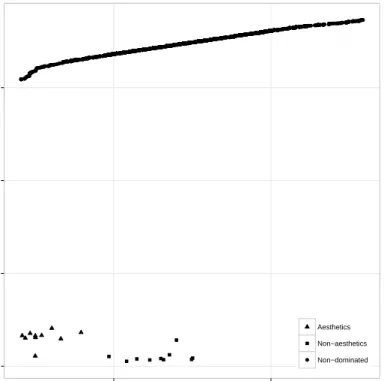
We have used the DEAP library [7] to implement the aforementioned algorithm. We have run 20 executions of the algorithm during 100 generations each. We have also computed the cumulative non-dominated set of solutions from every execution – see figure 1. As we can see, there is a linear relationship between both distances in the middle range of the front. This hints at the density of the search space and the feasibility of linearly trading increasing distance to good maps by increasing distance to bad maps.
0 2 4 6
0.5 1.0
distance to aesthetics
distance to non−aesthetics
Aesthetics Non−aesthetics Non−dominated
Figure 1: Cumulative set of non-dominated generated solutions (circle) and maps from aesthetic (triangle) and non-aesthetic (square) baseline sets.
Avg. distance Stdev. distance Avg. size Stdev. size Corr. size−ships
0.0 0.5 1.0 1.5
Non−dominated maps
Avg. distance Stdev. distance Avg. size Stdev. size Corr. size−ships
0.0 0.5 1.0 1.5
Aesthetics maps
Avg. distance Stdev. distance Avg. size Stdev. size Corr. size−ships
0.0 0.5 1.0 1.5
Non−Aesthetics maps
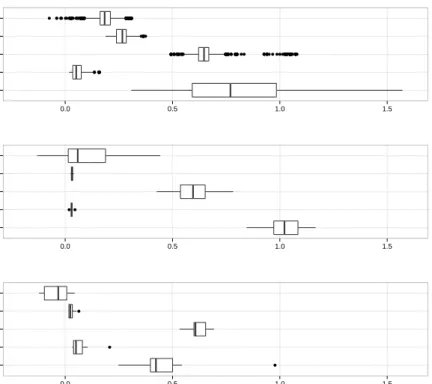
Figure 2: Characterization variables for both non-dominated and baseline maps
should explain the high distance between many solutions in the front and the baseline maps, as seen in figure 1. Another interesting observation is the highly distributed values ofµdin the non-dominated maps, which probably means that this variable has an uncertain effect over the fitness and hence the search space for this variable is wider with respect to other variables.
In order to check the validity of the generated maps, we built a support vector machine [3] (SVM) to classify maps (namely, characterization vectors) as aesthetic and non-aesthetic. Support vector machines are supervised learning models that recognize patterns and analyze data. They are able to perform linear and non-linear classification. The SVM was trained using the same sets of maps that the evolutionary algorithm has used to calculate the fitness. This SVM classified as aesthetic every map out of the 4289 non-dominated maps, which led us to think that the algorithm is capable of generating aesthetic maps.
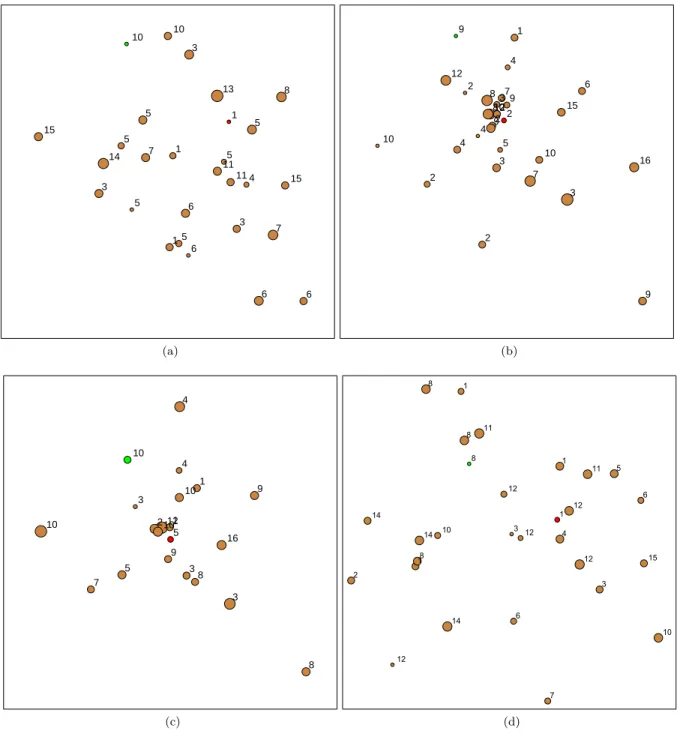
In addition to the aforementioned classifier, we created a self-organizing map (SOM) [13] with 32×32 process units over a non-toroidal rectangular layout, us-ing the same maps as the trainus-ing set. Self-organizus-ing maps are artificial neural networks that are trained using unsupervised learning to generate a discretized representation of the input space. As we can see in figure 3, this SOM estab-lished a separation between non-aesthetic (red zones, upper-right) and aesthetic maps (green zones, lower-left). Moreover, generated maps (blue zones) shared the same region as aesthetic maps, hence they should be considered aesthetic as well.
5
Conclusions
We have performed an initial approach towards the procedural aesthetic map generation for the RTS gamePlanet Wars. We have defined a method of map characterization based on several of its maps’ geometric and morphologic prop-erties in order to evaluate how aesthetic a map is. We have used two sets of maps (aesthetics and non-aesthetics) as a baseline to compare with, and an evolution strategy whose objectives are minimize and maximize the distance of the generated maps to the aesthetics and non-aesthetics maps of the baseline. The solutions have been tested with a SVM and a SOM. The SVM has classified each solution as aesthetic while the SOM was able to make a separation between aesthetic and non-aesthetic maps (the generated maps shared the same region as the aesthetic maps).
1 10 6 4 3 13 3 15 5 6 11 3 5 5 7 15 5 7 5 1 10 6 1 6 5 8 11 14 (a) 2 9 9 3 1 15 2 10 2 7 10 3 9 6 5 8 3 7 2 4
8 22 9 4 4 10 16 12 2 (b) 5 10 8 3 1 16 7 10 3 4 8 3 10 9 9 4 5 121 210 (c) 1 8 10 1 1 12 2 14 10 8 12 3 8 5 6 14 12 3 11 1 7 4 15 6 8 12 11 12 14 (d)
Acknowledgments
This work is partially supported by Spanish MICINN under project ANY-SELF1 (TIN2011-28627-C04-01), Junta de Andaluc´ıa under project
DNEME-SIS2(P10-TIC-6083) and Universidad de M´alaga. Campus de Excelencia
Inter-nacional Andaluc´ıa Tech.
References
[1] Buro, M.: RTS games and real-time AI research. In: Behavior Represen-tation in Modeling and Simulation Conference. vol. 1. Curran Associates, Inc. (2004)
[2] Collins, K.: An introduction to procedural music in video games. Contem-porary Music Review 28(1), 5–15 (2009)
[3] Cortes, C., Vapnik, V.: Support-vector networks. Machine Learning 20(3), 273–297 (1995)
[4] Deb, K., Agrawal, S., Pratab, A., Meyarivan, T.: A fast elitist non-dominated sorting genetic algorithm for multi-objective optimization: NSGA-II. In: Schoenauer, M., et al. (eds.) Parallel Problem Solving from Nature VI. Lecture Notes in Computer Science, vol. 1917, pp. 849–858. Springer-Verlag, Berlin Heidelberg (2000)
[5] Entertainment Software Association: Essential facts about the computer and video game industry (2012), http://www.theesa.com/facts/pdfs/ esa_ef_2012.pdf
[6] Font, J., Mahlmann, T., Manrique, D., Togelius, J.: A card game de-scription language. In: Esparcia-Alczar, A. (ed.) Applications of Evo-lutionary Computation, Lecture Notes in Computer Science, vol. 7835, pp. 254–263. Springer Berlin Heidelberg (2013),http://dx.doi.org/10. 1007/978-3-642-37192-9_26
[7] Fortin, F.A., Rainville, F.M.D., Gardner, M.A., Parizeau, M., Gagn´e, C.: DEAP: Evolutionary algorithms made easy. Journal of Machine Learning Research 13, 2171–2175 (jul 2012)
[8] Frade, M., de Vega, F., Cotta, C.: Evolution of artificial terrains for video games based on accessibility. In: Di Chio, C., et al. (eds.) Applications of Evolutionary Computation, Lecture Notes in Computer Science, vol. 6024, pp. 90–99. Springer-Verlag, Berlin Heidelberg (2010)
[9] Frade, M., de Vega, F.F., Cotta, C.: Modelling video games’ landscapes by means of genetic terrain programming - a new approach for improving users’
1http://anyself.wordpress.com/
experience. In: Giacobini, M., et al. (eds.) Applications of Evolutionary Computing. Lecture Notes in Computer Science, vol. 4974, pp. 485–490. Springer-Verlag, Berlin Heidelberg (2008)
[10] Frade, M., de Vega, F.F., Cotta, C.: Breeding terrains with genetic terrain programming: The evolution of terrain generators. International Journal of Computer Games Technology 2009 (2009)
[11] Frade, M., de Vega, F.F., Cotta, C.: Evolution of artificial terrains for video games based on obstacles edge length. In: IEEE Congress on Evolutionary Computation. pp. 1–8. IEEE (2010)
[12] Hendrikx, M., Meijer, S., Van Der Velden, J., Iosup, A.: Procedural content generation for games: A survey. ACM Trans. Multimedia Com-put. Commun. Appl. 9(1), 1:1–1:22 (Feb 2013), http://doi.acm.org/10. 1145/2422956.2422957
[13] Kohonen, T.: The self-organizing map. Proceedings of the IEEE 78(9), 1464–1480 (1990)
[14] Lara-Cabrera, R., Cotta, C., Fern´andez-Leiva, A.J.: A Review of Com-putational Intelligence in RTS Games. In: Ojeda, M., Cotta, C., Franco, L. (eds.) 2013 IEEE Symposium on Foundations of Computational Intelli-gence. pp. 114–121
[15] Lara-Cabrera, R., Cotta, C., Fern´andez-Leiva, A.J.: Procedural map gen-eration for a RTS game. In: Leiva, A.F., et al. (eds.) 13th International GAME-ON Conference on Intelligent Games and Simulation, pp. 53–58. Eurosis, Malaga (Spain) (2012)
[16] Lara-Cabrera, R., Cotta, C., Fern´andez-Leiva, A.J.: A procedural bal-anced map generator with self-adaptive complexity for the real-time strat-egy game planet wars. In: Esparcia-Alc´azar, A., et al. (eds.) Applications of Evolutionary Computation, pp. 274–283. Springer-Verlag, Berlin Heidel-berg (2013)
[17] Li, R.: Mixed-integer evolution strategies for parameter optimization and their applications to medical image analysis. Ph.D. thesis, Leiden Univer-sity (2009)
[18] Mahlmann, T., Togelius, J., Yannakakis, G.N.: Spicing up map genera-tion. In: Chio, C.D., et al. (eds.) Applications of Evolutionary Computa-tion. Lecture Notes in Computer Science, vol. 7248, pp. 224–233. Springer-Verlag, M´alaga, Spain (2012)
[20] Rudolph, G.: An evolutionary algorithm for integer programming. In: Davidor, Y., Schwefel, H.P., M¨anner, R. (eds.) Parallel Problem Solving from Nature III, Lecture Notes in Computer Science, vol. 866, pp. 139– 148. Springer-Verlag, Jerusalem, Israel (1994)
[21] Togelius, J., De Nardi, R., Lucas, S.: Towards automatic personalised con-tent creation for racing games. In: Computational Intelligence and Games, 2007. CIG 2007. IEEE Symposium on. pp. 252–259 (2007)