Departamento de Ingenier´ıa El´ectrica
Analysis and Operation of Smart
Grids with Electric Vehicles
PhD Dissertation
MIGUEL ´
ANGEL L ´
OPEZ P´
EREZ
Publicaciones y Divulgación Científica. Universidad de Málaga
Esta obra está sujeta a una licencia Creative Commons:
Reconocimiento - No comercial - SinObraDerivada (cc-by-nc-nd): Http://creativecommons.org/licences/by-nc-nd/3.0/es
Cualquier parte de esta obra se puede reproducir sin autorización pero con el reconocimiento y atribución de los autores.
No se puede hacer uso comercial de la obra y no se puede alterar, transformar o hacer obras derivadas.
PhD Dissertation
Analysis and Operation of Smart Grids with Electric
Vehicles
Departamento de Ingenier´ıa El´ectrica
Author:
Miguel ´
Angel L´
opez P´
erez
Supervisors:
Jose Antonio Aguado S´
anchez
Sebasti´
an de la Torre Fazio
Thesis submitted to the Universidad de M´
alaga for obtaining the degree
of Doctor por la Universidad de M´
alaga.
Dr. Jos´e Antonio Aguado S´anchez y Dr. Sebasti´an de la Torre Fazio, profesores doctores asociados al departamento de Ingenier´ıa El´ectrica de la Universidad de M´alaga y directores de la tesis de t´ıtulo “Analysis and Operation of Smart Grids with Electric Vehicles” realizada por el doctorando Miguel ´Angel L´opez P´erez, DNI 74853854D, dentro del programa de doctorado en Ingenier´ıa Mecatr´onica, certifican que:
• Han procedido con la revisi´on del texto completo de la tesis arriba mencionada.
• Autorizan su presentaci´on para la lectura y defensa de la misma.
JOS´E ANTONIO AGUADO S ´ANCHEZ SEBASTI ´AN DE LA TORRE FAZIO Director de tesis Director de tesis
Acknowledgements
This thesis was written during my work as an intern in the Electrical Engineering Department of the Universidad de M´alaga from December 2009 to March 2014. This is the part in which I would like to thank everybody who helped me in this difficult but grateful experience.
First and foremost I would like to thank Prof. Dr. Jos´e Antonio Aguado and Prof. Dr. Sebasti´an de la Torre. This thesis could not have been finished for sure without their effort, guidance and advice. The numerous meetings we had gave me the opportunity to improve my knowledge in electrical engineering research and make me better in professional and personal terms.
I would also to thank my colleague Sebasti´an Mart´ın who provided valuable contribu-tions for the thesis, helping me every time I encountered difficulties.
Thanks to my dear friend Bobby for spending time reviewing the thesis and giving me insightful comments to improve the text.
Thanks to Prof. Dr. Jo˜ao Pe¸cas for giving the opportunity to visit INESC Porto and kindly seeing me although having little time to do so. Thanks to Filipe J. Nunes and Matthias D. Galus, you have been a reference point to continuously improve myself and become better.
Thanks to Prof. Dr. Kai Strunz for receiving me in the Technische Universit¨at Berlin and discussing my research during the presentations. Thanks to Stefan Mischinger, Ar-naldo Arancibia and Andreas Raab for sharing a very good time in the city and their comments about my work.
Thanks to the my colleagues of the Electrical Engineering department: Miriam, Pepe, Antonio, Ignacio and Hugo. Thanks to Pedro and Emilio. Thanks also to Antonio Hijano, Miguel´on and Carolina. Their support has an inestimable value.
Abstract
Nowadays, the growing concern about environmental issues is leading many countries to take measures that allow a more rational energy usage and for a more sustainable future. The improvement on systems efficiency and the use of renewable sources are some points to work on to reduce anthropogenic greenhouse gas emissions, the main cause of climate change. In this respect, the electric sector is one of the most important sources of harmful emissions in the atmosphere, followed by the transportation sector. This statement is justified if the strong dependency of these sectors on fossil fuels, specifically petrol and its derivatives, is taken into account. That is why electric mobility is drawing the attention of companies, countries and research groups, as an important measure to face the negative consequences derived from the current energy usage.
It is clear that the inclusion of electric vehicles will strongly affect the operation, man-agement and planning of current electric power systems. Firstly, an additional load will have to be considered, the electric vehicles’ charging. In an initial stage, when the deploy-ment of electric vehicles is not significant, special measures will not be required. However, in the future with thousands of vehicles in operation, a bad electric vehicle management can lead to line congestion or voltage limits violation. Moreover, an update of the current electric power systems regarding more advanced information and communication tech-nologies, better metering devices, an appropriate charging and discharging infrastructure, as well as the presence of more renewable sources are required for the suitable integration of electric vehicles. In brief, electric systems have to incorporate more intelligence and be more sustainable, efficient and secure, in other words, they have to tend to the smart grid concept.
sumption patterns towards other behaviours that allow a more efficient operation of the power system. Thus, they aim at reducing the general electricity demand or, instead, shift the demand to other more favourable time periods. To this end, it is necessary to encourage consumers to modify their habits or plan their activities in a different way. In this thesis, the use of price signals is proposed to evoke these changes. The result is a flatter demand curve that allows makes the most of the existing infrastructure and avail-able generation resources, postponing ulterior reinforcements. From the consumer point of view, the energy costs are reduced.
In the absence of corrective measures, the presence of electric vehicles will cause tech-nical problems in the electricity system. In order to provide a solution for the most com-mon technical problems, two tools are developed in this thesis: a centralised approach that dispatches the generators within the grid, and an algorithm that makes use of electric vehicles. Both approaches permit the avoidance of line congestion problems effectively in certain situations. In particular, the electric vehicle charging or power injection in specific buses in the grid is proposed as way to lead the system to a secure state.
Resumen
Hoy en d´ıa la creciente preocupaci´on por temas medioambientales est´a llevando a muchos pa´ıses a tomar medidas que permitan un uso m´as racional de la energ´ıa y un futuro m´as sostenible. La mejora de la eficiencia de los sistemas y el uso de recursos renovables son algunos puntos sobre los que se debe trabajar para poder atajar las consecuencias de los gases de efecto invernadero, principal responsable del cambio clim´atico. En relaci´on con esto, el sector el´ectrico es el uno de los m´as importantes responsables de emisiones nocivas a la atm´osfera seguido por el sector del transporte. Su fuerte dependencia en los combustibles f´osiles, particularmente el petr´oleo y sus derivados, justifica esta ´ultima afirmaci´on. Por este motivo, la movilidad mediante veh´ıculos el´ectricos est´a atrayendo la atenci´on de empresas, pa´ıses y grupos de investigaci´on, como una medida importante para poder hacer frente a las consecuencias negativas derivadas del uso actual de la energ´ıa.
Resulta claro que la introducci´on del veh´ıculo el´ectrico afectar´a de manera importante a la operaci´on, gesti´on y planificaci´on de los sistemas el´ectricos actuales. En primer lugar, ser´a necesario tener en cuenta un consumo el´ectrico adicional, la carga de las bater´ıas de los veh´ıculos el´ectricos. En una primera etapa, donde el n´umero de veh´ıculos desplegados por las ciudades sea reducido no ser´an necesarias medidas especiales. Sin embargo, en un futuro con miles de veh´ıculos, una mala gesti´on de la carga puede llevar a problemas t´ecnicos de congesti´on en las l´ıneas o niveles de tensi´on no admisibles. Por otra parte, su adecuada integraci´on requiere que los sistemas el´ectricos existentes tiendan a incorporar las tecnolog´ıas de la informaci´on y comunicaci´on m´as avanzadas, mejores dispositivos de medida, una adecuada infraestructura para carga y descarga as´ı como una mayor presencia de energ´ıas renovables. En definitiva, los sistemas el´ectricos han de incorporar m´as inteligencia, ser m´as sostenibles, eficientes y seguros, en otras palabras, han de tender hacia el concepto de “smart grid”.
una nueva entidad gestora de veh´ıculos el´ectricos, el agregador.
La gesti´on de la demanda hace referencia a estrategias espec´ıficas que tratan de cam-biar los patrones de consumo actuales hacia otros comportamientos que permitan un funcionamiento m´as eficiente del sistema el´ectrico. De esta forma, se tiene como objetivo reducir la demanda de electricidad de forma general o bien desplazar dicha demanda hacia otros periodos de tiempo m´as favorables. Para conseguir esto, es necesario proporcionar alg´un tipo de incentivo a los consumidores para que puedan modificar sus h´abitos o plan-ificar sus actividades de otra manera. En esta tesis, se propone usar se˜nales de precio para provocar ese cambio. El resultado es una curva de demanda m´as plana que permite aprovechar mejor la infraestructura existente y los recursos de generaci´on disponibles, retrasando ulteriores planificaciones. Desde el punto vista del consumidor, los costes de la energ´ıa son menores.
En ausencia de medidas correctoras, la presencia de veh´ıculos provocar´a en el futuro problemas t´ecnicos en el sistema el´ectrico. Con vistas a proporcionar soluci´on los prob-lemas m´as comunes de ´ındole t´ecnica, dos herramientas se desarrollan en esta tesis, un problema centralizado que despacha a los generadores de la red y un algoritmo que hace uso de los veh´ıculos el´ectricos. Ambos enfoques permiten aliviar las congestiones de man-era efectiva en determinadas situaciones. En particular, la inyecci´on de potencia o la carga de los veh´ıculos en ciertos nudos de la red se propone como una medida posible para llevar al sistema a un estado seguro.
Resumen ampliado
En este apartado se resumen los temas principales trabajados durante el desarrollado
de la tesis y se ponen en relieve las contribuciones de la misma. La primera secci´on sirve
de introducci´on y expone la motivaci´on por el trabajo de investigaci´on. En las secciones
subsiguientes, se explica en detalle cada uno de los puntos en los que se ha incidido as´ı
como las metodolog´ıas empleadas y los resultados obtenidos. Finalmente, se presentan
las contribuciones m´as relevantes que surgen de la tesis y los art´ıculos publicados que la
avalan.
Introducci´
on
Hoy en d´ıa, la movilidad mediante veh´ıculos el´ectricos est´a atrayendo la atenci´on de numerosos pa´ıses, empresas y centros de investigaci´on. Su principal atractivo reside en su potencial para reducir las emisiones nocivas a la atm´osfera y su alta eficiencia de operaci´on si se compara con los veh´ıculos que utilizan motores de combusti´on interna. En un entorno donde el cambio clim´atico es una de las preocupaciones m´as extendidas en todos los pa´ıses, los veh´ıculos el´ectricos suponen una apuesta por una movilidad m´as sostenible. El sector el´ectrico y el del transporte, en todos sus ´ambitos, son dos de las fuentes m´as importantes de emisiones de gases de efecto invernadero a nivel global. En particular, el sector energ´etico en Espa˜na fue el que m´as emisiones caus´o en 2012, con un 78% del total, la mayor parte de ellas debidas a la generaci´on de electricidad y al transporte por carretera. Por tanto, resulta interesante estudiar alternativas de movilidad al modelo de transporte individual de personas que actualmente es fuertemente dependiente del petr´oleo y sus derivados. Entre dichas alternativas, se prev´e que el veh´ıculo el´ectrico juegue un papel fundamental en el medio plazo.
• La carga de las bater´ıas supondr´a una demanda adicional de electricidad que tendr´a que ser satisfecha. En un futuro donde el n´umero de veh´ıculos sea considerable, pueden producirse problemas t´ecnicos en los sistemas el´ectricos como consecuencia de una carga concentrada en determinadas horas. Por este motivo, resulta intere-sante el estudio de estrategias que permitan mover dicha carga a periodos de tiempo m´as favorables donde la demanda de electricidad es menor, es decir, desplazarla a las horas nocturnas.
• Su futuro est´a condicionado a un incremento en la participaci´on de las energ´ıas ren-ovables en la generaci´on de energ´ıa el´ectrica as´ı como de una actualizaci´on de los sistemas existentes. Por una parte, la carga de los veh´ıculos deber´ıa realizarse con tecnolog´ıas de generaci´on renovables o al menos que sean m´as eficientes y menos dependientes de los combustibles f´osiles. En otro caso, el problema de las emisiones persistir´ıa ya que ser´ıa trasladado al sector el´ectrico. Por otro parte, se hace nece-sario una evoluci´on de los sistemas el´ectricos actuales hacia el concepto de redes inteligentes o “smart grids”. Adem´as del cambio requerido en relaci´on a las plantas de generaci´on, es fundamental un incremento en las tecnolog´ıas de informaci´on y comunicaci´on y el uso de dispositivos m´as modernos de control y medida.
• Con el objeto de explotar algunas funcionalidades asociadas a la carga y descarga de las bater´ıas, se concibe la existencia de un agente o entidad responsable de su gesti´on. De esta forma, el as´ı llamado “agregador de veh´ıculos el´ectricos” se perfila como futuro gestor de la carga de los mismos. Su labor principal ser´a la de satisfacer las necesidades energ´eticas asociadas a la movilidad aunque, al mismo tiempo, tratar´a de aprovechar la tecnolog´ıa Vehicle-to-Grid (V2G), es decir, la inyecci´on de potencia en la red a trav´es de la descarga de las bater´ıas, para encontrar otras oportunidades de negocio. Por tanto, la gesti´on de veh´ıculos a trav´es de un agregador permitir´a un proceso de carga m´as eficiente, mayores beneficios tanto para el agregador como para los propietarios de los veh´ıculos y la prestaci´on de servicios complementarios como la reserva o la regulaci´on.
el´ectricos en las redes el´ectricas del futuro son abordadas desde distintas perspectivas. Asimismo, se proponen diversas herramientas susceptibles de ser usadas en la operaci´on de las smart grids con la participaci´on activa de los veh´ıculos el´ectricos. Dichos puntos son tratados en detalle en las secciones subsiguientes.
Gesti´
on de la demanda
En los sistemas el´ectricos actuales, la demanda de energ´ıa el´ectrica suele ser elevada en las horas intermedias y finales del d´ıa mientras que tiende a ser peque˜na durante las horas nocturnas. Este hecho provoca la existencia de picos importantes de la demanda que se acent´uan con los cambios estacionales debido, por ejemplo, a las necesidades de calefacci´on o aire acondicionado. Estos picos de demanda han de ser satisfechos por generadores flexibles y de respuesta r´apida, con el objecto de mantener el equilibrio entre demanda y generaci´on, pero que llevan asociados mayores costes de operaci´on. Sin embargo, durante aquellas horas de menor demanda existe una capacidad de generaci´on que no se est´a usando. Resulta atractivo, por tanto, el aplanar la curva de la demanda de energ´ıa el´ectrica para aprovechar mejor tanto las tecnolog´ıas de generaci´on como la infraestructura el´ectrica existente. La ausencia de mecanismos que gestionen la demanda de manera adecuada llevar´a en un futuro a incrementar el n´umero de generadores para cubrir los picos y a tener que reforzar las l´ıneas el´ectricas para que no se produzcan congestiones.
maximizar ingresos−costes
sujeto a f ≤0, g=0
(1)
donde “ingresos” y “costes” son t´erminos que dependen de los precios horarios de compra y de venta de la energ´ıa y las funcionesf y grepresentan las restricciones de desigualdad e igualdad respectivamente. El agente obtiene ingresos vendiendo la energ´ıa sobrante de sus generadores y, en cambio, incurre en costes al comprar la energ´ıa que necesita y en la operaci´on de sus activos de generaci´on.
Dentro del modelo presentado, las restricciones m´as importantes permiten definir c´omo puede desplazarse la demanda. De esta forma, se define un par´ametro k que representa el m´aximo n´umero de periodos que la demanda puede desplazarse hacia delante o hacia atr´as en el tiempo. La cantidad de demanda que puede ser movida se define como una fracci´on de la demanda total en cada uno de los periodos de tiempo. Otras restricciones del problema representan l´ımites t´ecnicos de ciertos elementos que posee el agente, como generadores o bater´ıas. El resultado del problema de optimizaci´on permite situar la de-manda en aquellos periodos de tiempo donde el beneficio, expresado como la diferencia entre ingresos y costes, es m´aximo. Teniendo en cuenta que la energ´ıa el´ectrica es m´as barata en aquellos periodos donde la demanda es menor, y viceversa, las cargas se de-splazar´an hacia aquellos periodos m´as ventajosos tanto desde el punto de vista econ´omico como desde el punto de vista t´ecnico. La formulaci´on completa de este problema se presenta en la Cap´ıtulo 2.
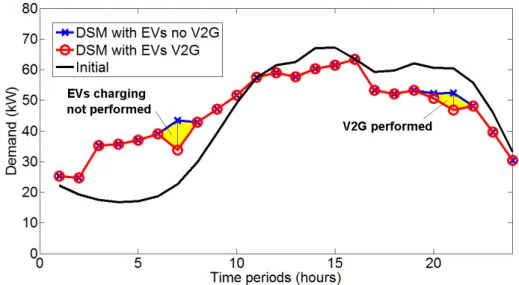
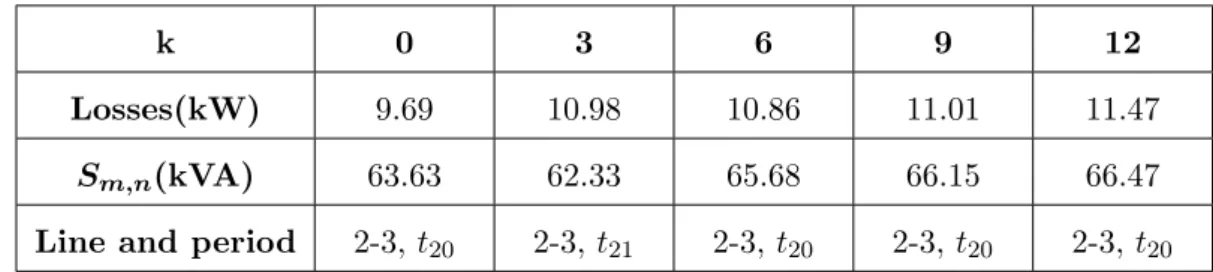
Los resultados obtenidos, aplicados en dos casos de estudio concretos, muestran que la curva de demanda final se aplana conforme el valor del par´ametrok crece, d´andose un valor ´optimo entre 3 y 12 para el cual los beneficios de los agentes involucrados as´ı como los obtenidos por del sistema, en t´erminos de p´erdidas y cantidad de potencia transportada por las l´ıneas, se encuentran compensados.
la bater´ıa debe estar completa en alguna de las primeras horas del d´ıa y se tiene en cuenta tambi´en la energ´ıa consumida en los desplazamientos del veh´ıculo. Este problema es el que desarrollar´ıa un agregador que tiene como objetivo maximizar sus beneficios, a trav´es de la carga y descarga de las bater´ıas de los veh´ıculos, pero satisfaciendo los requerimientos energ´eticos de la flota que representa. Esta estrategia es comparada con distintos tipos de carga no controlada resaltando los beneficios de una gesti´on mediante agregador. Este problema es estudiado m´as en detalle en el Cap´ıtulo 4.
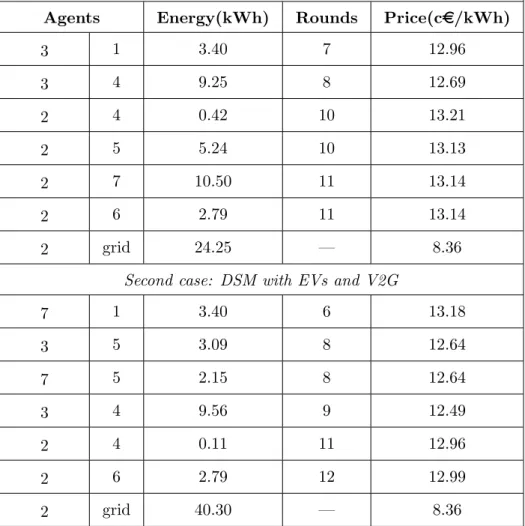
Dentro del Cap´ıtulo 2, tambi´en se describe un mecanismo de subasta susceptible de ser utilizado en mercados locales de energ´ıa el´ectrica, es decir, aquellos mercados no mayoristas que se dan a nivel de la red de distribuci´on. La idea de esta subasta es la de proporcionar un precio m´as favorable a los compradores y los vendedores por la energ´ıa que quieren comprar o vender con respecto a los precios que le ofrecer´ıa la red principal, que podr´ıa venir representada por un comerciante minorista. Partiendo de dos valores extremos, la subasta se desarrolla por rondas en las que los compradores emiten ofertas crecientes y los vendedores emiten ofertas decrecientes hasta que se produce un cruce de ofertas y la correspondiente casaci´on. Una vez que las cantidades que se pretenden intercambiar son conocidas, el precio que se oferta se calcula de acuerdo a la siguiente funci´on:
y= a
x+b +c (2)
donde a, b y c son par´ametros que dependen de cada agente y x es el ´ındice de las rondas. Los valores de estos par´ametros definen a los agentes compradores o vendedores adem´as del ritmo al que el precio aumenta o disminuye con las rondas. El mecanismo de subasta queda totalmente definido por un conjunto de reglas concretas que determinan las cantidades de energ´ıa el´ectrica que se intercambian y el precio en los distintos tipos de casaci´on que puedan darse, entre dos agentes solamente (un vendedor y un comprador) o entre m´ultiples agentes (varios compradores con varios vendedores).
Operaci´
on t´
ecnica
puede agravarse por flujos bidireccionales de potencia debidos a los generadores situados a nivel de distribuci´on. Con el objeto de dar soluci´on a este tipo de problemas se proponen dos formas de atajarlos. La primera forma opera de manera centralizada y la segunda hace uso de veh´ıculos el´ectricos. Ambas opciones son presentadas en el Cap´ıtulo 3.
El primer m´etodo propuesto hace uso de un problema de optimizaci´on conocido como flujo de cargas ´optimo. Se trata de llevar al sistema a un estado seguro tomando la potencia de salida de los generadores como variables de control. Este problema se formula de manera general de la siguiente forma:
minimizar incremento
sujeto a fC ≤0, gC =0
(3)
donde “incremento” es una funci´on que se expresa como una suma ponderada de las diferencias entre las potencias iniciales de los generadores (las que originan el problema t´ecnico) y las potencias finales (resultado del problema de optimizaci´on) en valor absoluto. Los t´erminosfC y gC son las restricciones de desigualdad e igualdad respectivamente, que
quedan representadas por l´ımites sobre los niveles de tensi´on o la capacidad de las l´ıneas as´ı como las ecuaciones del flujo de potencia que garantizan el balance.
Por tanto, mediante la aplicaci´on de este problema, se intentan corregir las infactibil-idades actuando sobre la potencia suministrada por los generadores pero tratando de quedarse lo m´as cerca posible del estado inicial. Los pesos de cada uno de los t´erminos de la funci´on objetivo permiten dar prioridad a modificar la potencia de algunos gener-adores sobre otros. De forma general, la energ´ıa proveniente de fuentes renovables ser´a la que en el ´ultima instancia se modifique en detrimento de otras fuentes de energ´ıa menos sostenibles.
El segundo m´etodo propuesto hace uso de los veh´ıculos el´ectricos para aliviar la con-gesti´on en las l´ıneas. Vali´endose del concepto de “factor de distribuci´on”, la capacidad de las bater´ıas para cargar o descargar en determinados nudos de la red es aprovechada para reducir el flujo de potencia en aquellas l´ıneas que se encuentren sobrecargadas. Los factores de distribuci´on pueden definirse como la variaci´on que se produce en el flujo de potencia de una l´ınea como consecuencia de una inyecci´on de potencia unitaria en un nudo de la red. Dichos factores pueden calcularse a partir de la topolog´ıa de la red de estudio, de sus caracter´ısticas de resistencia y reactancia as´ı como del estado de actual o de referencia del sistema. Puesto que la potencia puede ser activa o reactiva, se obtienen cuatro grupos de factores haciendo todas las combinaciones posibles.
Los factores de distribuci´on, de acuerdo a la definici´on, dan una idea de aquellos nudos que deben elegirse para provocar un cambio en el flujo de potencia en una l´ınea. De este modo, si una l´ınea concreta est´a congestionada, puede determinarse el nudo m´as adecuado, es decir, el que tenga el mayor valor del factor de distribuci´on, y aliviar el flujo de potencia de la misma. La base de este m´etodo est´a en que la contribuci´on de inyecci´on de potencia, en el nudo que corresponda, se lleve a cabo por los veh´ıculos el´ectricos mediante la carga o la descarga de sus bater´ıas. Se toma como hip´otesis que los veh´ıculos pueden modificar el flujo de potencia de una l´ınea solamente mediante aporte de potencia activa. El c´alculo de los factores de distribuci´on y el algoritmo que define el m´etodo se desarrollan en detalle en el Cap´ıtulo 3.
Tal como se ha comentado, el agregador se concibe como una futura entidad respon-sable de la carga de los veh´ıculos el´ectricos de forma las necesidades de movilidad de los propietarios se vean satisfechas. En esta tesis, se proponen dos problemas que involucran a los agregadores: un problema de maximizaci´on de beneficios y otro de liquidaci´on de mercado.
El problema del agregador se plantea como una maximizaci´on de la diferencia entre los ingresos que recibe por venta de energ´ıa (V2G o descarga) y los costes de compra de la misma (carga). Puesto que los precios quedan definidos de forma horaria, su estrategia consistir´a en proceder con la carga en aquellos periodos donde la energ´ıa sea m´as barata y realizar la descarga en los periodos de tiempo donde el precio de venta sea m´as favorable. Para que el agregador maximice sus beneficios, debe disponer de informaci´on adecuada respecto a los precios de venta y compra de energ´ıa as´ı como de la disponibilidad de los veh´ıculos con respecto a la conexi´on a la red. Por tanto, debe disponer de datos suficientes para estimar ambos aspectos que resultan claves para lograr sus objetivos. En el cap´ıtulo 4 se expone en detalle el problema del agregador y se estudia la influencia de los par´ametros que intervienen. En particular, se aplica una herramienta basada en cadenas de Markov para determinar el estado de los veh´ıculos (es decir, si est´a en movimiento o conectado a la red y el nudo de conexi´on) y una simulaci´on de Monte Carlo que permite generar patrones.
Finalmente, en el cap´ıtulo 5 se desarrolla un algoritmo de liquidaci´on de mercado con restricciones de seguridad. El objetivo de este algoritmo es determinar qu´e agentes se van a encargar de suministrar la energ´ıa el´ectrica, cu´ales van a comprar para satisfacer su demanda y tambi´en cu´ales son los precios asociados a dichas transacciones. En la formu-laci´on se concretan los agentes que tradicionalmente participan en los mercados el´ectricos, a saber, las compa˜n´ıas suministradoras, los consumidores y los contratos bilaterales. La inclusi´on del agente agregador de veh´ıculos como nueva entidad participante es la prin-cipal aportaci´on al respecto. Este algoritmo queda definido a trav´es de un problema de optimizaci´on de la siguiente forma:
maximizar zS+zC +zB+zA
sujeto a fS ≤0, fC ≤0, fB ≤0
fA≤0, g =0
(4)
donde los t´erminos zS, zC, zB y zA, por un lado, y fS, fC, fB y fA, por otro, representan
las funciones de utilidad y las restricciones asociadas a los suministradores, consumidores, contratos bilaterales y agregadores respectivamente. El t´ermino g tiene en cuenta las restricciones t´ecnicas de la red que garantizan el balance entre generaci´on y demanda.
El resultado de este problema da lugar al despacho ´optimo de las unidades de pro-ducci´on que satisfacen la demanda del sistema de acuerdo a las ofertas emitidas por cada uno de los agentes. Los suministradores emitir´an ofertas de venta de energ´ıa para pro-porcionar potencia y reserva y, en cambio, los consumidores emitir´an ofertas de compra. De forma general, ser´an aceptadas aquellas ofertas de venta m´as bajas, es decir, la de aquellos suministradores que est´an dispuestos a vender su energ´ıa m´as barata, ocurriendo lo contrario para las ofertas de compra, que ser´an rechazadas si el consumidor no est´a dispuesto a comprar su energ´ıa a un precio suficientemente alto. Para los consumidores se ha considerado que hay una fracci´on de la demanda que es fija y otra que es despachable, de manera que solo se emiten ofertas para ´esta ´ultima. Del mismo modo, los contratos bilaterales se resolver´an de acuerdo a los precios pactados entre ambas partes. Las re-stricciones para cada uno de estos agentes, por citar algunas, son por ejemplo los l´ımites de operaci´on de los generadores o la contribuci´on de potencia suministrada o demandada en cada uno de los nudos.
de beneficios permite a los agregadores evaluar las estrategias de oferta m´as favorables de cara a la participaci´on en los mercados el´ectricos. Las ofertas de compra ser´an altas en aquellos periodos de tiempo donde se prev´e que los precios de compra sean m´as peque˜nos mientras que las ofertas de venta ser´an bajas donde se espera que los precios ofrecidos sean m´as ventajosos.
El modelo propuesto se ha desarrollado para un sistema en el que participan tres agregadores con distintos veh´ıculos y patrones de movimiento. Los resultados arrojan que una buena estimaci´on de los precios de mercado y de la disponibilidad de los veh´ıculos para estar conectado a la red, permite a los agregadores emplazar la compra y la venta de energ´ıa en los periodos de tiempo que le reportan m´as beneficios.
Contribuciones
De acuerdo a las ideas expuestas anteriormente, las principales contribuciones de la tesis se presentan a continuaci´on:
• La formulaci´on de una estrategia espec´ıfica de gesti´on de demanda basada en prob-lemas de optimizaci´on. El problema se formula como una maximizaci´on de los ben-eficios de cada uno de los agentes siendo el desplazamiento de las cargas el medio para lograr una reducci´on de los costes de la energ´ıa. El aplanamiento de la curva de la demanda reporta tambi´en beneficios al sistema el´ectrico en t´erminos de una reducci´on de p´erdidas y un mejor aprovechamiento de los activos existentes. El emplazamiento horario de los generadores es tambi´en tenido en cuenta y se facilita la integraci´on de los veh´ıculos el´ectricos y las fuentes de generaci´on renovable.
• Un flujo ´optimo de cargas que permite actuar sobre los generadores para corregir problemas t´ecnicos que puedan surgir en las redes a nivel de distribuci´on. Como herramienta centralizada permite evitar congestiones modificando los niveles de gen-eraci´on y favoreciendo a las fuentes renovables.
Usando los factores de distribuci´on es posible seleccionar qu´e nudos con veh´ıculos son los m´as adecuados.
• Aspectos t´ecnicos y econ´omicos desarrollados en la tesis se ponen conjuntamente, proporcionando un esquema completo caracterizado por mecanismos de subasta, problemas de optimizaci´on de los agentes, gesti´on de los veh´ıculos y operaci´on t´ecnica centralizada.
• La implementaci´on de un problema de maximizaci´on de beneficios que puede ser usado por los agregadores y que le permite determinar la forma ´optima de participar en los mercados el´ectricos.
• El desarrollo de un algoritmo de liquidaci´on de mercado con restricciones de seguri-dad y que incluye a los agregadores de veh´ıculos como nuevos agentes participantes. Los art´ıculos que avalan la tesis se muestran a continuaci´on:
Publicados en revista
M.A. L´opez, S. Mart´ın, J.A. Aguado, S. de la Torre, V2G strategies for congestion management in microgrids with high penetration of electric vehicles, Electric Power Sys-tems Research, Volume 104, Noviembre 2013, Pages 28-34.
Aportaciones a congresos
M.A. L´opez, J.A. Aguado, S. de la Torre, M. Figueroa, Optimization-based market-clearing procedure with EVs aggregator participation, 4th IEEE PES Innovative Smart Grid Technologies (ISGT Europe), 2013, Pages 1-5, Octubre 2013.
M.A. L´opez, S. Mart´ın, J.A. Aguado, S. de la Torre, Optimal microgrid operation with electric vehicles, 2nd IEEE PES Innovative Smart Grid Technologies (ISGT Europe), Pages 1-8, Diciembre 2011.
M.A. L´opez, S. Mart´ın, J.A. Aguado, S. de la Torre, Market-oriented operation in MicroGrids using Multi-Agent Systems, 2011 International Conference on Power Engi-neering, Energy and Electrical Drives (POWERENG), Pages 1-6, Mayo 2011.
Enviados
List of Abbreviations
BEV Battery Electric Vehicle
DF Distribution Factor
DG Distributed Generation
EV Electric Vehicle
GHG Greenhouse Gases
ICE Internal Combustion Engine
ICT Information and Communication Technologies
M AS Multi-Agent System
M G MicroGrid
OP F Optimal Power Flow
P HEV Plug-in Hybrid Electric Vehicle
SOC State of Charge
SG Smart Grid
Contents
1 Introduction 1
1.1 Background and Motivation . . . 2 1.2 The Smart Grid Concept . . . 4 1.3 Electric Vehicles Modelling . . . 6 1.4 Framework, Electric Energy Systems . . . 12 1.5 State of the art . . . 14 1.6 Contributions . . . 18 1.7 Outline and structure of the Thesis . . . 19
2 Demand-side Management Strategies and Electric Vehicles 23
3 Congestion management through Vehicle-to-Grid 65
3.1 Technical Operation . . . 66 3.2 Congestion Management . . . 69 3.3 Results and discussion - Optimal power flow approach . . . 76 3.4 Results and discussion - Congestion management approach . . . 78 3.4.1 MG test system . . . 78 3.4.2 IEEE 37-bus test system . . . 81
4 The Electric Vehicles Aggregator Case 85
4.1 Introduction . . . 86 4.2 Operation rules of the EV aggregator . . . 87 4.3 EV aggregator optimisation problem . . . 88 4.4 EV patterns generation . . . 93 4.5 Economic and technical implications . . . 96 4.5.1 Data description . . . 96 4.5.2 Application to EV aggregators . . . 99 4.5.3 System Technical Performance . . . 102
5 Market-clearing with EV aggregators’ participation 105
5.1 Introduction . . . 106 5.2 Optimisation-based approach model . . . 106 5.2.1 Suppliers . . . 107 5.2.2 Consumers . . . 108 5.2.3 Bilateral agreements . . . 109 5.2.4 EV aggregator model . . . 109 5.2.5 Grid model . . . 111 5.2.6 Complete formulation . . . 112 5.3 Case study . . . 113 5.4 Results . . . 117
6 Conclusions and Future Work 123
CONTENTS xxv
List of Figures
1.1 Framework of the research study . . . 13 1.2 Contents within the scope of the thesis . . . 20 2.1 Demand-side management techniques . . . 24 2.2 Parameters and variables related to the demand . . . 30 2.3 Non-renewable generators costs . . . 31 2.4 Example of scenarios generation . . . 33 2.5 Auction procedure . . . 39 2.6 Auction bid curves . . . 40 2.7 Microgrid considered for case study . . . 41 2.8 Electricity Loads in the MG Feeders . . . 42 2.9 Renewable sources power output scenarios . . . 43 2.10 Uncontrolled Charging Strategies - EVs Total Charging Power . . . 44 2.11 Demand curve and price scenarios . . . 47 2.12 Daily electricity demand for several values of parameterk . . . 48 2.13 Microgrid power demand with DSM, k=12 . . . 49 2.14 Microgrid power supply with DSM, k=12 . . . 50 2.15 Daily electricity demand without DSM and EVs uncontrolled charging
2.22 Daily electricity load curves with V2G allowed . . . 62 2.23 State of Charge for different strategies EV 1 . . . 62 2.24 Total Income and Costs . . . 63 2.25 Total losses and maximum power . . . 64 3.1 EV Management Algorithm . . . 73 3.2 OPF correcting measures in power output . . . 78 3.3 Cases of study of the IEEE 37-bus system . . . 82 4.1 Steps of the EVs patterns generation process . . . 94 4.2 EVs states considered in the Markov chain . . . 95 4.3 Transition probabilities for the Markov chain . . . 98 4.4 Pattern generation for EVs 2(above) and 9(below) . . . 100 4.5 Monte Carlo simulation convergence . . . 101 4.6 Hourly EVs charging/discharging for uncontrolled/aggregator strategies . . 102 4.7 Cumulative distribution function for apparent power flow in line 1-9
Un-controlled . . . 103 4.8 Cumulative distribution function for apparent power flow in line 1-9
List of Tables
2.1 Values of binary variables related to non-renewable generators operation . 31 2.2 EVs technical characteristics . . . 44 2.3 Agents defined in the case study . . . 46 2.4 Standard deviation and demand range for different values of k . . . 49 2.5 Apparent power flow for line 1-9 at time period 19 for uncontrolled charging
strategies - Without DSM . . . 51 2.6 Apparent power flow for line 1-9 at time period 19 for uncontrolled charging
4.4 Normal distribution parameters . . . 99 5.1 Technical data for generating units . . . 114 5.2 Bilateral contracts results . . . 119 A.1 Line characteristics for the MG system . . . 130 A.2 Generation Costs for the MG case study . . . 130 A.3 Renewable Generators Maximum Power Output for the MG case study . . 131 A.4 Battery Technical Characteristics for the MG case study . . . 131 A.5 Electric vehicle connection pattern for uncontrolled charging type 1 . . . . 131 A.6 Electric vehicle connection pattern for uncontrolled charging type 2 . . . . 132 A.7 Electric vehicle connection pattern for uncontrolled charging type 3 . . . . 132 A.8 Line characteristics for the IEEE-37 system - Part I . . . 133 A.9 Line characteristics for the IEEE-37 system - Part II . . . 134 A.10 Generation Costs for the IEEE-37 system . . . 134 A.11 Renewable Generators Maximum Power Output for the IEEE-37 system . 135 A.12 Battery Technical Characteristics for the IEEE-37 system . . . 135 A.13 Electric vehicle connection pattern for uncontrolled charging for the
Chapter 1
Introduction
This chapter presents the motivation for this thesis and the fundamentals of some
concepts in relation to it. A review of the state of the art is also provided. It is concluded
1.1
Background and Motivation
Nowadays, there is a major concern for environmental issues such as the emission of GreenHouse effect Gases (GHG), which contribute to global warming, and atmospheric pollution, which degrades the air quality in many cities. These concerns go hand in hand with others related to the use of energy and the future of existing energy resources. In particular, climate and energy legislation in the EU aims to meet certain targets related to climate change. These targets consist of a 20% reduction in GHG emission, an increase in the ratio of renewable energy to 20% of the EU’s total energy consumption, and a 20% improvement in energy efficiency. Moreover, the 2030 policy framework for climate and energy presented by the European Commission at the beginning of 2014 proposes more ambitious targets to reduce GHG emissions, facilitate the integration of renewable energy sources and, in short, to make the EU’s economy and energy system more competitive, secure and sustainable [1].
In this regard, the road transport sector is responsible for an important share of the total energy consumption. In the EU, it represents one third of this total contributing about one fifth of the total carbon dioxide emissions with this figure constantly on the rise year on year. This situation is similar in other countries such as the United States, where the transportation sector was the second largest contributor of GHG in 2011 after the Electricity Sector [2]. Road transport also shows a high level of dependence on petroleum-derived fuels, mainly petrol and diesel, which are foreseen to be scarce in the future. Several authors and institutions forecast a near term peak in oil production followed by a significant decline, with alternative fuels not being capable of meeting the foreseen energy requirements. Furthermore, it is agreed by some that the production of oil has actually reached or even past that peak, anticipating a much more pessimistic scenario [3–7]. These concerns are aggravated by the increasing trend and high volatility in the price of crude oil [8].
Therefore, the road to a more sustainable energy future necessitates more efficient and low carbon technologies. To this end, given the considerable impact that road transport sector has on the environment, measures to improve the current automobile fleet need to be undertaken. Although there has been noteworthy progress in fuel efficiency and CO2
1.1 Background and Motivation 3
(EVs) are expected to play a crucial role [11].
EVs have been around for many years, the first of that kind dating back to the end of the nineteenth century. At that time, EVs had to compete against other vehi-cle technologies, namely the petrol-powered Internal Combustion Engine (ICE) and the steam-powered vehicle [12]. Each of them had its advantages and shortcomings although petrol-powered ICE cars were the fastest to overcome the difficulties encountered and they finally outpaced their competitors by the first quarter of the twentieth century [13]. EVs offered appealing features: they were clean, silent, simple to operate and they did not need mechanical transmissions. Nonetheless, the lack of suitable charging power stations, the required frequent battery maintenance, the reduced range due to vehicle speed, and the premature ageing of the battery were areas in which strong efforts were made but not enough to avoid its decline. Nowadays, these still constitute issues that need working on, although the prospects are quite different given the technological developments that have since been successfully achieved. Regarding the said issues, it is mainly the high costs and technical limits of the batteries that are hampering the success of the EV today [14]. On the other hand, in the near future, a varied mix of vehicle technologies including fuel cell, plug-in hybrid and electric vehicles is expected [15, 16].
EVs offer a high energy efficiency and a cleaner mode of personal transportation. Pos-sibly, the most important characteristic is that they run only on electricity, not producing any emissions at all. However, they rely on the energy contained in their batteries which necessarily require charging if they are close to depletion. Hence, an effective deploy-ment should not entail the substitution of tailpipe emissions by additional emissions from the increased electricity generation [17]. In this respect, the launch of EVs has to be accompanied by a corresponding increase in the power supplied by Renewable Energy Sources (RES) to the detriment of other high carbon generation technologies. Further-more, EVs could support large scale renewable power plants by exploiting their capability of absorbing (storing) energy in their batteries or returning stored energy to the grid, thus complementing fluctuations in the grid that result from the uncertainties or intermittency associated with wind and photovoltaic plants [18].
prob-lems, such as voltage limits violating or line congestion, mainly at the distribution level [19, 20]. Therefore, it is interesting to develop tools and strategies that allow tackling these or anticipate their consequences [21–24]. Furthermore, upcoming entities respon-sible for complying with the EVs’ mobility requirements will make their way through the existing regulatory framework and business models [25]. In general, the so called “EV aggregators” will try to maximise their benefits by allocating charging to the most favourable time periods [26]. Thus, charging takes place in those time periods when it is cheaper to do so, i.e. during night hours. These time periods are also suitable from a tech-nical point of view since the demand during the same is typically small [27, 28]. Finally, the management and exploitation of EVs’ capabilities is not possible with the existing infrastructure. Adequate metering devices, information and communication technologies and control, among other things, have to be put together to enable their integration. In short, the way towards a “smarter” grid have to be paved [29].
The smart grid concept as well as some ideas about EV modelling are introduced in Sections 1.2 and 1.3. Section 1.5 presents some interesting articles and works related to the topics of study. The thesis is outlined in Section 1.7. Finally, Sections 1.4, ?? and 1.6 introduce the framework of the research study, the structure of the thesis and the contributions respectively.
1.2
The Smart Grid Concept
1.2 The Smart Grid Concept 5
efficiency and operational capability [31]. Among other characteristics, it also allows for a more flexible demand and the efficient integration of renewable sources, boosted by con-cerns about the complete depletion of fossil fuels and the negative environmental impact of most of the current energy sources.
The transition towards SGs requires the addition of new functionalities and capabilities to the existing electricity grid. Distributed generation is a common characteristic of SGs and, in addition, the nature of these generators is varied since they can be renewable, such as wind turbines or photovoltaic panels, or otherwise, such as combined heat and power, fuel cells, microturbines or diesel-powered plants [32]. Devices which are able to store energy, such as electric fixed batteries, can help the system to smooth the intermittent behavior of renewable sources enabling an easier integration. The next generation of the electricity grid will also facilitate the electrification of transportation systems [33]. SGs comprise different entities that can interact with each other bidirectionally, allowing the establishment of commercial relationships to serve and request electric energy or to solve technical problems that could arise, thus empowering the consumer. These entities within the SG can respond to changes in the energy prices allowing them to minimise the cost of the energy they need to buy or maximise the income of the energy they can sell.
signals, changing their location or their consumption pattern if needed. Thus, an optimal charging allocation can be of benefit to both EV managers and system operators.
In this context, Microgrids (MGs) are power networks that have some properties in common with SGs [44]. Microgrids can be defined as integrated energy systems comprising distributed energy resources and multiple electrical loads, operating either in parallel or ’islanded’ from the main utility grid. In the most common configuration, several feeders are linked to the point of common coupling and then connected to the larger grid [45]. They are regarded as active energy networks since they are envisioned to facilitate the integration of distributed generation, with bidirectional electricity transportation, and allow the application of DSM techniques [46].
Although MGs are mainly conceived as low voltage systems [47], some authors sup-port the idea of a MG operating at medium voltage depending on the capacities of the distributed generation [48, 49]. In any case, these systems have adhere to certain char-acteristic features [45]: i) they can be grid-tied or off-grid remote systems, ii) MGs can operate ‘islanded’ from the main grid, iii) MGs require some level of storage, iv) they typically exploit their distributed energy resources at the retail distribution level. Addi-tionally, MGs offer different kinds of benefits: technical, economical and environmental [50]. From the technical point of view, they have the potential to improve energy efficiency, increase reliability and reduce dependency on the utility grid. Economical benefits are represented by the reduction in line losses, due to the small distances between generators and loads, and the minimisation of fuel costs among others. Finally, the environmental benefit is owed to lower emissions given the incorporation of cleaner energy sources. MGs can also integrate EVs satisfactorily. Regarding this, several authors have presented works in which EVs’ impact is analysed under different approaches [51–53].
1.3
Electric Vehicles Modelling
1.3 Electric Vehicles Modelling 7
that could arise. In this section, the main issues and characteristics with respect to EVs are presented.
In order to model EVs in steady-state operation, the most widely used tool is the power flow as a means for verifying the grid security state with respect to voltage limits violation and lines overload as a consequence of a moderate or high penetration of EVs. The analyses are usually performed on a hourly basis during a day, week, month or a complete year for low voltage and medium voltage networks. The correct EV modelling includes the knowledge or at least the estimation of several parameters affecting their behaviour. In general, these parameters are known with a certain degree of uncertainty, i.e., they are enclosed in a certain confidence interval [54]. Some of the most important data that have to be taken into account for EV studies are, but not limited to, the following:
• When EVs charge, remain idle or undertake a journey - time periods
• Where EVs charge - bus location
• How EVs charge and which is the charging rate - charge mode
• What is their State of Charge (SOC), the efficiency of the charging process and the battery energy consumption during journeys - battery energy level tracking
These data can be assumed for the purpose of the corresponding analysis either because a common behaviour of EVs is expected or because it represents a less favourable situation in which the study can be justified. One possible way to build EV patterns comes from the analysis of survey responses. This is the methodology used in projects like Merge and G4V [55, 56]. Examples of questions made to the survey respondents are related to:
• Personal data: birthplace, place of residence, job, age,...
• Main vehicle usage: work, shopping, leisure.
• Regularity of usage.
• Preferred moment for charging: whenever it is possible, at the end of the day, only when the battery is about to deplete, whenever it is convenient and there is time.
• Intention for changing the time of charging depending on specific tariffs.
• Vehicle location when not in use: at home (own private garage), at home (pub-lic street), at home (communal parking lot), at work, other place (train station, shopping centre).
• Possibility to access a socket for vehicle charging.
• Predicted mileage covered on weekdays and weekends.
• Time periods when the first journey of the day and the return journey are made.
With these data it is possible to extract some important information about the EVs’ patterns and behaviours that can be used in different studies. Other authors make use of the data of surveys developed in some countries, e.g., the National Household Trade Survey in United States [57].
One of the most important research issues is the possibility of incorporating the charg-ing of EVs into existcharg-ing electric power systems. In order to carry out this kind of study it is firstly necessary to characterize the hourly demand curve of the system under inves-tigation. The strategy usually consists in taking reference load curves based on historical data, extracted from grid operators or those data previously established in the case stud-ies. The EV charging is added to this base load under different scenarios of EVs’ behaviour or operation.
1.3 Electric Vehicles Modelling 9
The EV charging power is given depending on the availability of a charging point with the suitable infrastructure to supply the power for which it has been designed. The coexistence of three different charging levels is widely adopted [60–62]:
• slow charging (Level 1): around 3.0 kW (one phase, 230V AC–16A)
• slow charging (Level 2): up to 19.2 kW (one or three phase, 400V AC–80A)
• fast charging (Level 3): up to 100 kW (three phase, 600V AC or 300-600V DC–from 150A to 400A)
Slow charging (level 1) is considered the one that can be performed “at home”, with charging times that can be around eight hours depending on the type of EV. Slow charging (level 2), sometimes also called semi-fast charging, is suitable for commercial areas or public places with smaller charging times and where several charging points are grouped in common accessible zones where people who visit these buildings for leisure, business, etc. can park their EVs. Finally, fast charging (level 3) takes place in medium voltage connection points in AC or, at specific locations in DC. The latter way of charging is intended for gas stations, which can integrate EV charging points, and for charging times not higher than thirty minutes.
For these charging modes different connectors have been developed and proposed from the common Schuko socket to other connectors that incorporate both the feeding and communication cables [63–65].
One of the most important issues related to the EV pattern is to know when the charging takes place, e.g., at what time EVs charge during the day. In that regard, many authors differentiate among different charging behaviours directly related with the moment of the day when EVs are charging [19, 55, 66, 67]. It is generally accepted that they can follow different behaviours conditioning their charging pattern, however, regardless of the charging strategy considered, they have to fulfil particular requirements to meet their daily SOC needs.
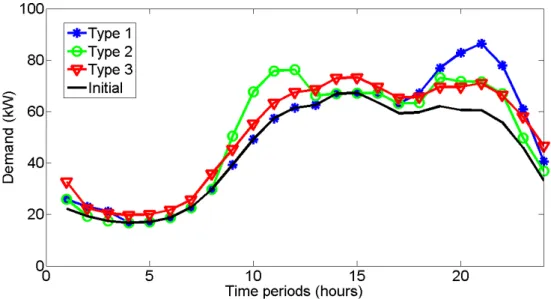
expected EV hourly patterns; some of them include the charge after the last journey of the day or the charge whenever possible [55]. Thus, uncontrolled charging encompasses those EV patterns that depend on the owners’ convenience for charging and, therefore, they are subject to an important uncertainty. It is envisaged that this will become a typical charging mode for many consumers during the development of better EV technologies.
Uncontrolled charging often means that EVs charge as soon as they arrive from the last journey of the day, which according to surveys is frequently between 17h and 20h [55, 68]. Thus, under uncontrolled charging it is common to assume a substantial demand during the latter period of the day, occurring at the same time as the peak of the demand curve. This charging mode provides a base scenario to study the impact of EVs on electric power systems. Some typical impacts under consideration by authors are, but not limited to: peak of the demand increase, congestion in lines and losses in the grid [27].
However, EVs can react to price signals and change their original charging schedule, if it is in their best economical interest. The prices for buying energy can be different in each time period or there may be two or three different prices during the day, commonly referred to in the literature as a multiple tariff scheme. Nevertheless, if the scheduling depends on the EV owner’s willingness to take advantage of this feature, this charging strategy is regarded as an uncontrolled charging.
When the EV charging or discharging is managed through an external agent it is said that the operation is controlled. This so called controlled charging relies on demand-side strategies by which EV charging can be allocated to other more convenient time periods based on a predefined contract or agreement between EV owners and the external agent. Among them, the strategy based on price signals has been studied deeply [55, 56]. The idea under this approach is to move the EV charging to those time periods when economical conditions are more favourable. “Smart charging” refers to specific controlled charging strategies for allocating EV charging based on algorithms to shift the charging to valley hours or, instead, altering the initial charging pattern [27].
1.3 Electric Vehicles Modelling 11
be technical reasons as well.
Regarding the point of connection, the maximum power that an EV can supply, or absorb, is conditioned by the location of the charging point. In the simplest case, the EV location is a known parameter of the problem. On the other hand, to account for the uncertainties in EV owner behaviour, Monte Carlo simulations or Markov chains based techniques [54] can be employed to determine the node of connection to the grid. In this last case, each EV is assumed to have a certain “state”, e.g. driving or charging, and the transition from one state to another is carried out according to transition probabilities. These probabilities are determined by statistically analysing some data extracted from surveys or mobility studies. For instance, it is highly probable that the EV stays at home during night hours or that it performs the first departure in the early hours of the morning. Regardless of the way of modelling EV movement, it is necessary to take into account those time periods in which EVs are moving or not connected to the grid since it may be necessary to update the state of charge despite EV not being associated to any node.
From the grid point of view, EVs can be mainly classified as plug-in hybrid electric vehicles (PHEV) or battery electric vehicles (BEV) [69]. PHEVs usually rely on an Internal Combustion Engine (ICE) used either for driving or to charge the battery which capacity typically is less than 15 kWh, however, BEVs only have the battery at their disposal to perform journeys with manifold capacities ranging from 15 kWh to 60 kWh. There are other types of EVs cited in the literature such as Extended Range Electric Vehicles (EREVs) or Fuel Cell Electric Vehicles (FCEVs) although they can either be considered as particular cases of the two main groups mentioned above or they are not of interest in the field of study. In general, EVs can be considered as mobile batteries that can charge or discharge.
According to different research studies and manufacturers datasheets, the battery consumption when EVs are in movement is around 0.15 kWh/km. In stochastic analyses, this consumption is modelled using typical random distributions which statistical data are taken from adequate patterns [54]. The studies carried out from several universities and research centres show that at least 50% of EV users could perform their daily mobility needs with only 30 kilometres of travel.
These kind of studies analyze situations in which a quick EVs’ response is required under the occurrence of certain circumstances. For example, regulation is needed to balance supply and demand and it requires fast responses taking typically less a minute. Com-pared to steady-state studies, dynamic studies are performed over a smaller time scale, commonly a few hundreds of seconds. They are related to the services that EVs are able to provide in the future like reserve, primary and secondary frequency control or renewable generation integration [18, 71].
Finally, it is important to remark the actions taken, with respect to EVs, regard-ing several initiatives launched in different countries. For instance, in Grid For Vehicles (G4V) [56] and Mobile Energy Resources in Grids of Electricity (MERGE) [55], both European projects, different studies were carried out on EV control strategies, challenges, impacts and opportunities, provision of services, or supporting of renewable energy sources through EVs. EDISON is another interesting project that pursued EV integration includ-ing aspects related to network operation, market issues and the contribution of different energy technologies [72]. In the United States, the largest deployment of EVs and charg-ing infrastructure in the world is takcharg-ing place under the EV Project [73]. Furthermore, in Spain there have been developing plans to foster the integration of EVs [74], projects that involve EV deployment [75] and specific normative has been issued dealing with charg-ing infrastructure, requirements and protection measures based in international standards [76].
1.4
Framework, Electric Energy Systems
In this section, the framework regarding electric energy systems is introduced.
1.4 Framework, Electric Energy Systems 13
for the necessities in different areas of the grid comprising loads, generators or storage systems. These entities are assumed to be intelligent agents and, thus, have some specific characteristics like reactivity, pro-activity and social abilities [77]; they will be referred to SG agents hereafter. Other more specific like the SG operator, main grid agent and EV aggregator are also taken into consideration, Fig. 1.1. The role of these agents will be clarified later and throughout the thesis.
Figure 1.1: Framework of the research study
According to the ideas mentioned above, SG agents can comprise different elements or assets, with several combinations. The following types of agents are possible:
• Demand agents: they only own loads located in certain buses in the grid. They can represent residential areas where some electrical needs have to be satisfied.
• Generator agents: they have loads and generators of non-renewable nature. They can represent industrial complexes where both generation and demand can be present at the same time.
• EV aggregator agents: they can be thought of as an entity responsible for the whole set, or a small group of EVs, in a grid. Hence, they manage the EV charging in order to satisfy their mobility requirements and they pursue new business opportunities to make the most of the services that EVs can provide.
As stated earlier, in order to generalise the approach, generic agents with loads, non-renewable and non-renewable generators, fixed batteries, EVs or any combination of these can be defined. Some have already been introduced, namely demand agents, generators agents, renewable agents and EV aggregators. However, the possibility of considering any kind of SG agent with the elements or assets that have been mentioned is stressed here. This distinction is important because it will affect the optimisation problem for DSM as will be explained in Chapter 2.
Finally, two specific entities have been considered in this research study. Firstly, the SG operator, responsible for the market and technical operation of the grid. On the one hand, it is conceived to collect the SG agents bids to clear the market using any suitable auction scheme. On the other, it watches over the grid making use of tools to prevent it from technical limits violating. Secondly, the main grid agent takes responsibility for balancing supply and demand in the grid regulating the power through the point of connection of the SG with the upstream system. These agents have to be coordinated with each other in order to maintain overall grid stability, for this purpose, the bidirectional communication is important.
1.5
State of the art
There are several interesting works regarding EVs and other related areas, all of them trying to focus on particular characteristics or fields of interest. In this section, some of these works are described stressing the goals pursued, the applied methodologies and the results presented.
1.5 State of the art 15
EVs for minimising operating costs and harmful gas emissions in commercial buildings is analysed in [80]. The results indicate that EVs are appealing for supplying electric energy in those time periods in which energy is more costly. An OPF for optimising operating generation costs and EV charging is used in [81] to determine the magnitude and time period in which the EV charging should take place. In [82], PHEVs impact for different charging levels and the use of DSM strategies is studied in detail for a particular case study. It is shown that EV charging can be moved to night hours giving benefits for both the EV owner and the grid; presenting the results through representative coefficients.
For future electricity systems, DSM and related techniques are expected to become very important. In [83], an optimisation model is described to maximise the utility of a consumer responding to uncertainty in electricity prices. In order to ensure secure operation of the grid under important peaks of demand, a voluntary household load shedding model is studied in [84]. Using two different methodologies, the benefits of DSM for both the consumers and utilities are shown in [85, 86], stressing the importance of identifying the flexible loads. In [87], a DSM strategy is implemented with the aim of bringing the final load curve as close to an objective load curve as possible.
EVs’ impact on the demand profile is analysed in [88] and, in [89], the authors try to integrate EVs with DR strategies involving the consumer. In [90], an interesting game theoretic approach is proposed to schedule EV charging for peak shaving and valley filling while, in [91], V2G is also considered for this purpose; developing an optimisation problem that aims to obtain a final load profile close to a target load curve. In [92], a coordination mechanism is proposed to allocate EV charging efficiently stressing the role of renewable energy. Other authors consider a specific smart load management approach that can be applied to EVs but focusing in technical aspects like losses minimisation or voltage limits [93]. In [94], the authors identify, through a broad review, which are the most important aspects that determine the impact of EVs on distribution grids such as driving patterns, charging characteristics, charge timing and vehicle penetration. Areas left for improvement include the addition of more stochasticity into models and the calculation of reliability indices considering EV load and V2G.
for EVs and their SOC in a problem in which losses are minimised. In [98], the MAS systems theory is used for modelling market operation and integrate EVs in a specific grid where they are managed by an aggregator. In [99], an agent based analysis tool is developed to assess the impact of a large scale adoption of EVs. The proposed tool is used to analyse interesting scenarios in which EVs can perform valley filling and peak shaving, balancing power from renewable sources or take voltage stability measures meanwhile a comprehensive vehicles, individual transportation behaviour and power system modelling is given.
Numerous authors have dealt with the joint integration of EVs and renewable energy sources, particularly when they are used to balance the intermittent power output asso-ciated to renewable generators. A complete stochastic process modelling is proposed in [66] to alleviate congestion in lines and maintain adequate voltage levels, where EVs are allowed to absorb energy from renewable sources. In [67], a framework is proposed with the purpose of integrating PHEVs into the existing electric power systems. The paper deals in detail with the current configuration of these systems, a state scheme for EVs and an application example for that framework considering controlled charging and V2G. The combined integration of renewable distributed generation, photovoltaic panels, store devices and EVs is analysed in [100]. The study shows how storage devices can be used to mitigate generation losses from PVs and coordinate with EVs.
op-1.5 State of the art 17
timisation procedure. Four different EV charging strategies are investigated from both economical and technical points of view in [101]. The impact of different types of EVs, with several charging levels and percentages of penetration is studied in [89]. The use of a DSM strategy is applied to avoid undesired demand peaks and line congestion in a distribution grid. The integration of EVs in distribution grids is analyzed in [102]. Their technical impacts and specific charging strategies to achieve different objectives are pro-posed under a complete framework. In [103], several optimisation problems to determine EV charging are formulated from the perspective of three different entities: consumers, system operators and wind power producers. Results stress the importance of the chosen objectives in final EVs’ profiles.
V2G has been taken into consideration in many works. In [104] an optimisation-based model permits a practical implementation of V2G as a part of the energy management system in MGs. A complete study of the impact of EVs capable of V2G is developed in [105]. The operation framework uses the independent Spanish system operator data carrying out an economic dispatch including EVs in the formulation. Different scenarios for renewable sources, generators, EV penetration and patterns, and demand curves are included as input parameters. Results show that an increase in EV penetration, along with the renewable share leads to reduction in costs. In regard to V2G, one of the most attractive aspects related to EVs is their suitability to provide ancillary services [71]. The authors of [106, 107] propose the use of EVs as an storage system that can be used in buildings whenever convenient considering DSM strategies. In [108], the provision of energy and ancillary services through V2G is studied via an algorithm to maximise EV aggregator’s benefits. It is shown that the algorithm makes possible reduce the charging costs and provide the system with additional flexibility.
numerical analysis. Charging and discharging of EVs are optimised in [112] where an aggregator agent allows an EV fleet to participate in the market. Specific algorithms are used to avoid technical problems arising from EV charging in [113]. Authors in [114] propose an EV charging planning to avoid congestion in grid lines while minimising the electricity costs. The effects of two scheduling models for EV charging on the day-ahead market is analysed in [115]. In [116], authors propose a model where an EV aggregator can coordinate EV charging and it can also offer services like V2G, energy and reserve. Finally, EV regulation services are investigated under three different strategies in [117].
With respect to uncertainty in EV pattern of mobility, in [118], authors analyse the impact of EVs considering a particular battery model and Monte Carlo techniques to de-scribe the EVs’ movements taking mobility patters from Barcelona. The model takes into account the uncertainty both associated with the EVs and the load of the grid. Results, developed in an adapted distribution grid, compare the impact of two different battery recharging models. Authors in [54] make use of Monte Carlo simulation and Markov chains to model the EV motion and charging in a grid. The battery consumption in journeys or the EV charging, for example, are calculated through probability distributions depending on the EV state. The impact is assessed in terms of technical issues such as losses, power flows levels or voltages. In [119], an OPF aiming at minimising system costs is proposed. The uncertainties associated to driving behavior are implemented in the form of chance constraints [120] and it is shown that it is possible to reduce the probability of violating grid constraints at small additional costs with respect to a deterministic approach.
1.6
Contributions
The main contributions of the thesis can be identified through the following achieve-ments:
1.7 Outline and structure of the Thesis 19
• A specific OPF acting on generators power output is proposed as a centralized tool to avoid or correct technical problems that can take place in distribution networks. It can be carried out in a way that renewable sources production is encouraged.
• A novel algorithm that uses EVs for congestion management taking advantage of charging and discharging, i.e. V2G, has been developed. Through DFs the most adequate EVs are selected in order to alleviate congestions.
• Technical and economic issues applicable to MGs and distribution grids can be linked providing a comprehensive scheme characterized by an auction mechanism, agents optimisation problems, EV management and centralized technical operation.
• A particular optimisation problem that can be used by EV aggregators to maximise their benefits has been proposed. It can be applied to assess the participation of EV aggregators in both local and wholesale electricity markets.
• A market-clearing procedure including technical security constraints and the role of EV aggregators has been presented.
1.7
Outline and structure of the Thesis
The thesis is organized into six chapters which address different issues regarding EV integration and their impact in future electric power systems, i.e. SGs.
The current chapter (Chapter 1) presents the motivation for the thesis along with a review of state of the art and some aspects in relation to the SG concept and EV modeling. The specified framework and the general structure that support the work developed within the scope of the thesis are also given.
Chapter 2deals with DSM strategies that can be applied to SGs including EVs. Load shifting is proposed to rearrange the hourly demand and make the most of the existing infrastructure through changes in the scheduled consumption patterns. This methodology can also be applied to EVs that can take advantage of the most favorable time periods for charging and discharging, maximising their expected benefits.