Increasing long-term business value is one of the most important objectives of a company. They suggested that this suggests that CEO duality has a significant negative effect on firm profitability. Furthermore, (Higgs, 2003; Cornett et al., 2008) documented that the separation of the CEO's dual role has a significant positive effect on firm profitability.
Nevertheless, (Iqbal et al., 2012) showed that CSR has a negative impact on the company's market value. In addition, they claimed that the CSR activities have no impact on the company's financial performance. In addition, this power integration will cause negative effects on the value of the firm, especially in the long term (Combs et al., 2007).
This because the non-executive directors considered as a significant elements and factors in the value creation process of the firm (Choi et al., 2007). Some research has argued that on average 5 to 16 members are present on the board of the firm (Yasser et al., 2014). Supporting these previous results (Yasser et al., 2011) suggested that the limited number of executive one on the board has a positive impact on the firm value.
In addition, managers can monitor performance and management tasks, which will ultimately increase the value of the firm (Abdullah et al., 2012).
Corporate Social Responsibility and Firm Value
Firm Value and Financial Performance
The competitive advantage maintained to achieve the company's goals, especially the welfare of the shareholders, which can be achieved by optimizing the value of the firm, which can be reflected by the share price. Fatihudin et al., 2018) shows that the increase in firm value is usually measured by the increase in the firm's stock price in the market and vice versa. A firm's stock price reflects the perception of stakeholders plus the firm's ability to earn and grow profits in the future.
The volatility of share prices can be affected by the condition and firm financial position, which often changes every period. A high firm value will in turn attract investors to invest in the firm, as there will be an increase in the firm's stock prices (Harningsih et al., 2019). Firm value considered as an economic concept, which reflects the value of the firm's success.
The higher company's profitability is considered the primary consideration by stakeholders in making their investment decisions. Improved profitability is expected to increase firm value, so that the higher the financial performance, the higher the firm value (Widagdo et al, 2020; . Modigliani and Miller, 1958).
Corporate Governance Mechanisms and Corporate Social Responsibility Practices
This is because large stakeholders and independence of boards of directors can be more short-sighted towards the firm's financial performance (Guthrie and Sokolowsky, 2010; Oh, Chang and Cheng, 2016; Arora and Dharwadkar, 2011). Furthermore, previous research documented inconclusive results on the relationship between corporate governance mechanism and CSR based on firm financial performance as a moderator in different causal directions (Marom, 2006; McWilliams and Siegel, 2000). In other words, there is a positive relationship between the firm's financial performance and CSR, therefore, effective governance mechanisms can promote CSR.
In contrast, if management entities accepted that CSR involvement does not improve the firm's financial performance outcomes. In other words, there is a negative relationship between firm's financial performance and CSR, consequently, effective management mechanisms may discourage CSR, as they may view CSR as an overinvestment and a waste of the firm's valuable resources (Waddock & Graves, 1997 ; H. Wang, Choi, & Li, 2008).
Research Conceptual Framework
Research Methodology
Research Variables and Regression Model
Firm Value
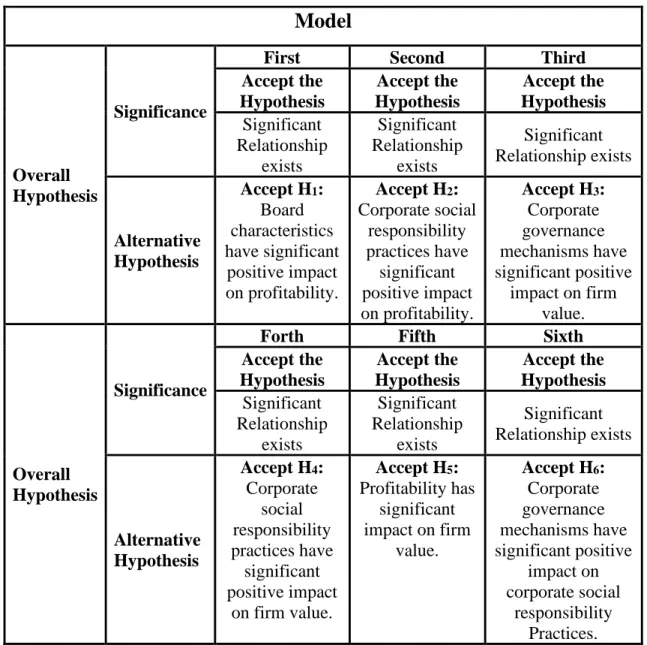
Second regression model, used to examine the impact of corporate social responsibility practices on profitability. Third regression model, used to examine the relationship between board characteristics (corporate governance mechanisms) and company value. Fourth regression model, used to examine the relationship between corporate social responsibility and corporate value.
The sixth regression model used to examine the relationship between corporate governance mechanisms and CSR practices. The definition and measurement of independent and dependent variables used in testing the research hypotheses is presented in Table (1). CEO duality occurs when the same CEO is the chairman of the board of directors.
Board Independence, a member of the board of directors is considered independent if he is not an investor in the company and is not involved in its daily operation in an executive manner. Board size is the total number of internal executive and external non-executive directors on the board. Corporate Social Responsibility practices are a management concept where companies integrate social and environmental concerns into their business operations and interactions with their stakeholders.
Corporate Responsibility Index (CRI) developed to enable quantification of the qualitative CSR data obtained from company annual reports. Firm Value (FV) Firm Value is the market value that a company is worth on a particular date. Enterprise value is measured by multiplying the number of shares outstanding by the market share price of the shares.
Return on equity refers to how a company's management is able to generate income from shareholders' investment by increasing productivity and profits in a sustainable manner. It compares the book value of its assets with how much more the company is worth. Tobin's Q = Market value of equity capital + Book value of current liabilities) ÷ Book value of total assets.
Statistical Results and Analysis
Linear OLS Panel Regression Models Model Structure View
Steps of constructing a Panel Regression Model
Display a graphical representation of your predicted values within the standard error of the model.
The six panel models for Estimating the three Multiple Linear Panel Regression Equations
From the previous table it is concluded that
Table (3) shows the statistical results for the second regression model used to examine the impact of corporate social responsibility practices on profitability. All the independent variables and the controlling variables have significant impact on ROA as all their p-values are less than 0.05. Table (4) shows the statistical results for the third regression model used to examine the impact of board characteristics (corporate governance mechanisms) on firm value.
All independent variables and the controlling variables have a significant impact on FV as all their p-values are less than 0.05. Table (5) shows the statistical results for the fourth regression model used to examine the impact of corporate social responsibility practices on firm value. Table (6) shows the statistical results for the fifth regression model used to examine the impact of profitability on firm value.
All profitability indicators (namely gross profit, return on assets and return on equity) and also the control variables: Tobin's Q and firm size have a positive significant influence on firm value. Table (7) shows the statistical results of the sixth regression model that was used to examine the impact of corporate governance mechanisms on corporate social responsibility practices. All the independent variables and the controlling variables have significant influence on CSR as all their p value is less than 0.05.
CEOD, board independence, Tobin's Q and firm size have a significant positive impact on corporate social responsibility.
Model
Conclusion
Impact of CEO and Audit Committee Duality on Firm Performance: A Study of Listed Oil and Gas Firms of Pakistan. CEO Duality and Firm Performance: An Empirical Study of EU Listed Firms”, 3rd IBA Bachelor Thesis Conference, Enschede, The Netherlands. The Dynamic Relationship between CEO Duality and Firm Performance: The Moderating Role of Board Independence”.
The Relationship Between Corporate Social Responsibility and Shareholder Value: An Empirical Test of the Risk Management Hypothesis”. The e-effect of financial performance on firm value with CSR disclosure and dividend policy as moderation. The value of corporate philanthropy in times of crisis: the empowering effect of employee engagement”.
“Dampak Corporate Governance Perception Index Terhadap Kinerja Perusahaan Pada Perusahaan Yang Terdaftar Di Bursa Efek Jakarta”. Dampak Tata Kelola Perusahaan terhadap Pengungkapan Lingkungan Perusahaan Non-Keuangan yang Terdaftar di Nigeria”. Ketika Masalah CEO Career Horizon Penting untuk Tanggung Jawab Sosial Perusahaan: Peran Moderasi dari Kebijaksanaan Tingkat Industri dan Kepemilikan Blockholder”.
Dampak independensi dewan dan dualitas CEO terhadap kinerja perusahaan: Analisis regresi kuantil untuk Indonesia, Malaysia, Korea Selatan dan Thailand. Pengaruh Good Corporate Governance terhadap Nilai Perusahaan dengan Kinerja Keuangan sebagai Variabel Intervening pada Perusahaan yang Mendapatkan Predikat Perusahaan Terpercaya di Indonesia – CGPI. Pengaruh tata kelola perusahaan yang baik dan pengungkapan tanggung jawab sosial perusahaan terhadap nilai perusahaan (studi empiris pada perusahaan tercatat di Indonesia pada periode tersebut.
The relationship between corporate governance and firm value in developing countries: evidence from Bangladesh. Analysis of social responsibility and reporting methods of Romanian companies in the countries of the European Union”. CEO duality and firm performance: The moderating roles of other lead and block outside directors.