
The study revealed a need of Geography pre-service teachers to improve their awareness of formative assessment. The study therefore confirmed the importance of preparing training program to improve Geography pre-service teachers' formative assessment competencies. What is the effectiveness of a training program based on Standards of Teacher Competence in Educational Assessment to improve formative assessment competencies for geography pre-service teachers.
What is the effectiveness of a training program for improving the cognitive competencies of formative assessment for pre-service geography teachers. What is the effectiveness of the training program for improving the skills of formative assessment competencies for pre-service geography teachers. Plan a training program based on the Standards for Teacher Competence in Educational Assessment to improve geography teachers' competencies for formative assessment.
Pre-service geography teacher training on activities and characterizing formative assessment knowledge and skills using active learning strategies. Identifying the effect of the suggested teaching program on the development of formative assessment competencies for pre-service geography teachers. Studying the development of pre-service geography teachers in relation to classroom-based formative assessment.
To keep pace with contemporary international changes in the development of formative assessment skills and knowledge for pre-service teachers.
Review of literature
Standards for Teacher Competence in Educational Assessment of Students
Formative assessment
- What is Formative Assessment?
- The purposes of formative assessment
According to many of these, the researcher identifies cognitive and skill competencies of formative assessment. A single commonly accepted definition of formative assessment describes it as a classroom-based process in which students and teachers gather evidence of learning to understand current learning progress and make adjustments to learning and teaching as needed (NICOL, D.J. There are two main goals) of formative assessment, the first is to support students' learning, while the other is to improve teachers' teaching.
First, supporting the students' learning included monitoring the improvement, learning or understanding of the students during the teaching and learning. The distinguishing feature of formative assessment is that the assessment information is used by the teacher and pupils to change their work to improve it and be more effective. Formative assessment is reactive in many ways: that it was recognized by its ongoing, active and progressive nature and that it tended to be informal, with no written record of the information gathered.
Formative assessment is interactive because there is interaction between teacher and student during the teaching and learning process. A new common comment from the teachers is that they were not always aware of doing formative assessment, especially unplanned or interactive formative assessment. This professional knowledge and experience includes the teachers' knowledge and activities about the subject, and the teachers' prior knowledge about the students themselves.
Another characteristic of formative assessment is that both the teacher and the student do the assessment. Teachers use formative assessment during the instructional process and use the information to make adjustments to their instruction to better meet the needs of students. Formative assessment strategies come in a variety of formats such as: homework, quizzes, tests, exit tickets, concept mapping, problem solving, observation, student survey, student feedback, and self and peer assessment, etc.
Regier, N. 2013) classified formative assessment strategies into: formative assessment strategies for teachers such as ABC Brainstorming; Analogies, checklists, choral response,. Cloze procedure, concept maps, discussions; Double book journals, examples/non-examples, three facts and a lie and a fist of five etc.; And formative assessment strategies for students such as Ask, Process Exempllars, Self-Marking Quizzes and Writing Continuums.
To summarize
Procedures of the study
Validating the program to make sure of its suitability
To what extent are the topics of the program sequential and connected to each other.
Fifth: Preparing the instruments of the study
Test validity
Piloting the Test
Internal consistency: it describes correlation coefficients between the score of each dimension and the score of other dimensions. In addition, the correlation between the score of each dimension and the total score of the test was calculated. The researcher concluded that each dimension in the test has statistically significant correlations with the other dimensions and with the total score of the test indicating that the test has a high degree of internal consistency.
After making modifications and omitting some items in the light of the opinions of the jury panel, the Test included (42) items.
Test of skills competencies of formative assessment Aim of the Test
Internal consistency: it describes Correlation coefficients between the score of each dimension
After making the changes and omitting some items in light of the panel of jurors' statements, the test included (18) items. The test score distributed using analytical rubric criteria to help the researcher judge more objectively, a grading rubric includes criteria, performance levels, scores, and descriptors for each question. A sample of the study consisted of geography preschool teachers enrolled in the third year at the Faculty of Girls, Ain shams university.
Seventh: Administering instruments of the study
The administration of the instruments and the teaching of the training program lasted 15 lectures during the first quarter of the academic year 2016/2017. The Formative Assessment Cognitive Competency Test and the Formative Assessment Skills Competency Test were administered to the sample after completion of the training program.
Results of the study
The results show that there is a statistically significant difference at p < 0.05 between the pre-service teachers' mean scores on the cognitive competence test of formative assessment before and after the study of the suggested program in favor of the post-administration. This shows that the suggested teaching program has positive effects on the development of cognitive competencies of formative assessment for pre-service geography teachers. Regarding the size of the effect of the program on the development of the cognitive competences of the formative assessment, the Cohen's d Calculator for the T Test was calculated. It reached Cohen = (8.6), the effect size = (0.97) which means that the program has a high effectiveness in cognitive competencies.
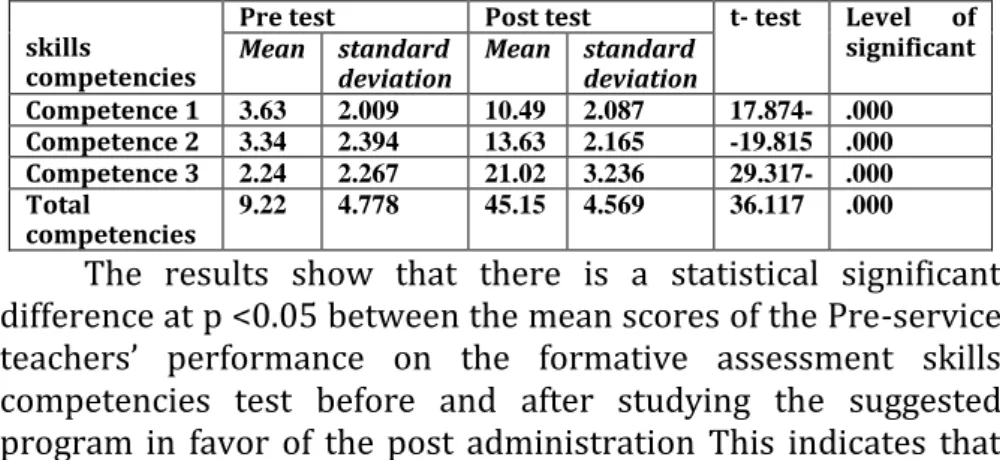
There is a statistically significant difference at p <0.05 between the mean scores of the formative assessment competence test of pre-service teachers before and after studying the proposed program in favor of the administration. The mean scores of the sample in the pre-posttest as a whole and for each level were calculated (Table 5). The results show that there is a statistically significant difference at p <0.05 between the mean performance scores of pre-service teachers on the formative assessment competency test before and after studying the proposed pro-service program.
This indicates that. the teaching of the proposed program has positive effects in developing the skill competencies of formative assessment of geography teachers. Regarding the effect size of the program on the development of formative assessment competencies, a Cohen's d calculator for the T test was calculated. 0.99), which means that the program has a high efficiency in skill competencies.
Discussion of the results
On the other hand, during the practical part, the researcher noticed that some competencies were difficult for the students, such as skills competency, one that required pre-service teachers to analyze the weaknesses and strengths of the students' answers by using samples of the students' answers to some geography exams and quizzes for secondary grade (2016) also; skills competency three, which required pre-service teachers to design peer and self-evaluation checklists; design rubric for projects or open questions, maybe it is due to leakage in applying skills. While learning some skills such as cognitive skills and using strategies in lesson plans, they had enthusiasm.
Recommendations of the study
Can teachers use assessment to improve the learning process? 2012), Regional Study on Teacher Policy – Phase II: Egypt Case Study, World Bank, Washington, DC. University of California, National Center for Research on Evaluation, Standards, and Student Testing (CRESST). 2000) „Improving formative assessment in geography‟ Teaching Geography, 25, 3, pp. 2000) „Diagnostic and formative assessment of student thinking‟, Teaching Geography, 25, 1, pp. OECD/CERI International Conference (2008) “Learning in the 21st century: research, innovation and policy” Assessment for Learning Formative Assessment, ORGANIZATION FOR ECONOMIC COOPERATION AND DEVELOPMENT.
Regier, N.(2012) Book Two: 60 Formative Assessment Strategies, Focus on Student Learning - Instructional Strategies Series, Regier Educational Resources. Trumbull, E& Lash, E.(2013) Understanding formative assessment insights from learning theory and measurement theory, West Ed on the topic of formative assessment. Zhang, Z. & Burry-Stock, J. (2003) Classroom Assessment Practices and Teachers' Perceived Assessment Skills, APPLIED MEASUREMENT IN EDUCATION.