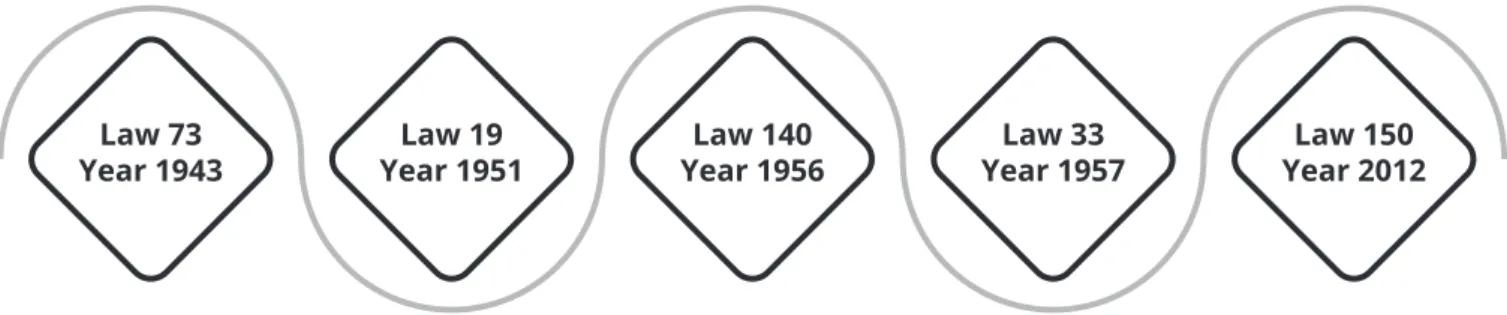
The opinions expressed in the paper are those of the authors and do not reflect the policies or views of AUC. Experiences of countries in dealing with the problem of informal traders Legal framework of informal traders in Egypt. The policy document deals with the issue of traders using unofficial means of transport, namely in the metro (underground) and railway stations.
The policy paper has proposed three policy options for dealing with the issue of trading in metro and railway stations. Therefore, the paper recommends the implementation of the policy of using communication technology tools (ICTs) to arrange the informal hawkers in the means of transport. The policy paper's primary target audiences are the Transport Planning Unit, the Egyptian Metro Management and Operations Corporation, Egyptian National Railways, Transport Police officials, the Ministry of Social Solidarity (MoSS), the Ministry of Communications and Information Technology (MCIT), the Micro, Small and Medium Enterprises Development Agency (MSMEDA) and the informal peddlers in means of transport.
The secondary audiences of the policy document are the private sector, National Non-Governmental Organizations (NGOs), International Non-Governmental Organizations (INOs), and the public/customers (passengers). As a result, the authorities either evict the informal hawkers or move them to another place under the policy enforcement of the urban order. Most of the working class citizens use the Metro and trains as the main means of transport to reach their workplace and homes.
There is a plan to increase the number of stalls in the future (Central Railway, 2019).
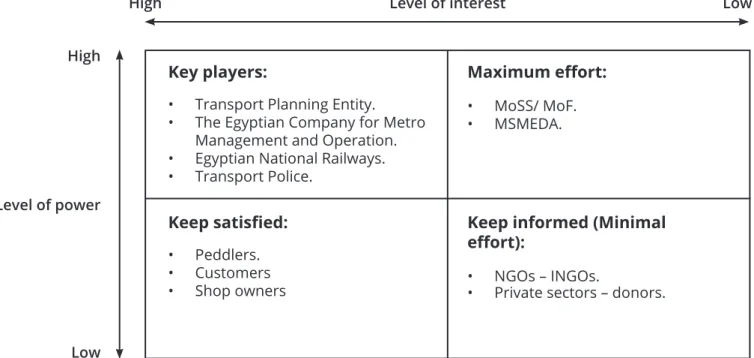
Informal Peddlers: They are the key stakeholder and aim to have a stable and
The Ministry of Transportation – Trans- port Planning Entity, the Egyptian Com-
Transport Police: The security arm to sup- port the regulation of the peddlers in the
The Ministry of Social Solidarity - MoSS
Shop owners: Informal peddlers are con- stituting a source of threat to them, as
The Medium, Small and Micro Enter- prises Development Agency - MSMEDA
National and international organiza- tions and the private sector: Play an im-
Informal hawkers are still an essential part of the informal economy and function without administrative action. The effectiveness criterion assesses the direct intended results of the policy and its contribution to the achievement of the policy results and objectives. It is important to analyze the consequences if the intended results of the policy do not occur (the counterfactual scenario) (Ministry of Foreign Affairs, Netherlands).
The criterion of equality aims to measure the inclusiveness of the policy to avoid any kind of injustice for other segments of society. Does the proposed policy option achieve more elements of the intended objectives compared to other proposed policy options. The location of this area is recommended to be near metro and railway stations, such as Syrian exhibitions located in the middle of vital roads.
Among the challenges faced in controlling the goods promoted by the informal hawkers are the low quality products, theft, harassment and tax evasion. Provide a large market for the government, improve the quality of the products and help the informal hawkers to access the export market. Companies can apply as individuals to win the kiosks, and this will limit the opportunities of the informal hawkers to have one of them.
This policy option is expected to receive approval from politicians and achieve its goal of removing informal hawkers from stations. This will be one of the national projects that may need enhanced coordination between different stakeholders. They will no longer avoid paying fees and taxes, and the stations will be given a civilized image.
Thus, the revenues of the two governments will increase with the expansion of the number of kiosks in transportation. The timeline of implementation is 1 to 2 months and the nature of these kiosks is already known. Before presenting the main points of the plan, three key steps must be accomplished.
Social Insurance Coverage
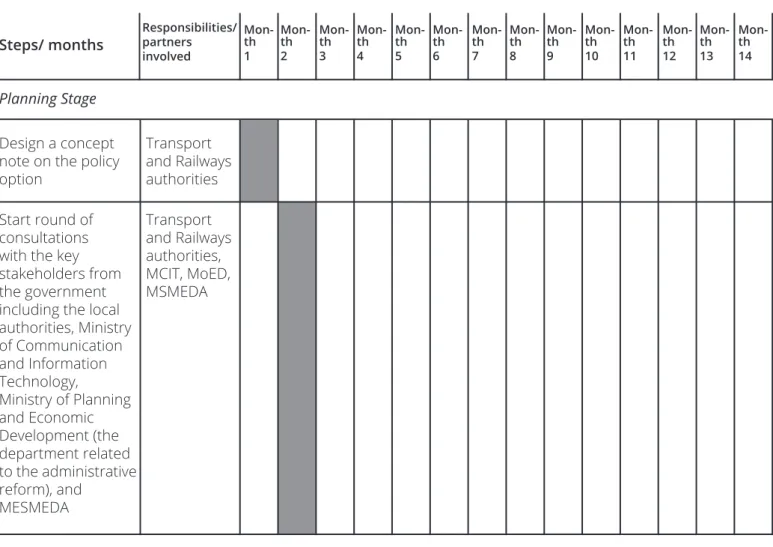
As a world that uses technology in all aspects of daily life, and as Egypt is becoming one of the leading developing countries in adopting digital transformation in various fields, it is recommended that it be used in addressing the issue of informal peddlers. In response to the selected policy option, an implementation plan is proposed with a proposed timeline to determine the steps that are recommended to be followed to ensure the success of the policy implementation.
Develop a training needs assessment survey (Enhancing the productivity of
Licenses
The system will automatically check the expiry date of the license, any missed installments of the peddlers and any payments due to violations and the size of the business. Personal QR code for informal traders, including personal information, sales, taxes and fees. A public QR code that includes information about the business of informal hawkers, such as goods and prices.
These QR codes will be sent directly to the vendors using their unique identification number through the connected phone number or email address (Hoang et al., 2019). The informal hawkers will undertake to provide receipts to the customers so that the government can calculate the taxes, and also in the beginning the government can give incentives to those who undertake to issue the receipts. Start consultation round with the most important stakeholders from the government, including the local authorities, the Ministry of Communications and Information Technology.
Hold consultation meetings with representatives from transport vendors to discuss the opportunities and challenges of the proposed policy and listen to their fears and suggestions Another consultation meeting with representatives from the private sector, NGOs, NGOs, experts, professors. Final policy document to be submitted to the Ministry of Transport Drafting of a detailed work plan for phased implementation. A more detailed plan should be. Transport and Railway Authorities, private sector, sponsors, NGOs, NGOs, experts, professors Transport and Railway Authorities.
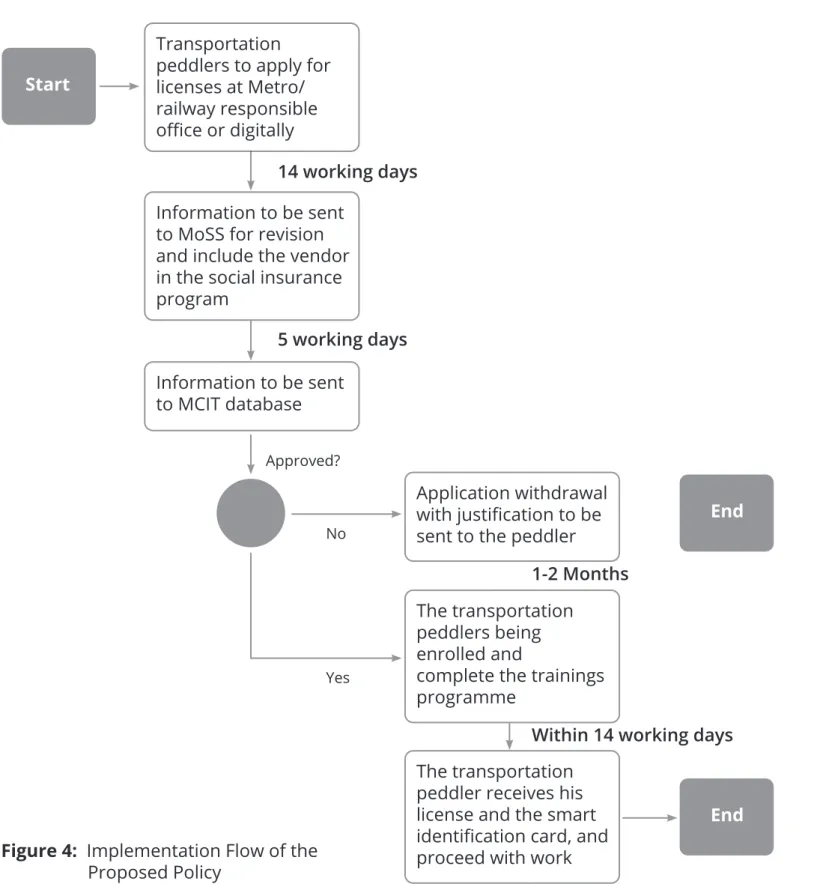
MCIT is starting the development of the QR codes, smart IDs and the database in collaboration with MoED (Administrative Reform branch). MoSS begins the consultations with Transport and Railway authorities and MoF on the development of a social insurance system for the transport hawkers. It is recommended to have a simple and clear workflow depending on the policy of one stop shop to encourage the transport peddlers to register.
Information to be sent to MoSS for review and including the supplier in the social insurance program.
It is recommended to develop a participatory monitoring and evaluation system, with the participation of the relevant government agencies, the private sector, NGOs, INGOs and also the transport traders, where they can articulate their suggestions and any obstacles. we are confronted with, to be part of the decision-making process, which will allow more efficient supervision of this part. The monitoring and evaluation process takes into account the key phases of policy implementation to ensure the achievement of the intended outputs and results. The main mandates of this independent authority are to conduct a baseline survey of the transport peddlers, review the progress reports received from the relevant government agencies that are part of the implementation process, assess the progress of the KPIs and provide training overseas. results, closely monitor the integrated database and electronic system, and evaluate the results of the policy and promote its impact.
These strategies will guarantee the effectiveness of the implementation and will provide a periodic assessment of the intervention. The proposed policy involves a number of risks which may affect successful implementation and which need to be considered in the early stages of implementation. In addition, this policy option provides a more stable and secure situation for the informal hawkers, including social insurance and the potential to expand their businesses.
In addition, the carriers (both Metro and Railways) will retain the right to collect services, increase their revenue, determine the extent of this peddling and maintain the civilized image of the means of transportation. The government is recommended to conduct a needs assessment study/situation analysis for informal peddlers and attract donors to fund the study to determine the size of this market, the number of informal peddlers participating in each market and the level of income through their businesses. It is recommended that each metro station and railway station provide the possibility of setting up committees, local bodies and unions to present the needs, proposals and demands of each group of hawkers and facilitate mediation and conflicts between hawkers and key stakeholders. .
Metro's spokesman for the citizens of the street vendors: Their goods are scrapped under the seats". Retrieved from: https://www.egypttoday.com/Article/73635/3/Egypt-prepares-to-issue-law-merging-informal-economy-with-legal. Jadaliyya(blog) Retrieved from: www.jadaliyya.com/pages/index/9542/ordering- the-disorderly-street-vendors-and-the-dev.
Retrieved from: https://www.freepressjournal.in/cmcm/. Mumbai-proposed-underground-hawking-zone-in-andheri-gets-nod. the challenge of informality in the Middle East and North Africa”. The Critical Role of Street Vendor Organizations in Moving Street Vendors to Public Markets: The Case of Hsinchu City, Taiwan”. It provides the mechanism through which the good ideas, plausible answers and meaningful solutions to Egypt's chronic and acute policy dilemmas proposed by the country's brightest minds, the experienced and creative ones from different age groups, can be nurtured, discussed, debated, refined, tested and presented to policy makers in a.

Where Rigour Meets Creativity