The overall shape of a sedimentary facies is a function of predepositional topography, the geomorphology of the depositional environment, and its postdepositional history. The lithology of a sedimentary facies is one of the easiest parameters to observe and one of considerable environmental importance. The coarser the grain size, the higher the energy level of the deposition current and.
Pre-depositional sedimentary structures are those observed at bed boundaries that formed before the deposition of the younger bed. Tectonic geomorphology is the study of the interaction between tectonic and geomorphic processes in areas where the Earth's crust is actively deforming. In shallow marine environments, landforms include ripples, dunes, sand waves, sand ridges, coastlines and subsurface channels. The continental slope transition zone consists of submarine canyons and trenches, inter-canyon areas, intra-slope basins, and depressions.
The scratch is formed on the face of the fallen block and faces the fallen block. This is the beginning of a river system where it grows due to the meeting of different tributaries.
Channel deposits
The geomorphological zones in alluvial and fluvial systems: In general, braided rivers are common in more proximal areas and meandering rivers. Repeated migration during floods produces 'sliding bars'. Deposition on point bars is the result of lateral migration of a meandering river during floods. The lithology and grain size of point-bar deposits depend on the available grain size. When rivers supply gravel-sand material, the change occurs from gravel, coarse sand to fine sand and silt at the top.
In rivers carrying fine-grained material, the change is from fine sand layers near the bottom to silty and clayey sediments near the top. According to the primary structures, the point strip deposits show large-scale transverse bedding (megaripple bedding) in the lower part. Above the needle-bedding zone is a zone of small-ripple cross-bedding and stick-ripple lamination.
In ancient sediments, they would occur as elongate, rather narrow mud layers within a sequence of point bars.
Bank deposits
The dikes slope gently from the river bank into flood basins away from the channel. Levees are better developed on the concave sides of the river channel; on convex sides dikes are graded to upper point bars. Natural levees are formed by the deposition of sediment when the flood waters of a stream exceed its banks.
The velocity decreases, causing a large portion of the suspended sediment to be deposited near the channel. Crevasse spray deposits are narrow to broad tongues of sediment that taper in one direction (flood basinward). Channel-fill deposits represent sedimentation in stream channels that have been abandoned due to disruption or avulsion processes.
Abandoned channels are slowly washed away and closed at both ends, so that the old channel loop is isolated in the form of a cut-off lake or ox lake. The bed fills are represented by a sequence of thick clayey sediments in the form of clay plugs, the thickness of which depends on the depth of the abandoned bed.
Flood basin deposits
Midfan (middle fan segment): the area between the fan head and the other lower boundaries of the fan. In the case of a large slope of the coast, the sandy area may be completely absent. Red clays and silts in the center of the lake basin generally pass through outwash alluvial plains into fanglomerates adjacent to the mountains.
The constituents of the clast are Eocene carbonates and chert. The conglomerates are immature and the absence of any form of clast-oriented long axis is common. Lake carbonate facies: dominated by algal stromatolites and oncolites and algal laminated dolomites. Stromatolites grow in conglomerates and are domal type. Associated oncoliths may support the shallow nearshore environment. The predominance of dolomites laminated with algae indicates limitation of lacustrine conditions (unfilled phase.).
This differential subsidence is characterized by a thickening of the fill in the eastern part compared to the western side. Subsequently, greater aridity prevailed during the formation of the upper unit, leading to the deposition of dolomite facies. These sandstones contain no fossils. The absence of pebbles, which are generally too heavy to be blown by the wind, and of clay, which is generally too light to settle on windy earth.
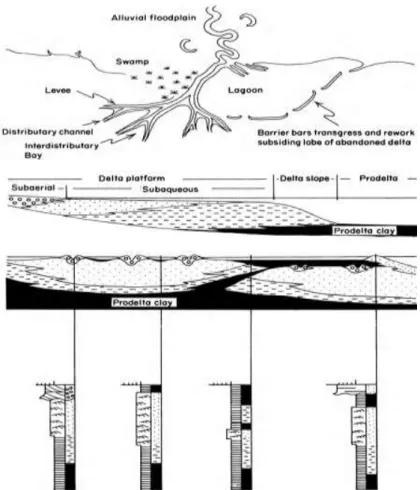
Aeolian sands are widely believed to be highly rounded, and certainly experiments show that wind is much more efficient at rounding quartz sand than running water. Aeolian sand grains show a frosted, pitted surface under the optical microscope and, under the higher powers of the electron microscope, show a variety of characters which can be used to distinguish them from sands subjected to hydrogeological and glacial action. .The presence of pebbles (ventifacts) facing the wind. Sedimentary structures are often used for it. Finer silt and clay are deposited in the flood basins and lagoons of the interdistributary areas. Offshore of the mouth of the distributary channel, sediment is deposited on the submarine delta platform.
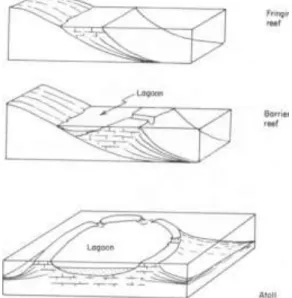
The relationships between the controls, the shape of the delta and the facies are summarized in Figure. Good examples occur along the desert coast of the Gulf of Aqaba on the Red Sea. It can be narrow or, in the case of the Great Barrier Reef of Australia.
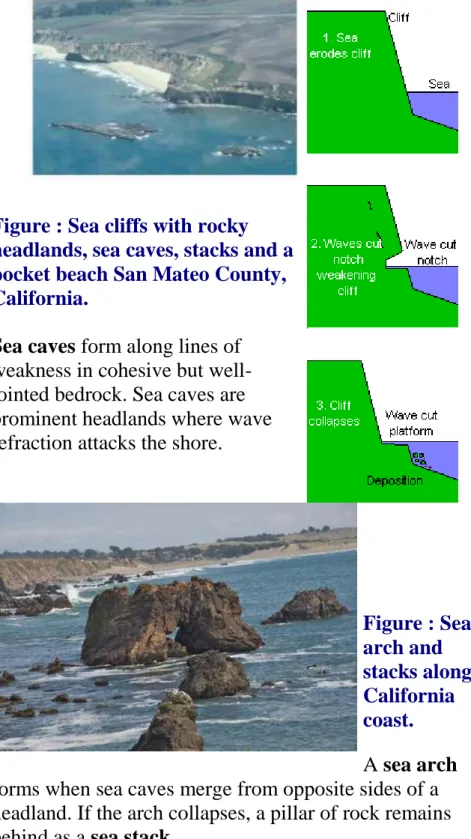
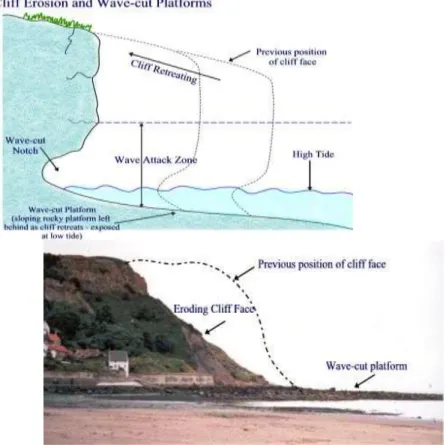
81 . is crucial for an understanding of their depositional environment. calcareous algae have been important reef organisms. Some of the most spectacular landscapes are found along coastlines and produced by the effects of wave erosion. If the domes enter the photozoan carbonate factory (i.e., the photic zone), they develop carbonate platforms that are circular or annular, reflecting the morphology of the upper salt surface.
In carbonate karst areas, most of the dissolution takes place in the epikarst, near the surface (Williams,.