VIII del laboratorio de Secuenciación Genómica de Biodiversidad y Salud, LANABIO, por su apoyo en esta investigación. El objetivo del presente estudio fue caracterizar molecularmente las ninfas encontradas para asociarlas con adultos de O.
Asociar los adultos de Ocoaxo assimilis con las ninfas encontradas en Nicolás Bravo, Puebla e identificar morfológicamente a las ninfas, describiendo su biología y hábitos. Reconocer morfológicamente a los adultos y asociar las ninfas con el adulto mediante un fragmento del gen COI (código de barras).
- Antecedentes
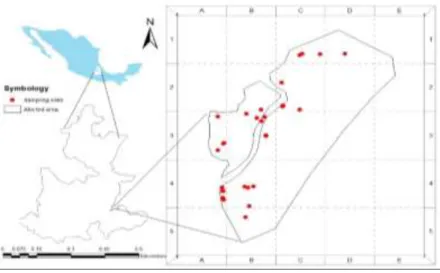
- Zona de Estudio
- Cercopidos
- Ocoaxos
- Amplificación de ADN por PCR
- Herramientas moleculares aplicadas al estudio de la diversidad
17 combustión de materia orgánica para ayudar a la penetración de productos químicos y biológicos (Cibrián Tovar et al., 2016). Alrededor de la picadura aparecen decoloraciones de los tejidos de la aguja en áreas concéntricas en forma de anillo.

Abstract
In Nicolás Bravo, State of Puebla, Mexico, yellowing was reported in a natural pine forest, a phenomenon termed "pine decline" and associated with the presence of Ocoaxo assimilis adults. In this study, using morphological and molecular data, we were able to link the immature instars with the adults of this species, which made it possible to determine the number of nymphal stages of this species, to know their abundance over time and to describe the morphological change they present during their life cycle. In addition, sampling of nymphs and adults, along with field and laboratory experiments, has provided knowledge of the voltamism, spectrum, and host preferences of these stages.
The appearance of nymphs is associated with the beginning of the rainy season, the preference of hosts in the most youthful stages (N1-N3) is very wide, they can eat from herbaceous to pine trees that pass through the bushes, from the 4th stage, nymphs prefer pines, in which they complete their transformation and feed themselves when they are adults.
Introduction
30 1969), Sphenorhina pseudoboliviana Paladini & Carvalho (Paladini and Carvalho 2013), Tunaima brunneolutea Carvalho (Carvalho 1990) and Zulia carbonaria Lallemand (Cardona et al. 2004); meanwhile, this topic is poorly studied in most members, especially in those species with conifer feeding preferences (Castro-Valderrama et al. 2019). Cercopids adults have been documented feeding on conifer species of Pinacea and Cupresaceae families; For example, Haematoloma dorsatum Ahrens is considered a common pest from Europe that promotes needle desiccation of at least seven Pinus species and also members of Abies Mill., Cedrus Trew, Cupressus L., Juniperus L., Picea Link and Pseudotsuga Carriére (Notario et al .al. 1981, Covassi et al. 1989, Cobos 1995). The pine spit Aphrophora cribrata (Walker et al. 1858) is another common species, native to North America that causes severe injury to conifers of all sizes, in nurseries and mature forest trees (Wilson 1991) of at least 17 species of Pinus L ., 12 of Picea (Skakel), three of Abies Mill., Larix Mill.
In the last ten years, the first records of spitting bug outbreaks have been documented in Mexican pine forests from Puebla, Oaxaca and Veracruz states (Castro-Valderrama et al. 2017, CONAFOR 2018); the insect symptomatology was named "pine reduction" and it was similar to that caused by adults of the pine spitter H. The characteristic colors and other symptoms of tree damage by adult spitting bugs were evident during the rainy season and these disappeared when the trees recovered their health appearance in the beginning of the next rainy season; phenomena occurring at different geographic scales every year until 2018 (Castro-Valderrama et al. 2017). The impact of damage from spittlebug outbreaks of about 2500 ha in the state of Veracruz (CONAFOR 2018) to 3,000 ha in Puebla (CONAFOR 2017, Pichardo Segura et al. 2017), which has led these insects to be considered pests of economic importance in these regions.
The absence of biological information on Ocoaxo species has led to rethinking their relationship with pine decline (Castro-Valderrama et al. 2017); therefore, its status as a pest species of economic importance is questioned.
Methodology
DNA extraction of nymphs and adults was performed using the standard protocol for Genomic DNA Spinning Column Kit EZ-10 (Bio Basic Inc.). Measurements were taken in micrometers from the reference point configurations, measuring the distance of the corresponding lms in the PAST version. The normality of the distribution of each continuous character was tested independently by the Shapiro-Wilkinson test (Shapiro and Wilk 1965).
Every three days the containers were sprinkled with water to maintain humidity and the number of salivary masses present as an indicator of live nymphs was recorded, after one month the percentage of survival of the nymphs in each host species including both replicates was counted . Host specimens were deposited in the herbarium of the Forest Sciences Department of Chapingo Autonomous University (numbers: 69559 to 69565). Two samples corresponding to the same host species and interspecific combinations of the three hosts were placed in each plastic container, quantifying a total of six treatments: (T1) Q.
The boxes corresponding to each treatment were placed in a Prendo CB-20 bioclimatic chamber that controls the soil moisture and temperature using the KC-300 4 in 1 Soil Survey Instrument sensor as well as the internal temperature of the chamber.
Results
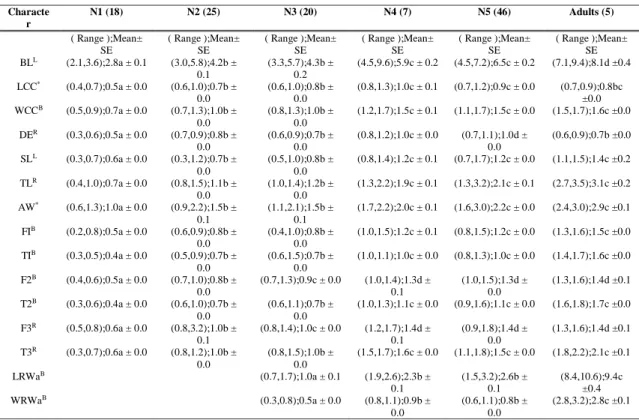
Four outliers from the pooled data were excluded from the analyzes in each of the 15 continuous morphological characters (n=121). 44 The first three components of the PCA taking into account the 15 continuous characters (BL, LCC, WCC, DE, SL, TL, AW, FI-FIII, TI-TIII, LRWa, WRWa) from both nymph and adult samples quantified 88. Biplots of the relative contribution of each character in both PCs supported that characters T3, T2, WCC and F2 contributed more to explain the differences in PC1 (among nymph groups) and LRWa, WRWa, T2 and T1 in PC 2 (among nymph groups) and adult samples). The first three components of the PCoA accounting for the four discrete characters (BC, FN, SWD and SMN) and 15 continuous characters (BL, LCC, WCC, DE, SL, TL, AW, FI-FIII, TI -TIII, LRWa, WRWa) from both nymph and adult samples quantified 84% of the total variation (PCo1-78.2%, PCo 2-4.2%, PCo 3-1.6%).
Multi-cancelled flagellum of antenna divided into six flagellomeres (Figs.. 30 and 31), wing appendages present as wing pads, exceeding third abdominal segment in dorsal view; with eleven to fourteen apical spines on metatarsi, abdomen similar to earlier stages with genital plates on the eighth and ninth segments more developed, allowing differentiation of the sexes (Fig. 52 red, brown wing pads exceeding third abdominal segment, tegmina with a cream-yellow basal spot, typical of the species Body color reddish-orange, multiple flagellum of antenna divided into six flagellomeres, buccal apparatus formed by maxillary stylets, saw mandibles, labium and palpus; these elements can be recognized from the nymphal stage one of which they enlarge in each of the stages (Figures 38-45); wings well developed, larger than abdomen, with eleven to fourteen apical spines on metatarsi; wings exhibit the diagnostic tegmina with a cream-yellow basal spot connected to a cream yellow longitudinal line, ending as a weakly outlined "tajamata".
A Nicolas Bravo forest was documented, showing a clear seasonality from the onset of summer rains, in the second half of June, until autumn in the second half of October. Adults were found from the second week of July to the third week of October, overlapping with N5; the higher numbers of adults were recorded in the last week of August (N=35) (Table 3). However, the specimens were unable to continue their development in all host species; in total, only 23% of them (n=13) survived to the end of the period.
Discussion
Genetic differences observed between the Guatemala and Nicolas Bravo sequences correspond to 9.1% divergence in the COI sequence data found among other Ocoaxo species and 7.1% in other species of Cercopidae (e.g., Sphenorhina spp.). Notable changes were also discerned throughout its evolution, such as the development of the wing packs or stubs, which help to differentiate the first two instars from the others, this facilitates the classification in the field of individuals per instar The presence of nymphal stage one was closely related to the increase in humidity in the environment, which is why nymphs emerge when the rainy season begins.
Nymphs are present from the beginning of the rainy season in the region, mid-June to early September. Adults met in the field from the third week of July to the third week of October. 63 the presence of these species in the forests and the need not to starve in search of the host plant.
The survival of the nymphs in the first experiment was probably related to that described by Ewan (1961) who states that the main stages (nymph three onwards) prefer woody plants and perform a differentiated migration rather than a mortality.
Acknowledgments
Two new species of bed bugs of the genus Ocoaxo Fennah (Hemiptera: Cercopidae) from Mexico and keys to groups, group three and subgroup one. Descriptions of immature stages and new host plant records of Notozulia entreriana (Berg) (Hemiptera: Cercopidae) pests of grasses in subtropical America. Mixed risk propagation strategies and population dynamics of the Brazilian rangeland pest, Deois flavopicta (Homoptera: . Cercopidae).
Identity and first record of the spitting beetle Mahanarva bipars (Hemiptera: Auchenorrhyncha: Cercopidae) on sugarcane in Colombia. Structure and function of Malpighain tubules and related behavior in juvenile cicadas: Evidence for homology with spitting bugs (Hemiptera: . Cicadoidea and Cercopoidea). Molecular phylogeny and DNA barcoding in the meadow louse Philaenus spumarius (Hemiptera, Cercopidae) and its related species.
Abrupt geographic transition between aposematic color forms in the fungus Prosapia ignipectus (Fitch) (Hemiptera: . Cercopidae).
Supplementary Data
Este estudio proporciona información importante sobre aspectos desconocidos de la biología de O. assimilis tales como: las características morfológicas que poseen las ninfas, sus plantas hospederas asociadas en esta etapa y el número de generaciones por año que presenta esta especie de pino. Mediante el apoyo de las claves taxonómicas proporcionadas por Castro-Valderrama et al. 2019) se comprobó que los adultos encontrados en el municipio de Nicolás Bravo, Puebla, pertenecen al O. Los individuos de esta especie presentan una generación por año, por lo que es una especie univoltina y la aparición de sus ninfas está muy relacionada con la estación. . de lluvia y la temperatura mínima que existe en el ambiente.
Se confirma la existencia de cinco estadios ninfales para esta especie, como lo menciona Castro Valderrama (2017), así como la existencia de los estadios 5a y 5b. Fluctuaciones poblacionales y GDD de mosca manchada en caña de azúcar en Ursulo Galván, Veracruz (págs. 16-18). Especies callosas y reactivas de oxígeno expresadas en hojas de caña de azúcar debido al daño mecánico causado por la mosca pinta.
Phylogeny and biogeography of Neotropical spitflies (Hemiptera: Cercopidae: . Ischnorhininae): Revised tribal classification based on morphological data.