Juan A. Fuster Verdú – IFIC, València XIII CPAN days
Huelva, 23 March 2022 p -
L
k 0 p +
p -
p - p
Accelerator and detector developments for future colliders;
Physics potential of e+e- linear colliders
J. Fuster 1
Acknowledgements, bibliography, information
Acknowledgements:
Thanks for the invitation to organizers
Special thanks (Material, pictures, talks, references):
Jie Gao (IHEP-CEPC), Juan Alcaraz CIEMAT), Marcel Vos (IFIC), Jenny List (DESY), Francisco Javier Cáceres
& Erik Fernández (INEUSTAR), Geoffrey Taylor (ICFA), Vladimir Shiltsev (Fermilab), Satoru Yamashita (U.
Tokio), Philip Burrows (John Adams Institute, U. Oxford), Tatsuya Nakada (EPFL), Shin Michizono (KEK), Michael Benedikt (CERN), Frank Simon (MPI), Steinar Stapnes (CERN), Ties Behnke (DESY), Marcel Stanitzki (DESY), Patrick Janot (CERN), Alain Blondel (LPNHE), Karl Jakobs (U. Freiburg), A, Faus-Golfe (IJCLab)
Outline:
• e+e- machines
• Detector proto-collaborations
• Specific physics potential of linear colliders w.r.t. circular colliders (complementary to M.
Mangano´s talk)
• On-going efforts of the community, Europe & Spain
J. Fuster 2
Energy dependence:
At low energies circular surpass linear colliders and can produce higher luminosities. At high energy this feature is highly reduced due to synchrotron radiation
At high energies linear colliders excellent (luminosity per beam power remains roughly constant)
Others interesting features:
LCs have polarized beams (80% e-, ILC also 30% e+), the spin of the e+e- beam can be maintained during the acceleration and collision. This can help significantly improve measurement precision.
Upgradeability: LCs can extend its collision energy by longer tunnel/ higher gradient
e+e- colliders linear versus circular
J. Fuster 3
Our instruments: e+e- Higgs Factories proposals
CEPC@China FCC-ee @ CERN
ILC @ JapanCLIC @ CERN
ILC: e+e- @ 250 GeV - 500 GeV – 1 TeV Polarized beams (e- 80%, e+ 30%) Technical Design Rep. in 2013 Staging proposal 2017:
• Start at 250 GeV, 500 Gev, 1 TeV
• Luminosity upgrade (increase RF power) Summer 2020: ICFA installed International
Development Team Now: Negotiating funding pre-laboratory
CEPC: e+e- @ 250 GeV & pp @ 70-100 GeV Conceptual Design Report published 2017 Technical Design by 2022
SppC: pp@ 50-70 GeV
FCC: e+e- @ 90-350 GeV & pp @ 100 TeV Conceptual Design Report published 2017 Feasibility study
CLIC: e+e- @ 0,38 TeV,1,4 TeV, 3 TeV Polarized beams (e- 80%, e+ 0%) Conceptual Design Report 2012 Updated Baseline 2017
11 Km-0,38 TeV
J. Fuster 4
Timeline and possible scenarios for future colliders
CERN Council president
J. Fuster 5
The International Linear Collider (ILC) in Japan
J. Fuster 6
ILC250 Acc. Design Overview
e- Source
e+ Main Liinac
e+ Source
e- Main Linac
Item Parameters
C.M. Energy 250 GeV
Length 20km
Luminosity 1.35 x1034cm-2s-1
Repetition 5 Hz
Beam Pulse Period 0.73 ms Beam Current 5.8 mA (in pulse) Beam size (y) at FF 7.7nm 250GeV
SRF Cavity G.
Q0
31.5MV/m (35 MV/m) Q0= 1x10 10 main linac
bunch compressor damping
ring
source pre-accelerator
collimation
final focus IP
extraction
& dump KeV
few GeV
few GeV
few GeV 250-500 GeV
Nano-beam Technology SRF Accelerating Technology
Key Technologies
Physics Detectors
Damping Ring
LC community meeting (Apr. 8,2019) Shin MICHIZONO
2
S. Michizono (LCWS21, 2021)
The International Linear Collider (ILC) in Japan
J. Fuster 7
ILC: Worldwide experience and construction capability
LC community meeting (Apr. 8,2019) 10
Shin MICHIZONO
SRF accelerators in the world
1.3GHz 9 cell cavity
SHINE
-75 cyromodules -~600 cavities - 8 GeV (CW)
Matured technology worldwide
J. Fuster 8
ILC: Beam parameters from Z-pole to 1 TeV
Matured technology worldwide
J. Fuster 9
ILC IDT (~1.5 years)
Prepare the work and deliverables of the ILC Pre- laboratory and work out, with national and regional laboratories, a scenario for their contributions
Prepare a proposal for the organisation and governance of the ILC Pre-laboratory
ILC Pre-laboratory (~4 years) Complete all the technical preparation necessary to start the ILC project (infrastructure,
environmental impact
and accelerator facility)
Prepare scenarios for the regional contributions to and organisation for the ILC.
ILC laboratory
Construction and commissioning of the ILC (~9-10 years)
Followed by the operation of the ILC
Managing the scientific programme of the ILC
ILC timeline
J. Fuster 10
ILC IDT (~1.5 years)
Prepare the work and deliverables of the ILC Pre- laboratory and work out, with national and regional laboratories, a scenario for their contributions
Prepare a proposal for the organisation and governance of the ILC Pre-laboratory
ILC Pre-laboratory (~4 years) Complete all the technical preparation necessary to start the ILC project (infrastructure,
environmental impact
and accelerator facility)
Prepare scenarios for the regional contributions to and organisation for the ILC.
ILC laboratory
Construction and commissioning of the ILC (~9-10 years)
Followed by the operation of the ILC
Managing the scientific programme of the ILC
Funding under negotiation:
February 2022 - MEXT did not accept the IDT proposal for Pre-lab as it stands but opened the
possibility for a reduced funding for ILC-R&D while international negotiations take place for seeking cooperation
End March 2022 - Important discussion at next ICFA meeting on how to proceed
ILC timeline
J. Fuster 11
ILC timeline
ILC IDT (~1.5 years)
Prepare the work and deliverables of the ILC Pre- laboratory and work out, with national and regional laboratories, a scenario for their contributions
Prepare a proposal for the organisation and governance of the ILC Pre-laboratory
ILC Pre-laboratory (~4 years) Complete all the technical preparation necessary to start the ILC project (infrastructure,
environmental impact
and accelerator facility)
Prepare scenarios for the regional contributions to and organisation for the ILC.
ILC laboratory
Construction and commissioning of the ILC (~9-10 years)
Followed by the operation of the ILC
Managing the scientific programme of the ILC
Funding under negotiation:
It’s not what we were aiming for at this moment but allows to move forward.
ICFA to decide next steps
J. Fuster 12
24
European ILC project plans
LC community meeting (Apr. 8,2019) Shin MICHIZONO
I. Introduction II. Accelerator
A. ILC accelerator competence in Europe
B. ILC accelerator Preparation Phase activities in Europe C. ILC accelerator in-kind contributions from Europe
during the ILC Construction Phase
D. Organisation of the accelerator activities
ILC Project: European perspective , arXiv:1901.09825
J. Fuster 13
24
European ILC project plans
LC community meeting (Apr. 8,2019) Shin MICHIZONO
I. Introduction II. Accelerator
A. ILC accelerator competence in Europe
B. ILC accelerator Preparation Phase activities in Europe C. ILC accelerator in-kind contributions from Europe
during the ILC Construction Phase
D. Organisation of the accelerator activities
Possible contribution from Europe:
20% of (stage 1) ILC = 1.0-1.5 B CHF
ILC Project: the European Perspective, arXiv:1901.09825
J. Fuster 14
Ph. Burrows (LCWS21, 2021)
CLIC: The Compact Linear Collider
J. Fuster 15
CLIC: The Compact Linear Collider
J. Fuster 16
Ph. Burrows (LCWS21, 2021)
CLIC: The Compact Linear Collider
J. Fuster 17
ILC & CLIC: Nano beams
J. Fuster 18
Future Circular Collider (FCC-ee, FCC-hh, FCC-he)
J. Fuster 19
Future Circular Collider (FCC-ee, FCC-hh, FCC-he)
J. Fuster 20
Future Circular Collider (FCC-ee, FCC-hh, FCC-he)
J. Fuster 21
Future Circular Collider: FCC-ee beam parameters
J. Fuster 22
Future Circular Collider (FCC-ee, FCC-hh, FCC-he)
J. Fuster 23
The Circular Electron Positron Collider (CEPC) in China
J. Fuster 24
The Circular Electron Positron Collider (CEPC) in China
J. Fuster 25
Center-of-Mass Energy [TeV]
0 1 2 3
] -2 cm-1 s-34 Inst. Luminosity [10
1 10 10
2Colliders e-
Luminosity vs Energy of Future e+
FCCee CEPC ILC baseline ILC luminosity upgrade ILC 10 Hz operation CLIC
Center-of-Mass Energy [TeV]
10
-11
Total AC Power [MW]
0 200 400 600
Colliders e-
AC Power vs Energy of Future e+
FCCee CEPC ILC baseline ILC luminosity upgrade ILC 10 Hz operation CLIC
Higgs Factories and power consumption
Luminosity Consumption
Linear Colliders ILC/CLIC: 250/380 GeV CM (Higgs Factory) extendable to ~ 1/3 TeV CM Circular Colliders: Higher Luminosities < 250 GeV
Polarisation (ILC) >80% e
-, 30-40% e
+(effective factor 2.5 in Luminosity)
No energy loss due to synchrotron radiation (DE ~ (E/m)
4R
-1) ---> Less power.
J. Fuster 26 Vladimir Shiltsev (Fermilab)
EPPSU 2019 Future Colliders, Granada
Higgs factories: maturity, consumption, cost
J. Fuster 27 Vladimir Shiltsev(Fermilab) EPPSU 2019 Future Colliders, Granada
Higgs factories: maturity, consumption, cost
J. Fuster
Our Instruments: Detector challenges (as an example ILC & CLIC)
) ,
,
( h ® b b c c t
+t
-s (1/ p) = 5 ´ 10 -5 /GeV
s E / E = 0.3/ E (GeV)
q µ
µ
s ip = 5 m Å 10 m / p sin 3 / 2
) nothing incl.
;
( e
+e
-® Zh ® !
+!
-X h ®
• Vertex, “flavour tag”
~1/5 r
beampipe, ~1/30 pixel size (ILC wrt LHC), vtx 1-2 cm vtx 2-3 cm (CLIC wrt ILC)
• Tracking, “recoil mass”
~1/6 material, ~1/7 resolution (ILC wrt LHC), B=4-5 T (CLIC and ILC)
• Particle Flow, Jet Energy Rec. à Tracker+Calorimetry
• Di-jet mass Resolution, Event Reconstruction, Hermiticity, coverage
~1/2 resolution (ILC wrt LEP),
Redesign Forward Region, HCAL 7,5 l (CLIC wrt ILC)
J. Fuster 29
Our Instruments: The detectors for Linear Colliders
https://www.ilcild.org/
https://pages.uoregon.edu/silicondetector/
https://clicdp.web.cern.ch/
https://agenda.linearcollider.org/event/9211/
J. Fuster 30
Our Instruments: The detectors for Circular Colliders
Mogens Dam
ECFA detector R&D Roadmap (Feb, 2021)
CEPC CDR
arXiv:1811.10545
physics potential for e+e- colliders
31 J. Fuster
FCC-ee FCC-ee: The Lepton Collider: Future Circular Collider Conceptual Report, Volume 2 CER-ACC-2018-0057
CEPC CEPC Conceptual Design Report: Volume 2, Physics & Detector arXiv:1811.10545
CLIC CLIC CDR, arXiv:1202.5940,1209.2543; Updated baseline for a staged Compact Linear Collider arXiv:1608.07537
ILC ILC Technical Design Report, Volume 2, arXiv:1306.6352;
The International Linear Collider: A Global Project arXiv1903.01629
• Physics case:
• Higgs physics (SM and non-SM)
• Top
• SUSY
• Dark matter
• New Z’ sector
• Contact interactions
• Extra dimensions
• ….
• Physics programme very similar to all machines within the
same energy range
physics potential for e+e- colliders
32 J. Fuster
FCC-ee FCC-ee: The Lepton Collider: Future Circular Collider Conceptual Report, Volume 2 CER-ACC-2018-0057
CEPC CEPC Conceptual Design Report: Volume 2, Physics & Detector arXiv:1811.10545
CLIC CLIC CDR, arXiv:1202.5940,1209.2543; Updated baseline for a staged Compact Linear Collider arXiv:1608.07537
ILC ILC Technical Design Report, Volume 2, arXiv:1306.6352;
The International Linear Collider: A Global Project arXiv1903.01629
• Physics case:
• Higgs physics (SM and non-SM)
• Top
• SUSY
• Dark matter
• New Z’ sector
• Contact interactions
• Extra dimensions
• ….
• Physics programme very similar to all machines within the same energy range
Not discussed here the common e+e- Collider Physics at 250 GeV (see talk by M. Mangano)
Only linear collider specific features
J. Fuster 33
pp (LHC, HL-LHC, FCC-hh):
Higher energy, higher statistics
e+e- (ILC, CLIC, FCC-ee, CEPC:
Higher sensitivity, higher precision
- pp reaches higher energies and higher statistics but can miss important effects due to larger backgrounds and systematics. Tevatron could not observe a clear signal of the Higgs boson though more than 20000 Higgs events were produced at the collider.
- e+e- allows to measure the Higgs properties in an easy and model-independent way at ~250 GeV.
- Signal/background events in pp collisions are produced through process which differ in various orders (higher backgrounds) whereas in e+e- all process are produced at similar rates.
- Linear Collider e+e- detectors have no trigger system, no pile-up, etc…, all events are collected !!
Reminder: conceptual differences pp vs. e+e-
Standard Model
(~1980)
Particles Interactions/Forces
The Standard Model
Symmetry
Higgs: EWSB
J. Fuster 34
J. Fuster 35
The Standard Model: Experimental pillars
Gfitter group
http://project-gfitter.web.cern.ch/project-gfitter/Standard_Model/
Roman Kogler 2021,
arXiv: 1509.00672;1708.06355;1803.01853
J. Fuster 36
The Standard Model: Experimental pillars
Gfitter group
http://project-gfitter.web.cern.ch/project-gfitter/Standard_Model/
Roman Kogler 2021,
arXiv: 1509.00672;1708.06355;1803.01853
e+e - an d po lari zat ion, ma ny yea rs late r, st ill fu nda me nta l to con stra int
the Sta nda rd Mo del
LEP exp erim ent s co llec ted ~20 M Z 0
com par ed to SL D wi th ~ 0,5 M Z 0
37 J. Fuster General references on polarised e+e– physics:
K, Fuji et al., arXiv:1801.02840
G Moortgat-Pick et al., Phys. Rept. 460 (2008) 131-243
J. List IFIC-seminar , April 2021
The magic of polarization: more observables & in some cases higher cross sections
Using polarized beams means…
38 J. Fuster
K. Fuji et al, arXiv1908,11299
At least factor 10, often ~50 improvement over LEP/SLC
Note in particular A
cis nearly 100 x better thanks to excellent
charm/anti-charm tagging:
• ultra-precise vertex detector
• Tiny beam spot
• Kaon-ID using DE/dX /in ILD ´ s TPC)
ILC/GigaZ is 2-3 less precise than FCCee’s unpolarised TeraZ
Use of polarization accounts for a factor of 50-100 in luminosity (not true for all observables)
Polarization and electroweak studies @ Z-pole
J. Fuster 39
e+e- Higgs Physics: Energy range
40 J. Fuster
Challenging channel (low cross-section and presence of irreducible backgrounds)
The Higgs self-coupling is at the heart of EWSB
On-going studies (full detector simulation) show the possibility to have D~ O(10%)
K. Fujii, 2016
Higgs self coupling
J. Fuster 41
But not only the H(125) !!!
Standard Model
42 J. Fuster
Top-quark physics at e+e- colliders
Need to reach higher energies > 350 GeV
43 J. Fuster
Production threshold at 475 GeV SM s(ttH) = 0.45fb @ 500 GeV
ILC running scenario D y
t= 6.3%
(@550 GeV D y
t= 2.5%)
(strong dependence on the CMS energy)
@ 1 TeV and 4ab
-1; D y
t= 1.4% (ILC)
@ 1.4 TeV and 1.5ab
-1; D y
t= 4.4% (CLIC)
Phys.Rev. D84 (2011) 014033 & arXiv:1506.07830
Top-quark physics at e+e- colliders: Yukawa coupling
44 J. Fuster
Top anomalous couplings:
• Distinguish variety of BSM models.
• Use beam polarization (separates g and Z, R and L)
• Sensitivity up to 20 TeV
BSM: Anomalous top couplings @ >500 GeV
Top-quark physics at e+e- colliders: Anomalous top couplings
ILD-PHYS-PUB-2019-007, arXiv:1908.11299, Eur.Phys.J. C78 (2018) 2, 155
New Physics: direct searches (power of beam polarization)
45 J. Fuster
46 J. Fuster
New Physics: direct searches (power of beam polarization)
New Physics: Dark Matter (power of beam polarization & extendibility in energy)
47 J. Fuster
M. Habermehl et al., Phys. Rev. D 101 (2020) 7
mono-photon search e+e–→ !!"
Main SM background: e+e–→##"
Polarization: Background reduction of ~10x
Dark matter search in e+e-:
• Polarization: Reduces background
• CMS energy: Improves sensitivity
as it increases
J. Fuster 48
The European Strategy 2020
HL-LHC (highest priority):
The successful completion of the high-luminosity upgrade of the machine and detectors should remain the focal point of European particle physics. The full physics potential of the LHC and the HL-LHC, including the study of flavour physics and the quark-gluon plasma.
Europe, and CERN through the Neutrino Platform:
Continue to support long baseline experiments in Japan and the United States. In particular, they should continue to collaborate with the United States and other international partners towards the successful implementation of the Long-Baseline Neutrino Facility (LBNF) and the Deep Underground Neutrino Experiment (DUNE).
General Considerations:
This Strategy update should be implemented to ensure Europe’s continued scientific and technological leadership.
The particle physics community must further strengthen the unique ecosystem of research centres in Europe. In particular, cooperative programmes between CERN and these research centres should be expanded and sustained with adequate resources in order to address the objectives set out in the Strategy update.
The implementation of the Strategy should proceed in strong collaboration with global partners and neighbouring fields.
Future Colliders:
An electron-positron Higgs factory is the highest-priority next collider. For the longer term, the European particle physics community has the ambition to operate a proton-proton collider at the highest achievable energy.
1
2
3
5
J. Fuster 4949
• Highest priority: Higgs Factory
• R&D effort in accelerator technology and in particular to develop high field
• Explore and investigate the possibility to build a future hadron collider of 100 TeV with an e+e- collider as first stage which operate at Z
0, Higgs and Top- quark thresholds
• Timely realization of the International Linear Collider in Japan is compatible with the European strategy thus including European
The European Strategy 2020: Future Colliders
J. Fuster 50
K. Jakobs (RECFA meeting, 2021)
The European Strategy 2020: Implementation
J. Fuster 51
K. Jakobs (RECFA meeting, 2021)
The European Strategy 2020: Implementation
J. Fuster 52
K. Jakobs (RECFA meeting, 2021)
The European Strategy 2020: Implementation
Physics potential, Juan Alcaraz (CIEMAT), Jenny List (DESY), Jorge de Blas (Granada), Fabio Maltoni (Louvain/Bologona)
Physics analysis methods, Patrizia Azzi (padova/CERN), Dirk Zerwas (IJCLab), Fulvio Piccinini (Pavia)
1st workshop at DESY 5-7 October 2022
J. Fuster 53
Spanish Network on Future Colliders
J. Fuster 54
Conclusion
Crucial and busy times to come in accelerator particle physics:
• HL-LHC a compelling physics programme to be accomplished
• e+e- Higgs factory the next collider Higgs factory proposals:
• @ 250 GeV all (circular vs linear) have similar performance (statistics vs polarization)
• Energy range (GigaZ, top physics, Higgs self-coupling, dark-
matter searches), technical readiness, timescales are the
main issue
J. Fuster 55
Conclusion, 2 nd part: El Roto
“ An expert has told me that only the largest and
most aggressive will survive”
A collaborative effort is
mandatory to find the best
solution
p - L
k 0 p +
p -
p - p
Back-up slides
J. Fuster 57
p p e + e -
Status of the ATLAS Experiment
Marumi Kado (LAL, Orsay)
On behalf of the ATLAS Collaboration
Recent (Selected) Highlights
p-value = probability of observing such a result if the Higgs was not there -> ~10
-12Is like flipping a coin
40 times and getting 40 heads
S.Bolognesi on behalf CMS
2
CERN Council meeting December 2012LHC
In Operation
CLIC e + e Linear Collider Studies
Additional Input on the Higgs self-coupling complementing submission ID 99
January 21st, 2013
This document provides input from the CLIC e+e linear collider studies to the update process of the European Strategy for Particle Physics. It is submitted on behalf of the CLIC/CTF3 collaboration and
the CLIC detector and physics study.
Corresponding editors: Tomas Lastovicka, Lucie Linssen, Jan Strube, Mark Thomson
1 Introduction
The measurement of the Higgs tri-linear self-coupling is a key component of a complete study of the Higgs mechanism, since it provides the possibility for a direct exploration of the Higgs potential. Above an centre-of-mass of 1 TeV, the dominating process for double Higgs production is the WW fusion process. This process is currently being studied both at 1.4 TeV and at 3 TeV. This measurement is an important part of the physics programme at a linear collider [1,2]. While these studies are still ongoing, we feel the analysis is important enough to share preliminary results.
2 Analysis Overview
The aim of the analysis is to measure the Higgs tri-linear self-coupling constant lHHH of the Higgs potential in Higgs boson pair production. The event topology of signal events in the channel HHnn is four jets and missing energy.
The main challenges of this analysis are a small signal cross section (0.16 fb atps=1.4 TeV and 0.63 fb atps=3 TeV) and large backgrounds, as well as the reconstruction of forward jets. Diagrams that are not sensitive to the Higgs tri-linear self-coupling contribute to the quoted cross sections destructively.
The cross sections for double Higgs production with lHHH = 0 are about twice as high as in the SM (0.4 fb atps=1.4 TeV and 1.3 fb atps=3 TeV).
In the reconstruction, events are forced into four jets. With risingps, the events tend more in the forward direction, such that parts of jets and isolated leptons are outside of the detector acceptance. We consider background from channels with two quarks and with and without missing energy (for the 3 TeV analysis only), two quarks and one or two charged leptons, channels with four quarks with or without missing energy, as well channels with four quarks and one or two charged leptons. Their cross sections are up to three to four orders of magnitude higher than the signal cross section.
The thrust axis divides the event into two hemispheres, and jets are paired by hemisphere, if possible, or by kinematic fitting otherwise. After a loose pre-selection, the event selection is performed by a neural network that has been trained on large samples of signal events and the dominant backgrounds. The number of signal and background events selected in a cut-and-count analysis is listed in Table 1. The uncertainties quoted in this note are obtained from a fit to the whole neural net spectrum.
3 Summary and Outlook
The production cross section of the channel HHnn can be measured at a CLIC with unpolarised beams with 1.5 ab 1 at ps= 1.4 TeV with a statistical uncertainty of about 25% and with 2.0 ab 1 at ps= 3 TeV with a statistical uncertainty of 10%. The dependence of the cross section of this process onlHHH
1
CepC 90..250 GeV FCC-ee 240..350 GeV Linear Colliders:
250...500...1000 GeV
250...1500...3000 GeV
Cirrcular Colliders:
2011-15 ~29 fb
-1@ 7/8 TeV
~2020 ~160 fb
-1@ 13 TeV
~2035 3000 fb
-1@ 14 TeV HL-LHC
(Others: γγ à H, ep à H+X, μμ à H) In operation: Belle II
Our Instruments: The accelerators landscape
Proposals
FCC-hh @100 TeV & SppC @ 50-70 TeV
Model independent tests @ 240-250 GeV
58 J. Fuster
Production dominated by Zh
( ILC with 2 ab-1 => ~600 000 Zh events) Measurements/Observables:
• (recoil) mass
• total Zh cross section: the key to model- independent
• h-> invisible (Dark Matter!):
expected limit < 0.3% @ 95%
• all kinds of branching ratios
• CP properties of h-fermion coupling
• CP properties of Zh coupling
ILC prospects as an example but similar to all e+e- colliders options For detailed precision see arXiv:1708.08912
59 J. Fuster
Production dominated by Zh
( ILC with 2 ab-1 => ~600 000 Zh events) Measurements/Observables:
• (recoil) mass
• total Zh cross section: the key to model- independent
• h-> invisible (Dark Matter!):
expected limit < 0.3% @ 95%
• all kinds of branching ratios
• CP properties of h-fermion coupling
• CP properties of Zh coupling
ILC prospects as an example but similar to all e+e- colliders options For detailed precision see arXiv:1708.08912
Model independent tests @ 240-250 GeV
60 J. Fuster FCC-ee prospects, Patrick Janot, FCC-ee workshop, CERN Jan. 2019
Model independent tests @ 240-250 GeV
61 J. Fuster
ILC Model independent tests
Model Independent tests allow for:
• No assumption for generation universality, unitarity, nor on BSM
• Apart from g, t, µ, accuracy is ~1 % or less (level that is meaningful in distinguishing models)
• The total Higgs width is extracted with a few percent uncertainty
• H->invisible with high accuracy
• Several channels (e.g.: H→cc, gg) very difficult in hadron collisions
• Coupling to the photon benefits from combination with HL-LHC which would provide Γ(H→γγ)/Γ(H→ZZ*)
A. Blondel et al., arXiv2106,13885
Higgs couplings
62 J. Fuster
Decoupling Theorem
When new physics at scale M are large, low energy theory is the SM. Up to m
2/M
2[O(1-10)% for M=TeV]
i.e., 1% precision will mean M=3 TeV (M. Peskin)
New Physics at 1 TeV imply D~10%
%-level precision needed and HL-LHC not enough.
Only e+e- colliders can do it.
K. Fujii 2016, Paris
Deviations in Higgs couplings
New Physics: Dark Matter
63 J. Fuster
64 J. Fuster
Top-quark physics at e+e- colliders: the mass
BSM ? SM ?
Standard Model Physics at the HL-LHC and HE-LHC, arXiv:1902.04070 Z.Z. Xing et al. et al, Phys.Rev. D72 (2008) 113016
HL-LHC (higher statistics):
• Possibility to use rare decays (J/Y)
• Restrict phase space regions
• Better control of systematics/modelling
• Expected accuracy: 200-300 MeV
• Need to develop further present theory calculations/predictions
• New observables or/and use of different mass definitions. To be explored
Collider e+e- (at top threshold):
• Well-defined mass scheme
• Access to top-width and Yukawa coupling
• Expected accuracy: m
t~ 40-75 MeV; G
t~100 MeV; y
t~15%
Collider e+e- (at continuum above top threshold):
• Well-defined mass scheme
• After 1-2 years data taking better accuracy than LHC/HL-LHC complete programme
• Expected accuracy: m
t~ 100-150 MeV
H. Abramowicz et al., CLICdp Collab., arXiv:1807.02441
[GeV]
s’
330 340 350 360 370 380
Events
0 200 400 600
Pseudodata Theoretical calculation Systematic scale variation
CLICdp
ℒ in t= 1 ab
−1
J. Fuster 65
Center-of-Mass Energy [TeV]
10
-11
]
-2cm
-1s
34Power [MW] / Lumi [10
1 10 10
2Colliders e-
AC Power / Lumi vs Energy of Future e+
FCCee CEPC ILC baseline
ILC luminosity upgrade ILC 10 Hz operation CLIC
Polarización >80% e
-, 30-40% e
+: aumenta un factor 2.5 en luminosidad (no visualizado en el gráfico) Lineal: no tiene perdida energética debido a radiación sincrotrón (DE ~ (E/m)
4R
-1) ---> Menor consumo Circular: mayor luminosidad a bajas energías (<250 GeV). Lineal necesario alcanzar nano-haces
Consumo/Luminosidad
Higgs Factories and power consumption
J. Fuster 66
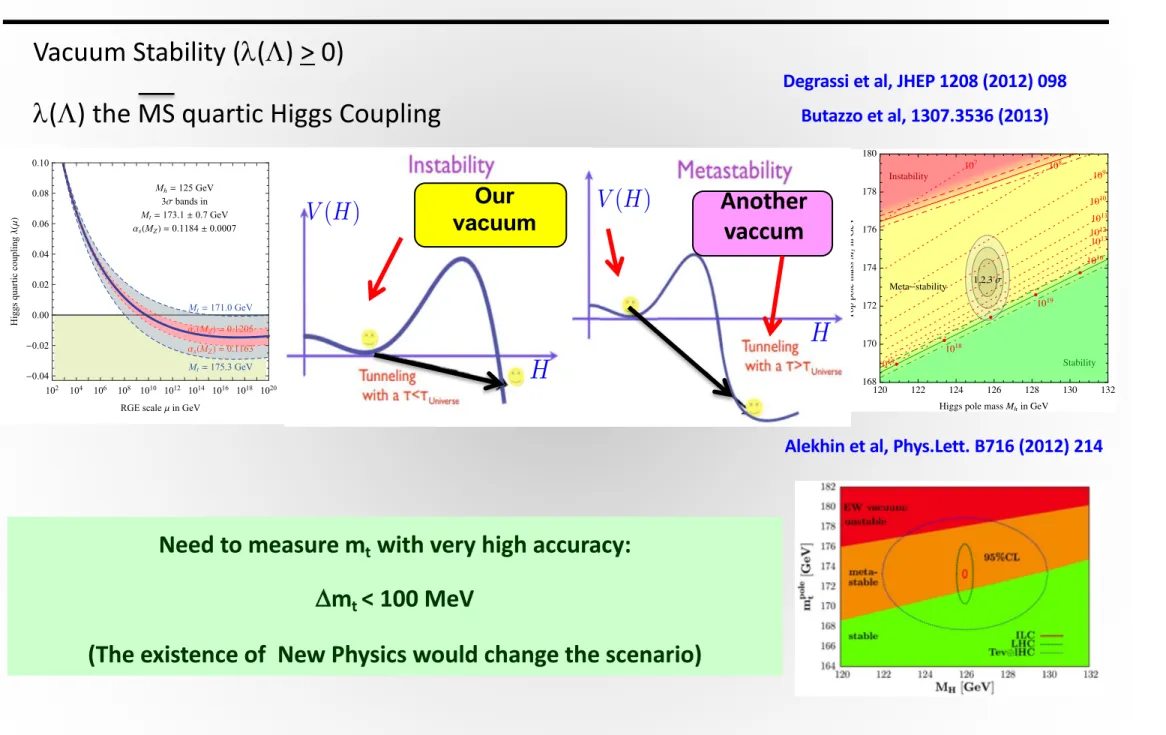
Stability of the Higgs potential (a personal, biased example)
Vacuum Stability: λ(Λ) ≥ 0
Degrassi et al, 1205.6497102 104 106 108 1010 1012 1014 1016 1018 1020
!0.04
!0.02 0.00 0.02 0.04 0.06 0.08 0.10
RGE scaleΜin GeV
HiggsquarticcouplingΛ!Μ"
Mh$125 GeV 3Σbands in Mt$173.1&0.7 GeV
Αs!MZ"$0.1184&0.0007
Mt$171.0 GeV
Αs!MZ"$0.1163
Αs!MZ"$0.1205
Mt$175.3 GeV
115 120 125 130 135
108 1010 1012 1014 1016 1018
Higgs massMhin GeV
InstabilityscaleinGeV
1Σband in Mt$173.1&0.7 GeV
Αs!MZ"$0.1184&0.0007
Λ = M
PlanckM
H> (129.4 ± 1.8) GeV
Assumes SM valid all the way up to Λ ≤ M
PlanckA. Pich IMFP 2013 10
Degrassi et al, JHEP 1208 (2012) 098 Butazzo et al, 1307.3536 (2013)
Alekhin et al, Phys.Lett. B716 (2012) 214
6 8 10
0 50 100 150 200
0 50 100 150 200
Higgs pole massMhin GeV ToppolemassMtinGeV
LI=1045GeV678910
12141619 Instability
Non-perturbativity
Stability Meta-stability
107 108
109
1010 1011 1012 1013
1014
1016
120 122 124 126 128 130 132
168 170 172 174 176 178 180
Higgs pole massMhin GeV ToppolemassMtinGeV
1017
1018
1019 1,2,3s
Instability
Stability Meta-stability
Figure 3: Left: SM phase diagram in terms of Higgs and top pole masses. The plane is divided into regions of absolute stability, meta-stability, instability of the SM vacuum, and non- perturbativity of the Higgs quartic coupling. The top Yukawa coupling becomes non-perturbative for Mt > 230 GeV. The dotted contour-lines show the instability scale ⇤I in GeV assuming
↵3(MZ) = 0.1184. Right: Zoom in the region of the preferred experimental range ofMhandMt
(the grey areas denote the allowed region at 1, 2, and 3 ). The three boundary lines correspond to 1- variations of↵3(MZ) = 0.1184±0.0007, and the grading of the colours indicates the size of the theoretical error.
The quantity e↵can be extracted from the e↵ective potential at two loops [107] and is explicitly given in appendixC.
4.3 The SM phase diagram in terms of Higgs and top masses
The two most important parameters that determine the various EW phases of the SM are the Higgs and top-quark masses. In fig. 3we update the phase diagram given in ref. [4] with our improved calculation of the evolution of the Higgs quartic coupling. The regions of stability, metastability, and instability of the EW vacuum are shown both for a broad range ofMhand Mt, and after zooming into the region corresponding to the measured values. The uncertainty from↵3 and from theoretical errors are indicated by the dashed lines and the colour shading along the borders. Also shown are contour lines of the instability scale⇤I.
As previously noticed in ref. [4], the measured values ofMh and Mt appear to be rather special, in the sense that they place the SM vacuum in a near-critical condition, at the border between stability and metastability. In the neighbourhood of the measured values ofMhand Mt, the stability condition is well approximated by
Mh>129.6 GeV + 2.0(Mt 173.35 GeV) 0.5 GeV↵3(MZ) 0.1184
0.0007 ±0.3 GeV. (59) The quoted uncertainty comes only from higher order perturbative corrections. Other non-
18
V (H )
H V (H )
H
Our
vacuum Another
vaccum
Need to measure m
twith very high accuracy:
Dm
t< 100 MeV
(The existence of New Physics would change the scenario)
Vacuum Stability (l(L) > 0)
l ( L ) the MS quartic Higgs Coupling
J. Fuster 67
[www.ifca.unican.es/users/heinemey/uni/plots]
Roberto Franceschini (IFIC seminar, Valencia)
Large mass Sizeable effects
SM with LHC mH
Top mass and W mass (a personal, biased example)
Low values of the
top-quark mass less SM
J. Fuster 68
Top mass and Higgs Mass relation (a personal, biased example)
New Physics at Low EW Energy Scales (Heinemmeyer et al.)
Need for New Physics @ Large Energy Scales Vacuum Stability: Meta-stable Universe Need for New Physics @ Large Energy Scales
Vacuum Stability: Unstable Universe
68 68
165 170 175 180
[GeV]
m t
Keeping present values/uncertainties of m
hand m
WJ. Fuster 69
Keeping present values/uncertainties of m
hand m
WNew Physics at Low EW Energy Scales (Heinemmeyer et al.)
Need for New Physics @ Large Energy Scales Vacuum Stability: Meta-stable Universe Need for New Physics @ Large Energy Scales
Vacuum Stability: Unstable Universe
Global Fit – NNLO QCD EW- Fits: HEPfit. & Gfitter ATLAS & CMS
Combinations
of “Direct Measurements”
ATLAS & CMS
Total & Differential Cross-Sections 3D and tt+1jet
69
165 170 175 180
[GeV]
m t Keeping present values/uncertainties of m
hand m
WTop mass and Higgs Mass relation (a personal, biased example)
J. Fuster 70
Keeping present values/uncertainties of m
hand m
WNew Physics at Low EW Energy Scales (Heinemmeyer et al.)
Need for New Physics @ Large Energy Scales Vacuum Stability: Meta-stable Universe Need for New Physics @ Large Energy Scales
Vacuum Stability: Unstable Universe
Global Fit – NNLO QCD EW- Fits: HEPfit. & Gfitter ATLAS & CMS
Combinations
of “Direct Measurements”
ATLAS & CMS
Total & Differential Cross-Sections 3D and tt+1jet
70
165 170 175 180
[GeV]
m t Keeping present values/uncertainties of m
hand m
WHL-LHC
Top mass and Higgs Mass relation (a personal, biased example)
J. Fuster 71
Keeping present values/uncertainties of m
hand m
WNew Physics at Low EW Energy Scales (Heinemmeyer et al.)
Need for New Physics @ Large Energy Scales Vacuum Stability: Meta-stable Universe Need for New Physics @ Large Energy Scales
Vacuum Stability: Unstable Universe
Global Fit – NNLO QCD EW- Fits: HEPfit. & Gfitter ATLAS & CMS
Combinations
of “Direct Measurements”
ATLAS & CMS
Total & Differential Cross-Sections 3D and tt+1jet
71
165 170 175 180
[GeV]
m t Keeping present values/uncertainties of m
hand m
WHL-LHC
Future e+e- Collider
Top mass and Higgs Mass relation (a personal, biased example)
Effects are seen as “low scale new physics” => modification of Higgs properties !
• different patterns of deviations from SM prediction for different NP models
• size of deviations depends on NP scale
Tiny differences between best fit and SM. In general precision at ~% or better is required
New Physics require precise measurements
72 J. Fuster
Effects are seen as “low scale new physics” => modification of Higgs properties !
• different patterns of deviations from SM prediction for different NP models
• size of deviations depends on NP scale
Tiny differences between best fit and SM. In general precision at ~% or better is required
New Physics require precise measurements
73 J. Fuster
Not only the values are important (~%) but also the pattern of the deviations
(to distinguish models)
74 J. Fuster
b
Rcompositeness could explain e.g. long-standing tension between two most precise determinations of sin2!eff- one of them from A
bFB(MZ) •
Remeasure couplings of b
Rand A
bFB(250GeV) and improve on LEP1?
S. Bilokin, arXiv 1709.04289
Allowing to test New Physics up to 60 TeV
Bottom physics at Higgs Factory