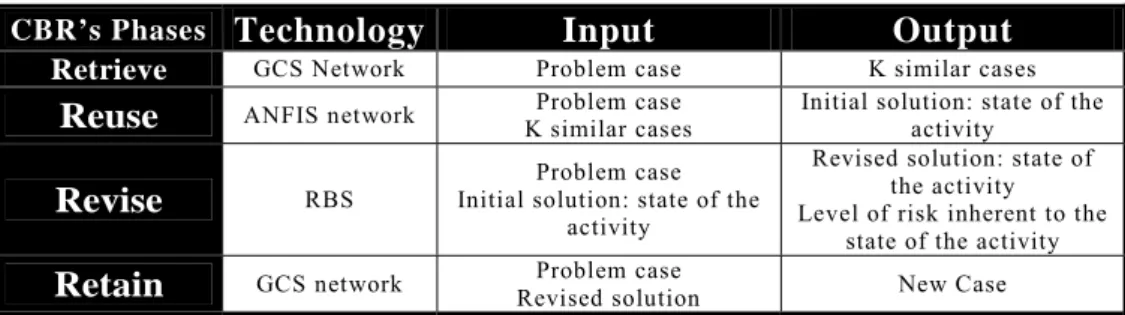
The objective of the system is to facilitate the internal audit process in small and medium enterprises. This means that the set of instances stored in the CBR systems memory represents the knowledge related to the CBR domain. The operations cycle of the developed case-based reasoning system is based on the classical life cycle of a CBR system (Aamodt and Plaza, 1994; Watson and Marir, 1994).
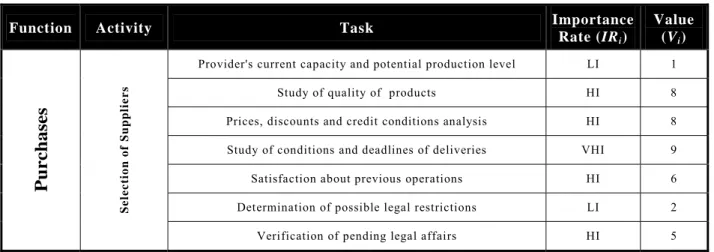
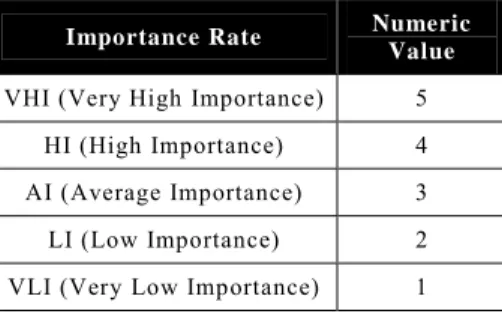
It can only take one of the following values: VHI (Very High Importance), HI (High Importance), AI (Medium Importance), LI (Low Importance), VLI (Very Low Importance).
ISA Subsystem (Identification of the State of the Activity)
- Retrieval Phase
- Advantages
- Reuse Phase
- Advantages
- Revision Phase
- Retain Phase
At the beginning of the learning process, the weight vector of each cell is initialized with random values. The parameter α reflects the constant decrement rate of the counter for the remaining cells in the current learning cycle. Higher values of σ ensure that the area of the dominant node in the centroid neighborhood is more extended.
Each attribute is represented by a Gaussian function (Eq. 9)), which is part of the antecedent of the rule. The problem is defined by a set of variables with certain values, which are used as input to the GCS network. This phase aims to obtain an initial estimate of the state of the analyzed activity.
One of the first hybrid neuro-fuzzy systems for function approximation was Jang's ANFIS model (Nauck, 1997). As of the final solution: the state of the activity, the system must work out the control risk associated with the activity. The calculation of the control risk level associated with an activity is based on the stream.
The calculation of the level of control risk is performed using if-then rules in which the importance that the auditors have assigned to that activity is compared with the final solution or state of the activity. For each of them, the input details, the process performed and the output details that will be used in the subsequent stages of the evaluation process are shown.
GR Subsystem (Generation of Recommendations)
Retrieval phase
Its solution or state of activity must be better than the one generated as the final solution in the previous subsystem by an interval between 15% and 20%. These two constant values were determined by the auditors who participated in the survey.
Reuse Phase
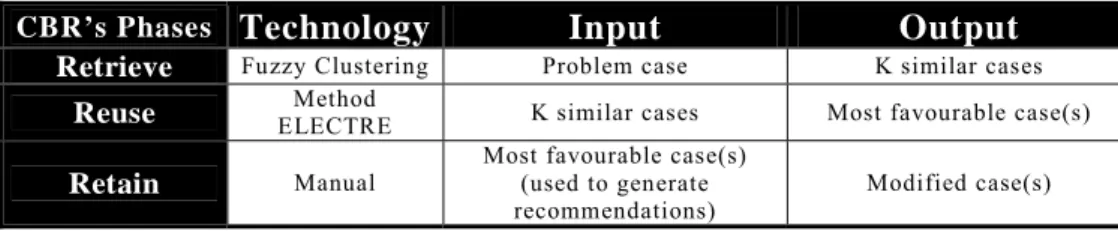
In this study, the initial version of the Electre method was chosen (Barba-Romero and Pomeral, 1997; Romero, 1993) in order to tackle the problem of choosing one of the alternatives. Since in this study the weight of an attribute (represented by its level of importance) is different for each alternative, it is necessary to obtain a unique weight vector for the attributes of the group of alternatives or recycled cases. The case obtained as a result of the application of the Electre method represents the objective to be achieved for the analyzed activity or the standard to be followed to achieve the objectives of the company or, specifically, the objective associated with the activity is associated.
In this way, the function of the recommendations that are then generated will be to ensure that the various tasks that form the problem case reach a situation as similar as possible to the case obtained as a result of the Electre method. In this way, to generate the recommendations, the output from the Electre method is compared to the problem case, comparing the values (Vi) of each of the attributes or tasks in both cases. The objective is to find out which tasks need to be improved by establishing a priority order in terms of the weight (IRi) of each task over the activity as a whole.
The group of attributes of the cases stored in the case database represents a group of values that both the experts of the individual activity and the auditors have assessed as effective (in the conducted researches) according to the characteristics of the company. Given that the characteristics of the current case (problem) are similar to the obtained objective case, the auditor can argue that the attribute values must also be similar. However, not all combinations are valid; some combinations may not be feasible or sensible.
Retain Phase
This provokes a more persuasive argument than one based on probabilities and estimated losses or risks. The generation of control recommendations by comparing the values of the current case with those of the past cases also eliminates other problems such as the lack of results or predetermined results. There are many possible values along with a large number of combinations that can be included in the auditor's recommendations.
In contrast to CBRs, both expert systems and neural networks will need to have predefined possible outputs. Based on the predictions and recommendations generated by the system, the internal auditor can inform the company about inconsistent processes and actions that need to be taken. For each of them, the input data, the performed process and the output data are shown.
Case Study
In this study, it has been chosen to follow instructions from the auditors who participated in the study, to retrieve those cases with a relevance for the cluster of over 65% and whose reliability is greater than 50%. The retrieved cases are used in the next phase, the adaptation phase, to train the ANFIS network. In the given example, after training the network with the instances obtained in the retrieval phase, this yields the initial solution shown in Table 8.
Therefore, the retrieval phase works with the same cluster used in this phase in the first subsystem (because it contains the cases that are most similar to the problem case). All those cases with a high confidence level, with a solution or activity state that is larger in interval, by 15% to 20%, compared to the situation generated as a final solution in the first subsystem are retrieved. Then, in the adjustment phase, using the Electre method, the most optimal one is chosen from all found cases.
In light of this situation, it was chosen to take as references the weights or levels of importance (IRi) of the tasks present in the optimal case. Specifically, the process consists of generating a recommendation that suggests the improvement of that task whose value (Vi) in the problem case is less than the value of the same task in the case proportioned by the Electre method. The process will continue with the comparison of the task values whose level of importance, in the case obtained after applying the Electre method, had High Importance (HI) as its value.
Results
Therefore, a recommendation of the type “the analysis of prices, discounts and credit terms needs to be improved” will be generated. To test the developed system, several complete operating cycles of the above-mentioned system were carried out. The results obtained show that the application of the recommendations generated by the system brings about a positive evolution in the companies.
The indicator considered to determine the positive evolution of the companies was the state of each of the analyzed activities. If this improvement occurs in the majority of activities (especially in those that are most relevant within the company), the company has improved its condition. To more reliably reflect the suitability of the system for the problem to be solved, the results obtained after analyzing these 22 companies were compared with those of another 5 companies where the recommendations generated by the system had not been implemented. applied.
In other words, the use of the recommendations generated by the system did not affect the company's activities. In one company, inconsistent processes increased, in other words, the use of recommendations generated by the system harmed the positive development of the company. In general, it could be said that these results demonstrate the suitability of the used techniques for their integration into the developed intelligent control system.
Conclusions
After analyzing the situation in the company, it was concluded that there was a high level of disorganization, without a clearly defined set of objectives. This is due to the fact that these firms have a greater opportunity to adapt and adopt the changes suggested by the system's recommendations. The case base should be representative of the entire spectrum of the problem.
The prototype cases used to build the case base are synthetic and have been created based on research conducted by auditors and experts in various functional areas. The system is able to assess or identify the state of the company's activities and the risk associated with them. In addition, the system generates recommendations that will guide the internal auditor in creating action plans to improve company processes.
The estimation in the environment of firms is difficult due to the complexity and the great dynamics of this environment. However, the developed model is able to estimate the state of the firm with precision, and propose solutions that enable the improvement of the state in question. The system will produce better results if it is provided with cases related to the sector in which it will be used.
This is due to the dependency between the processes in the companies and the sector in which the company is located. Steps have been taken in this direction and it is expected that the system can be evaluated in one of the major international companies of the textile sector.