Most of the leading universities in Europe participate in Erasmus Mundus Joint Masters Degrees. 16 University of Oslo 17 University of Bristol 18 University of Paris 19 University of Ghent 20 University of Aarhus 20 University of Stockholm 20 University of Groningen 21 University of Helsinki. 27 University of Liverpool 27 University of Nottingham 27 University of Southampton 27 University of Strasbourg 27 University of Warwick.
1 University of Oxford 2 University of Cambridge 3 Imperial College London 4 London School of Economics 5 University of Edinburgh. 28 University of Bonn 29 University of Birmingham 30 Aarhus University 31 University of Sheffield 32 University of Southampton 33 Gent University.

Statistical Analysis of Scholarship Holder Mobility flows Programme Country Students to Programme Countries
Factsheet 3 : Programme Country scholarship holders mobility Factsheet 4 : Scholarship holders’ mobility to Partner Countries
BACKGROUND
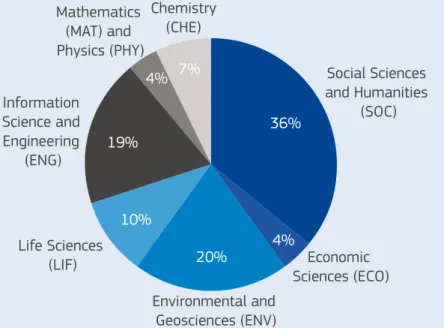
Overall, most program country fellows study in the humanities While 40% of fellows study the humanities (social sciences and humanities and economic sciences), the rest are equally divided (30% each) between life sciences (environmental and geosciences, life sciences) and exact sciences (information sciences and engineering, chemistry, mathematics and physics) (Figure 1). Over half of all program country scholarship holders come from five program countries. The EMJMD fellows come from 31 program countries out of 34. No fellows yet came from Malta (which is, however, involved in five projects as a full partner), Iceland and Liechtenstein 3.
MAIN RESULTS
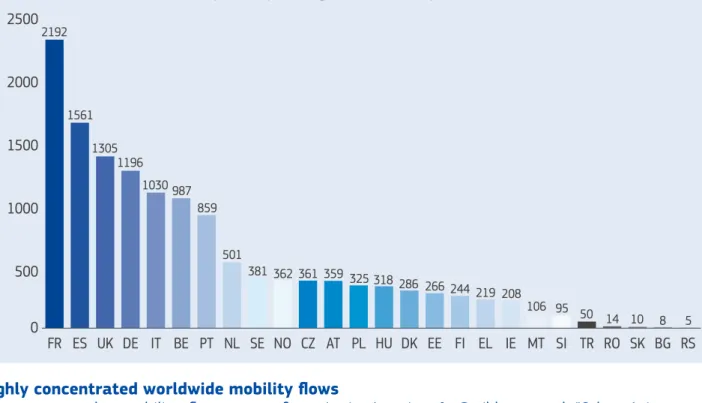
For example, France hosts almost 15% of study periods while less than 7% of all scholarship holders are French. Net exporter scholarship holders', such as Spain and Germany, which send more nationals than they expect study periods. Net importing scholarship holders', such as France and Portugal, which host more study periods than send nationals.
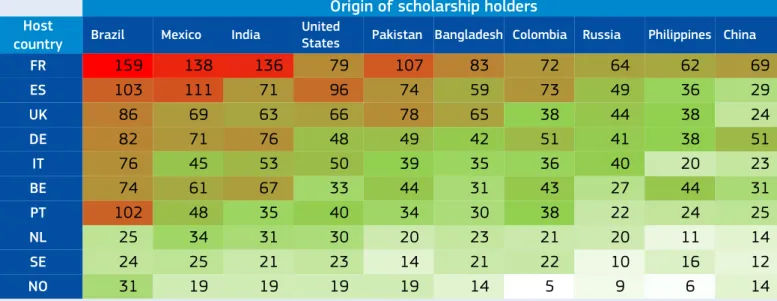
Parents are very similar when excluding scholarship holders studying in their country of residence. 15 Table 1: Location of study periods of scholars originating from the top 10 program countries (n=3,346). The number of participating scholarship holders from the program countries mainly depends on the population and the number of HEIs involved in the projects.
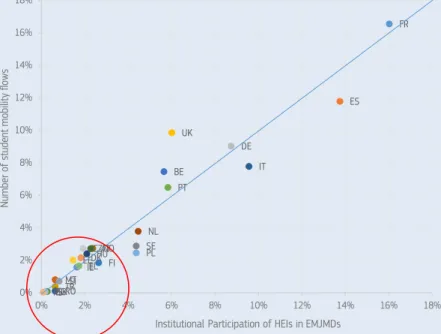
The number of participating scholarship students from Program Countries largely depends on the size of the population and the number of HEIs involved in the projects. 17 Figure 7 and Figure 7-zoom show the correlation between the percentage of fellows by nationality and institutional participation in program countries. For example, while France accounts for 16% of the HEIs involved (attendance cases), French students represent only 7% of all scholarship holders in Program Countries.
16% of HEIs involved (no more cases), French students represent only 7% of all Program country scholarship holders.

Statistical Analysis of Scholarship Holder Mobility flows to Partner Countries
Factsheet 4 : Scholarship holders’ mobility to Partner Countries Factsheet 5 : Statistical analysis of the main project features
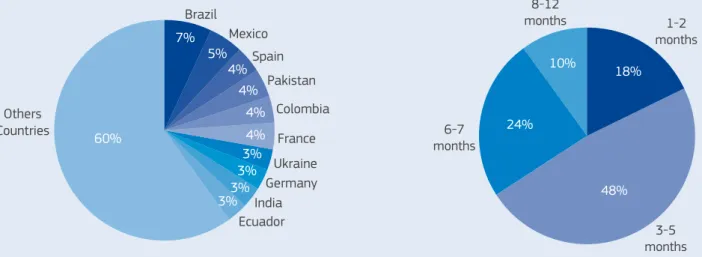
Almost 80% of all scholarship holders who have spent a mobility period in a partner country come from partner countries that reflect the composition of the overall population of the scholarship holders. Indeed, overall, partner country students represent 82% of all scholarship holders funded so far under Erasmus Mundus (n=7,718). The EMJMD scholarship holders who go to a partner country for a mobility period come from 72 different countries.
Around 52% of all scholarship holders are women (48% men), which is in line with the patterns of the overall scholarship population. Both program country and partner country scholarship holders are eligible to study in a partner country other than their home country. Most of the fellows go to a partner country for research, internships and thesis writing (Figure 4).
These types of mobilities represent almost half of all grant holder mobilities in partner countries, compared to only 34% for the total grant holder population. The number of fellows doing an internship during their mobility in a partner country (14%) is twice as high as the share of the total population of fellows doing an internship (7%). This is also reflected in the fact that for the total population of scholarship holders, only 10% of all mobilities take place with non-university institutions (e.g. companies, research institutes, NGOs, etc.), while for mobilities to partner countries this figure is 23%. .
The thematic fields of study for fellows who are on mobility to partner countries are identical to the thematic areas that fellows study overall.
Statistical Analysis of the Main Project Features
Most of the EMJMDs that received less than were selected during the two first calls, in a context where no budget was allocated for targeted regions in 2014 and applications with smaller budgets were received in 2015. The lowest expected number of scholarships for an EMJMD is 9, and the highest number is 94. Most of the EMJMDs that received less than those selected during the two first calls, in a context where no budget for targeted regions were not awarded in 2014 and applications with smaller budgets were received in 2015.
This factsheet analyzes the main characteristics of the selected EMJMD projects in relation to their study programs, consor a arrangements and openness to the world. The thematic areas of the EMJMDs are fairly evenly distributed across the three main thematic areas: 34%. A vast majority (95%) of EMJMDs offer master's programs worth 120 ECTS, which corresponds to two academic years.
FEATURES OF THE STUDY PROGRAMMES
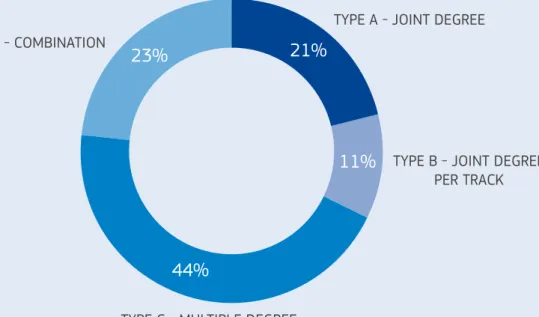
While on average 33% of EMJMDs award a joint degree, it should be noted that some countries/regions award proportionately more joint degrees than others. In the EMJMD programmes, the organization of the mobility path is largely open to the consortia's choice, provided they respect the minimum mobility rules. The EMJMD study periods must take place in at least two of the program countries that are represented in the consortium, and the students must acquire all ECTS points from the master's program (60, 90 or 120).
55% of EMJMDs (Type A + Type B + Type D) offer either joint degrees or degrees with a joint component (Figure 7). In 23% of EMJMDs, some partners confer a joint degree, while others still issue a separate degree (type D). More information on the type of degree is available in the 2020 EACEA study 'Implementing joint degrees in the Erasmus mundus action of the Erasmus+ programme'.
More than half of the consortia selected between 2014-2020 were new Master's programs Of the 250 EMJMD selected between 2014 and 2020, 177 correspond to a unique partnership according to the information provided by EMJMD applicants during the application phase. Furthermore, as the Erasmus Mundus program has been running since 2004, part of the selected EMJMDs received their first funding before the 2014-2020 funding period (Figure 10). As can be seen in Figure 11, 21 out of 34 program countries (62%) coordinated at least one EMJMD project.
France coordinated 65 out of the 250 selected EMJMDs (26%), making the country the most common project coordinator between 2014 and 2020.
COMPOSITION OF THE CONSORTIA
All EMJMDs consist of a consortium of at least three different higher education institutions from three different Erasmus+ countries. The selected EMJMDs represent a wide variety of consortium sizes (an average of 5 full partners per EMJMD), ranging from 3 to 14 full partners (Figure 12). Program countries involved as coordinators are often involved as coordinator countries in several EMJMDs.
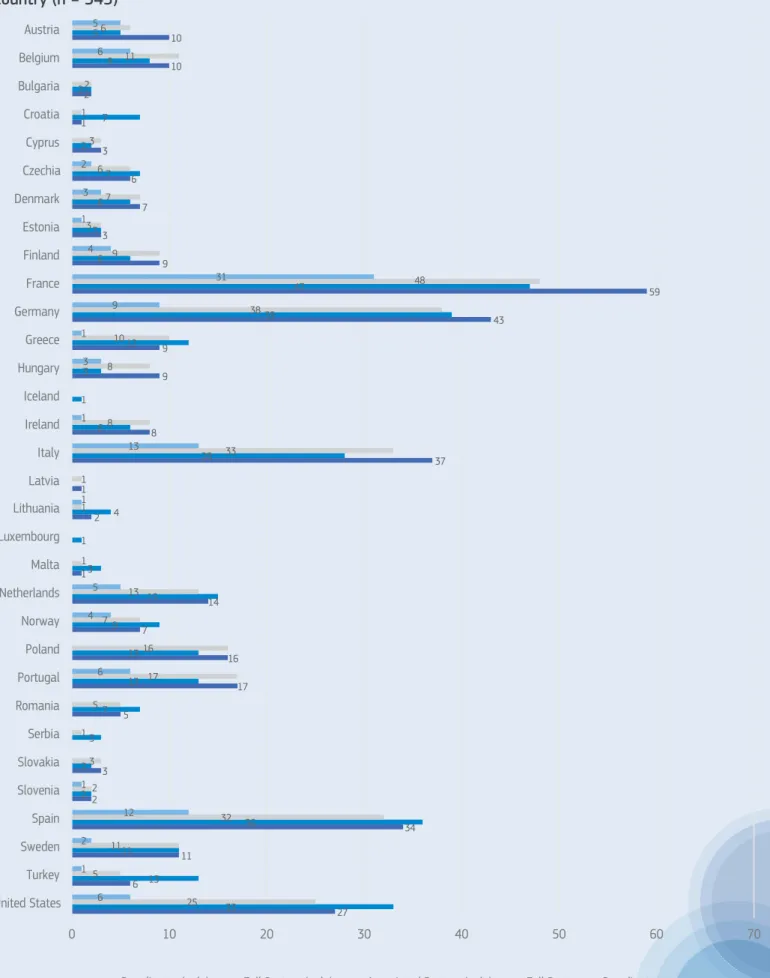
Bulgaria, Cyprus, Croatia, Iceland, Latvia, Liechtenstein, Luxembourg, Malta, North Macedonia, Poland, Romania, Serbia and Slovakia have not yet participated as coordinators in any EMJMD project. As can be seen in Figure 13 below, some program countries were involved more often than others. Countries such as France, Spain, Italy and Germany are included in more than 35% of the 250 selected EMJMDs.
Iceland, Liechtenstein, Luxembourg and North Macedonia have not yet participated as a full partner in any EMJMD project.
OPENING TO THE WORLD
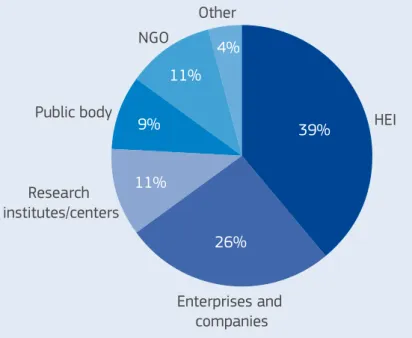
Almost three thirds (74%) of the selected EMJMDs between 2014 and 2020 involved at least one associate partner from a partner country. While 39% of the associated partners are HEIs, as many as 61% are other types of private and public institutions. Overall, 97 partner countries are represented in at least one EMJMD as either full partner or associate partner.
At the same time, 18% (17) of the participating partner countries were involved in more than 20 EMJMD. Of the 97 participating partner countries, 36 (37%) are included as full partners in at least one EMJMD.
Overview of the participating Higher Education Institutions
Factsheet 6 : Overview of the participating Higher Education Institutions
MAIN RESULTS - PROGRAMME COUNTRIES HEIs
On average, each HEI is involved in 3 different EMJMD (Figure 3) as coordinator or full partner. 33 Figure 4: Percentage of HEIs involved as coordinators or full partners in Erasmus Mundus for each country (based on the number of HEIs that have received the ECHE). For example, in the Netherlands 29% of all HEIs holding an ECHE are involved in EMJMD.
While these data are difficult to interpret and depend on the size and organization of the higher education system in the respective countries (especially the number of institutions offering master's degrees), this suggests that in most countries there is still potential for more higher educational institutions to be involved in Erasmus Mundus. In fact, on average only 6.2% of the program countries' higher education institutions labeled with an ECHE are involved in an EMJMD. Ghent University and Universitat de Barcelona are the most active higher education institutions involved in EMJMDs as full partners or coordinators.
36 Figure 5: Overview of higher education institutions involved in the pilot projects of the EMJMD and the European Universities Initiative. Many higher education institutions are involved in pilot projects of Erasmus Mundus and the European Universities Initiative. 369 higher education institutions of the program countries are involved in EMJMD as coordinators or full partners, and 295 in pilot projects of the European universities initiative.
58% of HEIs involved in the European Universities Initiative are also involved in EMJMDs, while around 46% of HEIs involved in EMJMDs are involved in the European Universities Initiative (Figure 5) .
MAIN RESULTS - PARTNER COUNTRIES HEIs
ANNEX 1
ANNEX 2
ANNEX 3
You can find the address of the nearest center at: europa.eu/contact BY PHONE OR BY EMAIL. Information in all official languages of the European Union is available on the Europa website: europa.eu EU PUBLICATIONS. You can download or order free and discounted EU publications from EU Bookshop at: http://bookshop.europa.eu.
Multiple copies of free publications can be obtained by contacting Europe Direct or your local information center (see http://europa..eu/contact). To access EU legal information, including all EU legislation since 1951 in all official language versions, visit EUR-Lex at. The EU Open Data Portal (http://data.europa.eu/euodp/en/data) provides access to datasets from the EU.