Motivation
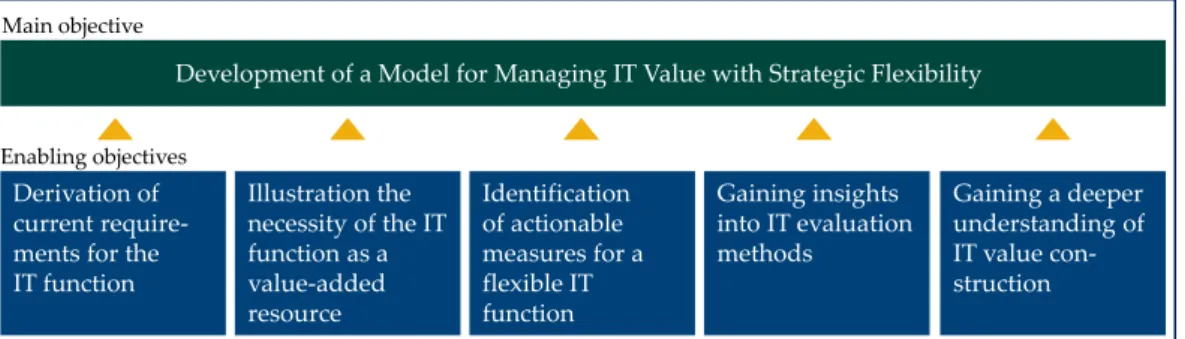
What actions (or instruments) should be integrated into the IT function to increase its flexibility to deliver an agile IT value proposition. Such performance targeting methods can create a comprehensive understanding of metrics for evaluating the IT value proposition.
Objectives
Eighty percent rank it among the top three most important trends for the IT function (KPMG, 2010). But what are the specific business requirements for the IT function in today's turbulent environment.
Method
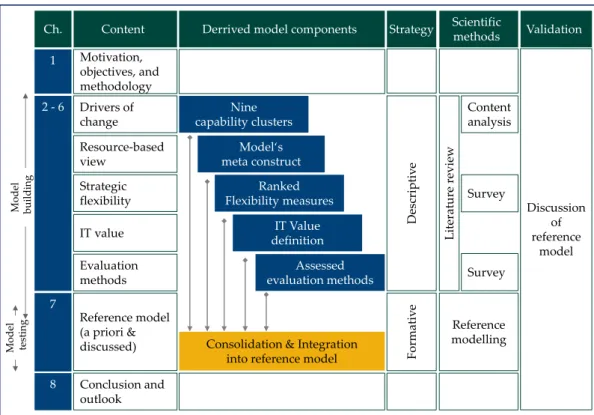
Therefore, to gain a comprehensive understanding of the IT value proposition, this study outlines IT job requirements based on a literature review of the current drivers of change in companies' IT jobs. The purpose of Chapter 5 is to define the IT value proposition to arrive at a consistent evaluation object.
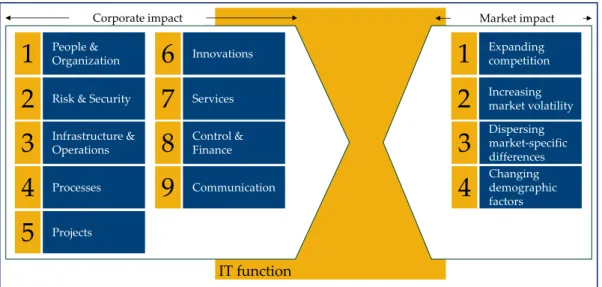
Market influences
- Expanding Competition
- Increasing market volatility
- Expanding market-specific differences
- Changing demographic factors
The innovation and life cycles15 of services and products have become shorter with the gradual increase in the rapid development of technological requirements.16. 20 Gros argues that "the current crisis was caused by a combination of asset price bubbles, mainly in the real estate sector, and a credit bubble that led to excessive leverage." Cp.
Corporate influences
People and Organization
In addition to meeting people-related challenges, the IT function must face organizational challenges: (1) business alignment, (2) adequate roles, and (3) operational effectiveness. Previous research examines the demand for the IT function to increase its familiarity with business strategy (CIO Executive Board, 2011).
Risk and Security
The financial scandals and abuses that ravaged several major companies (e.g., Enron, Worldcom) in the early 2000s triggered new regulations such as the Sarbanes-Oxley Act.40 It aims to rebuild trust by improving corporate governance structures through the brake and balances (Damianides, 2005). These government regulations need to be implemented into the internal control system of companies, but companies are not sure how to combine existing regulations with new technology.41.
Infrastructure and Operations
Given the requirements for IT infrastructure and for IT operations, what types of structures must the IT function implement to meet those requirements. Cloud computing, mobile internet and other requirements are influencing the design and structure of IT infrastructure.
Processes
Process management consists of methods and tools that support the design, activation, analysis and management of process life cycles (van der AAlst, ter Hofstede and Weske, 2003). For IT, process management can also be supported by other standards such as CMMI, ITIL and Cobit.62.
Projects
Regarding the current challenges of the IT function, strengthening project management capabilities is one of the most pressing issues. Implementing firm-wide project management standards will also support the CIO's governance requirements.
Innovations
For the people dimension, Kohli and Melville identified the need to hire employees who know how to solve problems and can work cross-functionally. 71 Kohli and Melville (2009) also pose a similar question: "What separates successful IT innovators from others.
Services
The overall goal of the IT function is the resource-efficient contribution of required IT services in line with the organizational business strategy (Beachboard et al., 2007). IT services provide a set of functions that support service customers79 and which must be defined and executed end-to-end across organizational and technological silos.80 Different IT services are described by the IT Infrastructure Library (ITIL).
Control and Finance
Instead, the important question is what impact these IT costs and investments have on supporting the firm's objectives (Bonfante, 2011b). Although many firms still focus on internal cost accounting, a comprehensive IT control must match the firm's objectives (Kesten, Müller and Schröder, 2007).
Communication
On the other hand, the IT function's own communication must be in line with the business objective. To achieve these goals, the IT function must use the upward, downward, and lateral communication directions.
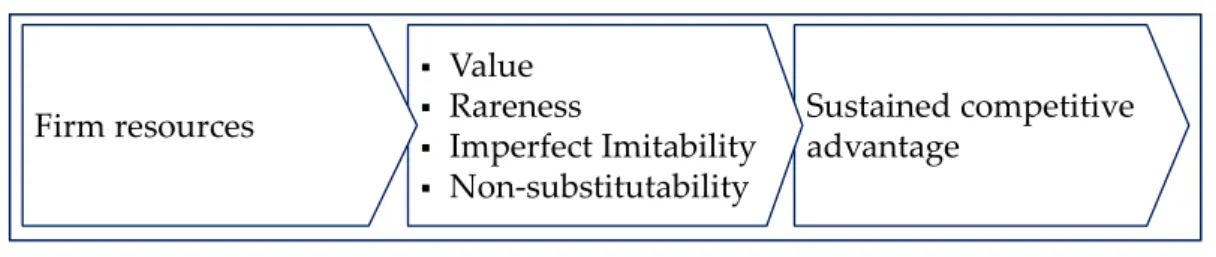
Resource-based theory as underlying theory
Valuable resources can only serve as a source of competitive advantage if competing companies cannot obtain or imitate them. A resource can be a source of competitive advantage if there are no strategically equivalent valuable resources that are untraceable or rare.
Competencies as extrapolation of resource-based theory
Existing deficits of the resource-based theory
Therefore, this study uses resource-based theory as the foundation of the model it develops. Thus, the value of resources can only be evaluated retrospectively.91 Furthermore, resource-based theory only includes a static view of currently existing resources.
Competencies as a special type of resources
Competencies are “the glue that binds existing companies.” Core products link competencies to the end products. Consequently, companies gain a strong competitive advantage only if they can develop a set of competencies that can be applied and are difficult to imitate (Ashurst, Doherty, and Peppard, 2008).
Classification of competencies
The quality of resource flexibility depends on a company's ability to use internal and external resources in other processes or to structure the demand for resources alternatively (Wycisk, 2009). Competence mode IV describes the inherent flexibility of resources, whereas competence mode V includes the company's overall ability to use its resources effectively in a wide range of work areas.
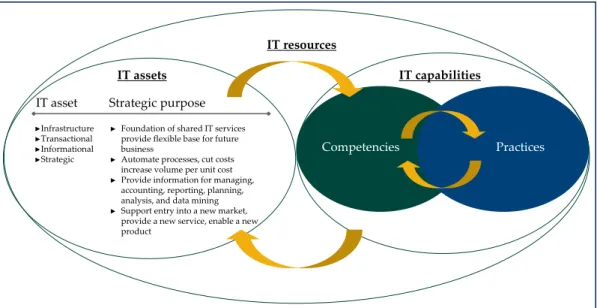
IT resources as an IT competency construct
The Aral and Weill model does not use ability and competence synonymously, but in a hierarchical relationship. By using the Aral and Weill model as a meta-construct, the current study can use the established definition of the IT value proposition.
Flexibility as scientific artifact
Uncertainty
However, managers must make decisions about their daily challenges (Harrison, 1977), and thus they have only two options: (1) decide nothing or (2) decide on uncertainty. The theoretical construct of uncertainty has long been discussed in the academic literature, providing a wide range of attributes and descriptions to characterize uncertainty. 2009) describe “the inability to recognize and articulate all relevant variables affecting performance” as unpredictable uncertainty.
Definition of flexibility
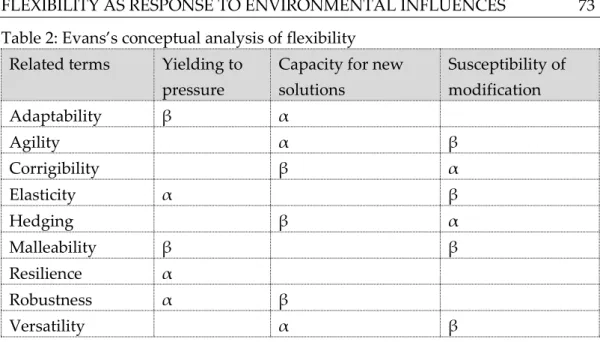
Although flexibility as a critical success factor for companies is almost universally accepted in the literature, there is no clear definition of the flexibility concept itself. Thus, it can be noted that the literature uses a variety of definitions, but lacks a comprehensive, accepted framework describing flexibility.
Negative impact of flexibility
Because of the (financial) commitment of flexibility potential, the IT function may not be able to support the value-adding processes within the firm. In their analysis, the value of IT flexibility depends strongly on the dynamics of the specific industry.
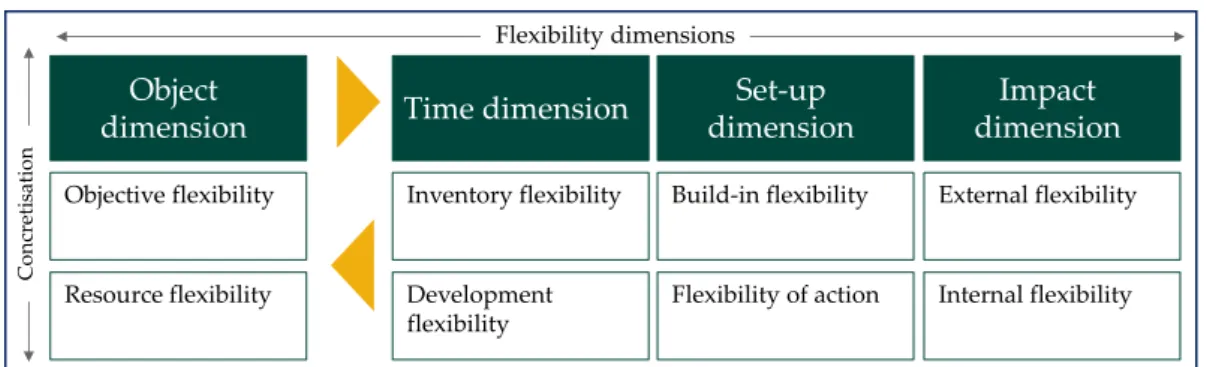
Multiple dimensions of flexibility
The objective flexibility describes the company's ability to change its goals, and that change can either be the rejection of goals or the inclusion of new goals. External flexibility refers to the firm's ability to respond to its environment by introducing new products or innovations.
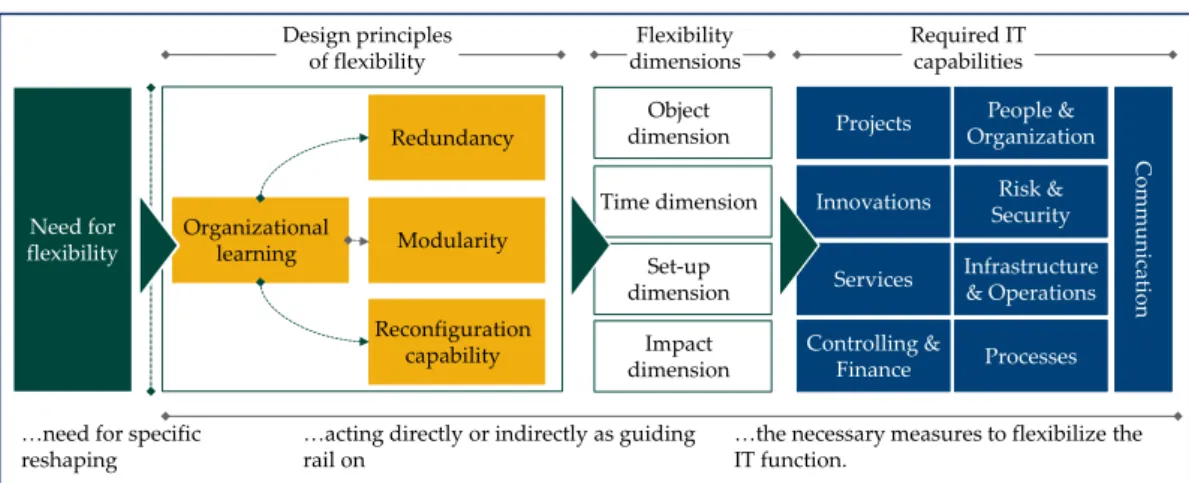
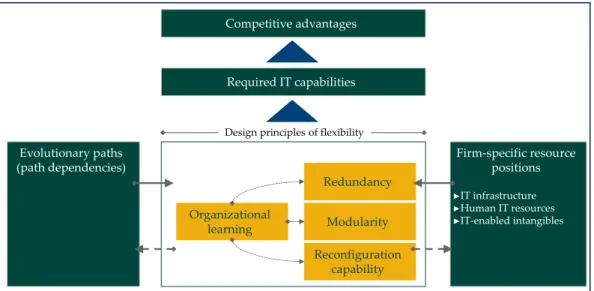
Design principles to define flexibility measures
- Overview and basic structure
- Redundancy
- Modularity
- Reconfiguration capability
- Organizational learning
Rapid response to various external situations requires both qualitative and quantitative excess resources that can be allocated in a timely and situation-specific manner to meet the demands of the situation (for example, the need for more storage capacity in the short term). It can be noted that the contribution of organizational learning lies in the fact that the learning process itself has a positive effect on the company's reaction speed and knowledge base.
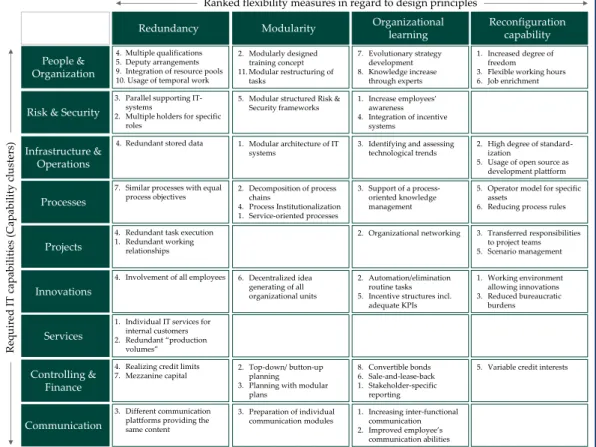
Deriving measures to support IT function flexibility
For example, only the processes of the PMI framework (Project Management Institute, 2010) can be applied as needed for a specific project (eg, knowledge domain “communication” processes). Flexibility gains can be achieved by the IT function as well as the firm as a whole.
Empirical assessment of derived measures
- People and Organization
- Risk and Security
- Infrastructure and Operations
- Processes
- Projects
- Innovations
- Services
- Control and Finance
- Communications
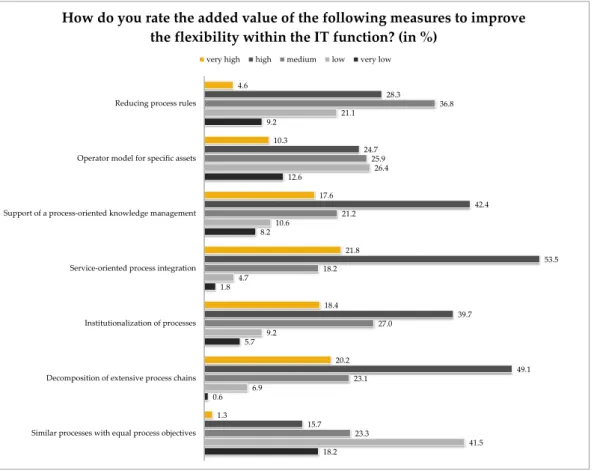
Almost 70% of all respondents rated this measure as having a large to very large impact on adaptability. However, only 23% of respondents rated this measure as having a very high and high impact on flexibility.
Economic perspective of value
This subjective evaluation theory129 rests on the decision-theoretic theory of investments (Cp., e.g. Serfling and Pape, 1995; Perridon and Steiner, 1999), where the value of the specific goods is equal to the marginal price130 for a potential buyer. The determination of value depends on an individual party who tries to maximize his individual value within his target system.131.
Definition of IT value
IT value proposition in academic literature
Cronk and Fitzgerald (1997) noted that sometimes the definition of IT value is the same as its measures. Pfeiffer (2003) argued that the academic debate on the definition of IT value originated with a 1983 article by Cron and Sobol.
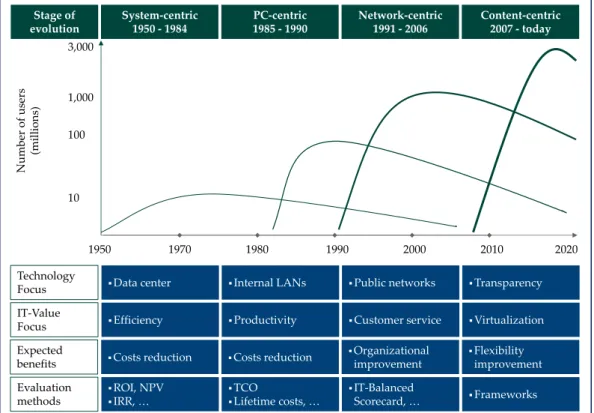
Historical evolution of IT value evaluation
He argued that IT value can be broadly defined as the overall support of the IT function to the company's business (Pfeifer, 2003). Ackhoff was one of the first theorists to express doubts about the value of information technology.
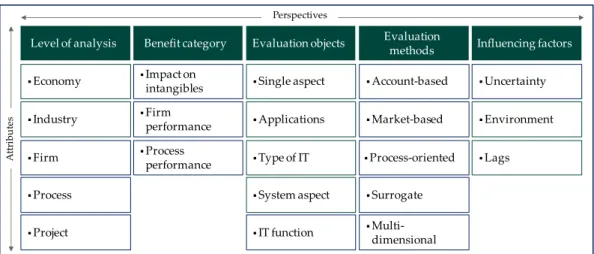
Deconstruction of IT value
- Perspectives on IT value
- Level of analysis
- Categorization of the benefit
- Types of evaluation subject
- Influencing factors
- Determining the IT value definition used
They noted that market value increases five to twenty times the amount of IT investment (Dehning and Richardson, 2002). 5.3.5.2.1 REDISTRIBUTION OF BENEFITS Another factor that affects the return on IT investments is the redistribution of IT investment benefits.
Catalogue of requirements
Group 1: General requirements
Throughout the study period, the evaluation method must remain valid (Dietrich, Schulze, & Weber, 2007). These results must be comparable not only with other evaluation methods (peer comparison), but also over time.
Group 2: Capability cluster requirements
An incomplete system of numbers provides no benefits because it may not fully determine certain KPIs.
Group 3: Flexibility requirements
If many pieces of the puzzle are missing or incomplete, analysts cannot draw reliable conclusions (Ibid, p. 15). The evaluation method must be able to control or evaluate internal structural change (e.g. process change).
Presentation of major evaluation methods
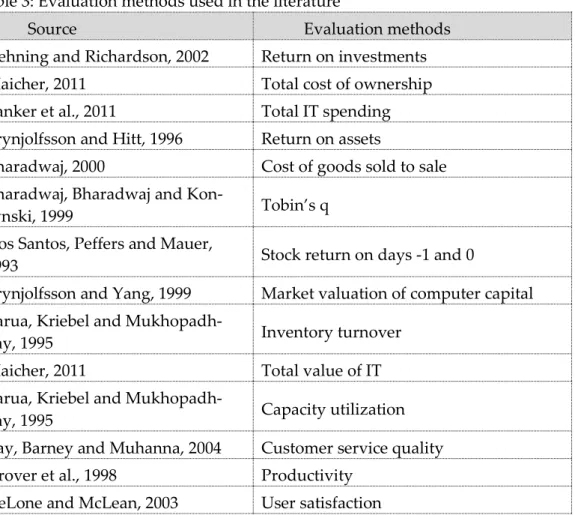
Evaluation methods in the literature
In addition to the analysis of evaluation methods for company performance, studies have analyzed process-oriented evaluation methods: Barua et al. The aforementioned evaluation methods primarily deal with material values, but other methods deal with the importance of intangible assets.
Taxonomy of selected evaluation methods
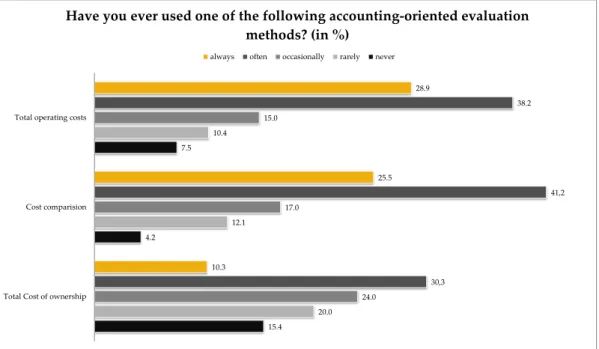
Respondents indicated that accounting-oriented evaluation methods have a high degree (81%) of utilization, followed by surrogate evaluation methods (69%) and market-oriented evaluation methods (67%). The very narrow set of process-oriented evaluation methods resulted in respondents not confirming the use of this category, with 94% of respondents not using any of the evaluation methods and only 6% using at least one.
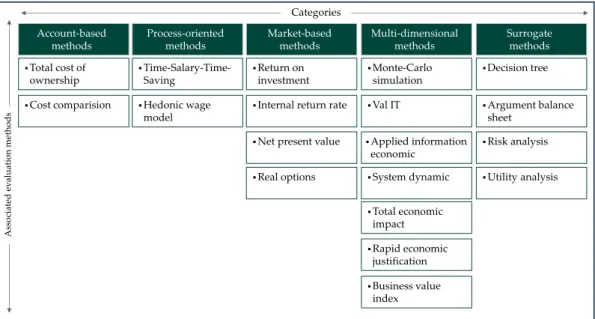
Categories of evaluation methods
The primary focus of process-oriented evaluation methods is the optimization of existing processes, for example by reducing processing time. 6.2.3.4.3 USABILITY ANALYSIS Usability analysis is one of the most popular methods of evaluating alternative investments in IT.
Critical assessment of evaluation method categories
- Accounting-oriented evaluation methods
- Market-oriented evaluation methods
- Multi-dimensional evaluation methods
- Process-oriented evaluation methods
- Surrogate evaluation methods
More than 50% of CIOs indicated that the results of these evaluation methods are understandable. More than 48% indicated that these evaluation methods can be easily adapted to changing business objectives.
Structure of the proposed reference model
Quality criteria and Objectives
Since general models have a large market, firm-specific adoptions should be included in the selection criteria of the model (Becker et al., 2002). This should ensure that the model users and developer do not suffer pseudo-accuracy (Becker et al., 2002).
General structure and elements of the reference model
Since each firm's specification of its IT value proposition differs, the associated evaluation methods must include all possible application areas. Following this definition, the proposed model will define for each capability grouping its associated evaluation methods and flexibility measures.
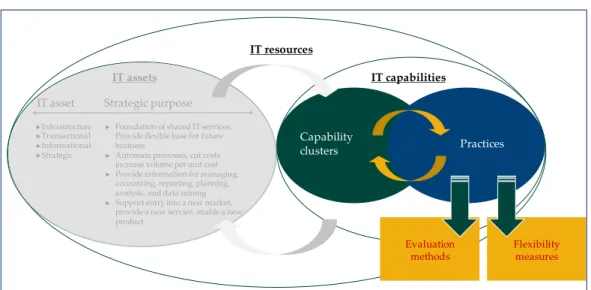
Content of the Reference Model
Survey respondents ranked accounting evaluation methods highest for supporting mastery of this element of the model (Figure 33). This is understandable, as the management of hardware and IT infrastructure is important for this part of the model.
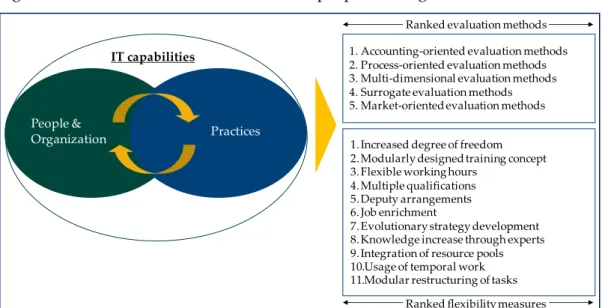
Critical assessment of the reference model
Assessment of Quality criteria
Assessment of the reference model’s objectives
Summary of key findings
Domains requiring further research
Outlook
Research Design of the literature review
Definition of the material
Analysis of the origin
Defining the research question
Executing the analysis
Compilation and interpretation
Quality assurance of the derived categories
Methodological design of the executed survey
Objective and methodology
Operationalization
Pre-test
Data collection
Analysis
Quality assurance
Development approach of the reference model
Definition