Blanka Klimova
University of Hradec Kralove, Czech Republic
Marcel Pikhart
University of Hradec Kralove, Czech Republic
Katerina Fronckova
University of Hradec Kralove, Czech Republic
Christina Sanchez- Stockhammer
Chemnitz University of Technology, Germany Yulia Stukalina Transport and
Telecommunication Institute, Latvia
Mikel Iruskieta
University of the Basque Country (UPV/EHU), Spain
Kübra Okumuş Dağdeler
Sivas Cumhuriyet University, Türkiye Eve Lejot
University of Luxembourg, Luxembourg
Antigoni Parmaxi
Cyprus University of Technology, Cyprus
Rocío Bartolomé Rodríguez Universidad Autónoma de Madrid, Spain
Antonio Pareja-Lora
Universidad de Alcalá (UAH), Spain
ANALYSIS OF FOREIGN LANGUAGE TEACHERS´
ATTITUDES TOWARDS DIGITAL TEACHING IN THE EUROPEAN UNION COUNTRIES
1Annotation. In the present era, both learning and teaching, including foreign language learning (FLL) and teaching, are being radically influenced by a massive implementation of digital technologies. The purpose of this study is to analyze foreign language teachers’ attitudes towards the use of technologies in foreign language teaching across Europe and to identify clear implications for their efficient implementation. The methodology of this study includes a mixed-method research design (quantitative and qualitative) with a survey conducted with altogether 234 foreign language (FL) teachers from different universities across Europe.
The results clearly show that FL teachers generally have a positive attitude towards the use of technologies in their classes and that they frequently use them in their teaching since they can make students more engaged in learning a foreign language.
In fact, the FL teachers have always been at the forefront of innovative approaches to teaching and learning. In spite of this, they admit that they would welcome more professional support from the management of their home institutions and demand training in the use of new technologies. The results of the research also indicate that special attention should be paid to the lack of personal contact, students' reactions, and the expression of emotions, which is difficult and almost impossible to achieve through the use of digital media. These findings are unique since they aim specifically at current FL teachers´ attitudes and needs across Europe and can be utilized by stakeholders and FLL course designers. Moreover, they can also be extended to a larger scale, i.e., the global level.
Keywords: digital learning; foreign language learning; L2; digital technologies;
qualitative study.
1 Acknowledgement: This study was supported by COST Action CA19102 project
‘Language in the Human-Machine Era’ (LITHME).
Introduction
Nowadays there is an urgent need to implement digital technologies in teaching more than ever before, due to the challenges caused by the COVID-19 pandemic. This trend is visible at all educational levels, starting from basic schools through high schools to universities, with various subjects involved, including university foreign language (FL) teaching. Most universities had to change their face-to-face teaching to online learning, or at least a blended learning model of instruction, which has resulted in unprecedented challenges to teachers' beliefs, practices and attitudes. These challenges also showed certain barriers or pitfalls very soon when employing Information and Communication Technologies (ICT) and data-driven methods in foreign language learning (FLL).
Recent research (Pratolo & Solikhati, 2021; Zamborová et al., 2021) indicates that FL teachers have quickly adapted to an online mode of teaching despite the limitations in technological resources and the absence of previous systematic training. Pratolo and Solikhati (2021) expand that although the FL teachers show positive attitudes to the use of digital literacy in their classrooms, they need to have access to better technical facilities, develop technological pedagogy, and support from policymakers to acquire relevant digital literacy. Furthermore, research reveals that digital pedagogy training depends on teachers’ ICT confidence levels (Pongsakdi et al., 2021). As Pongsakdi et al. (2021) point out, teachers with low confidence in ICT use exhibit an increased ICT confidence level after receiving digital training, while teachers with high confidence in ICT use exhibit no significant changes in their confidence level after receiving digital training. As Anggeraini (2020) reports in his qualitative research study, English teachers maintain that digital technology helps them create a stimulating atmosphere and that technology has a positive impact on English teaching and learning. However, he also states that FL teachers need training in digital technologies and more facilities in order to apply digital teaching efficiently and create their own digital media in their classrooms. Further research also indicates that university teachers are motivated to obtain digital training as it increases their abilities and skills to use various digital resources in the classroom
(Antón-Sancho et al., 2021). The key issue in this respect, however, is whether university teachers have remained motivated and capable of empowering students’ learning from a techno-pedagogical point of view (Fyfe, 2011).
In addition, it should be taken into account that within a period of only a few years, teachers’ instructional environment has transformed from a formalistic and grammatical curriculum design to a human-machine interaction where the student is in the center of the learning process and has to primarily develop communicative skills (Council of Europe, 2001; 2020) and digital competencies (Ferrari, 2013). In this environment, all learning, teaching and assessment are naturally related to online interactions. These changes inevitably affect FLL and FL teaching and their related tools, from the first oral text recordings (both cassettes and CD-ROMs) to corpus-based approaches and Computer-Aided Language Learning (CALL), or social networks or mobile devices (tablets and mobile phones), to learning analytics, or to metrics based on big data and large corpora to monitor student output (Camacho & Iruskieta, 2020).
Nowadays, employers and policy-makers are calling for the development of the 21st-century skills, of which some crucial ones are the foreign language skills and competencies necessary for supporting successful professional communication in an increasingly international job market, intercultural environments, and cross-cultural teams. Therefore, education and training systems have to reconsider the challenges associated with teaching and learning foreign languages online. Moreover, improved language learning and teaching could stimulate the creation of a European identity in all its diversity and “contribute to the development of citizenship and democratic competencies” (Council of the European Union, 2019).
Building a constructive language learning environment at universities is crucial for supporting language education (Council of Europe, 2001).
In the era of human-machine interaction or the digital transformation era of the contemporary economy and society (OECD, 2019; 2021), the learning environments based on ICT offer access to the knowledge areas not available earlier and encourage the development of language skills and competencies in the agenda of professional education (Stukalina & Zervina,
2015). Therefore, foreign language teachers have to address several issues related to teaching methodologies and learning formats, including the integration of ICT-based tools into their courses for stimulating students’
L2 acquisition and generally all basic language skills covering all communicative, linguistic, sociolinguistic, and digital competencies. As modern ICT has an enormous potential to provide innovative solutions in the context of language learning, FL teachers are well advised to adapt their attitudes towards digital learning. This involves altering their educational practices to online delivery and recognizing online instruction as essential for improving the studies. These attitudes will influence their choice of teaching strategies as a response to the challenges associated with the integration of ICT in teaching languages. An attitude seems to be the key term in this context, and it can be defined as a construct with several components, such as emotional or affective, behavioral and cognitive, that enable a learner to know the consistency of what teachers say, think, or do in such a way that certain given behaviors can be predictable in the future (Breckler, 1984;
González-Sanmamed et al., 2017).
Attitudes thus create a key subjective approach to a particular objective reality that will be crucial to the level of satisfaction, performance, outcomes and the general quality of the educational process. Previous studies focused on teachers’ attitudes and addressed individual factors, considering years of experience, age, gender, education, or contextual factors, such as country, culture, school model, language, ICT support, and access to research infrastructures. For example, the variables of gender and teaching experience are significant to help predict the teachers’ attitudes towards technological processes. The gender factor is quite controversial because some research (Antón-Sancho et al., 2021) shows that there is a discrepancy between males and females as females are more open to the use of digital resources than males; while other studies (Guillén-Gámez & Mayorga- Fernández, 2020) do not indicate gender differences towards the process of teaching with technology. In addition, the less experienced teachers tend to be more favorable to the use of ICT in their teaching (Alshammari et al., 2016; Olafare et al., 2018).
Generally, university teaching staff shows an average attitude towards the use of ICT (Guillén-Gámez & Mayorga-Fernández, 2020).
Nevertheless, it can be claimed that the more positive their attitude is, the more efficient their teaching could be. To achieve this goal, teachers need to understand the reasons why to use a technology (Anggeraini, 2020) within a techno-pedagogy perspective (Fyfe, 2011). Moreover, collaborative work among teachers creates a set of directions and guidelines relevant to the effectiveness of the course thanks to the particular skills of each teacher (Khoshsima et al., 2018). Contextual factors affect teachers’ attitudes, for example, if the teaching organization has a clear roadmap to develop an ICT ecosystem or a clear curriculum and use-cases to implement ICT, or if the teaching language is under-resourced, or if the teachers have no access to language technology (Camacho & Iruskieta, 2020). For these reasons, it is crucial to evaluate the teachers´ attitudes towards ICT in university foreign language learning. These attitudes could be related to the topics of anxiety, enjoyment, and self-confidence (Spanos & Sofos, 2015) and perceived computer self-efficacy, the value of technology, student learning, the commitment to technological innovation, teachers’ technological competence, and training of teachers (González-Sanmamed et al., 2017).
When these aspects are understood, it may be possible to streamline the educational process from the viewpoint of the teacher. Therefore, the aim of this study is to analyze foreign language teachers´ attitudes towards the use of technologies in foreign language teaching across Europe and to identify clear implications for the efficient implementation of digital teaching into university FLL curricula. Moreover, it aims at providing an overview of the current situation in the EU by collecting the available and relevant data pertinent to the researched topic. Namely, the attitude of university teachers involved in foreign language teaching with the help of various digital tools.
The research is different from other studies in its approach with respect to the geographical coverage of the research sample, which includes foreign language teachers from a variety of EU universities. So, multiple perspectives can provide new insights into the issue under discussion.
Research Questions
For a better understanding of the fast-changing context of modern higher L2 education, which is undergoing a digital transformation, more research focused on identifying and analyzing a variety of FL teachers’
attitudes is crucial. Therefore, in this respect, this study aims to answer the following research questions:
RQ1: Are university FL teachers able to use technologies for FLL?
RQ2: How do university FL teachers perceive the use of technologies for FLL?
RQ3: What is the level of subjective satisfaction in FL teachers who use technology for FLL?
RQ4: What is the correlation between gender, years of teaching experience and technology for FLL?
RQ5: What do teachers see as the biggest benefit of using technology for FLL?
RQ6: What do teachers see as the biggest drawback of using technology for FLL?
Research Methodology
To answer the above research questions, the authors have employed a mixed-method research design (quantitative and qualitative) in a survey with a 4-point Likert scale and open-ended questions. The research follows the strategy recommended by González-Sanmamed et al. (2017). They claimed that research studies can use four types of scales to measure teachers’ attitudes, that is, the association between the responses to an item and that item’s attributes. These scales are: (1) semantic differential scales to measure teacher’s attitudes, (2) additive or Likert scales to express how much teachers agree with a particular statement, (3) cumulative scales to know how much positive or negative attitude the teacher has towards a topic, and (4) comparative scales to measure teachers’ attitudes to evaluate one concept in direct comparison to other.
The data were collected by an online questionnaire sent to the respondents via Google Forms, and the whole process of data collection was conducted in English. The questionnaire was created by the authors of the study aiming at collecting relevant data pertinent to the study. The online questionnaire consisted of three major parts: the first part included the respondents’ data, containing five sociodemographic questions;
the second part formed the core of the questionnaire and contained 18 statements using a standardized 4-point Likert scale with the answers Strongly Disagree, Disagree, Agree, and Strongly Agree; and the third part consisted of six open-ended questions that created space for the subjective evaluation of the researched situation and contributed a qualitative perspective. The research sample was created by random sampling by sending an invitation email to randomly chosen teachers from various EU countries. Altogether 234 respondents from various European universities participated in the survey. All the respondents were second language/foreign language university teachers. To guarantee that all the respondents were university teachers, they were contacted via their university email addresses or university-related mailing lists, and no private emails were used.
The survey was conducted during September 2021 among teachers who were involved in the teaching of at least one foreign language at an institution of higher education, i.e., a university. It was primarily targeted at university teachers in Europe. A few non-European nationalities were included in the analysis too, as the respective participants are working as language teachers in European Union higher education institutions.
Descriptive characteristics of the respondent data were evaluated as part of the statistical analysis. In addition, the frequency analysis of responses to survey questions 1-18 was conducted, and the dependence of responses on gender and length of teaching experience of the respondents was also observed. For this purpose, contingency tables were constructed and χ2 tests of independence were performed. For the length of teaching experience, the created categories were considered. The assumptions of using the tests were always met. The significance level for testing was set at 0.05. The variable AGE was not included in the analyses as it is strongly correlated with length of experience (r = 0.862, p < 0.001); the preference
was given to the length of teaching experience, as that was reported by more respondents and is also more relevant to the focus of the research. The last part of the statistical analysis concerned the responses to the final open- ended questions. The analysis attempts to identify the categories of similar responses and quantitatively evaluate their representation. It is important to mention that one answer could fall into several categories. At the same time, these questions provided a more detailed insight into the views of the respondents and provided data to perform qualitative analyses. All analyses were performed using IBM SPSS Statistics 28 software. The GDPR (EU General Data Protection Regulation) was strictly followed, as no personal data about the respondents were collected. The research was approved by the Ethics Committee of the University of Hradec Kralove no. 2/2021.
The questionnaire was fully anonymous and voluntary, and the respondents expressed their agreement with the research at the beginning of the questionnaire. The only identification of the respondent was the date stamp of the particular questionnaire that contains the timestamp when the questionnaire was finalized and submitted.
Results
Demographic Information Related to Participants
The total number of all participants who took part in the survey was 234. Their answers regarding demographic information, such as gender, age, length of teaching experience, country and foreign language are detailed below.
Gender
The majority of the participants were females (177 participants = 75.6%), followed by 55 male participants (23.5%) and 2 participants indicating their gender as non-binary (0.9%) (see Figure 1 below).
Age
Among the 220 participants who stated their age, the mean age of the respondents was 47 years. The minimum value was 25 years, while the maximum value was 76 years. Only 14 respondents did not state their age in the questionnaire. The findings reveal that most of the participants (35.0%) were between 35–44 years old, followed by the age range of 45–54 years.
The youngest age range (25–34 years) was represented least frequently.
Length of Teaching Experience
A total number of 233 participants specified the length of their teaching experience. The least experienced participants had been teaching for one year, while the maximum length was 50 years, with an average length of 19 years. According to Table 1 below, most of the participants had been teaching a foreign language for 10–19 years (33.0%). The second largest group had been teaching for 20–29 years (27.5%). The proportions in the ranges of the least and most experienced participants were relatively similar.
Table 1
Length of Teaching Experience
Number of years f %
1–9 years 44 18.9
10–19 years 77 33.0
20–29 years 64 27.5
30+ years 48 20.6
Total 233 100.0
Note: "f" indicates the frequency
Institution, City, Nationality
Participants were also asked to indicate their institution, city and nationality – of which only the third category is detailed below, as the respondents within specific countries were usually from one or a few institutions only. The study included participants of 23 different nationalities (see Table 2). The respondents predominantly came from European countries, especially Germany (n = 103), Spain (n = 51), and Latvia (n = 26). Some of the respondents also work/worked at several different institutions in different countries. The non-European nationalities were included in the analysis as well, as the respective participants are working as language teachers in European Union higher education institutions.
Table 2 Nationality
Country f
Algeria 4
Argentina 1
Austria 1
Chile 1
China 1
Colombia 1
Cyprus 14
Czech Republic 9
France 3
Germany 103
Ireland 2
Israel 1
Italy 1
Latvia 26
Luxembourg 7
Peru 1
Country f
Russia 1
Spain 51
Switzerland 2
Turkey 3
UK 5
Uruguay 1
USA 4
Note: "f" indicates the frequency
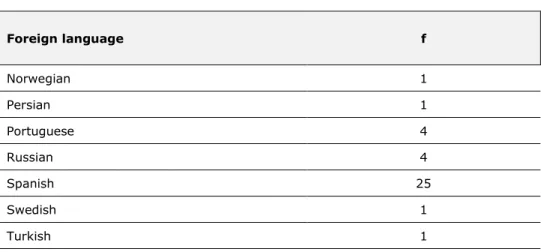
Foreign Languages Taught. Table 3 below illustrates the foreign languages that the respondents teach or taught at a university. The results show that English has the highest representation among the languages taught (n = 164), followed by German (n = 30), French (n = 25) and Spanish (n = 25).
Table 3
Foreign languages
Foreign language f
Basque 8
Chinese 1
Czech 1
Dutch 1
English 164
French 25
German 30
Greek 6
Hebrew 1
Italian 6
Latin 1
Latvian 1
Foreign language f
Norwegian 1
Persian 1
Portuguese 4
Russian 4
Spanish 25
Swedish 1
Turkish 1
Explanation: "f" indicates the frequency Quantitative Results
Table 5 below summarizes all the statements in the survey for which the participants had to express their degree of agreement on a scale from
"Strongly Disagree" to "Strongly Agree". The absolute frequency values are followed by the percentage based on the full number of participants (even in those cases where not all the participants answered the question under consideration).
The following discussion usually groups the two statements of disagreement and contrasts them with the grouped values for agreement.
Table 4
Frequency and Percentage of Items
Q Items Strongly
disagree Disagree Agree Strongly
agree Total
f % f % f % f % f %
1
I have been trained to teach with technologies.
26 11.2 75 32.2 113 48.5 19 8.2 233 99.6
2
I consider my students to have some background learning online.
3 1.3 41 17.5 159 67.9 31 13.2 234 100
3 I use various
digital tools to 4 1.7 15 6.5 141 61.0 71 30.7 231 98.7
Q Items Strongly
disagree Disagree Agree Strongly
agree Total
f % f % f % f % f %
enhance students’
foreign language learning during their traditional, i.e.
face-to-face, foreign language classes.
4
I easily communicate and interact with students online.
- - 29 12.4 113 48.3 92 39.3 234 100
5
I use various teaching techniques to enhance students’
foreign language online learning.
2 .9 18 7.7 133 57.1 80 34.3 233 99.6
6
I combine many ways of teaching to engage the students to study a foreign language online.
3 1.3 30 12.8 130 55.6 69 29.5 232 99.1
7
I use different gamification tools (e.g.
Kahoot, Quizizz, Menti) to teach different topics in language teaching.
31 13.2 66 28.2 93 39.7 44 18.8 234 100
8
I have no serious objections to teaching online.
8 3.4 60 25.9 110 47.4 54 23.1 232 99.1
9
I am quite confident about teaching a foreign language online.
8 3.5 40 17.4 112 48.7 70 30.4 230 98.3
10
I can easily motivate students to learn a foreign language by using different
3 1.3 50 21.6 139 60.2 39 16.9 231 98.7
Q Items Strongly
disagree Disagree Agree Strongly
agree Total
f % f % f % f % f %
technological devices/tools.
11
I can create a positive atmosphere during the traditional, i.e.
face-to-face, foreign language classes.
4 1.7 1 .4 84 35.9 144 61.8 233 99.6
12
I can create a positive atmosphere during online foreign language classes
5 2.2 32 13.8 134 57.8 61 26.3 232 99.1
13
I can easily assess my students’
foreign language knowledge and skills online.
9 3.9 89 38.4 111 47.8 23 9.9 232 99.1
14
I am better at teaching a foreign language face- to-face than online.
7 3.0 62 26.8 98 42.4 64 27.4 231 98.7
15
I enjoy teaching a foreign language online.
8 3.4 60 25.9 125 53.9 39 16.8 232 99.1
16
I believe that technologies can enhance foreign language learning.
1 .4 4 1.7 129 55.1 97 41.5 231 98.7
17
I always consider my students’
needs when planning my lessons.
1 .4 6 2.6 90 38.5 137 58.5 234 100
18
I frequently use
technologies in my foreign language classes.
- - 19 8.2 124 53.4 89 38.4 232 99.1 Note: "f" indicates the frequency
As illustrated in Table 4, the majority of the responses expressed agreement (rather than disagreement), and the most frequent answer was
"Agree". The weaker option of agreement/disagreement was more frequent for most questions. The answers allow drawing the conclusion that a large majority (91.8% in Q18) of teachers frequently use technology in language teaching. They have no serious objections and reservations to online teaching, which indicates that the participants have positive attitudes towards digital teaching.
Only slightly more than half of the teachers (56.7% in Q1) had been trained in the use of technology in teaching, which can mean anything from systematic and professional training to a more or less intuitive approach to the topic. Although more than half of the participants state that they are trained for digital teaching, they have an even more positive attitude towards online teaching with respect to their students. In summary, the vast majority of the teachers (81.1% in Q2) assume that their students have the basic knowledge and prerequisites required for online learning. Even though the teachers tend to have a positive attitude towards online teaching, a majority (69.3% in Q14) believe that they can teach better in the traditional way, and that they are better at teaching language face-to-face than online.
Nevertheless, the teachers also believe that they manage to create a positive atmosphere in online teaching (83.4% in Q12), even if they estimate that they can do so even better in a traditional teaching mode (97.4% in Q11).
Teachers not only use digital tools to enrich their online teaching, but the vast majority (91.7% in Q3) also employ these to supplement and enrich traditional instruction – even if the popularity of gamification tools is in the mid-range at 58.5% (Q7).
Most of the teachers enjoy teaching online (70.7% in Q15), and they also believe that they can easily motivate their students to learn a foreign language with technological tools (77.1% in Q10). Moreover, a large majority of teachers (87.6% in Q4) feel that they easily communicate with students online. A total of 97% of the teachers consider their students’ needs when planning their lessons (Q17). The overwhelming majority of the teachers state that they use a variety of teaching techniques (91% in Q5). The control question Q6, which uses a slightly modified wording of Q5, results in a very
similar finding, as 85.1% of the participants state that they combine different teaching methods. The teachers also assess students’ knowledge and skills in their online teaching – 57.2% of them even find this easy to do (Q13). Most teachers have no serious objections to teaching online (70.5% in Q8) – most probably because the majority feels confident about doing so (79.1% in Q9).
Almost all teachers (96.6% in Q16) believe that technology can improve language learning.
Dependence of Responses on Gender and Length of Teaching Experience
Gender
Within gender, only female and male categories were considered. As the respondents with non-binary gender were not sufficiently represented to make statistical judgments, they were not included in the analysis. Table 5 shows the p-values of the χ2 test of independence.
Table 5
Dependence of Responses on Gender
Items p
I use different gamification tools (e.g. Kahoot, Quizizz, Menti) to
teach different topics in language teaching (Q7) 0.010 I frequently use technologies in my foreign language classes
(Q18) 0.002
The above table indicates that there is a significant difference for questions 7 and 18 (at the 0.05 level of significance) based on the participants’ gender. With regard to the use of gamification tools like Kahoot (Q7), there is a significant prevalence of agreeing responses among female teachers (112 agreements vs. 65 disagreements) and a tendency towards disagreement among the male participants (24 agreements vs.
31 disagreements). Similarly, the female participants have a very significant
predominance of agreeing responses (167 agreements vs. 9 disagreements) regarding the frequent use of technologies in foreign language classes (Q18), while the male teachers have a less significant predominance of agreeing responses (44 agreements vs. 10 disagreements).
Length of Teaching Experience and Age
Significant (at the 0.05 level of significance) dependence of responses on length of teaching experience was found for question 7. The results indicate that as the length of teaching experience increases, the proportion of agreeing responses decreases, with disagreeing responses predominating in the "30+ years of experience" category in using different gamification tools.
On the basis of these findings, one can conclude that it is mainly the younger teachers who use gamification tools (Table 6).
Table 6
Dependence of Responses on Length of Teaching Experience
Item p
I use different gamification tools (e.g. Kahoot, Quizizz, Menti)
to teach different topics in language teaching. (Q7) 0.049
Qualitative Results
The survey was closed with six open-ended questions, for which the results are discussed in the subsection below.
Perceived Advantages of Technology in Language Teaching
The participants listed multifarious advantages in the use of technologies for language teaching when prompted to do so in open-ended Q19: What do you like about using technologies in your foreign language teaching? More specifically, the participants reported that technologies expanded and enriched learning opportunities, bringing greater variety to
learning activities (n = 51; 21.79%), that technology made learning more interesting and fun and was more motivating for young people (n = 42;
17.95%). In addition, the findings reveal that technologies have a big potential, which enabled greater interactivity, engagement, and collaboration among students (n = 30; 12.82%). The following statements exemplify these findings: “It can make the class interactive and interesting.” (P 9), or
“Engage students who hide behind black screens” (P 43).
In fact, the potential of technology to provide authentic experience seems to be amongst the popular advantages voiced by participants, as technology-enhanced learning is closer to the real world (n = 19; 8.12%).
The results also demonstrate that technologies provide easy and quick access to a wealth of information and allow easy sharing of learning materials (n = 18; 7.69%). The respondents also noted that technologies brought better adaptation to individual students’ needs, as students could learn at their own pace (n=18; 7.69%), as was exemplified in the statement “the asynchronous aspect; everyone can access/learn the content at their own time /speed” by Participant 51. Amongst the least frequently listed advantages in the use of technology is its potential to save time and bring flexibility (n = 13; 5.56%) and to change traditional teaching methods (n = 8; 3.42%). It is worth mentioning here that in spite of the positive framing of the question, some participants reported that technology was not the most important thing in teaching, and that it should be seen as a supplement only (n = 3; 1.28%), as exemplified by the following statements: “Using technology is complicated, demanding and dangerous” and “Nothing, on the contrary, technologies disrupt learning.”
Perceived Disadvantages of Technology in Language Teaching
When it comes to what the respondents dislike about the use of technologies in foreign language teaching (Q20 – What don’t you like about using technologies in your foreign language teaching?), the results show that not everything always works as it should. Therefore, technical problems can occur unexpectedly (n = 42; 17.95%), there is a lack of personal contact with students (n = 35; 14.96%), and that some students are less active
because there is not enough control. Thus, some of the respondents find it harder to remain attentive (n = 21; 8.97%). Furthermore, some teachers may not be comfortable using technology, or may not have the necessary technical equipment, or may not be comfortable with technology (n = 17;
7.26%). For example, Participant 2 stated that “some students still prefer face-to-face instruction”. The results also reveal that there is a lack of support from institutions, with technology being outdated and a lack of training for teachers (n = 15; 6.41%), as well as the fact that technology is more demanding and time-consuming (n = 15; 6.41%), as exemplified by the statement “More work for lecturers; more written tasks to correct, more individual feedback to provide” (P13). Furthermore, the results demonstrate that the teachers are aware of the fact that it is more difficult to test the students’ knowledge and that students can thus cheat more easily in an online mode (n = 10; 4.27%), and that there is a constant need to update, change and adapt to new developments, resulting in too much variety and diversity (n = 8; 3.42%).
Suggestions for Improvement in Foreign Language Online Teaching
The respondents were also asked to provide suggestions on how their foreign language online teaching could be improved (What would you like to improve in your foreign language online teaching?). In the most common answers, the respondents highlighted the need to improve students’
motivation and involvement in learning (n = 38; 16.24%), to increase their own proficiency in using different technologies (n=36; 15.38%), to try out other new technologies (n = 30; 12.82%), and to improve the process of testing students' knowledge (n = 23; 9.83%). The following excerpts testify to this: “More tools and depth of knowledge on the ones I use” (P227); “I would like them to be more involved and feel more confident to participate”
(P211), or “I would like to have more time and contact with the students. We need more time for the presentations of their projects” (P40).
Drawbacks of Online Foreign Language Teaching
The respondents were also invited to indicate the biggest drawbacks of online foreign language teaching (Q22 – What do you consider the biggest drawback of online foreign language teaching?). The most popular answer was the lack of personal contact (non-verbal communication, emotions, social contacts, etc.), as this was highlighted by almost 40% of participants (n = 92). Other answers noted here include the difficulty in motivating students to participate in the class (n = 23), as well as technical problems (n = 18) and problematic assessment and verification of students' knowledge (n = 15), as exemplified by the following statements: “Distant and difficult communication, and language learning is about communication” (P 56),
“Motivation-it is so easy for students to feel lonely and thus unmotivated”
(P 86), and “Not enough knowledge and interest of students, motivational problems due to difficult life circumstances (e.g. shared rooms with other family members)” (P 108).
The Biggest Benefit of Online Foreign Language Teaching
When it comes to the biggest benefit of online foreign language teaching (Q23 – What do you consider the biggest benefit of online foreign language teaching?), participants voiced its accessibility from anywhere, anytime, for anyone (n = 79; 33.76%), as exemplified by Participant 44’s statement “Could teach students all over the world while being at home”.
Other answers noted here include the fact that online foreign language teaching is time-saving and convenient (e.g., no commuting) (n = 35;
14.96%) and leaves more autonomy to students and better adaptation to individual students’ needs (n = 19; 8.12%). In summary, it is important to note that the participants realize positive and negative aspects in the use of technology in online foreign language teaching, with the prevailing opinion being that a combination of traditional teaching and the involvement of technology is best. The following excerpts from the participants’ responses underline this: “I think blended learning should be the future of language teaching” (P121), or “Technology is definitely a great benefit, but can hardly
replace face-to face [sic] lectures. A combination of both is advantageous”
(P133).
Discussion
The results described above provide answers to the research questions that are discussed in the context of relevant literature below.
RQ1: Are university FL teachers able to use technologies for FLL?
This question has to do with what other authors may refer to as ICT self-efficacy for teaching, ICT pedagogical competence, or digital competence for teaching (Moreira-Fontán et al., 2019). Some previous research studies reveal that teachers usually lack adequate pedagogical competencies and skills in implementing digital technologies (Mishra & Mehta 2017; Sumardi, 2020).
In addition, FL teachers were found to exhibit negative attitudes towards ICT integration (Hismanoglu, 2012), and some of them also thought that online teaching might be less stimulating than traditional, face-to-face teaching (Kulikowski et al., 2021). However, this is not the case for the teachers surveyed in this study because most FL teachers feel that they are able to use technology efficiently and frequently in their language teaching. Nevertheless, some would welcome better training and support from their institutions, especially for online teaching, which can be difficult to run and master from a technical point of view. In relation to this latter issue, and regarding the use of eLearning tools, Cross and Hong (2012) report that especially elementary teachers were satisfied when they felt encouraged by their school authorities to implement the innovative and efficient use of ICT for teaching (Pongsakdi et al., 2021).
In fact, the more satisfied they were with the degree of support provided by the administrators, the more positive attitudes they showed toward teaching. Moreover, other authors claim that both negative feelings arise and motivation decreases in teachers who do not feel supported enough by their institutions (Halbesleben & Demerouti, 2005; Moreira-Fontán et al.,
2019). Kulikowski et al. (2021) expand that also the lack of relevant technical equipment needed for online teaching negatively affects teachers´
performance and their willingness to use ICT in their teaching. This is in line with other studies, e.g., Moreira-Fontán et al. (2019) or Pongsakdi et al.
(2021). Therefore, these aspects, i.e., training and encouragement from their home institutions in implementing ICT in FL teaching and learning, seem to be critical issues for technology to be consistently and effectively used in foreign language teaching in higher education scenarios.
RQ2: How do university FL teachers perceive the use of technologies for FLL?
Previous studies have revealed that FL teachers who are not convinced of the ICT benefits on instructional performance are less likely to employ technology in their teaching (Pongsakdi et al., 2021). In this study, however, the predominantly positive view is that technology brings new possibilities to language learning, with various advantages and disadvantages (consult questions Q19, Q20, Q22, Q23). This positive attitude may be inherent in the respondents or accelerated by the needs the pandemic has generated in them. In any case, this positive predisposition is in line with other research studies (Housseine & Rabba, 2020; Khoshsima et al., 2018).
Moreover, Wang (2021) shows that teachers consider very beneficial the use of ICT in their classes as it can facilitate students’ motivation, as well as enhance content creation and access to authentic production of FL communication and the associated culture(s).
On the one hand, it has been shown that, at least in the case of pre- service teachers, computer knowledge and the use of technology positively correlate with happiness and perceived ease of ICT use (Moreira-Fontán et al., 2019). On the other hand, Kulikowski et al. (2021) report that the teachers who do not perceive themselves as digitally competent feel demotivated while conducting online teaching. For example, they may feel anxious to a lesser or greater extent (Moreira-Fontán et al., 2019). These authors also advise teachers to join their respective professional communities of practice as a strategy to feel supported and develop their expertise by
sharing knowledge. Some ICT teaching and learning tools, such as Edmodo (https://new.edmodo.com/), already include functions for creating and joining this kind of community of practice; and also, some research projects, such as OpenDigi funded by the Finnish Ministry of Education and Culture, aim at building teachers’ communities, in order to enhance digital pedagogical skills (Pongsakdi et al., 2021). As far as the results of this study are concerned, the majority of FL teachers agree that a combination of traditional teaching with the use of technology is ideal. This is in line with the studies by Civelek et al. (2021) and Zamborová et al. (2021). In addition, in online teaching alone, the biggest drawback perceived by the teachers is mainly the lack of face-to-face contact with students.
RQ3: What is the level of subjective satisfaction in FL teachers who use technology for FLL?
Most FL teachers in this study are satisfied with their use of technology. However, most of them state that they still prefer traditional, face-to-face teaching to online teaching. These findings are not surprising since traditional FL teaching is based on immediate interactions and feedback between a teacher and his/her students. Some authors, such as Merritt et al.
(2019), might disagree since they claim that teachers are primary change agents in society and they should be pioneers in innovations. But, according to the authors of this study, FL teachers are, in fact, at the forefront of all changes. They were among the first to employ digital technologies in their best practices (cfr. Klimova & Pikhart, 2021).
Concerning eLearning and online teaching, the FL teachers in this study would like to improve students’ motivation and increase students’
involvement in the learning process. At the same time, many teachers would also like to improve their skills and competencies for using technology and would even like to try other new technologies, especially gamification. This internal motivation is very important for any future outlook for a change as the motivated users of the technology will want to improve the status quo by their deeper involvement in the educational process. For these reasons, it is crucial to motivate the teachers to take the initiative to improve their digital
competencies and also seek support for this training from universities.
Moreira-Fontán et al. (2019) propose to enhance digital self-efficacy and the perceived support for innovation at teaching institutions, as well as to consider the emotions associated with them, such as ICT positive emotions and satisfaction with support in order to stimulate teachers' performance.
RQ4: What is the correlation between gender, years of teaching experience and technology for FLL?
In general, there was no significant effect of length of teaching experience on access to and use of technology. Significant differences only exist in the use of gamification tools, which are used less by FL teachers with longer teaching experience. Regarding the other demographic variable (gender), female teachers showed a significant prevalence of agreeing with responses regarding the use of gamification tools, such as Kahoot (Q7), while male teachers presented a tendency towards disagreement, which is rather counterintuitive. González-Sanmamed et al. (2017) also found that women held a more positive view towards the use of ICT than men. The same was true for the findings of Verges (2012), who reports that there is a visible correlation between gender and the use of technology.
RQ5: What do teachers see as the biggest benefit of using technology for FLL?
The FL teachers in the present study mainly state that technology expands and enriches both teaching and learning opportunities, brings more variety to classroom activities, makes learning more interesting and fun, and helps motivate young people. This aligns with other researchers’ results (Khoshsima et al., 2018; Valencia-Arias et al., 2018). For instance, some of them claim that digital technologies can foster students’ learning and motivation (Faber et al., 2017; Laakso et al., 2018). From the perspective of online learning, they see the biggest benefit of technology for FLL in its accessibility for anyone, from anywhere, and at any time, which has been described widely in many research studies across different disciplines
(Valencia-Arias et al., 2018). These authors also emphasize the role of technologies in developing especially collaborative learning and continuous assessment.
RQ6: What do teachers see as the biggest drawback of using technology for FLL?
According to the participants of the survey, not everything works as it should when it comes to the use of technology in FLL. For example, technical problems can occur unexpectedly, and not all FL teachers and students have full, adequate, and stable access to technologies. Technical issues as a major constraint have also been found in other research studies (Cosgun & Savaş, 2019; Khoshsima et al., 2018). Moreover, according to the UNESCO (2020), a sudden transition to online teaching and learning might be quite difficult and complex, raising both human and technical challenges. Ferri et al. (2020) detected three principal issues with respect to online teaching: technological (i.e., a shortage of technical equipment and Internet access), pedagogical (i.e., a deficit of relevant computer skills and competencies), and social (i.e., insufficient interactions and feedback with learners). Not surprisingly, the FL teachers in this study also consider the lack of personal contact to be the biggest disadvantage of online teaching. They also report on the lack of non- verbal communication, which is crucial in language teaching.
Furthermore, the respondents of this study criticize that in online teaching and learning, there is no possibility to perceive the students' reactions and adjust the interpretation accordingly, no expression of emotions, no social contacts. This lack of feedback and interaction is also pointed out by other scholars (e.g., Civelek et al., 2021; Khoshsima et al., 2018). At the same time, the results of this study indicate that the FL teachers find it more difficult to motivate students to participate in the class in online teaching. This is consistent with Civelek et al. (2021), whose findings revealed that 50% of their FL teachers also found their classes unstimulating, and that more than 50% of their learners felt demotivated about their online courses during the COVID-19 pandemic, and a result that is paralleled by Zamborová et al (2021).
In addition, the feeling that the use of technology for teaching is more demanding and time-consuming than traditional teaching formats is shared by teachers from other studies (González-Sanmamed et al., 2017;
Housseine & Rabba, 2020; Khoshsima et al., 2018; Kopcha, 2012; Pratolo &
Solikhati, 2021; Zamborová et al., 2021). More collaboration among teachers should also be considered when trying to implement the use of technologies in the classroom (Khoshsima et al., 2018), as well as more support from their institutions and more training for teachers because the lack of effective training is the most frequently encountered barrier to successful ICT integration (Civelek et al., 2021; Cincioğlu, 2015; Cosgun & Savaş, 2019;
González-Sanmamed et al., 2017; Hismanoglu, 2012). Therefore, as it has been mentioned several times before, teachers should be continuously offered further training both in the use of technologies, but also in the improvement of their pedagogical competencies and skills with respect to the curriculum content.
In summary, it can be concluded that since the respondents were university teachers, and they can be generally considered to be very responsible in answering the questions of the questionnaire, the findings could be applicable and transferrable into a large scale. This generalization of the findings can be particularly important as it is not possible to have fully comprehensive research sample of all European university teachers. The findings clearly show that the necessary trend of the implementation of various digital tools cannot be considered as straightforward and simple as the process needs time and serious fine-tuning. Although that university teachers have always been the major force of the implementation of trends and innovation in education, they are well aware of the potential pitfalls related to the utilization of technology in the learning process. Moreover, it is clearly visible that they call for a very clearly defined strategy on how to use digital media to create a supportive environment both for the educators and the students. All these findings summarized above can be considered authoritative enough to allow a creation of further manuals for the teachers on how to use digital media to their fullest potential. Furthermore, even if the research was conducted in Europe, it can be claimed that the results are transferable on a much larger, i.e., a global level.
Research Limitations
As regards the limitations of the present study, for all questions with a range of responses, the predominant choice is "Agree", which tends to be typical in questionnaire surveys, as participants generally tend to agree with the statements as stated and to prefer the weaker agree/disagree options.
Therefore, the answers may be biased to some extent. To reduce this bias, a 4-point Likert scale, that can reduce this neutral middle value present in a 5-point scale, had been chosen. Another source of bias may be the fact that both genders are not equally represented among the respondents, as women make up approximately three quarters of the respondents. In the case of two questions (Q7, Q18) where there were significant gender differences in the responses, the overall assessment of responses may be biased; there were also fewer young people under 35 among the respondents. This is, however, in line with the statistical representation of these two genders in educational institutions targeting foreign language learning generally.
Therefore, the results copy this societal occurrence and any balanced proportion of male and female would not create a true picture of the real situation.
Most of the respondents did not distinguish between online learning and the use of technology in traditional teaching; therefore, some questions could be understood differently by different respondents. However, the aim of the research was not to provide very exact definitions of Human-Computer Interaction, digital learning, or eLearning. There is vast and sufficient research into how to understand these concepts. This research mostly concentrated on practical use and the personal, and thus very subjective experience of the respondents who are university L2 teachers.
Conclusions
The findings of this research study can be significant for two main reasons. On the one hand, they apply to a wide geographical area that has not usually been covered in previous studies as it includes the opinions of teachers from many different European countries.
On the other hand, they shed light on the current state of FL teaching and learning. The findings clearly show that FL teachers are fully positive about the implementation of digital technologies in their teaching and can see many benefits in their use. The perceived advantages have more weight and situate the use of ICT as an indicator of the acceptance of the technology by FL teachers, which can result in their improved performance provided they are offered both professional and human support from their institutions. In addition, the findings are unique since they aim at specific and current FL teachers´ attitudes and needs across the whole of Europe, and they could be utilized by stakeholders and FLL course designers.
References
Alshammari, R., Reyes, V. C., Jr., & Parkes, M. (2016). Faculty attitudes towards the use of mobile devices in EFL teaching in a Saudi Arabian setting. In Mobile Learning Futures-Sustaining Quality Research and Practice in Mobile Learning (pp. 16–24). Australia, Sydney.
Anggeraini, Y. (2020). Language teaching in the digital age: teachers` views and its challenges. Research and Innovation in Language Learning, 3(3), 163–172.
Antón-Sancho, Á., Vergara, D., Lamas-Álvarez, V.E., & Fernández-Arias, P.
(2021) Digital Content Creation Tools: American University Teachers’
Perception. Applied Sciences, 11(24), 11649.
https://doi.org/10.3390/app112411649
Breckler, S. J. (1984). Empirical validation of affect, behavior, and cognition as distinct components of attitude. Journal of Personality and Social Psychology, 47(6), 1191.
Camacho, A., & Iruskieta, M. (2020). Euskararen i(ra)kaskuntza-prozesuak:
hezkuntza eta hizkuntza teknologiak [Basque language learning processes: education and language technologies]. Tantak, 32(2), 9–
31.
Cincioğlu, A. (2015). Digital language learning platforms from the perspectives of preparatory class teachers and students.
The Turkish Online Journal of Educational Technology, Special
Issue for INTE, 190–204.
Civelek, M., Toplu, I., & Uzun, L. (2021). Turkish EFL teachers’ attitudes towards online instruction throughout the Covid-19 outbreak. English Language Teaching Educational Journal, 4(2), 87–98.
Council of Europe. (2001). Common European Framework of Reference for Languages: Learning, Teaching, Assessment. Cambridge University Press. https://rm.coe.int/16802fc1bf
Council of Europe. (2020). Common European Framework of Reference for Languages: Learning, Teaching, Assessment—Companion Volume.
Council of Europe Publishing. https://www.coe.int/en/web/common- european-framework-reference-languages
Council of the European Union. (2019). Council Recommendation on a comprehensive approach to the teaching and learning of languages.
Official Journal of the European Union. https://eur- lex.europa.eu/legal-
content/EN/TXT/PDF/?uri=CELEX:32019H0605(02)&from=EN
Cosgun, G. E., & Savaş, P. (2019). Use of information and communication technology by in-service English teachers for self-directed professional development. Journal of Foreign Language Teaching, 16(2), 230–249.
Cross, D., & Hong, J. (2012). An ecological examination of teachers' emotions in the school context. Teaching and Teacher Education, 28, 957–967.
Faber, J., Luyten, J.W., & Visscher, A. J. (2017). The effects of a digital formative assessment tool on mathematics achievement and student motivation: Results of a randomized experiment. Computers &
Education, 106, 83–96.
Ferrari, A. (2013). DIGCOMP: A framework for developing and understanding digital competence in Europe. Publications Office of the European Union. https://doi.org/10.2788/52966
Ferri, F., Grifoni, P., & Guzzo, T. (2020). Online learning and emergency remote teaching: Opportunities and challenges in emergency
situations. Societies, 10(4), 86.
https://doi.org/10.3390/soc10040086
Fyfe, P. (2011). Digital pedagogy unplugged. Digital Humanities Quarterly,
5(3). https://hcommons.org/deposits/item/hc:31239
González-Sanmamed, M., Sangrà, A., & Muñoz-Carril, P. C. (2017). We can, we know how. But do we want to? Teaching attitudes towards ICT based on the level of technology integration in schools. Technology, Pedagogy and Education, 26(5), 633–647.
Guillén-Gámez, F., & Mayorga-Fernández, M. (2020). Identification of variables that predict teachers’ attitudes toward ICT in higher education for teaching and research: A study with regression.
Sustainability, 12, 1312. https://doi.org/10.3390/su12041312 Halbesleben, J.R., & Demerouti, E. (2005). The construct validity of an
alternative measure of burnout: Investigating the English translation of the Oldenburg Burnout Inventory. Work Stress, 19, 208–220.
https://doi.org/10.1080/02678370500340728
Hismanoglu, M. (2012). Prospective EFL teachers' perceptions of ICT integration: a study of distance higher education in Turkey.
Educational Technology & Society, 15(1), 185–196.
Housseine, B., & Rabba, S. (2020). The need of distance learning in the wake of COVID-19 in Morocco: Teachers’ attitudes and challenges in the EFL instruction. International Journal of Language and Literary Studies, 2(3), 240–256.
Khoshsima, H., Saed, A., & Arbabi, M. (2018). Online teachers’ attitudes toward using technology in teaching English as a foreign language.
Journal of Applied Linguistics and Language Research, 5(2), 134–148.
Klimova, B., & Pikhart, M. (2021). New advances in second language acquisition methodology in higher education. Education Sciences, 11(3), 128.
Kopcha, T. (2012). Teachers’ perceptions of the barriers to technology integration and practices with technology under situated professional development. Computers & Education, 59, 1109–1121.
Kulikowski, K., Przytuła, S., & Sułkowski, Ł. (2021). The motivation of academics in remote teaching during the Covid-19 pandemic in Polish universities - Opening the debate on a new equilibrium in e-learning.
Sustainability, 13, 2752. https://doi.org/10.3390/su13052752 Laakso, M., Kaila, E., & Rajala, T. (2018). ViLLE – Collaborative education
tool: Designing and utilizing an exercise-based learning environment.
Education and Information Technologies, 23, 1655–1676.
https://doi.org/10.1007/s10639-017-9659-1
Merritt, E., Hale, A., & Archambault, L. (2019). Changes in pre-service teachers’ values, sense of agency, motivation and consumption practices: A case study of an education for sustainability course.
Sustainability, 11(1), 155. https://doi.org/10.3390/su11010155 Mishra, P., & Mehta, R. (2017). What we educators get wrong about 21st-
century learning: Results of a survey. Journal of Digital Learning in
Teacher Education, 33(1), 6–19.
https://doi.org/10.1080/21532974.2016.1242392
Moreira-Fontán, E., García-Señorán, M., Conde-Rodríguez, A., & González, A.
(2019). Teachers' ICT-related self-efficacy, job resources, and positive emotions: Their structural relations with autonomous motivation and work engagement. Computers & Education, 134, 63–
77. https://doi.org/10.1016/j.compedu.2019.02.007
OECD (2019). Measuring the digital transformation: A Roadmap for the future. OECD Publishing. https://www.oecd.org/going- digital/measurement-roadmap.pdf
OECD (2021). Going digital in Latvia, OECD Reviews of digital transformation.
OECD Publishing. https://doi.org/10.1787/8eec1828-en
Olafare, F.O., Adeyanju, L.O., & Fakorede, S.O.A. (2018). Colleges of education lecturers’ attitude towards the use of Information and Communication Technology in Nigeria. Malaysian Online Journal of Educational Sciences, 5(4), 1–12.
Pongsakdi, N., Kortelainen, A., & Veermans, M. (2021). The impact of digital pedagogy training on in-service teachers’ attitudes towards digital technologies. Education and Information Technologies, 26, 5041–
5054.
Pratolo, B.W., & Solikhati, H.A. (2021). Investigating teachers’ attitude toward digital literacy in EFL classroom. Journal of Education and Learning (EduLearn), 15(1), 97–103.
Spanos, D., & Sofos, A. (2015). The Views and Attitudes of Students Participating in a One-to-One Laptop Initiative in Greece. Education