WILL IT LAST? AN ASSESSMENT OF THE 2011 SPANISH PENSION REFORM USING THE SWEDISH
SYSTEM AS BENCHMARK
CARLOS VIDAL-MELIÁ
FUNDACIÓN DE LAS CAJAS DE AHORROS DOCUMENTO DE TRABAJO
Nº 678/2012
De conformidad con la base quinta de la convocatoria del Programa de Estímulo a la Investigación, este trabajo ha sido sometido a eva- luación externa anónima de especialistas cualificados a fin de con- trastar su nivel técnico.
ISSN: 1988-8767
La serie DOCUMENTOS DE TRABAJO incluye avances y resultados de investigaciones dentro de los pro- gramas de la Fundación de las Cajas de Ahorros.
Las opiniones son responsabilidad de los autores.
Will it last? An assessment of the 2011 Spanish pension reform using the Swedish system as benchmark
Carlos Vidal-Meliá
ABSTRACT
The aim of this paper is to make an assessment of the 2011 reform of the public pension system in Spain using the Swedish system as benchmark. With this end in mind, after a brief description of the Spanish system and some comments regarding certain data, the system's main contents are broken down and a critical examination made of the official view. An assessment is then carried out with the focus on four principles: equity, transparency, solvency and communication with the public. The main conclusion is that the reform was a wasted opportunity given that Spain has not taken advantage of the lessons learned in Sweden, it did not include any elements for improving the management of pay-as-you-go systems and it still leaves plenty of room for the practice known as “populism in pensions” to continue. A new parametric reform will be needed sooner rather than later.
Key words: actuarial fairness, individual pension information, political risk, solvency, transparency.
JEL: D83, H55, J26
Address: Department of Financial Economics and Actuarial Science, University of Valencia, Avenida de los Naranjos, s.n. 46022 Valencia. (Spain). (e-mail: [email protected])
Acknowledgements: The origins of this paper are to be found in a presentation I was invited to give at the 1st Conference on Social Welfare organized by KPMG in Madrid (Spain) in June 2011, and I would especially like to thank Rafael Núñez, Ana del Solar and Ángel Santos for their encouragement and the invitation. I was asked to present what was a more developed version at the international workshop organized by Inarcassa in Rome (Italy) in February 2012, and I am grateful to Paola Muratorio, Ugo Inzerillo, Sergio Nistico, Alessandro Trudda, Elisa Baroni, M.Paz Jordá-Durá, Ole Settergren and Manuel Ventura-Marco for their comments and suggestions, and to Peter Hall for his English support. Most of the quantitative results presented in this paper come from the Fipros project 27/2010 of the Ministry of Labour and Immigration (now the Ministry of Employment and Social Security), on which the author was the main researcher, working with Marta Regúlez-Castillo and Manuel García-García. All errors are my own responsibility.
1 1.- Introduction.
One day in 2008 a French newspaper headline read "In Spain, the party's over"1, a message echoed in the English press2 and appearing to mark the end of what was known as the “Spanish economic miracle”, a period covering from 1994 to 2007. This so-called “Spanish miracle” is an extremely widespread myth disseminated by the political classes, but is simply another name for the considerable growth in GDP and employment that took place during those years3. Year after year, Spain’s per capita income drew closer to the European standard, and in 2006 the country overtook Italy in this respect. It seemed only a matter of time before it would catch up with France, but the Spanish success story came to a sudden end.
According to the Active Population Survey (Encuesta de Población Activa, EPA), the unemployment rate fell from 24.55% of the active population in the first quarter of 1994 to 7.95% in the second quarter of 2007. Over this period 60% of the jobs in the EU were created in Spain, but many of these new jobs were in low-productivity sectors of the Spanish economy, such as construction and domestic services, while other economic sectors remained lethargic.
In the first quarter of 2012 the unemployment rate was 24.4%. Annual accumulative growth in GDP for the period 1994-2007 was 3.70%, while between 2008-2011 it became negative, falling by an annual average of -0.70%.
The Spanish economic miracle cannot be explained by good political-economic management or by increased productivity, which is the measure normally used to analyze a production system's efficiency. Over the period 1995-2009, the average annual growth in productivity was 0.84%, which was lower than the 1.15% in the EU-15 and the 1.39% in the EU- 25, and much lower than Japan's 1.80% and the USA's 1.93%4. A likelier explanation for the
“miracle” is the growth in population - which increased from 39.3 million in 1994 to 45.2 million in 2008, with the immigrant population rising from 1% of the total in 1994 to 11% in 2008 - along with unsustainable private foreign debt and the “real estate bubble”5, which saw the number of new homes built increase from just over 200,000 in 1994 to almost 900,000 in 2007, more than Germany, France, Italy and the UK combined. The forecast is that no more than 100,000 homes will be built in 2012. To make matters worse, the government deficit was 9.2% of GDP in 2010 and 8.9% in 2011. According to official sources, it is estimated to fall to 4.5% in 2012 and 2.75%
in 2013.
As far as the public pension system is concerned, there was a sense of euphoria which reached a peak in 2007 due to the sustained growth resulting from massive job creation leading to record numbers of contributors6, which rose from 11.9 million in 2004 to 19.4 million in 2007.
1 “En Espagne, la fiesta est finie”, Le Tribune, August 5, 2008.
2 “The party is over”, The Economist, November 8, 2008
3 Official data available at http://www.ine.es/en/welcome_en.htm
4 EU KLEMS database.
5 This was mainly caused by a combination of low interest rates, financial deregulation, rising domestic incomes, the very bad governance of municipalities and strong demand from foreign investors. One effect was that it overshadowed Spain's falling competitiveness.
6 http://www.seg-social.es/Internet_1/Estadistica/Est/index.htm
2 In the early 1990s the “pension problem” had triggered widespread discussion in Spain, but this now became a far less urgent issue for politicians and was therefore left off the agenda for public debate.
Despite official optimism about the system's financial health, the real situation was unknown due to the fact that no official actuarial reports on the system's solvency were compiled on a regular basis. Boado-Penas et al. (2008) were the first to estimate the actuarial balance for the Spanish contributory pension system based on official data for the old-age contingency. A comparison of the consecutive balance sheets for 2001-2006 showed that the degree of insolvency was growing over time, even though the cash-flow outcome had improved over the same period. The absence of a balance sheet in this specific case produced a ‘mirage effect’, i.e. the presence of a hidden capital deficit reduced the importance of future cash deficits and there was an urgent need to take steps to restore the system's structural actuarial balance7. The process for discussing the reform of the Spanish public pension system could be said to have started on 22 April 2008, with the creation of another watchdog committee to review the Toledo Pact agreements, signed by all the political parties in 1995 with the aim of putting the social protection system beyond party politics, analyzing the social security system's structural problems and establishing plans for action and reform. The committee issued a new report on the Assessment and Reform of the Toledo Pact (PT, 2011), which was passed by the Spanish Parliament on 25 January 2011. Finally, at the end of a lengthy process of legislative changes, on 1 August 2011 the Official State Gazette (Boletín Oficial del Estado, BOE) published Act 27/2011 concerning the updating, adaptation and modernization of the social security system, officially based on the Toledo Pact report.
The most important aspects of the reform involve retirement age, calculating the regulating base, the coefficients per year worked and incentives for remaining in the labor market.
The aim of this paper is to assess the 2011 reform of the Spanish public pension system from the perspective of some of the principles that govern the Swedish system: equity, transparency, solvency and communication with the public. The Swedish public pension system has become a benchmark due to its ability to integrate actuarial analysis methodology into the field of public management so as to minimize the political risk to which PAYG pension systems are exposed and to correct almost automatically any imbalances that come about due to fluctuations caused by demography, the economy and/or the financial markets.
As far as we are aware, there is a large gap in the literature which we are attempting fill because the Spanish pension reform has not as yet been assessed from a qualitative approach using the Swedish system as benchmark. This paper will enable us to make an objective technical assessment of the reform and answer questions like:
7 Readers interested in a detailed discussion of these solvency problems should also see the papers by Vidal-Meliá et al (2006), Vidal-Meliá et al (2009) and Devesa-Devesa & Devesa-Devesa (2010), which looked at the divergences between expert opinion and the official view of the system as disseminated by the Spanish authorities.
3
What was the system's solvency or sustainability level, as measured in accordance with public Social Security Administration (SSA) practices in countries such as Sweden and the USA, in the year in which the Spanish reform was conceived?
Was the reform justified from an actuarial point of view?
Should the reform have been carried out earlier?
Has the system become more transparent since the reform?
Is the new formula for calculating retirement pension fair and simple, and does it include mechanisms for reflecting economic and demographic changes?
Are there instruments to push the system towards solvency in the short term?
Does the new legislation try to involve contributors and pensioners in the functioning of the system?
Will the reformed system manage to reduce the practice of populism in pensions?
The paper is structured as follows. After this introduction, Section 2 briefly describes the pension system in Spain and comments on certain significant data. Section 3 focuses on the 2011 reform, explaining its aims, describing the demographic problem, breaking down the main contents and examining the official view. Section 4 analyses the reform from the perspective of the principles of the public pension system in Sweden, and the paper ends with the conclusions, bibliographical references and a technical appendix.
2.- A brief description of the Spanish public pension system and some significant data.
A brief outline of the Spanish pension system would be:
1) First pillar. Non-contributory protection, the purpose of which is to provide financial cover for disability, old age, unemployment and family responsibilities. The amount payable is the same for everyone and conditional upon the beneficiary’s lack of resources. This type of protection is financed and managed by the state through taxation.
2) Second pillar. Contributory social insurance programs, organized along occupational lines. These programs award benefits to compensate for income no longer earned due to sickness, accident, unemployment, family responsibilities, disability, old age or death. The amount payable depends on how much has been contributed and for how long. This type of protection is financed by contributions from employees and/or employers and is run by the state. In short, this is a DB PAYG pillar.
3) Alongside the previous two types of state-run protection there is also a complementary system of privately-run protection financed by capitalization, mainly defined contribution, with advantageous tax treatment.
Table 1 shows some recent data for the public pension system. Over the last 10 years the number of contributors has risen by 7.44%, despite the fact that there has been a sharp fall over the last three years due to the economic crisis. The number of pensioners has increased by 13.68%, resulting in a 5.49% narrowing of the contributor-pensioner ratio, which in December 2011 reached its lowest level in recent times with just 1.97 contributors maintaining one pensioner.
4 The average pensions paid by the system have increased considerably in nominal and real terms over these last ten years, the main cause being the generous increases in minimum pensions8 and the strong replacement effect, i.e. pensions leaving the system are notably smaller than newly awarded ones9.
Table 1: Some significant data for the Spanish public pension system (2002-2011)
Items/Years 2002 2005 2008 2011 2002-2011
% Contributors (millions) 16.126 17.835 19.005 17.326 7.44
Pensioners
(millions) 7.745 7.980 8.391 8.805 13.68
Contributor to pensioner ratio 2.08 2.23 2.26 1.97 -5.49 Average benefit
(whole system) euros/year
7,223.58 8,536.5 10,075.72 11,269.44 56.00 Average benefit
(retirement)
euros/year 8,236.9 9,608.34 11,403.14 12,813.36 55.56
(expenditure on pensions/GDP)% 7.67 7.49 7.7 9.38 22.32
Source: Own based on
http://www.seg-social.es/Internet_1/Estadistica/Est/index.htm http://www.meyss.es/estadisticas/bel/welcome.htm
http://www.ine.es/jaxiBD/tabla.do?per=03&type=db&divi=CNTR&idtab=2
The direct consequence of this - fewer contributors and more pensioners with bigger pensions - is that spending on pensions as a percentage of GDP has risen by 22.32% in real terms over the last ten years. The system had a treasury shortfall of 998 million euros (0.09% of GDP) in 2011, although this would already have come about in 2010 if the interest generated by the reserve fund, which amounted to 6.11% of GDP in 2010, had not been taken into account.
The average retirement age in 2011 was around 63 as opposed to the ordinary retirement age of 65. The minimum retirement pension set for 2011 ranged from 7,345.80 euros/year to 10,255.80 euros/year depending on age and dependents, while the maximum annual pension was 34,971 euros. The ratio between average retirement pension and average salary was around 55% in 2011. There are also 456,000 non-contributory pensions and 601,000 public service pensions, amounting to 1.30% of GDP for 2011, which are paid directly out of the public purse. It can therefore be said that spending on the public pension system - contributory, non-contributory and public service - amounted to approximately 10.68% of GDP in 2011.
3.-The 2011 reform.
According to official Spanish government information in 2011, GE (2011), inspiration for the system's reform stemmed from recommendations included in the Toledo Pact. Parametric reforms of the pension system have been carried out within the framework of the pact aimed at simultaneously achieving two clearly contradictory objectives - to improve the system's financial
8 The minimum retirement benefit for a pensioner with a dependent spouse retiring at age 65 has increased by 28.69% in real terms over the period 2002-2011.
9 Over the last ten years the average initial pension entering the system has been approximately 29%
bigger than the average pension leaving the system. The calculation is ours based on Tables II.10.1 and II.16.1 of the appendix to the Economic-Financial Report, Volume 2.
5 sustainability and increase coverage and benefits - and therefore the reform has not eliminated the deeply-rooted practice of populism in pensions, i.e. the political use of the public system as an electoral weapon10.
It is understandable that there would be a permanent contradiction at the heart of the pact since the underlying idea, in complete opposition to expert opinion, was that the pension system's lack of financial viability was not as serious as certain organizations, (interested) sectors and experts would have people believe, and thus the necessary reforms were not so urgent and need not be so far-reaching. Reports submitted to the Toledo Pact committee by experts and prestigious institutions were frequently discredited and sparked controversy regarding the basic assumptions, the quality of the data, the methodology and the accuracy of the projections and results11.
The fact of the matter is that the reform of the Spanish pension system was rushed through because of the country's economic and financial difficulties, which reached a climax in May 2010 with the freezing of pensions in payment, the cutting of civil service salaries and the announcement of a reform of the public pension system. This came as no surprise since the most important previous reform took place in 1985, a critical moment for workers to become affiliated to the social security system due to the rapid descent of the contributor-pensioner ratio, which was 1.99. The 2011 reform came about in very similar or even worse circumstances, with a cash shortfall in the system, a steep drop in contributors, a contributor- pensioner ratio of less than 2 in 2011, a widening of the government deficit and tighter credit conditions associated with the financial crisis.
The reform of the Spanish pension system will come into force on 1 January 2013 and will be applied gradually over a transition period of 15 years, ending in 2027. From that year onwards the system's parameters will be reviewed every five years to take into account any differences between life expectancy at age 67 in the year the review is carried out and life expectancy at age 67 in 2027.
According to document GE (2011) and Act 27/2011, the aim of the reform is to meet the enormous challenge posed by population ageing and to partially correct the imbalance between what people contribute and what they receive.
3.1.-The problem of population ageing.
To deal with the question of ageing we will look at data provided by the National Institute of Statistics, (Instituto Nacional de Estadística, INE), and the scenarios drawn up by
10 Barea's (2007) paper expressly points to one of the most serious problems in the Spanish system as being “the (confirmed) temptation of politicians to use the system as an instrument for winning votes”.
Populism in pensions is not a problem exclusive to the Spanish system; in the case of the UK, for example, the conclusions about the system and the way it had been administered, according to the PC (2004), were devastating: “The Commission concluded that the problems of the British pension system today reflect the cumulative impact of short-term decisions, of commitments made, and of policies rejected, sometimes under the pressure of electoral cycles, by governments over several decades”
11 Anyone interested can consult the record of parliamentary proceedings in the Chamber of Deputies (the lower chamber of the Spanish Parliament, Congreso de los Diputados) for sessions 7 and 9 on 15 and 28 April 2009.
6 Vidal-Meliá et al (2011) for the FIPROS 2010/27 project under the auspices of the Spanish Ministry of Work and Immigration.
The population of Spain will evolve as follows over the period 2009-2048:
Population growth will progressively decrease over the next few decades.
There will be negative population growth from 2020 onwards.
The population over 64 will double over the next 40 years and represent over 30% of the total.
Life expectancy at birth is expected to increase by 6.25 and 5.50 years for men and women respectively, rising from 78.03 and 84.3 years in 2009 to 84.37 and 89.88 years in 2048.
In order to take into account the uncertainty surrounding demographic evolution over the usual 75-year projection period needed for compiling an actuarial balance, Vidal-Meliá et al (2011) establish three sets of assumptions affecting the main elements that determine population evolution: fertility, migration and mortality. Each assumption will determine a particular demographic scenario: “best estimate” or normal, optimistic and pessimistic scenarios.
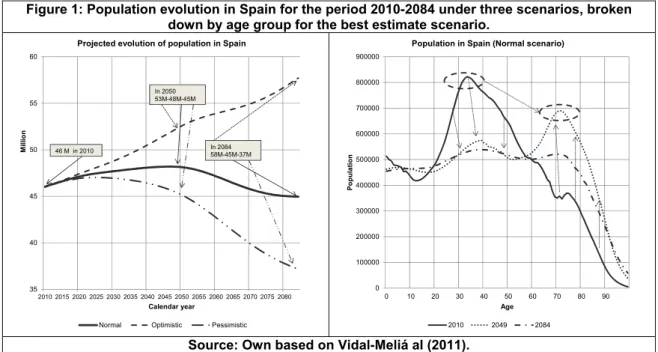
The demographic problem forecast for Spain can be seen in Figure 1, which shows population evolution for the period 2010-2084 for three different scenarios, broken down by age group for the normal scenario.
Figure 1: Population evolution in Spain for the period 2010-2084 under three scenarios, broken down by age group for the best estimate scenario.
Source: Own based on Vidal-Meliá al (2011).
35 40 45 50 55 60
2010 2015 2020 2025 2030 2035 2040 2045 2050 2055 2060 2065 2070 2075 2080
Million
Calendar year
Projected evolution of population in Spain
Normal Optimistic Pessimistic 46 M in 2010
In 2050 53M-48M-45M
In 2084 58M-45M-37M
0 100000 200000 300000 400000 500000 600000 700000 800000 900000
0 10 20 30 40 50 60 70 80 90
Population
Age Population in Spain (Normal scenario)
2010 2049 2084
7 Figure 2: Population pyramids for Spain in 2010, 2049 and 2084. Normal scenario.
Source: Own based on Vidal-Meliá et al (2011).
0 10 20 30 40 50 60 70 80 90
Age
Population in Spain, 2010
Males Females 46 M
0 10 20 30 40 50 60 70 80 90
Age
Population in Spain, 2049
Males Females 48 M
0 10 20 30 40 50 60 70 80 90
Age
Population in Spain, 2084
Males Females 45 M
8 The changes manifest themselves gradually over the years, but by the last year of the projection the population could show very different results: under the normal scenario there will be around 45 million inhabitants, while under the optimistic and pessimistic scenarios there will be 58 and 37 million respectively. The most important aspect, however, is the considerable ageing of the population seen in the second part of Figure 1, which shows that in 2049 there will be a big reduction in the working-age population and an increase in the retired or more elderly population. The trend may partially reverse by 2084.
In Figure 2, which shows the projected population pyramids for Spain, the effect of ageing can be seen even more clearly. The demographic dependency ratio, i.e. the population aged between 16 and 64 divided by the population aged 65 and over (based on Figure 2)12, will undergo a very sharp drop over the next four decades, from 4 in 2010 to 1.66 in 2049. At the end of the projection period there is a slight improvement over the situation in 2049, with a ratio value of around 2.
3.2- Main content.
The legal retirement age will generally be between 63 and 67 and the concept of a complete work history is introduced, set at 38.5 years. In fact there will be two normal retirement ages: 65 with 38.5 years' contributions and 67 with 37 years' contributions. The changeover from 65 to 67 years will take place gradually between 2013 and 2027.
To obtain a 100% pension it will be necessary to contribute for 37 years and retire at 67 or contribute for 38.5 years and retire at 65 (currently age 65 with 35 years' contributions).
Calculations will be made on the basis of monthly contributions rather than rounding up to the next full year as was the case prior to the reform. It is worth bearing in mind that in other OECD countries where there are conditions related to the number of years of contributions for retiring with full benefits before the normal pension age, the rules are generally stricter13.
For mothers who interrupt their contributing careers to have children, the accredited contribution period will be increased to account for this interruption. Under certain circumstances, it will be increased by the duration of the interruption period, up to a maximum of 9 months per child and 24 months per family.
There are changes to the scale applied, which rises smoothly and proportionally from a 50% minimum with 15 years' contributions. Before the reform, the system was biased in favor of shorter careers.
Early retirement will be possible for people with particularly dangerous or difficult jobs.
12 The age span 16-64 and + 65 is used for “comparative convenience” but can be criticized in a context where retirement age is increased.
13 According to the OECD (2011), France is increasing the number of years to 42, while in Italy and Luxembourg, for example, it is 40. When pension age reaches 67 in Germany, full benefits from age 65 will only be available to those with 45 years’ contributions.
9 There are two other ways to access early retirement, both subject to a minimum of 33 years' contributions (30 years prior to the reform): when a worker loses their job through no fault of their own (age 61 and over) and when a worker voluntarily gives up their job (age 63 and over).
In cases of early retirement the pension will be subject to reduction. This is done by applying an annual penalty coefficient of 7.5% for workers with less than 38.5 years' contributions and of 6.5% for workers with 38.5 years' contributions or over, for each year of retirement before age 67. The resulting benefit cannot be lower than the minimum pension depending on the beneficiary's family circumstances.
The period for calculating the regulating base will be extended from 15 to 25 years over a transition period of 10 years. The period will be progressively increased by one year from 2013 to 2022. The way of dealing with gaps in contributions also changes. There will be a maximum of 24 monthly contributions payable at least at the minimum contribution base at the time of payment, while most of any remaining contributions will be payable at 50% of the minimum contribution base. Before the reform gaps were payable monthly, with the minimum amount payable being the minimum contribution base for that period.
There are better incentives to voluntarily prolong working life: 2% per year for up to 25 years contributed, 2.75% for between 25 and 37 years contributed, and 4% for over 37 years contributed. However, no pension can exceed maximum taxable earnings at any particular time.
A partial exemption from contributing for common contingencies is also established - except for temporary incapacity deriving from these contingencies - once age 65 is reached with 38.5 years' contributions or age 67 with 37 years' contributions.
3.3-The official view.
To end this section we examine the official view of the reform according to the presentation, GE (2011), given after the cabinet meeting held on 25 March 2011. This official view was full of self-congratulatory statements with no reasoned justification to back them up, as we will see in the following extracts:
1.-“The reform guarantees the sustainability and adequacy of the public pension system in the medium and long term; it will slow down the rapid growth in spending that would destabilize the social security system in the future; and it will mean savings of 1.4% of GDP in 2030, 2.8% in 2040 and 3.5% in 2050. Spending on pensions will increase but not as much, and this will be in line with other EU countries”
This assessment of the reform's impact is not based on the results of any official actuarial balance. There are no details about what methodology and hypotheses have been used to make the assessment or how the so-called sustainability factor has been applied, the legislation for which is anyway far from clear and does not specify how it would be applied in real life. In addition to this, there are no references as to how high spending on pensions will be
10 as a proportion of GDP or what contribution rate will be needed to finance the scheduled benefits with or without reforms.
Some researchers in Spain have made “first assessments” or “quick estimates” of the reform's impact, especially the effect of pension spending on projected GDP14. These are financial assessments, i.e. they do not take into account the system's commitments to contributors and pensioners, only expected payments, and they do not include in the model a number of aspects of the real pension system. Although they are worthwhile papers and provide knowledge, they are no substitute for the actuarial balance model used by public SSAs.
The conclusions these papers come to are similar: the reform will delay growth in pension spending as a proportion of GDP by around 10 years in relation to projected spending for 2050, but it will only “save” a third of the projected increase in spending and therefore the other two-thirds of the increase in spending will need to be financed by other means. In other words there is no sound basis for claiming that the system's sustainability is assured in the medium term, the long term or even the short term.
2.-The reform “will, over the coming decades, enable social security to pay more and bigger pensions for longer”
This official conclusion is wrong because in order to obtain the same benefits the affiliate has to contribute longer and retire later. If it were right it would contradict the explanatory preamble to Act 27/2011, which establishes that the reform “aims to partially correct the imbalance between what one contributes and what one receives”.
According to Sáenz de Jáuregui (2011), for a typical contributor the reduction in the amount of pension resulting from the reform could be around 28%. Without taking the sustainability factor into account, Conde-Ruiz & González (2012) estimate a much smaller reduction in the average pension, around 9%, with this being greater for men than for women.
Finally, according to the OECD (2011), the projected pension gross replacement rate, i.e. the pension relative to earnings when working, on the OECD’s standard assumptions of 2.5% price inflation and 2% real earnings growth, for a full-career worker under the old legislation is 81.2%.
The reform, without taking into account further adjustments to parameters after 2027, is expected to reduce the replacement rate to 73.9%. Even so, this ratio averages out much lower in the 34 OECD countries: 57.3%.
3.-The reform “also makes the pension system more sensitive to situations of vulnerability, strengthening its supportive role”
It is on this point that the conflict between aims like supportiveness and actuarial fairness appears with greater clarity. For example, the eleventh additional provision of Act 27/2011 talks about the “advisability of establishing possible scenarios for the complementary funding of our social security system in the medium and long term” which would weaken the
14 See the papers by Conde-Ruiz & González (2012), De la Fuente & Domenech (2011) and Díaz- Giménez & Díaz-Saavedra (2011).
11 direct link between contributions and benefits and as a result, Linbeck & Persson (2003), would tend to reduce efficiency in the labour market. Meanwhile the thirteenth additional provision
“establishes a gradual increase in the amount of widows' pensions” without any modification of the contribution rate allocated to the widows' contingency. The reform establishes no clear mechanisms for all the non-contributory elements to be accounted for and fully funded through taxes.
4.-The reform “changes the conditions for entitlement to a retirement pension, making them more flexible and thereby strengthening the concept of retirement as a right”
A number of criticisms can be made on this point because the supposed flexibility comes at the cost of an excessively complex formula for calculating retirement pension that does not take into account the full contribution record, includes a great many exceptions, is not based on explicit actuarial elements, gives no real incentives for remaining longer in the labor market and contains no mechanisms for adapting it to any demographic changes that may affect the system.
As will be explained in the next section, the formula should have been designed to take the entire working history into account when calculating the regulating base, to balance the weight of years contributed in the replacement rate and to make the actuarial factor determining the pension automatic.
4.- Assessment of the reform of the Spanish system from the perspective of the Swedish pension system.
The Swedish public pension system15 has become a benchmark due to its ability to integrate actuarial analysis methodology into the field of public management. The instruments on which this methodology is based - notional accounts, actuarial balances, automatic balance mechanisms (ABMs) and personalized information statements - help to improve the system's equity, transparency, solvency and communication with contributors and pensioners.
In Spain, specifically within the Toledo Pact, the philosophy that inspired the reform of the public pension system in Sweden was proposed as a reference for reforming the Spanish pension system16, but, as will be shown below, the results of the Spanish reform deviate significantly away from the path followed in Sweden.
4.1.-Transparency
In the Swedish system the principle of transparency, Pensionsmyndigheten (2011), is fundamentally linked to the actuarial balance sheet. The regular publication of an official actuarial balance is also standard practice in countries such as the USA, Japan, Canada, the UK and Finland. There are compelling reasons for this: the growing social demand for
15 Three of the many papers that interested readers can consult are those by Palmer (2002), Sunden (2006) and Chłoń-Domińczakel al (2012).
16 See the report of parliamentary proceedings for the 20th session of the Chamber of Deputies on Wednesday 7 October 2009.
12 transparency in the management of public finances, the need to protect the DB PAYG system from populism in pensions, the desire to give the system more credibility in the eyes of contributors and pensioners, and the advisability of introducing ABMs to name just a few.
In the case of Spain it is clear that there is much room for improvement as far as the system's transparency is concerned. The opportunity should have been taken to establish an obligation to compile an actuarial balance officially and periodically in order to show stakeholders the pension system's real financial situation, since there has always been a divergence between political discourse and expert opinion. The government authorities had systematically denied that the pension system had sustainability problems, and this situation was helped by the absence of an official actuarial balance. Indeed, until early 2009 the Ministry of Work and Immigration was still insisting that “the system has the financial resources to ensure the system's horizon in the short, medium and long term” and that “it should not be thought that a (pension) system is in crisis when it is healthy; that would be very negative and is something we need to avoid”17.
The absence of an actuarial balance means there are a number of unknown quantities:
the level of solvency in the year the reform was conceived, justification for the reform from an actuarial point of view, and the opportunity any reform presents. To enable these questions to be answered, we compile two actuarial balance models for the Spanish public retirement pension system at 1-1-2010 and 31-12-2010 and then compare them with those for Sweden and the USA18. The underlying idea behind actuarial balances, in line with Barr & Diamond (2010), is that any analysis that looks only at the future liabilities of PAYG pension systems while ignoring explicit or implicit assets is misleading.
Table 2 takes the actuarial balance for all regimes of the Spanish retirement pension system as a percentage of GDP and compares it with that for the Swedish notional account system, which is financed by PAYG. In this type of actuarial balance sheet the main accounting entries are developed using the principles of double-entry bookkeeping and can briefly be summed up as showing the actuarial (im)balance in pension systems in clear language in the shape of assets and liabilities, without needing to use explicit projections19. The system´s solvency is measured (see technical appendix, formula 4) using the solvency indicator (SI). This is one case in which the saying “comparisons are hateful” would apply.
17 A generous interpretation might be that “politicians” feel that these “declarations” are justified because of the “high cost” that could be generated by the public's panic or lack of confidence should the system's real situation be known.
18 When it comes to compiling the actuarial balance (AB) for PAYG systems, there are basically two options to choose from: what are known as the Swedish and US models. See the papers by Boado-Penas
& Vidal-Meliá (2012) and Vidal-Meliá et al (2010) for the main differences and similarities between both types.
19 For the Spanish system, in order to calculate liabilities to contributors it is necessary to make explicit assumptions.
13 Table 2: Balance sheet as % of GDP for Spain (all regimes, retirement contingency) and Sweden
(NDC system) at 31-12-2010.
Assets Spain Sweden Liabilities Spain Sweden
Financial assets 3.7 27.1
Actuarial liabilities (Formulas 2 and 3 in
appendix)
266.4 223.2 Contribution asset
(Formula 1 in appendix) 171.5 199.2 Financial liabilities --- --- Accumulated deficit 91.1 --- Accumulated surplus --- 3.1
Total Assets 266.4 226.3 Total Liabilities 266.4 226.3 Solvency indicator (SI)% (Formula 4 in appendix)
SPAIN SWEDEN
65.7 100.24
Source: Own based on Vidal-Meliá et al (2011) and Settergren (2012).
It can be seen that the Swedish system is solvent, but what draws the attention is the extraordinary level of accumulated deficit in relation to GDP in the case of Spain. As a result the solvency indicator (SI) reaches a value of 65.7%, i.e. 34.3% of the commitments taken on are uncovered, or to put it another way, only 65.7% of the actuarial liabilities are backed up by assets.
Figure 3: Projected solvency ratios and actuarial results for the Spanish pension system.
Source: Own based on Vidal-Meliá et al (2011).
The perspectives for the Spanish system from the point of view of solvency are also very negative. Figure 3 shows the projected evolution of the solvency indicator without reform and the total result (TR), both of them with the strictly actuarial part (AR) separated. The solvency indicator (SI) will worsen considerably, although the strictly actuarial solvency indicator (ASI, formula 5 in appendix) improves after 2045 because, if the demographic forecasts for the normal scenario shown in Figure 1 are correct, the pension system will benefit from an increase in the contributor-pensioner ratio.
0.20 0.30 0.40 0.50 0.60 0.70
2010 2020 2030 2040 2050 2060 2070 2080
Calendar year Solvency ratios SI=0.657 in 2010
ASI=0.643 in 2010
ASI=0,463 in 2084
SI=0.33 in 2084
Min. ASI=0.412 in 2045
-11%
-9%
-7%
-5%
-3%
-1%
1%
3%
2011 2021 2031 2041 2051 2061 2071 2081
Calendar year Total and actuarial result as % GDP
Profits 2049-2069 2079-2084 Profits
Losses
TR
AR
14 The system will obtain strictly actuarial profits (AR) for the period 2049-2069 and again from 2079, but the total result (TR) will always be negative due to the high volume of financial obligations the system will have to take on in order to continue paying the scheduled pensions.
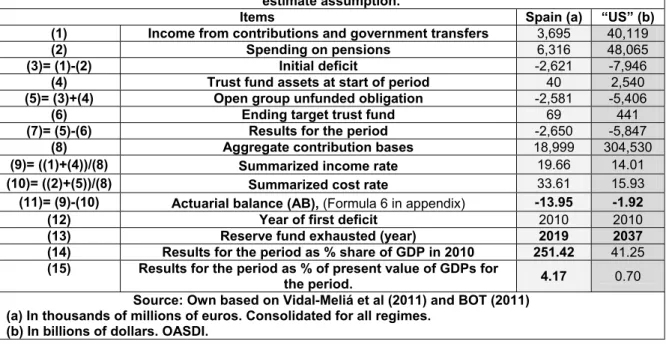
Table 3 compares the actuarial balance for all regimes of the Spanish retirement pension system as a percentage of GDP with that for the US model, which is financed by PAYG and also includes a disability contingency. This type of actuarial balance uses explicit projections to highlight future challenges to the financial side deriving basically from ageing, the expected increase in longevity and fluctuations in economic activity. In accordance with formula 6 in the technical appendix, its sustainability is measured using the AB indicator.
Comparisons are hateful in this case too. Judging from the result for the AB, which is - 1.92%, the US system is reasonably sustainable, although some reforms will be needed. In theory the payment of scheduled benefits are assured until 2037. The results for the Spanish system are unequivocal in that the system's financial health is far more delicate than it may appear. It can be seen that the first deficit already makes an appearance in 201020 and the reserve fund is exhausted in 2019. The result of the actuarial balance is -13.90%, i.e. the contribution rate would need to be increased by 13.90% from the very start and over the entire projection horizon in order to cover all the scheduled pensions.
Table 3: Elements of the 75-year actuarial balance 2010-2084. Present value at January 2010. Best estimate assumption.
Items Spain (a) “US” (b)
(1) Income from contributions and government transfers 3,695 40,119
(2) Spending on pensions 6,316 48,065
(3)= (1)-(2) Initial deficit -2,621 -7,946
(4) Trust fund assets at start of period 40 2,540
(5)= (3)+(4) Open group unfunded obligation -2,581 -5,406
(6) Ending target trust fund 69 441
(7)= (5)-(6) Results for the period -2,650 -5,847
(8) Aggregate contribution bases 18,999 304,530
(9)= ((1)+(4))/(8) Summarized income rate 19.66 14.01
(10)= ((2)+(5))/(8) Summarized cost rate 33.61 15.93
(11)= (9)-(10) Actuarial balance (AB), (Formula 6 in appendix) -13.95 -1.92
(12) Year of first deficit 2010 2010
(13) Reserve fund exhausted (year) 2019 2037
(14) Results for the period as % share of GDP in 2010 251.42 41.25 (15) Results for the period as % of present value of GDPs for
the period. 4.17 0.70
Source: Own based on Vidal-Meliá et al (2011) and BOT (2011) (a) In thousands of millions of euros. Consolidated for all regimes.
(b) In billions of dollars. OASDI.
In terms of GDP - the last two rows in Table 3 - the results are even more striking. If the aim were to “assure” payment of estimated benefits for the next 75 years, the initial financial contribution that would have to be added to the initial reserve fund would be 250.6% of GDP for the base year, or paid in installments at the rate of 4.15% of GDP for each year.
20 It should be pointed out that the official report on social security in Spain shows a treasury surplus because it includes the return on the reserve fund, but if this were not taken into account there would be a deficit.
15 These outcomes leave little room for doubt as far as justifying the recent reform of the pension system from an actuarial point of view is concerned. Indeed it could be said that, unlike what it states in the explanatory preamble to Act 27/2011, the main argument for justifying the 2011 reform is the pension system's actuarial imbalance over and above any demographic questions, although it is true that the projected evolution of the demographic variables according to Figures 1 and 2 will also present a serious threat to the system's health.
It is likely that if there had been some kind of official actuarial balance, the reform would indeed have been introduced earlier because, although the system's treasury situation enabled benefit payments to be made, the system's solvency, due to problems of actuarial imbalance caused by the lack of adjustment to the system's parameters and the projected effect of ageing, was already in a perilous state even though the impression it gave was the opposite. The way the system has been affected by the economic crisis, i.e. fewer contributors and more pensioners, makes the solvency indicator deteriorate even faster.
A question closely linked to the one above concerns what the impact of the pension reform will be. If an actuarial balance had been in place, it could have been clearly shown what the benefits of the changes introduced into the system would be.
4.2.- Equity or actuarial fairness.
As Queisser & Whitehouse (2006) point out, the concept of actuarial fairness refers to the entire lifetime of contributions and benefits, i.e. the relation (link) between contributions and benefits at the individual level, and requires that the expected (actuarial) value of lifetime contributions equals the expected present value of lifetime benefits. In the Swedish system this principle is fulfilled through notional defined contribution accounts (NDCs)21, which, as explained by Chłoń-Domińczak et al (2012), have also been set up in other countries such as Latvia, Poland and Italy.
A notional account is a virtual account reflecting each participant's individual contributions and the fictitious returns these contributions generate over the course of the participant’s working life. The contribution rate is fixed and the returns are calculated in line with a notional rate that may be the growth rate of GDP, the wage bill, contribution payments, etc.
When the individual retires, they receive a pension deriving from the value of the accumulated notional account, the expected mortality of the cohort retiring in that year and, possibly, a notional imputed future indexation rate. In this way the notional model combines PAYG financing with a pension formula that depends on the amount contributed and the return on it.
According to Holzmann (2006, 2007), NDCs have sufficient positive features for them to be put forward as a fundamental referent for the future unified pension system of the European Union.
21 The inspiring idea of NDCs was presented in two papers published in the 1960s by Buchanan (1968) and Castellino (1969), which were re-examined in the late 1990s by Gronchi (1998) and Valdés-Prieto (2000).
16 From the perspective of the NDC system, Lindbeck & Persson (2003), the formula for calculating the retirement pension resulting from the reform reproduces the flaws of the previous legislation and could be much improved as regards equity and simplicity. The new formula does not take into account all the contribution effort made by contributors, it has an excessively complex legal framework full of exceptions, it does not specifically incorporate any actuarial elements to give an incentive to remain in the labor market or a disincentive to leave it before normal retirement age, and it does not automatically introduce an indicator of the system's financial health into the indexing of contributions and pensions in payment.
Without going too deeply into the question, the advantages22 would have been considerable if a calculation formula based on notional philosophy had been introduced instead of keeping to the traditional defined-benefit formula, which is complex and badly designed from an actuarial point of view:
It would have encouraged actuarial fairness and stimulated contributors’ interest in the pension system.
Benefits would have been automatically linked to the system's financial health, avoiding arbitrariness in benefit indexation rules and adjustment factors.
It would have increased transparency and shown up hidden redistribution.
It would have enabled easy portability of pension rights between jobs, occupations and sectors.
It would have been very easy to implement and would still have used the PAYG system.
In this aspect, too, it is possible to see the differences between political discourse and expert opinion. The first precise and rigorous proposals for reforming the Spanish pension system in the direction of notional accounts were made by Devesa-Carpio & Vidal-Meliá (2004), Vidal-Meliá & Domínguez-Fabián (2006) and Vidal-Meliá et al. (2006). Organizations with much prestige in Spain, such as Fedea (2010) and Unespa (2011), have recently “rediscovered” this model and believe that the best option for the Spanish system would be to advance in the direction of notional accounts.
4.3.- Solvency.
In the Swedish system this principle involves what is known as the automatic balance mechanism (ABM). ABMs, Vidal-Meliá et al (2009), are a set of predetermined measures established by law to be applied immediately as required according to the solvency or sustainability indicator. Its purpose, through successive application, is to re-establish the financial equilibrium of PAYG pension systems so as to make them viable without the continual intervention of the legislators.
According to Lindbeck (2006), the core idea to back up ABMs is that the financial sustainability of social spending may be improved by a shift from discretionary ad hoc policies to
22 See for example the papers by Williamson (2004), Holzmann & Palmer (2006) and Whitehouse (2010) on this aspect.
17 automatic adjustment mechanisms in specific social insurance systems. For Diamond (2004), relying on fully automatic adjustment rather than assuming there will be periodic new legislation bears some similarity to the familiar distinction between macroeconomic rules and discretion for monetary policy and lowers the political cost of preserving equilibrium, since it is easier to legislate future rather than current pain.
The new legislation has introduced a sustainability factor based on differences in life expectancy at age 67 in the year of adjustment and life expectancy at age 67 in 2027. The first adjustment will be in 2032. The Spanish sustainability factor is really a semi-automatic balance mechanism with a very high level of arbitrariness implicit in its future activation.
This presumptuously-named sustainability factor does not fulfill any of the relevant criteria for ABMs:
Automation. The sustainability factor for Spain is not automatic and is only based on life expectancy in 2027. Decisions that may have to be taken to deal with potential situations of insolvency would therefore not be automatic and would not be based on a full solvency or sustainability indicator.
Short-term effects. The Spanish sustainability factor has no short-term effects. The strength of its long-term financial stability is very weak and the rule itself will be modified unpredictably by the political process. As a result the ABM could lose its effectiveness.
Rationality. ABMs make the process of pension system reform more rational in that, first of all, a number of rules that most people would consider reasonable are established but are then subsequently applied automatically only in specific situations in which legislation allowing the same measures would be accepted only with difficulty. In the Spanish case there are no predetermined rules, only an imprecise commitment to review the parameters of the system every five years starting in 2032.
Transparency. In the Spanish case, the designed mechanism is not transparent because it is unclear how adjustments will be made and who will bear the costs when an adjustment occurs.
Gradualness. The measures deriving from the application of ABMs should take the form of progressive changes without any individual or generation carrying too heavy a load over a short period of time. In the case of Spain there is a missed opportunity of at least 20 years (2012-2032) in which an ABM could be applied, and therefore possibly drastic adjustments will have to be made in line with the demographic projections shown in Figure 1.
It would not be unreasonable to say that the reform falls short from a solvency point of view. An ABM along the lines of those in force in Sweden, Canada, Germany and Japan should have been included in the legislation. The advantages would have been clear:
Adjustments would be gradual and objective depending on the solvency or sustainability indicator.
Measures would be applied immediately with a long-term planning horizon matching the pension system's time perspective.
18
Amendments would bring about greater intergenerational fairness due to the fact that ABMs can be considered time-consistent because no unnecessary adjustments are passed on to future generations.
4.4.- Communication with contributors and pensioners.
In the Swedish system this principle mainly involves the so-called “orange envelope”, which has been the cornerstone of communications with participants about the pension system.
This method is not limited to Sweden. As Regúlez-Castillo & Vidal-Meliá (2012) point out, a number of other countries also provide individual pension information statements on an annual basis, e.g. the “blue envelope” in France, the “yellow envelope” in Germany or the “social security statement” in the United States.
Individual information on pensions can be defined as all the information that individuals require to enable them to make suitable plans for the non-active period of their adult lives and to cover the risks associated with disability and death, in particular. The statement can also provide information on how the pension system works.
According to Larsson et al (2008), it is significant that many countries made meaningful improvements to the way in which they provided information - or introduced such a system to provide information - in the wake of a reform of their pension system. The provision of individual statements has proved to be an extremely useful tool, as pointed out by Botazzi et al (2006), given that the perceived impact of reforms on individuals depends to a large extent on the information provided about such changes. Similarly, as indicated by Boeri & Tabellini (2010), necessary reforms can obtain popular support if they are fully described, explained and understood. This also highlights the importance of efforts (by governments) to improve transparency and provide information as regards the future of the social security system as well as possible alternatives in order to guarantee its long-term solvency.
The Spanish social security system only provides annual information about contributions paid, enabling contributors to inform the administration if they detect any anomalies. It recently included computer software on its website to enable contributors to calculate the approximate amount of their future retirement pension, but this is based solely on information the contributors themselves enter.
The reform may be a slight improvement on the previous situation, bearing in mind that additional provision 26 (DA 26ª) reads: “Proposal for sending information regarding retirement entitlement”. It is recognized that citizens have a right to receive more and better information from the State and from the private sector in connection with their future rights based on contributions they have made. Despite recognizing this right, which should be put into practice at the beginning of 2013, the law does not establish exactly to what extent the regulation should be carried out, and neither does it establish whether information about the system's solvency should be included.
19 In short, it would not be an exaggeration to say that the reform is weak when it comes to communications with the public because it does not get the message across to affiliates that benefits are dependent on individual and collective elements. On the one hand, individual aspects means that benefits are dependent upon the affiliates' own actions, i.e. the amount of their contributions, the period during which they contribute, the age they retire, etc., while on the other hand, collective aspects refers to the system's ability to fulfill its commitments to contributors and pensioners, i.e. the system's financial difficulties may also affect the amount of benefit.
5.- Concluding remarks.
The 2011 reform of the Spanish public pension system, which would have been unexpected by most of the less well-informed relying on statements made by the government until 2009 and the absence of a recurrently compiled actuarial balance, is a small step towards containing the growth in pension spending as a proportion of GDP. However, it leaves much to be desired when it comes to reducing the political risk to which the system is exposed and which has been so damaging to it.
If in order to assess the reform we consider the principles of actuarial fairness, transparency, solvency and communication with the public, as embodied in instruments to bring them closer to actuarial practices in social security, the result is disheartening.
If transparency were a principle that was fully applied in public life in Spain, the reform would have been carried out much earlier. If an official actuarial balance had been available, it would have been impossible to disguise the system's solvency status and the hoped-for impact of the reform could have been assessed more accurately. However, the worst thing as regards transparency is that there are no plans to compile an actuarial balance in the short term to enable the system's situation to be assessed on a regular basis, and therefore it appears that the practice of populism in pensions can continue unabated.
The formula for calculating retirement pension could clearly be improved from the viewpoint of actuarial fairness and simplicity given that it does not take into account the full contributory effort made by affiliates, it has an excessively complex legal framework full of exceptions, it does not explicitly incorporate actuarial elements that “reward” people who remain in the labor market or “punish” those who leave early, and it does not automatically introduce an indicator of the system's financial health when indexing contributions. The formula for calculating benefits does not include mechanisms to reflect economic and demographic changes and therefore does not avoid unnecessary future reforms and gives politicians no incentive not to increase benefits should the economic situation improve.
The reform includes no effective instrument for pushing the system steadily towards solvency. The presumptuously named “sustainability factor” fulfills none of the properties applicable to ABMs: it is not automatic, it is based on only one aspect, i.e. life expectancy, and it has no short-term effects and no predetermined rules, only an intention to review the system's
20 parameters in 2032. It has very little transparency since it is not specified how it might be applied and what groups or collectives might bear the brunt of its application. Finally, it lacks any gradualness given that it ignores an opportunity of at least 20 years, which means that possibly drastic adjustments will need to be carried out later if the projected increase in longevity comes about.
The reform conveys no message to contributors and pensioners that their benefits depend on both their individual actions (more contributions over more time, retirement age, etc.) and the system's ability to fulfill its acquired commitments to contributors and pensioners. It does not make it clear to affiliates that complicated financial situations, measured by solvency or sustainability indicators can also affect the amount of benefit.
As a final conclusion it only remains to be said that the reform is a wasted opportunity given that Spain has not taken advantage of the lessons learned in Sweden. It does not ensure the system's sustainability in the short term, it does not increase transparency, it is a long way from achieving actuarial fairness, it does not encourage contributors to think about retirement and the risks to which they are exposed, it does not automatically link benefits to the system's financial health, it does not make redistribution clear and it does not reduce the politicians' incentive to make promises about future pension benefits.
A final question deriving from all the above is the following: how long will the Spanish pension system last without additional reforms? In the light of our analysis and assessment, it has to be concluded that a new parametric reform will be needed sooner rather than later.
21 6.- References.
Barea, J. 2007. Los problemas de sostenibilidad del sistema español de pensiones y de las propuestas de reforma. Cuadernos de pensamiento político FAES, 15, 69-85.
Barr, N, and P. Diamond 2010. Pension reform: a short guide, Oxford University Press, New York.
Boado-Penas, C, Valdés-Prieto, S. and Vidal-Meliá, C. 2008. An Actuarial Balance Sheet for Pay-As-You-Go Finance: Solvency Indicators for Spain and Sweden. Fiscal Studies, 29, 89- 134.
Boado-Penas, C. and C. Vidal-Meliá 2012. “The Actuarial Balance of the Pay-As-You-Go Pension System: the Swedish NDC model versus the US DB model.” In Holzmann, R., E.
Palmer and D. Robalino, eds. NDC Pension Schemes in a Changing Pension World, Chapter 14, Volume 2: Gender, Politics, and Financial Stability. Washington D.C.: The World Bank &
Swedish Social Insurance Agency. Forthcoming.
Board of Trustees, Federal Old-Age and Survivors Insurance and Disability Insurance Trust Funds (BOT) 2010. 2009 Annual Report. Washington, D.C.: Government Printing Office.
Boeri, T., and Tabellini, G. 2010. Does Information Increase Political Support for Pension Reform? Public Choice, 150 (1-2), 327-362.
Bottazzi, R, T. Jappelli, and M. Padula 2006. Retirement expectations, pension reforms, and their impact on private wealth accumulation, Journal of Public Economics, 90, 2187–2212.
Buchanan, J. 1968. Social insurance in a growing economy: A proposal for radical reform, National Tax Journal 21, 386–395.
Castellino, O. 1969. Un Sistema di Pensioni per la Vecchiaia Commisurate ai Versamenti Contributivi Eff ettuati e alla Dinamica dei Redditi Medi da Lavoro, Giornale degli Economisti e Annali di Economia 28, 1–23.
Chłoń-Domińczak, A., D. Franco and E. Palmer 2012. “The First Wave of NDC – Taking Stock Ten Years plus Down the Road”. In Holzmann, R., E. Palmer and D. Robalino, eds. NDC Pension Schemes in a Changing Pension World, Chapter 2, Volume 1: Progress, Lessons, and Implementation: The World Bank & Swedish Social Insurance Agency. Forthcoming.
Conde-Ruiz, J.I., and C. I. González 2012. Reforma de pensiones 2011 en España: una primera valoración. FEDEA. Colección Estudios Económicos 01-2012.
De la Fuente A. and Doménech R. 2011. The financial impact of Spanish pension reform: A quick estimate. Fundación BBVA.
Devesa-Carpio, J.E, and Devesa-Carpio, M. 2010. The cost and actuarial imbalance of pay-as- you-go systems: the case of Spain', Journal of Economic Policy Reform, 13: 3, 259 -276
22 Devesa-Carpio, J.E. and C. Vidal-Meliá 2004. ‘Notional defined contributions accounts (NDCs):
what effect would they have had on the Spanish pension system?, Moneda y Crédito, 219, 61- 103.
Diamond, P. 2004. Social Security, American Economic Review, 94 (1), 1-24.
Díaz-Giménez, J. and Díaz-Saavedra, J. 2011. “Parametric reforms of the Spanish pension system: a quantitative analysis”, IESE, Working Paper.
FEDEA 2010. “La reforma de las pensiones”. Documento de Fedea. Madrid, marzo.
Gobierno de España, GE 2011. “Una reforma para la garantía y mejora de las pensiones en España. Proyecto de Ley sobre actualización, adecuación y modernización del sistema de Seguridad Social” Consejo de Ministros, 25 Marzo de 201l
Gronchi, S. 1998. La sostenibilità delle nuove forme previdenziali ovvero il sistema pensionistico tra riforme fatte e da fare. Economia Politica Rivista di Teoria e Analisi, 15(2), 295–316.
Holzmann, R. 2006. Toward a reformed and coordinated pension system in Europe: Rationale and potential structure. In Pension Reform: Issues and Prospects for Notional Defined Contribution (NDC) Schemes, eds. R. Holzmann and E. Palmer, Chapter 11. Washington, D.C.:
World Bank.
Holzmann, R. 2007. Toward a pan-European pension reform approach: The promises and perspectives of unfunded individual account systems. NFT 1(07), 51–55.
Holzmann, R. and E. Palmer 2006. Pension Reform: Issues and Prospects for Notional Defined Contribution (NDC) Schemes. Washington, D.C.: World Bank.
Larsson, L., A. Sundén and O. Settergren 2008. Pension Information: The Annual Statement at a Glance, OECD Papers, 2008 (3), 129-170.
Lindbeck, A. 2006. Sustainable social spending, Journal of International of Tax and Public Finance, 13: 303–324.
Lindbeck, A. and M. Persson 2003. The Gains from Pension Reform, Journal of Economic Literature, Vol. XLI (March), 74–112.
Ministerio de Trabajo e Inmigración (MTIN) 2011. Informe de evaluación y reforma del pacto de Toledo, colección Seguridad Social.
OECD 2011. Pensions at a Glance 2011: Retirement Income Systems in OECD and G20 Countries, ISBN 978-92-64-09523-6.
Palmer, E. 2002. Is Swedish Pension Reform the Right Medicine for Aging Europe? Journal of Aging & Social Policy, 14: 1, 35-52.
Pensions Commission (PC) 2004. Pensions: challenges and choices: the first report of the Pensions Commission.