Atomic gas and galaxy evolution
Lourdes Verdes-Montenegro
(Instituto de Astrofísica de Andalucía-CSIC)
Physics opportunities with a new universe’s view: the SKA radio telescope IFIC, Valencia, 6-7 November 2017
Atomic gas and galaxy evolution
Lourdes Verdes-Montenegro
(Instituto de Astrofísica de Andalucía-CSIC)
Physics opportunities with a new universe’s view: the SKA radio telescope IFIC, Valencia, 6-7 November 2017
HI Science with the SKA: surveys
HI Science in Spain: Resolved studies, Environment, Star formation beyond the optical disc and cold gas accretion
Additional studies: Our Galaxy, HI in Absorption, HI evolution with z
Advancing Astrophysics with the SKA, Giardini Naxos, 2014
•The Hydrogen Universe with the SKA. Staveley-Smith & Oosterloo
•Neutral Hydrogen and Galaxy Evolution. Blyth et al.
•The Intergalactic Medium and the Cosmic Web. Popping et al.
•The Neutral Interstellar Medium in Galaxies. de Blok et al.
•The Galaxy and Magellanic System. McClure-Grifffiths et al
•Cool Outflows and HI absorbers Morganti et al
•Connecting the Baryons Meyer et al
•Galaxy Formation & Dark Matter Modelling in the Era of the SKA. Power et al
•SKA as Doorway to Angular Momentum Obreschkow et al
•The Physics of the Cold Neutral Medium: Low-frequency Radio Recombination Lines with the SKA Oonk et al
HI and Galaxy evolution Chapter: SKA White Book chapter
Verdes-Montenegro, Solanes, Domínguez-Tenreiro, Gil de Paz, Knapen, Lisenfeld, Ascasibar, del Olmo, García-Burillo, García-Lorenzo, Iglesias-Páramo, Perea, Pérez-Montero, Pérez-Torres, Quilis, Sabater, Sánchez,Toribio, Ascaso, Blasco, Brook, Font, García-Benito, Márquez, Ramírez-Moreta,Vílchez
HI Galaxy Science with the SKA
Martin Meyer & Erwin de Blok on behalf of the HI SWG. (May 2017)
B IBLIOGRAPHY
Revision of SKA
capabilities performed by the HI Science
Working Group
HI Science with the SKA
Gas collapse
SF
Return to the ISM Clouds of dust
and gas
Credits: wikipedia.org, pinterest.com
Internal evolution
Arp 87, HST image (NASA, ESA)
External:
interactions
Processed gas
SNe, AGN extraplanar feedback
Pristine gas
Agertz, Teyssier, Moore 2009 Galactic Fountain
(Fraternalli 2014)
Keres et al 2005, 2009 See for a review
Sanchez Almeida, Elmegreen, Muñoz- Tuñón, Elmegreen A&AR 2014
Cold gas accretion from the “Cosmic Web”
Processed gas
The Hydrogen Array was part of the initial concepts of the project
HI key in central processes of galaxy evolution and structure formation
‣ the buildup of stellar mass in galaxies
‣ galaxy dynamics
‣ SF in and beyond the optical disc
‣ probing environmental influence.
SKA will be the first telescope capable of directly mapping the full extent of the cosmic web that characterizes the large scale structure of the Universe (Wilcots 2004)
SKA1-mid = South Africa
350 MHz - 14GHz Baselines 150 km
Band 1 (0.35–1.05GHz) Band 2 (0.95–4.6GHz)
SKA1
Construction 2019 -2024 Early science 2020
133+64 dishes
skatelescope.org
skatelescope.org
Phased array feeds (PAF)
SKA2
2024 - 2030
Baselines up to 3500 km
Advanced Instrumentation Program
H I S CIENCE WITH THE SKA
K EY S CIENCE P ROJECTS
Notional package of Key Science Projects
• Outcome of well-documented SKA1 science prioritization process
• All objectives originated within the science community
• Review and strong endorsement by advisory bodies (SRP, SEAC)
• Representative package of high-impact science deliverables for 50 – 75% of the first 5 yrs of science operations
SWG$ Objective$
CD/EoR' Physics'of'the'early'universe'IGM'5'I.'Imaging'
CD/EoR' Physics'of'the'early'universe'IGM'5'II.'Power'spectrum'
Pulsars'' Reveal'pulsar'population'and'MSPs'for'gravity'tests'and'Gravitational'Wave'detection'' Pulsars'' High'precision'timing'for'testing'gravity'and'GW'detection'
HI' Resolved'HI'kinematics'and'morphology'of'~10^10'M_sol'mass'galaxies'out'to'z~0.8' HI' High'spatial'resolution'studies'of'the'ISM'in'the'nearby'Universe. '
HI' Multi5resolution'mapping'studies'of'the'ISM'in'our'Galaxy'
Transients' Solve'missing'baryon'problem'at'z~2'and'determine'the'Dark'Energy'Equation'of'State' Cradle'of'Life' Map'dust'grain'growth'in'the'terrestrial'planet'forming'zones'at'a'distance'of'100'pc'
Magnetism' The'resolved'all5Sky'characterisation'of'the'interstellar'and'intergalactic'magnetic'fields' Cosmology' Constraints'on'primordial'non5Gaussianity'and'tests'of'gravity'on'super5horizon'scales.'' Cosmology' Angular'correlation'functions'to'probe'non5Gaussianity'and'the'matter'dipole''
Continuum' Star'formation'history'of'the'Universe'(SFHU)'–'I+II.'Non5thermal'+'Thermal'processes'
' Braun et al, 2014, SKA1 Science Priority OutcomesB. Saxton (NRAO/AUI/NSF)
‣ Resolved HI kinematics and morphology of ~10^10 M⊙ mass galaxies out to z~0.8
‣ High spatial resolution (50 pc) studies of the ISM in the nearby Universe.
‣ Multi-resolution, multi-T mapping studies of the ISM in our Galaxy
‣ Cosmological evolution of cold HI (absorption) out to z = 6
‣ The gaseous interface and accretion physics between galaxies and the cosmic web
H IGH P RIORITY H I S CIENCE O BJECTIVES
Meyer on behalf of HISWG (Town Hall meeting, 2017)
P OSSIBLE SKA1 HI SURVEYS
Updated from Staveley-Smith & Oosterloo, 2015, PoS, AASKA14, 167
2e20 0.6e20 0.4e20
N(HI) at/cm2
Cosmology Environment Evolution with z
Band 1 (0.35–1.05GHz) Band 2 (0.95–4.6GHz)
Staveley-Smith & Oosterloo AAs 2014 Medium-Wide
Cosmology
Medium-Deep Environment
Deep Evolution
Distribution with z of HI masses of galaxies to be detected in the tiered set of 1000h surveys
M*(HI) at z = 0
P OSSIBLE SKA1 HI SURVEYS
‣ 1-2 commensal programs possible
P OSSIBLE SKA1 HI SURVEYS
Potential
commensalities
‣ Large area HI surveys
‣ Ultradeep
‣ HI detection up to z ~2
‣ Continuum SFR at high-z (Jarvis et al2014)
Updated from Staveley-Smith & Oosterloo, 2015, PoS, AASKA14, 167
‣ Deep + highly resolved
‣ HI in nearby galaxies
‣ deep continuum + B
‣ N(HI) < 10^18 at 1’
HI science in
Spain
Main areas of interest
‣ Synergies with nearby galaxy surveys
‣ Formation history of early type galaxies (ETGs)
‣ Environmental effects
‣ SF in the outskirts of disks and cold gas accretion
‣ Theoretical models (Domínguez-Tenreiro, Ascasibar, Quilis, Brook)
HI SCIENCE IN S PAIN
HI SCIENCE IN S PAIN
Why SKA is needed
‣ Mapping feasible so far at only moderate redshifts (z < 0.25)
‣ Extensive HI-mapping of nearby spirals exists, but with angular resolutions one order of magnitude higher than standard optical observations.
‣ HI mapping of ETGs has been scarce till recently: ETGs are not any more red and quiescent
‣ HI stripping proposed to inhibit SF in extreme environments, although the removed gas is suspected to exist at N(HI) below current detection limits
‣ Cosmological cold gas accretion, predicted to occur at too low column densities to be detected by current interferometers
Main areas of interest
‣ Synergies with nearby galaxy surveys
‣ Formation history of early type galaxies (ETGs)
‣ Environmental effects
‣ SF in the outskirts of disks and cold gas accretion
‣ Theoretical models (Domínguez-Tenreiro, Ascasibar, Quilis, Brook)
Lourdes Verdes-Montenegro (IAA-CSIC) Co-chair together with Sarah Blyth
S PANISH MEMBERS IN HI SWG
Bjorn Emonts (CAB (CSIC-INTA)) John Beckman (IAC)
Jorge Sánchez Almeida (IAC)
•Secular infall of HI to disc galaxies (involved in THINGS)
•Continuous line of research: kinematics of gas in the ISM out to ~ 20Mpc dv ~ 5 km/sec @1” with GHaFaS FP @4.2m WHT (La Palma)
•O b s e r v a t i o n s o f m a t c h i n g H I kinematics to probe SF, SN needed
•SF sustained by gas accretion
Sanchez Almeida et al 2014 (A&AAR)
•Cold gas in the proto-cluster environments of high-z radio galaxies: evolution into giant Es
•HI in absorption against their (bright) radio continuum sources
•most massive systems in the Early Universe, ideal to search HI out to z~1-3.
•Now: CO emission + CO & HI absorption, proto- cluster radiogalaxies (z~2,VLA,ALMA, ATCA ,GBT)
•Role of gas in both sustaining and inhibiting SF: two ideal laboratories
•isolated galaxies (gas accretion from companions minimized)
•Hickson Compact Groups, high HI deficiency/stripping
Resolved studies of galaxies
Barrera-Ballesteros et al 2014. CALIFA interacting galaxies
Beckman, GHAFAS sample
Verdes-Montenegro Hickson group HCG 54. VLA HI map
Interferometric HI studies of samples of nearby galaxies complement blind single dish studies as HIPASS and ALFALFA (HI-SF, morphology, mass, environment)
First steps to bridge the gap between star and galaxy scales
‣ THINGS: 34 galaxies, 3 < D < 15 Mpc, VLA B+C+D, 6” (500pc)
‣ LittleTHINGS observed 21 dwarf irregular and blue compact galaxies
‣ VLA-ANGST LP, 35 gas-rich and actively star forming (D < 4 Mpc), selected from HST
‣ FIGGS, HI imaging at GMRT of extremely faint nearby dwarf irregular galaxies.
‣ LVHIS, deep HI observations with ATCA for all nearby, gas-rich galaxies (D <10 Mpc, < -30) detected in HI PASS.
‣ WHISP HI-survey of spiral and irregular galaxies with WSRT
‣ SHIELD total halo masses of the extremely low-mass galaxies detected by ALFALFA with the VLA
‣ HALOGAS (Hydrogen Accretion in LOcal GAlaxieS), deep survey of edge-on nearby galaxies with the WSRT
SYNERGIES WITH NEARBY GALAXY SURVEYS
(Walter+08, Begum+08, Hunter+12, Ott+12, van der Hulst+01, Koribalski08, Heald+11, Cannon+11, Heald+ 2014)
SYNERGIES WITH NEARBY GALAXY SURVEYS
Pathfinders:
‣ MeerKAT revealing the edge of M83 & interaction with IGM (Heald+ 2016)
‣ See later Hess et al mapping of compact group HCG 44
M83. Image credit: optical data from
Palomar Observatory Sky Survey; radio data from SKA South Africa’s MeerKAT
SYNERGIES WITH NEARBY GALAXY SURVEYS
Pathfinders:
ASKAP instantaneous field of view of 30 deg2, allowing to map a large number of galaxies together with their environments as part of WALLABY large program (Koribalski et al 2012)
30 square degrees. WALLABY = 1,200 of these fields.
Each field = 500 galaxies detectable in HI
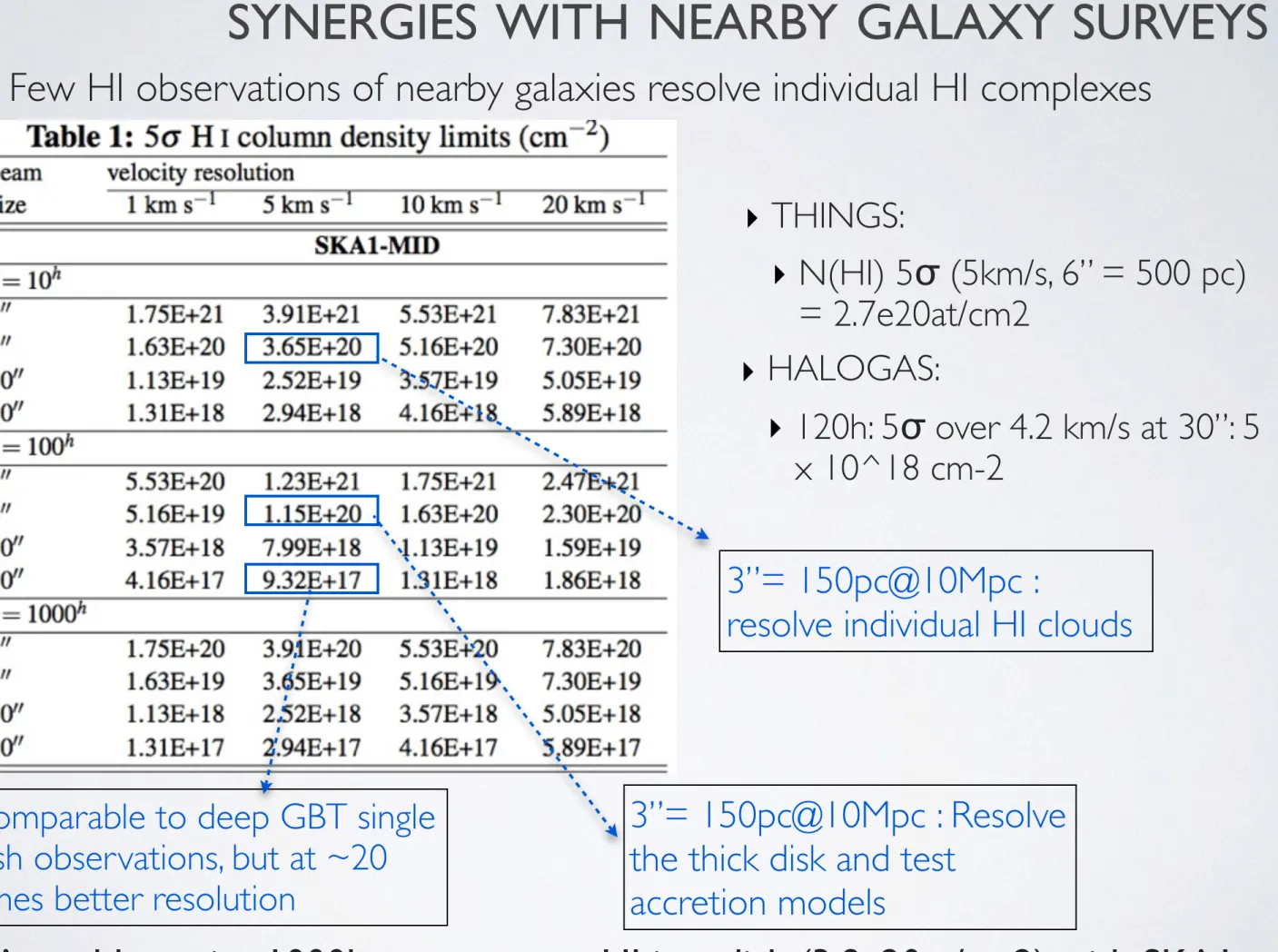
1” would require 1000h to map most HI in a disk (3.9e20at/cm2) with SKA1
‣ Few HI observations of nearby galaxies resolve individual HI complexes
SYNERGIES WITH NEARBY GALAXY SURVEYS
‣ THINGS:
‣ N(HI) 5σ (5km/s, 6” = 500 pc)
= 2.7e20at/cm2
‣ HALOGAS:
‣ 120h: 5σ over 4.2 km/s at 30”: 5 x 10^18 cm-2
3”= 150pc@10Mpc : Resolve the thick disk and test
accretion models Comparable to deep GBT single
dish observations, but at ~20 times better resolution
3”= 150pc@10Mpc :
resolve individual HI clouds
Table from Blok et al 2014
Multiwavelength surveys of nearby galaxies with strong Spanish involvement with importante synergies with the SKA
‣ Spitzer Survey of Stellar Structure in Galaxies (S4G, IRAC@Spitzer, 3.6 and 4.5μ), volume-limited (D < 40 Mpc) Nearby spiral, dwarf star-forming galaxies, ellipticals
‣ Synergies with SKA HI studies: outer regions of galaxies with deep mid-IR/optical and imaging (Knapen+ 2014):
‣ radial HI profiles in relation with truncation/antitruncation studies (e.g. Martín- Navarro+ 2012, Muñoz-Mateos+ 2013), detection of tails, shells (e.g. Laine+
2014, 2015), presence of tidal debris in ETGs (Kim+ 2012)
‣ NUGA (NUclei of GAlaxies ) IRAM key project: nuclear fueling, (few tens pc) later extended to the outer discs (HI-NUGA, 16 galaxies with VLA, few tens kpc):
complementarity ALMA - SKA
‣ Mapping the various spatial scales of the different instabilities (HI: outer, CO: inner):
non-axisymmetric potentials, tidal interactions.
‣ Sabater+ 2015 250, 000 galaxies from the SDSS: level of nuclear activity depends primarily on the availability of cold gas in the nuclear regions of galaxies, while large-scale
environment and galaxy interactions only affect AGN activity in an indirect manner, by influencing the central gas supply.
SYNERGIES WITH NEARBY GALAXY SURVEYS
CALIFA: IFU data of 600 galaxies. Stellar and ionized gas kinematics and metallicities, as well a spatial resolved
derivation of the full SF history (0.005 ≤ z ≤ 0.03)
S YNERGIES
SKA1-MID: HI @ 3′′ in 10h
GMRT HI
observations @ 20”
(Scott et al 2014)
Spatial resolved derivation of the full SF history +
properties of ionized gas mapped @ 2′′
Calar Alto Observatory
Combined with SKA data: gas duty cycle, since it will connect HI with the SF processes and the SF and chemical enrichment histories of galaxies
3.5 m@CAHA
Galaxies and their
environments
HI as a privileged tracer of galaxy interactions (nature vs nurture)
‣ Inventory of detailed HI observations of galaxies in environmentally selected samples is growing, ranging from isolated galaxies to groups or clusters.
‣ Large HI data set in and around many galaxies in different environments will be a prime goal for the SKA
G ALAXIES AND THEIR ENVIRONMENTS
Environment
ISOLATED GALAXIES
‣ AMIGA (Analysis of the interstellar Medium of Isolated GAlaxies) sample
‣ Lowest values relative to any other sample of most variables:
‣ LFIR, molecular gas, MH2/MHI, SFE, asymmetries, bulge/total ratio, radiocontinuum, nuclear activity, and
‣ HI asymmetry (Espada+11a, but still some level of HI asymmetry exists), generated recently (~1e8 yr) and with no tails/interactions with
currently observed minor companions (Espada+11b, Portas+11, Sengupta+12;
Scott+14, Ramírez-Moreta et al in prep)
In AMIGA sample the gas captured from companion galaxies and galactic fountain processes (due to SF and Active Galactic Nuclei, AGN) are minimized
Privileged environment to study cold gas accretion
Cig96, VLA C+D,
Ramírez-Moreta et al in prep
(Verdes-Montenegro+05, Lisenfeld+07,+11, Leon+08), Sabater +08,+13, Martin+14, Ocaña+14, Fernandez Lorenzo+12,13,14, Durbala+08,09).
N(HI) ~1x10^19 cm2
T WO EXTREME ENVIRONMENTS
See later
•
The HI scaling relations of isolated galaxies had not been updated since 1984.•
These relations provide an up-to-date metric of HI-normalcy of isolatedgalaxies
•
They are more self-consistent than previous relations and also include acomplete treatment of non-detections and uncertainties.
•
Reference for the HI content of galaxies in other environmentsAMIGA HI SCALING RELATIONS
A&A 2017, in press
H ICKSON C OMPACT G ROUPS
Proposed evolutionary model:
Amount of detected HI decreases further with evolution, by continuous tidal stripping
Low statistics to study correlation between tails and HI def.
In the other extreme of galaxy environments, atomic gas is missing...
•
Single dish study of 72 Hickson Compact Groups (Verdes-Montenegro et al 2001)HI deficiency of groups similar to Virgo or Coma clusters
•
VLA study of 26 Hickson Compact Groups (Verdes-Montenegro et al 2001, 2007) Phase 1: Mostgas in galaxies
Phase 2: Gas in tidal features
Phase 3. No HI in the galaxies
VLA data (C+CnB+D)
5e19 cm−2 at 20′′ & 10 km/s
HCG 16 VM01 HCG 16 VM01
VLA data (C+CnB+D)
5e19 cm−2 at 20′′ & 10 km/s
SKA1-MID, 10h:
1.3e18 cm−2 at 30′′ and 5 km/s.
FOV 30′
H ICKSON C OMPACT G ROUPS
HI observations of 22 HCGs with GBT (1pointing/group, Borthakur+ 2010,2014)
‣ HI deficiency reduced but not completely eliminated
‣ A diffuse HI component missed by the VLA
•
More consistent with tidalstripping than with ram-pressure
•
Spread over > 1000 km/s•
Increasing with evolutionary stage•
HI excess mass bimodal: suggests rapid transition from HSB to LSB•Most cases: filling factor << 100% == faint to be detected with VLA
•High filling factor cases == resolved extended structures
HCG 16 VM01 HCG 16 VM01
Improve statistics to study correlation between mass in HI tidal structures (VLA cubes) and HI deficiency (GBT single dish)
H ICKSON C OMPACT G ROUPS
x
X3D pathway, Vogt et al 2015
Verdes-M, Yun, Borthakur, archive
SKA1 expected to provide the needed N(HI) limit, UV coverage, FOV to map the diffuse gas
(
6e18 cm-2 @ 30” & 20 km/s, Blok et al 2014)
HCG 44
Hess et al 2017
HCG 16 VM01 HCG 16 VM01
Improve statistics to study correlation between mass in HI tidal structures (VLA cubes) and HI deficiency (GBT single dish)
H ICKSON C OMPACT G ROUPS
x
Verdes-M, Yun, Borthakur, archive
SKA1 expected to provide the needed N(HI) limit, UV coverage, FOV to map the diffuse gas
(
6e18 cm-2 @ 30” & 20 km/s, Blok et al 2014)
HCG 44
Hess et al 2017
Star formation beyond the optical disc and
cold gas accretion
‣ 1/3 of galaxies show unusually extended HI distributions (e.g. Bosma 1981, Huchtmeier 1982).
‣ GALEX (Martin+ 2005) showed SF far beyond the optical radius of galaxies (Thilker+
2005, Gil de Paz+ 2005, Erroz-Ferrer+ 2013), with good spatial correlation with the HI component (e.g Espada+ 2011).
‣ Comparing UV and HI: study of the Kennicutt- Schmidt law in the extreme low-density and often low-metallicity environments of the outskirts
SF BEYOND R25 AND COLD GAS ACCRETION
‣ 1/3 of galaxies show unusually extended HI distributions (e.g. Bosma 1981, Huchtmeier 1982).
‣ GALEX (Martin+ 2005) showed SF far beyond the optical radius of galaxies (Thilker+
2005, Gil de Paz+ 2005, Erroz-Ferrer+ 2013), with good spatial correlation with the HI component (e.g Espada+ 2011).
‣ Comparing UV and HI: study of the Kennicutt- Schmidt law in the extreme low-density and often low-metallicity environments of the outskirts
‣ SKA:
‣ It is possible to trigger SF in very low-density gaseous environments?
‣ How galaxies acquire sufficient gas to sustain SFR: If gas accretion from the IGM is the dominant process by which galaxies acquire their gas, then it must happen below the current observational limit for the HI column density N(HI) ~10^18 cm2.
‣ Consistent with the study of cosmological hydrodynamic simulations by Popping+ (2009).
In the filaments N(HI) decreases well below 10^18 cm2, making them only accessible to SKA.
SF BEYOND R25 AND COLD GAS ACCRETION
AMIGA sample the gas captured from companion galaxies and galactic fountain processes are minimized: Privileged
environment to study cold gas accretion
‣ ASKAP: IMAGINE Imaging Galaxies Intergalactic and Nearby Environment
‣ PI: Attila Popping 28 spiral Galaxies and their direct environment
• 8 most compact ATCA configs Total time 2688 hours
‣ • NHI~2.5x1017 cm-2 over 20 km s-1resolution 1’ to 2.5’ NGC2997
SF BEYOND R25 AND COLD GAS ACCRETION
de blok Goa 2016
Additional HI
science
Multi-resolution mapping studies of the ISM in our GalaxyHI absorption studies out to the highest redshifts
‣ So far only few hundred galaxies detected in HI beyond the local Universe.
‣ Resolved HI kinematics + morphology of ~10^10 M⊙ galaxies out to z~0.8:
‣ Mass Assembly, baryon cycle; DM dependencies
‣ HI mass function
HI EVOLUTION WITH REDSHIFT
See Michael G.
Jones talk
‣ JVLA CHILES (PI. van Gorkom)
‣ 1000hr, ~300 galaxies at 0 < z < 0.5
‣ Most distant detection of 21-cm line emission at z = 0.376
‣ Large starbursting galaxy rich in HI &
H2 gas (MHI = 3 x 10¹⁰ M⊙)
What about HI???
C ONCLUSIONS
As nicely expressed by T.J. Cornwell and R.A. Perley in 1991, in order to motivate a km2 Hydrogen Array:
“A volume of the ’Encyclopaedia of the Universe’ is written in 21
cm typescript. Unfortunately the printing is rather faint and we
need a large ’lens’ to read the text!”