Introduction
Study significance
Research background
Study aims
Research questions
Key terms
Chapter summary and overview of thesis document
Literature Review
Competency
The notion of competence has been discussed by researchers and experts in the field of every profession. The concept of competence will be defined through the reports of several sources. The term competence has been revised by several organizations and researchers of every profession, however it is a distinction for the field of education.
The skill to develop interest in students to learn and gain more knowledge, to promote students' affective development and interaction at school; to be competent for the development of a multicultural education; to be able to participate with students' families; to cooperate and work with others as a team; and to be an intuitive and reflective professional”.
Professional competency
Quality in the service of any job requires that standards and opportunities for improvement be identified (Kunakov & Romero, 2012). Thus, professionals who have concerns for quality service and competence to handle a position are required. It also values the concept of professional competence as the main characteristic of the activity of each profession, and it is related to the knowledge needed to hold a job.
It is required to appreciate the effectiveness of the teaching performance due to this way can have the expected balance in training and practicum.
Professional teaching competency
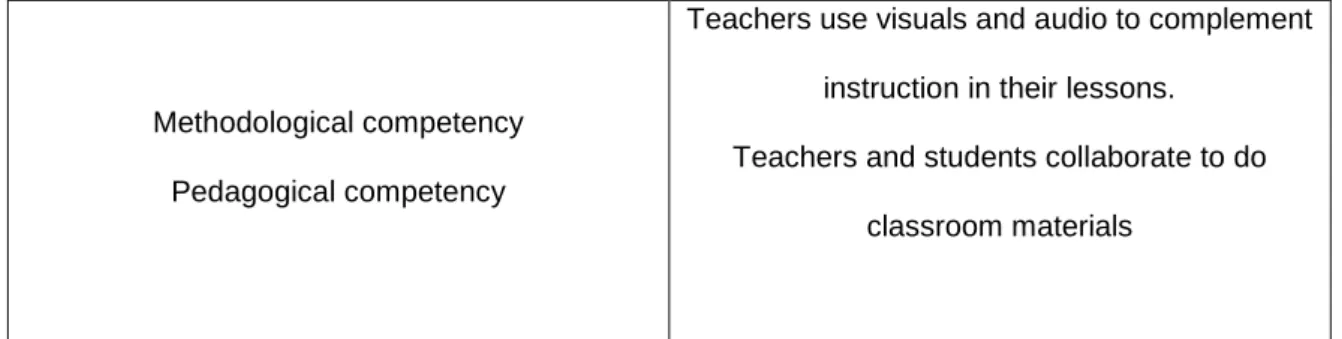
- Methodological competency
- Communicative competency
- Emotional and Cognitive competencies
- Pedagogical competency
This professional competence, which is related to the field of education, has special features for the professional to carry out in practice. 11 The professional competence will for this study be described as professional teaching competence due to its specificity in the activity in which the teachers carry out and develop it. This competency describes in detail the teaching knowledge and what kind of skills teachers must have in order to perform effectively in practice.
A professional competence is developed through teaching performance, it can also be done through continuous practice research from one work experience to another Le Boterf (as cited in Perronoud, 2004). Marchesi (as cited in España, 2011) considered that teaching competence is acquired through practices, is the result of professional life and has such importance for the promotion of meaningful learning. It is a broad branch of analysis for the teaching competence of every college professor who teaches as an alternative activity of his primary training, for the silent development in various performances and the complexity of pedagogical interactions, the classroom environment, the educational process, in training and actualization, attainment of postdoctoral courses, teaching competence (Guzmán, Marín, & Castro, 2011).
To foster confidence in students to keep following up and know more about any discussion in the classroom. To strengthen research and applicability that is in line with social needs – To promote learning that is focused on the demands and realities of a job. Pedagogical practice, however, works within interaction and the result is a pedagogical interaction, which is a complex phenomenon.
The development of teaching requires that all participants in the pedagogical process focus their work on the institution's mission; they know and respect the characteristics of the community and carry out consistent practice according to institutional principles” (Quesada, Cedeño y Zamora, 2007, p. 19). Therefore, there must be integrity in the various competencies in teaching practice, just to be considered fit for the institution.
Methodology
- Participants
- Research Methodology
- Data Collection Procedure
- The first stage collection procedure
- The second stage collection procedure
- Data Analysis
- Conclusion
16 Faculty of Languages and another from different Faculties to have enough information to know what beliefs they have about their University teachers. It was first approached for the project Development of Professional Competences of the Language Teacher: Students' beliefs at BUAP about the University Teachers' professional competencies (Desarrollo de Competencias Profesionales del Profesor de Lenguas: Creencias de los estudiantes de la BUAP acerca de las Competencias del Buen Profesionales Professor Universitario). The one that collected information about meaningful information about the professional competencies that a university teacher should possess.
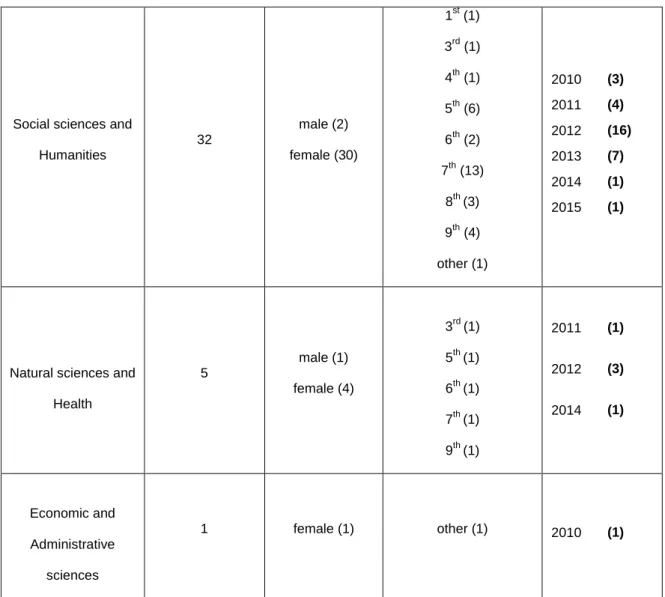
It collected information from students of the Faculty of Languages and some other faculties belonging to different areas of study: social sciences, education and humanities, engineering, natural sciences, medicine and mathematical sciences. The data collection instruments were an individual interview (see Appendix A) and a survey (see Appendix B), which were administered independently based on the participants' choice. The second phase, conducted in the fall, worked with the same tactics of using the interview and was conducted in the fall, with the same tactics of using the interview and survey to gather information.
The first part contains questions to collect information about the participants' age, gender, mother tongue, ethnicity, place of origin, marital status, term they are studying, and field of study. The second part is belief questions in which students have to describe the components of the professional competencies of good teachers. A questionnaire was administered to each student who was willing to participate in the research.
The data analysis method used in this case was based on categorization of respondents' answers. This case study completes two phases, where students' beliefs about university teachers' professional competences are described.
Results
Findings from first phase
- Questionnaire section 1 Participants characteristics…
- Questionnaire section 2 Beliefs about the components of professional
- Beliefs about the components of professional
- Beliefs about values in university teachers
- Beliefs about attitudes in university teachers
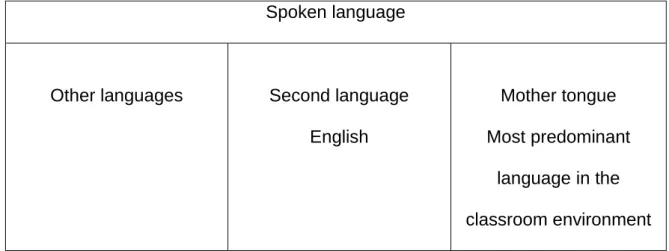
- Beliefs about fundamental teacher language speaking
- Beliefs about skills, should-do activities and materials in
- Fundamental characteristics of a good university teacher…26
22 Do, count to teach basic tools used in a professional context are referred to motivate students, give tools to solve real situations, make dynamic lessons, modify methods and methodology, promote participation, planning interactive lessons, gaining respect and attention from students, updating content of any course, modifying the course program according to students' needs, focusing on the topics suggested in the syllabus, consulting prior knowledge, following up on student learning, to advance classes plan and adapt to current needs, listen to students'. The values mentioned in the survey are respect, tolerance, honesty, dedication, ethical and commitment. Look for meaningful ways of teaching, innovate what and how of own teaching Create a relationship of mutual respect in the classroom.
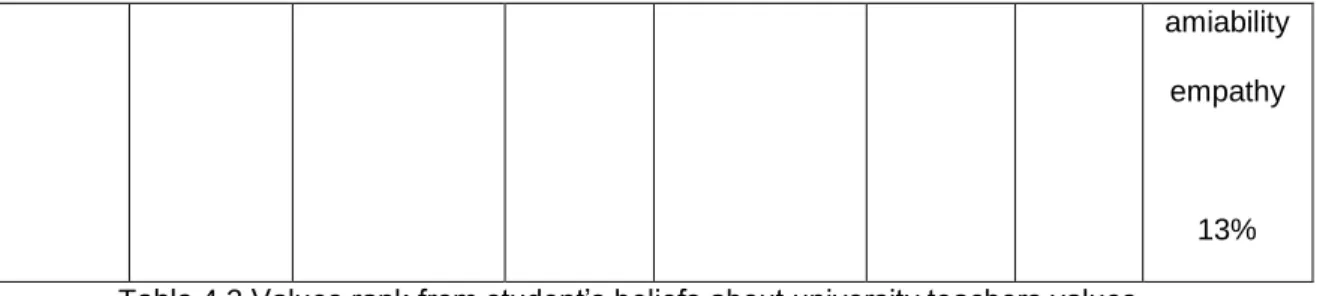
Has sufficient sense of humor and seriousness according to any subject Table 4.3 Beliefs about university teachers' attitudes. Teachers inspire students to be willing to participate and express their comments, ideas and opinions. They build confidence in their students to make them feel capable of participating in class.
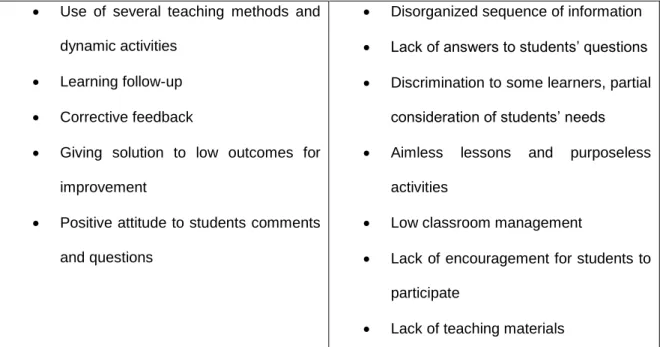
Most respondents described teacher attributes as high expectations, while others stated that a good teacher should show significantly more interest in teaching. From the students' point of view, some experiential lessons were required to simply get meaningful information about the qualities that a professional teacher should have. The table below compares two different scenarios, one described as effective teaching performance and another as ineffective teaching performance.
On the other hand, there are some things that create ineffective and irrelevant impressions on students. They were easily bored in class due to lack of knowledge in the subject or field of study, teachers' rude reactions to students' views, bullying in the classroom, lack of communication, lack of commitment, monotonous presentations and unattractive materials.
Findings from second phase
- Interview
Students believe that teachers cover the subject and provide up-to-date information in an easy way. The setting for the interview was the environment they were used to going to. The interview was never interrupted, unless during the interview the interview may require that one clarify something based on the information given to avoid too general answers.
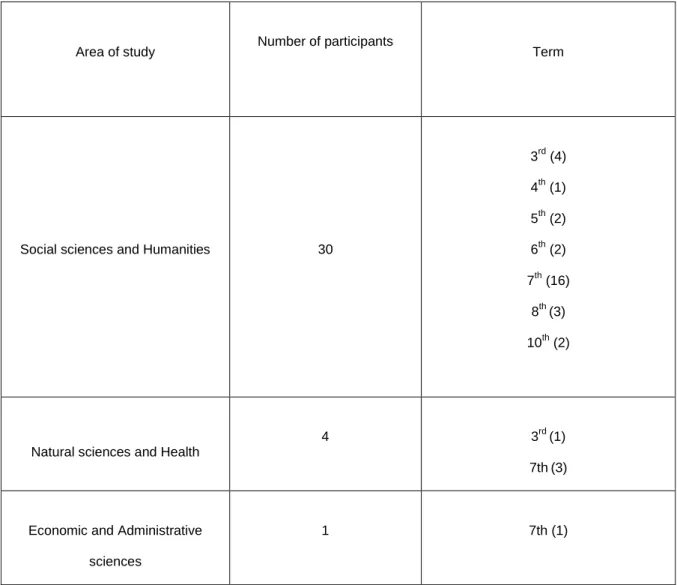
These were also labeled by putting a Q at the beginning and writing the number of participants in a logical number sequence starting from zero. From Natural Sciences and Health, two medical students and two others from Chemistry shared their convictions. Although it was said about the study and the talk was continuous and open, the students did not want to share basic information such as age or year they entered college.
Innovates own methodology Is open to new ways of teaching Table 4.8 Characteristics of a good university teacher.
Conclusion
31 However, it is important to investigate and have information about university teachers' professional competence beliefs.
Conclusion
- Purpose
- Main findings
- Answers to research questions
- Limitations
- Suggestions for further research
33 This presentation of results can explain what students identify as key components that a university teacher must possess. Compared to the interview stage, some students share certain beliefs that are relevant to be considered as a potential key point for improvement. Q019: (...) teachers should care for us because some of us have different life circumstances and they should be tolerant of our learning because not all of us learn in the same way as others, so it would be better than a teacher cares how we learn.
Based on that, it is better to address that every teacher should know about a teaching competency and to be aware of how students expect teachers to perform. Students claimed that it is indeed important to have the knowledge of the subject matter, but it cannot be the only teaching competence. Q017: (...) a good professor motivates students to learn and does not just limit learning to the standards, is interested in the students' goals to teach useful content.
These are also related to the five key competencies proposed since the beginning of the research: communicative, cognitive, methodological, pedagogical and emotional competencies. Considerable information has been collected from the survey employed, but both phases are limited by the size and complexity of the schedule and participant participation, as the total number of participants does not appear to be a representative sample. The results do not differ much from each student's beliefs due to comparisons and categorization of information.
Hay cuentas útiles que necesitan ser validadas con diferentes instrumentos y no sólo con declaraciones consensuadas. Desarrollo de las competencias profesionales del docente de idiomas: creencia de los estudiantes de la BUAP en las competencias profesionales de un buen docente universitario. Informe a la UNESCO de la Comisión Internacional sobre la Educación para el Siglo XXI, Madrid, España: Santillana/UNESCO.
El impacto de las competencias de los profesores universitarios en la calidad de la educación promovida.