BENEMÉRITA UNIVERSIDAD AUTÓNOMA DE PUEBLA
PERCEPTIONS OF TEACHERS AND STUDENTS FROM A BILINGUAL SCHOOL ABOUT MAZATECO
IN SAN MATEO YOLOXOCHITLÁN.
A Thesis Submitted to the School of Languages
for the Degree of
Licenciatura en la Enseñanza del Inglés
Presented by:
Carlos Ariel Cauhuizo Aca
Thesis director:
Dra. Barbara Pamela Olmos López
Puebla, Pue. November, 2019
PERCEPTIONS OF TEACHERS AND STUDENTS FROM A BILINGUAL SCHOOL ABOUT MAZATECO
IN SAN MATEO YOLOXOCHITLÁN.
This Thesis has been read by the members of the thesis committee of
CARLOS ARIEL CUAHUIZO ACA
And it is considered worthy of approval in partial fulfillment of the requirement for the degree of
LICENCIATURA EN LA ENSEÑANZA DEL INGLÉS Thesis director
_________________________
Dra. Barbara Pamela Olmos López
Committee Member ______________________
Mtro. Yonatan Puon Castro
Committee Member
_______________________
Mtra. María Teresa Fátima Encinas Prudencio
Benemérita Universidad Autónoma de Puebla November 12th, 2019
TABLE OF CONTENTS
Page
Acknowledgments………2
1. Chapter I: Introduction 1.1 Background information……….…3
1.2 Aim of the study……….….5
1.3 Research questions……….….5
1.4 Significance of the study………...5
1.5 Organization of the thesis………....6
2. Chapter II: Literature Review 2.1 Mazateco Language ………..8
2.1.1 San Mateo Yoloxochitlan as a linguistic variant………..12
2.1.2 Mazateco language studies………...14
2.2 Policies on indigenous languages……….17
2.2.1 The importance of language maintenance………....21
2.3 Bilingual Education………..23
2.3.1 The foundations on bilingual education………...26
2.3.2 The limitations for Indigenous Bilingual Education………27
2.4 Summary………...30
3. Chapter III: Methodology 3.1 Method………..32
3.2 Context ……….33
3.3 Participants………34
3.4 Instruments………37
3.5 Data collection procedure………..39
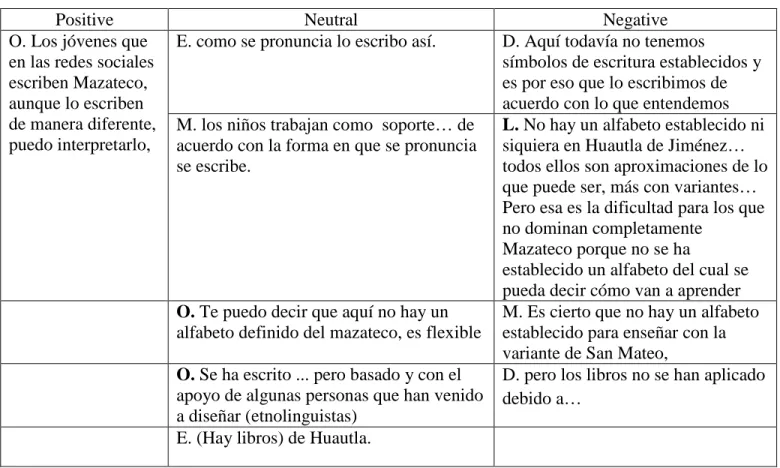
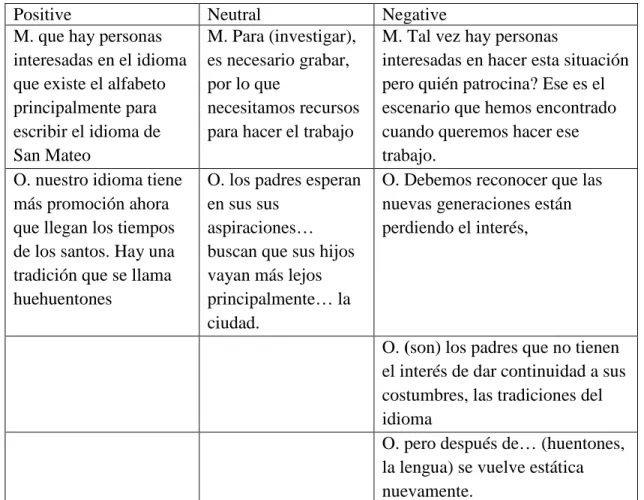
4. Chapter IV: Findings 4.1 First instrument data results………..41
4.2 Second instrument data results……….59
5. Chapter V: Conclusions 5.1 Answer to Research Questions……….68
5.1.1 Teachers’ perceptions of Mazateco language………..68
5.1.2 Children’s attitudes towards Mazateco ………...70
5.1.3 Practices and domains of Mazateco and Spanish………..70
5.1.4 The status of Mazateco in San Mateo………..71
5.2 Limitations………....73
5.3 Directions for further research………..73
6. List of references………...76
2 Acknowledgements
I would like to thank Mari for her goodness, friendship and enthusiasm to share with me the sounds of a beautiful language she grow up with, to her family that hosted me and showed me part of their worldview and everyday life. I also want to thank the teachers from the bilingual school who supported me and gave me the facilities to do the research and gather information in their school, particularly the sub-principal and her husband who showed me part of the Mazateco culture.
I would like to acknowledge, Dr. Pamela Olmos Lopez, my supervisor, who was a genuine and professional guide for this research. Her enthusiasm and interest in research inspired me to work on the topic of indigenous languages. Without her commitment and patient, this work could not have been done. Also, I express gratitude to Mtra. Fatima Encinas and Jonathan Puón whose feedback improved this project.
I want to dedicate this work to my family who has always supported me in my many projects and taught me to follow my dreams, and to my partner who was a moral motivator to do this project.
3 CHAPTER I: INTRODUCTION
1.1 Background
Mexico ranks within the ten countries with most languages spoken in the world (Ethnolongue, 2019). It possesses a repertoire of sixty-eight languages. One language can have different variants that diverge from its structure, intonation or sounds, word formation, grammar, lexicon and sociolinguistic identity (which is represented by sociocultural structures, social spaces and behavior based on the identity). That differs from the users of one variant to another (INALI, 2008). For example, Nahuatl spoken in North Puebla is not the same as Nahuatl spoken in Veracruz. Considering this, in Mexico there are three hundred sixty-four linguistic variants (INALI, 2008). The current situation of every language and its variations is different.
One of these sixty-eight languages that attracted my attention for a study is Mazateco because I had a personal story that got me close to the language. I was working in a restaurant where I met Mari. She is originally from Oaxaca and comes to work in Puebla. I asked her if she spoke another language and if she could teach me some words.
From the beginning, I felt in love with the first sounds and tones of Mazateco. She taught me basic words like adjectives, commands, and kitchen vocabulary. We used Mazateco as a secret code to have small conversations between us. I also found fascinating the stories she shared with me such as her hometown, why she moved to Puebla, her school, etc.
However, the time we spent together was not enough and my interest on her language was increasing. My commitment to learn more about Mazateco language and culture started since then. Indeed, this research project emerged from those conversations we had with my very basic Mazateco.
4 After meeting Mari, I decided to travel to Oaxaca to know more about her community and Mazateco. I wanted to identify where it is spoken, how it is taught in schools, whether it is used in public spaces or not, if there were monolingual speakers, how people write it, its transmission from generation to generation, etc. In December 2016, I started my first trip to her community in San Mateo Yoloxochitlán as a visitor. I spent three days with Mari’s family trying to learn as much Mazateco as I could. I was very surprised to see how their houses were surrounded by hills and nature, the houses were far from each other and the facilities were really basic as to live in a cold foggy area.
In her family, two of them were Mazateco monolingual and four were bilingual speakers, one of them was deaf, and most of them could only write and read in Spanish. This meant for me that I found a living language that I would like to work with.
After my trip finished, I came back to Puebla very enthusiastic to learn the language in autonomous way, sadly I found that there were not materials available and the ones I found were different variants from San Mateo Yoloxochitlán. I then started making a hypothesis, if there is not written language for Mazateco from San Mateo Yoloxochitlán, then there should be a probability for its death. Indeed, my subsequent trips showed me that the ethnic language in San Mateo is being replaced by Spanish, however, the cause of this phenomena is not the lack of a writing system but other factors that replace Mazateco for a dominant language like Spanish. Thus, I wanted to explore and deepen into the perceptions local people have towards Mazateco.
5 1.2 Aim of the Study
The purpose of this research is to explore teachers’ and students’ perceptions towards Mazateco in a bilingual school of San Mateo Yoloxochitlán in order to have a panorama of its use, students’ language proficiency and the attitudes they have towards both languages. This study aims to find the status of Mazateco as an indigenous language in this community in comparison with the status of Spanish based on a sample in a bilingual school.
1.3 Research Questions
The research questions I address in this study are:
1. What are teachers’ perceptions of Mazateco language in a bilingual primary school in San Mateo Yoloxochitlán?
2. What are children’s attitudes towards Mazateco in this educational institution?
3. In which practices and domains are Mazateco and Spanish used?
4. What is the status of Mazateco as an indigenous language in the community of San Mateo Yoloxochitlan?
1.4 Significance of the Study
Indigenous languages in Mexico are an important element of our cultural diversity. The fact of having three hundred sixty-four linguistic variants means that each one symbolizes the means of communication in a particular community. Many of these languages have been remaining as they have been transmitted orally from generation to generation. As an oral tradition, many communities place their knowledge, history, experience and worldview in the language. Thus, the language is an important element of
6 a community’s identity. These identities and different languages constitute our cultural diversity. The Mayan indigenous writer and translator Jorge Miguel (2017) exemplifies that the sixty-eight languages in Mexico are like sixty-eight nations in our territory.
The loss of one language or one linguistic variation results in the loss of one identity, culture and hundreds of years of knowledge and understandings. Then humankind impoverishes, as Nahuatl poet Miguel Portilla wrote. To prevent this, the National Institute of Indigenous Languages (Instituto Nacional de Lenguas Indigenas, INALI) and language policies promote linguistic rights for indigenous people and the research on indigenous languages. Unhappily, we still find cases of language barrier in public services for monolingual speakers and discrimination towards indigenous. The efforts of linguists, researchers, teachers, translators, cultural activists as well as the institutions have not covered all communities and linguistic variants yet, and this might be because of the multicultural dimensions of Mexico.
1.6 Organization of the Thesis
This thesis is organized in five chapters. The first one presents a preliminary panorama on indigenous languages and linguistic diversity in Mexico. Mazateco language and one of its variants are introduced as well as the reasons and motivations for its study in a small community in the North of Oaxaca. Another important section is the significance of the study where I discuss the importance of this research and researching indigenous languages in Mexico. I close the chapter with a brief description of the following chapters.
The second chapter provides a theoretical framework for Mazateco language studies. It includes a general review of the literature and the studies regarding Mazateco
7 linguistic variations, I explain the fact of considering San Mateo Yoloxochitlán as one of the Mazateco linguistic variants. Then, a brief section on policies regarding indigenous languages in Mexico is discussed. Some articles in the legislation for linguistic rights are contrasted with some examples in the practice. The importance of language maintenance is discussed too. To conclude this chapter a short section on bilingual education is presented. Here, I discuss the definition and types of bilingual education, a brief history on bilingual education in Mexico as well as some of the aspects and variables to consider in it.
Chapter Three contains the methodology used in this study. It contextualizes the study, describes the location in the community as well as the bilingual school. It gives information about the participants and their background. It also explains and justifies the method chosen for this research. It describes the instrument content and purpose. Finally, it describes how the data was collected.
Chapter Four discusses the findings on the data gathered. It describes the variables and the reasons for language shift based on teachers’ opinions, to support the argument on language replacement it shows students’ perceptions about their skills in both languages and the use of both languages within diverse domains. Finally, it catalogues the attitudes towards both languages with students and teachers’ ideas taken from the interview and the questionnaire.
Finally, Chapter Five draws a conclusion for the study, it answers the research questions and explains their implications. It provides and describes the limitations of the research that I faced during the study. It also provides directions for further studies and calls for action taking regarding language loss and shift in this community.
8 CHAPTER II: LITERATURE REVIEW
The purpose of this chapter is to discuss previous studies on Mazateco language and to give theoretical support for my research. The chapter is organized in three main sections.
The first section provides a general description of Mazateco language, culture and its linguistic variants. I specifically focus on Mazateco from San Mateo Yoloxochitlán as a linguistic variant. Then, I present a general panorama on the studies regarding Mazateco language. In section two, I mention some of the language policies that support indigenous people at the global level as well as some of the articles of the linguistic rights at the local level that defend, preserve and promote indigenous languages. I also explain the need for indigenous languages preservation. The last section includes an account on bilingual education. Since my research focuses on a bilingual school (Mazateco and Spanish), I discuss the foundations on bilingual education in Mexico, the types of bilingual education and some of the contrast with the reality and limitations of indigenous communities.
2.1 Mazateco Language.
Mazateco language belongs to the linguistic family group Otomangue spoken in the central south of Mexico (INALI, 2008). There are eleven linguistic families in Mexico, Otomangue is one of the biggest families in Mexico with fifteen languages, one of its main characteristics is that they are generally tonal with nasal and oral vowel sounds (De Ávila, 2008). The name Mazateco comes from Nahuatl “mazatecatl” meaning people from the deer land or deer people, nevertheless Mazatecos call themselves “ha shuta e Nima”
meaning humble people who work in the mountains and people of traditions (Luna, 2007).
Specifically, Mazateco is spoken in the North part of Oaxaca bordering with the south-
9 west part of Puebla and Veracruz. The communities where it is spoken are diverse and speak different Mazateco variants. Figure one below shows the location of the council towns where Mazateco is spoken.
Figure 1. The Mazateco communities. Taken from Atlas de los Pueblos Indígenas de México.
As we can observe, most of the populations are concentrated in the north part of Oaxaca. The geographical zone presents a mountainous relief in most of the towns, this characteristic isolated some of the communities and led people explore the whistled language, they are able to carry on conversation with whistles and no words, this practice is based on the tonal structure of Mazateco and it is used to communicate between hills or long distances. The arrow shows the community of San Mateo Yoloxochitlán.
Mazatecos are popular since the 60’s for their traditional ceremonies and their spiritual journeys made with the hallucinogenic mushrooms by Mazatec Maria Sabina (Skrobot, 2014). Some of the ceremonies are still made in Mazatec chants. They are also known for their biologic diversity and the resistance for maintaining their cultural identity (De Ávila, 2008). Each town, however, has particular characteristics.
10 A recent study of Mazateco dialectology proposes ten Mazateco languages considering their intelligibility and twenty linguistic variants that present particular characteristics (Chavez, Filio and Wagner, 2017). In this study, San Mateo Yoloxochitlán is considered as one of those twenty linguistic variants. This research follows that grouping since participants from this study do not feel identified with the linguistic variant
“Mazateco of the North” proposed by the Indigenous Languages Catalogue (Catalogo Nacional de las Lenguas Indigenas, CNLI, 2008), which proposes sixteen Mazateco variants. Each town names itself with a title in Mazateco language, for San Mateo they are said to be “én Naxotót'a” meaning people from the heart flower. Figure two presents Mazateco variants and the town councils where it is spoken.
11
Auto denomination Linguistic variant Town council
án Ngichintja /’án Xo’boó
<Cuaunecuiltla and Puebla Mazateco>
San Lorenzo Cuaunecuiltitla, Sta. Ma. Coyoameapan y San Sebastián Tlacotepec
ꞌán Ndeéxo̠ <Huehuetlán Mazateco> San Francisco Huehuetlán ꞌán So̠ndo̠no̠ <Ateixtlahuaca Mazateco> Santa Ana Ateixtlahuaca 'én Ndaja̠ <Ocopetatillo Mazateco> San Pedro Ocopetatillo 'én Na̠xi̠yanáxo̠ <Acatepec Mazateco> Santa Cruz Acatepec
'én Ngi̠xó < Eloxochitlán Mazateco > Eloxochitlán de Flores Magón 'én Na̠xi̠'í < Tecóatl Mazateco > San Jerónimo Tecóatl
'én Naxotót'a < Yoloxochitlán Mazateco
>
San Mateo Yoloxochitlán
'én San Lúka̠ < Zoquiapam Mazateco > San Lucas Zoquiapam, San Martín, Toxpalan, San Juan de los Cues
'íén Chintji̠e̠ < Mazatlán Mazateco> Mazatlán Villa de Flores, Santa María Tecomavaca
'én Ndáxó < Chilchotla Mazateco> Santa María Chilchotla
'én Te̱ja̱o̠ < Huautla Mazateco > Huautla de Jiménez, San José Tenango 'én Nanginna̱xi̱ <Asunción-Huatepec
Mazateco >
Santa María la Asunción, San Miguel Huautepec
'én Ngat'ia / 'én Na̠xi̠nduki̠cha̠
< Independencia Mazateco
>
San José Independencia, Acatlán de Pérez Figueroa, San Miguel Soyaltepec, San Pedro Ixcatlán, Tezonapa 'én Ngífi < Ayautla Mazateco > San Bartolomé Ayautla
'né nangi nisin te
< Chiquihuitlán Mazateco> Chiquihuitlán de Benito Juárez
'én Ntáxjo̠ < Jalapa Mazateco> San Felipe Jalapa de Díaz, San Pedro Teutila
'én Ningotsie < Ixcatlán Mazateco > San Pedro Ixcatlán, San Miguel Soyaltepec, Playa Vicente
'én Na̠xi̠je̠én <Acatlán-Soyaltepec Mazateco >
San Miguel Soyaltepec, Acatlán de Pérez Figueroa, Santa María Jacaltepec, Playa Vicente
Figure 2. Mazateco language variations taken from Chavez, Filio and Wagner, 2017:5
12 As we can appreciate, the colors in the table exemplify the level of intelligibility
among the linguistic variants. The more similar colors are the less level of intelligibility they possess. We can also observe that one variation might be spoken in more than two towns. San Mateo is considered as a single linguistic variant for the reasons exposed in the following section.
2.1.2 San Mateo Yoloxochitlán as a Linguistic Variant
Two people from the same linguistic group (Mazateco), but speaking different linguistic variations are said to have difficulties in decoding the message as socio- linguistic backgrounds and identities of both speakers are different (CNLI, 2008). Even when two Mazateco communities have a geographical proximity like Huautla de Jimenez and San Mateo Yoloxochitlán, they are said to be different cultures and to have lexical and phonetical differences in their language. These changes respond to the fact that language is never static; as Milroy & Milroy (1997) argue, language structure is constantly changing. Filio and Estrada (2008) affirm that Mazateco communities that are located in the south or low part of the state are intelligible; meanwhile the communities located in the north part have different sounds among them which makes it difficult for them to understand each other.
San Mateo Yoloxochitlán is a city council belonging to the region la Cañada in North Oaxaca. It is characterized as many other Mazateco communities by its mountain relief, one of its neighborhoods is Huautla de Jimenez, an important economy town center in the Mazateco Sierra, it takes fifteen minutes by car to get there. The town center is appreciated on the left in figure below.
13 Figure 3. San Mateo Yoloxochitlán town council.
We can observe a vast contact with nature which contributes to the knowledge of the community, and long distances between one town council and the others. This separation contributes to the diversification of the language caused by contacts between towns and their speakers are not so frequent. The diversification of the language has evolved significantly, Ventura (2006) reports that Spanish is used when two speakers of Mazateco do not understand each other’s variant. However, they use their own Mazateco variant and try to understand the other’s variant when one of the speakers does not know Spanish.
As I arrived in one of my trips before applying the first instrument I started to talk to teachers from bilingual school in Spanish; nevertheless, I could say some fillers in my speech like the word “Hõ” in Mazateco meaning “yes”, one of the teachers then identified my early contacts with one of the speakers from the community, she said that my “Hõ”
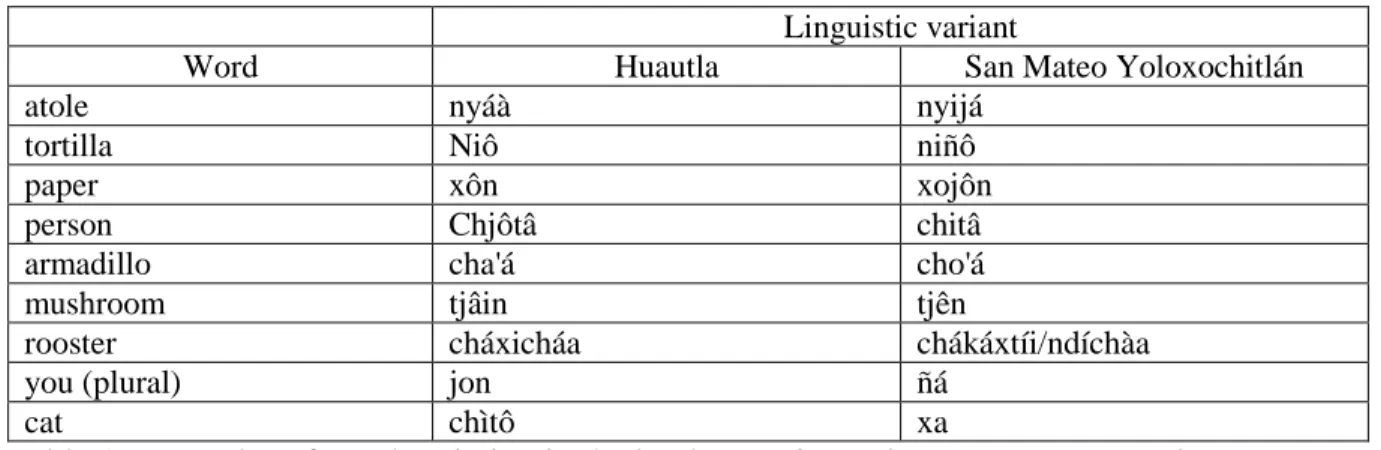
was properly from San Mateo (In Huautla it is pronounced as “Hau”). They also explained the word “nat’chà” that means banana in San Mateo but might be an offense in other communities. But more than a matter of some language changes in the words or in the pronunciation, it is a matter of belonging to the community using a common code, a
14 sociolinguistic identity that unifies them and differentiates them among other Mazateco communities. We can see more examples about language variation in Table 1.
Linguistic variant
Word Huautla San Mateo Yoloxochitlán
atole nyáà nyijá
tortilla Niô niñô
paper xôn xojôn
person Chjôtâ chitâ
armadillo cha'á cho'á
mushroom tjâin tjên
rooster cháxicháa chákáxtíi/ndíchàa
you (plural) jon ñá
cat chìtô xa
Table 1. Examples of word variation in the book Escribo mi lengua: Mazateco Alta.
This table presents the variation of the language between San Mateo and Huautla, two towns which are fifteen minutes distanced among hills. Here, we notice that to say a word it might vary in a vowel, a syllable or it might be completely different between two variants. Therefore, the sociolinguistic identity between the two towns is different. As Skrobot (2014) states that the linguistic groups of indigenous communities are characterized by their identity fragmentation, the identity of an indigenous community is regional and residential, not only idiomatic.
2.1.3 Mazateco Language Studies
Mazateco in general has a significant repertoire of studies compared to other linguistic groups, thus as we will see, there is a gap on research for not all the twenty variants have been studied. To have an idea of the records of this language through the time, I will now discuss and summarize the previous studies and current studies of Mazateco.
15 In the XIX century the studies about Mazateco were concentrated on its cataloguing with other languages, researching was about ethnographical geography and the elaboration of catalogues about southern and central languages in Mexico. Mazateco was not classified at first but later it was related with languages such as Zapoteco and Chiapaneco (Orozco, 1864; Pimentel, 1865; Brinton, 1891; and Peñafiel, 1897). Also, the first research on grammar about Mazateco was made by Belmar Francisco (cited in Vielma, 2017) where he explains the grammatical cases of Mazateco.
In the beginning of XX century the works on grammar emerged and the connections and comparisons with other languages for Mazateco cataloguing continued.
Some vocabularies were used as a tool for comparing numerals and pronouns, based on this comparison a relation was found with Popoloca, Chocholteco and Triqui languages.
Mazateco was classified with other languages as the Mazateco group and later catalogued as Popoloca group. Researchers made the hypothesis that Otomangue languages use a monosyllabic structure and their numerals morphology are similar among them (Mechling, 1912; De Angulo, 1925; Walter and Weitlaner cited in Vielma, 2017).
In the rest of the XX century the works on Mazateco were made under the grammar and phonetic approach. The topics for grammar about Mazateco contained or explored language structure, semantics, the perception of time, prefix and suffixes analysis, the word classes of Mazateco, a pedagogical proposal for grammar instruction, the aspect and tense, as well as the morphology of verbs, and the creation of dictionaries (Agee, 1986;
Guzman, 2011; Klint, 2016; Cowan, 1937; Terry, 1978; Schram, 1979; Black, 2014; and Jamienson, 1977).
There are also works that describe aspects like the whistle language, the writing system and the reconstruction of Proto-mazateco language. George Cowan (1943, 1948,
16 and 1952) demonstrates the existence of the whistle language as well as the importance of the pitch in discourse, he compares the whistle language of Mazateco and Tepehua.
Meanwhile, Busnel (1981) describes the different techniques used for the whistle language as tongue-labial and dental-labial.
The studies on the reconstruction of Proto-Mazateco language, situate Mazateco as part of the Protopopolca language, they calculate that the diversification of the Otomangue family was around 482 a. C. and 126. A. C. It is related to other languages that are tonal with lexical and grammatical functions. Mazateco is compared with other languages such as Ixcateco that shares 40 per cent of cognates. The numerals of 12 variants are compared as well as the personal pronouns in Popolocanas languages. And there are studies on dialectology of Mazateco variants, Chiquihuitlan variant is the most different, they find that 80 percent of intelligibility makes a variant easy to understand.
Some variants of Mazateco have been studied from different approaches. And we see there is a gap for bilingual education research in Mazateco. In general, the communities where Mazateco was studied are Jalapa de Díaz, Chiquihuitlan de Juarez, San Jerónimo Teocatl, Mazatlán Villa de Flores, Huahutla, Puebla, San Miguel Soyaltepec as well as San Pedro and San Jose. Other communities where Mazateco is spoken have not been studied yet.
For instance, Mazateco from San Mateo Yoloxochitlán has a morphological study by a linguist (Léonard, 2012). As previously pointed out it is mentioned in CNLI as part of a variant called North Mazateco and in another study it is classified as a local variant.
Moreover, this variant is considered in a book for writing Mazateco (see table 1 in previous section) as an example of word variation between San Mateo Yoloxochitlán and Huautla de Jimenez (Hidalgo, Torrescano & Vergara, 2014). In general, Mazateco from
17 San Mateo Yoloxochitlán has been mentioned as a reference in other studies with little information about it.
2.2 Policies on Indigenous Languages.
Policies on indigenous languages contribute to the preservation and diffusion of ethnic languages. They also establish the rights of speakers to prevent discrimination for speaking an indigenous language in the social and institutional context. There are some international laws and agreements at the macro level that support indigenous languages.
The knowledge of these rights is a first stage to avoid language replacement, stigma and discrimination.
The Universal Declaration of Linguistic Rights (1998) establishes Article 3.1
“Individuals have the right to use the language in private and public.”
Article 3.2
“Linguistic groups have the right to be taught in their own language… to be assisted in their language by official institutions.”
It was an important step to establish these articles since 1998, but currently some indigenous people prefer to speak the ethnic language only in the nuclear family or in the community for they are afraid non-native speakers point at them, as we will see later statistics on discrimination show that there is still bias and prejudice towards indigenous people in Mexico. In the institutions, we can still observe limitations of access for indigenous speakers.
At the national level, there is more promotion and stimulus for researching indigenous languages supported by Mexican institutions like INALI or article two in the
18 Mexican Constitution. However, these institutions and rights are the product of years of struggle and activism by indigenous groups and militants.
Indigenous language policies in Mexico have developed from an assimilation line, into integration to a more intercultural approach. In 1994, The Zapatist Army of National Liberation with the Indigenous movement claimed the executive power better social and political recognition to their rights. This, with other efforts like the San Andres agreements and the 169 convention from the International Organization of Work (Organización Internacional del Trabajo), led to the reform of the second article of the Mexican constitution (Diario Oficial, 2010).
The second article of the Mexican Constitution (2016) is dedicated to the Indigenous communities. In section A, fraction IV, it recognizes indigenous communities’
rights and allows their autonomy by preserving and enriching their languages, knowledge and their culture. In section B, fraction II, it guarantees and increments the levels of education, improving bilingual and intercultural education.
This article and their fractions are the main foundations for indigenous communities’ rights in Mexico. It gives them the legal protection for using and being taught in their mother tongue, and gives them the support for more access and opportunities in order to avoid inequality. Nevertheless, this Constitution has not been translated in Mazateco, consequently, monolingual indigenous speakers depend on Mazateco translators that understand the specific terminology of the Constitution.
Yet, one main legislation or institution for sixty-eight languages and their variants can be complex to manage. We have seen the case of Mazateco and discussed particularly one of its variants, San Mateo. Thus, every linguistic variant in Mexico is placed in a different situation and context. Kiliwa language in Baja California for example is an
19 endangered language that presents less than fifty native speakers. Other languages such as Zapoteco in Juchitan, Oaxaca are in revitalization programs, the community encourages its use and transmission to next generations. Nahuatl language, on the other hand, presents the largest population of speakers in Mexico. However, one of its variants Nahuatl from Veracruz is being lost too because the amount of people who speaks it decreases. All these multiplicity of languages have the support and protection by the same law.
In Mexico the main legislation that supports indigenous native speakers is the General Law of Indigenous Communities Linguistic Rights, LGDL (Ley General de Derechos Lingüísticos de los Pueblos Indígenas 2003). This regulation establishes the distribution of indigenous language speakers’ rights as well as the promotion and training of public servers like teachers or translators in indigenous languages. Regarding some of the articles that have to be with the preservation of the language and the integrity of their speakers, the LGDL in its article 5 (2003) states that “The state will recognize, protect, and promote the preservation, development and use of the indigenous languages” (p. 2).
However, the state lacks of mechanisms and systems for preserving them. Similarly, in the article 7, the LGDL stablishes that “Indigenous languages will be valid as Spanish, for any issue or public procedure, as well as for knowing the public management, services and information” (p. 2). These are essential articles for indigenous speakers have no limitations in the access of public services, also for the use of ethnic languages in legal procedures that gives them prestige and practicality.
Regarding the education field on indigenous languages, the General Law of Education in article 7 fraction IV (2018) establishes that “The state will promote linguistic plurality of the Nation and the respect of the linguistic rights of indigenous communities”
(p. 2). A more intercultural approach is encouraged in schools, yet, the success of
20 legislations for preserving or promoting a language is seen with long term language shift, maintenance, or loss (Gibbons, 2004).
Sadly, after years of these legislations, there is an evident lack of practice of language policies that have repercussions. A survey to some Mazateco communities reveals that monolingual Mazateco speakers’ access to public services is complicated for the employees do not know their language due to the lack of training and deficiencies in the system, this collocates their physical and legal status into risk (Ariano, Esteinou, Gómez, & Rodríguez, 2014). In other contexts, like education, the teachers know the language and linguistic variation of students, however, the materials they are given correspond to a different linguistic variant. Filio and Estrada (2008) report that the primers proposed by SEP, containing the Huautla de Jimenez variant, are not functional in Mazatlan Villa de Flores bilingual schools because the intelligibility between these two variants of Mazateco is different.
The reasons for the not congruence between law and practice include: a hegemonic conception of national unity (in which indigenous people are not considered), the unawareness of human, indigenous and linguistic rights, as well as the presence of racism and discrimination towards indigenous people. The LGDL does not establish instruments for applying the articles. For instance, INALI cannot sanction or supervise any breach (Diario Oficial, 2010). There is also a lack of inter-institutional synchronization for assisting indigenous communities (Skrobot, 2014). In other words, there is a significant gap in mechanisms and systems for supervising, operating and promoting linguistic rights in Mexico.
Indigenous people then realize that their ethnic language is not used for institutional procedures, the mass media distribute information in Spanish mainly, the
21 books or teachers do not use the adequate variant of students, they finally realize that their language limits them and exclude them from opportunities. Language displacement is affected then by social, institutional and jurisprudential discrimination, since there are limitations of the domains of the ethnic language use. Furthermore, this might allow the language process of death in the community. Holmes (2017) explains that the ethnic mother tongue of speakers might be reduced in terms of contexts of use, practices and complexity of their structural features when a majority group language extends into its domains.
2.2.1 The importance of Language Maintenance
The changes Mazateco communities have encountered in the recent decades have been crucial for new generations. Mazateco linguistic and cultural identity has been altered recently, particularly because their speakers have been incorporated into modernization which gives them facilities but also risk them into a process of homogenization (Carrera, 2014). This process of modernization can be seen in concerns like migration, identity hiding when asking for a job, and the attitude that Spanish will be more useful in the academic and social life of new generations than Mazateco itself. Also social changes like agroindustry and migration stop the oral transmission and reduce the sustainable consumption which might affect the collective knowledge and the relationships from young generations with old generations in indigenous communities (De Ávila, 2008).
This homogenization becomes crucial for communities that struggle in the diffusion and preservation of the ethnic mother tongue, their cultural identity and their local knowledge. The local knowledge of nature is connected with the community’s language words. There is a correlation between linguistic diversity and biodiversity.
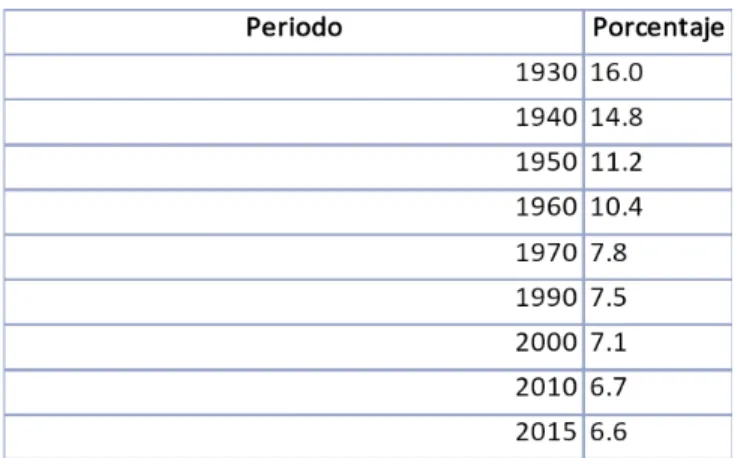
22 Oaxaca for instance is one of the most ecologically and linguistically diverse states in Mexico (De Ávila, 2008). Ecolinguistic balance can be threatened with the dying languages and the processes of substitution might bring consequences such as collective pathologies (Xochitl, Huerta and Osojnik, 2015). Losing the indigenous language for the community implies a slow process of displacement into homogenization. Holmes (2008) argues that the process of language death comes about gradual loss of fluency and competence by its speakers. Competence in the language does not disappear overnight. It gradually erodes over time. According to official statistics (INEGI, 2015), the amount of people that speak an indigenous language in Mexico has been decreasing progressively.
Figure 5. Number of people out of one hundred that speak an indigenous language older than 5. Adapted from INEGI
As we can appreciate in figure five the difference between 2010 and 2015 is minimal in number of indigenous language speakers, but it always goes down year-by- year and this tendency might mean the loss of some indigenous languages in the future.
The community must know that Mazateco is being replaced by Spanish, and their speakers need to change the paradigm of language hierarchies. Language replacement exists due to the idea that a better status as individual and community can be accessed by a dominant
23 language (Xochitl, Huerta, and Osojnik 2015). We also need to change the idea that Mazateco is not a language that can be written or used in legal procedures.
For gaining prestige as a language, there are projects and organizations that seek for applying a writing system and make literacy workshops in Mazateco. As an example for this kind of projects Filio & Estrada (2008) worked on a project for writing Mazateco.
They affirm that writing as an intellectual improvement of a person develops his or her historical memory, social interaction and language which also gains prestige.
Additionally, linguists and Mazateco speaking communities can contribute in the research about Mazateco linguistic varieties that have not yet been documented (Vielma, 2017).
In a recent interview with the director of INALI and Mazateco poet, Juan Gregorio Regino, he stated that the projects for language preservation should include the community consensuses. Indeed, one of the articles of the LGDL fosters the research and projects on indigenous languages. Yet, the first step to prevent language shift or replacement is that the community realizes that the ethnic language is in danger (Holmes, 2017).
But without the efforts and awareness of the community, without the legal support for indigenous speakers’ rights, without research on indigenous languages and without practices that preserve, use and promote the ethnic language, Mazateco and other languages in Mexico will die over time. Potential bilingual populations and communities will then become pure monolingual Spanish speaking communities.
2.3 Bilingual Education
We will now focus on bilingual education regarding indigenous languages in Mexico, this with the purpose of knowing more about the context of this study. But to talk about it first,
24 we will look at the definition on bilingualism and some of the implications of it. Grosjean (2010) defines bilinguals are those who use two or more languages (or dialects) in their everyday lives. In this definition he focuses on the language use more than the fluency on both languages. Bilingualism in San Mateo is a big spectrum in which bilinguals who speak the indigenous language (IL) and Spanish in a balanced way exist, bilinguals who understand the IL but speak it with some difficulties (and vice versa), bilinguals who are illiterate in both languages, bilinguals who speak Spanish only for specific purposes like shopping or at work, bilinguals who speak a third language like Nahuatl or English, and etc. If we took at the rigorous definition that bilinguals are those who are competent in two languages as native like speakers, then we would not have this multidimensional spectrum, and one thing is sure, the people from the examples above are not monolinguals (Grosjean, 2010).
However, the levels of bilingualism in this community might erode. One of the participants in the interview identified a concern, she mentions that first generations of students used to start the primary school speaking Mazateco and Spanish, nevertheless, new generations (children from first generations) start school being Spanish monolinguals. This is one of the consequences of the old subtractive or Hispanization (Castellanización) bilingual schools in long term period.
In the past, Bilingual Education in Mexico was aimed to unify the nation with a common language and to foster the literacy in Spanish language. Ignacio Manuel Altamirano, an indigenous teacher and activist described the instruction for indigenous people as “They were divided by castas and were sat in two different sections, one for the thinking kids and the other for indios who were poorly taught spoken Spanish.”
Segregation, exclusion or punishment practices were prevalent in students who spoke an
25 indigenous language. Nevertheless, Bilingual Education today aims to teach or instruct content in two or more languages, as well as to foster understanding and appreciation for languages, cultures and human diversity (Garcia, 2011). Due to the different contexts, historical and local needs of individuals and groups there are four types of bilingual education:
Subtractive:
In this model, the student speaks a first language and a second one is added while the first is subtracted.
L1 + L2 – L1 = L2
Additive:
A model under which the second language is added to the person’s repertoire and the two languages are maintained.
L1+ L2 = L1 + L2 Recursive:
When a community revitalizes their language practices, the language is added in bits and pieces, as ancestral language practices are reconstituted for new functions.
Dynamic:
Bilingualism involves a more dynamic cycle where language practices are multiple and ever adjusting to the multilingual multimodal terrain of the communicative act.
Figure 6. Types of bilingual education, adapted from Garcia, O. 2011, page 42.
In this range we see different models of schools. The subtractive and additive models are about withdrawing or maintaining the student ethnic language while teaching a second language. The content in the subtractive model is transmitted mainly in the second language. The recursive model is about reviving the ethnic language; it is studied mainly with isolated words or functions. Finally, the dynamic bilingual model is a more multidimensional model where languages have more interactions among them.
Teacher participants in the interview of this study retell their experiences on the subtractive bilingual school where they were punished and told not to use their mother tongue, whereas student participants in the present bilingual school move into the additive bilingual school where they can express themselves and are allowed to use the ethnic language.
26 2.3.1 The Foundations on Bilingual Education in Mexico
The change between these two different types of bilingual schools in Mexico had a complex process. After the conquest in Mexico, evangelizers and the Christianity educated indigenous people by using the indigenous language to convert them and teach them European culture. Then, in 1524 the first indigenous school in Texcoco was created to hispanicize and evangelize children. Moreover, indigenous communities were seen as communities with delay that needed a development that would quit the barriers for the national integration (Xochitl, Huerta, and Osojnik, 2015). Because of that ideology education was one of the State’s plans for assimilating indigenous people into the nation, its purpose was to hispanicize children through the belief of a modern country or through force (Diario Oficial, 2010).
After the independence war, education was declining for social and political disorganization. In 1868, Ignacio Ramirez formulates the curriculum with emphasis on indigenous people. (Xochitl, Huerta, and Osojnik, 2015). Since 1950’s primary education fostered the use indigenous language to facilitate the alphabetization and teaching of Spanish. Even though, policies for promoting and preserving indigenous culture flourished in the 1970’s with communities’ efforts, in 1994 with Zapatist movement, in 1996 with San Andres Accords and in 2001 with the reform of the constitution. After these attempts, the indigenous communities obtained indigenous rights, equal status of ethnic languages with Spanish as well as the right for intercultural and bilingual education (Zabecki, 2019).
As a result, indigenous education system replaced the hispanization approach into a more bilingual and bicultural approach. In 1978 SEP created General Department for
27 Indigenous Education (Dirección General de Educación Indigena, DGEI) for evaluating and supervising the services in indigenous schools (Xochitl, Huerta, and Osojnik, 2015).
After this struggle and years of activism, two strategies in bilingual education were inherited and applied, the first was the linguistic and cultural assimilation through hispanization, the second, with few examples was the genuine preservation of the Indigenous Languages (Hamel, 2016). Yet, the efforts and articulation with society, the community, institutions and students’ parents need to be stronger for the limitations that each community presents.
2.3.2 The Limitations for Indigenous Bilingual Education.
There are limitations for the effectiveness on Indigenous Bilingual Education that relate to institutional and social spheres. As an outsider and based on what mass media display about indigenous communities one would think that the limitations have to be the lack of electricity and infrastructure in the schools as well as poverty by indigenous communities. But regarding the Educational system as a whole, the institutions, society (non-indigenous language speakers) and each community, we will find more variables.
Indigenous bilingual education is one of the most deficient systems in Mexico. It offers insufficient multilingual and intercultural approach training for teachers, an incomplete number of indigenous language teachers with the adequate variant, a poor curriculum development for multilingual and intercultural approach and a lack of continuity after elementary school. Also the indigenous education budged is limited (Diario Oficial, 2010). This, other variables and the fact of treating 68 languages and 365 variants make Indigenous Education a complex system to manage. As a concern, a general evaluation for third grade is made in Spanish every year. This is not valid for diverse
28 students whose mother tongue skills are not the same as Spanish (Shmelkes, 2013). Also, the system continues rarely using the primers in native languages, following a common curriculum designed for all students in the country (despite it is a curriculum for the monolingual system), having poor conditions in the schools as well as indicators of poverty, presenting policies made top-down by the state, and reproducing the image of Spanish as the literary language. In other words, the indigenous educational system continues showing the poorest results in general (Hamel, 2016).
The boundaries also extend for teachers. A similar study made in two Spanish monolingual schools in Mexico City, where there were indigenous students Skrobot (2014), reports that teachers’ attitudes towards the linguistic diversity were positive but their actions did not show any change in students’ progress. They considered that they were not prepared for managing the linguistic diversity. This is a similar discourse in the indigenous Bilingual Education system, where teachers are somehow limited in the training aspect, 50% of indigenous school teachers are not graduated. The major in intercultural bilingual elementary education is limited in Mexico, there are 22 colleges offering this career apart from Escuelas Normales (Shmelkes, 2013). As another consequence, the number of teachers who are not bilingual is increasing, which allows that the instruction might be given in Spanish (Skrobot, 2014).
The general and political discourse towards the proud of linguistic and cultural diversity has not changed the teaching and the practices to promote them. The government and institutions are promoting a more intercultural education, but planning it without considering some realities in the classroom (Skrobot, 2014) and with no consensus from the communities. There is also a need for future research like the introduction of literacy for cultures with an oral tradition, the cultural significance of the books, the
29 multidimensional characteristic of bilingualism, the linguistic variations chosen for the textbook and the role of the bilingual teacher as an intermediary (Leon, 2016). But then again, the school does not guarantee the preservation of a language if it lacks of functions and prestige outside.
Some of the realities of indigenous classroom have to be with indigenous students’
limitations. Poverty and marginalization are some of the factors, in indigenous communities like San Mateo Yoloxochitlán some children have to help their parents or brothers in the fields. Indigenous children speakers from 6 to 14 years old represent 9.73%
of the population who does not attend elementary education. Meanwhile children who do not speak an indigenous language represent 4.45% of this sector (Xochitl, Huerta and Osojnik, 2015). Health access is another limitation for indigenous, about 80% of five years old indigenous children are undernourished. They have less access to medical treatment and some of their houses have not potable water or hygienic services (Skrobot, 2014).
Apart from marginalization, they also have to face discrimination by society. In a census about discrimination to indigenous people made by Consejo Nacional para Prevenir la Discriminación (CONAPRED) and Secretaría de Desarrollo Social (SEDESOL) in 2010, around six out of ten indigenous people prefer not to say they belong to an indigenous group when looking for a job or applying for a public service, so more than fifty percent prefer to hide their identity for these contexts. And certain percent of non-indigenous speakers prefer not share their homes with an indigenous person.
Discrimination can be overcome with information through mass media, still there is a gap in programs that present topics on cultural and linguistic diversity and fewer that include an indigenous native speaker in their program. Some broadcasts present a pejorative stereotype of indigenous or show an attribute to antique indigenous civilization, this
30 spread the idea that indigenous communities are extinct (Skrobot, 2014). All these social and institutional limitations make indigenous people vulnerable and allow them to better choose Spanish for their lives.
2.4 Summary
To summarize this chapter a general description of Mazateco language and previous studies were presented. We identified San Mateo Yoloxochitlán as a linguistic variant and the importance of considering it different from other variants. The policies regarding indigenous languages at the global and local level were discussed. We realize the importance of fostering and informing indigenous native speakers their linguistic rights, this in order to guarantee their access to public services in their languages and to consider Mazateco as valid as Spanish. Moreover, indigenous bilingual education and some of its implications were explained as well as some of the variables for its ineffectiveness.
After this discussion, we see the significance of designing projects for language preservation with the participation of the community, and the importance of promoting Mazateco uses in the community specifically in the academic context, this contributes to non-native and native speakers change their ideology about the ethnic language. Finally, we state the importance on teacher training in pedagogy, linguistics and language teaching for the systematic study of Mazateco. And we see the repercussions on the old traditional bilingual schools in the new generations that begin bilingual education as Spanish monolinguals.
Activism, language policies, language documentation and studies as well as bilingual education contribute to the preservation of indigenous languages, however,
31 languages rely on their people who speak it, a dead language means the dead of its last speaker, and then it is a big loss for humanity (Baker, 2011). If a language is not spoken at home or in the community then large studies, books as well as multimedia sources on that language will be stored in libraries or museums forever.
32 CHAPTER III: METHODOLOGY
After presenting the literature review that supports this research, this chapter explains and describes the methodology used for this study. It gives a detailed explanation of the context where the research takes place, participants and their backgrounds, as well as the instrument, the data collection and the data analysis procedures. The function of this chapter is to validate the method chosen and its appropriateness for the research purpose of this study.
As this study describes the current situation on Mazateco in a bilingual school in San Mateo and identifies the factors of the language to consider it as endangered; hence, I will use descriptive methodology for it implies the description, explanation and identification of a problem or phenomena. This methodology is used to observe, report and to see the possible variables of a problem. To know this panorama and factors I will explore students and teachers’ perceptions from this bilingual school. In order to collect this information from participants, the use of survey method is suitable.
There are two groups of participants in this study and subsequently two instruments applied. The first group is integrated by teachers from the bilingual school in which I used interview. And I applied questionnaires for students from the same bilingual school as the second group. The analysis contemplates students’ perceptions on their Mazateco and Spanish skills, students’ attitudes on what they think about Mazateco and Spanish, teachers’ opinions about the use of Mazateco in the community and the domains where Mazateco is used. With this analysis and description of the data I will present a panorama on the situation of Mazateco in a small sample based on the bilingual school. I will now explain in detail each of the elements in this section.
33 3. 1 Context
I remember that the way from Mary’s house to the town center was full of nature, plants that grow up in the edge of the path, isolated houses, farms on the uphill, a smell of humid earth emanated from the path, water falling from the hills, and people passing by and saying ndalí or buenas tardes to you. This illustrates one of the characteristics around this town which is its nature. San Mateo Yoloxochitlán has the name of the representative tree of its town, called Yoloxóchitl. In Nahuatl language it means "heart flower" and in the Mazateco language it is referred as "yá naxó totá", this tree represents some of the legends around the community.
It has some water springs that are used for population basic supplies and for agricultural purposes. It has predominantly a sub-tropical climate with an average temperature of 25° C and abundant rains in summer as well as frequent fogs in winter.
The economy for the community is agriculture, although the land is not plane, they can plant corn, beans, and other vegetables. Some houses are made of concrete or cinder block, others are made of wood and galvanized iron plate. Some families use gas lpg for cooking and heating, some others have to cut trees in order to have these goods. This is an example of some of the families’ limitations in the community, their economy draws on them boundaries for having opportunities. To illustrate this, I can mention Mary’s family, she did not study the secondary school for she had to take care of their brothers, their brothers did not finish high school and her sister should had to learn Mexican Sign Language since she is deaf. Here, also public programs and public services play an important role.
About public services they have access to a medical clinic that works for the town, three elementary schools, two of them are general schools (monolingual) and one of them is a bilingual school (Mazateco and Spanish are taught), one junior high school and one
34 high school. They only have one church and the presidency of the village. Moto-taxis, collective taxis and public trucks transport people from the village around town and to other towns. There are not linguistic landscapes or any advertisement in Mazateco, though the speaker announces important messages in both languages. As previously mentioned in chapter two, villagers might present different dimensions on bilingualism.
The specific location of this study is a bilingual elementary school named
‘Cuahutemoc’ which is located fifteen minutes from the town center by walking. It contains six classrooms and the principal’s office, four restrooms (two with water and two without water). Six female teachers work in the school, one male is the principal and another male is the domestic worker. The 1st, 2nd and 3rd grade classrooms are in the low level of the hill while 4th, 5th and 6th grade classrooms are in the upper level of the hill.
The groups contain from 12 – 20 students approximately. After the earthquake that Oaxaca suffered on September 19th, 2017, the state was expected to afford economic support for fixing the wall near the hill edge that collapsed after the earthquake, even though such support never happened. The school had to move into a provisional building and after one month that the support did not arrive they decided to go back to the school building.
3.2 Participants
There are two groups of participants in this study, teachers and students. Teachers’
perceptions and opinions about Mazateco language are important to know their experience with bilingual students, Mazateco teaching, educational policies and the community attitudes, whereas students’ attitudes for the ethnic language are relevant for they reflect part of the phenomena on language shift. Seven teachers participated as the first group for the interview, six women and one man. They are all teachers from the bilingual primary
35 school in San Mateo Yoloxochitlán the man that participated in this interview is the principal of the school who authorized the application of the instrument. The main characteristics of each person are summarized in the following table.
All their names have been changed to protect their privacy.
36 Table 2. Participants’ backgrounds and personal information.
Name and Age
Hometown and place of
birth
First and Second Language
Contacts with Mazateco.
Background
Daniela 45
San Mateo, originally from Huautla
L1
Spanish, L2 Mazateco
Huautla and San Mateo
Teacher of 6th grade, she learned Mazateco language with their classmates in her childhood. She married a villager from San Mateo Yoloxochitlán. She works as the sub-principal of the bilingual school. She has participated in some workshops for Mazateco language teaching and documentation.
Eleazar 35
San Mateo, originally from Huautla
L1 Mazateco, L2 Spanish
Chilchotla, San Mateo and Huautla
Teacher of the 5th grade of the primary school. Her concern about social issues that influence language transmission like family and ideologies are stated in her answers. Before starting the meetings with teachers in this interview she was one of the teachers that started to talk in Mazateco. Her volume of voice is one of the lowest from all teachers.
Julieta 38
Huautla de Jimenez
L1
Spanish, L2 Mazateco
San Mateo and San Antonio
Teacher of the 4th grade. She has acquired Mazateco as a second language through the interaction with her students. In the interview she shows a limited participation but clear when asked.
Ana 35
San Mateo, originally from Huautla
L1 Spanish, L2 Mazateco
San Lucas Z., San Antonio, San Mateo
Teacher of the 2nd grade of the primary school. She has Mazateco as her second language, she is not from San Mateo Yoloxochitlán, and she is committed with issues of language inequality and discrimination.
Leticia 35
Huautla de Jimenez
L1 Spanish, L2 Mazateco
Huautla and San Mateo
Teacher of 3rd grade, she also has a major as a lawyer. She has been in contact with other variants of Mazateco and has been in other schools where Mazateco is spoken. When talking about language and law and language policies she is the one that discuss the most about the topic.
Mónica 45
San Mateo L1 Mazateco, L2 Spanish
Mazatlán Villa, San Lucas Z., San Mateo
1st grade teacher from the institution, she is concerned with issues of language variation and usage, as well as the language as part of village identity. She is the one that has knowledge about literature or texts in Mazateco language from San Mateo.
Octavio 50
Huautla de Jimenez
L1 Spanish L2 Mazateco
San Mateo, Chilchotla and Huautla
He is the principal from the institution. His stance like other participants is very clear about the new educative reform and the importance of preserving the language and the role of new generations and parents in the process of language maintenance.
37 As we can appreciate in the table, the participants show different backgrounds in their
location, mother tongue, language acquisition, contacts with other variants and work experience, this gives diverse perceptions and understanding of the ethnic language. For some of them Mazateco was forbidden at schools, for others it was taught in the family and others had to learn Mazateco for work.
The second group of participants is integrated by twenty-one students who contributed in the questionnaire. The sample selected took into account the last grades of school since they are more conscious about their own bilingualism. Their ages range from eight to twelve years old, grades 4th and 6th (5th grade did not have class the day the instrument was administered), eleven boys and ten girls answered the questionnaire. One boy and one girl were handicap, in the 6th grade the boy did not take the questionnaire, the girl did. The test took around thirty minutes. It was managed on Friday 25th of May 2018. In the 6th grade it was applied at 9:45 am. (8:45 am. local area) and 10:30 am (9:30 am local area). Three people were absent in 6th grade that day while in 4th grade four students were absent, one girl arrived just at the end of the test (The questionnaire was not applied to her for not interrupting the teachers’ class).
3.3 Instruments
There are two instruments used in this investigation, an interview for teachers and a questionnaire administered to the students. The interview seemed pertinent for collecting perceptions about socio-cultural issues regarding Mazateco language. There were seven teachers from the bilingual primary school of the village during the interview. The interview consisted of eleven open questions to all teachers. The dynamic for answering them was asking questions one, two and three and letting teachers respond by turns as they were in the
38 same interview. The first two questions addressed participants’ backgrounds such as
Mazateco language acquisition and whether if they studied in a bilingual or monolingual school, the purpose of this content is to know their experience with the ethnic language in their childhood and the dynamics on bilingual schools in the past. Question three addressed their contacts with other linguistic variation as well as levels of intelligibility, this was in order to see whether San Mateo is considered a single linguistic variant by participants.
Then the next questions (four to eleven) were asked and the participants were allowed to interact without turns. These questions required more complex issues as language policies, language shift and use in public places, language inequality and discrimination, the role of Mazateco in bilingual education, materials or texts available in Mazateco from San Mateo, the writing system of Mazateco, and the attitudes of the students towards the indigenous language. Questions of the interview were designed to cover as many aspects to see all the variables in the ethnic language teaching and use. Questions are available in the Appendix section.
The second instrument used in this investigation was a questionnaire for students.
This questionnaire contains the following: a question of multiple choice of participants’
mother tongue; a chart where they select their four skills proficiency in Mazateco and Spanish according to their perceptions; a second chart where they select what language (s) they use within certain contexts or people (this is to know the domains where Mazateco is used); one open question that asks for their Mazateco speaking relatives (for knowing the transmission of the ethnic language between generations); one question that asks whether if they know a legend or song in Mazateco, and two open questions that require students to complete an idea regarding their opinions or perceptions about Spanish and Mazateco. The questionnaire was