BENEMÉRITA UNIVERSIDAD AUTÓNOMA DE PUEBLA
FACULTAD DE LENGUAS
ANALYZING LEARNERS’ BELIEFS ABOUT
WRITING ERRORS AND MISTAKES
THESIS
AND IT IS CONSIDERED WORTHY OF APPROVAL IN PARTIAL FULFILLMENT OF THE REQUIREMENT
FOR THE DEGREE OF:
LICENCIATURA EN ENSEÑANZA DE INGLÉS
PRESENTED BY:
ALMA CASTRO FLORES ARELI PEÑA ARIZA
THESIS DIRECTOR DR. REBECA TAPIA CARLÍN
PUEBLA, PUE. JUNE, 2017
“ANALYZING LEARNERS’ BELIEFS ABOUT WRITING ERRORS AND MISTAKES”
This thesis has been read by the committee members of:
Alma Castro Flores Areli Peña Ariza
And it is considered worthy of approval in partial fulfillment of the requirement for the degree of:
LICENCIATURA EN ENSEÑANZA DE INGLÉS
Dr. Rebeca Elena Tapia Carlín Thesis Director
Committee member Committee member
Dr. Eliphelet Rivera Cuayahuitl Mtra. Verónica Guadalupe Morales Martínez
Dedications
Firstly, we want to thank God to give us life, patience, health, the facility to acquire new knowledge, bravery and the enormous capacity to finish the thesis. A special feeling of gratitude to our parents who never let us alone during this process;
they have been important people in our life because they were in the most important moments since we started the major until we finished it.
We feel grateful to all our family, grandparents, aunts, uncles, cousins, nephews who share with us happiness and sadness, we know that even the problems they are proud of us and they feel love for us as we feel it for them. All our family lives in our heart wherever they are.
Finally, we want to dedicate to all our friends for their huge help in the hard moments and their sincere friendship during the university. We are truly thanked to all people who were besides us from the bottom of our hearts.
Acknowledgments
Firstly, we dedicate this thesis to our teachers who taught us that the best abilities of teaching English and for their constant support and encouragement during our professional formation as teachers.
Secondly, our deepest admiration and gratitude to our thesis Director Dr.
Rebeca Elena Tapia Carlín, for giving us all her time, all her support and all the advices she helped us to improve our work. Since the first moment she was ready to listen to us and to help in everything; she is a great, tolerant and intelligent person and an excellent teacher. One day we want to be an English teacher like her.
Thirdly, our deepest gratitude to our readers Dr. Eliphelet Rivera Cuayahuitl and Mtra. Veronica Guadalupe Morales Martinez. Thank them for their valuable time spent in reading our thesis providing us useful feedback that helped us to improve the format of our thesis.
i Table of Contents.
List of tables ... iv
List of graphics ... v
Abstract ... vi
List of Acronyms ... vii
1.1 Introduction to the problem………..1
1.2 Statement of the problem ... 2
1.3 Purpose of study ... 3
1.4 General objectives ... 4
1.5 Specific objectives ... 4
1.6 Research Questions ... 4
1.7 Significance of the study ... 4
1.8 Methodology ... 5
1.9 Definition of terms ... 5
CHAPTER II: LITERATURE REVIEW………...6
2.1 Foreign Language vs. second language acquisition ... 6
2.1.1 The process of foreign language acquisition ... 6
2.2 Error Analysis ... 7
2.3 Errors ... 9
2.3.1 Interlingual errors ... 9
2.3.2 Intralingual errors ... 11
2.4 Mistakes... 14
2.5 Errors and Mistakes ... 15
2.5.1 Why do learners make mistakes and errors? ... 16
2.5.2 Analysis of errors and mistakes ... 16
2.6 The importance of writing... 17
2.6.1 The Nature of Writing ... 18
2.6.2 The Aspects of Writing ... 18
2.7 Significance of Learner Beliefs ... 20
CHAPTER III: METHODOLOGY………22
3.1 Methodology ... 22
3.2 Subjects ... 23
ii
3.3 Instruments ... 23
3.3.1 Questionnaire ... 23
3.3.2 Descriptions ... 23
3.4 Piloting ... 24
3.5 Procedures ... 24
3.6 Data Analysis ... 24
CHAPTER IV: RESULTS……….26
4.1 The importance of writing... 26
4.2 Amount of instruction in writing ... 27
4.3 Learners’ beliefs about their language proficiency ... 29
4.4 Specific types of writing assignments ... 30
4.5 Analyzing learners’ beliefs about what an error is. ... 30
4.6 Analyzing learners’ beliefs about what a mistake is. ... 31
4.7 Learning from own errors. ... 33
4.8 Analyzing Free writing ... 34
CHAPTER V: CONCLUSIONS………36
5.1 Context... 36
5.2 Answers to the Research Questions ... 36
5.2.6 Summary of data and interpretation ... 41
5.3 Discussion ... 43
5.4 Suggestions for Further Research ... 44
5.6 Limitations ... 45
REFERENCE………..46
APPENDIX I……….50
APPENDIX II………53
APPENDIX III……….56
APPENDIX IV……….58
APPENDIX VI:………62
iii List of Tables
Table 2.1.1 Examples of learners’ errors which can be pushed
from mother tongue ………7
Table 2.3.1 Types and examples of interlingual error ………...9
Table 2.3.2 Types and examples of intralingual errors ………...11
Table 2.4 Classification of mistakes ………...14
Table 4.7 Learners’ beliefs about their mistakes……….……….34
Table 5.2 Learners’ beliefs about the development of writing …………...37
Table 5.2.1 Learners’ beliefs about what an error is ………..39
Table 5.2.2 Learners beliefs about what a mistake is ……….40
Table 5.2.6 Data and interpretation ……….41
iv List of Figures
Figure 4.1: Beliefs’ towards writing: ... 27 Figure4.2: Amount English writing instruction: ... 28 Figure4.3: Learners’ beliefs about their language profiency ... 29 Figure 4.4: The most common types of writing that learner
performance in their classes at language ………... 30 Figure 4.5: Learners beliefs about what an error is: ... 31 Figure 4.6 Learners beliefs about what a mistakes is ………. 32
v Abstract
The aim of this descriptive research was to analyze learners’ beliefs about writing errors and mistakes in Target Language V. The used instruments were; a questionnaire integrated by closed- ended questions and open- ended questions and short writing descriptions about Christmas’ vacation. The research findings showed that students may not make difference between errors and mistakes. Furthermore, the main intralingual errors were exploiting redundancy, misanalysis and false analogy while interlingual errors were not identified in the learners’ descriptions. Finally, the main mistakes found in writing were: something that has been left out, something is not necessary, the incorrect spelling and the wrong tense when conjugating a verb.
vi List of Acronyms
(BUAP) - Benemérita Universidad Autónoma de Puebla
(TESOL) -Teachers of English to Speakers of Other Languages
(UNESCO) - United Nations Educational, Scientific and Cultural Organization (ONU) - United Nations Organization
(SEP) - Secretaría de Educación Pública (L1) - First language
(TL5) - Target Language V
1 CHAPTER I: INTRODUCTION
1.1 Introduction to the problem
During the last years, the world has suffered the globalization’s effects, provoking different changes in human life. Because of this, humans have to face new challenges in order to survive. These changes have promoted the use of English all over the world. English has become one of the common languages in all international aspects such as trade, science and education. According to the United Nations Organization (ONU) (2005), there are six languages (Arabic, Chinese, English, French, Russian and Spanish) that have been considered official in order to translate all the issues affecting the whole world.
English is essential to the field of education. Therefore, in many countries, most of learners are taught and encouraged to learn English as a foreign language. For example, the United Nations Educational, Scientific and Cultural Organization (UNESCO) (2005) establishes; English has taken an important role in the education, it is one of the most spoken languages in the world. On the other hand, an international organization Teachers of English to Speakers of Other Languages (TESOL) (2006) also establishes: the main objective is creating new strategies to improve the learning of a foreign language. Also, a Mexican national organization Secretaría de Educación Pública (SEP) (1992) recognizes the universality in the teaching, rise a good education to learners about the importance of the learning of English as a foreign language.
The acquisition of English as a foreign language implies the development of listening, speaking, reading and writing skill. So, writing is a complex process that learners have to develop during the acquisition of a foreign language. Consequently,
2 learners commit errors and mistakes in their writing production. For this purpose, the aims of present research were intended as a significant contribution for error analysts who wish to know learners’ beliefs about writing error and mistakes.
1.2 Statement of the problem
The writing skill is complex and sometimes difficult to develop, requiring masterly not only of grammatical and rhetorical devices but also of conceptual and judgment elements (Heaton, 1975). It requires the use of specific knowledge, the ability to construct meanings, and the ability to put ideas down in a writing in a clearly way. In other words, it requires the use of specific knowledge, the ability to discover and construct meanings, and the ability to put ideas down in writing using clear language (Olinghouse and Santangelo, 2010). Thus, writing is not an easy skill, or a natural process that just happens during the acquisition of a foreign language.
Previous researchers proved that EFL learners face some writing problems.
They cannot link sentences into a coherent paragraph, nor can they express their thought in an organized way. El-Shafie (2006) stated that writing is the most difficult skill of all the language skills taught to EFL students. They cannot develop their ideas, and certain types of grammar mistakes dominate their writings (e.g. sentence structure, conjunctions, tenses, adverbs, adjectives, prepositions, word order, spelling, paragraph development, vocabulary choice, and punctuation In addition, their sentences are almost mother tongue (MT) structures literally translated. Their writing is unsatisfactory and poor and they are unable to express themselves in writing appropriately and correctly.
3 During the acquisition of a foreign language, writing is one of the most important skills to develop. However, many foreign language learners (FLL) do not aware about the importance of writing. This may happen due to writing skill takes the last place at foreign language acquisition and the amount of input is poor. For example, foreign language learners from Language Faculty at Benemérita Universidad Autónoma de Puebla (BUAP) face a lot of challenges to differ writing error from mistake besides they challenge to perform a good writing in their academic papers.
1.3 Purpose of study
This research mainly focused on analyzing learners´ beliefs towards errors and mistakes. A close study carried out at Swedish junior high school by Taher (2011) . It was explored the Swedish learners’ written productions where were used error analysis as a method to find the most frequent errors that the learners make. The results show that the most frequent errors made by Swedish junior high school learners are errors of verb tense, verb inflection and subject-verb agreement. Another similar study Strossmayera (2015) this research focuses on the beliefs and attitudes of primary school learners toward error. The awareness of learners’ beliefs toward error treatment helped teachers of foreign languages in applying more successful language teaching methods and techniques. The results suggest that learners of German have more positive attitudes toward error treatment in general than learners of English. Therefore, learners should be more concerned about how to deal with errors than just simple identify them. For this reason, research is focused in the understanding of these two terms "errors" and "mistakes" because sometimes it is difficult to distinguish them.
4 1.4 General objectives
The main objective of this study is to do a general analysis about the main learners’ beliefs about errors and mistakes during the development of writing skill.
1.5 Specific objectives
Analyzing learners’ beliefs and researching the most frequent errors and mistakes on learners’ writing productions.
1.6 Research Questions
1. What are learners’ beliefs towards the development of writing skill?
2. According with learners’ beliefs of target language v, what is their English level proficiency?
3. What type of writings take place in target language V?
4. What are learners’ beliefs about the errors and mistakes?
5. Which are the most frequent errors and mistakes produced by learners of target language V in their writings?
1.7 Significance of the study
The significance of this study was contributed to the field of linguistic study in the development of writing skill. Writing takes an important role in the process of foreign language learning, bear in mind that; writing is not use only for assessments in the classroom but also for academic writing. Thus, this research sets out the beliefs, errors and mistakes that students presented.
5 1.8 Methodology
This research applied a mix-method which was divided in qualitative and quantitative process; those contributed to reach the general and specific objectives in the study (see Chapter 3).
1.9 Definition of terms
Acquisition: this term refers to the spontaneous and incidental process of rule internalization the result from natural language use, where the learner attention is focus on meaning rather that form (Krashen, 1981, cited in Ellis p. 692)
Foreign language: This term is used to refer to the learning of a second language in a formal classroom situation that takes place in the country where the language being taught is not the native language (Gas &Selinker, 1983).
Beliefs: “psychologically held understandings, premises or propositions about the world that are felt to be true”. (Victori & Lockhart, 1995, pag. 224)
Writing: is useful because it motivates learners’ thinking, organizing ideas, developing their ability to summarize, analyze and criticize, Rao (2007),
Errors: They are denied as a deviation in learner language that result from lack of knowledge of the correct rule. It contracts with mistakes. (Corder, 1967).
Mistakes: these are defined as a deviation in learner language that occurs when learners fail to perform their competence. (Corder, 1967).
Target Language V: Fifth course in English program within the faculty of languages.
6 CHAPTER II: LITERATURE REVIEW
This chapter provides the theoretical framework related to this research. The first part discussed the process of a foreign language acquisition. Second part was based on error analysis, error and types of errors. Third part was based on mistakes and types of mistakes. Fourth part was based in the difference of errors and mistakes. Finally, researchers point out on learners’ beliefs.
2.1 Foreign Language vs. second language acquisition
The acquisition a foreign language or a second language is essential to the development of humans’ life. However, the purpose to acquire a foreign or second language depends of the context and the term. A foreign language is a language studied in an environment where it is not the primary vehicle for daily interaction and where input in that language is restricted (Oxford 2003). On the other hand, second language refers to a language studied in a setting where that language is the main vehicle of everyday communication and where abundant inputs exist in that language.
(Oxford 2003). In other words, both terms are similar but their acquisition is different.
2.1.1 The process of foreign language acquisition
Foreign Language refers to the learning of a nonnative language in the environment of one’s native language (e.g., Spanish speakers are learning English at the language faculty in the BUAP). This is most commonly done within the context of the classroom” (Gass and Selinker, 2001, p. 5). This is a real case about the participants of this study; they are acquiring the English as a foreign language because they live in Puebla where the English is not spoken as a first language. As a consequently the English has been acquiring as a foreign language.
7 Learners acquire a foreign language when they make use of existing knowledge of their native language to internalize knowledge of their foreign language. According to Lado (1957), learners tend to transfer the structures and meanings of their native language to the language that they are learning. However, the use of the native language has both negative and positive effects.
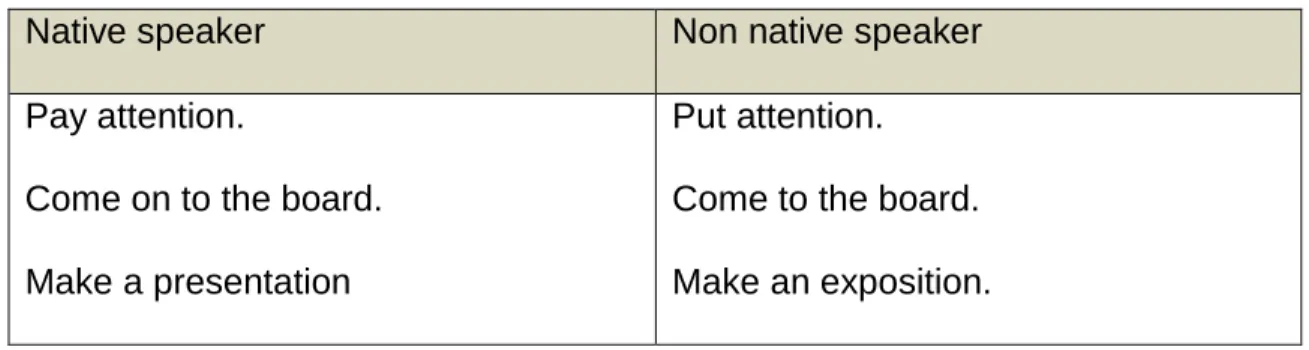
The negative and positive effects depend on how different or similar the two languages are. For example:
Table 2.1.1 Examples of learners’ errors which can be pushed from mother tongue.
Native speaker Non native speaker
Pay attention.
Come on to the board.
Make a presentation
Put attention.
Come to the board.
Make an exposition.
Loft (1983) declares that one of the main explanations about the learners’ errors is that those errors can be pushed from the mother tongue. Consequently, the interference of mother tongue in foreign language brings some disadvantages like the appearance of errors which were discussed in the next section.
2.2 Error Analysis
The error analysis is an essential method to describe what kinds of error that learners produce and to analyze the causes of the errors. All of experts who teach English as second and foreign language are supposed to be able to analyze and to correct their learners’ error. Furthermore, Corder (1971) states that error analysis is branch of applied linguistic, which has two functions, theoretical and practical.
8 Theoretical is used to investigate the language learning process, and practical is used to guide the remedial action.
Based on the short discussion above, it can be concluded that errors are natural part of language learning that cannot be avoided in writing process. Error analysis is a process of observing, analyzing, and classifying learners ‘error to find out the types and the sources of their errors. It has two purposes; they are to show interference of language learning process and the most difficult language learned by students.
Error analysis has become one of the important tools to improve writing skill.
But, just few learners know about error analysis. Learners should not just identify errors, but know how to deal with their own errors. So, it was necessary to have a theoretical foundation about error analysis. Richards and Schmidt (2002 pag.184) define error analysis as “the study and analysis of the errors made by foreign language learners”.
According to Hasyim (2002) error analysis may be carried out in order to:
a) Find out how well someone knows a language, b) Find out how a person learns a language, and
c) Obtain information on common difficulties in language learning, as an aid in teaching or in the preparation of teaching materials.
Another view of error analysis is given by Crystal (as cited by Hasyim, 2002) proposes that error analysis is a technique for identifying, classifying and systematically interpreting the unacceptable forms produced by someone learning a foreign language.
As it was mentioned, this research intends to discuss the topic of mistakes and errors
9 within the context of learners’ beliefs and error analysis so that it is important to define these concepts
2.3 Errors
Many learners present problems during the acquisition of a foreign language;
because they continue producing errors. According to Norrish (1983) defines an error as a systematic deviation when a learner has not learnt something and consistently gets it wrong. Likewise, Broadly (1993), learners make errors when they try to do something with the language which they are not yet able to do. Errors can be classified as interlingual or intralingual (Richards & Schmidt, 2002).
2.3.1 Interlingual errors
Several learners are influenced by their mother tongue; it can be seen as a negative aspect in the acquisition of a foreign language. Under those circumstances, learners tend to use some words from their mother tongue to their foreign language.
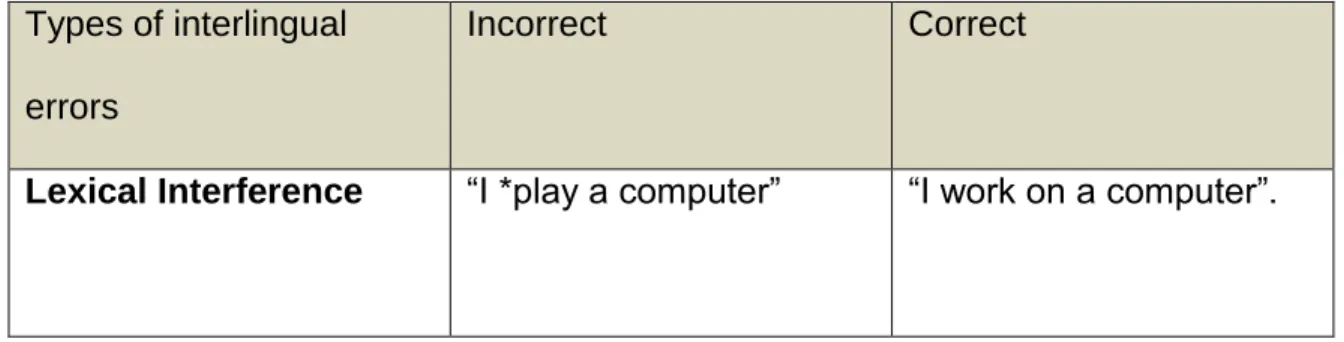
Subsequently, Interlingual errors are negative influence of the mother tongue language to the performance of the target language learner (Lado, 1964). Some interlingual errors occur when the habits of native language interfere in obtaining the patterns and rules to the foreign language (Corder, 1971). For example:
Table 2.3.1 Types and examples of interlingual errors
Types of interlingual errors
Incorrect Correct
Lexical Interference “I *play a computer” “I work on a computer”.
10 Confusion of Sense
Relation
I *play the internet.
There is no *day on this mail.
I will *keep money for a house.
(*surf) (*date)
(*save)
Collocational Error He described *about his house.”
*[Ø]
Syntactic Interference Have many trees in the university.
I like to go out with my friends, but I don’t like to have alcohol
He is a fat boy and friendly.
(There are)
it is not good for health. (because)
(friendly, fat boy )
Discourse Interference Problem with the organization of information into a coherent text.
11 That is to say, interlingual errors are caused when students use the same structure of the mother tongue to the foreign language. This theoretical framework is also focused in other kind of errors; intralingual.
2.3.2 Intralingual errors
Intralingual errors are those originating within the structure of English itself because learners have not exposure yet to use an extend vocabulary, complex language structures and language restrictions. According to Richards (1971) errors are produced by the learners which reflect not the structure of the mother tongue, but generalizations based on partial exposure to the target language. In other words, errors are produced by erroneous deviation applying the knowledge of the target language rules and structures to new situations.
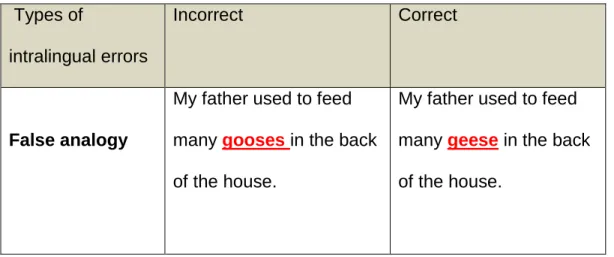
Furthermore, intralingual errors are not related to the first language transfer, but contributed by the target language itself. There are seven categories of intralingual errors; false analogy, misanalysis, incomplete rule application, exploiting redundancy, overlooking co-occurrence restrictions, hypercorrection (monitor over use) and overgeneralization.
Table 2.3.2 Types and examples of intralingual errors
Types of
intralingual errors
Incorrect Correct
False analogy
My father used to feed many gooses in the back of the house.
My father used to feed many geese in the back of the house.
12 Childsin the villagelike to
play with me.
Children in the village like to play with me.
Misanalysis
Harry Potter is my favorite who has beautiful
pictures and exciting scene.
I have two pets. It is a dog and a cat.
Harry Potter is my favorite which has beautiful pictures and exciting scene.
I have two pets. They are a dog and a cat.
Incomplete rule application
At that time I didn’t know what should I say to him.
At that time I didn’t know what I should say to him.
Exploiting redundancy
Word
My mother and I are very happy to get a *free gift from the department store during New Year Festival.
Qualifier
My mother and I are very happy to get a gift from the department store during New Year Festival
13 Pang is a *very perfect
girl because she is beautiful and intelligent.
Synonyms
I repeated it *again.
*All the time I have been here, I *always miss my family.
Pang is a perfect girl because she is beautiful and intelligent.
I repeated it
*All the time I have been here, I miss my family.
Overlooking cooccurrence restrictions
I would enjoy to learn I am willing to *meeting with all my old friends.
(*meet)
I would like to learn I am willing to meet with all my old friends.
Hypercorrection
I am a second years English major student.
I am a second year English major student.
Overgeneralizati on
He speaks very good and I understand him.
I have so much friends in the university.
He speaks very well and I understand him.
I have so many friends in the university.
The previous chart shows that errors are caused from the limited linguistic knowledge. For example, incomplete applications of rules, and false concepts
14 hypothesized. Specific rules in the target language may be rather confusing and may have some exceptions in which the learners need to understand, memorize and practice in order to acquire them.
To sum up, Interlingual errors can be result from learners’ first language features, for example, grammatical, lexical or pragmatic errors. On the other hand, intralingual errors are overgeneralizations in the target language, resulting from ignorance of rule restrictions. This study is also focused in mistakes which are presenting above:
2.4 Mistakes
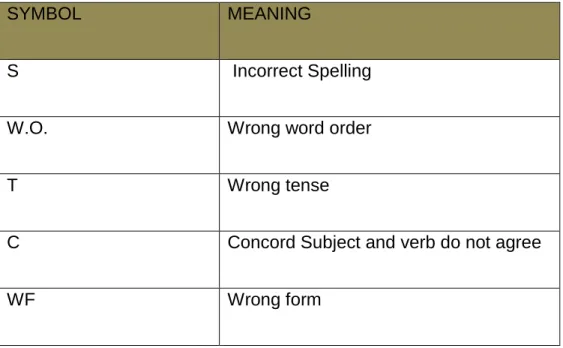
Mistakes are produced in awarded form by the learners during the learning of a foreign language. A mistake is a performance error that is a failure to utilize a word correctly (Ancker, 2000). In other words, mistakes are slips produce for most of learners during the acquisition of a foreign language and these represent the incorrect use of a word in writing process. The different kind of mistakes is the following:
Table 2.4 Classification of mistakes
SYMBOL MEANING
S Incorrect Spelling
W.O. Wrong word order
T Wrong tense
C Concord Subject and verb do not agree
WF Wrong form
15
S/P Singular or plural from wrong
L Something has been left out
[ ] Something is not necessary
?M Meaning is not clear
NA The usage is not appropriate
P Punctuation wrong
Mistakes are divided into 3 broad categories: Slips: students can correct themselves.
Errors: students cannot correct themselves. Attempts: ambitious language use, by using structures they have not learnt yet (Edge, 1993).
2.5 Errors and Mistakes
Frequently, students present many corrections in their writings; those corrections are mistakes and errors. Error analysts distinguish between errors, which are systematic, and mistakes, which are not. David and Pears (2000) declare that a
“mistake is an incorrect form or use of language that learners can correct because they know the correct form, on the contrary, error is an incorrect form of use the language that learners cannot correct because they do not know the correct form” (p. 208). They often seek to develop a classification of errors. Error can be classified by how clear they are. Overt errors (obvious) such as “I angry” are evident even out of context, while covert errors (hidden) are evident only in context.
16 Errors may also be classified according to the level of language: phonological errors, vocabulary or lexical errors, syntactic errors, and so on. They may be discussed according to the degree to which they interfere with communication. Global errors cause an utterance to be difficult to understand, while local errors do not. In the above example, “I angry” would be a local error, since the meaning is clear. For that reason, errors and mistakes should not be ignored in writing. Firstly, they are direct proof of what students know and what they don’t know. Secondly, mistakes and errors are associated of any problems that students may have.
2.5.1 Why do learners make mistakes and errors?
Lopez (2007) Mistakes and errors may be caused because of:
a) Ignorance, of not knowing the rules, the structure of the language, and so on.
b) The inability of students to apply what they have learned.
The mentalist attitude considers mistakes and errors as proof that the student is learning. The learners learn even more from mistakes and errors when they are carefully corrected. Errors in written language must be corrected more carefully because if they are left uncorrected they become fossilized. Mistakes and errors must not be left uncorrected. Students must be informed of their mistakes and errors, and they must constantly be updated on their learning development. Positive analysis of mistakes and errors encourages the learner to progress and does not worry them.
2.5.2 Analysis of errors and mistakes
Lopez (2007) Work is more valuable when mistakes and errors are analyzed. It is useful to find general mistakes and errors, so that after careful analysis the mistakes and errors are not repeated. An analysis of mistakes and errors enables teachers to
17 identify a student’s deficiencies and needs. An analysis through contrast may serve as a tool by saving time and effort for both the teachers and students.
An analysis of the mistakes and errors:
– Reveals any general deficiencies and weaknesses that the students have;
– Highlights words, utterances and structures that prove to be difficult at a particular stage of development;
– Highlights gaps in student knowledge.
An analysis of mistakes and errors may also show fields where study-research activity should be concentrated in the future.
– An appreciation of the psychological conditions of their students
The tight time of the curriculum and the subject syllabus is a contributing factor here, so that the learners may be able to recognize their mistakes and errors and then consider any corrections from their classmates and teacher. On the other hand, as it was mentioned, this study is focused in writing; so it is relevant to explain the importance of writing.
2.6 The importance of writing
English writing is becoming increasingly dominant in educational programs (Leki, 2001). Writing in a foreign language often presents the greatest challenge to the learners at all stages, particularly academic writings because they are usually extended and complex therefore they become more demanding. To become a proficient writer is a wish of many learners in order to succeed in their subjects. In addition, writing in
18 English as a foreign language has always been considered an important skill in learning. According to Rao (2007), English foreign language writing is useful because it motivates learners’ thinking, organizing ideas, developing their ability to summarize, analyze and criticize. However, writing is always a big problem for English foreign language learners in terms language uses, grammatical structures, and cultural communication.
2.6.1 The Nature of Writing
Writing is an essential part in foreign language learning because a learner needs to explain his idea in written language, especially in academic environment. Raimes (1983) says that writing becomes a very necessary device to involve with the new language especially when expressing the ideas. Other opinion, Ghaith (2002) asserts that writing is to explore thoughts and ideas, and make them visible and concrete. When thought is written down, ideas can be examined, reconsidered, added to, rearranged, and changed.
From the definitions above, it can be concluded that writing is an essential part of second language learning. It becomes the most difficult skill for foreign language learners because it needs effort to express ideas. It also serves as a reinforcement of learning grammatical and vocabulary knowledge and provides correctness of oral language.
2.6.2 The Aspects of Writing
Writing as a complex process consists of multiple components or aspects that a writer has to concern. It is important for a writer before he writes. Uusen (2006) divides writing components into content, form, and punctuation.
19 Raimes (1983) states that in producing a piece of writing which has clear, fluent, and effective communication ideas, writers have to deal with:
a. Content: relevance, clarity, originality, logic, etc.
b. Syntax: sentence structure and boundaries, stylistic choice, etc.
c. Grammar: rules for verbs, agreement, articles, pronouns, etc.
d. Mechanics: handwriting, spelling, punctuation, etc.
e. Organizations: paragraphs, topic and support, cohesion, and unity f. Word choice: vocabulary, idiom, tone
g. Purpose of writing
h. Audience or target readers
i. A writer processes: getting ideas, getting started, writing drafts, revising.
From the definitions above, it can be concluded that writing has multiple components. The components are content, form, and punctuation. Besides the three components, to deliver the message clearly a writer needs to consider syntax, grammar, organization, word choice (vocabulary), purpose of writing, audience or target readers of different kind of discourse. Richards & Renandya (2002) state writing is not only in generating and organizing ideas, but also in translating them into readable text. At the present study, researchers also explored learners’ beliefs so that it is important to explore about the importance of beliefs.
20 Many people and even cultures have strong beliefs about language learning. For example, When someone says that children learn languages easily and naturally or that women are better language learners than men, they are expressing common but not necessarily correct beliefs about language learning. It is ingenuous to think that cultural beliefs about the nature of language learning do not influence the learners.
Many researchers have recognized that learners preconceived notions about the nature of language learning and that many of these preconceptions can be counterproductive to language learning. According to the socio-cognitive theory of Bandura (1989; 1997; 2001), in which the concept of domain-specific writing beliefs can originate, beliefs (or self-beliefs) are considered to play a crucial role in successes and failures.
2.7 Significance of Learner Beliefs
Learners' beliefs about language learning may have an impact on performance of learners’ writings (Richardson, 1996 pag.103) beliefs are defined as “psychologically held understandings, premises or propositions about the world that are felt to be true”.
(Victori & Lockhart, 1995, pag. 224) state beliefs are “general assumptions that students hold about themselves as learners, about factors influencing learning and about the nature of language learning”. For example, if learners believes that they are not good writers, they are going to create a negative attitude themselves towards writing, so they may not make much effort to improve their writing skill. According to Graham et al., 2007 and Knudson, 1995, writing attitudes affect writing achievement and writing competence. A student who has a positive writing attitude is more likely to plan writing actions, be more effortful, persevere despite challenges, set goals that will challenge him or herself, and believe in his or her own success (Bandura, 1995;
21 Graham, 2006). However, learners with negative attitudes, though, may choose to avoid writing tasks and put forth little effort when writing (Graham et al., 2007). For that reason, researchers paid close attention to learners' beliefs in order to in order to draw some conclusions about the nature of learners’ beliefs towards writing error and mistakes.
It is clear that learners’ beliefs play an important role in learners’ experience and their success or failure as language learners. Several researchers note that learners who consider beliefs important for English language learning show higher degrees of perseverance in their learning tasks (see, e.g., Pintrich & De Groot, 1990; Cotterall, 1999).
Some researchers viewed beliefs about language learning as a part of metacognitive knowledge; however, Wenden (1998) claimed that in second and foreign language literature, these two terms are used interchangeably to refer to the same construct.
22 CHAPTER III: METHODOLOGY
This chapter provides specific information about the methodology used in this research, which was a mix method. The first section of this chapter described the participants (number of participants and language level). The second section described the instruments. Finally, the third section explained the procedures.
3.1 Methodology
In order to analyzing the beliefs and the types of errors and mistakes made by learners of target language V, this study adopted a mixed method. Mixed method is a research in which the researchers collect and analyze data, integrate the findings, and draw inferences using both qualitative and quantitative approaches (Tashakkori &
Creswell, 2007, p.4). In other words, a mixed method is a methodology for conducting research that involves collecting, analyzing and integrating quantitative and qualitative research; quantitative research includes close-ended information such as that found to measure attitudes, behaviors and performance instruments. The analysis of this type of data consists of statistically analyzing scores collected on instruments to answer research questions. And qualitative research consists of open-ended information that the researcher usually gathers through interviews, focus groups and observations. In this research was based in an appropriated and trustworthy research like mixed method (quantitative and qualitative research) focused on identify and analyze learners’ beliefs about error and mistakes in writing.
23 3.2 Subjects
The study was carried out in Faculty of Languages at BUAP which is located in Puebla City. This is a public university where learners are majoring teaching English.
The participants who took part in this research were 20 students (17 woman and 3 men) ages ranging from 21 to 23 years old. All participants were studying target language V, English is taught as a foreign language. Their mother tongue is Spanish and they were taking English classes five days a week for approximately 50 minutes per session.
3.3 Instruments
The instruments were based in a mixed method; it was divided in a quantitative and qualitative process. The quantitative and qualitative processes were applied in a questionnaire with (open ended and close ended questions) and a short free writing to develop this study.
3.3.1 Questionnaire
The questionnaire was based in eight questions; it contained open ended and close ended questions based in learners’ beliefs about writing errors and mistakes.
3.3.2 Descriptions
Descriptions were used as another instrument to evaluate errors and mistakes.
The short descriptions (150 words minimum) were based on what learners have done during their last vacation. Furthermore, the description was a useful tool to analyze how learners write.
24 3.4 Piloting
At the beginning, the first questionnaire was elaborated with ten questions; the elaboration of the questionnaire was complicated because the instructions were not clear. Therefore, some questions provoked confused in learners and complicated the researchers’ analysis. Then, the hard questions were improved and the second questionnaire resulted more coherence and the researchers obtained more effective results about learners’ beliefs.
3.5 Procedures
In order to carry out this research, researchers applied the instruments. First, researchers asked teacher the permission to apply the questionnaires to the learners and learners were asked to write a description about their last vacation. After that, questions were transcribed and carefully analyzed. After, the written productions were analyzed sentence by sentence in order to identify the main errors (interlingual and intralingual) and mistakes.
3.6 Data Analysis
The data was collected, they were analyzed. Firstly, learners’ answers from closed ended questions were processed in Microsoft Excel in order to analyze numbers and percentages. Secondly, opened ended questions were transcribed and examined.
After that, researchers classified the data obtained into four different categorizations named: “learners believed that error was a deviation from grammar of mother tongue to the foreign language, reflecting the lack of knowledge.”, “learners believed that a mistake was a failure to use English language correctly” “errors and mistakes are the same concept” and “no answers”. Finally, researchers understood learners were not conscious about the differences between error and mistake and researchers realized
25 most of the participants answered without many details, especially to the open-ended questions.
26 CHAPTER IV: RESULTS
In this chapter, the questionnaire is presented and discussed, and the answers to the research questions, based on the learners’ beliefs are provided. For that reason, it is important to remain the research questions:
1) According with the students of target language V perception, what is their English level proficiency?
2) What type of writings take place in target language V?
3) What are the learners´ beliefs about errors and mistakes?
4) Which are the most frequent errors and mistakes presented by students of target language V in their writing skill?
4.1 The importance of writing
Once of the instruments were collected, they were scored and the data processed quantitative and qualitative analysis. The results of this analysis are shown in the following tables and figures which contain the main findings.
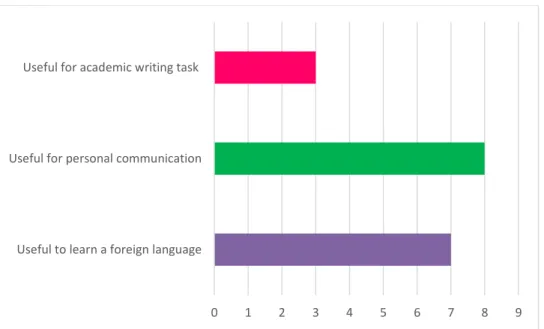
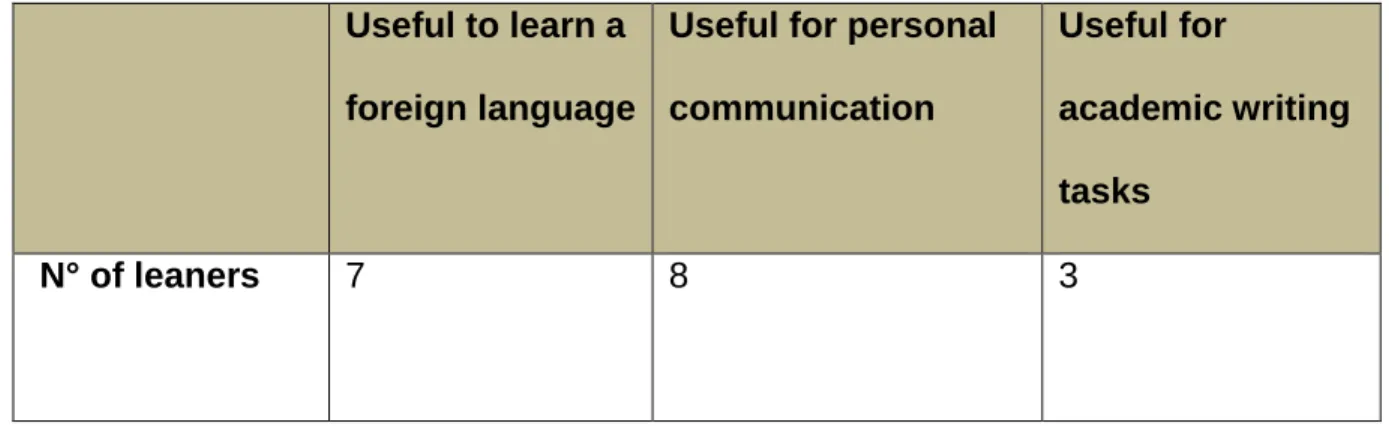
The first question in the instrument represents the importance that learners gave to the development of the writing skill. Findings show that almost half of the learners believed that writing is important for communication while seven of them thought that writing is useful to reinforce the learning of a foreign language. Although three of the learners were sure that writing is useful for their daily lives.
27 Fig. 4.1 Beliefs towards writing.
Fig. 4.1 confirms that for most of learners considered important the development of writing skill because it is a fundamental main of communication for the human communication to express emotions and ideas through a written way. Moreover, learners considered writing is a support skill, used to reinforce the acquisition of grammar to support the memorization of language structures within the learning of a foreign language. These positive aspects should be used to advantage by encouraging more writing interested with the implementation appropriate writing assessment in the classroom during all foreign language instruction.
4.2 Amount of instruction in writing
The next figure explored about the amount of writing instruction learners have received to improve their writing during the learning of their foreign language (Fig 4.2).
Findings show that one of the reasons for the problems of lack of EFL writing skills are the insufficient amount of writing instruction.
0 1 2 3 4 5 6 7 8 9
Useful to learn a foreign language Useful for personal communication Useful for academic writing task
28 Fig. 4.2 Amount of English writing instruction.
These outcomes may indicate that the most obvious reason that learners do not write well is that they receive a limited amount of instruction in writing. Also, these results shows that the absence of pre-writing activities may be another reason. The pre-writing activities can enable learners to collect enough ideas and information necessary for writing or the lack of due time and attention devoted to developing writing skills and its different sub-skills (Helal,2003).
Learners do not write very much when they do really write, they write just short assessments to be graded without really caring about the development of the ability to write well. Learners may also lack the grammatical, syntactic and morphological knowledge enough to face more challenging writing tasks. In addition, they may need spend more time on developing this skill due to the limited amount of instruction they have. In sum, learners’ writing instruction within language faculty shows a deficiency. It is important, then, for learners to reinforce their writing abilities through the autonomy practice of their writings until they will be able to produce good writing papers.
35%
65%
enough English writing instruction inssuficient English writing instruction
29 4.3 Learners’ beliefs about their language proficiency
In order to know learners’ writing competence, it is crucial to determine learners’
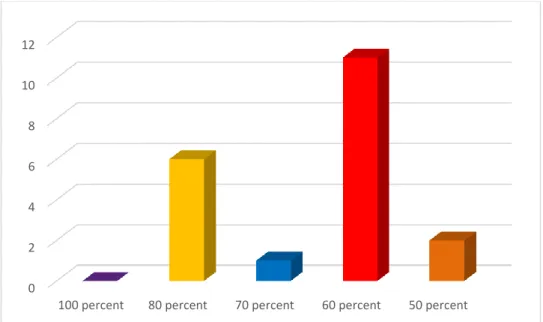
perceptions about their own language proficiency. Learners were asked to choose approximately a percentage of their own English language proficiency divided into five categories: 50%, 60%, 70%, 80%, 100%. The results are illustrated below (Fig. 4.3).
Fig. 4.3 Learners’ beliefs about their language proficiency
As can be seen, a half of the subjects believed to have intermediate level of English. These results may indicate that learners may be able to write a good writing to satisfy the demands of their school. Also, It may indicate that half of learners had possitive attitude towards their English level proficiency. According to Graham et al., 2007 and Knudson, 1995, writing attitudes affect writing achievement and writing competence. A student who has a positive writing attitude is more likely to plan writing actions, be more effortful, persevere despite challenges, set goals that will challenge him or herself, and believe in his or her own success (Bandura, 1995; Graham, 2006).
0 2 4 6 8 10 12
100 percent 80 percent 70 percent 60 percent 50 percent
30 4.4 Specific types of writing assignments
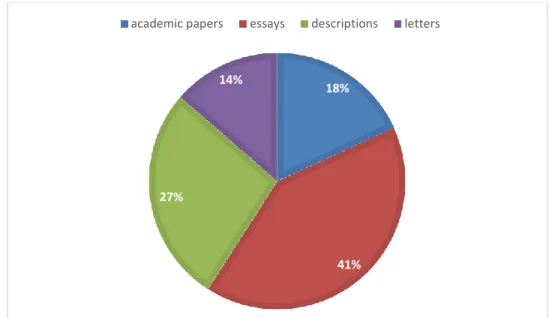
During learners’ long experience in learning English language, learners face difficulties in writing English so that learners practice their writing with specific types of writing assignments. Academic papers, essays, descriptions and letters are the types of writing learners may encounter while they study in language faculty. The following figure shows the most common writing assignments learners used in Target Language V (Fig. 4.4)
Fig. 4.4 The most common types of writing that learners performance in Target language V.
Findings show that most of the learners tended to use essays as a form of assignment within classroom. The outcomes show that English language learners may performance advanced writing assignments.
4.5 Analyzing learners’ beliefs about what an error is.
As it was stated in the general objective of thesis research, one of the most important features was asked about learners’ beliefs towards error concept. As mentioned in the review of literature, beliefs regarding the benefit of analyzing learning
18%
41%
27%
14%
academic papers essays descriptions letters
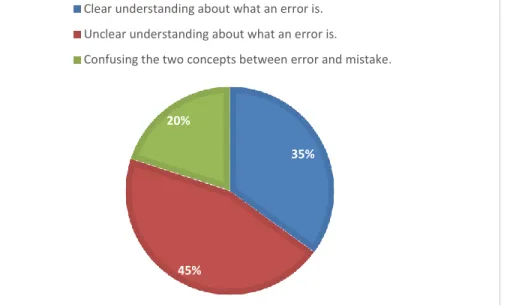
31 errors during the learning of a foreign language. The answers of the following question were analyzed dividing them into three categories “Clear understanding”, “Unclear understanding” and “Confusing the two concepts between error and mistake” (Fig. 4.5)
Fig. 4.5 Learners’ beliefs about what an error is.
According to the responses identified. 36% of participants are aware about what an error is. However, 45% of learners are not aware that errors are part of lack of understanding and proper knowledge of the foreign language. These results show that
learners may not understand the common errors and difficulties in learning. This limitation may be due to lack of enough syntactic and morphological competences during learners’ foreign language instruction, carelessness and laziness for dealing with writing errors and working with difficulties in writing.
4.6 Analyzing learners’ beliefs about what a mistake is.
The following opened-ended question represents learners’ beliefs about what a mistake is (Fig. 4.6). The results obtained were also categorized and analyzed into three groups “Clear understanding”, “Unclear understanding” and “Confusing the two concepts”
35%
45%
20%
Clear understanding about what an error is.
Unclear understanding about what an error is.
Confusing the two concepts between error and mistake.
32 Fig. 4.6 Learners’ beliefs about what a mistake is.
Findings showed that most of learners know what a mistake is. The results show that learners may distinguish that mistakes occur when the person fails to use the language correctly and they can be corrected by learners easily. Also these results show that learners may learn better when they understand the aspects of the language such as the origin of writing errors.
For most of learners, the learning of a foreign language is difficult. Despite of, teachers believe that learners are prepared with the enough knowledge about the corresponding terms of morphology, syntax, pragmatics, phonetics and phonology in learners’ answers about errors and mistakes showed insufficient knowledge to distinguish the two terms in study. The results showed most of the learners distinguish that mistakes occur when a person fails to correct usage of language and they can be corrected by learners easily, but what is an error for learners? This term is not clear for them; most of them confuse errors with mistakes. As a conclusion, most of the learners can distinguish just one term the writing mistake.
0 2 4 6 8 10 12
Clear understanding about what a mistake
is.
Unclear understanding about what a mistake
is.
Confusing the two concepts between error and mistake.
12
8
0
33 During the learning of English as a foreign language, learners have to take five levels of Target Language. Despite of, learners have practiced for most of the career writing in each subject; they continue committing mistakes which are simple slips and despite of, error are a little be complicate, learners avoid them in writings. Focus on this, researchers propose, teachers might apply different strategies to develop writing skill in a better way. Also, it is necessary teachers explain the difference between errors and mistakes and teachers must correct writings’ learners to avoid commit them in a frequency form.
4.7 Learning from own errors.
The next question was referred about what learners believed about their own errors. Learners thought that errors are part of learning process. For example, in a learner’s utterance “I learn more when I can see my errors in my writings”. As it was seen, errors sometimes help learners learn more. According with other learner’s utterance, “I often find it difficult to write well in my academic paper, but I think if someone corrects me I can improve my writing”. In this way, errors make learners successful. When learners commit errors, they must work at it, forcing them to learn it better during their writing process. The findings show that most of them were agreed that it is good to learn from errors. On the other hand, a few students had a negative perspective about their own errors. “Unfortunately, the mother tongue interference is always presented, so it is common use it to other foreign languages” see table. 4.7
Table. 4.7 Learners’ beliefs about their mistakes.
Learners’ positive beliefs Learners’ negative beliefs N° of learners 15
N° of learners 4
34 4.8 Analyzing Free writing
The follow analysis is focused on learners’ writing. These free writings were used as instruments to identify the most common mistakes and errors that students present in their writings. The analyses of writings were derived from Corder's (1967) method on error analysis. This method has three steps: 1) collection of sample errors, 2) identification of errors and 3) description of errors. The second instrument of the study explored the most common errors leaners produce (Fig. 4.8)
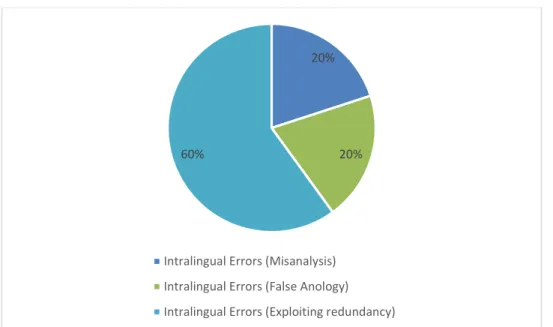
Fig. 4.8 Analyzing the most common errors
Findings show that 60% of learners produced exploiting redundancy errors in their writing paper while 20 % of learners produced misanalysis and false analogy errors. These outcomes may indicate that learners still lack of proper language knowledge of their foreign language. Learners should be learned of their own errors, and learners must constantly be encouraged to reduce them through the error analysis.
20%
20%
60%
Intralingual Errors (Misanalysis) Intralingual Errors (False Anology) Intralingual Errors (Exploiting redundancy)
35 Fig. 4.8 Analyzing the most common mistakes
In addition, the second instrument of the study explored the most common mistakes learners make (Fig. 4.8) Findings show that most mistakes made by learners were something that has been left out. While 45 of mistakes were some words were not needed. Although, 30 of mistakes made were incorrect spelling and the 25 mistakes were related with the wrong tense when conjugating a verb. These outcomes may indicate that some learners are still reluctant to be careful to produce good papers during their writing assessments. Also the findings show that laziness may be a contributing factor here.
0 10 20 30 40 50 60
S W.O. T C WF S/P L [ ] ?M NA P
S W.O.
T C WF S/P L [ ]
?M NA
36 CHAPTER V: CONCLUSIONS
The main purpose of this chapter was to presented the interpretation of the results obtained in the previous chapter. This chapter was divided in four sections. The first section referred to the context. The second section emphasized to the results and the conclusion obtained. The third section focused on the implications and the suggestions. Finally, the last section presented the limitation.
5.1 Context
This research is based in the beliefs that the students perceived towards writing errors and mistakes. More specifically, the responses of question-answers of the opened-ended questions were analyzed in a qualitative way, in order to draw some conclusions about the nature of learners’ beliefs towards the two concepts in study.
Other purpose of this research was to identify the main academic mistakes and errors in a writing paper. For this purpose, free writings were used and carefully analyzed.
The focus of the analysis was on errors and mistakes produced by target language V learners of the faculty of language at BUAP. The number of errors and mistakes produced by learners was determined, and they were further analyzed.
5.2 Answers to the Research Questions
The results and its main highlights will be presented below as they relate to the research questions posed in chapter 1.
1. What are learners’ beliefs towards the development of writing skill?
The development of this ability during foreign’ language learning involves the ability to organize ideas in piece of writing. As a result, the most of students consider important
37 the development of writing skill for the following reasons “Writing is an important tool to learn a language”, “Writing is important for my major and academic papers” and “Writing is important for communication in any situation to express emotions and ideas” which responses were classified into three main categories. The analysis can be observed in table 5.2.
Table 5.2 Learners’ beliefs about the development of writing.
Useful to learn a foreign language
Useful for personal communication
Useful for
academic writing tasks
N° of leaners 7 8 3
Writing was the main dimension in the research. Learning to write in English as a second language allows learners to put their thoughts on paper, see their ideas in print, and share them with others. Writing also enhances language acquisition as learners’ experiment with words, sentences, and large chunks of writing to communicate their ideas effectively and to reinforce grammar and vocabulary they are learning in class (Bello, 1997).
2. According with the students of target language V perception, what is their English level proficiency?
As it can be seen in chapter IV, the result indicated half of the learners believed to have an intermediate level of English. It may indicate that learners had possitive attitude towards their English level proficiency. To solve most of the problems and the
38 difficulties EFL learners encounter in writing and that reflect their negative attitudes towards writing.
Writing process is seen as both a cognitive process (Flowers & Hayes 1981;
Bereiter & Scardamalia 1987) and a socio-cultural activity (Freedman &Medway 1994).
The cognitive model of writing is seen as a mental process involving directed decision making and problem solving (Chandrasegaran, 2004). Siti Hamin (2004) states that the skills in writing are not acquired but culturally transmitted. The students' writing skills do not come naturally but are cultivated through much practice and conscious effort.
Moreover, learners continue presenting difficulties to develop a good writing because they still lacked of vocabulary, grammar structures, syntactic competence and morphological competence.
3. What type of writing takes place in target language V?
Findings showed that essays were the most frequent texts practicing by learners of T5. The outcomes show that learners might be practiced with challenging writing according with their English level. The more writing practice, the more writing abilities are developed during the acquisition of a foreign language.
In addition, written communication needs accuracy because when the communication is happening there are only the readers involved in it. So, writing skill involves the accuracy of dictions, grammar, spelling and also the special terms which are used to express the opinions. In short, it is possible to state that learning to write supports students in learning the rules of usage; they learn to spell and to use appropriate grammar.
39 4. What are the students´ beliefs about the errors and mistakes that are
affecting the development of their writing skill?
According to Norrish (1987) defines an error as a systematic deviation when a learner has not learnt something and consistently gets it wrong. Likewise, Broadly (1993), learners make errors when they try to do something with the language which they are not yet able to do.
Findings showed that just few learners know the differences for the following reasons “An error is when you do not have the knowledge of the usage of grammar and vocabulary.”, “An error is an incorrigible failure at the moment of the writing” and
“An error is something what learners have not learned yet” which responses were classified into three categories. The analysis can be observed in table 5.2.1
Table 5.2.1 Learners’ beliefs about what an error is.
Learners’
beliefs about an error is:
Clear
understanding about what an error is.
Unclear
understanding about what an error is.
Confusing the two concepts between error and mistake.
N° of learners
7 9 4
Errors are natural part of language learning that cannot be avoided in writing process. Errors show interference of language learning process and the most difficult language learned by learners. Learners should not just identify errors, but know
40 what errors are. So, it was necessary a detail analysis about learners’ beliefs towards what an error is.
Table 5.2.2 Learners’ beliefs about what a mistake is.
Learners’
beliefs about a mistake is:
Clear
understanding about what a mistake is
Unclear
understanding about what an error is
Confusing the two
concepts between error and mistake
N° of learners
12 8 0
Learners have to distinguish errors from mistakes due to an "error" is seen as resulting from a learner's lack of proper language knowledge while a "mistake" occurs when the person fails to use the language correctly. If they know more about errors and mistakes, they will be able to correct their own errors and mistakes in their writings.
Secondly, they will be able to help others to improve academic papers. Finally, learners may become great writers of important publications.
5. Which are the most frequent errors and mistakes presented by students of target language V in their writing skill?
Errors can be classified as interlingual or intralingual (Richards & Schmidt, 2002).
Findings showed that misanalysis, false analogy and exploiting redundancy were the main intralingual errors while interlingual errors were not found. These results indicated that learners may fail to express what they intend to say in English writing, especially they sometimes unaware make generalization of the rules of the target language.
41 5.2.6 Summary of data and interpretation
In this next section, a summary of the results and their main highlights of the questionnaire and the free writing are presented see Table 5.2.6.
Table 5.2.6 Data and interpretation
Analyzing beliefs towards the development of writing.
Amount of instruction in writing
Learners’
beliefs about their
language proficiency
80% 70% 60% 50%
Number of learners
6 1 11 2
0 2 4 6 8
Useful to learn a foreign language
Useful for personal communication Useful for academic
writing task
Number of learners
Enough English writing instruction Inssuficient 35%
English writing instruction
65%
Enough English writing instruction
Inssuficient English writing instruction