The "Library of Jewish History and Culture" is part of the research project "European Traditions - Encyclopedia of Jewish Cultures" at the Saxon Academy of Sciences and Humanities in Leipzig. It is sponsored by the Academic Program of the Federal Republic of Germany and the Free State of Saxony. The academy program is coordinated by the Association of German Academies of Sciences and Humanities.
With the present selection of his writings, accompanied by introductory texts, they are responding to the invitation of the project "European Traditions - Encyclopedia of Jewish Cultures", forwarded to the Saxon Academy of Sciences and Humanities in Leipzig.
Editors’ Introduction
On the Scope and Motives of this Volume
A distinguishing feature of this book is that it offers some of Rawidowicz's most important texts in Hebrew, in addition to English translations. Essays on the “Ever-Dying People,” edited by Rawidowicz's son and co-editor of this book, Benjamin Ravid.2 Ravid also collected and introduced a longer collection of his father's scientific writings in Hebrew, Iyyunim be- maḥashevet Yisra'el (Studies in Jewish Thought).3. This book appears at a time when Rawidowicz's often forgotten perspective can gain new relevance.
Seen from this perspective, Rawidowicz's vision of "Babylon and Jerusalem" is both Germanic and less far-fetched than one might otherwise think.
The Peripatetic Journeys of a “Solitary Man”
15 From Bialik's remarks in the opening issue of the Hebrew magazine Dvir (Sanctuary) in Berlin (1926). But like those contemporaries, Rawidowicz was deeply involved in the intense ideological battles of the time. A key factor in this shift was the establishment of the State of Israel in 1948.
The first part of the book presented a comprehensive vision of Jewish intellectual and political history.
On the Texts in this Edition
One text in Hebrew is reproduced for the first time.69 The English translation has been omitted due to its publication in an annotated form in 2008.70. The texts are presented exactly as they were written, specific features as well as interventions of the editors are highlighted. Typographical and grammatical errors have not been corrected, but marked with “[sic]” in English and “[!]” in Hebrew texts.
In addition, the spacing between letters in the Hebrew texts in the translation is printed in italics for better readability.
Acknowledgments
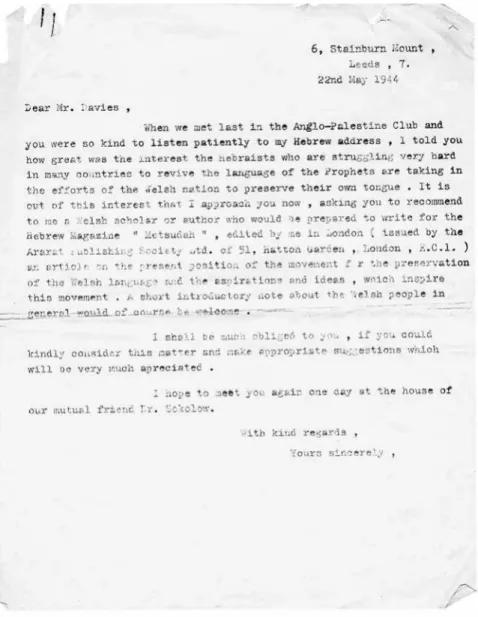
He was also a member of the editorial board of Stybel publishing house (founded in 1902) during the Berlin period. In his search for a possible expert who could write about the efforts of the Welsh to preserve their language, he turned to Welsh trade unionist and Labor politician Rhys John Davies. Louis Ginzberg was an eminent rabbi scholar and a leading figure of the conservative movement in the United States.
All other images appear courtesy of the Simon and Esther Rawidowicz Archive of Professor Benjamin Ravid in Newton, Massachusetts.
Selected Writings
Transcription Conventions
Studies in Jewish Philosophy
- Introduction
- Yehuda Halevi (On the Eight Hundredth Anniversary of his Death)
- Yehuda Halevi. His Philosophy of Nation and Land
- Introduction to Maimonides’ Sefer ha-madda
Rawidowicz appreciated Halevi's mastery of the dominant philosophical idiom of his Spanish milieu, but also his. The Greek philosophers have to reason about the problem concerning God and the creation of the world. The path of one, like that of the other, leads to the "heart" of history and tradition.
The Jewish Renaissance movement, the revival of Hebrew literature and Zionism gave impetus to the rebirth of the great.
Mishneh Torah
The age of Maimonides was like the age of our holy Rabbi [Judah ha-Nasi]; the purpose of the “Mishneh Torah”. All questions that the [current] generation faces – they will necessarily find their answer in the 'Mishneh Torah', which is not limited to the boundaries of the Talmud and its literature. For example, Aḥai regulated all laws according to the commandments of the Torah; R.
Simon Kajara and al-Fasi used the arrangement of the Mishnah as a model, omitting the laws that apply only to the days of the year. The laws of unleavened bread and maẓah entered the "Sefer ha-zmanim" (for the law precedes the deed), and the laws of the Passover sacrifice entered the "Sefer ha-korbanot" [Book of Offerings]. Anyone who wishes to analyze this dispute must make a distinction between the claims and criticisms made against the Mishneh Torah in the wake of Maimonides' "sins" in Moreh nevukhim and those that specifically address order and system, approach. and the purpose of the work itself.
47 Maimonides was convinced that the language of the Mishnah was the most accessible to members of his generation. 52 On the nature of language in the Torah Mishnah, see in detail Bacher, Aus dem Wörterbuchre Tanchum Jeruschalmi's, 117 ff. In the "Mishne Torah" dictionary, we will try to summarize the different opinions on this matter with new comments.
Many halakhic decision makers (the Ba'al ha-Turim [Master of the Columns, i.e. Jacob ben Asher], [the author of] Shulḥan Arukh [The Prepared Table], [Joseph Karo] and others) used the “Mishneh Torah” as model and example. Both editions contain only the main text of the work, but several commentaries were added to the third edition (1509).
Sefer ha-madda
- Introduction to the Second Edition
The conquest of the self gives the conquest of the All, and if man returns to his own soul, he returns to the soul of the world |24| and adheres to that Source which springs To be out of His goodness, without whom the world would not have existed, even for an hour. Aristotle, however, failed to understand the teachings of Plato's master, his own teacher, for whom knowledge is also a prerequisite and an axiom that does not need to be considered. Passing the Platonic-Aristotelian conception of "knowledge" through the furnace of love of the Jewish faith, much of the abstract and vague was removed from "knowledge," and as its layers and elements dissolved, it began to absorb tender love, affective grace, and religious passion; then an abundance of heavenly and hidden life-force began to break forth from within it; and then love was also endowed with the profundity of the intellect, the majesty of the mind, and the "firmness" of logic, which greatly resembles the cold that never freezes.
It remained hidden from this scholar that the source and development of these ideas are not of the same cloth, and these observations require an extensive discussion for which this is not the place. For our nation is a nation full of knowledge, as the Creator, may he be exalted, made clear through the agency of the Master (Moses), who made us perfect. "Mishneh Torah" seeks to bring redemption to Jewish law and thought, and "Sefer ha-madda" seeks to redeem knowledge - which is an asset to the people of Israel - from the hands of the nations of the world, to present succinctly to the Jew the sum of knowledge and thoughts about the Gentiles and about Israel, to ground them in the Torah and to free the people of Israel from the "ignorant".
And because Maimonides assigned this task to the "Sefer ha-madda," he placed it at the head of the work and made it the crown of his entire edifice. Sefer ha-madda” is not just an entrance way or corridor leading to the salon; it is the beginning and the end, the sum of the "Mishneh Torah". |27|. In our various footnotes - on matters of content, language and source citations - we have tried to present to the reader the central problems that Maimonides deals with in this work and for the sake of completeness we have added the formulations of the "Mishneh Torah". on matters of metaphysics, prophecy, ethics, and the like), various other statements which Maimonides made on the same subject elsewhere, thus clearly describing and making clear to the reader the evolution of each idea.
And so if the reader is stimulated to learn more about that subject and read the source texts of the quoted passages, that will be our reward. When we publish the other "books" of the "Mishneh Torah" we will fill in those gaps.
I said to myself: I can no longer delay the publication of his second edition because of the book on RaNa"K and the book on Jewish thought not yet published - so that one delay does not cause another. To the credit of RaNa" more stood in good place - and also "in the shade" so to speak. Not a single book in our modern literature has appeared in this format of 'Kitvei RaNa"K' and indeed this is our only book.
Shortly after the publication of Kitvei RaNa"K (in the spring of 1925), I visited Achad Ha-Am in Tel Aviv. After his death, I learned from the article by Alter Druyanov about the extent of the "interest" of Achad Ha-Am in my introduction to Kitvei RaNa"K: If you want to deal with RaNa"K, go to Warsaw, it's the right place to do it.">. As for Gutmann's actual research, it does not add much to the essence of scholarship on RaNa"K. In my book I will deal with him in the context of the examination of some articles on RaNa"K, and here I will limit myself to these details. If it will return one day and be imbued with the spirit of RaNa"K, it will bring much good. Fortunately, he is that his name is associated with the spread of Kitvei RaNa"K among the people of Israel. But the issue we face today is not one of language, but of the spiritual survival of the people of Israel in the Diaspora. In any case, we must give up the monopoly of the settlement of the Land of Israel. As much as the creative power of the diaspora will decline, so will creativity on Earth. 17| We have learned that the renewed Hebrew culture cannot be created in the Land of Israel alone, nor can Diaspora Judaism exist by itself, except through creativity. Is it indeed determined that we will suffer isolation in the life of the Diaspora. The salvation of the Hebrew book in the Land of Israel will only come from the renewal of the literary creativity of the Jews in the Diaspora. 33| The time has come to put an end to the shame of the Hebrew writer in the Diaspora. And even the gates of the Land of Israel are only open to a few of them. The Land of Israel took in about 1 percent of the refugees who fled Hitler's regime in the years 1933–1934. There is no room for two leaderships in the "solution" of the issue of our diaspora in Germany. The building of the land of Israel should take the greatest possible advantage of the revolution of 1933. And multiply in the diaspora – as Jewish, as bearers of the existence of the people of Israel and its destiny.6. 100th Anniversary of Nachman Krochmal