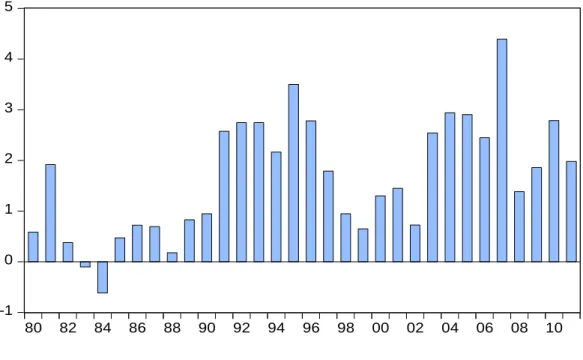
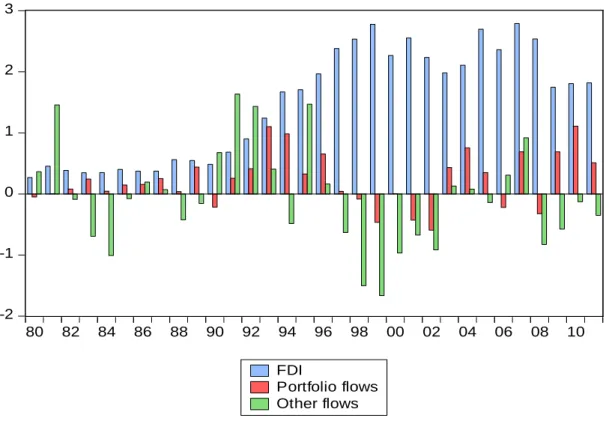
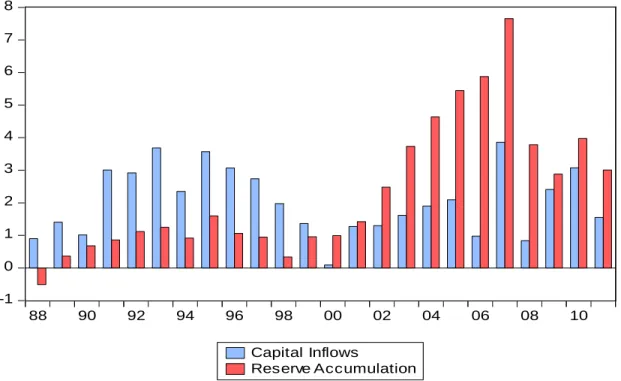
This paper presents an analytical overview of recent contributions to the literature on the policy implications of capital flows in emerging and developing countries, focusing specifically on capital inflows as well as on the relationships between inflows and subsequent capital flow reversals. These challenges have led to a large literature dealing with the policy implications of capital flows in emerging and developing countries. Overall, the systematic evidence from this period suggests that much of the variation in capital flows in the early 1990s was driven by “push” factors – specifically industrial-country interest rates (IMF, 2011).
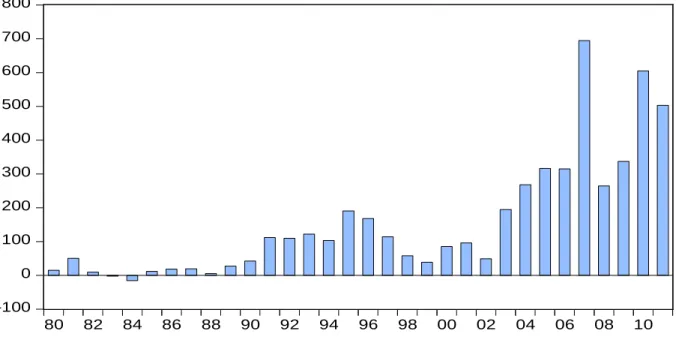
Policy Challenges Associated with Capital Flows
This distinction matters because, in principle, as argued in the last section, a variety of shocks can be associated with the emergence of capital inflows, and the welfare implications of such flows should generally be expected to be different depending on the source of the shock. what causes them, as well as the characteristics of the economy that receives them. The mechanism works by improving the liquidity of the domestic asset acquired by the foreign investor. In that context, a "push" shock associated with a capital inflow will lead to an appreciation of the nominal (and real) exchange rate.
The result would be macroeconomic overheating, i.e. an excessive increase in aggregate demand, which would lead to an increase in domestic inflation and an appreciation of the real exchange rate. To avoid nominal exchange rate appreciation, the central bank would have to intervene in the foreign exchange market to purchase the excess supply of foreign currency at the prevailing exchange rate. With a fixed nominal exchange rate, the rise in domestic prices would mean a gradual appreciation of the real exchange rate.
Finally, to the extent that inflow episodes prove to be persistent and the perceived sustainable value of the real exchange rate appreciates, the profitability of the domestic traded goods sector may deteriorate and resources will flow out of this sector. The question of what effect capital inflows can have on the profitability of the export sector is actually not well-settled, because both capital inflows and export competitiveness are endogenous macroeconomic variables. Although the real equilibrium exchange rate will also rise in this case, as the traded goods sector offers resources away from non-traded goods, thereby increasing the relative price of the latter, capital inflows are associated with an increase in the competitiveness of traded goods.
The easier it is to move assets in or out of the economy, the greater the outflow period likely comes with an incentive of some magnitude to move assets abroad.
The Policy Response
These are standard prudential measures to prevent moral hazard lending throughout the domestic financial system in the presence of asymmetric information and contract enforcement costs. First, capital inflow episodes can be caused by distortions in the domestic financial system that attract foreign capital. Less obviously, purely macroeconomic distortions, such as an undervalued real exchange rate, can attract capital inflows into the domestic financial system at the same time as they cause rapid expansion in the domestic economy.
As mentioned above, the latter could avoid any foreign exchange accumulation in the limit (fully floating exchange rates). Policies that accept an increase in the base but attempt to limit its effects on broader monetary aggregates. On the other hand, controls were associated with a significantly lower share of short-term flows and portfolio flows – the two components of the capital account targeted by measures in the sample countries – and a higher share of FDI.
In Colombia, for example, the volatility of the nominal exchange rate increased significantly after the adoption of the band, suggesting that the group intended in part to reduce the degree of intervention in the foreign exchange market. The advent of capital inflows did not impose a uniform pattern on the behavior of real effective exchange rates between countries in the episode of the early 1990s. Sterilization resulted in rapid increases in the stock of the instrument of sterilization relative to GDP in many countries. .
But this outcome would also correspond to the arrival of capital inflows attracted by favorable domestic productivity shocks (current or expected) or by the emergence of a moral hazard problem in the domestic banking system.
Policy Strategies
It found a strong nationwide positive correlation between the change in the share of consumption in absorption and the extent of real exchange rate appreciation, as well as a weaker positive relationship between the increase in the share of investment in absorption and the change in economic growth. In both cases, these correlations can be interpreted as causation going either way, but a strong relationship was present between the degree of fiscal contraction during the inflow period and the increase in the share of investment in absorption. The Bank concluded that a tight-fiscal loose monetary policy strategy is associated with faster growth and less real appreciation than an alternative tight-fiscal relatively loose fiscal strategy.
A tight-money-loose fiscal policy combination was associated with a greater share of short-term approaches and therefore with a greater build-up of vulnerability. Indeed, an increased reliance on sterilization in East Asia after 1994 was associated with a markedly increased share of short-term approaches in the run-up to the onset of the Asian financial crisis in 1997. Specifically, weak macro fundamentals meant both more debt rather than equity and more short-term rather than long-term debt.
As already noted, the presence or absence of restrictions on the capital account also influenced the composition of external liabilities.
A Policy Decision Tree
On the macro side, it argues that if the exchange rate is initially undervalued, it should be allowed to appreciate. If inflows are considered permanent, adjustment is indicated, presumably in the form of exchange rate appreciation. If the country is committed to nominal exchange rate stability (say as in the Hong Kong currency board or in the case of Eastern European emerging economies pegged to the euro in anticipation of adopting it at some point in the future), the answer is no .
The more the nominal exchange rate is allowed to move, the greater the loss of competitiveness and the smaller the expansion of aggregate demand. 48. in the form of some combination of monetary and fiscal policy), an appropriate mix of exchange rate and stabilization policy should enable the achievement of both goals at the same time. Assume that the real exchange rate depends on the nominal exchange rate, which in turn depends on the volume of capital inflows and the volume of central bank intervention, while aggregate demand depends on the real exchange rate, the volume of capital inflows, and stabilization policy. .
If the real exchange rate is not more depreciated than its desired value (ie, if RER – RER* ≥ 0 does not hold, where a larger value of RER is a more depreciated one), the real appreciation that would be associated with a capital inflow in lack of central bank intervention should be resisted (right column of the table). In this case, if aggregate demand was initially deficient, an expansionary stabilization policy would be needed (lower left corner) because the real exchange rate appreciation would further reduce demand for domestic goods.
Conclusions: A Framework for Resiliency
In general, a combination of the two is likely to be optimal, with the relative weight to be placed on each depending on the size of the quasi-fiscal costs associated with sterilization, the strength of the central bank's capital base, and the remaining need for prudential restrictions on banking sector activities. Forbes and Warnock's (2011) comprehensive study of the factors driving different types of capital flow episodes concludes that global risk, global growth and contagion play the most important roles. Third, resilience is also likely to be enhanced by an exchange rate regime that allows significant short-term exchange rate fluctuations, supported by a large stock of liquid foreign exchange reserves (a managed float with active intervention).
Short-term exchange rate variability not only prevents the perception of exchange rate guarantees that may favor short-term foreign currency capital inflows, but more importantly provides an automatic stabilizer against the effects of capital inflows or sudden outflows on macroeconomic stability. . The overheating associated with large inflow surges can be at least partially offset by real exchange rate appreciation, and the contractionary effects of sudden outflows can be mitigated by real exchange rate depreciation. Accumulating reserves during inflow episodes and using them during sudden stops can, on the other hand, ensure that real exchange rate volatility is not excessive, thereby preventing capital flows from exacerbating too much the signal acquisition problem faced by decision-making agents , how to allocate capital between market and non-market activities in the domestic economy.
It is worth noting that avoiding real exchange rate overvaluation and maintaining large reserves have also proven to be strong predictors of countries' ability to avoid financial crises (Frankel and Saravelos 2012), so the exchange rate regime can provide protection against vulnerability. This means a central bank that is independent (including being well capitalized), has a good understanding of the internal mechanism of monetary transmission, has cultivated an anti-inflationary reputation, and implements a well-understood policy rule.
Latin American Access to International Capital Markets: Good Behavior or Global Liquidity?” NBER Working Paper 13194. Waves of Capital Flows: Booms, Stops, Flight, and Decline." Cambridge, United States: Massachusetts Institute of Technology. Explaining the Rise in Official Reserves in Emerging Markets Since the 1980s. Paper IMF working paper WP/12/34.
The Effectiveness of Capital Controls and Prudential Policies in Managing Large Inflows.” IMF Staff Position Paper SPN/11/14. On the consequences of sterilization interventions in Latin America. Washington, DC, United States: The World Bank. Capital Controls: Gates and Walls” paper presented at the Brookings Panel on Economic Activity, Washington, DC, United States, September.
Can Liberalizing Capital Outflows Increase Net Capital Inflows?” Journal of International Money and Finance. Exchange Rate Regimes for Emerging Markets: Moral Hazard and International Overindebtedness.” Oxford Journal of Economic Policy.