Full Terms & Conditions of access and use can be found at
http://www.tandfonline.com/action/journalInformation?journalCode=cirs20
Download by: [Fondo de Información y Documentación para la Industria ] Date: 11 May 2017, At: 09:25
International Review of Sociology
Revue Internationale de Sociologie
ISSN: 0390-6701 (Print) 1469-9273 (Online) Journal homepage: http://www.tandfonline.com/loi/cirs20
Central American regional integration in science, technology and innovation: a new challenge
Mónica Casalet & Edgar Buenrostro
To cite this article: Mónica Casalet & Edgar Buenrostro (2014) Central American regional integration in science, technology and innovation: a new challenge, International Review of Sociology, 24:2, 345-365, DOI: 10.1080/03906701.2014.933018
To link to this article: http://dx.doi.org/10.1080/03906701.2014.933018
Published online: 28 Jul 2014.
Submit your article to this journal
Article views: 73
View related articles
View Crossmark data
NOTES & PROPOSALS
Central American regional integration in science, technology and innovation: a new challenge
Mónica Casaleta*and Edgar Buenrostrob
aLatin American Faculty of Social Sciences (FLACSO), Mexico City, México;bFund for Information and Documentation for Industry (INFOTEC), Mexico City, México
(Received January 2013; accepted April 2013)
In recent years in international cooperation policies and public policies of the Central American (CA) region multilateral mechanisms were generated to form interinstitu- tional networks that drive science, technology, and innovation (STI) as the engine for regional economic growth. In the agreements social, political, and economic disparity were taken into account in order to stimulate the articulation between actors and potentialize local strengths to generate critical mass on the level of knowledge and build a research core base. The aim of this article is to identify institutional and productive capacities acquired in the countries of the region (CA) that encourage interaction on a national level and create favorable conditions to generate regional agreements to build regional interaction on STI. Results show deficiencies in the linking between public and private agents derived from the limited funds destined to I +D, the insufficient channels of information and the lack of interest of the investigations to respond to priority problems of the region, which weaken links with the productive sector. From there, arise the need to build a joint and collaborative work agenda to consolidated the institutional environment and favors the capacities to absorb knowledge.
Keywords: Regional System of Innovation; Central America; STI Policies; Inter- institutional collaboration; multilateral governance
1. Introduction
In Central American governments and academic presentations, the role of science, technology, and innovation (STI) is increasingly recognized as a driver of sustainable, long-term growth for the Central American region. In recent years, important progress has been made in the development of STI programs aimed at capacity building in national players and strengthening regional relations. The initial concern of bolstering the infrastructure for human resource training has gradually incorporated other issues associated with the need to co-ordinate knowledge production with the development of new technologies, leading to innovative processes and the growth of production sectors. In spite of these concerns and initiatives, significant weaknesses prevail which result in low innovative activity.
This paper aims to identify the institutional and production capacities acquired in various countries of the Central American (CA) region that promote interaction between nations and create favorable conditions for the development of regional agreements to
*Corresponding author. Email:[email protected]
© 2014 University of Rome‘La Sapienza’
build (a fragile prospect) regional STI integration. The driving questions behind the analysis, then, are: (1) What conditions exist at a country and regional level for developing new complementarities that affect the production system and the consolida- tion of a critical mass of human resources whose positive effects contribute to the cohesion of innovation systems and the generation of new, value-added products and services? (2) How have adopted policies been able to drive methods of stimulating innovation, access to new technologies, and knowledge transfer to achieve closer co- operation between countries of the region and, in turn, stimulate scientific, relational capacity and reduce disparities between them? (3) How can regional STI integration be organized considering existing capacities and disparities? And how feasible is it to reduce the technology gap and achieve greater social inclusion and equity for countries and the region as a whole?
Multiple studies of the CA region on the characteristics of production systems and the institutional context have shown that the challenge is for CA countries to increase the complexities of macro and micro production systems and innovation to push perpetually the development of change-driving capacities in production and institutional processes towards greater complementarity.
The absence of a critical mass, along with weak absorption capacities and low connectivity, results in strong fragmentation of the interactions which condition the learning processes in the different countries. Diagnoses of the region identify the key problems which affect and limit the results achieved insofar as they relate to: (1) infrastructure, particularly information and communication systems which broaden knowledge transfer, (2) productive and technology capacities which facilitate knowledge absorption and the rapid incorpora- tion of new technologies into production, (3) an institutional context open to incorporating changes which facilitate competitiveness, governed by institutional management capable of responding to the challenges of research, production, and circulation of knowledge, (4) regulatory inequality; in some cases, total unawareness of the legal framework strips credibility from STI programs and research and technology development institutions.
The paper consists of four sections which form the pivotal dimensions of the analysis:
(1) The importance of strengthening regional STI integration addressing unsolved deficits in STI programs and in research management and knowledge transfer. The strategies adopted in the European Union and Mercosur countries can be used as a departure point to establish an innovation platform and consolidate transdisciplinary research groups in the search for new forms of governance for the management of public affairs. (2) Asymmetries in economic, productive and institutional development where the perform- ance of Guatemala, El Salvador, Honduras, and Nicaragua is well below that of Costa Rica, Panama, and the Dominican Republic, a situation which creates strong relational weaknesses within and between the countries. (3) The proposals for driving a new governance based on regional collaboration for research, the creation of transdisciplinary networks, and the formation of production clusters connected with new technologies (biotechnology and ICT).
2. The importance of regional integration in science, technology and innovation as a focal point
In recent decades, international co-operation has acquired renewed importance on the agenda of developing countries due to the contribution it makes to the development of science, technology, and innovation (CGEE-ECLAC2011). The concept of international
co-operation has evolved, coinciding with changes in the production and technology paradigms of society. Today, initiatives that encourage collective action, complementarity of efforts and resources for the acquisition of learning and knowledge, whether bilateral or multilateral, are of strategic importance in addressing specific, common problems that affect the Central American region.
The majority of international co-operation experiences involving STI and aimed at countries in Latin America and the Caribbean have been North–South, adopting different approaches ranging from accessing the resources of funding and promotion programs to participating in joint ventures which unite research centers and higher education institutes from different countries in what are considered strategic areas, to stimulate networking.
Regional and international organizations (ECLAC, IDB, WB, OAS, and UNESCO) have been crucial in this respect, creating a scientific infrastructure, generating diagnoses and information systematization whether in graduate studies in strategic areas or in the creation of a critical mass of human resources associated with production sectors.
Over the last few decades, political spheres and academic debates have revealed a growing concern for fitting science into the development of new technologies and innovative processes. Initiatives adopted by the European Union have been woven into the design of policies to foster interinstitutional collaboration (public and private). In spite of the differential histories of its member countries, at the end of the 1990s the European Union was able to form agreements to adapt institutional and organizational structures to the new demands of competitiveness and knowledge. These initiatives were aimed, according to the specifics of each country, at restructuring and designing new programs for the organization and funding of research projects in innovative areas of knowledge (biotechnology, new materials, nanotechnologies, and, to a lesser extent, social sciences and regional development), to strengthen scientific development in close association with efforts to improve national competitive advantages.
Such gradual transformations established a new governability based on the definition of thematic research priorities, venturing into the frontiers of knowledge. The consolida- tion of multidisciplinary and interinstitutional research groups was crucial to initiating projects with predetermined time frames and specific needs (applied research) to be developed, where the inclusion of young doctoral student researchers enabled them to improve their investigative skills and acquire learning in project management.
The emergence of Framework Programs in 1984 pushed competitiveness, innovation, and transnational and international collaboration even further to create inter-supranational institutions and third-party country networks. In contrast to earlier research funding programs, these multiple funds, instruments, and agreements specified objectives to be achieved through the collaboration of heterogeneous actors or multi-actors involving universities, research centers, research groups belonging to different universities, busi- nesses, public sector programs, foundations, and civil society organizations (Casalet 2009). The promotion of multidisciplinary and interinstitutional research is a focal point of STI policies adopted by the EU, in a top-down, bottom-up approach. The quest for excellence led to a commitment in the social consensus so that funding would yield the projected fruits.
In Latin America and Central America over the last 20 years, some important changes have been experienced in the way knowledge is produced, in the organizational structure of universities and public research centers, and in the search for new sources of financing for research development. These transformations significantly altered relations between the different economic and social agents (businesses, sectors, regions, government, civil
society, researchers, and graduate students). In the recent science, technology, and innovation plans of almost all the Latin American countries (Argentina, Brazil, Chile, Costa Rica, Colombia, Ecuador, Honduras, Mexico, Nicaragua, Panama, Peru, Uruguay), new programs and instruments are emerging to ensure the transition from a commodity- driven production structure towards a knowledge-intense structure, where the options are inclined to respond to questions such as: (1) What knowledge must be generated to reach a critical mass of researchers capable of forming multidisciplinary teams and dialoging with international peers? (2) What are the country’s priority areas, from a knowledge point of view, and in order to achieve competitive advantages at sectoral and regional level? (3) How do we design more effective ways to overcome institutional, organiza- tional, and relational barriers which hinder the development of collaborative behaviors, both in universities and research centers, and with external agents, especially the production sectors and other societal organizations?
A parallel trend towards the construction of a regional agenda on STI policy and integration resulted in the ‘Regional Dialog for International Technology Cooperation Policies’ organized by the IDB in November 2010, the South American Council for Education, Culture, Science, Technology and Innovation (COSECCTI) of the Union of South American Nations (UNASUR 2012), Ibero-American Program of Science and Technology for Development (CYTED 2012), the Andean Council for Science and Technology (CACYT) (Comunidad Andina 2012), the Inter-American Committee on Science and Technology (COMCYT), the Caribbean Council for Science and Technology (CCCT), the Central American Integration System (SICA) constituted in December 1991 and backed by the General Assembly of the United Nations, and the creation of the Science and Technology Commission for Central America, Panama and the Dominican Republic (CTCAP) whose action is channeled to strengthening strategic partnership for the region (SICA2012).
These meetings and initiatives promoted networks for the diffusion of information on science, technology, and innovation policies and practices and co-ordinated organizations which have attempted to encourage the exchange of information and joint projects, in particular, the International Network of Information Sources and Knowledge for STI Man- agement (ScienTI), the Latin American Technological Information Network (RITLA), and the Inter-American Network of Academies of Sciences (IANAS), (CGEE-ECLAC2011).
The member countries of Mercosur (Argentina, Brazil, Uruguay, Venezuela, and Paraguay, the last-mentioned suspended) with the support of the Spanish Agency for International Development Cooperation (AECID) are trying out new measures such as Territorial Production Integration Groups (GIPT) in an effort to evaluate production, credit, trade, and company formation in specific territories which include a region sometimes belonging to several countries. The study of these production clusters must shift from a logic of conflict to one of co-operation with the support of partnership projects. To consolidate these budding clusters, a Regional Fund was proposed to support small and medium enterprises (SMEs) and the training of officials and entrepreneurs in production integration.
The decade from 2005 to 2014 has been proclaimed the United Nations Decade of Education for Sustainable Development. The contents of the Decade, led by UNESCO, are reflected in the LAC Regional Declaration that seeks to consolidate the relevance, ownership, efficacy, and efficiency of STI proposals and increase the weight of South–
South co-operation, which embraces the view that agency-guided science and technology
programs, and within a context of developed countries, do not provide the answers and solutions to many of the issues specific to less developed countries (UNESCO2010).
The ability to transform Central American co-operation into a supranational route for strengthening innovation capacities and forming research groups in priority areas for the development of the Central American (CA) region can be a decisive way to exploit the complementarities between different countries and generate synergies to make the existing weak links between production sectors, universities, and research centers more complex (Chaminade2011). The countries of the CA region, despite their differences in growth, productivity, and institutional development, exhibit similar conditions that facilitate the adoption of measures to stimulate public–private investment in R&D and innovation in the development of endogenous capacity. The co-ordination of STI strategies among countries of the region emerges as an alternative to address specific challenges until now resolved with the help of North–South international co-operation and by means of bilateral agreements. Closer co-operation between institutions from different CA countries through consortiums and agreements to organize production clusters, such as in Mercosur, could contribute to strengthening scientific and negotiation capacity and the evaluation of results and play an important role in reducing disparities between countries. Social inclusion acquires a strategic importance not only in reducing inequality and poverty, but fundamentally for the design of appropriate, specific solutions for the challenges of development.
3. Asymmetries that affect the weakness of actors at country and regional level The formation of co-operation processes between Central American countries must fit the circumstances of national production systems and their conditions of development, where services provide an important part of the GDP and exports are largely made up of agroindustrial products which still occupy a significant proportion of the economically active population (EAP) (World Bank 2012). As a whole, the CA region extends over 547,982 km2 (Directorate of Intelligence 2012) covering Costa Rica, El Salvador, Guatemala, Honduras, Nicaragua, Panama, and the Dominican Republic. It has a population of just over 52 million inhabitants, Guatemala being the most populated and Panama the least (Table 1), with a heterogeneous population density towards the interior of the region.
Table 1. General conditions of central America 2010.
Country Area km2 Population GDP in USD, 2000
Per capita GDP in USD, 2000
Costa Rica 51,100 4,659,000 24,175,089,457 5,188.9
El Salvador 21,041 6,193,000 15,838,186,519 2,557.4
Guatemala 108,889 14,389,000 26,774,387,795 1,860.7
Honduras 112,492 7,600,000 10,582,329,897 1,392.4
Nicaragua 130,370 5,789,000 5,490,032,606 948.4
Panama 75,420 3,517,000 20,752,469,794 5,900.6
Dominican Rep. 48,670 9,927,320 40,196,106,908 4,049
Total 547,982 52,074,320 143,808,602,976 2,761.6
Source: Author’s compilation based on data from The World Factbook 2012 and World Bank2012.
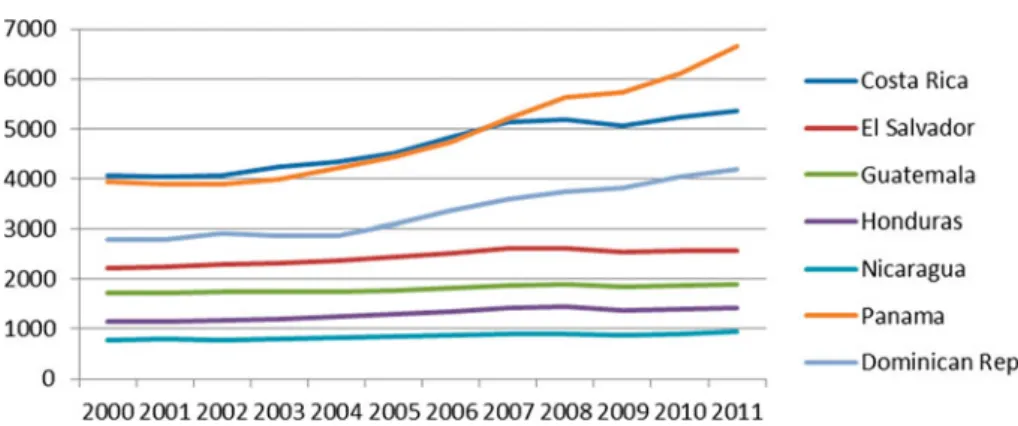
In absolute terms, the biggest economy in the region is that of the Dominican Republic which represents around 28%, but when GDP is related to population and area Costa Rica and Panama have had the largest per capita GDP for some years and together have the highest growth rates among the countries mentioned. At the other extreme is Nicaragua which has shown little variation along with a limited economy (Figure 1). The decline in recent years can be attributed to the crisis that affected developed countries in 2008 and impacted commodities prices, one of the region’s main exports, but the Central American Bank of Economic Integration (BCIE 2012) said the 2009 financial crisis affected Central American countries less severely, with consequences that cannot be compared with those of the 1980s.
The economic context is reflected in a social arena that positions the region unfavorably in the United Nations Human Development Index, with the exception of Costa Rica and Panama which have risen steadily in this index since 1980 (Table 2). Nevertheless, there is no linear relationship between per capita GDP growth and the improvement of social conditions, showing that some countries have been able to advance further in this area, although they are still a long way from the developing countries of Latin America.
In recent years, the extensive use of ICT has become central for measuring a country’s level of development and a key indicator for estimating progress towards an information Figure 1. Growth of per capita GDP in Central America and Panama 2000–2010.
Source: Author’s compilation based on data from The World Bank 2011.
Table 2. Human development index trends 1980–2011.
Year
Position Country 1980 1985 1990 1995 2000 2005 2010 2011
69 Costa Rica 0.614 0.626 0.656 0.684 0.703 0.723 0.742 0.744 105 El Salvador 0.466 0.484 0.524 0.580 0.619 0.652 0.672 0.674 131 Guatemala 0.428 0.437 0.462 0.490 0.525 0.550 0.573 0.574 121 Honduras 0.451 0.492 0.513 0.540 0.569 0.597 0.623 0.625 129 Nicaragua 0.457 0.463 0.473 0.495 0.533 0.566 0.587 0.589
58 Panama 0.628 0.654 0.660 0.689 0.718 0.740 0.765 0.768
98 Dominican Rep. 0.532 0.549 0.577 0.608 0.640 0.658 0.686 0.689 Source: UNDP 2012.
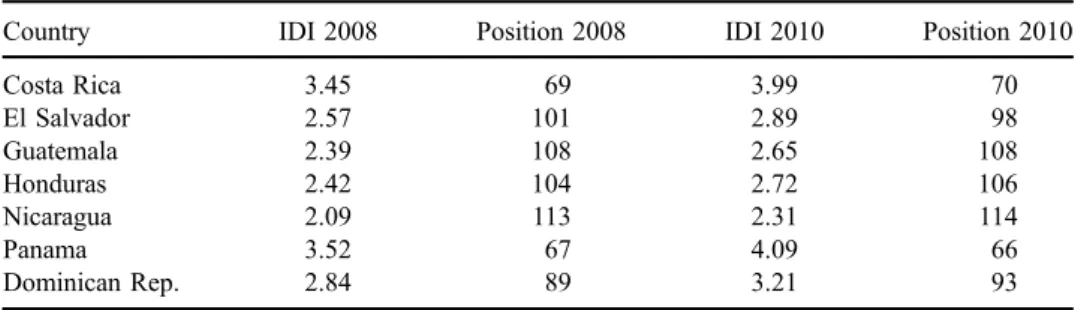
society. The United Nations ICT Development Index (IDI) uses 11 indicators to measure the level of ICT uptake (access, use, and knowledge) on a scale up to 10. The Central American region is located in the lower-middle part of the international classification (Table 3), illustrating the limited possibilities for knowledge transfer and access to knowledge created elsewhere.
The formation of the regional innovation system that encourages supranational ties, which, in turn, drive horizontal co-operation between CA countries, develops instruments which co-ordinate national efforts, shaping them into policies aimed at reducing disparities in social conditions and production structures between the countries of the region. These policies are central to increasing capacities to generate sustained innovation processes within and between the participants.
3.1. National and regional weaknesses that affect the formation of the innovation system
Co-ordination between the public and private stakeholders of production sectors is fundamental for establishing a favorable environment for innovation. The interaction with universities, research and development centers, and production sectors weaves a network of exchanges that can broaden future collaborations which, in turn, strengthen agreements and the public negotiating space between agents. The viability of organizing and maintaining effective co-ordination between the different CA countries is dependent on diverse collaboration agreements between economic agents aimed at generating a competitive benefit (Dini2010). These collaboration agreements can take on basic forms such as horizontal networks with symmetrical member participation to more complex schemes such as clusters or production groups integrated into a value chain which, depending on the sector, may be more or less hierarchical.
The establishment of a favorable environment for innovation assumes:
(1) A geographical space that favors interaction and the forming of ties between the socio-economic actors. Proximity as a geographical dimension forms a cognitive, institutional, and organizational dimension that facilitates learning and the process of accumulating resources. The geographical area generally brings together a combination of enterprises, suppliers, research, and technical training centers in conjunction with intermediary organizations, which act as a liaison between the growth demands of the sector and the inputs provided by research.
Table 3. IDI 2008–2010.
Country IDI 2008 Position 2008 IDI 2010 Position 2010
Costa Rica 3.45 69 3.99 70
El Salvador 2.57 101 2.89 98
Guatemala 2.39 108 2.65 108
Honduras 2.42 104 2.72 106
Nicaragua 2.09 113 2.31 114
Panama 3.52 67 4.09 66
Dominican Rep. 2.84 89 3.21 93
Source: ITU 2011.
(2) The more or less formal methods of institutional co-ordination create a power structure to control effectively the strategic resources and the specific compe- tences among agents with complementary knowledge. Interaction sustained by common interest is seen as a field of mutual influence (Le Breton 2004) that meets the needs of some to acquire new knowledge and join a production system, and of others who seek new opportunities at lower costs. Geographical closeness is important for maintaining interactive relations which trigger knowledge flows between the different actors, implying easy connectivity between them. The co- ordination structure between different public and private actors coalesces in clusters in order to increase exchanges and the transfer of knowledge (university/
enterprises/public sector).
(3) The action of public policies is crucial for guiding trends, investment incentives, and capacity building, and to evaluate results and tailor new selective proposals to improve processes and the linkages between agents. A further requirement is the creation of regulations for the production and marketing process, national and international quality requirements, and the setting of criteria to reduce fragmenta- tion between research and the production sector, especially to establish actions of collaboration, knowledge and technology transfer, and the training of skilled human resources with university institutions and Technology Development Centers (TDC) of the region and country. Central American countries are relatively unequal in terms of legal framework.
(4) The importance of regional and sectoral intermediary organizations, whose action tends to link heterogeneous actors (companies, university technology develop- ment centers), strengthening multifunctional networks to secure confidence ties and maintain the circulation of information. Weak links between universities, TDCs and companies require the participation of more flexible organizations that function as a negotiation and liaison structure to make the link between universities, TDCs, the production sector, and the public sector effective.
Intermediary or bridging organizations fill an active role reinforcing support for the production system by liaising with the scientific community and other institutions. They perform relational activities which make up for the absence of knowledge transfer offices, especially in co-ordination and liaison activities, to ensure collaboration between multiple agents and further innovation networks.
(5) The role of universities, technology development centers, and specialized research groups acquires strategic importance for business innovation and the development of national and regional innovation systems. As the economy becomes more knowledge-intense, the role of universities assumes a new prominence in the translation of research results and production applications of emerging industries. Collaboration with universities and TDCs associated with production sectors reinforces interest in developing a new form of governance based on collaboration through networks involving negotiation, collaboration agreements, and the establishment of formal and informal relations to develop complementary skills and the exploration of new areas of opportunity. Third mission activities, those related to the generation, use, application, and exploita- tion of knowledge outside the academic arena, convert the university into a determining factor in economic development processes. Participation in collab- oration agreements with the production sector results in a change of attitude in the perception and behavior of initially opposed or barely interested research groups.
In turn, managing the organizational structure of the university is transformed to respond positively to this relational challenge.
Central American countries have higher education institutions (HEIs) and research centers that conduct research which can be applied to production sector development through laboratories and test centers with local products. They teach undergraduate and graduate programs to train skilled human resources with expertise in production and processing techniques, ensuring the right conditions for the generation of an innovation system that enables the increased production and added value of the different crops and related processes. (Casaletet al.2011, Casalet2012).
4. Principal agents that form the innovation system at national and regional level 4.1. Government entities
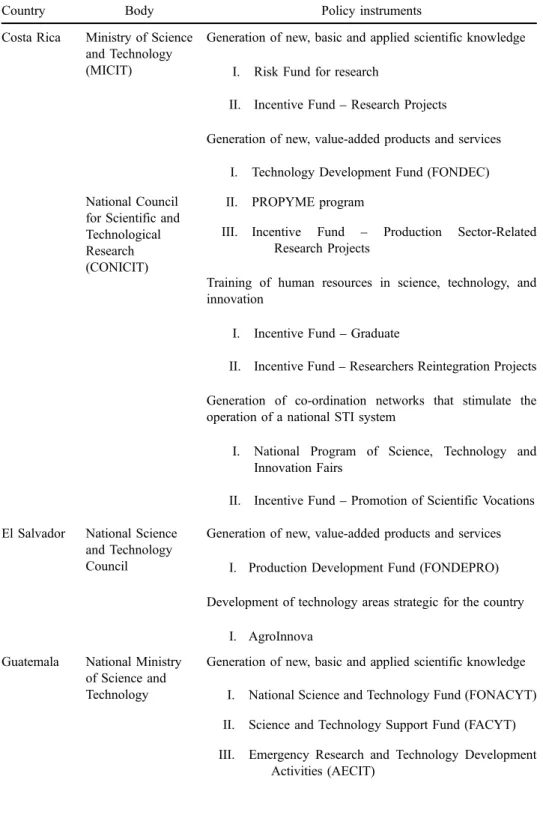
All CA countries have the strengths to form production clusters which, with the help of biotechnology and STI, derive in a hub of capacity building and competitiveness. Each understands the importance of science and technology as crucial to improving the social conditions of the population. They all have a public body whose function is to design and implement public STI policies, but the relative importance is different between them, and is reflected in the level of the agency responsible for those actions (Table 4). In some cases, such as Guatemala, Costa Rica, and Panama, there is a Ministry specifically responsible for scientific programming. In El Salvador, Honduras, and Nicaragua the hierarchical level is that of a Council and/or Department.
An analysis of STI policies by country reveals the initiatives aimed at strengthening co-ordination between agents on two levels: One, to foster the creation of transfer offices and public and private intermediary bodies to link HEIs and TDCs with the production sector; the other, to strengthen the mobility of researchers and spread the importance of STI in order to boost interest in the link between the different actors of society.
Administrative complexity and the inflexibility of existing instruments (the absence of a legal framework) prevent the development of productive collaboration activities and knowledge transfer. The lack of flexibility of administrative procedures makes it difficult to establish partnership agreements such as the formation of public–private consortiums and the use of infrastructure.
Recent political discourse has addressed the development of laws and agencies to provide production with legal certainty and regulations, especially in the protection of intellectual property. This is in conjunction with testing and certification centers for the application of current quality standards, in addition to the standardization of products and metrology patterns that can be applied internationally. To this formalization can be added programs to promote graduate development (master’s and doctoral) in higher education institutions to heighten the knowledge and skills of researchers and students.
There is a significant absence of contestable funds for STI activities to strengthen knowledge production and partnering in almost all Central American policies; only Costa Rica, El Salvador, Guatemala, Panama, and the Dominican Republic have contestable funds to finance research. Nicaragua and Honduras have no resources targeted directly to STI activities, nor do they have public or private loans with preferential access for STI.
El Salvador is the only country to have created public risk capital funds. Costa Rica and Panama both have a public fund to support the commercialization of innovations.
Table 4. Characteristics of the official bodies of science and technology in Central America.
Country Body Policy instruments
Costa Rica Ministry of Science and Technology (MICIT)
National Council for Scientific and Technological Research (CONICIT)
Generation of new, basic and applied scientific knowledge I. Risk Fund for research
II. Incentive Fund–Research Projects
Generation of new, value-added products and services I. Technology Development Fund (FONDEC) II. PROPYME program
III. Incentive Fund – Production Sector-Related Research Projects
Training of human resources in science, technology, and innovation
I. Incentive Fund–Graduate
II. Incentive Fund–Researchers Reintegration Projects Generation of co-ordination networks that stimulate the operation of a national STI system
I. National Program of Science, Technology and Innovation Fairs
II. Incentive Fund–Promotion of Scientific Vocations El Salvador National Science
and Technology Council
Generation of new, value-added products and services I. Production Development Fund (FONDEPRO) Development of technology areas strategic for the country
I. AgroInnova Guatemala National Ministry
of Science and Technology
Generation of new, basic and applied scientific knowledge I. National Science and Technology Fund (FONACYT) II. Science and Technology Support Fund (FACYT) III. Emergency Research and Technology Development
Activities (AECIT)
Table 4 (Continued)
Country Body Policy instruments
National Science and Technology Council
Training of human resources in science, technology, and innovation
I. National Program for the Training of Human Resources in Science, Technology and Innovation.
Development of technology areas strategic for the country I. National Science Program. Technology and Innova-
tion in Information, Computer and Communica- tions 2008–2012
II. National Science, Technology and Innovation Pro- grams in: Agriculture, Construction, Industry, Environment, Energy, Health, Basic Sciences III. National Biotechnology Program of Guatemala
Generation of co-ordination networks that stimulate the operation of a national STI system
I. National Program for the Diffusion, Communication, Popularization and Transfer of Science, Technology and Innovation
Honduras Honduran Science and Technology Council
Generation of co-ordination networks that stimulate the operation of a national STI system
I. Interactive Teaching Center CHIMINIKE Nicaragua Nicaraguan Science
and Technology Council
Generation of new, basic and applied scientific knowledge I. ‘The Entrepreneurial University in Nicaragua’
Program
Generation of new, value-added products and services I. Business Management and Innovation
Development of technology areas strategic for the country I. Interinstitutional Energy Network
Panama National Ministry of Science, Technology and Innovation
Generation of new, basic and applied scientific knowledge I. New Researchers Support–SENACYT
II. Science Against Poverty–SENACYT
The region’s limitations in funding science and technology are due to the tiny proportion of GDP earmarked for these activities.
4.2. Companies that channel production activity
Companies operating in Central America can be divided into two large groups. Micro and small businesses lack the capacity to meet the requirements demanded by international markets; their production is targeted to the local market and has little or no added value from processing or packaging. Large companies, on the other hand, make use of large Table 4 (Continued)
Country Body Policy instruments
Training of human resources in science, technology, and innovation
I. Masters or Doctoral Scholarships DAAD – SENACYT
II. Masters or Doctoral Scholarships in Administrative Sciences–SENACYT
III. Masters or Doctoral Scholarships SFERE – SENACYT
IV. Undergraduate Excellence Scholarships–SENACYT V. Scholarships for Doctoral or Postdoctoral Studies–
SENACYT
VI. Sciences Training–SENACYT
VII. Support for the Generation of Scientific and Techno- logical Skills–SENACYT
Dominican Republic
Ministry of Higher Education, Science and Technology (MESCyT)
Generation of new, basic and applied scientific knowledge I. National Fund for Innovation and Science and
Technology Development (FONDOCyT) Generation of new, value-added products and services
I. Competitiveness Fund–National Innovation Council Training of human resources in science, technology, and innovation
I. National and International Scholarship Program – Undergraduate and Postgraduate (SEESCYT) II. ITLA Scholarship Program (SEESCYT)
Source: Author’s compilation based on data from the RICYT platform for science, technology, and innovation policies and instruments.
technified areas for production destined for domestic consumption and export, since they have the capacities to meet quantity, quality, time, and packaging requirements.
The collaboration of large companies relies on the functioning of different associations which negotiate between producers and the agents that form part of the regional innovation system (RIS). The activities they promote address the need to incorporate access to technology and markets and offer training programs and help in accessing national support programs in different sectors.
The majority of the associations are national and local, but there are efforts to group the region’s producers so as to strengthen co-ordination between plans and actions beyond the borders of each country. Such is the case of the Federation of Industry Chambers of Central America (FECAICA2012). In other cases, associations are formed with growers of, for example, coffee, sugar cane, and banana, which are the region’s main export products.
Some have institutions that regularly conduct scientific and technological research either individually or in conjunction with HEIs and TDCs to generate production innovations.
These centers are aimed at solving the issues facing the region’s products to meet the standards and requirements for international marketing.
4.3. Higher education institutions and TDCs
The Technology Development Centers and Higher Education Institutions in almost all Central American counties seek to nurture economic and social development by supporting competitiveness, the formation of companies, and quality. The majority have experience in providing technical services to government entities, local groups, and companies (Table 5) and have a skill base for conducting research geared to the production sector, particularly agroindustry which provides the bulk of the region’s exports.
The limited capacity of HEIs and TDCs to conduct frontier research is the result of a set of material and human conditions that make it difficult to carry out complex projects involving production sectors. One explanation is the scarce number of researchers with a master’s degree, much less a doctorate. This deficiency deters them from accessing networks of excellence and consequently new sources of funding. Young graduate students have little involvement in research projects and so are excluded from new knowledge and learning and are deterred from taking part in international exchanges.
Furthermore, only a few centers have the latest-generation equipment for biotechnology research, for example, or the study of genetically altered varieties.
The countries of the region have large disparities in GDP size and the human development index, although those which perform well on both indicators allocate insufficient amounts to R&D activities as a percentage of GDP. In no case does R&D spending exceed 1% of GDP. From lowest to highest participation, Nicaragua allocates 0.05%, Honduras and Guatemala 0.06%, El Salvador 0.1%, the Dominican Republic 0.2%, Panama 0.2%, and Costa Rica 0.53% (RICYT 2009). A look at the percentages and their relation to the size of the national economies shows that the majority of countries cover only operative costs and do not have the funds to conduct research. Only Costa Rica and Panama have created government funds for these activities.
Poor co-ordination between academic research and market demands results in a dearth of new funds to support research development. In the shortcomings of both HEIs and TDCs, research is not co-ordinated with the demands of producers. Researchers in general are unaware of market needs and receive no incentives to market the results.
Spin-offs are rare. In addition, institutions lack liaison or technology transfer offices, so
Table 5. HEIs and TDCs important for the formation of a RIS in Central America.
Technology Development Centers
Country Center Activities
Costa Rica National Center of Food Science and Technology (CITA)
Broad collaboration with companies in the country able to provide distance education, certification services, and technical assistance for food processing and the use of biomass from agricultural byproducts National Institute of Biodiversity
(INBIO)
Dedicated to the investigation of enzymes in food, production of active compounds from mushroom cultivation, with extensive links in the USA and Europe
Honduras Agricultural College of Zamorano Studies in agronomic engineering and agroindustry
Panama Institute of Scientific Research and High Technology Services of Panama (INDICASAT)
Aimed at the identification and purification of marine compounds with anticancer activities
Gorgas Memorial Institute for Health Studies
Research on infectious diseases, De Chagas disease, and biotechnological enhancement of Panamanian coffee varieties
Dominican Republic
Dominican Institute of Agricultural and Forestry Research (IDIAF)
Conducts investigations in molecular biology, bioprospecting, and among the research areas is the genetic enhancement of plants for the local economy and export Institute of Innovation in
Biotechnology and Industry (IIBI)
Research in molecular biology, genetic engineering, transgenic crops, bioactive substances, environment
Higher Education Institutions
Country HEI Activities
Costa Rica University of Costa Rica Diverse research centers which drive work in areas of biotechnology, environment, biodiversity, food safety, and health Technological Institute of Costa Rica National institution with research centers
for biotechnology, environment, agroindustry, chemical and
microbiological, materials and computing El Salvador University of El Salvador Certification in agricultural production
processes
Guatemala University of San Carlos of Guatemala Research on food, nutrition, and environment
Honduras National University of Agriculture (UNA)
Research on animal production, environment, and agricultural production Nicaragua National Autonomous University of
Nicaragua
Treatment and management of aquifers, bioplastics, biotechnology, and molecular biology
Panama University of Panama Conducts research in phytopathology, food processing, physical chemistry, and computing
results remain on paper and HEIs are not actively and extensively involved in society. In other words, the third mission of the university is never accomplished.
HEIs have been unable to establish research groups that compete in projects and maintain continuity and national recognition. While TDCs do maintain academic collaborations with other international TDCs, collaboration between TDCs of the CA region is minimal (BID–CTCAP2010). One cause is the lack of national and/or regional networking between researchers and production sectors. Neither are there any programs to link and co-ordinate interinstitutional and multidisciplinary scientific efforts that expand the scope and reach of projects. Despite these limitations, TDCs can become catalysts for different agents and institutions to support and co-ordinate the creation of production clusters and the formation of interinstitutional networks that link research with production sectors. TDCs can fulfill a complementary role and extend the functions of HEIs since they already have the preparation, and in some cases the experience, to approach companies, especially SMBs.
Analyzing by country, Panama and Costa Rica have the best conditions for realizing complex projects since they allocate the biggest percentage of GDP to these activities as well as having the highest proportion of personnel in science and technology activities for every 1000 inhabitants of economically active population (EAP), 4.45 and 4.2 respectively (RICYT 2009), higher than larger Latin American countries such as Brazil (2.1) and Mexico (0.6). At the other extreme are El Salvador and Guatemala with only 0.1.
The effects of R&D support are reflected in the number of patents applied for per million inhabitants: 70 in Panama, 170.5 in Costa Rica, and only 12.6 in Nicaragua.
Similarly, using the number of scientific publications per million inhabitants as the indicator, the first two places are unchanged (Panama 107 and Costa Rica 97.9) but the lowest performer is El Salvador with 4. The differences between the region’s countries do not curb the opportunity to create clusters that co-ordinate the development of R&D+i activities (RICYT 2012).
4.4. Non-governmental organizations
Common throughout the region is the permanent and enterprising presence of international co-operation to maintain national research activities. For years these funds have allowed the development and maintenance of scientific and production programs and projects such as the creation of a scientific infrastructure. The importance of Table 5 (Continued)
Higher Education Institutions
Country HEI Activities
Technological University of Panama Intellectual property guidelines project for Panamanian SMBs, PILA Project, Incubation System for Business Development Project, UNEE-PUEDES Project, UTP-Emprende Project Dominican
Republic
Autonomous University of Santo Domingo
Crop production models for warm intertropical zones, pest management, genetic enhancement
Source: Author’s compilation based on data from the web pages of each institution.
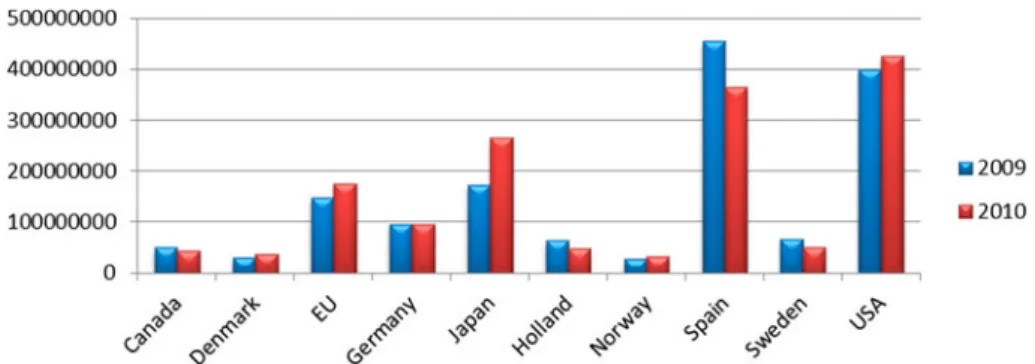
international donations can be observed inFigure 2which shows the amounts granted by countries which contribute most to the region.
Beyond direct funding, the participation of NGOs and international agencies fulfill different roles within the national and regional innovation system. Among the most important are interest in reducing the disparities between countries, and facilitating the creation of a scientific and co-ordination structure between HEIs and international research centers of the region. They also diffuse and mobilize knowledge between the different actors and benefit the link between academia and the production sector, becoming a central element within the system.
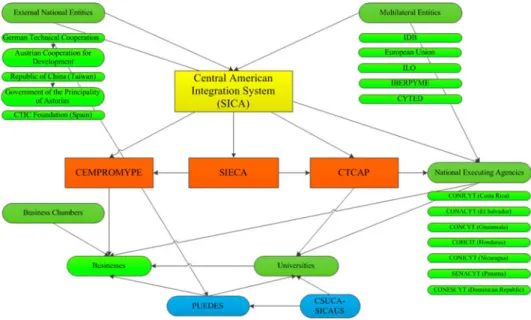
All the actors are co-ordinated under the Central American Integration System, the mechanism through which the countries of the region co-ordinate resources to achieve economic growth and improve the social conditions of the population in general (SICA 2012), as can be seen inFigure 3.
Figure 2. Donations made by the main countries to Central America (dollars).
Source: Author’s compilation based on data from The World Bank2012.
Figure 3. Central American regional innovation system.
Source: Author’s compilation based on information from the respective web pages.
5. Restrictions to the formation of a national and regional innovation system From the above analysis, the main elements that frustrate the strengthening of a national and regional innovation system in Central America include: the lack of co-ordination of support programs and limited coverage and funding; the absence of private capital for production projects; the reduced availability of labor due to national and international migration;
deficient capacities of producers to use new processes; scarce co-ordination between the different regional actors; and, lastly, the difficulties of technology development and research centers and HEIs to perform activities aimed at the production sector.
Among the difficulties facing TDCs and HEIs are: (1) few TDCs have the capacity to conduct complex research; (2) inadequate links between the region’s TDCs, HEIs, and the market, and (3) funding problems for STI activities.
Based on these factors, a scheme has been developed which identifies the problems and the causes giving rise to each one (Figure 4). The four major issues affecting the weakness of regional integration are: (1) STI research has only limited scope; (2) research conducted by HEIs and TDCs never reaches the market; (3) North–South transfer models are generated meaning producers are dependent on external suppliers and TDCs and HEIs on international bodies; and (4) research funds are very limited.
The identification of previous factors and issues that have impeded the formation of a regional innovation system opens the door for alternatives which can facilitate exchanges and establish a relational and human capital.
Dealing with the crisis (economic, institutional) that derives from the incoordination, lack of incentives, non-existence of priority research areas, and fragmented human resources calls for an efficient institutional framework with the potential to be transformed into a positive force capable of inducing innovation processes and the creation of skilled human resources with societal ties. Central to this is the ability of the regional integration process to guide policies in determining under which institutions and what conditions
Figure 4. Restrictions to the formation of a RIS.
Source: Author’s compilation.
economic incentives will be oriented to innovate and adopt new technologies that benefit sectors with export potential.
The creation of a contestable Regional Fund for the development of joint projects between the region’s TDCs, HEIs, and production sectors may be a possibility along the lines of Mercosur, to bring together public and private actors with specific goals for sectoral development and innovation capacities. The creation of a Regional Fund would be aimed at promoting and strengthening the ties between institutions that conduct scientific projects in the region in order to accumulate strengths and capacities, and improve research by funding STI activities applied to the regional and national development of Central American countries.
The creation of this fund would aim to expand the quality of research conducted in HEIs and TDCs in order to improve research capabilities. In turn, it would strengthen the visibility and management of institutions to meet the needs of economic growth, enabling researchers to enhance their training with graduate studies in centers of renowned international prestige, but geared towards areas of regional and national priority.
The creation of the Regional Fund should be complemented with the development of programs to form national, regional, and international interdisciplinary networks for innovation. These networks are a way to encourage the mobility of students, faculty, and visiting researchers which would establish an effective exchange platform between researchers from each country, region, and abroad, helping to develop academic links with centers of excellence, supporting publications, and primarily knowledge transfer with production sectors and society. Networking with graduate students and researchers from the region living abroad would be an opportunity to connect emigrated talent with national problems.
6. Final recommendations
The paper has reviewed the existing weaknesses in the development of the STI system in the Central American region. The scarce resources earmarked for R&D+i, both in the public and private sector, hinder the strengthening of research and the formation of interdisciplinary groups in which young graduate students participate. Among HEIs and researchers there is a notable lack of interest in orienting research projects towards priority issues. Such isolation further weakens the links with production sectors. The fact that innovation is perceived as an interactive process gives importance to communication flows between the different actors. In most CA countries, as analyzed in this paper, there is no effective link between science and the production system. The recommendations, therefore, are aimed at encouraging and galvanizing relations between the different actors of the system, both nationally and regionally.
The purpose of the recommendations is to seek STI integration in the CA region, resorting to a wide range of national, bilateral, and regional levels as starting-points to stimulate the integration of STI institutions and intermediary bodies in order to establish production co-ordination mechanisms. The formation of the production system requires the building of absorption and connectivity capacities. The challenge for CA countries is to increase the complexity of production and innovation systems at micro and macro levels. This implies the design of instruments and programs to stimulate capacity building and promote changes in processes towards a production structure with better complementarities.
In order for CA countries to build a joint working agenda, the design of STI policies must be perceived as an experimental and dynamic process that amalgamates the consensus of the different protagonists (public and private sectors, HEIs, TDCs, international co-operation bodies) in which the instruments undergo continuous correc- tion through the evaluation of results.
The possibility of creating a Regional Fund for program funding and guidance, along with financial support to strengthen knowledge absorption capacities, regional in scope but with broad national impact at institutional level and in the formation of research groups, can be an effective instrument for enhancing new regional and national capacity building. The action of the Regional Fund will impact favorably in many aspects: the streamlining of procedures making interinstitutional collaboration to address strategic interests more dynamic, the diffusion of knowledge, and a more balanced development of the region.
The experiences of the European Union and Mercosur countries are appropriate benchmarks for the organization and operation of the Regional Fund. This implies that a country’s geographical or historic situation is not a determining factor, but rather the decision and determination to apply effective policies with responsible institutions in order to fulfill the fund’s mission.
This regional integration is complemented and strengthened by national institutional frameworks capable of undertaking institutional management and the transfer of new knowledge. They encourage greater connectivity between training, research, and the production sectors through the emergence and consolidation of production clusters and interinstitutional networks that boost efficiency to provide solutions for improving competitiveness.
Notes on contributors
Monica Casalet is a researcher in the Latin American Faculty of Social Sciences (FLACSO- Mexico) and she is a member of the Mexican Social Sciences Academy and a part of Mexican National Research System. She was invited to join the Transition Team for Science and Technology put forward by president Vicente Fox, and also by the current president Felipe Calderon. She takes part in professional consultancy teams with many international institutions such as ECLAC, ILO, IDRC and IDB, and also in Mexican National Institutions such as CONACYT, NAFIN, the Ministry of Labour, and the Ministry of Economic. She is a member of the Research Consortia EULAKS Project approved by 7th Framework Program Title“Connecting socioeconomic research on the dynamics of the knowledge Economy in LAC”(Agreement 217190-2007/10). She was the coordinator of the Knowledge Economic in LAC Program supported by IDRC grant 102497-003 2006/09. She was a consultant for IDRC and ECLAC to elaborate the Nicaragua STI Program. She has been invited to integrate the team organized by IDRC and ECLAC to elaborate the Panama STI Program. She has published widely on institution innovation, intermediary institutions on STI and public policy on STI in LAC. She is an advisor in the Editorial Boards of several Latin-American Journals in this field.
Edgar Buenrostro is a Researcher at the Fund for Information and Documentation Industry (INFOTEC), part of CONACyT Research Centers. He has been a consultant to the Economic Commission for Latin America and the Caribbean (ECLAC) in Mexico and worked on research projects for national and international organizations, among the most important are the International Labour Organization (ILO) in his office for Mexico and Cuba, the Latin American Faculty of Social Sciences (FLACSO) in Mexico, Fundación Carolina, Seventh Framework Programme of the European Union, CEPAL–Chile and CONACyT. His areas of interest include the use of ICT for innovation, the formation of business networks in international knowledge-intensive sectors, clusters, regional development, technology transfer and science and technology policy.
References
Banco Centroamericano de Producción Económica, 2012. Productos y servicios [online].
BCIE. Available from: http://www.bcie.org/?cat=8&title=Productos%20y%20servicios&lang=es [Accessed 5 April 2012].
BID–CTCAP, 2010.Creación de una Red Regional de TDC para Centroamérica. San Salvador:
BID, ATN/SF-11308-RGg.
Casalet, M., 2009. Las nuevas tendencias en la organización y financiamiento de la investigación: el caso de México. In: J. Basave and M.A. Rivera, eds.Globalización, conocimiento y desarrollo.
2. Teoría y estrategias de desarrollo en el contexto del cambio histórico mundial. México:
PROGLOCODE-UNAM-Miguel Ángel Porrúa, 495–513.
Casalet, M., 2012. Las relaciones de colaboración entre la Universidad y los Sectores Productivos:
Una oportunidad a construir en la política de innovación. In: J. Carrillo, A. Hualde, and D.
Villavicencio, eds.Dilemas de la Innovación en México: Dinámicas sectoriales, territoriales e institucionales. Guadalajara, Jal.: COLEF-CONACYT, 109–142
Casalet, M.,et al., 2011.Evolución y complejidad en el desarrollo de encadenamientos productivos en México. Los desafíos de la construcción del clúster aeroespacial de Querétaro. Santiago de Chile: CEPAL.
Centro Nacional de Ciencia y Tecnología de Alimentos, 2012.Programas[online]. CITA. Available from:http://www.cita.ucr.ac.cr[Accessed 6 April 2012].
CGEE-ECLAC, 2011.Integración Regional CTI: situación actual y perspectivas en Latinoamérica y el Caribe. Santiago de Chile: CEPAL.
Chaminade, C., 2011.Transnational innovation systems. Mexico City: CEPAL.
Comunidad Andina, 2012. Sistema Andino de Integración [online]. CA. Available from:http://
www.comunidadandina.org[Accessed 3 November 2012].
CYTED, 2012.Programa Iberoamericano de Ciencia y Tecnología [online]. CYTED. Available from:http://www.cyted.org[Accessed 2 November 2012].
Dini, M., 2010. Competitividad, redes empresariales y desarrollo productivo. Santiago de Chile:
ILPES–ECLAC.
Directorate of Intelligence, 2012.The world factbook[online]. Central Intelligence Agency. Avail- able from:https://www.cia.gov/library/publications/the-world-factbook[Accessed 2 April 2012].
ECLAC, 2011.Presentación del Plan Estratégico Regional y Lineamientos para el Plan de Acción.
San Salvador: CEPAL, ATN/SF1108-R6.
Escuela Agrícola Panamericana en Honduras, 2012. Informe anual 2010 [online]. Zamorano.
Available from:http://www.zamorano.edu/zamo/informe-anual-2010[Accessed 6 April 2012].
Federación de Cámaras y Asociaciones Industriales Centroamericanas, 2012.Memoria de labores 2011–2012[online]. FECAICA. Available from:http://www.fecaica.org/memoriadelabores.php [Accessed 10 April 2012].
Ferraro, C., ed., 2010.Clusters y políticas de articulación productiva en América Latina. Santiago de Chile: ECLAC-FUNDES.
Instituto Conmemorativo Gorgas de Estudios de la Salud, 2012. Producción científica [online].
ICGES. Available from: http://www.gorgas.gob.pa/index.php?option=com_content&view=arti- cle&id=63&Itemid=119&lang=es[Accessed 6 April 2012].
Instituto de Innovación en Biotecnología e Industria, 2012.Servicios[online]. IIBI. Available from:
http://www.iibi.gov.do[Accessed 6 April 2012].
Instituto de Investigaciones Científicas y Servicios de Alta Tecnología, 2012. Investigación [online]. INDICASAT. Available from:http://www.indicasat.org.pa/index.php?option=com_con- tent&view=article&id=50&Itemid=57&lang=es[Accessed 6 April 2012].
Instituto Dominicano de Investigaciones Agropecuarias y Forestales, 2012.Programas y proyectos [online]. IDIAF. Available from:http://www.idiaf.gov.do/el_instituto/programams_proyectos.php [Accessed 7 April 2012].
Instituto Nacional de Biodiversidad, 2012.Acerca de INBio[online]. INBio. Available from:http://
www.inbio.ac.cr/que-es-inbio/acerca.html[Accessed 6 April 2012].
International Telecommunication Union, 2011.Measuring the information society. Geneva: UN.
Le Breton, R., 2004.L ínteractionnisme symbolique. Paris: Press Universitaire de France.
Organización Internacional del Trabajo, 2011. Panorama Laboral 2011. América Latina y el Caribe. Lima: ILO.
Plataforma de Políticas e Instrumentos en Ciencia, Tecnología e Innovación, 2012. Reporte de Indicadores [online]. Políticas CTI. Available from: http://www.politicascti.net/index.php?
option=com_content&view=article&id=21&Itemid=50&lang=es[Accessed 4 April 2012].
Red de Indicadores de Ciencia y Tecnología (RICYT), 2009. Gasto en CyT en relación al PIB [online]. RICYT. Available from: http://db.ricyt.org/query/AR,BO,BR,CA,CL,CO,CR,CU,EC, ES,GT,HN,JM,MX,NI,PA,PE,PR,PT,PY,SV,TT,US,UY,VE,AL,IB/1990%2C2011/GASTOxPBI [Accessed 14 September 2012].
Red de Indicadores de Ciencia y Tecnología, 2012. Indicadores comparativos[online]. RICYT.
Available from: http://www.ricyt.org/index.php?option=com_content&view=article&id=149&I- temid=3[Accessed 14 April 2012].
Sistema de Integración Centroamericana, 2012. Un vistazo a la integración [online]. SICA.
Available from:http://www.sica.int[Accessed 12 September 2012].
Tecnológico de Costa Rica, 2012.Investigación[online]. TEC. Available from:http://www.tec.ac.
cr/sitios/Vicerrectoria/vie/Paginas/default.aspx[Accessed 7 April 2012].
Unión de Naciones Suramericanas, 2012. La organización [online]. UNASUR. Available from:
http://unasursg.org/inicio/organizacion[Accessed 5 November 2012].
UNESCO, 2010.Sistemas nacionales de ciencia, tecnología e innovación en América Latina y el Caribe. Montevideo: UNESCO.
United Nations Development Program, 2011.Informe sobre desarrollo humano. New York: PNUD.
Universidad de Costa Rica, 2012.Investigación en la UCR[online]. UCR. Available from:http://
www.ucr.ac.cr/investigacion[Accessed 7 April 2012].
Universidad de El Salvador, 2012. Investigación[online]. UES. Available from:http://www.ues.
edu.sv/content/investigaci%C3%B3n[Accessed 7 April 2012].
Universidad de Panamá, 2012.Investigaciones[online]. UP. Available from:http://www.up.ac.pa/
ftp/2010/principal/Proyecto_de_Investigaciones_Universidad_de_Panam%C3%A1.pdf [Accessed 7 April 2012].
Universidad Nacional Autónoma de Nicaragua, 2012. Investigación [online]. UNAN. Available from:https://www.unan.edu.ni/index.php/investigacion[Accessed 7 April 2012].
Universidad Nacional de Agricultura, 2012.Investigación[online]. UNA. Available from:http://www.
unag.edu.hn/index.php/en/2012-06-09-01-15-47/investigacion-y-extension[Accessed 7 April 2012].
Universidad San Carlos de Guatemala, 2012.Investigación[online]. USAC. Available from:http://
www.usac.edu.gt/index.php[Accessed 7 April 2012].
Universidad Tecnológica de Panamá, 2012. Investigación [online]. UTP. Available from: http://
www.utp.ac.pa/introduccion-investigacion[Accessed 7 April 2012].
World Bank, 2012. World databank [online]. World Bank. Available from: http://databank.
worldbank.org/ddp/home.do[Accessed 3 April 2012].