Communication strategies on Twitter and institutional websites in the Covid-
19 second wave: analysis of the governments of Germany, Spain, Portugal, and the United Kingdom
Estrategias comunicativas en Twitter y portales institucionales durante la segunda ola de Covid-19: análisis de los gobiernos de
Alemania, España, Portugal y Reino Unido
Rubén Rivas-de-Roca. University of Seville. Spain.
[email protected] [CV]
Mar García-Gordillo. University of Seville. Spain.
[email protected] [CV]
José Luis Rojas-Torrijos. University of Seville. Spain.
[CV]
This work has been funded by the VI PPIT-US (Research and Transfer Plan of the University of Seville), through the Predoctoral Contract for the Development of the University of Seville's R+D+I Program in Areas of Special Attention assigned to the Department of Journalism II (2017), whose beneficiary is the author Rubén Rivas-de-Roca. Start of the research: 01/10/2020. End of the research: 31/01/2021.
How to cite this article
Rivas-de-Roca, R., García-Gordillo, M., and Rojas-Torrijos, J. L. (2021). Communication strategies on Twitter and institutional websites in the Covid-19 second wave: analysis of the governments of Germany, Spain, Portugal, and the United Kingdom. Revista Latina de Comunicación Social, 79, 49-73. https://www.doi.org/10.4185/RLCS-2021-1517
ABSTRACT
Introduction: The social restrictions imposed by the Covid-19 pandemic increased the role of digital technologies as tools of interaction, but also their role in the institutional communication developed by governments to explain their political decisions in a crisis. Methodology: This study examines some of the communication strategies of the governments of Germany, Spain, Portugal, and the United Kingdom. To do this, the topics and objectives of their leaders or spokespersons on Twitter are studied: Steffen Seibert representing Merkel (Germany), Pedro Sánchez (Spain), António Costa (Portugal), and Boris Johnson (United Kingdom). Likewise, the messages disseminated on the official websites of the governments (Bundesregierung, La Moncloa, República Portuguesa, and GOV.UK) are analyzed. Results: Results show low use of digital interaction potential. In addition,
the preferred themes and objectives are repeated on Twitter and institutional webs, focusing on the announcement and evaluation of health and economic issues. However, the messages on the social network refer to a greater plurality of issues. Discussion: Based on the similarities and divergences found, we argue that a reflection on the role of political cultures in communication actions should be noted, as well as the need to respond to the interests of the audience. Conclusions: Government communication has addressed the most immediate issues of the pandemic, such as health and the economy, developing a broader agenda on Twitter that, on the other hand, did not correspond to the interests observed among the public.
KEYWORDS: Crisis communication; Covid-19; institutional communication; institutional webs;
leadership; political communication; Twitter.
RESUMEN
Introducción: Las restricciones sociales impuestas por la pandemia de Covid-19 acentuaron el rol de las tecnologías como herramientas de interacción, pero también la función de las mismas en la comunicación institucional desarrollada por los gobiernos para explicar sus decisiones políticas ante una situación de crisis. Metodología: Esta investigación analiza comparativamente algunas de las estrategias comunicativas de los gobiernos de Alemania, España, Portugal y Reino Unido. Para ello se estudian los temas y objetivos de sus líderes o portavoces en Twitter: Steffen Seibert como representante de Merkel (Alemania), Pedro Sánchez (España), António Costa (Portugal) y Boris Johnson (Reino Unido). Asimismo, se analizan los mensajes en las webs oficiales de los gobiernos (Bundesregierung, La Moncloa, República Portuguesa y GOV.UK). Resultados: Se advierte una infrautilización de las potencialidades interactivas. Además, los temas y objetivos preferentes se repiten en Twitter y los portales institucionales, centrándose en el anuncio y evaluación de cuestiones sanitarias y económicas, si bien los mensajes en la red social abordan una mayor pluralidad de asuntos que no coindicen con los más retuiteados. Discusión: Las similitudes y divergencias halladas plantean una reflexión sobre el papel de las culturas políticas en la intervención comunicativa de los gobiernos, así como acerca de la necesidad de responder a los intereses de la audiencia.
Conclusiones: La comunicación gubernamental se ha dirigido a las cuestiones más inmediatas de la pandemia, como la sanidad y la economía, desarrollando una agenda más amplia en Twitter que, en cambio, no se corresponde con los intereses observados entre el público.
PALABRAS CLAVE: Comunicación de crisis; comunicación institucional; comunicación política;
Covid-19; liderazgo; portales institucionales; Twitter.
CONTENTS
1. Introduction. 2. Background. 2.1. Strategies and political communication on Twitter. 2.2.
Institutional communication in times of crisis: the role of government websites. 3. Methodology. 4.
Results. 4.1. Description of the sample and qualitative analysis. 4.2. Topics and objectives of government communication. 4.3. Information sources and citizens’ interests. 5. Discussion and conclusions. 6. References.
Translation by Paula González (Universidad Católica Andrés Bello, Venezuela) 1. Introduction
Digital technologies are a fundamental piece in current political communication, which alters the traditional information cycle towards a new role for the audience (Enli, 2017). The Covid-19 pandemic has increased the weight of digitization as a way of reaching citizens, in the face of a set of social restrictions in the different viral waves. Governments have had to resort to spaces such as
social networks to explain their decisions and thus validate their actions (Losada Díaz et al., 2020).
Research works on the first pandemic wave indicate a growing personalization of political communication in different geographical contexts (Manfredi-Sánchez et al., 2021).
Although the arrival of the virus in the spring of 2020 was an unexpected event, the subsequent management allows the observation of trends in institutional public communication. Its development occurs in a hybrid environment, in which traditional and digital systems coexist to configure the public sphere (Chadwick, 2017). In fact, Covid-19 has meant a new role for conventional media as a means of citizen information, by establishing itself as a reliable source (Casero-Ripollés and García- Gordillo, 2021). Therefore, the findings of how the political conversation is articulated are ambivalent, although the influence of social networks on the traditional media system is confirmed (Broersma and Graham, 2013; Hermida and Mellado, 2020).
Personalization spurred by the political use of social networks has not generated the expected degree of interaction with the audience, reproducing the one-way communication model (Boerman and Kruikemeier, 2016). This weighs down citizen participation, key in the construction of an idealized digital space for exchange between governors and governed (Sampedro and Martínez Avidad, 2018).
Another damaging element in its genesis has been the enormous proliferation of disinformation in recent years (Bimber and Gil de Zúñiga, 2020), fueling distrust and cynicism towards the political class.
In this sense, Covid-19 brought with it a phenomenon of “infodemic” (Nielsen et al., 2020), marked by the appearance of hoaxes and false beliefs, which could further increase the discredit of some authorities responsible for health care. This connects with the harmful effects of disinformation in the increase in the discredit of public institutions, very tangible in a pandemic situation that involves extensive government action (Pérez-Curiel and Velasco Molpeceres, 2020). It must be taken into account that the impact of misinformation, as well as the use of social networks, varies by country (Fletcher et al., 2020), making comparative studies necessary to know the communicative response to the pandemic of different governments.
This research contributes to the state of the art by analyzing institutional communication tools implemented by the governments of Germany, Spain, Portugal, and the United Kingdom for the management of Covid-19, assigned to different political and media cultures (Hanusch and Hanitzsch, 2017). The personal Twitter accounts of political leaders are of interest, but so are institutional websites, as they function as a source of information for the media and citizens (Bruns et al., 2016).
In this way, the aim is to explore the topics, objectives, and resources used in a situation of established crisis.
2. Background
2.1. Strategies and political communication on Twitter
The social network Twitter has received great attention in the last decade as a communication tool for political broadcasters, whether they are leaders or social organizations (Aharony, 2012; Campos- Domínguez, 2017). Its instantaneous features adapt to the accelerated pace of information (Gainous and Wagner, 2014), which makes it a privileged channel for political communication (Jungherr, 2016).
Part of the success of Twitter in this area lies in the fact that it allows a direct flow of information from the ruling class to the public, something that was revealed fundamental in the institutional strategy in the face of the outbreak of Covid-19 (Drylie-Carey et al., 2020).
Twitter results in an established trend such as the personalization of politics (McAllister, 2007), by providing space for more humane issues that overlap with infotainment and pop politics (Crilley and Gillespie, 2019; Kruikemeier et al., 2013). However, the communicative possibilities of this direct channel are reduced by the limited interactivity that characterizes the Twitter action of political actors (Stromer-Galley, 2014). Faced with this, its main mission is the dissemination of information, a practice that fits with the data needs during the pandemic and that until now had been mainly used in electoral periods (D'Heer and Verdegem, 2015).
The role of Twitter in disinformation phenomena that have boosted populist formations and figures around the world can cause distrust in the political system (Engesser et al., 2017). The literature points out that populism uses social networks to spread its ideology in a fragmented way, presenting itself as opposed to the establishment (van Kessel and Castelein, 2016). The democratic impact of these platforms is articulated as an object of academic concern (Bennett and Livingstone, 2018), which in turn shows the difficulties to be interpreted as reliable sources by citizens.
Beyond the fact that the use of Twitter for political purposes differs enormously by country (Scherpereel et al., 2016), the pandemic opens the door to a rediscovery of the potential of social networks, widely addressed as places of broadcast and little interactivity (Geise et al., 2021). Covid-19 has accelerated changes in consumption patterns, hence there may be room for more visual and dynamic Twitter approaches that connect with the transparency mechanisms demanded by society.
2.2. Institutional communication in times of crisis: the role of government websites
Institutional communication fulfills a social function of a democratic nature since its origins (Rebolledo et al., 2017). However, in crises, this feature acquires a special meaning, since it is essential as a communication tool between public institutions and their citizens to reduce the social uncertainty generated by the new situation and mitigate its impact (Cornelissen, 2008; Sierra Rodríguez, 2020).
The coordination of government communication in these situations must be positioned at the top of the decision-making pyramid (Jacobs and Wonneberger, 2019). The design of a communication strategy for crisis management, the development of clear, direct, and unequivocal messages for each of the media and supports (Burgueño, 2014), awareness campaigns and social education aimed at the different audience targets, transparency (Díez Garrido et al., 2019), active listening, appearances, etc., are fundamental communication keys for crisis management by public institutions.
The current situation caused by COVID-19 has made communication an essential tool for managing the crisis caused by the pandemic. Governments have had to diversify their communication strategies to adapt them not only by attending to the traditional media (Barroso Simao et al., 2016), which have seen their monopoly of the information message altered (Langer and Gruber, 2021) but also by developing information for tools such as websites and social networks, which allow reaching the citizen without any mediation (Kreiss and McGregor, 2018). They also need a domain of new and diverse communicative codes for each of them, they require an active attitude of listening and response to the citizen, and they require monitoring and control of the message to manage hoaxes and fake news (Bennett and Livingstone, 2018), which can lead to other crises that go beyond health.
Government websites constitute a powerful communication tool, an open window for citizen information that serves as a support for the management of other communication channels (Castillo- Esparcia et al., 2020). Websites should be the place where governments express themselves in the first person, publish their decisions, and give instructions to the different social actors (Hancu-Budui et al.,
2020). They transmit essential information for citizens, making the political strategy explicit in general terms and for the management of specific crises such as the Covid-19 pandemic.
Given the above, this study's main objective is to analyze the digital communication strategies of the governments of Germany, Spain, Portugal, and the United Kingdom in the face of the second wave of Covid-19 in autumn 2020, to assess their use of technological platforms in democratic accountability.
The following objectives emerge from this general approach:
O1. Analyze the configuration of the political language implemented in two communication channels (Twitter and websites), observing possible similarities and divergences.
O2. Know the issues and purposes that have focused government communication, both of figures who assume a leadership role and of institutional websites.
O3. Assess possible assimilation between institutional messages and citizens’ interests through the degree of interaction on Twitter.
3. Methodology
This research compares the communicative management carried out by different European governments, which articulate their strategies even through different categories of personalities. To do this, it is proposed to answer three research questions:
RQ.1. Are digital messages structured around the same topics, objectives, and discursive components by country?
RQ.2. Are there adaptations of the strategy depending on the selected communication tool?
RQ.3. Is there a correspondence between the disseminated content and citizens’ interests after months of experience in crisis management?
Methodological triangulation is advocated to address the set objectives, using quantitative and qualitative-discursive content analysis (Callejo, 2010; Rivas-de-Roca et al., 2020). We apply a multi- method protocol, which refers to the study of leaders' tweets, publications on institutional websites, and user interaction metrics. This approach is based on the need to delve into a hybrid media model (Chadwick, 2017), in which, however, technological platforms have an increasing weight in the configuration of political communication (Kreiss and Mcgregor, 2018).
For the quantitative study, content analysis is used, which makes it possible to detail the elements that make up a communicative message (Krippendorff, 2012). The validity of this modality in research on Twitter has been supported by various research works (Brantner and Pfeffer, 2018;
Fernández Crespo, 2014). Regarding the qualitative phase, a discursive contextualization study is carried out (van Dijk, 2015), for which a sample based on keywords obtained inductively from the set of analyzed pieces is limited.
A methodological proposal is designed that analyzes the Twitter profiles of government leaders or spokespersons from Germany, Spain, Portugal, and the United Kingdom. These are European countries belonging to different media systems (Hallin and Mancini, 2004) and journalistic cultures derived from their political tradition (Hanusch and Hanitzsch, 2017), which generates different expectations of interaction in their digital audiences. Their selection is also explained because they were strongly affected by the second wave, compared to other states such as Italy and France, which suffered more from the first and third viral waves, respectively. The focus on this social network is motivated by its advantages for political and institutional communication (Bruns et al., 2016; D’Heer and Verdegem, 2015), being capable of causing changes in the democratic knowledge of citizens.
Taking into account its potential implications, the following is the sample of Twitter profiles:
Pedro Sánchez (president, Spain). @sanchezcastejon (only account in Spanish).
António Costa (Prime Minister, Portugal). @antoniocostapm (only account in Portuguese).
Boris Johnson (Prime Minister, United Kingdom). @BorisJohnson (only account in English).
In the German case, their federal spokesperson is selected because Merkel does not have a Twitter profile. It so happens that Seibert enjoys a leadership role in this social network, with more than a million followers on his official German government spokesperson account (@RegSprecher). This role as a channel of communication from the Foreign Ministry seems useful for this study, even if it does not constitute a head of government.
Besides the topics and apparent purposes of institutional tweets, our analysis considers government websites since they have played a role in the dissemination of official information in the coronavirus crisis (Castillo-Esparcia et al., 2020). Moreover, previous studies on communication in the pandemic have focused on individual figures (Manfredi-Sánchez et al., 2021), leaving aside the role of institutional websites as spaces of transparency (Díez Garrido et al., 2019). This motivates the selection of the official portals for each country in the sample:
Bundesregierung (Germany). https://www.bundesregierung.de/
La Moncloa (Spain). https://www.lamoncloa.gob.es/
República Portuguesa (Portugal). https://www.portugal.gov.pt/
GOV.UK (United Kingdom). https://www.gov.uk/
To evaluate communication strategies, a data collection period is established that covers from October 1st to December 31st, 2020, a period of three months in which European countries had to adopt new restrictions to face the second wave of Covid-19. The end date coincides with the end of 2020, a potential turning point towards other measures in 2021. Political communication on Twitter has been intensively analyzed in electoral processes (Gainous and Wagner, 2014; Jungherr, 2016), something that has been repeated in times of strong symbolic charge such as the outbreak of the coronavirus in the spring of 2020 (Wang et al., 2021). On the other hand, in valley situations, such as the consolidation of the pandemic in the medium term, its use is less referenced.
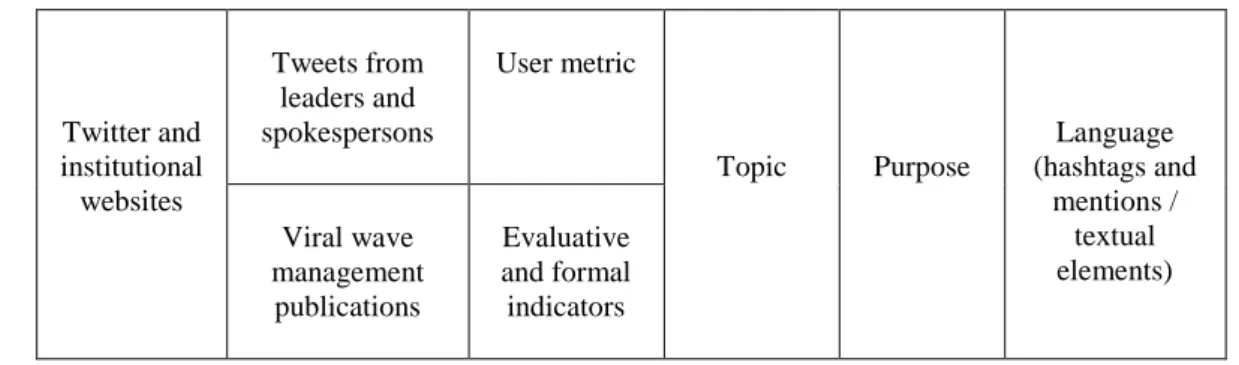
The sample is made up of all the tweets published by the aforementioned profiles, as well as web publications about Covid-19, to delimit the information chosen within the great communicative proliferation of institutional portals. Four keywords are used to carry out a search on them: "Covid- 19", "coronavirus", "pandemic", and "restrictions". We intend to know the interaction between public actors and citizens in the digital spaces of democracy, which the literature identifies as progressively more endogamous and asymmetric, according to the phenomenon of platformization (Colleoni et al., 2014; Smyrnaios and Rebillard, 2019). This is the reason why the quantitative/qualitative file (table 1) incorporates discursive elements to the analysis of the topic and the objectives (purpose) of the messages:
Table 1. Metric indicators and contingency variables of the multimodal analysis
Twitter and institutional websites
Tweets from leaders and spokespersons
User metric
Topic Purpose
Language (hashtags and
mentions / textual elements) Viral wave
management publications
Evaluative and formal indicators
Source: Self-made
The sample on Twitter is made up of 975 messages (tweets), distributed as follows: Seibert 224, Sánchez 312, Costa 250, and Johnson 189. In the case of publications, their size is smaller (n=427), divided more homogeneously: Bundesregierung 105, La Moncloa 107, República Portuguesa 91, and GOV.UK 124. Therefore, the volume by country is relatively similar, which allows comparisons to be drawn on the institutional communication exercised around the second wave of Covid-19.
This study includes the tweets and the responses of the candidates, but not the retweets, since their information does not necessarily connect with the agenda of the political actors (Larsson and Ihlen, 2015). The collection of the sample in this social network is carried out through the paid version of Twitonomy, subsequently being analyzed with the statistical software IBM SPSS Statistics, version 25. A specific file has also been developed with exclusive categories for the analysis units (table 2), whether they are tweets or web content, based on other research works on the social network Twitter (Carral and Tuñón-Navarro, 2020).
Table 2. Defined categories for content analysis (topics and objectives)
Topics Objectives of the message
1. Conspiracy theories 1. Publicize their political meetings 2. Foreign relations 2. Promote their presence in the media 3. Immigration / security 3. Promote agreements
4. Economy / industry and services sector
4. Announce legislative measures 5. Education 5. Assess the situation
6. Social services 6. Confront political rivals
7. Environment 7. Refer to issues of government’s strategy 8. Sanitary actions 8. Others
9. Political rivals 10. Events 11. Others
Source: Self-made
Concerning the qualitative study of language, on Twitter, the hashtags and profiles mentioned in the sample are analyzed, while in the publications of the websites the contents are evaluated in a similar selection through three variables defined as key: order and form, sense, and style (van Dijk, 2015).
As a general framework, critical discourse analysis is applied (Flowerdew and Richardson, 2017), which has also been used in transnational studies (Alonso-Muñoz and Casero-Ripollés, 2020). In this
way, the aim is to discuss the construction of these messages by public actors, relying later on quantitative findings related to communication topics and purposes.
4. Results
4.1. Description of the sample and qualitative analysis
The results on Twitter indicate that Sánchez, Costa, and Johnson present a fairly similar proportion between messages with a positive and neutral tone, marking their communication practices in the selected period. This bias analysis allows us to understand the setting in which a crisis has been managed. Johnson shows a slight predisposition for the positive approach (47.1% to 43.9%), while the Portuguese Costa orients balance to neutral positions (46.4% to 41.6%). Positive messages correspond to optimistic references, which highlight that health measures are giving good results or underline the hope that vaccines represent. For example, in a tweet on December 30th, 2020, Johnson claimed that AstraZeneca's approval was "fantastic news" and "a triumph of science", thus being categorized under a positive tone.
On the other hand, the neutral tone concerns those messages that do not apply optimistic views but do not include criticism or negative evaluations, identified as belonging to the negative approach. In this sense, the most differential behavior is experienced by the German spokesperson Seibert, who clearly prefers tweets with a neutral bias (62.9%). Examples of this are the messages that state the issues discussed in the meetings of the European Council, such as the one released on December 10th of that year: “Agreement of the European Council: budget, development fund, and conditionality mechanism agreed unanimously #EUCO " (translation to English). This reveals that the German strategy in this social network set aside the optimism in the face of the pandemic, observable in other political actors on the continent, and focused on the political agenda.
Graph 1: Distribution of the bias of the tweets according to the profile (%) Source: Self-made
By country, Steffen Seibert's account has a barely personal tone. The most referenced hashtags are very general, referring to the pandemic (#Corona) and the chancellor (#Merkel). There are also some thematic markers referring to vaccines (#Imfgung), digitization (#Digitalisierung), and, above all, the implementation of measures to alleviate the effects of the pandemic (#barrierefrei). Direct mentions are not usually displayed, although most of those detected refer to German federal bodies (@BMBF_Bund,
18,8
44,2 41,6 47,1
18,3
11,2 12 9
62,9
44,6 46,4 43,9
0 10 20 30 40 50 60 70
Steffen Seibert Pedro Sánchez António Costa Boris Johnson
T W I T T E R M E S S A G E B I A S
Positive Critical Neutral
BMJV_Bund, etc.). On the other hand, Bundesregierung's web content presents several publications that reflect citizens' feelings about the pandemic, posing in an informal style based on textual statements. The purpose is to raise public awareness, which is accompanied by numerous assessments of the situation by Merkel.
Regarding Spain, Pedro Sánchez's profile on Twitter is quite institutional, reviewing his daily activity and events (#DíaDelMigrante, #DíaDeLosDerechosHumanos). Therefore, there is no continuity in the used hashtags, although there is a higher use of those linked to the pandemic (#COVID19) and the European institutions (#EUCO). This connects with the mentions, more present in this case and directed to community figures (@MichelBarnier, @vonderleyen) or other European presidents (@EmmnuelMacron). This governmental aspect is repeated in the portal La Moncloa, where the action of the ministries to face the pandemic is highlighted. The structure of subject, verb, and predicate is predominantly followed, with an informative sense and a formal style (image 1). This institutional tone is a constant both in the analyzed web publications and in @sanchezcastejon, who, however, does occasionally incorporate more evaluative elements.
Image 1: Web publication of the Government of Spain about economic measures for recovery Source: La Moncloa, https://bit.ly/2Pu3Q8d
In Portugal, António Costa uses his Twitter account in a slightly less institutional way, with more apparently personal assessments of the situation, which is not an obstacle to a preponderance of hashtags related to the country itself (#Portugal), the pandemic (#COVID19), and the European project (#UE, #EUCO, #UE2021PT, #Brexit, #Bruxelas), while Portugal assumed the presidency of the Council of the EU in the following months of 2021 (image 2). The direct quotes to European figures (@vonderleyen, @Lagarde) are explained in this way, but the Portuguese government (@govpt) and the unions (@CGTP_In) are also warned, with Costa being the selected leader who most uses the possibility of mentions on Twitter. As for the government website República Portuguesa, it fulfills the classic function of announcing executive measures and providing the agenda of its components through a formal style. Consequently, its mission is institutional, although the use of personal quotes from ministers and videos that provide an individualized perspective stand out.
Image 2: Tweet by António Costa regarding a European meeting for the Recovery Plan Source: Twitter (@antoniocostapm), https://bit.ly/3rlkqos
For his part, Boris Johnson's use of Twitter can be interpreted as emotional and personal, full of qualifying adjectives. In this sense, terms such as "unforgettable", "unprecedented", "brilliant", or
"fantastic" are common. He does not use hashtags and mentions regularly, but is limited to specific moments such as international summits (#G20) or open question and answer sessions to the prime minister (#PeoplesPMQs), as well as to figures who at some point capture the attention, such as international leaders (@narendramodi) or pharmaceutical companies (@Pfizer, @AstraZeneca). The messages on the harshest issues of the virus are not accompanied by these expressive modalities, presenting only text. In fact, this is repeated in the GOV.UK portal. The updates about Covid-19 are exposed in schematic pieces, which distribute the data in points with a sober and simple style, evidencing an informative purpose.
This qualitative approach seeks to offer a first overview of how two possible mechanisms of democratic accountability were articulated during the set period (Twitter accounts and official web pages), revealing relevant lines of research. These findings are quantitatively contrasted below, while others are detected.
4.2. Topics and objectives of government communication
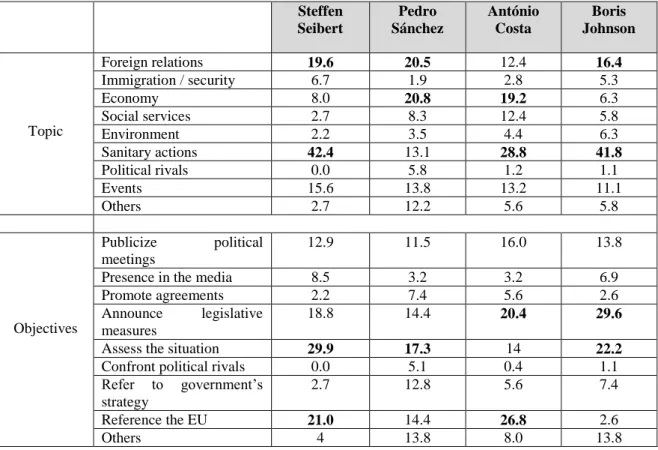
The analysis of the agenda and the purposes of the messages yield relevant data, reflecting divergences of interest. In the first place, the topic distribution of the tweets shows that most of the representatives focus on health actions as a result of the pandemic (Table 3): 42.4% of the messages in Seibert, 28.8%
in Costa, and 41.8% in Johnson. The only leader who does not place it between his two preferred subjects is Sánchez, who publishes more on foreign relations (20.5%) and the economy (20.8%). In any case, it is broadly in tune with the strategy of other leaders, since Seibert (19.6%) and Johnson (16.4%) also give great space to foreign relations, while Costa does so to the economy (19.2%). Furthermore, they all agree to dedicate more than 10% of their tweets to events. A fairly similar topic strategy is
denoted, except for a greater concern for economic issues in the personalities of the Iberian Peninsula, perhaps motivated by a higher financial impact of the Covid-19 crisis in these countries.
Table 3. Distribution of the tweets of institutional representatives according to their topic and objectives (%). * Percentages in bold indicate data highlighted for this study
Steffen Seibert
Pedro Sánchez
António Costa
Boris Johnson
Topic
Foreign relations 19.6 20.5 12.4 16.4
Immigration / security 6.7 1.9 2.8 5.3
Economy 8.0 20.8 19.2 6.3
Social services 2.7 8.3 12.4 5.8
Environment 2.2 3.5 4.4 6.3
Sanitary actions 42.4 13.1 28.8 41.8
Political rivals 0.0 5.8 1.2 1.1
Events 15.6 13.8 13.2 11.1
Others 2.7 12.2 5.6 5.8
Objectives
Publicize political meetings
12.9 11.5 16.0 13.8
Presence in the media 8.5 3.2 3.2 6.9
Promote agreements 2.2 7.4 5.6 2.6
Announce legislative measures
18.8 14.4 20.4 29.6
Assess the situation 29.9 17.3 14 22.2
Confront political rivals 0.0 5.1 0.4 1.1
Refer to government’s strategy
2.7 12.8 5.6 7.4
Reference the EU 21.0 14.4 26.8 2.6
Others 4 13.8 8.0 13.8
Source: Self-made
The similarities can also be seen in the objectives, but in this area, the disparity is slightly higher.
Seibert (29.9%) and Sánchez (17.3%) focus their messages on evaluating the situation. For their part, Costa (20.4%) and Johnson (29.6%) tweet more to announce legislative measures. However, these two purposes (evaluate and present actions) seem fundamental in the four leaders. Likewise, the dissemination of political meetings occupies prominent positions.
The item with the most heterogeneous volume of allusion is that of references to the EU. For Costa, it is his main objective (26.8%), followed by Seibert (21%). Both show an activity on Twitter that frequently cites the European Union in managing the pandemic. In contrast, Johnson hardly mentions the EU (2.6%), which is remarkable in the context of Brexit. The practices of the British Prime Minister fit more closely with those of the sample as a whole, which reveals a predilection for sanitary elements, with the aforementioned purposes of assessment and legislative proposals (image 3).
Image 3: Tweets by António Costa and Boris Johnson about legislative measures (objective) of sanitary actions (topic): vaccination plan and confinement regulations.
Source: Twitter (@antoniocostapm and @BorisJohnson), https://bit.ly/304zBXk, and https://bit.ly/382nDls
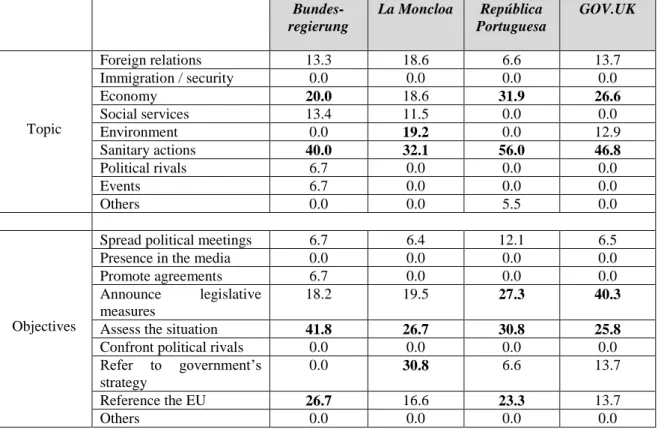
Institutional websites continue with the trend observed on Twitter. According to the data collected by our research (table 4), a predisposition towards sanitary actions is maintained, with higher percentages in government websites: 40% in Bundesregierung, 32.1% in La Moncloa, 56% in República Portuguesa, and 46.8% in GOV.UK. This entails a topic concentration on the websites, that is, a greater number of issues were addressed on Twitter with high volumes. The economy is once again the second preferred subject, with also higher percentages. The frequency of the environment in La Moncloa stands out here (19.2%), a fact not located in Sánchez's profile.
Table 4. Distribution of institutional web publications according to their topic and objectives (%). * Percentages in bold indicate data highlighted for this study
Bundes- regierung
La Moncloa República Portuguesa
GOV.UK
Topic
Foreign relations 13.3 18.6 6.6 13.7
Immigration / security 0.0 0.0 0.0 0.0
Economy 20.0 18.6 31.9 26.6
Social services 13.4 11.5 0.0 0.0
Environment 0.0 19.2 0.0 12.9
Sanitary actions 40.0 32.1 56.0 46.8
Political rivals 6.7 0.0 0.0 0.0
Events 6.7 0.0 0.0 0.0
Others 0.0 0.0 5.5 0.0
Objectives
Spread political meetings 6.7 6.4 12.1 6.5
Presence in the media 0.0 0.0 0.0 0.0
Promote agreements 6.7 0.0 0.0 0.0
Announce legislative measures
18.2 19.5 27.3 40.3
Assess the situation 41.8 26.7 30.8 25.8
Confront political rivals 0.0 0.0 0.0 0.0
Refer to government’s strategy
0.0 30.8 6.6 13.7
Reference the EU 26.7 16.6 23.3 13.7
Others 0.0 0.0 0.0 0.0
Source: Self-made
Regarding the objectives of web publications, a predominance of initiative announcements and, especially, evaluations of the situation are repeated. As in the case of topics, the percentages of these purposes are higher in institutional websites compared to Twitter, evidencing a concentration on certain items for said websites. A differential objective is the high volume of references to the EU in the German (26.7%) and Portuguese (23.3%) governments, something that corresponds to what was seen in the accounts of Seibert and Costa.
Another characteristic feature is the allusions to the government’s strategy on the La Moncloa website, which has become its most common goal (30.8%). This pattern, which consists of mentioning government priorities or analyzing compliance with the electoral program, was only observable at a lower level in Sánchez's profile on Twitter. This connects with a frame oriented towards thematic issues (62.2%), and markedly opinionative (63.5%) in the Spanish institutional website, according to our analysis of formal indicators (headlines) in the pieces about Covid-19 (Table 5). The inclination towards these factual components of politics can be seen in Bundesregierung (60%), although its typology is eminently informative (53.3%), presenting the lowest levels of evaluation, which is consistent with the neutral character located in the German spokesperson.
Table 5. Approach and typology of headlines on institutional websites (%). * Percentages in bold indicate data highlighted for this study
Bundes- regierung
La Moncloa República Portuguesa
GOV.UK
Headline
Focused on political personality
26.7 31.4 56.0 67.7
Focused on thematic issues
60.0 62.2 37.4 32.3
No clear object of attention
13.3 6.4 6.6 0.0
Type of headline
Informative 53.3 23.7 37.4 52.4
Interpretative 13.3 12.8 5.5 0.0
Opinionative / evaluative
33.3 63.5 57.1 47.6
Source: Self-made
On the other hand, the websites of República Portuguesa (56%) and GOV.UK (67.7%) tend to focus their information on political personalities, either the prime minister or members of his cabinet, with thematic figures that also exceed 30% in both cases. On the contrary, these countries differ significantly in the purpose of the headline, since in the United Kingdom an informative approach prevails (52.4%), something in line with the austere style commented on in the qualitative analysis.
In Portugal, the majority typology is evaluative (57.1%), which does not preclude having a relevant percentage of informative headlines (37.4%). Thus, the construction of the contents on the institutional websites presents divergences in the four selected countries, developing with different frames and purposes.
4.3. Information sources and citizens' interests
To complete the study, it is necessary to determine what is the degree of attention of citizens for the institutional messages and if it is related to the used strategies. Through the number of retweets, the results show that the interest of the audience in this social network does not correlate with the preferred objectives of the leaders (Table 6). The purposes that have the most retweets are the confrontation with political rivals (84.2% of their messages have over 300 interactions) and the allusion to the government's strategy (66.2%). It differs from the announcement of legislative measures (38.1%) and the assessment of the situation (47%), which were the two priority missions for leaders on Twitter. It should be noted that these variables present notable levels of appearance (33% and 25.3%, respectively) in the band with the least interaction between 1 and 49 retweets.
Our study of citizen attention on Twitter focuses on the objectives of the messages, which allows us to assess in-depth the motivations behind the tweets that generate more attention. We consider that in this case, this approach, based on the types of preferred messages, is more pertinent than topic analysis since it can be subject to fluctuations depending on the number of followers and events of an unexpected nature.
Table 6. Frequency of retweets according to the objective of the message (%). * Percentages in bold indicate data highlighted for this study
1-49 retweets
50-99 retweets
100-299 retweets
300 or more retweets
Spread political meetings 35.9 8.4 27.5 28.2
Presence in the media 36.0 16.0 10.0 38.0
Promote agreements 40.4 12.8 6.4 40.4
Announce legislative measures 33.0 7.7 21.1 38.1
Assess the situation 25.3 3.5 24.2 47.0
Confront political rivals 5.3 0.0 10.5 84.2
Refer to government’s strategy 12.2 5.4 16.2 66.2
Reference the EU 56.7 11.6 12.2 19.5
Others 18.4 3.1 26.5 52.0
Source: Self-made
Likewise, the high level of interaction of the category "others" (52% have over 300 retweets), linked to events such as the celebration of world days or anniversaries, is remarkable, since this has been the category that has contained all those topics. These are positive issues that involve a cascade of reactions, moving away from more political purposes. On the other hand, there is little interest in references to the EU, to the point that they represent the target with the most retweets in the lower echelon (56.75%). These messages about the Union refer to meetings such as those of the European Council (image 4), in which coordinated measures are drawn up for the management of the pandemic.
Image 4: Tweet by Steffen Seibert providing statements by Merkel after a European Council.
Source: Twitter (@RegSprecher), https://bit.ly/2MDyavO
The previous results denote that the citizen interest does not correspond to the political one in the framework of our research. This may connect with a structural disinterest in these issues, which would limit the impact of institutional communication (Jacobs and Wonneberger, 2019). In this direction, the volume of retweets per leader could be analyzed, but the significant variations in their number of
citizens and other actors in the configuration of communication strategies in their websites (table 7).
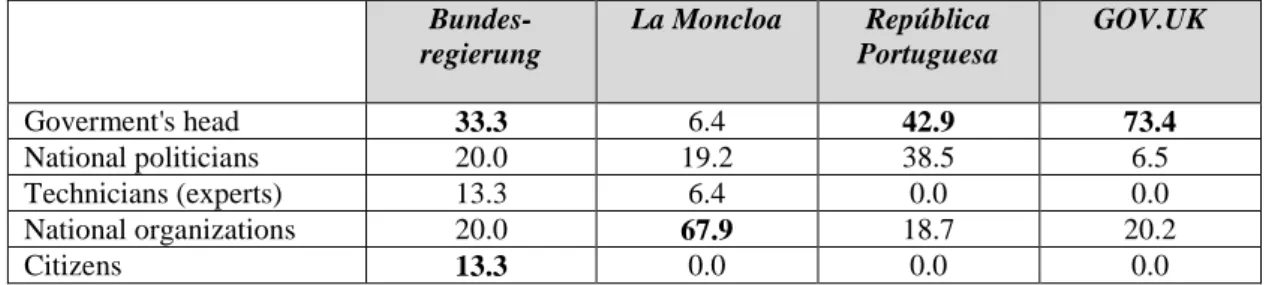
Heads of Government function as the main source of information in Bundesregierung (33.3%), República Portuguesa (42.9%), and GOV.UK (73.4%), that is, both Merkel and Costa and Johnson are articulated in the main source of data for web communication of their governments.
Table 7. Typology of preferred sources on each government website (%). * Percentages in bold indicate data highlighted for this study
Bundes- regierung
La Moncloa República Portuguesa
GOV.UK
Goverment's head 33.3 6.4 42.9 73.4
National politicians 20.0 19.2 38.5 6.5
Technicians (experts) 13.3 6.4 0.0 0.0
National organizations 20.0 67.9 18.7 20.2
Citizens 13.3 0.0 0.0 0.0
Source: Self-made
Compared to the previous trend, in La Moncloa, the national organizations prevail (67.9%). It is followed in proportion by national politicians such as ministers (19.2%), who also occupy prominent positions in Bundesregierung (20%) and República Portuguesa (38.5%), while the use of the head of Government in Spain is low (6.4%). Furthermore, national organizations prove to be a frequent source throughout the sample.
The variables that offer the greatest singularities are attributed to technical profiles (experts) and citizens. The experts appear in Bundesregierung (13.3%), and at a lower level in La Moncloa (6.4%).
As for citizens as an informative source, they are only referenced on the German portal (13.3%). Image 5 exemplifies their use for social awareness purposes, citing the personal experience of a young man who overcame Covid-19.
Image 5: German federal government web post about a personal experience with the virus.
Source: Bundesregierung, https://bit.ly/3bdMRPX
The individual's story is exposed in the first person, with personal data of the person involved, of which video statements and transcription of the most important enunciated aspects are provided. As has been commented, there is a desire to sensitize the population about the pandemic through common subjects identifiable with the public. This is relevant, given that the literature emphasizes the role of the audience in spreading what is false (Pérez-Curiel and Velasco Molpeceres, 2020), something that has been revealed in the “infodemic” spurred by Covid-19 (Nielsen et al., 2020).
Consequently, there is no appearance of citizens as objects of attention on institutional websites, after detecting on Twitter that their interests differ in part from those favored by the political class in the treatment of the pandemic. These findings, together with the preponderance of heads of government and national organizations as sources, invite us to reflect on the link between the communication implemented and the target audience.
5. Discussion and conclusions
In the context of health and economic crisis, the results obtained make it possible to answer the questions formulated to compare some of the communication actions of different European governments around the second wave of Covid-19. Concerning the first research question about whether digital messages are organized around the same topics, objectives, and discourses, differences of interest are observed by country. For the social network Twitter, the tone of Seibert (Germany) and Sánchez (Spain) is institutional, compared to the more personal character of Costa (Portugal) and Johnson (United Kingdom). However, the topic distribution of all these figures focus on health actions, the economy, and foreign relations, with slight differences in Sánchez. The purposes of these messages reflect a shared logic, which revolves around legislative announcements and assessment of the situation. References to the EU also emerge in this variable, notorious in the Portuguese and German cases. To all this is added the analysis of the tone as a communicative framework, very balanced between positive and negative biases in Sánchez, Costa, and Johnson. The German Seibert stands out from the aforementioned trend, with a preponderance of the neutral approach.
Regarding websites, their contents show differences for each of the four countries in the sample. The focus on political personalities from República Portuguesa and GOV.UK is channeled in the British case in an informative way, while the Portuguese portal bets on greater evaluative weight.
Bundesregierung and La Moncloa are inclined towards factual issues, although the German government shows a preference for the informational component and the Spanish government does so for the evaluative one.
As a second contribution, it is appreciated that there are adaptations of the institutional strategy depending on the tool (Twitter or website). Although the official portals continue with the dynamics of the social network, the topic concentration is higher in them. Health actions as issues and legislative measures and assessments of the situation in terms of objectives, reach higher percentages in web news, in turn demonstrating the plurality of communicative action on Twitter. The issues and purposes are repeated, but the concentration of the web contrasts with the fragmentation in this social network. Furthermore, there is an abundant use of the government's strategy in La Moncloa, not detected in Sánchez's profile.
As the third contribution in response to the correspondence between the disseminated content and the audience’s interests, there is an absence of correlation between the objectives of the messages shared by the leaders and those that achieve higher levels of attention according to the number of retweets.
and the allusion to government strategies, which do not coincide with the enunciation of measures and the assessment of the situation prioritized by the leaders. This is also observed in the references to the EU, common in Seibert and Costa, but which are the objective with the fewest retweets.
An additional element to highlight about the public is that citizens are hardly identified as sources in institutional websites, except for the German government. On the other hand, the heads of Government and other figures or institutions of an institutional nature monopolize the information flow in the estimated period of the pandemic. This causes a potential disconnection between citizens and their leaders, as can be deduced from the distribution of retweets by objectives, outside the leaders' preferred frameworks.
As a discussion, we consider that digital platforms’ potential for creating conversation has been underutilized from the institutional point of view, in line with previous research (Boerman and Kruikemeier, 2016). The topics and objectives are limited to classic tasks such as the announcement of proposals, linked here to the health field. However, joint findings of interest emerge, such as the abundant references to the EU by the German and Portuguese governments, from which a claim to propose a European solution to the pandemic is deduced. Other elements detected, such as allusions to the economy in the profiles of the Spanish and Portuguese leaders on Twitter, can be linked to the difficult situation suffered during the euro crisis (2010-2014) by those countries. This antecedent would function as an explanatory factor for economic concern from the institutional point of view.
Our research contributes to the current discussions on government communication management, showing that institutional websites present less plurality of topics and objectives than messages on Twitter. Added to this is the deficient connection with citizens’ interests. The digital and extended response by governments to Covid-19 also has differences between countries, depending on their political and media cultures. Evidence of this is the aseptic approach in Germany, the prevalence of political personalism in the United Kingdom, or the search for community solutions in the European States.
Scientific inquiries into the first wave of Covid-19 underscore the use of incongruous institutional communication in the face of the pandemic (Wang et al., 2021), which addressed a large amount of data without sufficient coherence. Heterogeneous approaches were also detected among European leaders in terms of recommended measures and the image transmitted on Twitter (Drylie-Carey et al., 2020). Faced with this, Internet consumers in countries like Spain prioritized content that appealed to empathy (Losada Díaz et al., 2020). This would explain the personalistic actions, typical of cultural celebrities, of leaders like Sánchez during the first phase of the pandemic (Manfredi- Sánchez et al., 2021) when the messages were focused on the health issue.
On the other hand, the results presented here for the second viral wave suggest certain changes, since the communication of the four leaders not only refers to health aspects but also economic ones.
Attempts are observed to provide proposals or solutions that improve the situation that citizens are going through, while heads of government like Sánchez move towards a more institutional profile. In any case, important divergences still exist between the communication applied by the different European governments. Furthermore, the lack of citizen interest in political issues may imply an added difficulty in achieving credibility and transparency, established as fundamental values in the communicative management of Covid-19 (Ataguba and Ataguba, 2020). The arrival of vaccines at the end of the analyzed cycle is another component to consider in the evolution of institutional communication (Warren and Lofstedt, 2021).
A limitation of our study is that it serves a limited sample, restricted to a singular moment. Precisely this exceptional character attributes interest to the studied period, but research extended over time would be necessary to verify the validity of the observed trends. Second, this proposal lacks tools to assess the impact of these governments on public discussion, something that could be used to determine the possible cause-effect relationship with the attention generated in the audience. Instead, it has been advocated to disaggregate the communicative action in tweets and websites, comparing it with two elements of interaction and participation.
In summary, this study reveals the characteristics and possible limitations of various strategies implemented in the second wave of Covid-19, at the same time that it identifies shared and differentiated patterns in countries belonging to a joint geographic space such as Europe. Digital platforms, be they social networks or ad hoc institutional websites, can function as mechanisms for democratic accountability, hence it is necessary to continue deepening their configuration at times of enormous social significance.
6. References
Aharony, N. (2012). Twitter use by three political leaders: an exploratory analysis. Online Information Review, 36(4), 587-603. https://doi.org/10.1108/14684521211254086
Alonso-Muñoz, L. y Casero-Ripollés, A. (2020). Populism against Europe in social media: The Eurosceptic discourse on Twitter in Spain, Italy, France, and United Kingdom during the campaign of the 2019 European Parliament election. Frontiers in Communication, 5(54).
https://doi.org/10.3389/fcomm.2020.00054
Ataguba, O. A. y Ataguba, J. E. (2020). Social determinants of health: the role of effective communication in the COVID-19 pandemic in developing countries. Global Health Action, 13(1), 1788263. https://doi.org/10.1080/16549716.2020.1788263
Barroso Simao, L., Gouveia Rodrigues, R. y Madeira, M. J. (2016). External relationships in the organizational innovation. RAI - Revista de Administração e Inovação, 13(3), 156-165.
https://doi.org/10.1016/j.rai.2016.06.002
Bennett, W. L. y Livingston, S. (2018). The disinformation order: Disruptive communication and the decline of democratic institutions. European Journal of Communication, 33(2), 122-139.
https://doi.org/10.1177/0267323118760317
Bimber, B. y Gil de Zúñiga, H. (2020). The unedited public sphere. New Media & Society, 22(4), 700-715. https://doi.org/10.1177/1461444819893980
Brantner, C. y Pfeffer, J. (2018). Content analysis of Twitter - big data, big studies. En: S. Elridge II y B. Franklin (Eds.), The Routledge Handbook of Developments in Digital Journalism Studies (79-92). Taylor & Francis.
Boerman, S. C. y Kruikemeier, S. (2016). Consumer responses to promoted tweets sent by brands and political parties. Computers in Human Behavior, 65, 285-294.
https://doi.org/10.1016/j.chb.2016.08.033
Broersma, M. y Graham, T. (2013). Twitter as a news source: How Dutch and British newspapers used tweets in their news coverage, 2007-2011. Journalism Practice, 7(4), 446-464.
https://doi.org/10.1080/17512786.2013.802481
Bruns, A., Enli, G., Skogerbö, E., Larsson, A. y Christensen, C. (Eds.) (2016). Routledge Companion to Social Media and Politics. Routledge.
Burgueño, J. M. (2014). Comunicación institucional para periodistas. Manual práctico de comunicación y relaciones públicas. UOC.
Callejo, J. (2010). Introducción a las técnicas de investigación social. Universitaria Ramón Areces.
Campos-Domínguez, E. (2017). Twitter y la comunicación política. El profesional de la información, 26(5), 785-793. https://doi.org/10.3145/epi.2017.sep.01
Carral, U. y Tuñón-Navarro, J. (2020). Estrategia de comunicación organizacional en redes sociales:
análisis electoral de la extrema derecha francesa en Twitter. Profesional de la información, 29(6), e290608. https://doi.org/10.3145/epi.2020.nov.08
Casero-Ripollés, A. y García-Gordillo, M. (2021). La influencia del periodismo en el ecosistema digital. En: L. M. Pedrero-Esteban y A. Pérez-Escoda (Coords.). Cartografía de la comunicación postdigital: medios y audiencias en la sociedad de la COVID-19 (157-176). Thomson Reuters Aranzadi Civitas.
Castillo-Esparcia, A., Moreno, A. y Capriotti-Peri, P. (2020). Relaciones públicas y comunicación institucional ante la crisis del COVID-19. Revista Internacional de Relaciones Públicas, 10(19), 1-6. http://dx.doi.org/10.5783/RIRP-19-2020-01-01-06
Chadwick, A. (2017). The hybrid media system. Politics and power. Oxford University Press.
Colleoni, E., Rozza, A. y Arvidsson, A. (2014). Echo chamber or public sphere? Predicting political orientation and measuring political homophily in Twitter using big data. Journal of Communication, 64(2), 317-332. https://doi.org/10.1111/jcom.12084
Cornelissen, J. (2008). Corporate communication: A guide to theory and practice. Sage.
Crilley, R. y Gillespie, M. (2019). What to do about social media? Politics, populism and journalism.
Journalism, 20(1), 173-176. https://doi.org/10.1177/1464884918807344
D’Heer, E. y Verdegem, P. (2015). What social media data mean for audience studies: a multidimensional investigation of Twitter use during a current affairs TV programme.
Information, Communication & Society, 18(2), 221-234.
https://doi.org/10.1080/1369118X.2014.952318
Díez Garrido, M., Campos Domínguez, E. y Calvo, D. (2019). La transparencia de los partidos políticos como estrategia electoral. Una evaluación de sus promesas y sus páginas web. Trípodos, 44, 83-104.
Drylie-Carey, L., Sánchez-Castillo, S. y Galán-Cubillo, E. (2020). European leaders unmasked:
Covid-19 communication strategy through Twitter. Profesional de la información, 29(5), e290504. https://doi.org/10.3145/epi.2020.sep.04
Engesser, S., Ernst, N., Esser, F. y Büchel, F. (2017). Populism and social media: how politicians spread a fragmented ideology. Information, Communication & Society, 20(8), 1109-1126.
https://doi.org/10.1080/1369118X.2016.1207697
Enli, G. (2017). Twitter as arena for the authentic outsider: Exploring the social media campaigns of Trump and Clinton in the 2016 US presidential election. European Journal of Communication, 32(1), 50-61. https://doi.org/10.1177/0267323116682802
Fernández Crespo, M. (2014). Metodología para el análisis de las redes sociales. En: R. Cotarelo y J.
A. Olmeda (Eds.), La democracia del siglo XXI. Política, medios de comunicación, internet y redes sociales (383-408). Centro de Estudios Políticos y Constitucionales.
Fletcher, R., Cornia, A. y Nielsen, R. K. (2020). How polarized are online and offline news audiences? A comparative analysis of twelve countries. The International Journal of Press/Politics, 25(2), 169-195. https://doi.org/10.1177/1940161219892768
Flowerdew, J. y Richardson, J. E. (2017). The Routledge Handbook of Critical Discourse Studies.
Routledge.
Gainous, J. y Wagner, K. M. (2014). Tweeting to power: The social media revolution in American politics. Oxford University Press.
Geise, S., Panke, D. y Heck, A. (2021). Still images-moving people? How media images of protest issues and movements influence participatory intentions. The International Journal of Press/Politics, 26(1), 92-118. https://doi.org/10.1177/1940161220968534
Hallin, D. C. y Mancini, P. (2004). Comparing media systems. Three models of media and politics.
Cambridge University Press.
Hancu-Budui, A., Zorio-Grima, A. y Blanco-Vega, J. (2020). Audit institutions in the European Union: Public service promotion, environmental engagement and Covid crisis communication through social media. Sustainability, 12(23), 9816. https://doi.org/10.3390/su12239816
Hanusch, F. y Hanitzsch, T. (2017). Comparing journalistic cultures across nations. Journalism Studies, 18(5), 525-535. https://doi.org/10.1080/1461670X.2017.1280229
Hermida, A. y Mellado, C. (2020). Dimensions of social media logics: Mapping forms of journalistic norms and practices on Twitter and Instagram. Digital Journalism, 8(7), 864-884.
https://doi.org/10.1080/21670811.2020.1805779
Jacobs, S. y Wonneberger, A. (2019). Dealing with increasing complexity: media orientations of communication manager in public sector organizations. International Journal of Communication, 13, 918-937.
Jungherr, A. (2016). Twitter use in election campaigns: A systematic literature review. Journal of
Information Technology & Politics, 13(1), 72-91.
https://doi.org/10.1080/19331681.2015.1132401
Kreiss, D. y Mcgregor, S. C. (2018). Technology firms shape political communication: The work of Microsoft, Facebook, Twitter, and Google with campaigns during the 2016 U.S. presidential cycle. Political Communication, 35(2), 155-177. https://doi.org/10.1080/10584609.2017.1364814 Krippendorff, K. (2012). Content analysis: An introduction to its methodology. Sage.
Kruikemeier, S., van Noort, G., Vliegenthart, R. y de Vreese, C. H. (2013). Getting closer: The effects of personalized and interactive online political communication. European Journal of Communication, 28(1), 53-66. https://doi.org/10.1177/0267323112464837
Langer, A. I. y Gruber, J. B. (2021). Political agenda setting in the hybrid media system: why legacy media still matter a great deal. The International Journal of Press/Politics, 26(2), 313-340.
https://doi.org/10.1177/1940161220925023
Larsson, A. O e Ihlen, Ø. (2015). Birds of a feather flock together? Party leaders on Twitter during the 2013 Norwegian elections. European Journal of Communication, 30(6), 666-681.
https://doi.org/10.1177/0267323115595525
Losada Díaz, J. C., Rodríguez Fernández, L. y Paniagua Rojano, F. J. (2020). Comunicación gubernamental y emociones en la crisis del Covid-19 en España. Revista Latina de Comunicación Social, 78, 1-18. https://doi.org/10.4185/RLCS-2020-1467
Manfredi-Sánchez, J.-L., Amado-Suárez, A. y Waisbord, S. (2021). Presidential Twitter in the face of COVID-19: Between populism and pop politics. Comunicar, 29(66), 79-90.
https://doi.org/10.3916/C66-2021-07
McAllister, I. (2007). The personalization of politics. En: R. J. Dalton y H. D. Klingemann (Eds.), The Oxford Handbook of Political Behaviour (571-588). Oxford University Press.
Nielsen, R. K., Fletcher, R., Newman, N., Brennen, J. S. y Howard, P. N. (2020). Navigating the
‘infodemic’: how people in six countries access and rate news and information about coronavirus.
Reuters Institute for the Study of Journalism, University of Oxford.
Pérez-Curiel, C. y Velasco Molpeceres, A. M. (2020). Impacto del discurso político en la difusión de bulos sobre Covid-19. Influencia de la desinformación en públicos y medios. Revista Latina de Comunicación Social, 78, 86-119. https://doi.org/10.4185/RLCS-2020-1469
Rebolledo, M., Zamora-Medina, R. y Rodríguez-Virgili, J. (2017). Transparency in citizen participations tools and public information: A comparative study of the Spanish city councils’
websites. El profesional de la información, 26(3), 361-369.
https://doi.org/10.3145/epi.2017.may.02
Rivas-de-Roca, R., García-Gordillo, M. y Bezunartea-Valencia, O. (2020). The far-right’s influence on Twitter during the 2018 Andalusian elections: an approach through political leaders.
Communication & Society, 33(2), 227-242. https://doi.org/10.15581/003.33.2.227-242