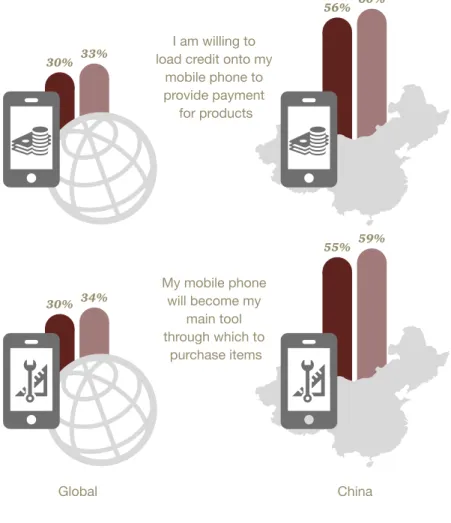
In other words, what Chinese consumers are doing today, shoppers in the rest of the world will be doing in the not too distant future. Projecting from relative trends in recent years, we can expect the world to follow Chinese shopping behavior. As Figure 1 illustrates, in the past four surveys we have asked how often respondents have shopped online.
If online shoppers around the world follow Chinese consumers again in the coming year, we will see a huge increase in the use of mobile payments worldwide. This year, for the first time, we asked what would drive our global sample to buy from an online retailer abroad in the next 12 months. The two highest-income households in each of our surveyed countries plan to buy from an online retailer abroad for better prices in the next 12 months.

Store traffic doesn’t matter as much as overall customer conversion across channels
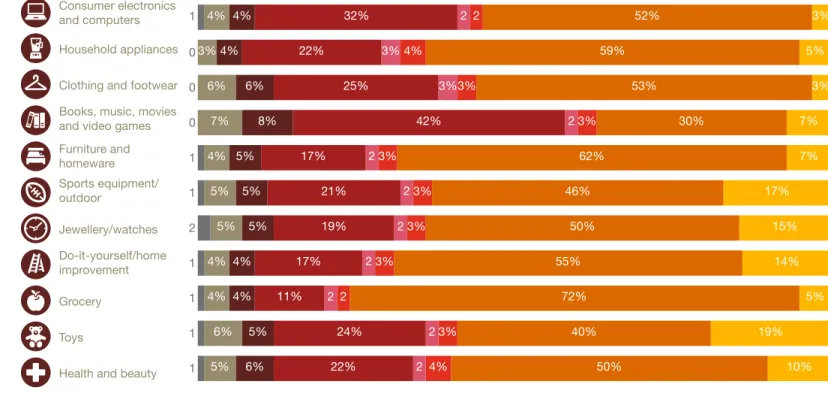
Entertainment electronics and computers Household appliances Clothing and footwear Books, music, movies and video games Home furniture and equipment Sports equipment/. Next generation wearables (watch, glasses, pens) Online via mobile phone or smartphone Online via tablet. Online via PC TV Shopping Catalog/Magazine In Store Do not explore/buy this category.
In fact, even in those product categories where shoppers clearly prefer to research online, such as in consumer electronics and computers, home appliances, and clothing and footwear, many still like to go to a store to buy the product. Just 29% of our global sample prefer to do their research in a physical store, but 52% prefer to shop in a physical store. For example: flagship experiential stores, destination malls, specialist stores and pop-up stores make it very clear to the shopper what their respective purpose is so that customer expectations are more likely to be met.
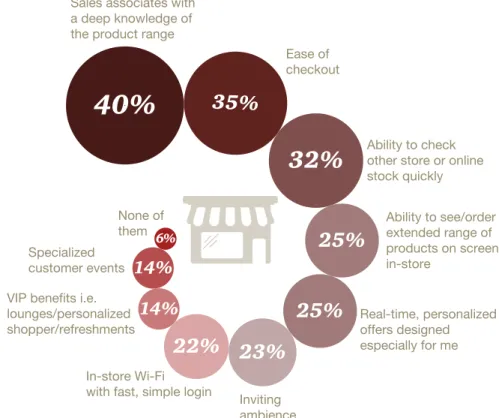
Consumer Electronics & Computers Home Appliances Clothing & Shoes Books, Music, Movies & Video Games Furniture & Home Appliances Sports Equipment/. What shoppers say is the key to an in-store experience that can get the most out of a trip to the store. When we asked our global sample what would make the in-store shopping experience better, the most popular responses suggested a host of changes retailers could make to improve their brick-and-mortar stores.
Another angle we explored is the in-store experience, focused on mobile and how consumers want to use it within the four walls of the store. 6 Ease of checkout" was created by combining the options "self-service checkout" and "sales associates who can take payment without going to the cashier".
Retail talent (finally) matters
By far the factor that would make the experience in the store better is sales staff with a deep knowledge of the product range, at 40%; another important option for consumers was the ability to quickly check other stores or online stores. Companies like Apple and Nike's commitment to in-store customer service and nurturing experienced, knowledgeable employees have raised the bar for retailers everywhere. Research from current and former Wharton academics confirms that customer service and employee training can have a positive impact on both customer satisfaction and sales.
One study found that, among other operational variables, store staff (as measured by payroll records) and customers' assessments of employee knowledge affect customer satisfaction and sales.7 Another study examined educational attainment of Dillard sales associates. Experticity, a source of online training models, found that each training module completed increased a sales associate's sales by 1.8%.8 Figure 10 shows consumers' desire for helpful, knowledgeable store associates in a different way. No less than four of the top five answers given related to store employees: better aftercare/.
7 Fisher Marshall L., Jayanth Krishnan and Serguei Netessine (2006), Retail Wound Execution: An Empirical Study, http://knowledge.wharton.upenn.edu/. For retailers, a thorough understanding of the market is important for effective investments in sales associate training and customer service. In some countries (UK, France, Japan, Italy), customer service is listed below as a factor in creating a great shopping experience.
But in Thailand, China and the Middle East, for example, customers rank customer service relatively higher as a driver of their preferred retailer perception. In other countries (Germany, Spain and Chile), customer service has a huge impact on the perception of the retailer of choice, and improved service would improve both the in-store experience and local retailer preference.

Mobile devices have turned the corner as purchasing tools
But it's not until we look at shopping behavior in emerging versus established markets that the bright future of mobile shopping really becomes clear.11. High Street” and with a much lower percentage of PC owners than in established countries, consumers in emerging markets have made the transition to mobile phones and are choosing them as their preferred shopping channel. And looking at how often online shoppers buy products on their mobile at least once a month, the gap widens significantly.
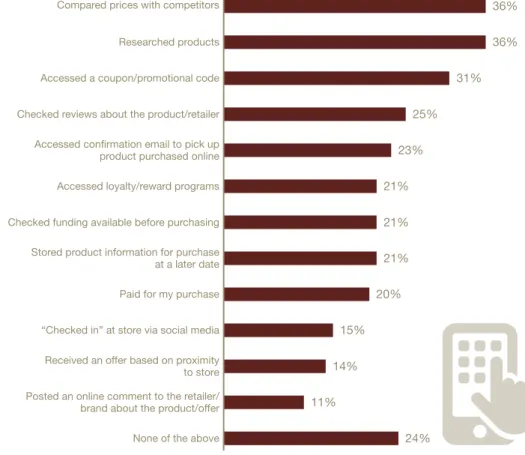
Thirty-five percent of respondents in emerging markets buy products on their mobile at least once a month, compared to 22% of respondents in established markets. However, consumers from emerging countries are still more willing to top up their mobile phones and save their delivery information in an app. Twenty-seven percent of shoppers in emerging markets paid for in-store purchases using a mobile phone, while only 13% of shoppers in established markets did so.
Perhaps the best overall illustration of this move into mobile is to look back a few years to see how respondents answered the question, "How often do you buy products through the following shopping channels?" Figure 12 shows that in the mobile/smartphone category the biggest change occurred in the 'Never' category. The aim of the Studio is to quickly create new digital products, services and experiences for Zalando's online customers. While the number of respondents who shop on their mobile phone only once a year has remained stable at 7%.
Part of the reason consumers try and stick with mobile shopping is the increasing ease of use. Twenty-four percent of millennials said they paid for purchases on their mobile phone compared to 16% for all others, 23% accessed their loyalty/rewards program compared to 18% for all others, and 26%.

Today’s consumers look to community
In fact, behind the most popular answers to the question we asked about loyalty programs were other data that suggest a desire for higher levels of customization and unique, exclusive benefits. From a geographic perspective, if the effect of the China leading indicator discussed earlier in this report can be applied to loyalty programs, expect much less consumer focus on rewards points and shipping in the future, as Chinese online shoppers value access to special member events . (32%) and personalized marketing (36%) offer much more than their global peers. Many retailers are betting that the desire for community among shoppers will only become more pronounced.
For example, the high-end American department store chain Nordstrom, with a well-deserved reputation for innovation, has created strong customer engagement through the popular social medium Pinterest. Tesco - The UK grocer is 'recycling' retail space into a more welcoming environment in its large stores, with cafes, nail bars, gyms and communal areas. Its "Rapha Cycle Club" offers limited edition products, access to off-the-beaten-track cycling routes and an international cycling concierge service for questions and local information.
The club has also established a global network of meeting places - often cafes selling the Rapha collection - for like-minded cyclists. Waitrose - This chic British supermarket has launched its own cooking website, Waitrose Kitchen, invitingly. Due to the success of Waitrose Kitchen, Waitrose Florist and Waitrose Cellar were also introduced, creating a one-stop shopping experience for this customer community.
—The iconic Swedish retailer has empowered "IKEA fans" who interact through its own blogs and other forums throughout IKEA's social community, organizing posts by room (e.g. kitchen) or interest (e.g. green living) . Sport Chek—This Canadian sports apparel and equipment company filmed nine basketball mini-documentaries in nine different Toronto neighborhoods and showed the pieces in its.

Social media is the “great influencer”
For example, in Denmark only 22% of survey participants are influenced by reading reviews, comments and feedback, while in Malaysia it is 69%. This year is also the first time in the history of this survey that we have seen a significant increase in the number of online shoppers purchasing directly via a social media channel. Sixteen percent of our survey sample said they buy products this way, an increase of 9% since the 2014 survey.
When discussing social media, our data illustrates that geography and age are big factors. Consumers in emerging markets are much more influenced by social media (92%) than consumers in established countries (66%). Moreover, when it comes to valuing the brand due to social media interactions, another huge gap is visible.
Eighty percent of emerging market online shoppers who had interactions on social media valued the brand more, while only 47% of established market online shoppers did. At around age 45, our global sample of consumers' shopping behavior starts to become less influenced by social media. This is also the age when our respondents begin to report fewer total interactions with their favorite brands on social media.
We'd expect this dynamic to change in the coming years, however, as Millennials (ages 18-34) and those in their mid-30s—buyers who have had a decade or more of experience with social media—.

There is room for retailers to grab the “leading innovator” mantle
The problem for retailers is the small percentage of respondents who believe their preferred retailer is innovative enough to be a "leading innovator." No category topped 17%, and only 10% of respondents said social media and sustainability were categories where their favorite retailer is a leading innovator. Given how active the world's online shoppers are on social media, retailers will surely want to improve here. Perhaps consumers are setting the bar extremely high for social media innovation, in which case retailers simply have more room to improve.
For those retailers who can afford to invest, there is plenty of room to become known as a leading innovator.