Access to the content of the doctoral thesis and its use must respect copyright. In any case, when using its content, the full name of the author and the title of the thesis must be clearly indicated. A thesis submitted in fulfillment of the requirements for the degree of Doctor of Philosophy in Law, Economics and Business.
The research was conducted to investigate and understand the relationship between leadership styles and their behavior with organizational outcomes, job involvement and the generational differences of the sample studied. The scope of the study was limited to 167 employees of 7 different multinational companies and of 31 different nationalities. They love to nurture the intelligence of teams and encourage the curiosity and bold moves of the employees.
RESUM (CATALAN VERSION)
Finalment, la correlació del tercer estudi va mostrar que tots els comportaments transformacionals (5I) tenien una correlació forta i positiva amb la satisfacció laboral a través de les generacions, i l'anàlisi de regressió múltiple va indicar que els trets idealitzats i l'estimulació intel·lectual van promoure un augment positiu significatiu de la satisfacció dels mil·lenaris en comparació amb no empleats. -millennials. Els resultats de la tesi van aportar contribucions importants i originals per validar i ampliar l'evidència dels beneficis de l'estil i comportaments transformacionals en el lideratge d'equips multiculturals i multigeneracionals amb èxit. L'abast de l'estudi es va limitar a 167 empleats de 7 empreses multinacionals diferents i 31 nacionalitats diferents.
Finalment, cal esmentar que les dades es van obtenir abans de l'impacte de la COVID-19. Per a estudis futurs, seria interessant recollir dades un cop l'impacte de la COVID-19 s'hagi estabilitzat per a totes les comunitats i després confirmar si l'impacte va comportar un possible canvi en la tendència de lideratge. La tesi conclou que l'estil de lideratge transformacional és el que influeix més positivament de manera significativa i que és un indicador positiu sobre els resultats organitzatius, el compromís laboral i la satisfacció dels empleats mil·lenaris.
KEYWORDS
JEL CLASSIFICATION
PUBLICATIONS DURING THE PHD DEGREE
Quartiles and SJR categories: Q2 Law / Q3 Business and International Management / Q3 Information Systems and Management / Q3 Public Administration / Q3 Sociology and Political Science / Q3 Strategy and Management. Quartiles and SJR Categories: Q2 Law / Q3 Business and International Management / Q3 Information Systems and Management / Q3 Public Administration / Q3 Sociology and Political Science / Q3 Strategy and Management.
ACKNOWLEDGMENTS
LIST OF ABBREVIATIONS
INTRODUCTION
Introduction
This chapter presents basic definitions and general concepts of management, the various management theories, methods and instruments and finally a deep dive into the concepts of organizational performance, work engagement, the millennial generation and the demographic profile.
Defining Leadership and leader
General leadership theories
- Great men theory
- Trait theories
- Behavioral theories
- Contingency Theories
- Process Theories
- Relational Theories
- Transactional Theory
- Transformational Theory
- Future rising theories
From the limitations of the theory of great men, the theory of leadership traits was born in the 20th century (Kirkpatrick & Locke, 1991). The limitations of the great man theory and the trait theory gave rise to the behavioral theory of leadership (1940). The role of the leader in path-goal theory is to increase the follower's goal attainment by making the path to the goal more attainable (by clarifying the goal and the path), by increasing the attractiveness of the goal, by reducing obstacles along the way, and by increasing opportunities for gratification along the way (House, 1996).
One of the most studied models is the servant leadership theory, which focuses on the needs of followers and helps them become more autonomous, freer and knowledgeable (Greenleaf, 1996). The dominant approach within relational theories is leader-member exchange (LMX) theory (Graen et al., 1982), which looks at how the quality of the relationship between a leader and a follower affects a number of outcomes. Leadership theories, from the late 1970s and early 1980s, began to shift away from specific perspectives of the leader, the leadership context, and the follower, and moved toward practices that focused more on the exchanges between followers and leaders.
Introduction of the full-range leadership model
- The full-range leadership model
These theories lacked the sophistication to build greater contingency of leaders due to the inability to explain leadership distraction (Timothy et al., 2003). The full leadership model involves leadership beyond the scope of a leader's behavior or attitude (Randolph, 2021). The whole leadership theory (Bass & Avolio, 1994) states that successful leaders use three styles of leadership in combination (Antonakis et al., 2003).
All in all, the full-range lead analyzes the characteristics of the three styles mentioned that are divided into nine factors. Finally, the passive avoidance style is divided into two factors: management by exception passive and hands-off leadership or laissez-faire (Antonakis et al., 2003; Antonakis & House, 2014). The full leadership model is representative of leaders who use a variation of the nine factors to lead their employees (see Appendix III).
The meaning of work engagement
It also involves the use of corrective criticism, negative feedback and negative reinforcement for non-compliance or lack of performance (Northouse, 2019). Third, the passive-avoidance style is characterized by leaders who avoid decision-making, providing rewards and providing positive or negative feedback to their employees, with the leader clearly abdicating responsibility to others (Bass & Avolio, 1997; Mester et al. , 2003). Second, the transactional style is divided into two factors: management by exception active and contingent reward (Geier, 2016).
The majority of studies have adopted a between-person approach, showing that there are average level differences in work engagement between individuals as a function of work conditions, personal characteristics and behavioral strategies (Bakker et al., 2014). However, research over the past decade has shown that work engagement can also vary within people - across time and situations. For example, research has shown that workers are most engaged during a challenging two-hour work episode (Reina-Tamayo et al., 2018), during workdays preceded by evenings when workers have recovered well (Sonnentag, 2003) and during workdays when they have access to a variety of resources (Bakker, 2014).
Millennial influence on work environment
Summary of research
Thesis aims
Methodology 1. Introduction
- Demographic profile
- Multifactor Leadership Questionnaire
- Full-range leadership model and MLQ
- Organizational outcomes based on MLQ
- Utrecht Work Engagement Scale
- The General framework
- Statistical tools used to analyze the data
Leadership style in group management is assessed by the Multifactorial Leadership Questionnaire (Bass & Avolio, 1997), an instrument based on the full range leadership model. The full range leadership model by Bass and Avolio (2004) proposes that leadership behavior ranges along a continuum from passive avoidance leadership to transactional leadership to transformational leadership (see Appendix III). Systematic reviews of the literature indicate that the UWES has been applied almost exclusively as a valid basis for developing work engagement interventions (Knight et al., 2017).
However, additional studies of the UWES-3 are needed to ensure the continuity of its use and the cross-cultural interpretation of its measurement validity (Soto et al., 2022). Both the long and short versions of the UWES cover all three theoretically posited dimensions: power, commitment. In the 9-item version of the UWES, each dimension is covered by three items, while in the 17-item version, liveliness is covered by six items, commitment by five items, and absorption by six items (Schaufeli et al., 2002).
Justification of the investigation
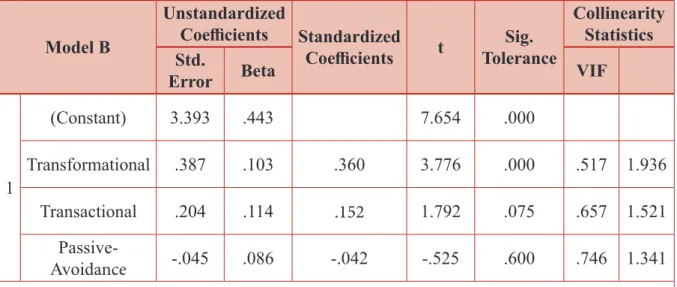
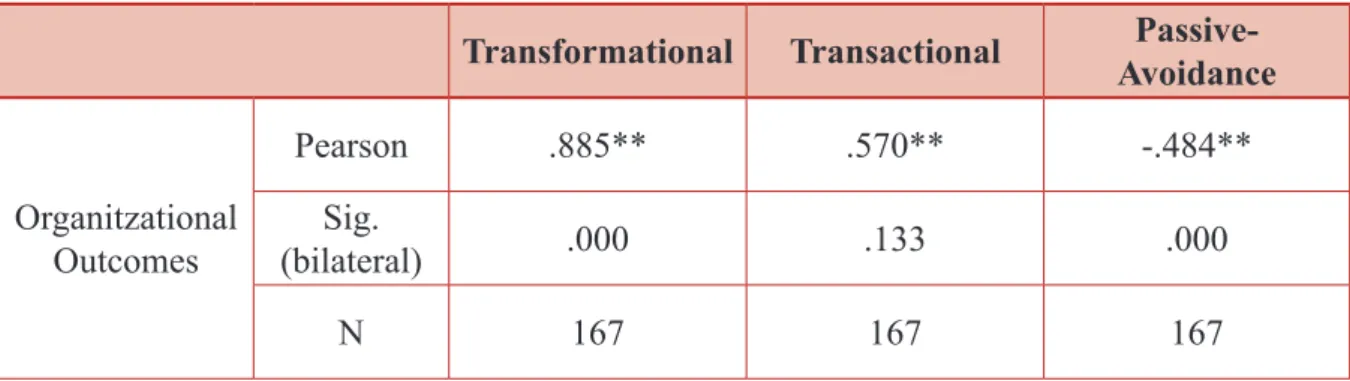
The purpose of this article is to examine the relationship between leadership styles and organizational outcomes (in terms of effectiveness, job satisfaction and extra effort). One of the most validated theories is "The Full-range Model of Leadership" (Bass & Avolio, 1994) and the Multifactor Leadership Questionnaire (MLQ) from Bass and Avolio (2004). The purpose of the quantitative study was to investigate the extent to which leadership styles are associated with employees' perception of their manager's influence on organizational results (efficiency, job satisfaction and extra effort) and to understand which leadership style (Transformational, Transactional or Passive-Avoidance) has a significant correlation and encourages a positive increase in organizational performance to help and advise the future leaders and managers.
A suggestion for further analysis is to check each style dimension (Contingent Reward, Management by Exception (Active). The scope of the study is limited to a sample of 167 employees from 7 different multinational companies and 31 different nationalities. Studies have shown that one of the most critical factors to have better work engagement is leadership (Rao et al., 2020).
One of the most validated models is "The Full-range Model of Leadership" (Bass & Avolio, 1994). Mean calculation, bivariate correlation and multiple regression analysis were assessed to understand the perception and relationship between management behaviors on work engagement. The first objective of this study was to determine the relationship between leadership styles and employee engagement.
The aim of the paper is to determine which leadership style and behavior have the most positive effect on the satisfaction of millennials when working in a multinational environment and to understand the differences between millennials and non-millennials. In fact, the transformational style is derived from the “Full Scale Model of Leadership” (Bass & Avolio, 1994). The aim of the study is to prove whether the transformational style has the most positive impact on millennial job satisfaction compared to the transactional style and the passive avoidance style.
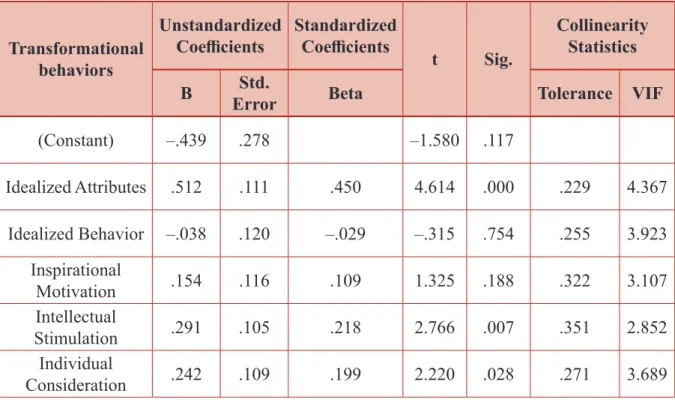
Out of the 45 questions in the MLQ, the concrete case study analyzed 22 questions that only focused on the transformational leadership style. Averaging the perceived transformational behaviors (5I's) shows that inspirational motivation has the highest mean for millennials (3.93) and non-millennials (3.85). The purpose of the study was to determine the correlation or relationship between leadership styles and millennial job satisfaction.
Main results and discussion with the literature
Strengths, limitations and directions for future research
Conclusions
Managerial implications
The manager must focus on the long-term direction of the company and commit to the vision and value of the organization. The manager must provide emotional and physical support to the employee and have the ability to solve the problem immediately. The manager must know the skills and preferences of each employee in order to delegate the task accordingly and develop or design the correct career paths for each employee.
A leader should intellectually stimulate employees by empowering them to explore a new way of creating solutions. A leader must provide motivation to new generations such as millennials to feel important to the organization. A leader should encourage employees to make bold moves and feel comfortable accepting failure and challenging the problem again.
Training and mentoring programs should be provided to managers, especially on the subject of developing EQ, giving feedback (verbal skills) and introducing innovative thinking. The manager should identify the right moments to give positive or negative feedback to the employee. The manager should request that a transformational leadership culture program be implemented throughout the company, starting with top management and executives.
What is your gender?
In which year were you born?
In which country were you born?
What is the highest degree or level of school you have completed? If currently enrolled, highest degree received
In which department are you working?
How many companies have you worked for?
How long you have been working within Hewlett Packard?
My manager/supervisor provides me with assistance in exchange for my efforts 1 - Not at all
My manager/supervisor re-examines critical assumptions to question whether they are appropriate
My manager/supervisor fails to interfere until problems become serious 1 - Not at all
My manager/supervisor focuses attention on irregularities, mistakes, exceptions, and deviations from standards
My manager/supervisor avoids getting involved when important issues arise 1 - Not at all
My manager/supervisor talks about their most important values and beliefs 1 - Not at all
My manager/supervisor is absent when needed 1 - Not at all
My manager/supervisor seeks differing perspectives when solving problems 1 - Not at all
My manager/supervisor talks optimistically about the future 1 - Not at all
My manager/supervisor instills pride in me for being associated with him/her 1 - Not at all
My manager/supervisor discusses in specific terms who is responsible for achieving performance targets
My manager/supervisor waits for things to go wrong before taking action 1 - Not at all
My manager/supervisor talks enthusiastically about what needs to be accomplished 1 - Not at all
My manager/supervisor specifies the importance of having a strong sense of purpose 1 - Not at all
My manager/supervisor spends time teaching and coaching 1 - Not at all
My manager/supervisor makes clear what one can expect to receive when performance goals are achieved
My manager/supervisor show that he/she is a firm believer in “If it ain’t broke, don’t fix it”
My manager/supervisor goes beyond self-interested for the good of the group 1 - Not at all
My manager/supervisor treats me as an individual rather than just as a member of a group
My manager/supervisor demonstrates that problems must become chronic before taking action
My manager/supervisor acts in ways that builds my respect 1 - Not at all
My manager/supervisor concentrates his/her full attention on dealing with mistakes, complaints, and failures
My manager/supervisor considers the moral and ethical consequences of decisions 1 - Not at all
My manager/supervisor keeps tracks of all mistakes 1 - Not at all
My manager/supervisor displays a sense of power and confidence 1 - Not at all
My manager/supervisor articulates a compelling vision of the future 1 - Not at all
My manager/supervisor directs my attention toward failures to meet standards 1 - Not at all
My manager/supervisor avoids making decisions 1 - Not at all
My manager/supervisor gets me to look at problems from many different angles 1 - Not at all
My manager/supervisor helps me to develop my strengths 1 - Not at all
My manager/supervisor suggests me news ways of looking at how complete assignments
My manager/supervisor delays responding to urgent questions 1 - Not at all
My manager/supervisor emphasizes the importance of having a collective sense of mission
My manager/supervisor expresses satisfaction when I meet expectations 1 - Not at all
My manager/supervisor expresses confidence that goals will be achieved 1 - Not at all
My manager/supervisor is effective in meeting my job-related needs 1 - Not at all
My manager/supervisor uses methods of leadership that are satisfying 1 - Not at all
My manager/supervisor is effective in representing me to higher authority 1 - Not at all
My manager/supervisor works with me in a satisfactory way 1 - Not at all
My manager/supervisor heightens my desire to succeed 1 - Not at all
My manager/supervisor is effective in meeting organizational requirements 1 - Not at all
My manager/supervisor increases my willingness to try harder 1 - Not at all
My manager/supervisor leads a group that is effective 1 - Not at all
At my work, I feel bursting with energy 1 - Never
I find the work that I do full of meaning and purpose 1 - Never
Time flies when I’m working 1 - Never
At my job, I feel strong and vigorous 1 - Never
I am enthusiastic about my job 1 - Never
When I am working, I forget everything else around me 1 - Never
My job inspires me 1 - Never
When I get up in the morning, I feel like going to work 1 - Never
I feel happy when I am working intensely 1 - Never
I am immersed in my work 1 - Never
I can continue working for very long periods at a time 1 - Never
To me, my job is challenging 1 - Never
I get carried away when I’m working 1 - Never
At my job, I am very resilient, mentally 1 - Never
It is difficult to detach myself from my job 1 - Never
At my work I always persevere, even when things do not go well 1 - Never