In addition, I am grateful for the company, help, support and learning of various members of the research team, especially my friends and colleagues. The introduction of new sensitive materials has broadened the range of gases to be detected, thereby expanding the field of application of gas sensors. The main goal of the development of gas sensors is to contribute to the well-being of people, as Taguchi envisioned.
Considering this trend, and the expertise of the research group to modify the morphology of metal oxides and characterize gas sensors, the current project envisages the design, fabrication and characterization of flexible gas sensors based on metal oxides. In addition, it provides a summary of the current state of flexible gas sensors based on metal oxides.
Introduction
The substrate is a piece of material, the base of the sensor, in which all the sensor elements are deposited. In air, the adsorption of oxygen on the n-type metal oxide surface creates a depleted layer. This is the sensor's ability to distinguish one gas based on the presence of interfering gases.
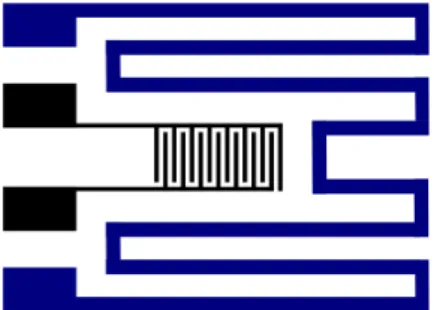
It is the ability of the sensor to maintain its performance throughout its life. Electrodes were pressed into one side of the substrate; a heating element was printed on the back.

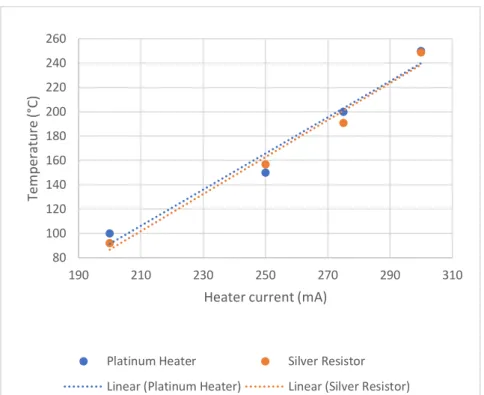
Furthermore, the use of the same type of heater implies that the sensor must be attached to an alumina substrate with the polymeric substrate. Furthermore, temperature calibration of the heater was performed to determine the required power to heat the active layer. Given the flexible and adhesive properties of the polymeric substrate, it is attached to an alumina substrate.
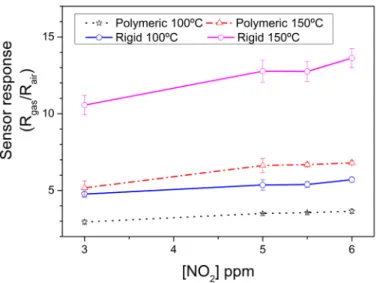
The drop coating process was repeated until the resistance of the active layer reached values below 10 MΩ. In the case of metal oxide gas sensors, better sensor responses can be obtained by increasing the temperature of the active layer. A constant current was applied to the platinum heaters while the resistance of the resistor was continuously measured.
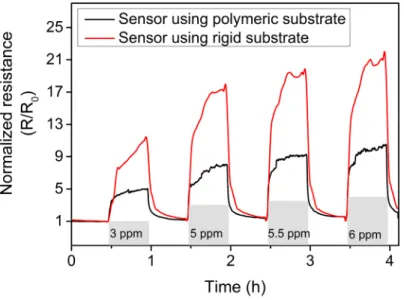
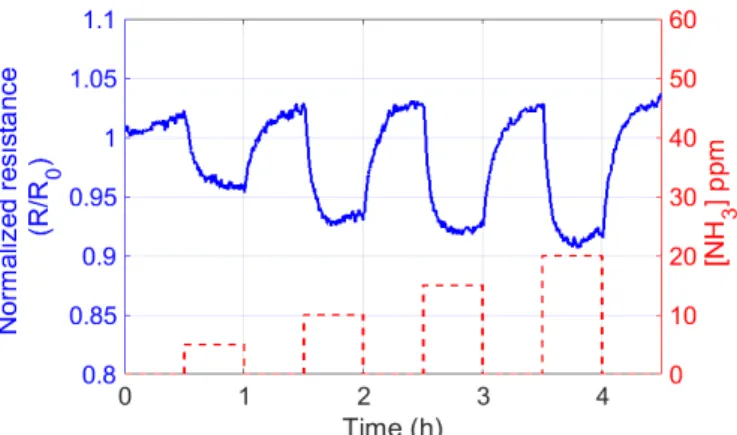
Gas sensing was measured as changes in the electrical resistance of the active layer. The drop-coating technique used to deposit the active layer enabled a complete coating of the surface corresponding to the electrodes over the polymer substrate. This was confirmed by an increase in resistance in the presence of oxidizing gases (NO2) and a decrease in the presence of reducing gases (NH3 or H2).
Theoretically, the Schottky barrier is the difference between the work function of the metal and the electron affinity of the semiconductor. When the mobility occurs, atoms migrate from the electrode to the semiconductor layer, causing a doping effect. The lower metal content and the presence of binding agents could contribute to the reduction of sensor responses [99].
Sensing
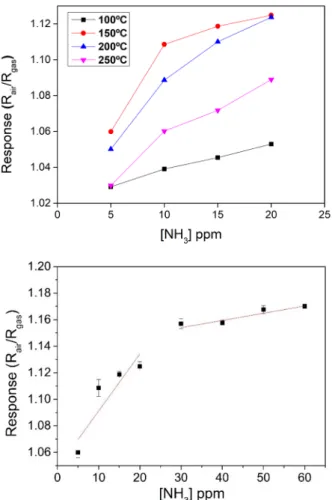
After stabilizing the resistance of the sensor, the applied gas pulses caused the resistance to decrease. The analysis of the gas measurements at different temperatures showed that In2O3 sensors had the highest response at 250 °C. The elementary drop coating technique used for the fabrication of the sensors allows the active layer to be deposited at low temperatures, below 150 °C.
Therefore, it is suitable for the production of flexible gas sensors, even using other flexible substrates, such as PET or paper. Moreover, the integration of particles synthesized at temperatures beyond the working temperature of flexible substrates opens up a number of possibilities to produce flexible gas sensors. Also, there is a point of improvement if specialized equipment is used to perform drop coating deposition.
The presented method of synthesizing the precursor made it possible to obtain a sensitive material quickly and easily compared to other methods such as chemical vapor deposition (CVD) or vapor transport (VPT). The flexible substrate used made a significant difference in manufacturing costs compared to traditional rigid substrates. The cost of the necessary polymer substrate for the manufacture of one converter is approximately two thousand times lower than the cost of manufacturing one converter based on aluminum oxide.
The maximum operating temperature of the sensor was limited to around 250 °C because conductive traces caused damage when the sensor was heated to this temperature.
Flexible Gas Sensor Fabricated by AA-CVD using Silver Electrodes
Finally, if the heater surrounds the electrodes, the size of the sensor increases and the homogeneity of the temperature decreases. Through temperature modulation, it is possible to find the ideal operating temperature for the sensor [110]. The estimated voltage to raise the sensor temperature to 150 °C was applied to the heater.
Monitoring the electrical resistance can warn of damage due to the bending test. A significant increase in the electrical resistance will also indicate the breaking of the conductive traces or active layer. For the bending test, the handles of the universal testing machine held the sensor at its ends.
In the first stage, the sensor is in the flat position and the electrical resistance of the sensor is R0. After returning to the flat position, the electrical resistance of the sensor decreased to values close to R0, but greater. At the end of the bending test, the electrical resistance of the sensor in the flat position (Rf) was recorded.
At the end of the bending test, the electrical resistance of the sensor experienced an increase of less than 1%. Sensor resistance values below the maximum deflection indicated that the sensor had track breakage. In the case of WO3-Pd sensors, the inclusion of palladium in the active layer promotes an increase in sensor responses.

Flexible Gas Sensor Fabricated by AA-CVD using Inkjet-Printed Au
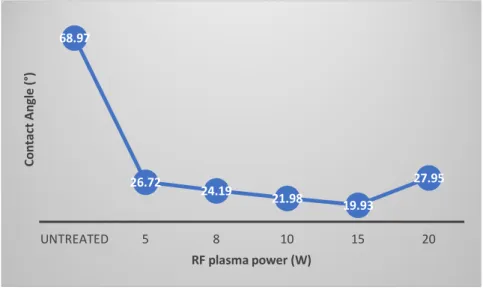
The main purpose of oxygen plasma treatment was to improve the hydrophilicity of the substrate. Thus, contact angle measurements were performed to evaluate the hydrophilicity of the substrate after oxygen plasma treatment. The contact angle on untreated Kapton was 69°. The contact angle decreased after plasma treatment with powers between 5 and 15 W.
In addition, an estimation of the contact angle for the gold ink can be made according to Keller and Stüwe [123]. The print jobs used only one of the cartridge's sixteen nozzles. It was thus necessary to obtain the temperature coefficient of resistivity (TCR) of the gold traces.
The comparison of the sensor responses before and after the bend test showed that the sensor retained its gas sensing properties. During the bend test, the electrical resistance behavior of the sensor showed positive increases. During the bending test, the electrical resistance of the sensor was measured continuously on site.
When the bending test was completed, the resistance of the sensor in the flat position did not change. This can be explained by separation or displacement of the nanowires during the bending test. The separation or displacement reduces the contact areas between nanowires, again "freeing" the surface for gas adsorption to occur.
Flexible ZnO Sensors Fabricated by Screen Printing
For the design of the sensor, two alternative locations to place the heater were considered. This, despite the high power consumption of using a coplanar heater to heat the active layer due to the low thermal conductivity of the Kapton. The polymers as dispersing/coating agents which will ensure the binding of the printed ink to the substrate;.
The pattern of the sieve mesh could be observed in the deposited layer. These clusters may form due to the coalescence effect of the metal nanoparticles during the annealing step. Prior to the gas detection test, it was necessary to characterize the heater to relate its voltage and current values to the temperature of the active layer.
The electrical resistance of the heater for each temperature was measured and used to calculate the TCR. The values obtained showed the linear increase of the resistance of the heater as a function of temperature as in Fig. Due to the low resolution of the camera and the small size of the sensor, the emission of both,.
We can see that the temperature of the active layer is not homogeneous due to the extremely low thermal conductivity of the polymer film. The improvement in the performance of the sensor can be explained by the reduction of the dispersant content. During annealing, the coalescence of zinc oxide nanoparticles increases the contact between them.
Conclusions and Perspectives
In most fabricated sensors, electrodes and heaters were made with silver paint. The difference can be attributed to the interaction of the sensitive material with the electrode material. WO3 sensors were obtained by direct growth of nanowires on the flexible substrate.
Fabrication of a screen-printed ZnO sensor demonstrated that flexible gas sensors can be fabricated with at least four basic steps: deposition and drying of conductive traces; application and drying of the active layer. The results show that the selected materials, transducer dimensions and manufacturing parameters affect the performance and reliability of flexible gas sensors. The materials chosen are up to the manufacturing process, which required working at the upper limit of the substrate's operating temperature.
Flexible sensors can be obtained by appropriate adjustment of the process parameters. Replacing the substrate brings a reduction in the cost of gas sensors due to the favorable prices of plastic substrates. The market trend is the development of composite inks to reduce the cost of electronics production [135].
Furthermore, the electrical and mechanical properties of graphene can help to know the degree of deformation to which a flexible gas sensor is subjected, making it possible to adjust the sensor responses according to the degree of deformation of the sensor. Therefore, the effects of these sintering methods on the figures of merit of the sensor must be studied. Lucat, Influence of the nature of the screen-printed electrode metal on the transport and detection properties of thick-film semiconductor gas sensors, sensor actuators B.

Flexible gas sensors fabricated using aqueous direct growth techniques for the deposition of the active layer.

![Fig. 1.8 Schematic representation of (a) a continuous inkjet printing (CIJ) and (b) Drop-on- Drop-on-Demand system [1]](https://thumb-us.123doks.com/thumbv2/123dok_es/5788762.5474409/41.748.183.577.400.904/schematic-representation-continuous-inkjet-printing-drop-drop-demand.webp)