A different energ y future Where energy transformation is leading us
www.pwc.com/utilities
97%
expect to see a medium to very high level of market disruption by 2020.
73%
anticipate major or very major business model transformation by 2030.
60%
say their main home market will be more than ‘50% transformed’
by 2030.
Introduction
We are witnessing considerable disruption in the power sector arising from a combination of policy, technological and customer change. It’s creating a transformation in how we think about, produce and use electricity. In some parts of the world, disruption is already taking a strong hold. In other parts of the world, it is just beginning. It comes on top of the already considerable existing challenges companies face in providing energy
security, affordability and sustainability.
In response, the business models and the operational focus of many companies in the sector are changing. We focus on these changes in much of this year’s survey. We look at what is driving the change and where it is leading. We include an analysis of some of the principal disruptive factors at work and, based on the survey data, have constructed a Power & Utility Market Disruption Index that shows the extent to which disruption is expected to intensify in the next five years to 2020.
Looking further ahead, we find that a clear majority in our survey expect significant or very significant market model change by 2030 in response to energy transformation and that current business models won’t be sustainable for long. For some the need for change is pressing and, indeed, well over a third of those in North America and Europe say that current power sector company business models are already broken and the need for change is urgent. But elsewhere in the world, the imperative to change is felt to be less immediate.
We examine what all this means for the operational focus of companies. As well as a switch away from thermal to renewable generation, we find a big step-up in activity is expected in areas that are of limited or only emerging importance to the sector at the moment, such as smart city, smart home and smart community infrastructure, local energy systems, electric vehicles and off-grid
solutions. We conclude with a look at the capabilities that will be needed and get the industry’s opinion on whether we can expect a new ‘golden age’ for the sector or whether the future is less promising.
companies
70
different countries
52
We look at these big issues through the viewpoint of a survey that is extensive in scope as well as intensive in its depth. We have talked to senior power and utility company executives in 70 companies and 52 different countries around the world. The survey is supplemented by the ‘on the record’
perspectives of a number of CEOs that are also included in the report. We report survey responses to a range of questions and also, in a series of future scenarios, views on how particular aspects of the world of electricity will look in the future.
By the term ‘energy transformation’we refer to the convergent effects of technological advances, the growth of distributed generation, new forms of competition, changes in customer behaviour, regulatory direction and their combined impact on the nature of the power system and power companies.
The term ‘disruption’is used to mean a change in the established way of doing business. It could arise from a single factor, such as technological change, regulatory change, competitive forces, changes in customer behaviour, or from the accumulated impact of a host of factors. The result is a challenge and a shift in existing business viability or ways of working.
Terminology used in the report
We use the term ‘market models’ to refer to the way a market is structured and designed, whether it is policy/regulator-led, market- led or a mixture of both, the extent of competition, separation or integration of roles and the ‘policy goals’
that are promoted.
By the term ‘business model’ we mean the means by which a power and utility company makes a profit or creates revenue – what it does, how it addresses its marketplace, and the business relationships it deploys to do so.
Introduction 2
Executive summary 4
A trickier balancing act 9 The shifting energy trilemma 9 Responding to megatrends 11
Rising risk levels 13
A different future world 16 The extent and pace of 19 energy transformation
The rise of distributed generation 22 The impact of other technologies 25 Disruption and market change 26 Future business models 36 The end game – golden age, 44 slow decline or death spiral?
Contacts 46
Contents
Norbert Schwieters
Global Power & Utilities Leader
Argentina Australia Austria Belgium Brazil Canada Chile China Colombia Croatia
Czech Republic Finland
France Germany Greece India Indonesia Ireland Italy Japan Jordan Kenya Libya Malawi Malaysia Mexico Mozambique Namibia Nepal
New Zealand
Nigeria
Norway
Oman
Poland
Portugal
Romania
Russia
Saudi Arabia
South Africa
South Korea
Spain
Sri Lanka
Sweden
Tanzania
Thailand
Turkey
UAE
Uganda
UK
USA
Venezuela
Vietnam
Executive summary
The PwC Global Power & Utilities Survey goes to the heart of
boardroom thinking in utility companies across the globe.
In this, our 14th edition, we look at the major changes facing the sector as it gets to grips with the prospect of a very different energy world ahead. We look at the way companies expect their markets and business models to change in the period to 2030 and get their viewpoint on the outlook for the energy trilemma and risks facing them in the short term. For many, the
current way of doing business is at stake and survey participants give their insight on what
operational changes lie ahead and whether the future will bring success or failure.
A changing emphasis in the energy trilemma
Survey respondents appear to be anticipating a more robust climate deal at the December 2015 inter-governmental climate change summit in Paris than has been achieved before. Evaluating the classic energy trilemma between security, affordability and sustainability, they expect significant change in the next five years. Currently they give sustainability/cleaner energy only 61 per cent of the emphasis given to security of supply (with affordability receiving 92 per cent). By 2020 they expect sustainability/clean energy to move up to 81 per cent, largely at the expense of affordability.
A mixed record on the megatrends
Five megatrends – technological breakthroughs;
climate change and resource scarcity; demographic and social change; a shift in global economic power;
and rapid urbanisation – are having a significant impact on the power sector. Many of our survey respondents recognise their importance for their companies but the sector has a mixed record at best in responding to them. In the case of technology breakthroughs and the shift in global economic power, more participants report little or no success than report high or very high success. And nearly as many companies in the sector say they are unsuccessful in addressing climate change and demographic trends as say they are successful.
Rapid urbanisation was the only example of a megatrend where many more reported success than those who said they are having little or no success.
Rising risk levels
Concern about nearly all of the major risks facing the power sector is rising. Regulatory uncertainty and the difficulties of attracting investment top the list of concerns. The challenge of managing these two leading risks looks set to be all the greater as a result of rising risk concern levels for the five other risks that we asked survey respondents to assess – blackouts, market dislocation, emissions/air pollution, fuel availability/supply risk, and cyberattack. Concern about all of these risks is heightening. Around three-quarters of survey participants think these will be medium to high-level concerns in 2020. Many more companies expect to have them on their high alert radar than is the case today.
Energy transformation sights set mainly on the next decade
The convergent effects of technological advances, policy measures, the growth of distributed generation, new forms of competition and changes in customer behaviour are having a transformative impact on power markets. We asked the survey participants about the extent and pace of energy transformation in their main home markets.
Some expect it to intensify in the next five years but most anticipate transformation will take real hold in the 2020s. Only a few (14%) expect that their main home market will be more than
‘50% transformed’ by 2020. But by 2030, three-fifths anticipate transformation of this magnitude.
Customer pull gains ground on regulatory push
All regions except North America report that regulatory direction is the biggest driving force behind energy transformation. But in North America, it is changes in customer behaviour that are cited by most respondents. The contrast is evident when comparing Europe and North America. In Europe, 87 per cent of survey
participants say regulatory change is having a high or very high impact compared to just 43 per cent saying the same about customer behaviour. But in North America it is the reverse – more (71%) point to customer behaviour as the factor having the high or very high impact than choose regulatory direction (57%). As energy transformation takes hold, we would expect customer pull to increasingly take over from regulatory push.
The rise of distributed generation
In some territories, distributed generation is already taking a large chunk out of the market for centralised generation, undermining the classic power utility business model and adding complexity into the task of balancing supply and demand.
Globally, survey respondents anticipate distributed generation will take a 10–20% share of total generation by 2020, rising to a 20–30% share by 2030. But a significant minority think the distributed generation share could be higher.
Over a fifth (22%) anticipate a ‘30% plus’ share for distributed sources by 2030. Nearly half of survey respondents (47%) say there is a medium to high probability that distributed generation could shrink the role of some power utility companies to providers of back-up power.
Market disruption intensifies
Disruption and market change are gathering pace in power markets around the world. Over half of survey participants (55%) report that their market is undergoing a medium degree of disruption now and a further 16 per cent report high levels of disruption. Less than one in three said their market is relatively undisrupted now and hardly any expect that situation to continue to be the case in the next five years. Looking ahead to 2020, nearly half (47%) expect a high or very high amount of disruption, with a further 51 per cent anticipating medium levels of disruption.
Executive summary
expect a medium or high amount of disruption in their main home market by 2020.
97 %
expect their main home market will be more than
‘50% transformed’ by 2030.
60 %
Widespread market model change anticipated
Across all regions, 70 per cent expect significant or very significant market model change by 2030.
A further 22 per cent anticipate medium change.
Less than one in twelve think there will be little or no change in market models. The global figures mask significant regional differences, with the expectation of change most intense in Europe and North America, where 91 per cent and 86 per cent predict major change. There is less consensus about the extent of market change elsewhere although a clear majority (59%) in the Asia Pacific region and nearly half (46%) in the Middle East and Africa share the viewpoint of their peers in Europe and North America.
A more open, competitive and different type of power market
An expectation of a more open and competitive power market is shared by many of the survey participants. Nearly four fifths (78%) anticipate greater competition and competition from outside the sector is being taken very seriously.
Three-quarters see a medium to high level of competitive threat coming from companies with a technology or engineering focus and nearly as many (71%) from companies from the IT/telecoms sector.
Powerful brands from the retailing or online sectors are also seen as a threat. Smart grids, micro-grids, local generation and local storage all create opportunities to engage customers in new ways.
Increasingly, we are seeing interest in the power sector from companies in the online, digital and data management world who are looking at media and entertainment, home automation, energy saving and data aggregation opportunities.
The Power & Utilities Market Disruption Index
The Power & Utilities Market Disruption Index is based on survey respondents’ assessment of disruption in five key areas – policy and regulation, customer behaviour, competition, the production service model (the infrastructure, products and services provided by the sector), and distribution channels (how the sector reaches and delivers to customers). For each one it is possible to identify developments that are happening now and which, if they accelerate or impact in combination, could intensify disruption. The Market Disruption Index is a composite measure of a basket of these five disruption factors.
On a global level, the market disruption index rises by 42 per cent between 2015 and 2020. Europe remains the most disrupted region in 2020 but, because it is already experiencing a relatively high degree of disruption, the 2015–2020 rise is one of the smallest. Survey participants in North America anticipate the biggest market disruption index increase, up 64 per cent from 3.9 to 6.3 to take the region to disruption levels comparable with Europe by 2020. All regions record significant increases in the market disruption index. North America moves above the Asia Pacific region to second place in the ranking by 2020.
Executive summary
anticipate greater competition.
78 %
Scored on a scale of 1–10 where 1 = no disruption; 10 = very disrupted.
The index comprises the mean scores recorded for a basket of five disruption factors (policy & regulation; technology change; production service model;
distribution channels; customer behaviour; and competition. Each disruption factor is given an equal weighting.
Source: 14th PwC Global Power & Utilities Survey
1. Europe 2. North America 3. Asia Pacific
4. Middle East & Africa 5. South America Global
2020 Index score
6.7 6.3 5.5 5.5 4.9 6.0 2020
ranking
2015–2020
% increase
+33%
+64%
+33%
+50%
+44%
+42%
Future power sector business models
What’s the future for the current power utility business model? Much will be determined by the future direction of each country’s market and regulatory situation. This location-specific shaping of business models is reflected in the wide variety of answers we got from different regions of the world on the outlook for existing power sector business models. In North America, only seven per cent of survey participants feel that current business models will ‘serve us well into the future’ but nearly half (47%) of those in the Asia Pacific region think that current business models will remain durable.
However, globally, only a quarter (26%) agreed with this optimistic outlook, with just over half (52%) disagreeing. In part, these different regional outlooks reflect the different patterns of state ownership and market opening of the sector across the world, with developing countries, in particular, having a higher number of state-owned utilities and finding it less imperative to consider business model change.
A changed operational focus
There is a big step-up in activity in areas that are of limited or only emerging importance to the sector at the moment. The number saying involvement in smart city, smart home and smart community infrastructure will be of major importance rises from 14 per cent now to 62 per cent in 2030. Similar big increases are evident across a range of areas:
• Local energy systems and infrastructure – up from 11 per cent now to 55 per cent in 2030;
• Electric vehicles and transportation – 11 per cent now versus 51 per cent in 2030;
• Own distributed generation – 8 per cent now versus 48 per cent in 2030;
• Support for customer or third-party distributed generation – 5 per cent now versus 41 per cent in 2030;
• Off-grid energy solutions – 3 per cent now versus 37 per cent in 2030.
The end game – rise or fall?
New market models and new business models will become established as a result of energy
transformation and could quickly eclipse current company strategies. We presented a trio of future scenarios to survey participants – an optimistic
‘golden age’ one in which power utilities flourish and grow, a pessimistic ‘death spiral’ scenario in which the sector declines rapidly, and a middle ground of flatter growth and a slow transition away from the current central grid model.
Opinion is evidently undecided on exactly where transformation and disruption is taking us:
• 89 per cent say there is a medium to high probability of a ‘flat and declining role for power utility companies and current central grid-based energy systems’;
• But 70 per cent also attach a medium/high probability to ‘a ‘golden age’ of utility reinvention in which power utilities enjoy significant success and growth;
• Yet 58 per cent don’t rule out a ‘downward’ or even ‘death spiral’ from disintermediation, technology disruption and customer behaviour, with power utility companies and current energy systems undergoing a major decline.’
Looking ahead, we think predictions of a ‘death spiral’ for companies in the power and utilities sector are overdone. But if companies in the power sector don’t stay ahead of change, the challenges they face will intensify. The challenge will be to make timely moves to gain the most of the market opportunity of ‘old energy’ systems and business models while, at the same time, transitioning to the new business models required as energy transformation takes hold.
Executive summary
say business model change is becoming urgent.
66 %
If companies in the power sector
don’t stay ahead of change, the
challenges they face will intensify.
Many of the issues discussed in this survey are the focus of PwC and Strategy&’s Energy Transformation framework. The framework helps companies map the effect on them of the disruption and transformation taking place in the sector all the way from the root causes through to impacts on future market designs and business models.
This programme of work with companies helps them address a series of crucial questions. What will the future market design look like? Who will be our competitors? What will customers want? How might regulation be responding? What are the implications for the company’s purpose, role and positioning?
What will be the winning business models?
Mapping a successful energy transformation path
The challenge for many companies in the sector will be to make timely moves to gain the most of the market opportunity of ‘old energy’ systems and business models while, at the same time, transitioning to the new business models required as energy transformation takes hold.
In parallel, companies will need to judge carefully what capabilities they can successfully add themselves and what will need to come from partnerships, joint ventures or M&A strategies.
Demographic changes How are megatrends
affecting the energy sector?
What are the disruption factors
impacting the power sector?
What could this mean for future market models?
What business models are likely to evolve?
What transformations are necessary?
Customer
behaviour Competition Production
service model
Green command and control
Ultra distributed generation
Local energy systems
Regional supergrid Distribution
channels
Government and regulation Shift in
economic power
Accelerating urbanisation Climate change and
resource scarcity Technological
breakthroughs
Purpose Business
model
Operating model/
capabilities HR model Financial
performance
Disruption dynamics
Power & utility company transformation
Executive summary
‘Where do we play?’
‘How do we win?’
What should our future business models look like?
‘How do we play?’
PwC energy transformation framework
A trickier
balancing act
The balancing act facing power utility companies is multiplying in complexity. As well as the classic trilemma of security, affordability and sustainability, a range of new issues has to be weighed up. Foremost among them are decisions that flow from a series of megatrends at work in the world.
How best to respond to technological change and energy transformation which is altering the way in which we use and think about electricity?
What parts of the value chain to focus on in an era of energy transformation? How to manage an increasing level of risk on a number of fronts, including a more precarious balancing of supply and demand and new concerns such as cyberattack? In this chapter we look at how survey participants view the energy trilemma, global megatrends and the risks facing the sector.
In the following chapter, we look more closely at energy transformation and where it is taking companies in the future.
The shifting energy trilemma
The trade-off between the three classic energy objectives of security of supply, affordability and sustainability has long been recognised as a central dilemma, or ‘trilemma’, for energy policy.
The energy supply that might be the most secure may not be the most affordable and/or the most sustainable and vice versa. As the World Energy Council points out, “delivering policies which simultaneously address energy security, universal access to affordable energy services, and
environmentally sensitive production and use of energy is one of the most formidable challenges facing government and industry.”1
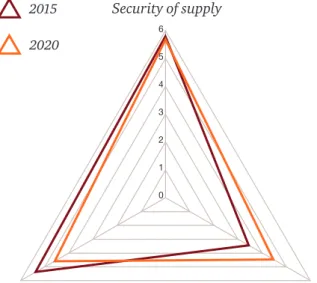
2015
Security of supply Affordability Sustainability
Average score
5.9 5.5 3.6
Index
100 92 61
2020
Security of supply Affordability Sustainability
Average score
5.7 4.7 4.6
Index
100 83 81
*Respondents were given a total sum of 15 points to allocate between the three trilemma goals. All 15 points had to be used.
The lead goal is then indexed to 100.
Source: 14th PwC Global Power & Utilities Survey
Figure 1: Energy trilemma
Where is your ‘home country’ energy market positioned in the ‘trilemma’ between security of supply, affordability and sustainability now and where do you expect your ‘home country’ energy market to be positioned in 2020?*
2020
2015 Security of supply
Sustainability Affordability
6
5
4
3
2
1
0
1 http://www.worldenergy.org.
We put the question of this ‘energy trilemma’ to our survey participants. We asked them to assess how well they feel their ‘home country’ market rates on each dimension of the trilemma but also forced them to make trade-offs between the different elements, in a reflection of the real-life trade-offs that exist. The responses confirm security of supply as the foremost priority, with affordability not far behind (figure 1). Both receive an ‘above par’
score. But survey participants expect significant change in the next five years. Currently they give sustainability only 61 per cent of the emphasis given to security of supply. By 2020 they expect this to even out somewhat with sustainability moving up to 81 per cent, largely at the expense of affordability (figure 1).
The trend towards a more elevated priority for sustainability is one that’s expected by survey participants in every main region of the world.
As we see in figure 2, sustainability currently gets about two-thirds of the attention given to the lead goal of security of supply according to survey participants in North America and Europe, and even less in Asia Pacific, South America and the Middle East and Africa.
But respondents anticipate that will change quite significantly in the next five years and that, by 2020, it will be gaining around a 90 per cent focus in North America and Europe and around 75 per cent elsewhere. In December 2015, in the biggest climate change meeting since the 2009 Copenhagen summit, representatives from more than 190 countries are due to meet in Paris to sign an international agreement to cut CO2 emissions.
The shift in the energy trilemma emphasis placed on sustainability and clean power suggest that our survey respondents expect a more robust deal than was achieved in 2009.
A trickier balancing act
2015 2020
Figure 2: Sustainability – moving up the agenda
Sustainability indexed against security of supply – 2015 and 2020*
Global 61%
81%
North America
65%
87%
Europe 68%
93%
Asia Pacific 55%
66%
*Point share allocated to sustainability/clean energy as a proportion of those allocated to the lead goal of security of supply. Indexed against security of supply = 100.
Source: 14th PwC Global Power & Utilities Survey
South America
54%
83%
Middle East
& Africa
55%
76%
The relative priority expected to be given to sustainability in the energy trilemma in 2020 compared to security of supply, up from 61% in 2015.
81 %
A trickier balancing act
Responding to megatrends
We’ve identified five megatrends – technological breakthroughs; climate change and resource scarcity; demographic and social change; a shift in global economic power; and rapid urbanisation – that are presenting important challenges for all businesses. And many aspects of them are having a profound impact on the power sector. For example, the regulatory encouragement of renewable power comes partly in direct response to climate change concerns. Other trends are interacting, for example the potential for rapid urbanisation to accelerate the roll-out of distributed energy and micro-grids.
And, of course, the shift in the focus of global economic growth is amplified by population growth in many of the same high-growth markets.
All of these megatrends are rated as being of medium to high importance by a majority of the companies in our global survey (figure 3).
Technology breakthroughs and climate
change/resource scarcity head the list with over 80 per cent saying they are important and the vast majority of these saying there are of high or very high importance. Urbanisation is also high on the agenda for many companies, with 77 per cent of respondents ranking it of medium to major importance.
Technology breakthroughs and climate change are rated as being of fairly uniform importance by power utility companies in all regions. But the other megatrends impact different power utilities in different ways depending on their geographic and market circumstances. The shift in global economic growth, for example, has led a number of European power companies to try to gain market share in fast-growth Latin American and other overseas markets to offset dwindling growth in Europe.
But the same need to switch focus is not of such importance for companies who judge that their current markets offer sufficient potential for future growth. Reflecting this, over half (52%) of survey participants in Europe said the shift in global economic growth was of major importance for their company compared with a third (32%) of all respondents globally.
Similarly, the impact of demographic trends is felt more in some regions than others, with around 54 per cent of respondents in the Middle East and Africa and Asia Pacific saying it is of major importance to their company compared to only 29 per cent of all respondents. And accelerating urbanisation is also more of a concern for survey participants in the Middle East and Africa and Asia Pacific than those in North America and Europe.
Indeed, 77 per cent of those in the Middle East and Africa say it is of major importance to their companies. Africa already has at least 120 cities of over half a million residents and 47 of over a million, spread out among 54 countries2. It is home to seven of the world’s megacities and more than half of global population growth between now and 2050 is expected to occur in Africa.3
% rating medium importance
% rating high or very high importance Figure 3: Global megatrends – level of importance*
Technology breakthroughs
29%
60%
Climate change and resource scarcity
19%
62%
Accelerating urbanisation
25%
52%
Demographic changes
40%
29%
Shift in global economic power (e.g. west to east)
29%
32%
*Score 1 to 5 where 1 = not important; 5 = very important. Scores 3 (medium) and 4/5 reported.
Source: 14th PwC Global Power & Utilities Survey
2 For cities of over half a million inhabitants, see Demographia World Urban Areas: 11th Annual Edition: 2015:01, Table 5: Summary: Urban Areas 500,000 & Over, p. 132, Demographia, January 2015, at http://www.demographia.com/db-worldua.pdf; for cities of over a million, see the infographic by Future Cape Town on its website at http://futurecapetown.com/2013/07/infographic-fastest-growingafrican-cities/#.VMqShqlv3dl.
3 World Population Prospects: The 2012 Revision, Population Division, UN Department of Economic and Social Affairs.
Expect climate change and resource scarcity will be of major importance in 2020 compared to just 19% in 2015.
62 %
But while there is a considerable recognition of the importance of the megatrends for power and utility companies, many are having difficulties responding to them. We asked survey participants to rate how successful they feel their company is at addressing each megatrend. We then filtered the results to exclude any respondents who thought a trend wasn’t important for their company.
The results are in figure 4.
In the case of technology breakthroughs and the shift in global economic power, more participants report little or no success than report high or very high success. And nearly as many companies in the sector say they are unsuccessful in addressing climate change and demographic trends as say they are successful. Rapid urbanisation was the only example of a megatrend where many more reported success as said they are having little or no success.
To some extent, these results are a reflection of a moment in time. Success takes some time to come to fruition and some companies may feel their strategies are at too early a stage to justify reporting successful outcomes. On the other hand, they also reflect some of the things we know about the sector. Historically, the pace of technology adoption in the power utilities sector has been slow. Key technological developments, such as the use of system operation computers for grid energy management, have taken a decade or longer to become established.
The traditional centralised generation and grid model is relatively unchanged and companies are used to medium to long capital programme cycles for renewal and innovation rather than the months and few years that have come to characterise fast-moving technology adoption in the digital communications world. It’s no surprise that power and utility companies report that they are struggling to respond to technology breakthroughs, especially when some of these technologies are at the consumer end of the value chain.
When it comes to global repositioning moves to respond to the shift in global economic power, again we would expect many survey participants to report difficulties in executing strategy successfully.
Moving away from mature markets into fast-growing but often more volatile and less familiar
environments, is challenging. Brazil is a case in point. A market downturn has put pressure on Brazilian power utility companies and financial troubles, including bankruptcy filings, have been a setback to European expansion ambitions there.
A trickier balancing act
% reporting low or no success in addressing them
% rating high or very high success in addressing them
Technology breakthroughs
38%
25%
Climate change and resource scarcity
34%
36%
Accelerating urbanisation
11%
43%
Demographic changes
30%
36%
Shift in global economic power (e.g. west to east)
43%
32%
*Rated success of company on a score of 1 to 5 where 1 = not successful to 5 = very successful.
Scores 1/2 and 4/5 reported.
Source: 14th PwC Global Power & Utilities Survey
Figure 4: Global megatrends – level of success in addressing them Results for those saying the particular megatrend is of medium to high importance for their company.*
More survey participants say they are having difficulty responding to technological change than report success.
Responding to megatrends
38 %
vs
25 %
A trickier balancing act
Rising risk levels
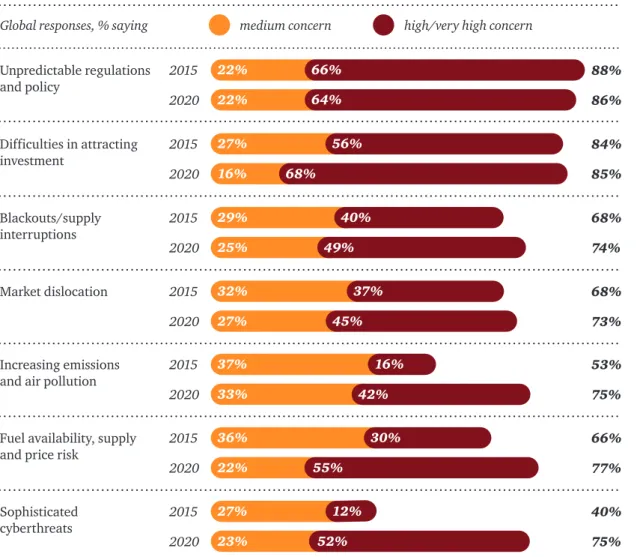
Regulatory risk and the difficulty of attracting the investment required in the sector are the highest-rated concerns among the risks we asked survey respondents to assess (figure 5). They were rated as medium to high-level concerns by well over 80 per cent of participants. Few anticipate any improvement between now and 2020. Indeed, the proportion with high or very high-level concerns about attracting investment rises from 56 per cent in 2015 to 68 per cent in 2020.
Both these risks are concerns across all regions with very little regional variation. The exception is ‘difficulties in attracting investment’ where the proportion of respondents in Asia Pacific and South America rating this as a medium to high-level 2015 concern was rather less than in other regions – 59 per cent and 67 per cent respectively versus 84 per cent globally.
However, greater optimism in both these regions is not maintained in their 2020 outlook, with concern levels for both risks rising back up.
medium concern
Global responses, % saying high/very high concern
Figure 5: Power sector risks – now and in 2020
What is your assessment of the following power sector risks in your ‘home country’ market?*
Unpredictable regulations and policy
2015 2020
2015 2020
2015 2020
2015 2020
2015 2020
2015 2020 Difficulties in attracting
investment
Blackouts/supply interruptions
Market dislocation
Note: Numbers are rounded to a single whole number. Rounding accuracy means totals may not exactly match the sum.
*Scale of 1-5 where 1 = no concern; 5 = very high concern. Medium = 3. High/very high = 4/5.
Source: 14th PwC Global Power & Utilities Survey
Increasing emissions and air pollution
Fuel availability, supply and price risk
22% 66%
22% 64%
27% 56%
16% 68%
29%
25%
40%
49%
32%
27%
37%
45%
37%
33%
16%
42%
36%
22%
30%
55%
2015 2020
88%
86%
84%
85%
68%
74%
68%
73%
53%
75%
66%
77%
40%
75%
Sophisticated cyberthreats
27%
23%
12%
52%
More are struggling to respond effectively to the shift in global economic power than are dealing with it successfully.
Responding to megatrends
43 %
vs
32 %
A trickier balancing act
The challenge of managing these two leading risks looks set to be all the greater as a result of rising risk concern levels for the five other risks that we asked survey respondents to assess – blackouts, market dislocation, emissions/air pollution, fuel availability/supply risk, and cyberattack.
Concern about all of these risks is heightening.
Around three-quarters of survey participants think these will be medium to high-level concerns in 2020. More companies expect to have them on their high alert radar than is the case today.
In the case of cybersecurity, for example, only 40 per cent report it as a concern in 2015 but this rises to 75 per cent when asked about 2020.
It should be noted that we conducted this survey before the major power failure that affected much of Turkey in April 2015 and which led to an initial move by the energy minister to monitor whether a cyberattack could have been a cause, although sabotage was later ruled out. The critical national infrastructure of the power sector is a particular target for cyberattack, as are the online systems for the commercial relationships the sector has with millions of customers.
A similar rise in risk concern is seen in the case of emissions and air pollution – up from just over half (53%) being concerned today to 75 per cent in 2020. As we noted earlier, UN negotiations are under way to develop a new international climate change agreement that will cover all countries from 2020. But irrespective of whatever is decided on the international stage, national governments are moving to tighten national air pollution and emissions rules. In China the risks arising from air pollution are the subject of increasing discussion and, recently, the government announced that the last of the coal-fired generation plants around Beijing are to be closed. This is a noteworthy move although China’s power generation is heavily dependent on coal and longer-term moves to limit emissions remain unclear.
In the US, coal-fired power plants are subject to the Mercury and Air Toxics Standards (MATS), which require significant reductions in the emissions of mercury, acid gases, and toxic metals. The standards are scheduled to take effect in 2015 and 2016, with generators needing to install costly pollution-control equipment if they want to keep their coal plants running. A further tightening of rules could come in the form of the proposed Clean Power Plan, which will require carbon emission from the power sector to be cut by 30 per cent nationwide below 2005 levels by 2030. These measures are very significant for many power companies in the US.
Reflecting this, in our regional results, it is North American survey respondents who rate air pollution risk highest – 79 per cent expect it to be a medium to high-level concern by 2020, with the proportion expecting it to be a high or very high-level concern rising from 21 per cent in 2015 to 57 per cent in 2020.
Proportion of survey participants expressing concern about cyberthreat risk.
40 %
rising to
75 %
CEO perspective
In step with the pace of change
Pacific Gas and Electric Company (PG&E) is one of the largest natural gas and electric utilities in the United States. Tony Earley, Chairman, CEO and President of PG&E Corporation, gives his viewpoint on some of the key questions arising from the PwC survey findings.
PwC: Is the power utilities sector underestimating the speed of energy transformation taking place and where it is taking us? Four-fifths see market transformation as largely coming in the next decade. But doesn’t ‘success or fail’ action need to be taken now?
Earley: I believe the utilities sector is very much in tune with the speed of energy transformation. We have to remember that change is not new in our industry. For over a century, utilities have been leaders and innovators in building an infrastructure that has helped enable economic development on a scale and at a pace unmatched in history.
Of course, we have also seen examples of companies getting too far ahead of changes and failing in their critical present-day mission. Today, change is happening faster than ever, and every utility is in a different place in terms of the pace of change within their market.
At PG&E, for example, which serves nearly 16 million people in Northern and Central California, we recently crossed the 165,000 mark for the number of customers with rooftop solar—by far the most of any US utility. We’ve also seen the number of electric vehicles double in less than two years. And other consumer technologies are entering the market seemingly every day—from smarter appliances and thermostats to new battery storage options.
Regardless of how quickly these technologies are emerging in various parts of the country, utilities need to take action today to prepare for a future where more of our customers want and have access to these technologies. At PG&E, we’re doing this by focusing foremost on investing in the underlying infrastructure. To be relevant for our customers in the future, our systems must continue to be safe, reliable and affordable. But they must also be smarter, more flexible and more dynamic—incorporating layers of information technology and data analytics capabilities. Creating this type of infrastructure for the 21st century will require continued investment from utilities, and importantly, policies at the federal, state and local levels that pave the way for doing so.
PwC: Is there a danger that companies in the sector will find themselves following not leading? For example, many report they are struggling to respond to the pace of technological change and are not setting that pace themselves.
Earley: The reality today is that a lot of the innovation happening in energy is being driven by non-traditional players. It used to be that utilities were the sole innovators in our sector—that’s simply not the case anymore. Instead, we have to look for ways to collaborate.
In recent years, PG&E has worked with dozens of companies in California to develop and pilot new technologies, and we want to expand these partnerships. You can compare it to what Bill Ford, executive chairman of Ford Motor Company, said recently about the auto industry. He predicted that automakers will not own or develop a lot of the technology that’s changing their business. Instead, they have to be “thoughtful integrators” of other companies’ technology. I think that applies every bit as much to utilities, which means we need to be open and excited about partnering with non-traditional players.
PwC: Give us your vision for where energy transformation is heading in your main market.
Earley: At PG&E, we envision a future where the grid that we own and operate functions as a Grid of Things™—like the internet of things—where all of the energy technologies that our customers want to pursue are connected together to an integrated grid. Through the Grid of Things, we can accommodate increasing amounts of those technologies, adding tremendous value for our customers and to the grid itself. Think about the potential to offset dips in renewable energy with power from stationary electric vehicle (EV) batteries, for example. Our nation is on the cusp of an incredibly bright energy future. With continued investment, the right policies, and openness to new partnerships, the path to that future runs through the 21st century utility.
We are reaching a point where the growth of renewable energy is becoming market-driven rather than subsidy-driven.
A different future world
Technological innovation is at the heart of the shifts that are heralding the prospect of a very different future power sector world. The spread of wind and solar generation is the most visible manifestation of this.
But advances are happening in many other parts of the sector – for example, in large-scale technologies such as high- voltage DC transmission, in distributed and smaller-scale customer-based energy systems, in smart grids and on the load side. These developments in power technology are running in parallel with the digital revolution, which is opening up new easier ways of controlling, managing and trading energy.
Power is being transformed from a top-down centralised system to one that is much more interactive but also decentralised and fragmented.
Technological advances are being accompanied by price falls, most strikingly in the cost of solar modules. A recent analysis by Deutsche Bank notes that unsubsidized rooftop solar electricity costs anywhere between $0.13 and $0.23/kWh today, well below retail price of electricity in many markets globally. And it goes on to anticipate further cost reductions resulting in solar achieving grid parity in around half of the target markets that were studied, with the potential for another 30 per cent of countries to have solar grid parity within the next five years or so if forecast further cost reductions materialise.4
The economics of solar are now comparable with that of onshore wind power. Grid parity is now increasingly well established for both these renewable energy sources and we are reaching a point where their growth is becoming market- driven rather than subsidy-driven. And because the economics are attractive on both a small scale and a large scale, more and more households and businesses are deciding to generate their own electricity.
It’s a scenario that a big majority of our survey respondents recognise – 85 per cent predict falling technology costs will mean new sources of power generation will become widespread and accessible, with half believing there is a high or very high likelihood of this happening (see panel on p. 17).
However, few go on to conclude that falling technology costs are going to translate into cheaper power prices (see p. 18 panel).
4 Deutsche Bank Markets Research, 2015 Solar Outlook, 13 January 2015.
Future scenario Falling technology costs
give it a medium to high/very high probability score.
85%
attach a low probability score to this scenario.
15%
Falling technology costs will make new sources of power generation plentiful
85 per cent predict falling technology costs will mean that new sources of power generation become widespread and accessible. Indeed half (51%) of all survey respondents say there is a high or very high likelihood of this happening with a further third (34%) rating it as a medium probability. Only 15 per cent said there is a low probability of such a scenario becoming reality.
Scale used 0% = zero probability;
100% = maximum probability.
Low = 0–40%; Medium 40–60%;
High/very high 60–100%.
Future scenario An era of cheaper power prices
give it a medium to high/very high probability score.
41%
attach a low probability score to this scenario.
59%
Falling technology costs will make power cheaper for end customers
On balance, survey respondents rule out the likelihood of falling technology costs and breakthroughs heralding an era of cheap electricity. A majority (59%) attach only a low probability to this scenario and, of the rest, only 15 per cent are bold enough to give it a high probability. Across the regions, interestingly it is only respondents in the Middle East and Africa who are inclined to buck the trend, with a third giving it a high rating, perhaps mindful of the possibilities of the falling cost of standalone renewable generation to bring power to rural areas.
Scale used 0% = zero probability;
100% = maximum probability.
Low = 0–40%; Medium 40–60%;
High/very high 60–100%.
A different future world
The extent and pace of energy transformation
The convergent effects of technological advances, policy measures, the growth of distributed generation, new forms of competition and changes in customer behaviour are having a transformative impact on power markets. We asked the survey participants about the extent and pace of energy transformation in their main home markets.
Some expect it to intensify in the next five years but most anticipate transformation will take real hold in the 2020s.
Only 14 per cent expect that their main home market will be more than ‘50% transformed’ by 2020. But by 2030, three-fifths (60%) anticipate transformation of this magnitude. Indeed, over a third (37%) expect transformation of the order of 70–100% by 2030 (figure 6). Expectations of ‘near 100%’ transformation are strongest in Europe, where nearly half (48%) predict 70–100%
transformation by 2030.
Figure 6: Extent of energy transformation
What will be the extent of energy transformation in the ‘home market’ that your company serves?*
By 2020
12%
67%
15%
5%
*% of respondents.
Source: 14th PwC Global Power & Utilities Survey
By 2030
0%
19%
44%
37%
Less than 10% transformation 10 – 40% transformation 40 – 70% transformation 70 – 100% transformation
Extent of transformation
0% 100%
Extent of transformation
0% 100%
A different future world
We report the average for each region in figure 7.
Clear regional differences emerge. The strongest expectations of transformation are in Europe, North America and South America where, on average, survey respondents predict 60–70% transformation by 2030. In the Asia Pacific and Middle East and Africa regions, the average expectation is for 50–60% transformation by 2030.
Much of the ‘push’ to energy transformation is coming from government policy. Regulatory direction tops the list of factors that survey participants perceive as having a major impact on their market. But other factors are not far behind, not least technological advances and the new energy sources and distributed generation that they make possible. And there are interesting regional differences that suggest that, while regulatory change and technological advances may be ‘push factors’, customer behaviour is likely to become a strong ‘pull factor’.
Figure 8: Drivers of energy transformation
Which of the following factors play a major role in energy transformation in the ‘home market’ where your company operates?*
*Scale of 1–5 where 1 = no impact; 5 = very high impact.
Source: 14th PwC Global Power & Utilities Survey Factor
Regulatory direction New energy sources Technological advances
The growth of distributed generation New forms of competition
Changes in customer behaviour
Average score
4.16 3.67 3.67 3.64 3.58 3.41
% rating high or very high impact
75%
60%
55%
59%
52%
42%
By 2020 By 2030
Figure 7: Regional analysis: extent of energy transformation*
Global 20–30%
50–60%
North America
60–70%
Europe
Asia Pacific 30–40%
*Extent of energy transformation in 10% bands on a scale of 0–100 where 0 = no transformation;
100 = 100% transformation. Results reported are the average responses from all survey respondents globally and in each region.
Source: 14th PwC Global Power & Utilities Survey
South America
Middle East
& Africa
20–30%
20–30%
20–30%
60–70%
50–60%
30–40%
60–70%
50–60%
While regulatory change and
technological advances may
be ‘push factors’, customer
behaviour is likely to become
a strong ‘pull factor’.
A different future world All regions except the Americas report that
regulation is the factor having the biggest impact.
In South America, new energy sources are seen as most important. But in North America, it is changes in customer behaviour that are cited by most respondents as driving energy transformation.
The contrast can be seen by comparing Europe and North America (figure 9). In Europe, 87 per cent say regulatory change is having a high or very high impact compared to just 43 per cent saying the same about customer behaviour. But in North America it is the reverse – more (71%) point to customer behaviour as the factor having a high or very high impact than choose regulatory direction (57%).
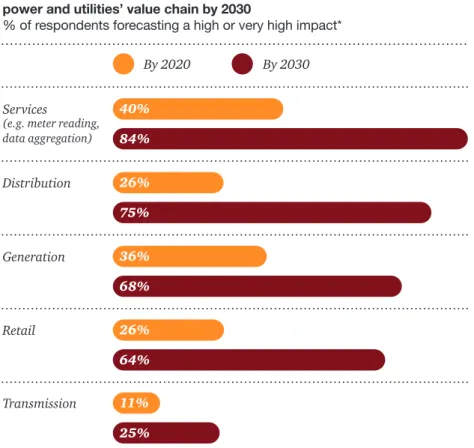
The impact of energy transformation is being felt in all parts of the value chain, particularly in generation and services that interact with customer energy usage. Both these areas are expected to be the ones most affected by energy transformation in the near future. Forty per cent of survey participants expect energy transformation to have a high or very high impact on services, 36 per cent on generation and a quarter (26%) on distribution and retail by 2020. Looking further ahead to 2030, the consensus is that energy transformation will have a major impact on most parts of the value chain. Eighty four per cent predict a high or very high impact on services, 75 per cent expect a similar impact on distribution, 68 per cent on generation, and 64 per cent on retailing. And transmission is not immune, with a quarter forecasting it too will be affected in a major way.
North America Europe
Figure 9: Energy transformation – regulatory push versus customer pull*
Changes in customer behaviour
Regulatory direction
*% saying it is having a high or very high impact.
Source: 14th PwC Global Power & Utilities Survey
71%
43%
57%
87%
By 2020 By 2030
Figure 10: Impact of energy transformation on different parts of the power and utilities’ value chain by 2030
% of respondents forecasting a high or very high impact*
Services
(e.g. meter reading, data aggregation)
40%
84%
Distribution 26%
75%
Generation 36%
68%
Retail 26%
64%
*Rated on a scale of 1-5 where 1 = no impact; 5 = very high impact. Scores 4/5 reported.
Source: 14th PwC Global Power & Utilities Survey
Transmission 11%
25%
A different future world
The rise of distributed generation
Distributed energy is a key focus both for incumbent power utility companies and for new entrants.
It’s a big market space, worth tens of billions.
It covers a wide spectrum of opportunities, from energy controls and demand management activities that save energy, to local generation, both small- scale and larger-scale, embedded in own use or local networks, through to distributed storage that can shift loads or, ultimately, end grid dependency.
It is clear that distributed generation is a key transformative element but how far does the sector expect it to take over from centralised generation?
We presented four different energy transformation visions as part of the survey interviews. We report the global results in figure 11. The visions are not all mutually exclusive so rather than select one vision alone, respondents were invited to score all the scenarios, according to how well they matched their own vision.
Three quarters (73%) envisage a mix of centralised and distributed generation but there is also
significant support (45%) for centralised generation and transmission continuing to be the main
response to demand. But an equal proportion (45%) of all survey respondents see local energy systems and distributed generation being the main response in areas that are not yet served by or that are currently underserved by the grid. A quarter envisage a more radical future, saying they expect distributed generation to take over from centralised generation.
The ‘energy transformation visions’ vary
considerably between different parts of the world.
The lead scenario for survey participants in Europe, North America and South America is for distributed generation to be playing a role alongside centralised generation, with 87 per cent, 79 per cent and 83 per cent respectively expecting this to be the case.
In contrast, in the Asia Pacific and Middle East and Africa regions it is centralised generation and transmission that is the lead expectation – 65 per cent and 77 per cent respectively. In both of these regions, though, the mixed scenario of distributed generation being developed alongside centralised generation also won support – with more than half of respondents (59 per cent in Asia Pacific and 54 per cent in the Middle East and Africa) scoring it highly.
In all regions (except the Asia Pacific region, where it is just over a third) around half of survey respondents expect local energy systems and distributed generation to be the main power provision in areas that are not yet served well or not served at all by the grid. The radical scenario of centralised generation largely being replaced by distributed generation won support from a sizeable minority of respondents in North America (29%), Europe (48%) and the Middle East and Africa (23%) but had no support from Asia Pacific and South American respondents.
45%
73%
Figure 11: Which of the following energy market transformation visions most closely matches your expectation for your ‘home market’ by 2030?
% reporting close or very close match to their expectation*
*Scale of 1-5 where 1 = no match; 5 = very close match. 4/5 scores reported.
Source: 14th PwC Global Power & Utilities Survey
A mixture of large-scale centralised generation and distributed generation will be developed to meet demand and/or replace retired generation assets
Large-scale centralised generation and transmission will be developed to meet demand
Areas not yet served by the grid or with underdeveloped centralised generation will instead be served by local energy systems/distributed generation, with customers playing a key role
Centralised generation will be largely replaced by distributed generation
45%
25%
14th PwC Global Power & Utilities Survey 23
A different future world In some territories, distributed generation is
already taking a large chunk out of the market for centralised generation, undermining the classic power utility business model and adding complexity into the task of balancing supply and demand.
In many parts of Germany, for example, it is not uncommon for more than 80 per cent of the local demand to come from distributed generation, much of it in the form of rooftop solar and landowner wind projects.
The economics of centralised generation are being hit hard. This is a trend that is most advanced in Germany, spurred on by strong policy
encouragement for renewables, but it is also becoming strongly evident elsewhere. In California, for example, a study by the California ISO predicts that by 2020 as much as 60% of the energy production in times of low load and high renewable generation would come from renewable generators that displace conventional generation.5
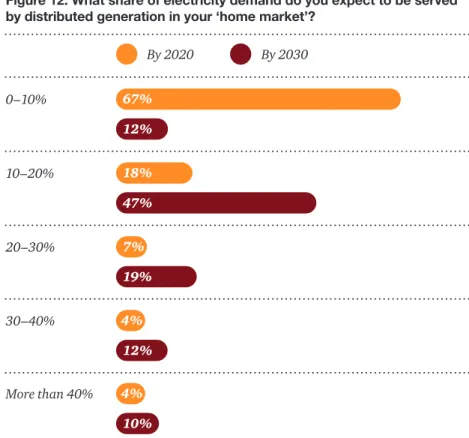
Some of this distributed generation is owned by power utility companies and many companies are making moves to build a greater presence in distributed generation. But much of it is not, removing a significant slice of the market from power companies. We asked survey participants what share of total generation they expect to come from distributed sources by 2020 and by 2030 (figure 12). On average, a 10–20% share is expected by 2020, rising to 20–30% by 2030.
But a significant minority think the distributed generation share could be higher.
Over a fifth (22%) anticipate a ‘30% plus’ share for distributed sources by 2030. Much of this is due to sentiment in Europe and North America where 39 per cent and 29 per cent of respondents anticipate ‘30% plus’ shares. Any business that faced such a large slice of their market being jeopardised would move quickly to change course.
Many power utility companies in both these regions are doing exactly that, increasingly switching their business model focus away from centralised generation and onto distributed energy and other new parts of the energy value chain, as we discuss in the next section.
By 2020 By 2030
Figure 12: What share of electricity demand do you expect to be served by distributed generation in your ‘home market’?
0–10% 67%
12%
10–20% 18%
47%
20–30% 7%
19%
30–40% 4%
4%
12%
Source: 14th PwC Global Power & Utilities Survey
More than 40%
10%
5 What the duck curve tells us about managing a green grid, California Independent System Operator.
The economics of centralised
generation are being hit hard
in some markets.
Future scenario A shrinking role for power utility companies
give it a medium or high probability score.
47%
attach a low probability score to this scenario.
53%
Distributed generation could shrink the role of some power utility companies to providers of back-up power
The sector is alert to the danger of such a scenario unfolding but most (53%) rule it out, giving it a low probability score.
But this leaves nearly half (47%) giving it either a medium (19% of all survey participants) or high (27%) probability rating. Across the regions, European respondents are most likely to believe this scenario could become a reality – 43 per cent rate it as a high probability compared to 27 per cent of global respondents.
Scale used 0% = zero probability;
100% = maximum probability.
Low = 0–40%; Medium 40–60%;
High/very high 60–100%.