
With this approach, responses in urban areas should adequately and sustainably address diverse needs. Guidelines for responding to displacement in urban areas also advocate seeking synergies in service provision and infrastructure projects.
FOR RESPONSE IN URBAN AREAS
Often the areas of the city they settle in, the basic and social services they access, and the labor markets available to them are not stable to begin with. Against this background of opportunities and challenges, it is critical to recognize both the emergency perspective typical of humanitarian responses and the development-focused perspective of the city.
Essential elements for a spatial understanding of the city
These are political documents that emphasize priorities and defined projects for individual parts of the city. Understanding a city's public transportation networks is important for determining the mobility of its residents.
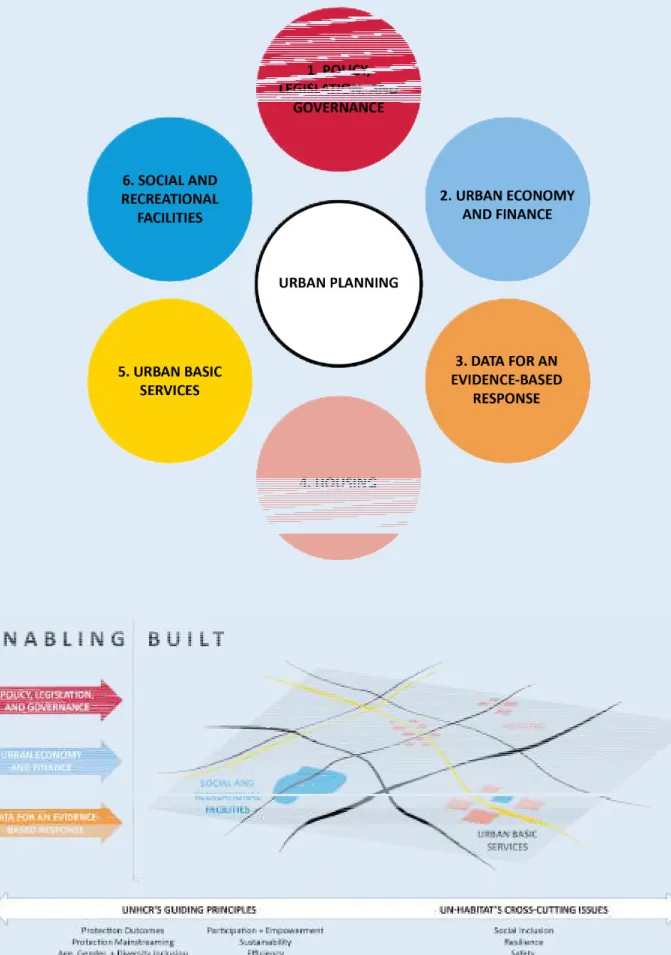
The Built Environment includes systems that are physical manifestations or structural elements of the city that are essential to formulating a response to displacement. The systems of the built environment include 4) Housing, 5) Urban Basic Services, and 6) Social and Recreational Facilities. By addressing the thematic areas of the enabling environment, it is possible to identify gaps and streamline action to sustain and develop the Built Environment.
The matrix (see below) can be used as a simple starting point in planning a comprehensive response that integrates the enablement and site-building components. This can be done through a legal analysis of the existing rights enjoyed by displaced persons in the domestic legal framework.
KEY CONSIDERATIONS Legal framework
Governance in urban contexts provides the framework that defines the needs, interests, rights and responsibilities of displaced persons while identifying institutions responsible for coordinating and managing resources. International normative frameworks, such as the United Nations Guiding Principles on Internal Displacement and the Convention Relating to the Status of Refugees (1951) with its Protocol (1967), imply a clear need to make special efforts to ensure the full participation of displaced persons. guarantees. people in planning and managing their return or resettlement and reintegration. When conducting humanitarian responses, it is crucial from an urban governance perspective to enshrine the relevant rights and obligations of displaced persons in national law and create the necessary institutions and processes for implementation.
Determining the legal status of displaced individuals is essential for their access to rights and services. Relevant rights include enjoyment of safety, access to justice through free legal aid, security and freedom of movement, an adequate standard of living (including access to adequate food, water, housing, health care and basic education), access to work and livelihood, and access to effective mechanisms that guarantee their housing, land and property rights.
Municipal finance
Local representation and engagement
URBAN ECONOMY AND FINANCE
KEY CONSIDERATIONS Emergency
Post-emergency
CAIRO, EGYPT
Improving refugees and host community livelihoods in Greater Cairo, Egypt
Introduction
Description
Actions / Approach
Lessons learned
DATA FOR AN EVIDENCE-BASED RESPONSE
Rapid surveys should be carried out in priority areas to assess the actual conditions of the factors being assessed. While data analysis can highlight priorities, monitoring and evaluation (M&E) should be an integral part of the data management strategy. The main purpose of the Settlement Information Portal (SIP) is to provide a global database mapping UNHCR's active refugee and internally displaced settlements.
Phase one consists of the rapid profiling of urban conditions at national and local level. Information is collected through standard interviews and discussions with institutions and key informants to assess the strengths, weaknesses, opportunities and threats (SWOT) of the national and local urban setting.
HOUSING, LAND AND PROPERTY 38
Responsive exit strategies would depend on self-sustainability (ability to work) and security of tenure of displaced persons. Establish centers where displaced persons can access information, guidance, legal assistance and support for housing options and the protection of their MHP rights. Identify and analyze existing housing rights systems in areas where displaced people may be concentrated to facilitate safe and equitable access to housing, basic services and facilities.
Identifying and mapping relevant international, national and local laws, regulations and policies will help identify context-relevant opportunities and constraints related to displaced people's HLP rights. Whether local authorities lack the knowledge and expertise required to provide the necessary tailored protection that should be provided to displaced people;.
UNHCR Accommodation Scheme - Greece*
UNHCR partners are addressing barriers to refugee access to tenancy agreements by entering into direct contractual agreements with apartment owners, adopting common tenancy agreement templates based on national legislation. At the same time, ad hoc agreements between the partners managing the accommodation and the PoC beneficiaries ensure that rights and obligations are stated when the latter enter the apartment. The development of technical guidance for UNHCR and partners regarding the selection of apartments and buildings to be rented out to house refugees under the scheme.
Technical Standards, which refer to mandatory criteria based on Greek law, and Technical Guidelines, which are not mandatory criteria, but must be followed to ensure a common approach among partners in the selection of accommodation facilities.
Challenges
KABUL AND HERAT, AFGHANISTAN
Sustainable Human Settlements in Urban Areas to Support Reintegration
The Afghanistan Land Authority (ARAZI) has inventoried 19,000 hectares of state land in high turnover and displacement provinces and is working towards finalizing land clearance. The approach was used in the space between formal and informal recognition of land rights (defined in the UN Habitat continuum of land security). Permit to remain' took the form of letters from the government allowing people to stay on the land.
Once the approach was implemented, people were able to build their lives because they no longer feared evictions.
URBAN BASIC SERVICES
Carrying out an age-gender-diversity-based assessment of needs (eg Safety Audits47), access and potential barriers can help to prioritize the provision of basic services. Analyzing the local context for the delivery of basic services can help identify existing capacities and gaps, and which partners will be needed to engage in response. Where possible, a cost benefit analysis can help direct investment towards repairs, upgrades or new infrastructure and services.
Supporting the alignment of newly introduced systems with local, regional or national policies, plans, standards, resources and capabilities can help the long-term operation and management of integrated basic services. Conducting regular assessments of the level and affordability of urban basic service provision, with particular attention to those who are most vulnerable, can help improve, prioritize and phase programs that reduce identified inequalities.
KAMPALA, UGANDA
KCCA has launched a public-private partnership for waste collection to meet the increased demand and maintain the quality of this service. If funds were available and landlords could access them at a low interest rate, they could build facilities that met minimum standards. In the past, KCCA collected solid waste free of charge from informal settlements where refugees live, but did not have the capacity to collect all the solid waste generated.
A public private partnership was established where the private entity was contracted to collect waste from informal settlements at a very low cost, supported by government subsidies. The National Water and Sewerage Cooperation (NWSC) – the body responsible for providing clean water to residents – devised pro-poor services to ensure that people living in informal settlements have access to clean, safe water.
Lessons Learned
This strengthens their technical, operational and management capacity to deliver subsidized services and helps to address barriers to access in the long term. However, there were challenges in how to meet this demand with limited resources.
SOCIAL AND RECREATIONAL FACILITIES
Integrating a shared facilities and public space component into existing emergency action plans for dealing with displacement (where available) can help address important social, educational, health and well-being, and economic components of urban life. Encouraging local authorities to include consideration of displaced people in the programming and management of communal facilities and public spaces can help reduce potential social tensions in the long term. Using participatory processes that include facilitated channels of open communication between displaced people and host communities to inform design and programming changes can help promote community cohesion xviii.
Linking incentives for housing and employment opportunities in the vicinity of common facilities and public space can be further strengthened after the emergency response phase. Encouraging local authorities to plan activities in public spaces and shared facilities that help connect displaced people and host communities can further help create a stronger sense of place and build social bonds.
TRIPOLI, LEBANON
Restoration of Chaarani Stairs as a Public Space for Social Inclusion
With commitment from the beginning of the project, the municipality became a partner when unexpected difficulties appeared. A series of urban profiles developed by UN-Habitat as part of the Saudi Future Cities Programme. Humanitarian Action Practices deployed in humanitarian action in the most unstable environments and for the benefit of the most vulnerable victims of humanitarian emergencies.
It is an integral part of the policy on UNHCR's involvement in situations of internal displacement. Carrying out a spatial analysis of the city, as described in "Preparing for response in urban areas", highlights gaps and opportunities that can help inform a decision-making process, taking into account the local context.
LIST OF ABBREVIATIONS
UNHCR, 'Cities are our future', UNHCR Innovation Service: The power of cities, 2016, https://www.unhcr.org/innovation/the-power-of-cities/, verkry op 02/02/20. -2018.pdf/. UNHCR, 'UNHCR Policy on Age, Gender and Diversity Policy', UNHCR, 2018, https://www.unhcr.org/protection/women/5aa13c0c7/policy-age-gender- diversityaccountability-2018.html, verkry op 01/02 /20. UNHCR, 'Policy on Refugee Protection and Solutions in Urban Areas', UNHCR, September 2009, https://www.unhcr.org/en-au/protection/. hcdialogue%20/4ab356ab6/unhcr-policy-refugee-protection-solutions- urban-areas.html, verkry op 03/02/20.
UNHCR, “Designing a Global Strategy on Refugee Livelihoods and Economic Inclusion”, UNHCR, 2019, https://www.unhcr.org/publications/. Implementing the Pinheiro Principles', OCHA, March 2007, https://www.ohchr.org/Documents/Publications/pinheiro_principles.pdf, accessed 08/02/20.
GUIDANCE FOR RESPONDING TO
DISPLACEMENT IN URBAN AREAS
RESPONDING TO DISPLACEMENT IN
