Gracias Anil por tu apoyo y por la sabiduría que me has dado cuando te la he pedido. Desiderio, gracias por el apoyo que me has brindado a lo largo de los años y por el excelente trabajo que hemos podido realizar juntos a través de esta tesis.
A DISTRIBUTIONAL ANALYSIS FOR
THE DISTRIBUTIONAL EFFECTS
16 TESIS SERIE CIENCIAS SOCIALES
A COMPUTABLE GENERAL EQUILIBRIUM
BIBLIOGRAPHY 131
20 TESIS SERIE CIENCIAS SOCIALES
Inequality has become particularly important on the environmental policy agenda and many studies have focused on the issue of who bears the costs of environmental and climate protection, as well as who is affected by a poor environment. Inequality has also become particularly important on the environmental policy agenda and many studies (OECD, 2006) have focused on the issue of who bears the costs of environmental and climate protection, as well as who is affected by a poor environment.
30 TESIS SERIE CIENCIAS SOCIALES
The connection between these methods makes it possible to combine the advantages of CGE and MS models. The connection between CGE and MS models enables us to analyze macroeconomic policy simulations at the microeconomic level.
32 TESIS SERIE CIENCIAS SOCIALES
INTRODUCTION
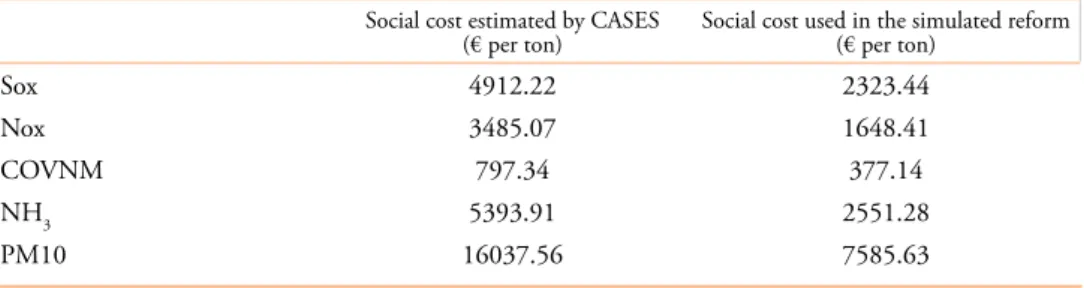
Indeed, global climate change (GCC) and local air pollution (LAP) are two important, interrelated causes of environmental concern whose potential synergies could improve policy making (Swart et al., 2004). See, for example, Feng et al. 2011) find no evidence that annual income overestimates distributional effects.
38 TESIS. SERIE CIENCIAS SOCIALES
METHODS AND DATA
- Methods
In this approach, the output of the macro model is used as input in the micro model, allowing the distributional impacts to be analyzed. In the second phase, a microsimulation model is used to calculate the distributional effects of price changes.
40 TESIS. SERIE CIENCIAS SOCIALES
The simulation performed is based on an indirect tax reform equal to the price change obtained. The distributional impacts on the short-term effects of the price change are therefore investigated.
42 TESIS. SERIE CIENCIAS SOCIALES
Data sources
TAX SCENARIOS
44 TESIS. SERIE CIENCIAS SOCIALES
RESULTS
- Price impacts
The impacts on prices obtained with the IO model are presented first, then the distributional effects obtained when these price impacts are factored into the demand model are analyzed. Although all these sectors show a similar impact on prices for the different tax scenarios, there are differences that are worth mentioning.
46 TESIS. SERIE CIENCIAS SOCIALES
Distributional effects
In the case of the LAP tax, the bottom deciles pay a larger share of their expenses than the top deciles. As shown in the previous section, the LAP tax increases the price of food and energy more than for other sectors.
48 TESIS. SERIE CIENCIAS SOCIALES
Effects of revenue recycling on income distribution
These results are consistent with the literature on the double-dividend hypothesis, which reports that costs decrease when environmental tax revenues are reused through labor taxes (Goulder, 1995). Our results show that there can be a trade-off between efficiency and equity (distributive effects) when choosing specific revenue recycling based on low labor taxes.
50 TESIS. SERIE CIENCIAS SOCIALES
Indexes for measuring regressivity
Specifically, it is slightly more progressive under the WRR assumption and more redistributive under the NRR. With the GCC tax, the change in the system is negligible, and the LAP tax slightly reduces the progressivity of the system.
CONCLUSIONS
52 TESIS. SERIE CIENCIAS SOCIALES
INTRODUCTION
Furthermore, dietary changes may be attractive not only from a climate perspective, but also from a public health perspective (Mytton et al., 2012). 1 According to Stehfest et al. 2009), a global transition to a low-meat diet, as recommended for health reasons, would reduce mitigation costs to achieve a CO2-eq of 450 ppm.
56 TESIS SERIE CIENCIAS SOCIALES
METHODS AND DATA
- Demand model
First, a demand model is estimated to provide a set of estimates of the substitution, own-price, and expenditure elasticities for the analyzed goods. These elasticities are then used in Section 3 to simulate distributional and welfare effects generated by tax rates on food.
58 TESIS SERIE CIENCIAS SOCIALES
Data
60 TESIS SERIE CIENCIAS SOCIALES
Elasticities
62 TESIS SERIE CIENCIAS SOCIALES
TAX SCENARIOS
Tax imposed per scenario and foodstuff
RESULTS AND DISCUSSION
- Emissions
The emissions and consumption per food falls by the same proportion because the emission factors are kept constant in the analysis. First note that emission reductions are in line with the levy imposed: the higher the emission factor per food.
64 TESIS SERIE CIENCIAS SOCIALES
Welfare and distributional effects
Consistent with average impacts, HCT has the largest welfare impacts, while REF has the lowest impact for all spending groups. Although the carbon price is higher in ExeHT than in REF, ExeHT includes similar welfare impacts for the tax scenario.

66 TESIS SERIE CIENCIAS SOCIALES
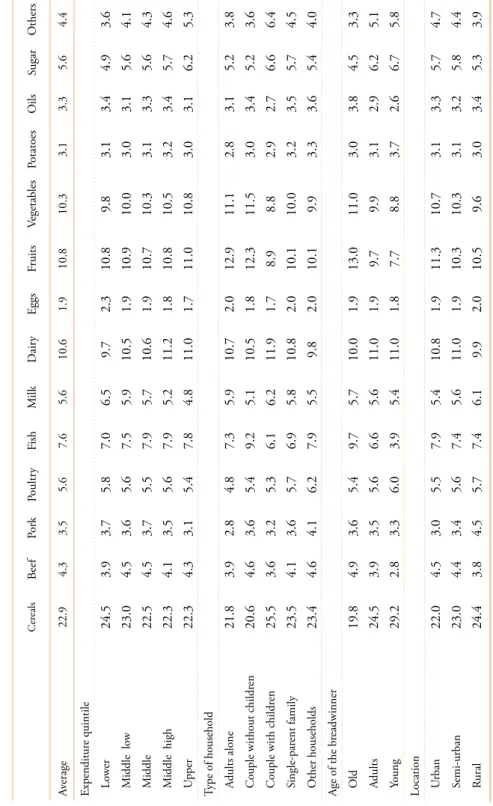
In line with the above results, the youngest households suffer the least impact on welfare (Figure 2.6).
68 TESIS SERIE CIENCIAS SOCIALES
Progressivity and redistributive effects
Also, the Kakwani index is negative in all analyzed cases, so the tax system can be said to be regressive in all scenarios, so, as can be seen, ATR decreases with the level of income, which confirms regressivity in all three scenarios .
Progressivity and redistribution indices
The Reynolds index values are negative but very close to zero in all scenarios, showing that the food taxes analyzed here have no redistributive effect. In other words, lower-income households bear a larger share of the tax relative to their income.
70 TESIS SERIE CIENCIAS SOCIALES
Nutritional impacts
Thus, the ExeHT scenario is more in line with WHO recommendations (WHO, 2015), which encourage increased fiber intake and reduced saturated fat and animal protein.
CONCLUSIONS
72 TESIS SERIE CIENCIAS SOCIALES
ANALYSIS FOR THE UNITED STATES
INTRODUCTION
Given such competitiveness concerns, this study investigates the economic effects of four alternative safeguards for US EITE industries: (i) production-based rebates, (ii) emissions pricing exemptions, (iii) energy intensity standards (rather than emissions pricing). , and (iv) carbon intensity standards (rather than emission pricing). Based on simulations with a large-scale computable general equilibrium (CGE) model for the global economy, we quantify how these safeguards affect the competitiveness of US EITE industries against alternative levels of climate policy stringency in other OECD countries.
76 TESIS SERIE CIENCIAS SOCIALES
LITERATURE REVIEW
To date there are only a few studies comparing alternative protective measures: Böhringer et al. Böhringer et al. 2012b) extend the comparison to include tax exemptions for EITE industries and find that the negative repercussions on domestic EITE production can be greatly reduced by frontier carbon adjustments, while tax exemptions and output-based rebates can achieve only a fraction of this relief.
STYLIZED THEORETICAL ANALYSIS
The bulk of these studies examine boundary carbon adaptations (e.g., Babiker and Rutherford, 2005; Mattoo et al., 2009; McKibben and Wilcoxen, 2009; Dissou and Eyland, 2011; Winchester et al., 2010; Böhringer et al. , 2010) and report effects on EITE industries in terms of change in manufacturing output. The overall finding is that carbon border adjustment mitigates negative output effects for EITE industries in unilaterally regulated countries (see Böhringer et al., 2012a for a meta-analysis), while yielding only limited gains in the global cost-effectiveness of unilateral action and improvement of negative terms of trade carryover effects to countries without emission regulations.
78 TESIS SERIE CIENCIAS SOCIALES
The producer price in the regulated country then no longer includes the costs of the remaining contained emissions, but the emission intensities (and corresponding production costs) correspond to the emission tax, so that the production costs with output-based discount correspond to the production costs for the case of emission taxes alone. If we set the implicit tax for the case of standards equal to the exogenous emission tax t, the effects of intensity standards and output-based discount are identical in our simple model framework where we do not have multiple products that differ in emission intensity.2 .
80 TESIS SERIE CIENCIAS SOCIALES
COMPUTABLE GENERAL EQUILIBRIUM ANALYSIS
- Non-technical model summary
At the second level, a CES function describes the substitution possibilities between the intermediate demand for energy composition and a value-added aggregate of labor and capital. Final consumption demand is given as a CES aggregate of composite non-energy consumption and composite energy consumption.
82 TESIS SERIE CIENCIAS SOCIALES
Data
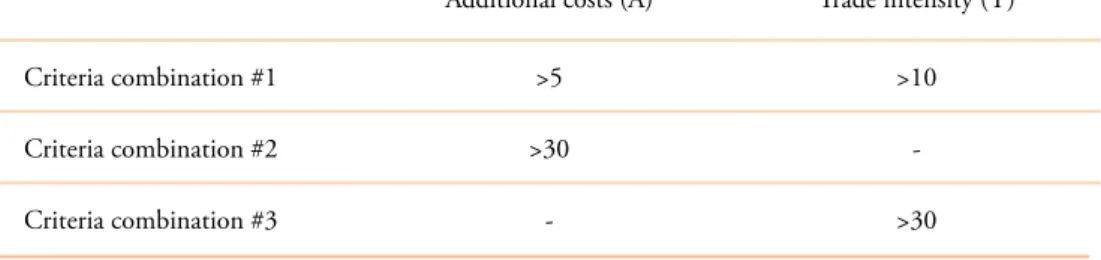
Qualification criteria for EITE sectors
Ɛ is the expected carbon price in 2020, and ω indicates the gross added value at factor costs.3. While we apply these criteria to the GTAP data set, the sectors that qualify contribute only 13% to overall gross value added.
84 TESIS SERIE CIENCIAS SOCIALES
Sector-specific competitiveness indicators
To assess the competitive effects of emissions regulation on EITE sectors, we first use two commonly used competitive indicators: world relative trade shares (RWS) and revealed comparative advantage (RCA).
86 TESIS SERIE CIENCIAS SOCIALES
Policy scenarios
In our core case simulation, we assume that the US is committed to reducing CO2 emissions by 30% compared to business-as-usual emissions. This emissions reduction target is roughly in line with the voluntary commitments to reduce greenhouse gas emissions submitted by the US under the Paris Agreement.
Summary of policy scenarios (scenario acronyms in parenthesis)
In the reference scenario (ref), the emissions reduction target is achieved through uniform CO2 emissions pricing across all segments of the economy – an economy-wide CO2 emissions tax is set sufficiently high to achieve a 30% reduction in domestic emissions.6 When we replace emissions pricing in EITE sectors based on intensity targets, we have set EITE intensity standards at the level achieved in the ref scenario, while endogenously adjusting carbon emissions taxes for all other segments of the US economy to achieve the 30% US emissions reduction justifiable for the entire economy. 7. In our central case simulations, we reflect such asymmetries between countries in climate action by assuming that non-OECD countries have negligible emission prices, while emission prices in OECD countries are significant.
88 TESIS SERIE CIENCIAS SOCIALES
Simulation results
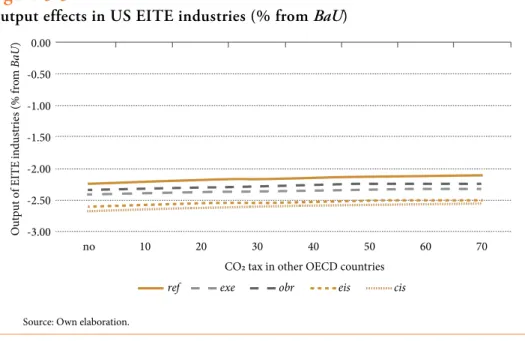
Production-based rebates (obr) moderate the price increases of EITE industries by recycling sector-specific emissions payments through clear production subsidies. US EITE sectors are commercially intensive, but their production still depends largely on domestic demand.
90 TESIS SERIE CIENCIAS SOCIALES
When the EITE industries are completely exempt from emission prices (exe), the rest of the US economy faces a significantly higher CO2 price, i.e. in scenario exe, only non-EITE sectors are subject to strict CO2 emission pricing, which lowers their value of output below the ref level.

92 TESIS SERIE CIENCIAS SOCIALES
Sensitivity analysis
94 TESIS SERIE CIENCIAS SOCIALES
CONCLUSION AND POLICY IMPLICATIONS
INTRODUCTION
98 TESIS SERIE CIENCIAS SOCIALES
RES-E PROMOTION AND ELECTRICITY PRICES IN SPAIN
The RES-E support scheme in Spain has been mainly based on feed-in tariffs and premiums since 1998, with some rather minor reforms of the whole scheme taking place in 2004 and 2007 under the Spanish Renewable Energy Law. The maximum level of generation of RES-E was on February 13, 2016, when renewable energy accounted for 67.5% of the day's output.
100 TESIS SERIE CIENCIAS SOCIALES
METHODOLOGY AND DATA
- Methods
102 TESIS SERIE CIENCIAS SOCIALES
The demand model captures actual household behavior and provides a realistic picture of substitution effects using econometric techniques. We estimate a demand model to provide a set of estimates of substitution, own-price, and expenditure elasticities for the analyzed goods.
104 TESIS SERIE CIENCIAS SOCIALES
Model linking
Subsequent iterations involve running the first step through the third until the two models converge (see Rutherford and Tar, 2008, or Rausch and Rutherford, 2007, for the detailed description of the model recalibration). Similarly, on the income side, we also scale capital and labor income from the MS model to match total income according to the IO table.
Data
Third, we re-solve the CGE model using the new preferences of the representative agent model calibrated using MS. To achieve the required matching, we scale up total household expenditure from microsimulation data to match total household expenditure according to national accounts.
106 TESIS SERIE CIENCIAS SOCIALES
RESULTS AND DISCUSSION
- Scenarios
Model sectors and commodities
Cost effectiveness results
This subsection presents the overall economic effects of the different scenarios in terms of percentage changes from the business-as-usual (BaU) scenario, assuming that each scenario achieves a comparable renewable energy supply. While the overall economic outcomes for each scenario regarding BaU are quite low, there are some differences worth highlighting.
Summary of policy scenarios (scenario acronyms in parentheses)
These results are not surprising, not only because each scenario uses similar revenues to fund the promotion of RES-E, but also because the amounts are not very significant when compared to the economy's total output or GDP. From a policy point of view, policymakers can choose between the different forms of financing without worrying about efficiency.
108 TESIS SERIE CIENCIAS SOCIALES
Sectoral impacts
Lsm and VAT financing designs confirm the positive impact of economic sectors when the effort to finance the promotion of RES-E is not covered by industries. All in all, our results show general benefits when the effort to finance the promotion of RES-E is not covered by electricity prices.
Distributional impacts
On the other hand, the fuel tax shows that the beneficiaries of abolishing the electricity surcharge are mainly the electricity industry, the sectors related to electricity production (such as coal or mining) and energy-intensive industries. However, under the fuel tax, the oil sector and the sectors related to the production and consumption of oil, such as crude oil (cru) and transportation (trp), experience higher costs.
110 TESIS SERIE CIENCIAS SOCIALES
Greater impacts on goods or income sources more closely associated with low-income households would typically lead to greater losses among the poorest households. Second, the effects on income sources are also quite modest (Table 4.4), with the only noteworthy case being the transfer effects when lsm is instituted.

112 TESIS SERIE CIENCIAS SOCIALES
CONCLUSIONS
The schemes considered include exemptions from the RES-E surcharge on the price of electricity for producers or households and also alternatives where the costs of renewable energy sources are not financed from the electricity bill but from other tax sources such as fuel tax, VAT or transfers. Our results provide evidence against the use of an electricity price surcharge to promote renewable energy sources.
114 TESIS SERIE CIENCIAS SOCIALES
GENERAL CONCLUSIONS
The previous chapters show that the welfare effects are on average below 1% when it comes to equivalent variation. Even in Chapter 3, where an ambitious climate policy is introduced in the US (with a 30% reduction in domestic emissions), the wealth effects are about 0.5% in terms of equivalent variation.
118 TESIS SERIE CIENCIAS SOCIALES
As pointed out in the introduction and in Chapters 1 and 2, mitigation options to achieve targets have traditionally focused mostly on the energy and transport sectors and on global climate change. It is pointed out that these policy options can be effective instruments to reduce emissions related to climate change.
120 TESIS SERIE CIENCIAS SOCIALES
FURTHER RESEARCH
Scarcity rent benefits (iii), transition costs (v), and asset price effects (vi) are important effects in the distributional analysis, but with respect to our case studies, we believe that protection benefits are the key distributional effect to consider in future studies. Further studies would do well to expand the potential benefits of this approach and include all distributional influences.
FINAL REMARK
The main limitation of these studies is that welfare impacts are analyzed purely from an income perspective, without accounting for the monetary health benefits associated with improved diets or local air pollution. In both cases there are many studies (see for example Pye et al., 2005 on local air pollution and Martin et al., 2008 on diets) which show that air pollution and poor dietary habits affect families with low income and thus may benefit much more from these policies Thus, in future research factoring the benefits of regulation into distributional studies may help enrich the analysis.
122 TESIS SERIE CIENCIAS SOCIALES
As an equivalent variation, it is defined as the amount of money that households would be willing to pay to prevent the price change caused by the tax increase from occurring.
124 TESIS SERIE CIENCIAS SOCIALES
126 TESIS SERIE CIENCIAS SOCIALES
15. Armington aggregate
Aigr Armington aggregate of good i for demand category (item) g in region r IMir Total import of good i and region r. P Price of import composite for good i in region r Wr Price of labor (wage rate) in region r.
128 TESIS SERIE CIENCIAS SOCIALES
130 TESIS SERIE CIENCIAS SOCIALES
Gilligan (2014), Importance of food demand management for climate mitigation. 1962), Recent Developments in the Competitiveness of American Industry and Prospects for the Future. Köhler (1998), Equality and Eco-Tax Reform in the EU: Achieving a 10 Percent Reduction in CO2 Emissions Using Excise Taxes.
134 TESIS. SERIE CIENCIAS SOCIALES
Chintakayala (2010), Aceptación pública del comercio de carbono personal y el impuesto al carbono. 2011), precio de la electricidad y política de cambio climático: ¿qué papel puede jugar un impuesto al carbono en España? Koppman (2013), Fuga de carbono y el futuro del mercado del RCDE UE: impacto de los desarrollos recientes en el RCDE UE en la lista de sectores que se espera que estén expuestos a la fuga de carbono.
136 TESIS. SERIE CIENCIAS SOCIALES
Wilkinson (2015), The potential to reduce UK greenhouse gas emissions through healthy and realistic dietary change. Should a carbon tax be differentiated across sectors?, Journal of Public Economics Emissions taxes versus intensity standards: Second-best environmental policies with incomplete regulation.
138 TESIS. SERIE CIENCIAS SOCIALES
Aguilera (2013), How changes in diet and trade patterns have shaped the N cycle on a national scale: Spain Reg Environ Change. Qaim (2009), The transformation of the food system in developing countries: an analysis of the demand for fruits and vegetables in Vietnam. 1999), A distributional analysis of green tax reforms.
140 TESIS. SERIE CIENCIAS SOCIALES
Vizcaíno (2008), Analyzing the impact of renewable electricity support schemes on electricity prices: the case of wind electricity in Spain. Genoese (2008), The Merit-Order Effect: A detailed analysis of the price effect of renewable electricity generation on spot market prices in Germany.
142 TESIS. SERIE CIENCIAS SOCIALES
º 3. LAS VERSIONES CASTELLANAS MEDIEVALES DE LA CONSOLATIO PHILOSOPHIAE DE BOECIO (Serie Humanidades)
º 4. ESSAYS ON FAMILIARITY AND CHOICE (Serie Ciencias Sociales) Por Francesco Cerigioni
DISTRIBUTIONAL ANALYSIS OF CLIMATE CHANGE MITIGATION