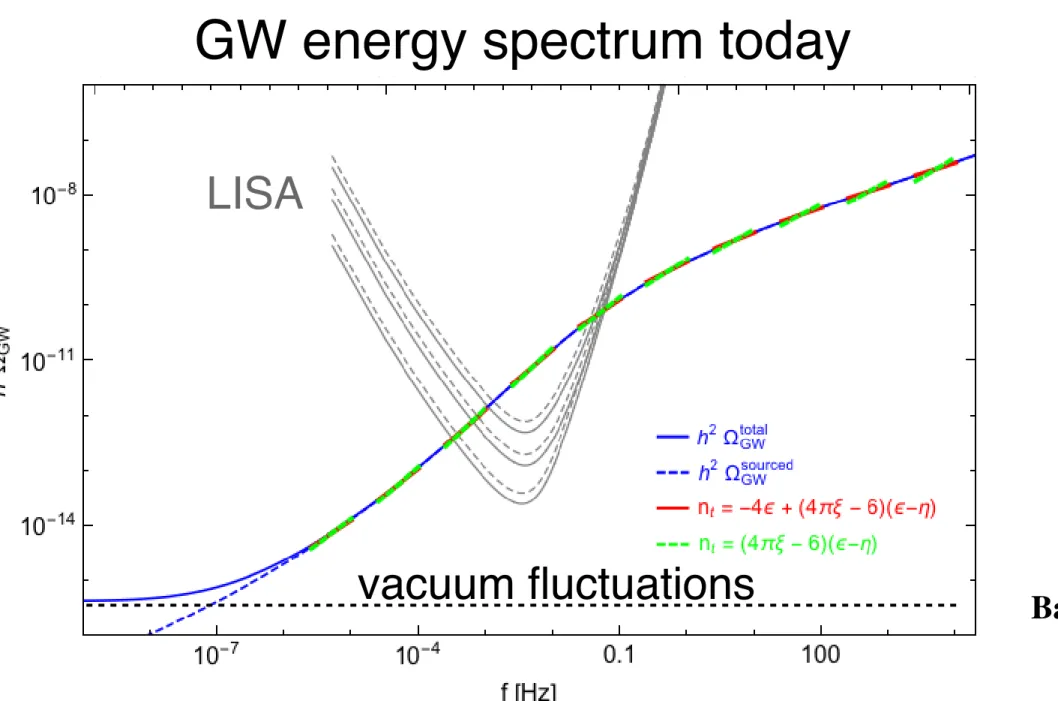
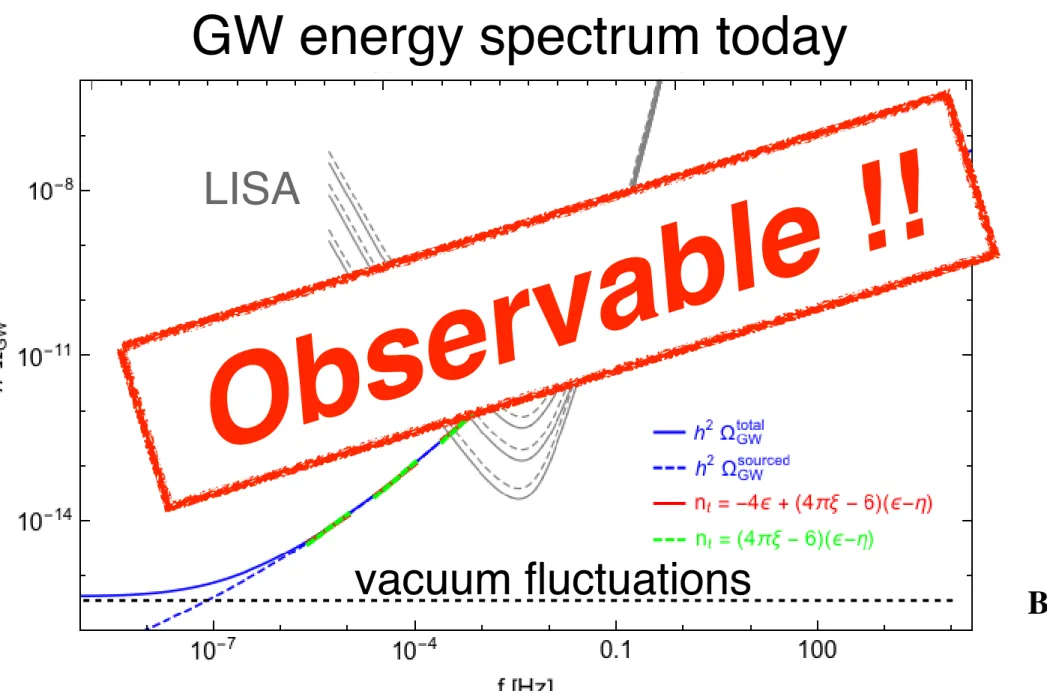
GRAVITATIONAL WAVES
AS A PROBE OF EARLY UNIVERSE COSMOLOGY
DANIEL G. FIGUEROA
LPPC, EPFL, Lausanne
Rencontres de Moriond: Cosmology 2018 (March 17-24). La Thuile, Italy Rencontres de Moriond, Gravitation 2019, March 24-30, La Thuile, Italy
& EARLY UNIVERSE COSMOLOGY
Invisibles19, Valencia, Spain, Europe, Earth, Solar System, Milky Way, Universe
(soon to be drinking tons of )
[LIGO & Virgo Scientific Collaborations]
[LIGO & Virgo Scientific Collaborations (arXiv:1602.03841)]
Gravitational Waves (GWs)
detected !
Einstein 1916 … LIGO/VIRGO 2015/16/17
We can observe the Universe
through GWs
Milestone
2015-2019
* Late Universe: Hubble diagram from Binaries
* Early Universe: High Energy Particle Physics
Cosmology with GWs
Can we really probe High Energy Physics
using Gravitational Waves (GWs) ? How ?
Particle Production
( t . 1s)
Cosmic Defects Quantum
Fluctuations
Phase Transitions
The Early Universe
( t . 1s)
Probe of the early Universe
GWs
The Early Universe
Particle Production
Cosmic Defects Quantum
Fluctuations
Phase
Transitions
( t . 1s)
Probe of the early Universe
GWs
The Early Universe
Particle Production
Cosmic Defects Quantum
Fluctuations
Phase Transitions
‘Holy Grail’ of Stochastic GW
Backgrounds
(N. Christensen)
GRAVITATIONAL WAVES (GW): PROBING the EARLY UNIVERSE (t . 1 s)
1
WEAKNESS of GRAVITY:
ADVANTAGE: GW DECOUPLE upon Production DISADVANTAGE: DIFFICULT DETECTION
2
ADVANTAGE: GW ! Probe for Early Universe
!
⇢ Decouple ! Spectral Form Retained Specific HEP , Specific GW
3
Physical Processes:
8 >
> <
> >
:
Inflation Reheating
Phase Transitions Turbulence
GWs: probe of the early Universe
Cosmic Defects
@ Early Universe
Well motivated case !
0) GW definition
OUTLINE
1) GWs from Inflation
2) GWs from Preheating
3) GWs from Phase Transitions 4) GWs from Cosmic Defects Early
Universe
Gravitational Waves in Cosmology
1. Gravitational Waves (GWs) [Basics]
• GW: ds
2= a
2( d⌘
2+ (
ij+ h
ij)dx
idx
j), TT :
⇢ h
ii= 0 h
ij,
j= 0
Eom: h
00ij+ 2 H h
0ijr
2h
ij= 16⇡ G⇧
TTij, ⇧
ij= T
ijh T
iji
FRWTransverse-Traceless (TT) dof carry energy out of the source!!!
• GW Source(s): ( SCALARS , VECTOR , FERMIONS )
⇧
T Tij/ { @
i a@
j a}
T T, { E
iE
j+ B
iB
j}
T T, { ¯
iD
j}
T TFRW:
1. Gravitational Waves (GWs) [Basics]
• GW: ds 2 = a 2 ( d⌘ 2 + ( ij + h ij )dx i dx j ), TT :
⇢ h ii = 0 h ij , j = 0
Eom: h 00 ij + 2 H h 0 ij r 2 h ij = 16⇡ G⇧ TT ij , ⇧ ij = T ij h T ij i
FRWTransverse-Traceless (TT) dof carry energy out of the source!!!
• GW Source(s): ( SCALARS , VECTOR , FERMIONS )
⇧ T T ij / { @ i a @ j a } T T , { E i E j + B i B j } T T , { ¯ i D j } T T
1. Gravitational Waves (GWs) [Basics]
• GW: ds
2= a
2( d⌘
2+ (
ij+ h
ij)dx
idx
j), TT :
⇢ h
ii= 0 h
ij,
j= 0
Eom: h
00ij+ 2 H h
0ijr
2h
ij= 16⇡G⇧
TTij, ⇧
ij= T
ijh T
iji
FRWTransverse-Traceless (TT) dof carry energy out of the source!!!
• GW Source(s): ( SCALARS , VECTOR , FERMIONS )
⇧
T Tij/ { @
i a@
j a}
T T, { E
iE
j+ B
iB
j}
T T, { ¯
iD
j}
T TSource: Anisotropic Stress
Creation/Propagation GWs
Transverse-Traceless (TT)
0) GW definition
Gravitational Waves as a probe of the early Universe
OUTLINE
1) GWs from Inflation
2) GWs from Preheating
3) GWs from Phase Transitions 4) GWs from Cosmic Defects Early
Universe
Irreducible GW background from Inflation
⌦
(o)GW(f ) ⌘ 1
⇢
(o)c✓ d log ⇢
GWd log k
◆
o
= ⌦
(o)Rad24
2h⇤
(k )
2h(k) = 2
⇡
2✓ H m
p◆
2✓ k aH
◆
ntn
t⌘ 2✏
-18.0 -14.0 -10.0 -6.0 -2.0 2.0 6.0 10.0
Log[f]
-16.0 -14.0 -12.0 -10.0 -8.0 -6.0 -4.0 -2.0 0.0
Log[h 0
2 Ω GW]
Figure 12: The spectrum of amplification of vacuum fluctuations produced by a phase of De Sitter inflation (solid line), with a value of H that saturates the COBE bound. The nucleosynthesis bound (dotted line) and the pulsar bound (triangle shaped) of fig. 11 are also shown for comparison.
63
scale-invariant (RD modes) (MD modes)
⌦
GW/ 1/k
2red tilted (quasi-) scale-invariant (RD modes)
}
T (k) / k
0(RD)
Transfer Funct.:
aLIGO
LISA
energy scale
d⇢
GWd log k
Irreducible GW background from Inflation
⌦
(o)GW(f ) ⌘ 1
⇢
(o)c✓ d log ⇢
GWd log k
◆
o
= ⌦
(o)Rad24
2h⇤
(k )
2h(k) = 2
⇡
2✓ H m
p◆
2✓ k aH
◆
ntn
t⌘ 2✏
-18.0 -14.0 -10.0 -6.0 -2.0 2.0 6.0 10.0
Log[f]
-16.0 -14.0 -12.0 -10.0 -8.0 -6.0 -4.0 -2.0 0.0
Log[h 0
2 Ω GW]
Figure 12: The spectrum of amplification of vacuum fluctuations produced by a phase of De Sitter inflation (solid line), with a value of H that saturates the COBE bound. The nucleosynthesis bound (dotted line) and the pulsar bound (triangle shaped) of fig. 11 are also shown for comparison.
63
scale-invariant (RD modes) (MD modes)
⌦
GW/ 1/k
2red tilted (quasi-) scale-invariant (RD modes)
}
T (k) / k
0(RD)
Transfer Funct.:
aLIGO
LISA
energy scale
Not Obs erva ble !
d⇢
GWd log k
Irreducible GW background from Inflation
⌦
(o)GW(f ) ⌘ 1
⇢
(o)c✓ d log ⇢
GWd log k
◆
o
= ⌦
(o)Rad24
2h⇤
(k )
2h(k) = 2
⇡
2✓ H m
p◆
2✓ k aH
◆
ntn
t⌘ 2✏
-18.0 -14.0 -10.0 -6.0 -2.0 2.0 6.0 10.0
Log[f]
-16.0 -14.0 -12.0 -10.0 -8.0 -6.0 -4.0 -2.0 0.0
Log[h 0
2 Ω GW]
Figure 12: The spectrum of amplification of vacuum fluctuations produced by a phase of De Sitter inflation (solid line), with a value of H that saturates the COBE bound. The nucleosynthesis bound (dotted line) and the pulsar bound (triangle shaped) of fig. 11 are also shown for comparison.
63
scale-invariant (RD modes) (MD modes)
⌦
GW/ 1/k
2red tilted (quasi-) scale-invariant (RD modes)
}
T (k) / k
0(RD)
Transfer Funct.:
aLIGO
LISA
energy scale
Not Obs erva ble !
except (perhaps)
indir ectly , @ the CMB …
d⇢
GWd log k
INFLATIONARY COSMOLOGY
( initial cond. )
Inflation = {
Scenarios
Primordial perturbations
Tensor Scalar
Irreducible GW Background
Enhanced GWs Enhanced Scalar Pert.
Extra species/symmetries
Modified Gravity, spectator fields, graviton mass, …
{
INFLATIONARY COSMOLOGY
( initial cond. )
Inflation = {
Scenarios
Primordial perturbations
Tensor Scalar
Enhanced GWs Enhanced Scalar Pert.
Extra species/symmetries
Modified Gravity, spectator fields, graviton mass, …
{
Irreducible GW
Background
INFLATIONARY MODELS
We focus on a specific scenario, with a natural class of models of inflation and with a mechanism of production / exp ˙
GW signal naturally grows at interferometer scales, while small at CMB scales
• CMB in agreement with simplest models of slow-roll cosmic inflation
r ⌘ P GW
P ⇣ , n s 1 ⌘ d ln P ⇣
d ln k , f NL ⇠ h ⇣ 3 i
h ⇣ 2 i 2 = O (✏ V , ⌘ V )
✏ V ⌘ M p 2 2
⇣ V
,
V
⌘ 2
⌧ 1 ⌘ V ⌘ M p 2 V ,
V ⌧ 1
• Flatness and gaussianity ! small self-couplings Axion (Natural) Inflation
• Shift symmetry on couplings to other fields Freese, Frieman, Olinto ’90; . . .
(review Pajer, MP ’13)
L = 1
2 (@ µ ) 2 + V shift ( ) + c
f @ µ ¯ µ 5 + ↵
f F µ⌫ F ˜ µ⌫
has the advantage that
• Smallness of V shift technically natural. V / V shift
• Constrained couplings to matter (predictivity)
We focus on a specific scenario, with a natural class of models of inflation and with a mechanism of production / exp ˙
GW signal naturally grows at interferometer scales, while small at CMB scales
• CMB in agreement with simplest models of slow-roll cosmic inflation
r ⌘ P GW
P ⇣ , n s 1 ⌘ d ln P ⇣
d ln k , f NL ⇠ h ⇣ 3 i
h ⇣ 2 i 2 = O (✏ V , ⌘ V )
✏ V ⌘ M p 2 2
⇣ V
,
V
⌘ 2
⌧ 1 ⌘ V ⌘ M p 2 V ,
V ⌧ 1
• Flatness and gaussianity ! small self-couplings Axion (Natural) Inflation
• Shift symmetry on couplings to other fields Freese, Frieman, Olinto ’90; . . .
(review Pajer, MP ’13)
L = 1
2 (@ µ ) 2 + V shift ( ) + c
f @ µ ¯ µ 5 + ↵
f F µ⌫ F ˜ µ⌫
has the advantage that
• Smallness of V shift technically natural. V / V shift
• Constrained couplings to matter (predictivity)
We focus on a specific scenario, with a natural class of models of inflation and with a mechanism of production / exp ˙
GW signal naturally grows at interferometer scales, while small at CMB scales
• CMB in agreement with simplest models of slow-roll cosmic inflation
r ⌘ P
GWP
⇣, n
s1 ⌘ d ln P
⇣d ln k , f
NL⇠ h ⇣
3i
h ⇣
2i
2= O (✏
V, ⌘
V)
✏
V⌘ M
p22
⇣ V
,
V
⌘
2⌧ 1 ⌘
V⌘ M
p2V
,V ⌧ 1
• Flatness and gaussianity ! small self-couplings Axion (Natural) Inflation
• Shift symmetry on couplings to other fields Freese, Frieman, Olinto ’90; . . .
(review Pajer, MP ’13)
L = 1
2 (@
µ)
2+ V
shift( ) + c
f @
µ¯
µ 5+ ↵
f F
µ⌫F ˜
µ⌫has the advantage that
• Smallness of V
shifttechnically natural. V / V
shift• Constrained couplings to matter (predictivity) We focus on a specific scenario, with a natural class of models of inflation
and with a mechanism of production / exp ˙
GW signal naturally grows at interferometer scales, while small at CMB scales
• CMB in agreement with simplest models of slow-roll inflation
r ⌘ P
GWP
⇣, n
s1 ⌘ d ln P
⇣d ln k , f
NL⇠ h ⇣
3i
h ⇣
2i
2= O (✏, ⌘)
• Flatness and gaussianity ! small inflaton self-couplings
• Shift symmetry (broken by V ) on couplings to other fields has advantages
Freese, Frieman, Olinto ’90; . . . (review Pajer, MP ’13)
Planck ’15
P
s/ k
ns 1r = P
tP
s• No observed departure from (primordial) gaussianity, h ⇣
3i ⌧ h ⇣
2i
3/2Local NG : (x) =
g(x) + f
NLlocal⇥
2g
(x) ⌦
2g
↵⇤
• Agreement with standard single field slow roll
r, n
s1, f
NL= O (✏, ⌘)
✏ ⌘ M
p22
⇣ V
,
V
⌘
2⌧ 1 , ⌘ ⌘ M
p2V
,V ⌧ 1
• CMB in agreement with simplest models of slow-roll inflation
r ⌘ P
GWP
⇣, n
s1 ⌘ d ln P
⇣d ln k , f
NL⇠ h ⇣
3i
h ⇣
2i
2= O (✏, ⌘)
• Flatness and gaussianity ! small inflaton self-couplings
• Shift symmetry (broken by V ) on couplings to other fields has advantages
Freese, Frieman, Olinto ’90; . . . (review Pajer, MP ’13)
Planck ’15
P
s/ k
ns 1r = P
tP
s• No observed departure from (primordial) gaussianity, h ⇣
3i ⌧ h ⇣
2i
3/2Local NG : (x) =
g(x) + f
NLlocal⇥
2g
(x) ⌦
2g
↵⇤
• Agreement with standard single field slow roll
r, n
s1, f
NL= O (✏, ⌘)
✏ ⌘ M
p22
⇣ V
,
V
⌘
2⌧ 1 , ⌘ ⌘ M
p2V
,V ⌧ 1
We focus on a specific scenario, with a natural class of models of inflation and with a mechanism of production / exp ˙
GW signal naturally grows at interferometer scales, while small at CMB scales
Axion ⇤ Inflation
• Shift symmetry ! + C on couplings to other fields Freese, Frieman, Olinto ’90; . . .
(review Pajer, MP ’13)
L = 1
2 (@ µ ) 2 + V shift ( ) + c
f @ µ ¯ µ 5 + ↵
f F µ⌫ F ˜ µ⌫
has the advantage that
• Smallness of V shift technically natural. V / V shift
• Constrained couplings to matter (predictivity)
⇤ Not the QCD axion; reference values f ⇠ 10 16 GeV , m ' 10 13 GeV
Axion
⇤Inflation
• Shift symmetry on couplings to other fields
Freese, Frieman, Olinto ’90; . . . (review Pajer, MP ’13)
L = 1
2 (@
µ)
2+ V
shift( ) + c
f @
µ¯
µ 5+ ↵
f F
µ⌫F ˜
µ⌫has the advantage that
• Smallness of V
shifttechnically natural. V / V
shift• Constrained couplings to matter (predictivity)
⇤
Not the QCD axion; reference values f ⇠ 10
16GeV , m ' 10
13GeV
Shi ft s ym me try ! + C . E .g. axi on (na tur al) infl ation
Fre ese , F riem an, Oli nto ’90
L = 1
2 ( @ µ ) 2 + V shif t ( ) + C f
@ µ ¯ µ 5
+
↵ f
F µ ⌫ F ˜ µ ⌫
• Sm allne ss of V shif t
tec hni cal ly na tur al. V / V shif t
• Cons tra ine d c oupl ings to ma tte r (p redi ctiv ity)
! '
C 2
2 ⇡ f 2
m m 2
! AA =
↵ 2
64 ⇡ f 2
m 3
! AA typi cal ly c ont rols rehe ating.
Onl y re cent ly r eal ized
tha t it can pla y a n im por tant role also dur ing infl ation.
— —
Couplings in axion inflation
Freese, Frieman, Olinto ’90 . . .
(review Pajer, MP ’13)
L = 1
2 (@ µ ) 2 + V shift ( ) + c
f @ µ ¯ µ 5 + ↵
f F µ⌫ F ˜ µ⌫
• Smallness of V shift technically natural. V / V shift
• Constrained couplings to matter (predictivity)
! ' c 2
2 ⇡ f 2 m m 2 ! AA = ↵ 2
64 ⇡ f 2 m 3
! AA typically controls reheating. More recently, realized that it can play an important role also during inflation
Axion ⇤ Inflation
• Shift symmetry ! + C on couplings to other fields
Freese, Frieman, Olinto ’90; . . . (review Pajer, MP ’13)
L = 1
2 ( @ µ ) 2 + V shift ( ) + c
f @ µ ¯ µ 5 + ↵
f F µ⌫ F ˜ µ⌫
has the advantage that
• Smallness of V shift technically natural. V / V shift
• Constrained couplings to matter (predictivity)
⇤ Not the QCD axion; reference values f ⇠ 10 16 GeV , m ' 10 13 GeV We focus on a specific scenario, with a natural class of models of inflation
and with a mechanism of production / exp ˙
GW signal naturally grows at interferometer scales, while small at CMB scales
Axion ⇤ Inflation
• Shift symmetry ! + C on couplings to other fields Freese, Frieman, Olinto ’90; . . .
(review Pajer, MP ’13)
L = 1
2 (@ µ ) 2 + V shift ( ) + c
f @ µ ¯ µ 5 + ↵
f F µ⌫ F ˜ µ⌫
has the advantage that
• Smallness of V shift technically natural. V / V shift
• Constrained couplings to matter (predictivity)
⇤ Not the QCD axion; reference values f ⇠ 10 16 GeV , m ' 10 13 GeV Slow roll inflation requires very flat potential V , and, generically,
hard to explain why V protected against quantum corrections.
With shift symmetry, V / V shift
We focus on a specific scenario, with a natural class of models of inflation and with a mechanism of production / exp ˙
GW signal naturally grows at interferometer scales, while small at CMB scales
Axion ⇤ Inflation
• Shift symmetry ! + C on couplings to other fields Freese, Frieman, Olinto ’90; . . .
(review Pajer, MP ’13)
L = 1
2 (@ µ ) 2 + V shift ( ) + c
f @ µ ¯ µ 5 + ↵
f F µ⌫ F ˜ µ⌫
has the advantage that
• Smallness of V shift technically natural. V / V shift
• Constrained couplings to matter (predictivity)
⇤ Not the QCD axion; reference values f ⇠ 10 16 GeV , m ' 10 13 GeV Slow roll inflation requires very flat potential V , and, generically,
hard to explain why V protected against quantum corrections.
With shift symmetry, V / V shift
We focus on a specific scenario, with a natural class of models of inflation and with a mechanism of production / exp ˙
GW signal naturally grows at interferometer scales, while small at CMB scales
Axion ⇤ Inflation
• Shift symmetry ! + C on couplings to other fields Freese, Frieman, Olinto ’90; . . .
(review Pajer, MP ’13)
L = 1
2 (@ µ ) 2 + V shift ( ) + c
f @ µ ¯ µ 5 + ↵
f F µ⌫ F ˜ µ⌫
has the advantage that
• Smallness of V shift technically natural. V / V shift
• Constrained couplings to matter (predictivity)
⇤ Not the QCD axion; reference values f ⇠ 10 16 GeV , m ' 10 13 GeV Slow roll inflation requires very flat potential V , and, generically,
hard to explain why V protected against quantum corrections.
With shift symmetry, V / V shift
inflaton = pseudo-scalar axion ' V (') + ↵
f F
µ⌫F ˜
µ⌫We focus on a specific scenario, with a natural class of models of inflation and with a mechanism of production / exp ˙
GW signal naturally grows at interferometer scales, while small at CMB scales
• CMB in agreement with simplest models of slow-roll cosmic inflation
r ⌘ P
GWP
⇣, n
s1 ⌘ d ln P
⇣d ln k , f
NL⇠ h ⇣
3i
h ⇣
2i
2= O (✏
V, ⌘
V)
✏
V⌘ M
p22
⇣ V
,
V
⌘
2⌧ 1 ⌘
V⌘ M
p2V
,V ⌧ 1
• Flatness and gaussianity ! small self-couplings Axion (Natural) Inflation
• Shift symmetry on couplings to other fields Freese, Frieman, Olinto ’90; . . .
(review Pajer, MP ’13)
L = 1
2 (@
µ)
2+ V
shift( ) + c
f @
µ¯
µ 5+ ↵
f F
µ⌫F ˜
µ⌫has the advantage that
• Smallness of V
shifttechnically natural. V / V
shift• Constrained couplings to matter (predictivity)
We focus on a specific scenario, with a natural class of models of inflation and with a mechanism of production / exp ˙
GW signal naturally grows at interferometer scales, while small at CMB scales
• CMB in agreement with simplest models of slow-roll cosmic inflation
r ⌘ P
GWP
⇣, n
s1 ⌘ d ln P
⇣d ln k , f
NL⇠ h ⇣
3i
h ⇣
2i
2= O (✏
V, ⌘
V)
✏
V⌘ M
p22
⇣ V
,
V
⌘
2⌧ 1 ⌘
V⌘ M
p2V
,V ⌧ 1
• Flatness and gaussianity ! small self-couplings Axion (Natural) Inflation
• Shift symmetry on couplings to other fields Freese, Frieman, Olinto ’90; . . .
(review Pajer, MP ’13)
L = 1
2 (@
µ)
2+ V
shift( ) + c
f @
µ¯
µ 5+ ↵
f F
µ⌫F ˜
µ⌫has the advantage that
• Smallness of V
shifttechnically natural. V / V
shift• Constrained couplings to matter (predictivity)
We focus on a specific scenario, with a natural class of models of inflation and with a mechanism of production / exp ˙
GW signal naturally grows at interferometer scales, while small at CMB scales
• CMB in agreement with simplest models of slow-roll cosmic inflation
r ⌘ P
GWP
⇣, n
s1 ⌘ d ln P
⇣d ln k , f
NL⇠ h ⇣
3i
h ⇣
2i
2= O (✏
V, ⌘
V)
✏
V⌘ M
p22
⇣ V
,
V
⌘
2⌧ 1 ⌘
V⌘ M
p2V
,V ⌧ 1
• Flatness and gaussianity ! small self-couplings Axion (Natural) Inflation
• Shift symmetry on couplings to other fields Freese, Frieman, Olinto ’90; . . .
(review Pajer, MP ’13)
L = 1
2 (@
µ)
2+ V
shift( ) + c
f @
µ¯
µ 5+ ↵
f F
µ⌫F ˜
µ⌫has the advantage that
• Smallness of V
shifttechnically natural. V / V
shift• Constrained couplings to matter (predictivity) We focus on a specific scenario, with a natural class of models of inflation
and with a mechanism of production / exp ˙
GW signal naturally grows at interferometer scales, while small at CMB scales
• CMB in agreement with simplest models of slow-roll inflation
r ⌘ PGW
P⇣ , ns 1 ⌘ dlnP⇣
dlnk , fNL ⇠ h⇣3i
h⇣2i2 = O (✏,⌘)
• Flatness and gaussianity ! small inflaton self-couplings
• Shift symmetry (broken by V ) on couplings to other fields has advantages
Freese, Frieman, Olinto ’90; . . . (review Pajer, MP ’13)
Planck ’15
Ps / kns 1 r = Pt
Ps
• No observed departure from (primordial) gaussianity, h⇣3i ⌧ h⇣2i3/2
Local NG : (x) =
g(x) + f
NLlocal⇥
2g
(x) ⌦
2g
↵⇤
• Agreement with standard single field slow roll
r, ns 1, fNL = O (✏,⌘)
✏ ⌘ Mp2 2
⇣
V,
V
⌘
2⌧ 1 , ⌘ ⌘ Mp2 V,
V ⌧ 1
• CMB in agreement with simplest models of slow-roll inflation
r ⌘ PGW
P⇣ , ns 1 ⌘ dlnP⇣
dlnk , fNL ⇠ h⇣3i
h⇣2i2 = O (✏,⌘)
• Flatness and gaussianity ! small inflaton self-couplings
• Shift symmetry (broken by V ) on couplings to other fields has advantages
Freese, Frieman, Olinto ’90; . . . (review Pajer, MP ’13)
Planck ’15
Ps / kns 1 r = Pt Ps
• No observed departure from (primordial) gaussianity, h⇣3i ⌧ h⇣2i3/2
Local NG : (x) = g (x) + fNLlocal ⇥ 2
g (x) ⌦ 2
g
↵⇤
• Agreement with standard single field slow roll
r, ns 1, fNL = O (✏,⌘)
✏ ⌘ Mp2 2
⇣V
,
V
⌘2
⌧ 1 , ⌘ ⌘ Mp2 V,
V ⌧ 1
We focus on a specific scenario, with a natural class of models of inflation and with a mechanism of production / exp ˙
GW signal naturally grows at interferometer scales, while small at CMB scales
Axion ⇤ Inflation
• Shift symmetry ! + C on couplings to other fields Freese, Frieman, Olinto ’90; . . .
(review Pajer, MP ’13)
L = 1
2 (@ µ ) 2 + V shift ( ) + c
f @ µ ¯ µ 5 + ↵
f F µ⌫ F ˜ µ⌫
has the advantage that
• Smallness of V shift technically natural. V / V shift
• Constrained couplings to matter (predictivity)
⇤ Not the QCD axion; reference values f ⇠ 10 16 GeV , m ' 10 13 GeV
Axion⇤ Inflation
• Shift symmetry on couplings to other fields
Freese, Frieman, Olinto ’90; . . . (review Pajer, MP ’13)
L = 1
2 (@µ )2 + Vshift ( ) + c
f @µ ¯ µ 5 + ↵
f Fµ⌫ F˜µ⌫
has the advantage that
• Smallness of Vshift technically natural. V / Vshift
• Constrained couplings to matter (predictivity)
⇤ Not the QCD axion; reference values f ⇠ 1016GeV , m ' 1013 GeV
Shi ft s ym me try ! + C . E .g. axi on (na tur al) infl ation
Fre ese , F riem an, Oli nto ’90
L = 1
2 ( @ µ ) 2 + V shif t ( ) + C f
@ µ ¯ µ 5
+ ↵ f
F µ ⌫ F ˜ µ ⌫
• Sm allne ss of V shif t
tec hni cal ly na tur al. V / V shif t
• Cons tra ine d c oupl ings to ma tte r (p redi ctiv ity)
! '
C 2
2 ⇡ f 2
m m 2
! AA =
↵ 2
64 ⇡ f 2
m 3
! AA typi cal ly c ont rols rehe ating.
Onl y re cent ly r eal ized
tha t it can pla y a n im por tant role also dur ing infl ation.
— —
Couplings in axion inflation
Freese, Frieman, Olinto ’90 . . .
(review Pajer, MP ’13)
L = 1
2 (@
µ)
2+ V
shift( ) + c
f @
µ¯
µ 5+ ↵
f F
µ⌫F ˜
µ⌫• Smallness of V
shifttechnically natural. V / V
shift• Constrained couplings to matter (predictivity)
!
' c
22⇡f
2m m
2 !AA= ↵
264⇡ f
2m
3! AA typically controls reheating. More recently, realized that it can play an important role also during inflation
Axion
⇤Inflation
• Shift symmetry ! + C on couplings to other fields
Freese, Frieman, Olinto ’90; . . . (review Pajer, MP ’13)
L = 1
2 (@
µ)
2+ V
shift( ) + c
f @
µ¯
µ 5+ ↵
f F
µ⌫F ˜
µ⌫has the advantage that
• Smallness of V
shifttechnically natural. V / V
shift• Constrained couplings to matter (predictivity)
⇤
Not the QCD axion; reference values f ⇠ 10
16GeV , m ' 10
13GeV We focus on a specific scenario, with a natural class of models of inflation
and with a mechanism of production / exp ˙
GW signal naturally grows at interferometer scales, while small at CMB scales
Axion
⇤Inflation
• Shift symmetry ! + C on couplings to other fields Freese, Frieman, Olinto ’90; . . .
(review Pajer, MP ’13)
L = 1
2 (@
µ)
2+ V
shift( ) + c
f @
µ¯
µ 5+ ↵
f F
µ⌫F ˜
µ⌫has the advantage that
• Smallness of V
shifttechnically natural. V / V
shift• Constrained couplings to matter (predictivity)
⇤
Not the QCD axion; reference values f ⇠ 10
16GeV , m ' 10
13GeV Slow roll inflation requires very flat potential V , and, generically,
hard to explain why V protected against quantum corrections.
With shift symmetry, V / V
shiftWe focus on a specific scenario, with a natural class of models of inflation and with a mechanism of production / exp ˙
GW signal naturally grows at interferometer scales, while small at CMB scales
Axion
⇤Inflation
• Shift symmetry ! + C on couplings to other fields Freese, Frieman, Olinto ’90; . . .
(review Pajer, MP ’13)
L = 1
2 (@
µ)
2+ V
shift( ) + c
f @
µ¯
µ 5+ ↵
f F
µ⌫F ˜
µ⌫has the advantage that
• Smallness of V
shifttechnically natural. V / V
shift• Constrained couplings to matter (predictivity)
⇤
Not the QCD axion; reference values f ⇠ 10
16GeV , m ' 10
13GeV Slow roll inflation requires very flat potential V , and, generically,
hard to explain why V protected against quantum corrections.
With shift symmetry, V / V
shiftWe focus on a specific scenario, with a natural class of models of inflation and with a mechanism of production / exp ˙
GW signal naturally grows at interferometer scales, while small at CMB scales
Axion
⇤Inflation
• Shift symmetry ! + C on couplings to other fields Freese, Frieman, Olinto ’90; . . .
(review Pajer, MP ’13)
L = 1
2 (@
µ)
2+ V
shift( ) + c
f @
µ¯
µ 5+ ↵
f F
µ⌫F ˜
µ⌫has the advantage that
• Smallness of V
shifttechnically natural. V / V
shift• Constrained couplings to matter (predictivity)
⇤
Not the QCD axion; reference values f ⇠ 10
16GeV , m ' 10
13GeV Slow roll inflation requires very flat potential V , and, generically,
hard to explain why V protected against quantum corrections.
With shift symmetry, V / V
shiftAxion-Inflation ' ! ' + const.
'
INFLATIONARY MODELS
We focus on a specific scenario, with a natural class of models of inflation and with a mechanism of production / exp ˙
GW signal naturally grows at interferometer scales, while small at CMB scales
• CMB in agreement with simplest models of slow-roll cosmic inflation
r ⌘ P GW
P ⇣ , n s 1 ⌘ d ln P ⇣
d ln k , f NL ⇠ h ⇣ 3 i
h ⇣ 2 i 2 = O (✏ V , ⌘ V )
✏ V ⌘ M p 2 2
⇣ V
,
V
⌘ 2
⌧ 1 ⌘ V ⌘ M p 2 V ,
V ⌧ 1
• Flatness and gaussianity ! small self-couplings Axion (Natural) Inflation
• Shift symmetry on couplings to other fields Freese, Frieman, Olinto ’90; . . .
(review Pajer, MP ’13)
L = 1
2 (@ µ ) 2 + V shift ( ) + c
f @ µ ¯ µ 5 + ↵
f F µ⌫ F ˜ µ⌫
has the advantage that
• Smallness of V shift technically natural. V / V shift
• Constrained couplings to matter (predictivity)
We focus on a specific scenario, with a natural class of models of inflation and with a mechanism of production / exp ˙
GW signal naturally grows at interferometer scales, while small at CMB scales
• CMB in agreement with simplest models of slow-roll cosmic inflation
r ⌘ P GW
P ⇣ , n s 1 ⌘ d ln P ⇣
d ln k , f NL ⇠ h ⇣ 3 i
h ⇣ 2 i 2 = O (✏ V , ⌘ V )
✏ V ⌘ M p 2 2
⇣ V
,
V
⌘ 2
⌧ 1 ⌘ V ⌘ M p 2 V ,
V ⌧ 1
• Flatness and gaussianity ! small self-couplings Axion (Natural) Inflation
• Shift symmetry on couplings to other fields Freese, Frieman, Olinto ’90; . . .
(review Pajer, MP ’13)
L = 1
2 (@ µ ) 2 + V shift ( ) + c
f @ µ ¯ µ 5 + ↵
f F µ⌫ F ˜ µ⌫
has the advantage that
• Smallness of V shift technically natural. V / V shift
• Constrained couplings to matter (predictivity)
We focus on a specific scenario, with a natural class of models of inflation and with a mechanism of production / exp ˙
GW signal naturally grows at interferometer scales, while small at CMB scales
• CMB in agreement with simplest models of slow-roll cosmic inflation
r ⌘ P
GWP
⇣, n
s1 ⌘ d ln P
⇣d ln k , f
NL⇠ h ⇣
3i
h ⇣
2i
2= O (✏
V, ⌘
V)
✏
V⌘ M
p22
⇣ V
,
V
⌘
2⌧ 1 ⌘
V⌘ M
p2V
,V ⌧ 1
• Flatness and gaussianity ! small self-couplings Axion (Natural) Inflation
• Shift symmetry on couplings to other fields Freese, Frieman, Olinto ’90; . . .
(review Pajer, MP ’13)
L = 1
2 (@
µ)
2+ V
shift( ) + c
f @
µ¯
µ 5+ ↵
f F
µ⌫F ˜
µ⌫has the advantage that
• Smallness of V
shifttechnically natural. V / V
shift• Constrained couplings to matter (predictivity) We focus on a specific scenario, with a natural class of models of inflation
and with a mechanism of production / exp ˙
GW signal naturally grows at interferometer scales, while small at CMB scales
• CMB in agreement with simplest models of slow-roll inflation
r ⌘ P
GWP
⇣, n
s1 ⌘ d ln P
⇣d ln k , f
NL⇠ h ⇣
3i
h ⇣
2i
2= O (✏, ⌘)
• Flatness and gaussianity ! small inflaton self-couplings
• Shift symmetry (broken by V ) on couplings to other fields has advantages
Freese, Frieman, Olinto ’90; . . . (review Pajer, MP ’13)
Planck ’15
P
s/ k
ns 1r = P
tP
s• No observed departure from (primordial) gaussianity, h ⇣
3i ⌧ h ⇣
2i
3/2Local NG : (x) =
g(x) + f
NLlocal⇥
2g
(x) ⌦
2g
↵⇤
• Agreement with standard single field slow roll
r, n
s1, f
NL= O (✏, ⌘)
✏ ⌘ M
p22
⇣ V
,
V
⌘
2⌧ 1 , ⌘ ⌘ M
p2V
,V ⌧ 1
• CMB in agreement with simplest models of slow-roll inflation
r ⌘ P
GWP
⇣, n
s1 ⌘ d ln P
⇣d ln k , f
NL⇠ h ⇣
3i
h ⇣
2i
2= O (✏, ⌘)
• Flatness and gaussianity ! small inflaton self-couplings
• Shift symmetry (broken by V ) on couplings to other fields has advantages
Freese, Frieman, Olinto ’90; . . . (review Pajer, MP ’13)
Planck ’15
P
s/ k
ns 1r = P
tP
s• No observed departure from (primordial) gaussianity, h ⇣
3i ⌧ h ⇣
2i
3/2Local NG : (x) =
g(x) + f
NLlocal⇥
2g
(x) ⌦
2g
↵⇤
• Agreement with standard single field slow roll
r, n
s1, f
NL= O (✏, ⌘)
✏ ⌘ M
p22
⇣ V
,
V
⌘
2⌧ 1 , ⌘ ⌘ M
p2V
,V ⌧ 1
We focus on a specific scenario, with a natural class of models of inflation and with a mechanism of production / exp ˙
GW signal naturally grows at interferometer scales, while small at CMB scales
Axion ⇤ Inflation
• Shift symmetry ! + C on couplings to other fields Freese, Frieman, Olinto ’90; . . .
(review Pajer, MP ’13)
L = 1
2 (@ µ ) 2 + V shift ( ) + c
f @ µ ¯ µ 5 + ↵
f F µ⌫ F ˜ µ⌫
has the advantage that
• Smallness of V shift technically natural. V / V shift
• Constrained couplings to matter (predictivity)
⇤ Not the QCD axion; reference values f ⇠ 10 16 GeV , m ' 10 13 GeV
Axion
⇤Inflation
• Shift symmetry on couplings to other fields
Freese, Frieman, Olinto ’90; . . . (review Pajer, MP ’13)
L = 1
2 (@
µ)
2+ V
shift( ) + c
f @
µ¯
µ 5+ ↵
f F
µ⌫F ˜
µ⌫has the advantage that
• Smallness of V
shifttechnically natural. V / V
shift• Constrained couplings to matter (predictivity)
⇤
Not the QCD axion; reference values f ⇠ 10
16GeV , m ' 10
13GeV
Shi ft s ym me try ! + C . E .g. axi on (na tur al) infl ation
Fre ese , F riem an, Oli nto ’90
L = 1
2 ( @ µ ) 2 + V shif t ( ) + C f
@ µ ¯ µ 5
+
↵ f
F µ ⌫ F ˜ µ ⌫
• Sm allne ss of V shif t
tec hni cal ly na tur al. V / V shif t
• Cons tra ine d c oupl ings to ma tte r (p redi ctiv ity)
! '
C 2
2 ⇡ f 2
m m 2
! AA =
↵ 2
64 ⇡ f 2
m 3
! AA typi cal ly c ont rols rehe ating.
Onl y re cent ly r eal ized
tha t it can pla y a n im por tant role also dur ing infl ation.
— —
Couplings in axion inflation
Freese, Frieman, Olinto ’90 . . .
(review Pajer, MP ’13)
L = 1
2 (@ µ ) 2 + V shift ( ) + c
f @ µ ¯ µ 5 + ↵
f F µ⌫ F ˜ µ⌫
• Smallness of V shift technically natural. V / V shift
• Constrained couplings to matter (predictivity)
! ' c 2
2 ⇡ f 2 m m 2 ! AA = ↵ 2
64 ⇡ f 2 m 3
! AA typically controls reheating. More recently, realized that it can play an important role also during inflation
Axion ⇤ Inflation
• Shift symmetry ! + C on couplings to other fields
Freese, Frieman, Olinto ’90; . . . (review Pajer, MP ’13)
L = 1
2 ( @ µ ) 2 + V shift ( ) + c
f @ µ ¯ µ 5 + ↵
f F µ⌫ F ˜ µ⌫
has the advantage that
• Smallness of V shift technically natural. V / V shift
• Constrained couplings to matter (predictivity)
⇤ Not the QCD axion; reference values f ⇠ 10 16 GeV , m ' 10 13 GeV We focus on a specific scenario, with a natural class of models of inflation
and with a mechanism of production / exp ˙
GW signal naturally grows at interferometer scales, while small at CMB scales
Axion ⇤ Inflation
• Shift symmetry ! + C on couplings to other fields Freese, Frieman, Olinto ’90; . . .
(review Pajer, MP ’13)
L = 1
2 (@ µ ) 2 + V shift ( ) + c
f @ µ ¯ µ 5 + ↵
f F µ⌫ F ˜ µ⌫
has the advantage that
• Smallness of V shift technically natural. V / V shift
• Constrained couplings to matter (predictivity)
⇤ Not the QCD axion; reference values f ⇠ 10 16 GeV , m ' 10 13 GeV Slow roll inflation requires very flat potential V , and, generically,
hard to explain why V protected against quantum corrections.
With shift symmetry, V / V shift
We focus on a specific scenario, with a natural class of models of inflation and with a mechanism of production / exp ˙
GW signal naturally grows at interferometer scales, while small at CMB scales
Axion ⇤ Inflation
• Shift symmetry ! + C on couplings to other fields Freese, Frieman, Olinto ’90; . . .
(review Pajer, MP ’13)
L = 1
2 (@ µ ) 2 + V shift ( ) + c
f @ µ ¯ µ 5 + ↵
f F µ⌫ F ˜ µ⌫
has the advantage that
• Smallness of V shift technically natural. V / V shift
• Constrained couplings to matter (predictivity)
⇤ Not the QCD axion; reference values f ⇠ 10 16 GeV , m ' 10 13 GeV Slow roll inflation requires very flat potential V , and, generically,
hard to explain why V protected against quantum corrections.
With shift symmetry, V / V shift
We focus on a specific scenario, with a natural class of models of inflation and with a mechanism of production / exp ˙
GW signal naturally grows at interferometer scales, while small at CMB scales
Axion ⇤ Inflation
• Shift symmetry ! + C on couplings to other fields Freese, Frieman, Olinto ’90; . . .
(review Pajer, MP ’13)
L = 1
2 (@ µ ) 2 + V shift ( ) + c
f @ µ ¯ µ 5 + ↵
f F µ⌫ F ˜ µ⌫
has the advantage that
• Smallness of V shift technically natural. V / V shift
• Constrained couplings to matter (predictivity)
⇤ Not the QCD axion; reference values f ⇠ 10 16 GeV , m ' 10 13 GeV Slow roll inflation requires very flat potential V , and, generically,
hard to explain why V protected against quantum corrections.
With shift symmetry, V / V shift
[J. Cook, L. Sorbo (arXiv:1109.0022)] [N. Barnaby, E. Pajer, M. Peloso (arXiv:1110.3327)]
inflaton = pseudo-scalar axion '
Chiral instability
where “h.c.” denotes the Hermitian conjugate of the preceding term, the annihilation/creation operators obey
! a
λ(k), a
†λ′(k
′) "
= δ
λλ′δ
(3)(k − k
′) (2.9) Here ⃗ϵ
λare circular polarization vectors satisfying ⃗ k · ⃗ϵ
±#
⃗ k $
= 0, ⃗ k × ⃗ϵ
±#
⃗ k $
= ∓ ik⃗ϵ
±#
⃗ k $ ,
⃗ϵ
±#
− ⃗ k $
= ⃗ϵ
±#
⃗ k $
∗, and normalized according to ⃗ϵ
λ#
⃗ k $
∗· ⃗ϵ
λ′#
⃗ k $
= δ
λλ′.
Inserting the decomposition (2.8) into eq. (2.5) results in the equation of motion
% ∂
2∂τ
2+ k
2± 2kξ τ
&
A
±(τ , k) = 0, ξ ≡ α φ ˙
2f H (2.10)
for the c-number mode functions A
±. During inflation the parameter ξ may be treated as constant, as its time variation is subleading in a slow roll expansion.
From equation (2.10) we see that one of the polarizations of A ⃗
λexperiences a tachyonic instability for k/(aH ) ∼
<2ξ . Without loss of generality, we assume that ˙ φ > 0 during inflation, so that the mode exhibiting the instability is A
+. In appendix A we review the solutions of (2.10) and show that the growth of fluctuations is well described by [15]
A
+(τ , k) ∼ = 1
√ 2k
' k
2ξ aH
(
1/4e
πξ−2√
2ξk/(aH)
(2.11)
in the interval (8ξ )
−1∼
<k/(aH ) ∼
<2ξ [18] of phase space that accounts for most of the power in the produced gauge fluctuations. The phase space of growing modes is non- vanishing for ξ ∼
>O (1), which we assume throughout. Notice the exponential enhancement e
πξin the solution (2.11), which arises due to tachyonic instability, and reflects significant nonperturbative gauge particle production in the regime ξ ∼
>1. On the other hand, the production of gauge field fluctuations is uninterestingly small for ξ < 1. Note also that the other polarization state, A
−(τ , k), is not produced and can therefore be ignored.
We have thus seen that the motion of the homogeneous inflaton φ(t) leads to produc- tion of gauge field quanta δA
µ. There are two key physical effects associated with the interactions of these produced quanta with the inflaton. The first effect is the backreaction of the produced quanta on the homogeneous dynamics of φ(t), a(t). In the next subsec- tion we study the conditions under which backreaction effects are negligible. The second key physical effect is the production of inflaton fluctuations via inverse decay ; this is the subject of subsection 2.3.
2.2 Backreaction Effects
Backreaction effects can be accounted for using the mean of the field equations (2.6):
φ ¨ + 3H φ ˙ + V
′(φ) = α
f ⟨ E ⃗ · B ⃗ ⟩ (2.12)
3H
2= 1 M
p2% 1
2 φ ˙
2+ V (φ) + 1
2 ⟨ E ⃗
2+ B ⃗
2⟩
&
(2.13) where we have switched to physical time. The expectation values appearing in (2.12,2.13) encode the backreaction of the produced gauge quanta on the homogeneous dynamics of
– 6 –
where “h.c.” denotes the Hermitian conjugate of the preceding term, the annihilation/creation operators obey
! a
λ(k), a
†λ′(k
′) "
= δ
λλ′δ
(3)(k − k
′) (2.9) Here ⃗ϵ
λare circular polarization vectors satisfying ⃗ k · ⃗ϵ
±#
⃗ k $
= 0, ⃗ k × ⃗ϵ
±#
⃗ k $
= ∓ ik⃗ϵ
±#
⃗ k $ ,
⃗ϵ
±#
− ⃗ k $
= ⃗ϵ
±#
⃗ k $
∗, and normalized according to ⃗ϵ
λ#
⃗ k $
∗· ⃗ϵ
λ′#
⃗ k $
= δ
λλ′.
Inserting the decomposition (2.8) into eq. (2.5) results in the equation of motion
% ∂
2∂τ
2+ k
2± 2kξ τ
&
A
±(τ , k) = 0, ξ ≡ α φ ˙
2f H (2.10)
for the c-number mode functions A
±. During inflation the parameter ξ may be treated as constant, as its time variation is subleading in a slow roll expansion.
From equation (2.10) we see that one of the polarizations of A ⃗
λexperiences a tachyonic instability for k/(aH ) ∼
<2ξ. Without loss of generality, we assume that ˙ φ > 0 during inflation, so that the mode exhibiting the instability is A
+. In appendix A we review the solutions of (2.10) and show that the growth of fluctuations is well described by [15]
A
+(τ , k) ∼ = 1
√ 2k
' k
2ξ aH
(
1/4e
πξ−2√
2ξk/(aH)
(2.11)
in the interval (8ξ )
−1∼
<k/(aH ) ∼
<2ξ [18] of phase space that accounts for most of the power in the produced gauge fluctuations. The phase space of growing modes is non- vanishing for ξ ∼
>O (1), which we assume throughout. Notice the exponential enhancement e
πξin the solution (2.11), which arises due to tachyonic instability, and reflects significant nonperturbative gauge particle production in the regime ξ ∼
>1. On the other hand, the production of gauge field fluctuations is uninterestingly small for ξ < 1. Note also that the other polarization state, A
−(τ , k), is not produced and can therefore be ignored.
We have thus seen that the motion of the homogeneous inflaton φ(t) leads to produc- tion of gauge field quanta δA
µ. There are two key physical effects associated with the interactions of these produced quanta with the inflaton. The first effect is the backreaction of the produced quanta on the homogeneous dynamics of φ(t), a(t). In the next subsec- tion we study the conditions under which backreaction effects are negligible. The second key physical effect is the production of inflaton fluctuations via inverse decay ; this is the subject of subsection 2.3.
2.2 Backreaction Effects
Backreaction effects can be accounted for using the mean of the field equations (2.6):
φ ¨ + 3H φ ˙ + V
′(φ) = α
f ⟨ E ⃗ · B ⃗ ⟩ (2.12)
3H
2= 1 M
p2% 1
2 φ ˙
2+ V (φ) + 1
2 ⟨ E ⃗
2+ B ⃗
2⟩
&
(2.13) where we have switched to physical time. The expectation values appearing in (2.12,2.13) encode the backreaction of the produced gauge quanta on the homogeneous dynamics of
– 6 – Photon: !
2 helicities
A
+/ e
⇡⇠, | A | ⌧ | A
+| A+ exponentially amplified, !
V (') + ↵
f F
µ⌫F ˜
µ⌫We focus on a specific scenario, with a natural class of models of inflation and with a mechanism of production / exp ˙
GW signal naturally grows at interferometer scales, while small at CMB scales
• CMB in agreement with simplest models of slow-roll cosmic inflation
r ⌘ P
GWP
⇣, n
s1 ⌘ d ln P
⇣d ln k , f
NL⇠ h ⇣
3i
h ⇣
2i
2= O (✏
V, ⌘
V)
✏
V⌘ M
p22
⇣ V
,
V
⌘
2⌧ 1 ⌘
V⌘ M
p2V
,V ⌧ 1
• Flatness and gaussianity ! small self-couplings Axion (Natural) Inflation
• Shift symmetry on couplings to other fields Freese, Frieman, Olinto ’90; . . .
(review Pajer, MP ’13)
L = 1
2 (@
µ)
2+ V
shift( ) + c
f @
µ¯
µ 5+ ↵
f F
µ⌫F ˜
µ⌫has the advantage that
• Smallness of V
shifttechnically natural. V / V
shift• Constrained couplings to matter (predictivity)
We focus on a specific scenario, with a natural class of models of inflation and with a mechanism of production / exp ˙
GW signal naturally grows at interferometer scales, while small at CMB scales
• CMB in agreement with simplest models of slow-roll cosmic inflation
r ⌘ P
GWP
⇣, n
s1 ⌘ d ln P
⇣d ln k , f
NL⇠ h ⇣
3i
h ⇣
2i
2= O (✏
V, ⌘
V)
✏
V⌘ M
p22
⇣ V
,
V
⌘
2⌧ 1 ⌘
V⌘ M
p2V
,V ⌧ 1
• Flatness and gaussianity ! small self-couplings Axion (Natural) Inflation
• Shift symmetry on couplings to other fields Freese, Frieman, Olinto ’90; . . .
(review Pajer, MP ’13)
L = 1
2 (@
µ)
2+ V
shift( ) + c
f @
µ¯
µ 5+ ↵
f F
µ⌫F ˜
µ⌫has the advantage that
• Smallness of V
shifttechnically natural. V / V
shift• Constrained couplings to matter (predictivity)
We focus on a specific scenario, with a natural class of models of inflation and with a mechanism of production / exp ˙
GW signal naturally grows at interferometer scales, while small at CMB scales
• CMB in agreement with simplest models of slow-roll cosmic inflation
r ⌘ P
GWP
⇣, n
s1 ⌘ d ln P
⇣d ln k , f
NL⇠ h ⇣
3i
h ⇣
2i
2= O (✏
V, ⌘
V)
✏
V⌘ M
p22
⇣ V
,
V
⌘
2⌧ 1 ⌘
V⌘ M
p2V
,V ⌧ 1
• Flatness and gaussianity ! small self-couplings Axion (Natural) Inflation
• Shift symmetry on couplings to other fields Freese, Frieman, Olinto ’90; . . .
(review Pajer, MP ’13)
L = 1
2 (@
µ)
2+ V
shift( ) + c
f @
µ¯
µ 5+ ↵
f F
µ⌫F ˜
µ⌫has the advantage that
• Smallness of V
shifttechnically natural. V / V
shift• Constrained couplings to matter (predictivity) We focus on a specific scenar