Economic Impacts of Climate Change on Two Mexican Coastal Fisheries: Implications to Food
Security
Alonso Aguilar Ibarra, Armando Sanchez Vargas, and Benjamin Martinez Lopez
Universidad Nacional Autónoma de México (UNAM), Mexico City
Please cite the corresponding journal article:
http://dx.doi.org/10.5018/economics-ejournal.ja.2013-36
Abstract This paper has a two-fold objective. First, to estimate the changes in landings value by 2030 of two Mexican coastal fisheries: shrimp and sardines as a consequence of climate change. And second, to discuss the implications for food security of such impacts. We estimated output equations using a dynamic panel model for the Mexican fisheries sector with data from 1990 through 2009. Scenarios were generated for the expected changes in fish production. Our results suggest that shrimp production will be negatively affected in about 1.1% in decreasing catch for every 1%
of temperature increase by 2030. In contrast, the sardine fishery would benefit by approximately a 4% increase in production for every 1% increase in temperature. For the shrimp fishery, losses amount from US$ 95 million (discount rate = 4%) to US$
444 million (discount rate = 1%). For the sardine fishery, gains range from US$ 46 million (discount rate = 4%) to US$ 184 million (discount rate = 1%). Most losses/gains would be observed in the NW Mexican Pacific, where the fishing sector has an important role in the local economy and represents therefore a risk to food security on a local basis.
Paper submitted to the special issue Food Security and Climate Change
JEL C23, Q22, Q51, Q54
Keywords Monetary estimation; climate change; Mexico; shrimp fishery; sardine fishery; food security
Correspondence Alonso, Aguilar Ibarra, Environmental Economics Research Unit D-209, Instituto de Investigaciones Económicas, UNAM, Circuito Mario de la Cueva, Ciudad Universitaria, Mexico City 04510, Mexico; e-mail: [email protected]
© Author(s) 2012. Licensed under a Creative Commons License - Attribution-NonCommercial 2.0 Germany Discussion Paper
No. 2012-64 | December 19, 2012 | http://www.economics-ejournal.org/economics/discussionpapers/2012-64
2
1 Introduction
The fisheries sector is important to national economies in the developing world; for example, several countries from both Asia and Latin America are among the major fishing nations in the world (FAO, 2012). Although its importance is frequently underestimated (Allison et al. 2009), it has a relevant role for local livelihoods and regional development (Daw et al. 2009). In fact, about 3 billion people take almost 20% of their protein intake from fish products and 4.3 billion with about 15% of their protein intake (FAO 2012:5). According to Garcia and Rosenberg (2010), fisheries help to warrant food security either as direct nourishment, or indirectly as a source of income to buy foodstuffs. In fact, fisheries production would have to increase in about 50% over the coming decades in order to cope with nutritional demand worldwide (Rice and Garcia 2011); however, the trend seems to go the wrong way: fisheries over-capacity has to be curtailed because it already threatens food security in a number of regions (Smith et al. 2010; Srinivasan et al. 2010). Therefore, the potential effects of climate change (CC) on fisheries imply consequences on food security (FAO 2007; Daw et al. 2009; Garcia and Rosenberg 2010).
Recent reviews on CC and fisheries have been presented by Brander (2007), Allison et al. (2009), Barange and Perry (2009), Daw et al. (2009), Dulvy et al. (2010), Hanna (2010), Perry et al. (2010), Perry (2011), and Rice and Garcia (2011), among others.
Several conclusions can be drawn from these reviews:
• First, physical and ecological effects mainly concern changes in distributions and abundances of fisheries resources. For example, species will move toward higher latitudes and migrations will change patterns. Moreover, ocean acidification will directly impact species with calcium carbonate skeletons, which include a number of invertebrate fisheries (Perry 2011).
• Second, such modifications will alter fisheries productivity; thus, in some regions catches will decrease for some species whereas in others production will increase. For example, Cheung et al. (2010) projected a total global maximum catch potential variation of about 1% between 2005 and 2055, with the larger reductions in the tropics, semi-enclosed seas and inshore waters.
• Third, economic impacts will be generated in both costs and profits. Yet, studies of monetary impacts are scarce. For example, Sumaila and Cheung (2010 on World Bank report) predict that, by 2050, estimated global losses in landed catch value would be from US$ 7 to US$ 19 billion for developing countries and from US$ 2 to US$ 8 billion for developed countries. Indeed, both the economic context of the fishery and fishing region are factors that will influence profitability (Hanna 2010). According to the World Bank (2010), the monetary loss in landed values of fish catches by 2050 (discount rate = 0%) would amount to up to US$ 10.9 billion in East Asia and the Pacific region and US$ 2.2 billion in Latin America and the Caribbean, while Europe and Central Asia in another scenario would have positive profits of about US$ 0.01 billion. Studies on a smaller scale or for specific fisheries are just a few. For instance, losses from small pelagic fisheries would amount between US$ 1 million and US$ 300
3 million in Thailand, from US$ 53 million to US$ 210 million in India, and from US$ 165 million to US$ 700 million in Philippines (Dulvy et al. 2010). With respect to the US mollusks fishery, Cooley and Doney (2009) estimated a net present value of ex-vessel revenue losses (discount rate = 4%) between US$ 0.32 billion and US$ 1.36 billion by 2060 due to ocean acidification.
• Fourth, vulnerability of fisheries toward CC will be exacerbated by poor management strategies. Actually, vulnerability of fisheries is likely to be higher where overcapacity is already present (Brander 2007; Daw et al. 2009). Therefore, future research must be focused on identifying the most vulnerable regions (Brander 2007; Allison et al.
2009). It should also recognize that both climate variability and direct human stressors (e.g. overfishing) are inexorably linked (Brander 2007; Dulvy et al. 2010;
Hanna 2010; Perry 2011), and that adaptation will depend on the heterogeneity of the fisheries sector (Daw et al. 2009).
• And fifth, these reviews demonstrate that the existing literature on CC and fisheries mostly deals with global studies. Furthermore, fewer studies on CC and fisheries have focused on tropical and subtropical seas than in temperate waters (Barange and Perry 2009).
The latter point brings about an important issue: the scale of analysis (Daw et al.
2009). On the one hand, smaller spatial scales would improve the performance of predictive models (Brander 2007; Perry 2011). In fact, fisheries management implies multiple scales (Hanna 2010; Perry et al. 2010) since both adaptation and fisheries policies are mostly implemented at either regional or national levels (Allison et al.
2009; Barange et al. 2010). Furthermore, the problem of food security under a changing climate is important to be tackled on a multi-scale focus (Ericksen et al.
2009). On the other hand, economic effects of climate change are both short-term and long-term (Hanna 2010). Indeed, factors by markets, demographic and institutional issues will have a larger short-term effect on fisheries than CC itself (Daw et al. 2009).
Furthermore, fish stocks become more vulnerable in the short-term due to overfishing rather than because of natural climate variability (Dulvy et al. 2010).
Thus, we argue that short-term analysis should be embedded into long-term policy goals. Long-term in CC analyses implies 50-100 years, which is a rather correct time span for industries such as forestry but other natural resources, such as fisheries, need shorter periods for implementing management actions before collapse. A shorter span would be useful for redirecting and adapting policies concerning natural resources conservation under changing climate conditions. Hence, since adaptation policies to CC in the fishing sector need to be coupled with fisheries management actions, analyses in shorter spans at smaller spatial scales are warrant.
This paper has, therefore, the objective of providing a national and sub-national assessment on the effects of CC on coastal fisheries. We estimate changes in landings value by 2030, and we discuss implications for food security and adaptation/mitigation policies using the Mexican fisheries sector as an example.
4
2 Methods 2.1 Study area
Our study assesses the Mexican fishing sector, which is an important source of food and employment on a local basis (Ibarra et al. 2000). As most impacts of CC in local economies are expected in coastal areas (Guzman-Amaya et al. 2010), we analyze two important coastal fisheries: shrimp and sardines. These fisheries were chosen by the following reasons:
• Both fisheries represent some of the major Mexican coastal ecosystems according to the classification of Martinez-Arroyo et al. (2011): estuaries, coastal wetlands and upwelling areas.
• Both fisheries contribute either directly or indirectly to food security. Shrimp is an export commodity from which earnings in Mexico allow to buy food. Sardines are eaten by Mexican consumers and are used as fishmeal by the livestock sector.
• They accounted for 60.5% in volume and 50.7% in value of the total catch in Mexico in 2009 (CONAPESCA 2009: 4, 9).
• Reliable time series datasets are available for both fisheries, allowing for more accurate estimates of CC impacts.
Mexico is an emerging economy with a variety of oceanic and ecological regimes which result in high marine diversity. Martinez-Arroyo et al. (2011) describe in detail the oceanographic and ecological features relevant to Mexican fisheries and CC. For a summary on the Mexican fishing sector and fisheries management see OECD (2006).
Mexico is among the first 15 fishing nations in capture fisheries volume (FAO, 2012).
Its fisheries sector’s exposure to climate by 2050 for the IPCC scenario B2 is moderate (Allison et al. 2009). The economic dependence on fisheries in Mexico with respect to:
(a) fishers as a proportion of the economically active population is moderate, (b) fisheries landings is high, (c) export value of fisheries products expressed as a proportion of total value of all exports is low, and (d) fish consumption as a proportion of total animal protein consumption is low (Allison et al. 2009). Its vulnerability, sensitivity and adaptive capacity to impacts of CC on fisheries are all moderate (Allison et al. 2009). Cheung et al. (2010) predicted a negative change in catch potential for Mexico of about 4-5% under two scenarios: the Special Report on Emission Scenarios (SRES) A1B and the stable-2000 level scenario.
2.2 The variables
We estimated output equations using panel data from the Mexican fisheries sector from 1990 through 2009. This is an appropriate time span for analyzing CC impacts in fisheries (see Cheung et al. 2010). Panels comprised data for 17 coastal Mexican provinces (i.e. states). The spreadsheet containing the entire database is provided as supplementary material.
5 Fishing output (tons in live weight) for shrimp and sardines fisheries were used as latent variables.
We used the definition of Dalton (2001) for fishing effort as the number of vessels or boats landing an individual species. We assumed variable and fixed costs as being directly proportional to fishing effort. In fact, according to Cheung et al. (2010), potential catch shifts would render fishing activities more costly as fishing effort increases accordingly. Data were gathered from the annual records of the Mexican fisheries agency (CONAPESCA, several years). We used the number of people hired in fishing activities (CONAPESCA, several years). Following Allison et al. (2009), we assumed that strong dependence on fisheries for employment may reflect high absolute dependence (i.e. a large number of fishers). Capital and labor (production inputs) are variables typically used in a production function, as they measure the extent to which supply depends on the inputs used by the producer of such goods.
Total output, total effort and effort from other fisheries were incorporated in order to check out for potential impacts in other fisheries.
We included a variable with annual financing amount from both government and private agencies (CONAPESCA, several years), in order to measure the impact of credits and subsidies on fish output. According to Dulvy et al. (2010 in OECD), reductions in financial capital can be observed as a consequence of climatic variability. We also include financing in our equation.
We used the average price of total output at constant prices in each province (CONAPESCA, several years) and the National Consumer Prices Index for the fishing and hunting sector (BANXICO, 2012).
Two variables accounting for climate effects were considered: average annual sea surface temperature (SST), and average annual rainfall. The source datasets are:
• Version 2 of the National Oceanic and Atmospheric Administration (NOAA) monthly optimum interpolation (OI.v2) SST analysis (Reynolds et al. 2002).
• The 0.5° latitude x 0.5° longitude gridded monthly rainfall data (mm/month) from the Global Precipitation Climatology Centre (GPCC) dataset, managed by the World Climate Research Programme’s (WCRP) Global Climate Observing System (GCOS) project (Rudolf et al. 2010).
The optimum interpolation sea surface temperature analysis is produced weekly on a one-degree grid. The NOAA OI.v2 SST monthly fields are derived by a linear interpolation of the weekly optimum interpolation version 2 fields to daily fields; then averaging the daily values over a month. The temporal coverage of the monthly data is from 1981/11 to 2011/07 (both weekly and monthly data are available at:
http://www.emc.ncep.noaa.gov/research/cmb/sst_analysis/). The GPCC V5 0.5 precipitation monthly data is available from 1901 to 2009. The gridded GPCC analysis products are available at http://gpcc.dwd.de. We used annual averages for each coastal province.
6 As the El Nino / La Nina Southern Oscillation is a major event in climate variability affecting Mexican fisheries (Martinez-Arroyo et al. 2011), we included a dummy variable in years when Moderate/Strong El Nino or Moderate/Strong La Nina were present.
Finally, models were run with and without natural logs for each variable.
2.3 The model
A dynamic panel model was employed for assessing the impact of economic and CC variables on capture fisheries production. The estimator employed is the one proposed by Blunder-Bond (1998) which is a system GMM (generalized moments method) estimator. The use of such estimator is appropriate in this context, because fish supply is often modeled as a dynamic process and the OLS and the within-group estimators are both biased and inconsistent when estimating highly persistent data.
More specifically, to determine whether climate shocks have a lasting impact on fish production, we estimated production equations that combine individual specific effects with dynamics as follows:
t i i t i t i t
i p x u
p, =δ ,−1 + ,β +α + , (1)
where pi,t stands for some type of fish production for a specific province per year;
α
i is an unobservable province-specific effect which is constant across time; xi,t is a vector of explanatory variables (described above); and ui,t is a random disturbance term. In other words, we are estimating an equation in which the supply of some type of fish catch (i.e. shrimp or sardine) is the response variable, whereas lagged fish output, capital, financing and labor are the main determinants of catches. Indeed, our model includes lagged fish supply reflecting that supply of fish is often considered a persistent phenomenon.From an econometric point of view, Equation (1) faces two problems:
a) Factor inputs (capital and labor) are likely to be endogenous if there is contemporaneous correlation between the error term and such factors due to simultaneity problems.
b) There is the possibility of unobserved province-specific effects correlated with the explanatory variables, including lagged fish output.
Thus, it seems desirable to control for simultaneity problems and the existence of individual effects to obtain unbiased and consistent parameter estimates. In order to obtain consistent estimates of the parameters of interest, a better approach would be to transform Equation (1) by taking first differences of the data, eliminating thus the problem of correlation between lagged fish output and province specific effects. Thus, the alternative specification to equation (1) would be:
7
t i t
i t
i t
i p x u
p, = ∆ , 1+∆ , +∆ ,
∆ δ − β (2)
where the province-specific effects (
α
i) have been eliminated but, by construction, there is still correlation between the lagged differences of fish production and the error term. To purge such correlation we used the Arellano and Bover (1995) system GMM estimator, which allows to use lags of the level of fish output or lags of the first differenced fish output, and of the regressors (pi,t−2 or ∆pi,t−2) as valid instruments.Hence, the Arellano-Bover estimator computes the production Equation (2) and all the orthogonality conditions that exist between lagged values of fish output and the disturbances. Furthermore, it is the most efficient estimator available for exploiting additional moment conditions by combining, in a single system, the fish production equation in differences and levels. Thus, each equation is provided with a specific set of instrumental variables as follows:
t i t
i t
i t
i p x u
p, = ∆ , 1+∆ , +∆ ,
∆ δ − β (3)
t i i t i t i t
i p x u
p, =δ ,−1+ ,β +α + , (4)
Equation (4) denotes the output data generating process in levels in which the province-specific effect is not eliminated but must be controlled for by the use of instrumental variables. Therefore, this setup is the best one since it exploits all the moment conditions and gives us substantial efficiency gains over other estimators.
This discussion is important because although all the dynamic panel estimators are an improvement over cross sectional estimators, not all of them will perform equally well.
To assess the reliability of our output equation estimations it is advisable to carry out specification tests. The so-called Sargan test for over-identifying restrictions is one of such tests. It allows to ensuring the validity of the instruments by analyzing the sample counterparts of the moment conditions used in the estimation process.
Another important specification test is a non-serial correlation test. This test verifies whether the residual of the regression in differences is first or second order serially correlated. We expect that the differenced residuals are first order serially correlated, unless they follow a random walk. However, we also expect to find that such residuals are not second-order serially correlated so as to ensure the validity of the postulated instruments.
2.4 Scenarios analysis
Once the coefficients were obtained from the dynamic panel model, scenarios were generated for the expected changes in fish production. We assumed the estimates obtained by Martinez-Arroyo et al. (2011:115-116), who predict that by 2030, the average temperature in the Gulf of Mexico will increase from 0.0 to 1.0 degrees Celsius, while in the Mexican Pacific will increase between 0.5 and 1.5 degrees Celsius.
We used annual average for both fish output and temperature for each province to
8 determine the corresponding percentage increase in temperature specified by Martinez-Arroyo et al. (2011). Thus, variations were obtained (either positive or negative) by multiplying the model semi-elasticities by the average value (in 2009 USD) according to the level of change in degrees Celsius by 2030. Finally, the net present value of the change in catch value (discount rates = 1% and 4%) in 2030 was computed as a monetary measure of the impact of climate change. Detailed computation of scenarios is given in a spreadsheet file as supplementary material.
3 Results and discussion
3.1 Estimates of monetary impacts
Estimates of the dynamic panel model coefficients (i.e. semi-elasticities), resulting from the production solution are shown in Table 1. The FINANCING and TEMPERATURE variables are treated as exogenous, and the rest of the explanatory variables and their lags (predetermined variables), are included as instruments in the System GMM estimates for the output of shrimp and sardine. The instruments we used were validated by the Sargan tests and the AR(1) and AR(2) tests.
Table 1: Results from the dynamic panel model.
Independent Variable SHRIMP SARDINE
GMM-SYS GMM-SYS
Temperature -0.0112224
( 0.01027)
0.0399647 ( 0.02522)
Temperature(t-1) -0.00677598
( 0.007506)
0.0181174 ( 0.02453)
Temperature(t-2) -0.0136262
( 0.007918)
0.0116555 ( 0.02499)
Temperature(t-3) - 0.0529214
( 0.02560)
Temperature(t-4) - 0.0266599
( 0.01917)
Temperature(t-5) - 0.0214378
( 0.02013)
Capital* 0.0442466
( 0.04878)
0.133621 ( 0.03017)
Capital(t-2) 0.0902726
( 0.04736)
-
Capital(t-3) - 0.0687704
( 0.09961)
Capital(t-4) - 0.0693346
( 0.1205)
9
Capital(t-4) - -
Capital(t-5) - -
Labor 0.0129704
( 0.01130) -
Labor(t-1) 0.0132902
( 0.01004)
0.146006 ( 0.05349)
Labor(t-2) 0.0233448
( 0.01111)
-
Labor(t-4) - 0.178906
( 0.07437)
Financing 0.0775595
( 0.06908) -
Wald (joint)
( 0.000) ( 0.000)
Wald (dummy) ( 0.000) ( 0.000)
Wald (Time)
( 0.000) ( 0.000)
Sargan test
(1.000) (1.000)
AR(1)
(0.095) (0.068)
AR(2) (0.254) (0.409)
* Capital refers to number of boats.
All variables are statistically significant and they all confirm that CC will have a meaningful influence on fish catch. Such effects will be differentiated according to the fishery and will vary among provinces. Such result is coherent with former evidence and has been observed on a larger scale (e.g. Cheung et al. 2010, Hanna 2010). Hence, shrimp production will be negatively affected in about 1.1% in decreasing catch for every 1% of temperature increase (Table 1). In fact, shrimp fisheries are highly dependent on mangroves and wetlands, which are ecosystems among the most vulnerable to both CC and other threats such as land use, pollution, salinity changes and sea level rise (Martinez-Arroyo et al. 2011). Due to ocean acidification, organisms with calcium carbonate skeletons, such as shrimp, will be negatively affected (Perry 2011). Furthermore, according to Guzman-Amaya et al. (2010), shrimp fisheries will suffer not only biological impacts, but also consequences on facilities concerning storage and distribution will be observed.
In contrast, the sardine fishery would benefit by approximately a 4% increase in production for every 1% increase in temperature. Sardine stocks, nevertheless present high natural variations in abundance, so that, assessing how much these will be impacted by CC is rather uncertain (Perry et al. 2010). Yet, there are conditions which may indicate consequences from CC. One of these is the ENSO effects on small pelagic fish (Chavez et al. 2003; Dulvy et al. 2010). For example, Allison et al. (2009) point out that ENSO warming effects off Peru are associated with a decline in anchovies, but with the opposite effect on sardines. According to Martinez-Arroyo et al. (2011) higher abundances of sardines in the Easter Tropical Pacific may be
10 associated to warmer regimes and the presence of eddies in the California Current. In this respect, King et al. (2011) point out that, fluctuations of Pacific sardine stocks will continue in this region, probably with more frequent periods of high abundance.
Furthermore, coastal upwelling off California will intensify due to CC (Snyder et al.
2003). Similar phenomena have been observed elsewhere for other species of sardines (e.g. Binet 1997). Our result that sardines fisheries would be positively influenced by future warmer conditions supports such ideas.
Cheung et al. (2010) analyzed aggregated Mexican fish production and concluded that catch potential would have a negative change of about 4-5% by 2055 under the
“SRES-AB1” and “Stabilization at 2000-level” scenarios. In fact, Cheung et al. (2010) included fish species that presumably would be negatively affected by CC, like for example squid, tuna, oyster, swordfish, sharks, anchovy, among others (Guzman- Amaya et al. 2010; Martinez-Arroyo et al. 2011). In our study, we found that effects from CC would be differentiated according to species and regions. Nevertheless, we are aware that our analysis did not include other important Mexican fisheries. We rather focused on the classification proposed by Martinez-Arroyo et al. (2011) for the most vulnerable marine and coastal environments in Mexico: 1) Lagoons, estuaries and wetlands; 2) Upwelling areas; 3) Marine current and frontal systems; and 4) Coral reefs. The former two were analyzed with the shrimp and sardines fisheries. With respect to marine systems, we reckoned that a different way of modeling such systems is needed (e.g. Suarez-Sanchez et al. 2004; Stock et al. 2011) because fishing fleets behave in a very different way than in near shore waters since these fish stocks (e.g. tunas) migrate throughout international waters. And finally, it is difficult to gather reliable data on fishing linked to coral reefs.
It is worth mentioning that labor and capital (i.e. boats) positively affect fish production for both shrimp and sardines fisheries, just as fisheries economics theory predicts (Hannesson 1993). In spite that labor was an aggregated variable and artisanal boats were not included in our models, our results are congruent with similar reports in the literature (as noted above).
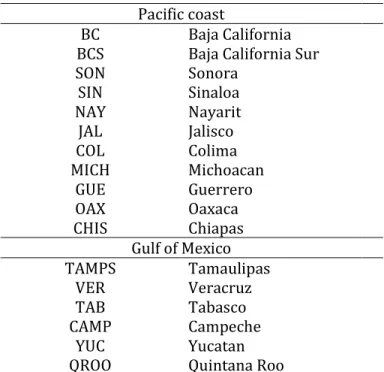
Monetary changes in catch value (live weight) by 2030 are shown in Table 2. For the shrimp fishery, losses amount from US$ 95 million (discount rate = 4%) to US$ 444 million (discount rate = 1%). For the sardine fishery, gains range from US$ 46 million (discount rate = 4%) to US$ 184 million (discount rate = 1%). Most losses/gains would be observed in the NW Mexican Pacific, where the fishing sector has an important role in local economies (Figure 1). Hence, Sinaloa (SIN) is the most vulnerable province, followed (in descending order of vulnerability) by: Sonora (SON), Tamaulipas (TAMPS), Nayarit (NAY), Chiapas (CHIS) and Campeche (CAMP).
The least vulnerable would be Baja California (BC) and Baja California Sur (BCS). For the first group, the dependence on shrimp fishing will be decisive, while the provinces of Baja California peninsula would be better off due to sardine increase. Monetary gains from the sardine fishery in the Gulf of Mexico are rather small. Nevertheless, as Brander (2007) points out, due to high uncertainty on both climatic and economic conditions, predictions on future fish production imply low confidence estimates.
11 Table 2: Net present value (thousands of US dollars) of landed catch value by 2030 for
Mexican coastal provinces in both the Pacific and Gulf of Mexico.
Shrimp Sardine
discount rate discount rate
PACIFIC
Scenarios*
(°C) 0.01 0.04 0.01 0.04
BC 0.5 - 2,247 - 1,700 12,232 9,258
1.5 - 6,740 - 5,101 36,695 27,773
BCS 0.5 - 2,464 - 1,865 6,950 5,260
1.5 - 7,393 - 5,595 20,849 15,780
SON 0.5 - 55,347 - 41,890 37,778 28,593
1.5 - 166,041 - 125,671 113,335 85,780
SIN 0.5 - 50,293 - 38,065 4,235 3,205
1.5 - 150,879 - 114,196 12,704 9,615
NAY 0.5 - 6,742 - 5,103 - -
1.5 - 20,227 - 15,309 - -
JAL 0.5 - 34 - 26 - -
1.5 - 102 - 77 - -
COL 0.5 - 675 - 511 13 10 1.5 - 2,024 - 1,532 38 29 MICH 0.5 - 7 - 5 - -
1.5 - 21 - 16 - -
GUE 0.5 - 172 - 130 - -
1.5 - 517 - 391 - -
OAX 0.5 - 3,043 - 2,303 - - 1.5 - 9,128 - 6,909 - - CHIS 0.5 - 4,392 - 3,324 - - 1.5 - 13,177 - 9,973 - - GULF OF MEXICO TAMPS 0.0 - - - - 1.0 - 38,340 - 29,018 - - VER 0.0 - - - - 1.0 - 8,204 - 6,210 161 122 TAB 0.0 - - - - 1.0 - 899 - 681 - -
CAMP 0.0 - - - -
1.0 - 16,926 - 12,811 11 8
YUC 0.0 - - - -
1.0 - 1,649 - 1,248 - -
QROO 0.0 - - - -
12
1.0 - 1,412 - 1,069 11 8
Total
Pacific 0.5 - 125,416 - 94,924 61,207 46,325
1.5 - 376,248 - 284,771 183,620 138,976
Total
GoM 0.0 - - - -
1.0 - 67,431 - 51,036 357 270
GRAND TOTAL
lower
bound - 125,416 - 94,924 61,207 46,325
upper
bound - 443,679 - 335,808 183,977 139,247
* Scenarios correspond to the minimum and maximum increase in temperature reported by Martinez-Arroyo et al.
(2011) for both shores in 2030.
Comparing our results to other studies is rather difficult due to the scarcity of papers dealing with costs estimation and due to the difference in approaches, time scale, discounting, and scenarios construction. Most studies are large-scale oriented (e.g.
Sumaila and Cheung 2010; World Bank 2010). For example, according to the World Bank (2010) the monetary loss in landed values of fish catches by 2050 (discount rate
= 0%) would range between US$ 0.73 billion and US$ 2.17 billion in Latin America and the Caribbean. In contrast, there are only a few cases devoted to specific fisheries;
for instance, Dulvy et al. (2010) report losses for small pelagic fisheries (e.g. sardines and anchovies) in Asian countries from US$ 1 million (in Thailand) to US$ 700 million (in the Philippines). In our case, the sardine fishery would benefit from CC. Such contrast might be explained by the higher latitude of the Mexican sardine fishery than in those Asian countries. As Cheung et al. (2010: 32) point out, fisheries of temperate waters will benefit the most due to CC.
As far as we know, no studies concerning costs for shrimp fisheries due to CC are available. For the US mollusks fishery, Cooley and Doney (2009) report ex-vessel revenue losses between US$ 0.32 and US$ 1.36 billion by 2060 (discount rate = 4%).
Differences between mollusks and crustaceans fisheries are evident but both are especially vulnerable to increasing ocean acidification (Cooley and Doney 2009; Perry 2011).
Our estimates involve the monetary value of fish landings due to CC impacts (either positive or negative). Further research should focus on the adaptation and mitigation costs of the fishing sector. This is, however, no simple task. As noted by Parry et al.
(2009), costs of adaptation have been frequently under-estimated in a number of studies for developing countries. Further, the food sector has proven to be a difficult one for reliable estimates of both adaptation costs (Wheeler and Tiffin 2009) and food security impacts (Ericksen et al. 2009). In our case, our scenarios are made up on a direct link between temperature rise and fish production. However, the latter might be influenced by other factors such as coastal degradation, pollution, increasing demand of fish products, or changes in prices. These factors might well undermine fisheries productivities, potentially resulting in greater losses than those estimated in our model.
13 Figure 1: Map showing the Mexican coastal provinces with average monetary impacts in a) shrimp and b) sardine fisheries due to CC by 2030 (millions of US dollars at discount rate = 4%). See Appendix for provinces codes.
14
3.2 Food security, adaptation and mitigation policies
Concerning food security, Garcia and Rosenberg (2010) indicate that fisheries contribute to food security in either direct or indirect ways. In Mexico, sardines are directly consumed by domestic consumers, and indirectly as fishmeal for livestock.
While shrimp is mostly an export commodity, it indirectly contributes to domestic food security since money is earned in order to buy food. If shrimp production eventually decreases, fishermen will target other species in order to compensate their monetary losses. Being shrimp a high-value fishery, a major risk of over-exploitation of other fish stocks might lead to food security concerns. In fact, food security is already under threat due to current overfishing (Srinivasan et al. 2010); CC will only exacerbate this condition.
However, the question of how the effects of CC on fisheries will impact food security remains unanswered (Rice and Garcia 2011:1343). On the one hand, according to Garcia and Rosenberg (2010: 2876), CC will have minimal effects on global contribution of fish to food security. In fact, global fish catch has stabilized during the last decade (FAO 2012), but a closer look indicates that a number of fish stocks have collapsed (Worm et al. 2006). Thus, global fish supply remains somewhat constant presumably due to species substitution, increasing fishing effort, and expansion of fishing grounds, among other factors. Nevertheless, both consumers and producers will have to adapt to new species and markets dynamics, as in the case of fishmeal (Merino et al. 2010), because per capita fish products consumption is growing in both developing and developed countries (FAO 2012:4).
On the other hand, on a smaller scale, livelihoods that depend on fisheries will suffer the most in poorer regions, resulting in reduced production opportunities, damages to productive assets, and decreased ability to planning livelihood activities (Daw et al.
2009). According to Badjeck et al. (2010: 375), about 90% of fishers depend on small- scale fisheries around the world. In Mexico, for example, artisanal fishers would not cope with changing distribution of certain species due to their lack of capital-intensive fishing methods (Guzman-Amaya et al. 2010). Thus, migration from coastal zones would be expected, rather than adaptation strategies (Guzman-Amaya et al. 2010).
As argued by Rice and Garcia (2011), aquaculture is seen as an alternate source of protein. However, large aquaculture yields are often obtained by over-fishing wild stocks which serve as food of cultivated species (Naylor et al. 2001), and a number of aquaculture facilities in Mexico will be at risk due to increasing sea level (Guzman- Amaya et al. 2010). Therefore, the role of aquaculture as an option for food security remains ambiguous.
With respect to adaptation policies, there are actions to be taken for the Mexican fishing sector. First, an adaptation policy based on subsidies directed to alleviate variable costs is in the wrong direction because fishing fleets do generate CC emissions as demonstrated by Tyedmers et al. (2005), and such subsidies foster over- exploitation of fish stocks (Sumaila et al. 2010). For example, our variable FINANCING was significant to shrimp fisheries, reflecting the fact that subsidies and soft credits
15 have presumably helped to maintain fishing effort, so that shrimp production has been sustained over the years. In this case, a policy that eliminates fuel subsidies is urgently needed in Mexico. Second, the big problem with fisheries facing CC scenarios is that negative effects will be exacerbated by poor management. In other words, already ill-managed fisheries will be the most vulnerable in the short-term (Allison et al. 2009; Daw et al 2009; Hanna 2010; McIlgorm et al. 2010).
Therefore, the major step for an adaptation policy in the fisheries sector is to address the problems of over-fishing and ecosystem degradation (Brander 2007; Perry et al.
2010). Other proposed measures for Mexico and elsewhere are: the diversification of fisheries practices and livelihoods, and more investment on research (Lluch-Cota 2004; Daw et al. 2009; Dulvy et al. 2010; Guzman-Amaya et al. 2010; Martinez-Arroyo et al. 2011). For a detailed account of specific adaptations to climate impacts on fisheries, see Daw et al. (2009), Dulvy et al. (2010), Grafton (2010), Johnson and Welch (2010), Hanna (2010), and Rice and Garcia (2011).
Acknowledgements
The authors thank Jose F. Frey Aguilar, Ana Liz Herrera Merino, Debora Martinez Ventura and Diego Ali Roman Cedillo for help in data processing. We also benefited from discussions at the Second National Congress on Climate Change in Mexico City (October 15-19, 2012). Comments from V. Sophie Avila Foucat, Jose Ignacio Fernandez Mendez, Citlalin Martinez Cordova and Rosario H. Perez Espejo improved earlier versions of this draft. This project was partially funded by the University of Mexico Program on Climate Change (PINCC-UNAM).
References
Allison, E.H., A.L. Perry, M.C. Badjeck, W.N. Adger, K. Brown, D. Conway, A.S. Halls, G.M.
Pilling, J.D. Reynolds, N.L. Andrew, and N.K. Dulvy (2009). Vulnerability of national economies to the impacts of climate change on fisheries. Fish and Fisheries 10 (2):
173–196. DOI: 10.1111/j.1467-2979.2008.00310.x.
Arellano, M., and O. Bover (1995). Another look at the instrumental variable estimation of error-components models. Journal of Econometrics 68 (1): 29–51.
http://dx.doi.org/10.1016/0304-4076(94)01642-D.
Badjeck, M.C., Allison, E.H., A.S. Halls, and N.K. Dulvy (2010). Impacts of climate variability and change on fishery-based livelihoods. Marine Policy 34 (3): 375–383.
http://dx.doi.org/10.1016/j.marpol.2009.08.007.
BANXICO (2012). Indices de Precios al Consumidor y UDIS. Banco de Mexico. CP5 – INPC. Periodo: Ene 1969 - Jun 2011, Mensual, Sin Unidad, Indices, Base 2Q Dic 2010.
http://www.banxico.org.mx/SieInternet/consultarDirectorioInternetAction.do?accio n=consultarCuadro&idCuadro=CP5§or=8&locale=es.
16 Barange, M, and R.I. Perry (2009). Physical and ecological impacts of climate change relevant to marine and inland capture fisheries and aquaculture. In K. Cochrane, C. De young, D. Soto, T. Bahri (Eds.), Climate change implications for fisheries and aquaculture. Overview of current scientific knowledge. FAO Fisheries and Aquaculture Technical Paper 530: 7–106.
http://www.fao.org/fileadmin/user_upload/newsroom/docs/FTP530.pdf
Barange, M., W.W.L. Cheung, G. Merino, and R.I. Perry (2010). Modelling the potential impacts of climate change and human activities on the sustainability of marine resources. Current Opinion in Environmental Sustainability 2 (5-6): 326–333. DOI:
10.1016/j.cosust.2010.10.002.
Binet, D. (1997). Climate and pelagic fisheries in the Canary and Guinea currents 1964-1993: the role of trade winds and the southern oscillation. Oceanologica Acta 20 (1): 177-190. http://archimer.ifremer.fr/doc/00093/20390/18057.pdf.
Blundell, R., and S. Bond (1998). Initial conditions and moments restrictions in dynamic panel data models. Journal of Econometrics 87 (1): 115–143.
http://dx.doi.org/10.1016/S0304-4076(98)00009-8.
Brander, K.M. (2007). Global fish production and climate change. Proceedings of the National Academy of Sciences 104 (50): 19709–19714.
http://www.pnas.org/content/104/50/19709.full.pdf+html.
Chavez, F.P., J. Ryan, S.E. Lluch-Cota, and M. Niquen (2003). From anchovies to sardines and back: multidecadal change in the Pacific Ocean. Science 299 (5604): 217- 221. DOI: 10.1126/science.1075880.
Cheung, W.W.L., V.W.Y. Lam, J.L. Sarmiento, K. Kearney, R. Watson, D. Zeller, and D.
Pauly (2010). Large-scale redistribution of maximum fisheries catch potential in the global ocean under climate change. Global Change Biology 16 (1): 24–35. doi:
10.1111/j.1365-2486.2009.01995.x.
CONAPESCA (several years), Anuario estadistico de pesca y acuacultura. Comision Nacional de Pesca y Acuacultura, SAGARPA, Mazatlan, Mexico.
http://www.conapesca.sagarpa.gob.mx/wb/cona/cona_anuario_estadistico_de_pesca.
Cooley, S.R., and S.C. Doney (2009). Anticipating ocean acidification’s economic consequences for commercial fisheries. Environmental Research Letters 4 (2): 1-8.
http://iopscience.iop.org/1748-9326/4/2/024007.
Dalton, M.G. (2001). El Niño, expectations, and fishing effort in Monterey Bay, California. Journal of Environmental Economics and Management 42 (3): 336-359.
http://dx.doi.org/10.1006/jeem.2000.1158.
Daw, T., W.N. Adger, K. Brown, and M.C. Badjeck (2009). Climate change and capture fisheries: potential impacts, adaptation and mitigation. En: Climate change implications for fisheries and aquaculture. Overview of current scientific knowledge.
17 In K. Cochrane, C. De young, D. Soto, T. Bahri (Eds.), Climate change implications for fisheries and aquaculture. Overview of current scientific knowledge. FAO Fisheries and Aquaculture Technical Paper 530: 107-150.
http://www.fao.org/fileadmin/user_upload/newsroom/docs/FTP530.pdf.
Dulvy, N.K., J.D. Reynolds, G.M. Pilling, J.K. Pinnegar, J.S. Phillips, E.H. Allison, and M.C.
Badjeck (2010). Fisheries management and governance challenges in a climate change. In: OECD, The economics of adapting fisheries to climate change. Paris: OECD Publishing: 31-90. http://dx.doi.org/10.1787/9789264090415-en.
Ericksen, P.J., J.S.I. Ingram, and D.M. Liverman (2009). Food security and global environmental change: emerging challenges. Environmental Science & Policy 12 (4):
373–377. http://dx.doi.org/10.1016/j.envsci.2009.04.007.
FAO (2007). Adaptation to climate change in agriculture, forestry and fisheries:
Perspective, framework and priorities. Rome: Food and Agriculture Organization of the United Nations. ftp://ftp.fao.org/docrep/fao/009/j9271e/j9271e.pdf.
FAO (2012). The state of world fisheries and aquaculture. Rome: Food and Agriculture Organization of the United Nations.
http://www.fao.org/docrep/016/i2727e/i2727e00.htm.
Garcia, S.M., and A.A. Rosenberg (2010). Food security and marine capture fisheries:
characteristics, trends, drivers and future perspectives. Philosophical Transactions of the Royal Society B 365 (1554): 2869–2880. doi:10.1098/rstb.2010.0171.
Grafton, R.Q. (2010). Adaptation to climate change in marine capture fisheries. Marine Policy 34 (3): 606–615. doi:10.1016/j.marpol.2009.11.011.
Guzman-Amaya P., P.M. Rojas-Carrillo, G.Z. Morales-Garcia, and E. Espino-Barr (2010).
Retos para el sector pesquero y acuicola ante el cambio climatico. In A.V. Botello, S.
Villanueva-Fragoso, J. Gutierrez, and J.L. Rojas Galaviz (Eds.), Vulnerabilidad de las zonas costeras mexicanas ante el cambio climatico. Mexico: SEMARNAT-INE, UNAM- ICMYL, Universidad Autonoma de Campeche: 113-164.
http://etzna.uacam.mx/epomex/Vulnerabilidad.html.
Hanna, S. (2010). Economic and policy issues related to the impact of climate change on fisheries. In: OECD, The economics of adapting fisheries to climate change. Paris:
OECD Publishing: 91-116. http://dx.doi.org/10.1787/9789264090415-en.
Hannesson, R. (1993). Bioeconomic analysis of fisheries. New York: John Wiley & Sons.
Ibarra, A.A., C. Reid, and A. Thorpe (2000). The political economy of marine fisheries development in Peru, Chile and Mexico. Journal of Latin American Studies 32(2): 503- 527.
http://journals.cambridge.org/action/displayIssue?decade=2000&jid=LAS&volumeI d=32&issueId=02&iid=15954.
18 Johnson, J.E., and E.J. Welch (2010). Marine fisheries management in a changing climate: a review of vulnerability and future options. Reviews in Fisheries Science 18 (1): 106–124. DOI: 10.1080/10641260903434557.
King, J.R., V.N. Agostini, C.J. Harvey, G.A. McFarlane, M.G.G. Foreman, J.E. Overland, E.
Di Lorenzo, N.A. Bond, and K.Y. Aydin (2011). Climate forcing and the California Current ecosystem. ICES Journal of Marine Science. 68 (6): 1199–1216.
DOI:10.1093/icesjms/fsr009.
Lluch-Cota, D. (2004). El sector pesquero. In J. Martinez, and A. Fernandez-Bremauntz (Eds.), Cambio climatico: una vision desde Mexico. Mexico: SEMARNAT-INE: 327-335.
http://www2.ine.gob.mx/publicaciones/download/437.pdf.
Martinez-Arroyo, A., S. Manzanilla-Naim, and J. Zavala-Hidalgo (2011). Vulnerability to climate change of marine and coastal fisheries in Mexico. Atmosfera 24 (1): 103- 123. http://www.journals.unam.mx/index.php/atm/article/view/23805.
McIlgorm A., S. Hanna, G. Knapp, P. LeFloc’H, F. Miller, and M. Pan (2010). How will climate change alter fishery governance? Insights from seven international case studies. Marine Policy 34 (1): 170–177. DOI:10.1016/j.marpol.2009.06.004.
Merino, G., M. Barange, and C. Mullon (2010). Climate variability and change scenarios for a marine commodity: Modelling small pelagic fish, fisheries and fishmeal in a globalized market. Journal of Marine Systems 81 (1-2): 196–205.
http://dx.doi.org/10.1016/j.jmarsys.2009.12.010.
Naylor, R.L., R.J. Goldburg, J. Primavera, N. Kautsky, M.C.M. Beveridge, J. Clay, C. Folke, J. Lubchenco, H. Mooney, and M. Troell (2001). Effects of aquaculture on world fish supplies. Nature 405: 1017-1024. DOI:10.1038/35016500.
OECD (2006). Agricultural and fisheries policies in Mexico: Recent achievements, continuing the reform agenda. Paris: Organisation for Economic Co-operation and Development.
Parry, M., N. Arnell, P. Berry, D. Dodman, S. Fankhauser, C. Hope, S. Kovats, R. Nicholls, D. Satterthwaite, R. Tiffin, T. Wheeler, J. Lowe, and C. Hanson (2009). Overview of conclusions. In M. , N. Arnell, P. Berry, D. Dodman, S. Fankhauser, C. Hope, S. Kovats, R.
Nicholls, D. Satterthwaite, R. Tiffin, and T. Wheeler (Eds.), Assessing the costs of adaptation to climate change: A review of the UNFCCC and other recent estimates.
London: International Institute for Environment and Development and Grantham Institute for Climate Change: 6-18. http://pubs.iied.org/11501IIED.html.
Perry, I. (2011). Potential impacts of climate change on marine wild capture fisheries:
an update. The Journal of Agricultural Science 49 (S1): 63-75.
DOI:10.1017/S0021859610000961.
19 Perry, I., R.E. Ommer, M. Barange, and F. Werner (2010). The challenge of adapting marine social–ecological systems to the additional stress of climate change. Current Opinion in Environmental Sustainability 2 (5-6): 356–363.
Reynolds, R.W., N.A. Rayner, T.M. Smith, D.C. Stokes, and W. Wang (2002). An improved in situ and satellite SST analysis for climate. Journal of Climate 15 (13):
1609-1625.
DOI: http://dx.doi.org/10.1175/1520-0442(2002)015<1609:AIISAS>2.0.CO;2.
Rice, J.C., and S.M. Garcia (2011). Fisheries, food security, climate change, and biodiversity: characteristics of the sector and perspectives on emerging issues. ICES Journal of Marine Science 68 (6): 1343–1353. DOI:10.1093/icesjms/fsr041.
Rudolf, B., Andreas Becker, U. Schneider, A. Meyer-Christoffer, and M. Ziese (2010).
The new “GPCC Full Data Reanalysis Version 5” providing high-quality gridded monthly precipitation data for the global land-surface is public available since December 2010.
Global Precipitation Climatology Centre Status Report, December 2010.
http://www.dwd.de/bvbw/appmanager/bvbw/dwdwwwDesktop;jsessionid=41nZQ YQKkQyTK7JnPGcQ7KJz1WpWt9yc729pp3FhyHM2gMKHvQB9!549881051!-
151774236?_nfpb=true&_pageLabel=dwd.
Smith, M.D., C.A. Roheim, L.B. Crowder, B.S. Halpern, M. Turnipseed, J.L. Anderson, F.
Asche, L. Bourillon, A.G. Guttormsen, A. Khan, L.A. Liguori, A. McNevin, D. Squires, P.
Tyedmers, C. Brownstein, K. Carden, D.H. Klinger, R.D. Sagarin, and K.A. Selkoe (2010).
Sustainability and global seafood. Science 327 (5967): 784-786.
DOI:10.1126/science.1185345.
Srinivasan, U.T., W.W. L. Cheung, R. Watson, and U.R. Sumaila (2010). Food security implications of global marine catch losses due to overfishing. Journal of Bioeconomics 12 (3): 183–200. DOI 10.1007/s10818-010-9090-9.
Stock, C.A., M.A. Alexander, N.A. Bond, K.M. Brander, W.W.L. Cheung, E.N. Curchitser, T.L. Delworth, J.P. Dunne, S.M. Griffies, M.A. Haltuch, J.A. Hare, A.B. Hollowed, P.
Lehodey, S.A. Levin, J.S. Link, K.A. Rosem, R.R. Rykaczewski, J.L. Sarmiento, R.J.
Stouffer, F.B. Schwing, G.A. Vecchi, and F.E. Werner (2011). On the use of IPCC-class models to assess the impact of climate on living marine resources. Progress in Oceanography 88 (1–4): 1–27. DOI:10.1016/j.pocean.2010.09.001.
J. Suárez-Sánchez, W. Ritter-Ortiz, C. Gay-García, and J. Torres-Jácome (2004). ENSO- tuna relations in the eastern Pacific Ocean and its prediction as a non-linear dynamic system. Atmosfera 17 (4): 245-258.
http://www.scielo.org.mx/scielo.php?script=sci_pdf&pid=S0187- 62362004000400004&lng=es&nrm=iso&tlng=en.
Sumaila, U.R., and W.W. L. Cheung (2010). Cost of adapting fisheries to climate change.
World Bank Discussion Paper 5. Washington: The World Bank.
http://siteresources.worldbank.org/EXTCC/Resources/407863- 1229101582229/DCCDP_5Fisheries.pdf.
20 Sumaila, R., A.S. Khan, A.J. Dyck, R. Watson, G. Munro, P. Tydemers, and D. Pauly (2010). A bottom-up re-estimation of global fisheries subsidies. Journal of Bioeconomics 12 (3): 201–225. DOI 10.1007/s10818-010-9091-8.
Tyedmers, P.T., R. Watson, and D. Pauly (2005). Fueling global fishing fleets. Ambio 34 (8): 635-638. http://dx.doi.org/10.1579/0044-7447-34.8.635.
Wheeler, T., and R. Tiffin (2009). Costs of adaptation in agriculture, forestry and fisheries. In M. Parry, N. Arnell, P. Berry, D. Dodman, S. Fankhauser, C. Hope, S. Kovats, R. Nicholls, D. Satterthwaite, R. Tiffin, and T. Wheeler (Eds.), Assessing the costs of adaptation to climate change: A review of the UNFCCC and other recent estimates.
London: International Institute for Environment and Development and Grantham Institute for Climate Change: 29-39. http://pubs.iied.org/11501IIED.html.
World Bank (2010). The costs to developing countries of adapting to climate change:
New methods and estimates. The Global Report of the Economics of Adaptation to Climate Change Study. Consultation Draft. Washington: The World Bank.
http://siteresources.worldbank.org/EXTCC/Resources/EACC-june2010.pdf.
Worm, B., E.B. Barbier, N. Beaumont, J.E. Duffy, C. Folke, B. Halpern, J.B.C. Jackson, H.K.
Lotze, F. Micheli, S.R. Palumbi, E. Sala, K.A. Selkoe, J.J. Stachowicz, and R. Watson (2006). Impacts of biodiversity loss on ocean ecosystem services. Science 314 (5800):
787-790. DOI:10.1126/science.1132294.
Appendix: Provinces codes
Pacific coast
BC Baja California
BCS Baja California Sur
SON Sonora
SIN Sinaloa
NAY Nayarit
JAL Jalisco
COL Colima
MICH Michoacan
GUE Guerrero
OAX Oaxaca
CHIS Chiapas
Gulf of Mexico
TAMPS Tamaulipas
VER Veracruz
TAB Tabasco
CAMP Campeche
YUC Yucatan
QROO Quintana Roo
Please note:
You are most sincerely encouraged to participate in the open assessment of this discussion paper. You can do so by either recommending the paper or by posting your comments.
Please go to:
http://www.economics-ejournal.org/economics/discussionpapers/2012-64
The Editor
© Author(s) 2012. Licensed under a Creative Commons License - Attribution-NonCommercial 2.0 Germany