Editor in Chief
Alfonso Vargas-Sánchez, University of Huelva, Spain Associate Editor
T.C. Huan, National Chiayi University, Taiwan Books Review Editor
Steve Watson, York St. John University, United Kingdom Secretariat
Cinta Borrero-Domínguez, University of Huelva, Spain Mirko Perano, University of Salerno, Italy
Style reviewer and text editor
Beatriz Rodríguez-Arrizabalaga, University of Huelva, Spain
Editorial Board
José Manuel Alcaraz, Barna Business School, República Dominicana
Mario Castellanos-Verdugo, University of Seville, España José Antonio Fraiz-Brea, University of Vigo, España José Manuel Hernández-Mogollón, University of Extremadura, España
Shaul Krakover, Ben Gurion University, Israel
Jean Pierre Levy-Mangin, University of Quebec, Canadá Tomás López-Guzmán, University of Córdoba, España Alfonso Morvillo, National Research Council (CNR), Italia Yasuo Ohe, Chiba University, Japón
María de los Ángeles Plaza-Mejía, University of Huelva, España
Nuria Porras-Bueno, University of Huelva, España João Albino Silva, Algarve University, Portugal
Advisory Board (Spanish Members)
César Camisón-Zornoza, Jaume I University, Spain Enrique Claver-Cortés, University of Alicante, Spain María Teresa Fernández-Alles, University of Cádiz, Spain José Luis Galán-González, University of Seville, Spain Félix Grande-Torraleja, University of Jaén, España Inmaculada Martín-Rojo, University of Málaga, Spain Antonio Manuel Martínez-López, University of Huelva, España
Josep Francesc Valls-Giménez, ESADE, España
Advisory Board (Other European Members)
Paulo Aguas, Algarve University, Portugal Gustavo Barresi, University of Messina, Italy Carlos Costa, Aveiro University, Portugal
Salvatore Esposito de Falco, University of Rome “La Sapienza", Italy
Sheila Flanagan, Dublín Institute of Technology, Ireland Tania Gorcheva, Tsenov Academy of Economics, Bulgaria Tadeja Jere-Lazanski, University of Primorska, Slovenia Metin Kozak, Mugla University, Turkey
Álvaro Matias, Lusiada University, Portugal Claudio Nigro, University of Foggia, Italy
Angelo Presenza, University "G. D'Annunzio" of Chieti- Pescara, Italy
Renee Reid, Glasgow Caledonian University, United Kingdom
Advisory Board (Members from the rest of the world)
John Allee, American University of Sharjah, United Arab Emirates
Nestor Pedro Braidot, National University of La Plata, Argentina
Roberto Elias Canese, Columbia University, Rector, Paraguay
Luca Casali, Queensland University of Technology, Australia Nimit Chowdhary, Indian Institute of Tourism and Travel Management, India
Steven Chung-chi Wu, National Pingtung University of Science and Technology, Taiwán
Dianne Dredge, Southern Cross University, Australia Daniel Fesenmaier, Temple University, United States Babu George, University of Southern Mississippi, United States
Dogan Gursoy, Washington State University, United States Kanes Rajah, Tshwane University of Technology, South Africa
Albert Yeh Shangpao, I-SHOU University, Taiwán Pauline Sheldon, University of Hawaii, United States Germán A. Sierra-Anaya, University of Cartagena de Indias, Rector, Colombia
Xiaohua Yang, University of San Francisco, United States
19
SPANISH INTERNET USERS AND TOURISM:
ANALYSIS OF ONLINE TOURIST BEHAVIOUR AMONG EXPERIENCED USERS
Pablo Garrido-Pintado
Francisco de Vitoria University (Spain) [email protected]
ABSTRACT
Internet and E-commerce continue to expand in today´s information and communication society. This research focuses on the most relevant characteristics of experienced Spanish Internet users. More specifically, this document concentrates on Internet users and travellers who buy or may buy in the future services offered by travel agents or other operators in the tourism industry. The findings from this study were collected through questionnaires. Once collected, all the data was subjected to statistical analysis in order to determine the demographic characteristics, values, uses and attitudes of the individuals included in the sampling, as well as the interaction between the above mentioned items. This process allowed us to reach sound conclusions.
KEYWORDS
E- commerce, electronic tourism, online travel agencies
ECONLIT KEYS L830; J110; O300
1. INTRODUCTION
The social, economic and technological changes which took place during the last third of the 20th century have brought a new meaning and scope to the travel and tourism industry (Buhalis, 2003; Poon, 1993; Sheldon, 1997). These processes have
20
lead to an emerging society where access to information is easier and better, thanks to the advances in Information and Communication Technologies (ICT).
These technologies are changing the rules in the tourism industry (Poon, 1993), allowing new services to be produced and driving changes in the field of tourism. The market has evolved; where previously the majority of the offers were based on massive, inflexible and standardized products, the current approach is more flexible and globally oriented (Buhalis and Law, 2008; O´Connor and Murphy, 2004).
The roles of the different agents in the value chain have likewise changed (Werthner and Klein, 2001). Before the advent of the Internet, tourism companies were organized in different strata based on a model which was made up of suppliers (accommodation, restaurants, airlines, etc.), brokers (hotel chains, travel agents, computerized booking systems, destination marketing organizations), and finally, tourists, i.e. the end user of tourism services. Nowadays, traditional agents have to share the stage with new actors, such as infomediaries (Buhalis and Law, 2008;
Middleton, Fyall, Morgan and Ranchod, 2009; UNCTAD, 2000) as well as with providers who can now directly address the end customer's needs by using new technologies.
This context is most advantageous for tourists, who can now use hypertext, interactive and multimedia tools. Travellers have direct access to a volume of information (Mills and Law, 2004) which is much larger than any information that any public or private tourism organization may offer separately. Internet has altered the behaviour patterns, more than any other technology, when it comes to picking, booking or writing a review about a trip. It’s a one-stop shop, where users can find information and book online without a travel agent (Morrison, Jing, O'Leary and Lipping, 2001). Also, as new social media tools are developed, Internet has become the perfect place to share travel experiences (Gretzel, 2006) and relive them (Pudliner, 2007; Tussyadiah and Fesenmaier, 2009).
The 21st Century tourist has more assessment tools, and demands higher quality.
Figueroa (2008) claims “this impacts companies' management, the relationships of such companies with every destination and cooperation with other institutions, in order to create completely new experiences in travel destinations to meet the customers' requirements”.
21
Both public and private sectors have to work together in order to bring the largest possible number of tourists to their destinations. According to Rivera (2001:472), such tourists follow trends imposed by changes in the labour world, new global values (Reisinger, 2006), consumer trends and buying patterns. Regarding labour, post-employed population has significantly increased - retired people with enough purchasing power and time for leisure activities - while young people are entering the labour market at an older age. We also see changes in values; a large group of consumers are focusing on improving their quality of life and self-fulfilment, and thus value other social and environmental aspects when they travel. Also, more people are now concerned about health and beauty, and this impacts patterns among tourism consumers.
We are, therefore, talking about tourists whose behavioural patterns are quite different from those of mass tourists in previous decades. As Reisinger (2009) claims, during the 80s and 90s, the trend was for standardized products in the travel package market, while the target market was barely segmented. Currently, social and economic changes, plus the introduction of new technologies in daily life, have brought along new patterns for tourism consumers. New consumers are more selfish;
they demand more customized, developed products, with the right quality and at a reasonable price.
They have more information, and they use it better thanks to new computerized systems. Despite being virtually unknown in Spain 10 years ago, E-Commerce has also contributed to this evolution, and generated a significant volume of 7.7 billion Euros in trade in 2009 (Red.es, 2010).
Due to their inherent characteristics, tourism services have adopted this channel and have been in leading positions in Spanish sales rankings. More than 40% of all Internet users in Spain shop online (Red.es, 2010); travel tickets, accommodation booking and tickets for events are the most sought after products.
The main purpose of this research is to analyze the travel industry in Spain, particularly the main characteristics of experienced Spanish Internet users who search for, pick and buy tourist services online. We want to find out their demographic characteristics, how they use Internet, their behaviour as tourists and the existing patterns among tourism consumers who use this interactive channel.
This drill-down analysis will focus on Internet advanced users in order to define future
22
behaviour patterns among current users who may expand their "digital literacy" in the coming years.
2. ANALYSIS OF SPANISH EXPERIENCED INTERNET USERS' BEHAVIOUR IN THE FIELD OF TOURISM
The tourism industry has adopted Internet as its main information resource;
indeed, tourism related information is one of the main driving forces in the Internet (Furr, Bonn and Haussmann, 2002). Internet is the ideal place when it comes to planning travel: transactions are very fast, the opportunity exists to compare offers and it is possible to go online anytime, anywhere (Gretzel, Yuan and Fesenmaier, 2000; O´Connor, 1999). However, some authors find this wealth of information actually to be a handicap. Pan and Fesenmaier (2006) refer to previous research, e.g. by Radosevich (1997) and Stolz (1999), which shows how planning travel via Internet can turn out to be a frustrating experience.
In this regard, Fleischer and Felsenstein (2004) pointed out how research on travelling in the Internet uses two different approaches. One of them focuses on changes regarding suppliers – traditional brokers, new services and new brokerage platforms –, while the other is more closely related to the purpose of this research and focuses on Internet users’ social and economic profiles, and their attitude towards purchasing tourism services online.
The socio-demographic characteristics show us the behaviour related to purchasing tourism services online. The actual purchase of a product is determined by age, education, income and occupation (Morrison et al, 2001).
A study by Webber and Roehl (1999) gives us a profile of people who use Internet to find information or purchase travel. This survey concludes that the users most likely to purchase travel through the World Wide Web are as follows: aged between 26-55, with a high financial status, working in administration or computer related industries, and with several years of online experience. According to this study, the main obstacles to purchasing are security concerns about payment methods and user privacy.
Other studies (Bonn, Furr and Susskind, 1998) focus on the leisure travel industry, whilst Lang (2000) studied the impact of Internet on tourism services consumers and
23
its repercussion on travel agents. We also find studies focused on specific age groups – travel for children (Tufte and Rasmussen, 2003) and for senior population (Graeupl, 2006).
In general terms, research by Beldona, Morrison and O´Leary (2005) is the first study to capture all the components of a trip and relate them to purchasing behaviour. The study identifies the different types of tourism products in E- Commerce, and states that flight tickets and car rentals are the top selling products.
On the other hand, consumers seek more and more information in products such as leisure activities, accommodation and events.
Internet usage and the ability to search and handle tourism related information have also been studied. Authors like Luo, Feng and Cai (2004) studied the association between information search patterns online and other sources of information, and how they were related to the socio-demographic characteristics of tourists. They show how sex and level of income determine which source of information is used.
The technology adoption theory has also been used to explain why people tend to buy online (Beldona et.al. 2005). García and Gertrudix (2010) provide a generic definition of the different types of people that exist in the digital world, including:
philosophers, politicians, explorers, agitators, savage, native, colonists, nomads and migrant-immigrants or migrant-emigrant, dissidents and apocalyptic. Other authors define the technology adoption cycle in five segments: explorers, pioneers, sceptic, paranoid and laggard (Parasuraman and Colby, 2001). Expert Internet users, also known as superusers, would belong to the first and second segments. They use Internet intensively for business, learning or leisure. They have years of Internet experience and the number of hours they are online every week is higher than that of the average person. Some authors (Chau, Cole, Massey, Montoya-Weiss and O'Keefe, 2002) claim that the “online life style” is essential when it comes to forecasting purchasing behaviours in the net. Other factors, such as the type of Internet connection (Beldona, Kline and Morrison, 2004) or the experience in Internet (Bellman, Lohse and Johnson, 1999; Weber and Roehl, 1999) also determine the buying behaviour online.
Expert users are able to process information much easier than other users. They can do searches, pick information and book tourism services easily. Because expert
24
users are familiar with the system, they are more likely to buy repeatedly; however, their behaviour may change if they do not receive stimuli that encourage them to buy, and they may choose a different Web site in such case (Park, Iyer and Smith, 1989).
2.1) METHODS OF THE STUDY
A 35 question questionnaire was designed for the purpose of this study. We were trying to determine the socio-demographic characteristics of the sample population, tourism related habits, usage of Internet and habits related to purchasing tourism services online. The questionnaire was based on other studies of tourism, E- Commerce and digital media usage, such as the Survey on Domestic and Outbound Tourism by Spanish Residents (Familitur) (IET, 2008), the yearly study in B2C E- Commerce by Red.es (2009, 2010) and the Web Surfers Study 2008, by Spanish Mass Media Research Association, AIMC (2009).
The sample included 204 people over 18 years of age who were intensive Internet users. Public and private organizations working on information and communication technologies, freelancer professionals and academicians were contacted for this survey.
The previous sample was carried out in 2008, and the survey was validated with a smaller selection of subjects. In 2009, subjects were sent an e-mail inviting them to answer the questionnaire online via a professional tool for collecting input, analyzing results and managing statistics,- namely Survey Monkey.
Next, all data was coded and processed with SPAD, a statistics tool for exploratory analysis of multidimensional data. SPAD is designed for statistic descriptive analysis of large data tables generated by surveys. This software helped perform hierarchical cluster analysis. This process consists of distributing and grouping all items in the sample based on similar characteristics, so that internal homogeneous groups are formed. This type of analysis is commonly used in fields such as biological science, engineering and social sciences. It is very useful when large volumes of data are collected through a questionnaire and it is necessary to apply some reduction technique in order to work with more manageable groups.
In this particular case, cluster analysis helped define a number of profiles based on three different groups of questions which were included in the questionnaire:
25
tourism habits, usage of Internet and purchasing habits related to online tourism products.
Once the cluster analysis had concluded and study groups had been defined, the chi-square test was applied on contingency tables in order to confirm or rule out statistically significant relations between study variables. This test used demographic data (sex, age and education) as independent variables in order to match data tables and reach relevant conclusions.
2.2) MAIN OUTCOME
After applying the questionnaire, the main outcome is described below.
2.2.1 Descriptive Statistics
This is a summary of the elementary statistic data produced by the questionnaires regarding socio-demographic profiles, tourism behaviour, Internet usage and purchasing habits related to online tourism products.
2.2.1.1 Socio-demographic Profile
The sample includes 199 subjects, out of which 113 are female (56.8%) and 87 are male (43.2%).
When asked about their education, 79.9% of those interviewed claim they have finished some type of University studies. Out of that percentage, 35.2% have finished a University degree. Only 20% of subjects did not have access to University.
In terms of place of residence, more than half of the subjects (54.4%) live in large cities (over 1 million of inhabitants), whereas 16.4% live in cities with 100,000- 1,000,000 inhabitants. The remaining 19.4 of the sample live in towns with populations below 10,000 inhabitants.
2.2.1.2 Habits Related To Tourism Behaviour
26
Asked whether they had travelled for tourism during the previous 12 months, 96.9% of them said they had. Most travels were for leisure, recreation and holidays (80.7%), while 27.1% were related to paying visits to friends and relations, and 22.4% were for work reasons.
Regarding the favourite time of the year for travelling, respondents say they travel in the summer time (72.4%), although there exists also a demand for weekends, bank holidays, Easter and Christmas.
In terms of most common destinations, a broad majority (72.1%) chooses domestic travel - however, they travel to destinations outside their autonomous community regions. During the previous 12 months, 56% of respondents said they had travelled abroad. Regarding the length of stay per destination, 66.1% said they stayed between 3 and 7 days, versus 25.5% who confirmed they travelled for periods between 7 and 15 days.
Airplane was the chosen means of transport for 79.9%, followed by private vehicle (58.3%), train (30.2%) and bus (28.1%).
Regarding accommodation, 71.6% picked hotels and 58.4% stayed with friends and relations. Rural accommodation and second private residences came third and fourth in this question.
As to how travel was organized, every second respondent opts for the web site of a tourism provider or travel agent, versus 32.3% who prefer closing purchases in physical shops.
2.2.1.3 Internet Usage
Since most respondents work in public or private sectors with high usage of new technologies, results show a high rate of time spent online and usage of Internet services.
Most of the respondents (80.5%) have over 4 years of experience in using Internet. They say they go online everyday (84.2%) both from work and from home.
The most frequently used services are e-mail (95.8%), World Wide Web (86.4%) and instant messaging (55%).
27
When asked about whether they use Internet as a tool for finding information, 89.4% said they always, or nearly always, go online.
When looking for trips and destinations in Internet, 80.4% said they search for offers and basic information about tourism services (how to get there, leisure options, monuments), and 72% for destinations.
2.2.1.4 Purchasing habits related to tourism services Online
Among the respondents, 74.4% said they had bought some tourism related product via Internet.
Flights Train Bus Car rental Cruises Hotel bookings
Hotel vouchers
Rural
houses Packages
Don't know or refuse to answer
Other
86.4% 37.9% 32.9% 18.6% 0.7% 62.9% 7.1% 19.3% 8.6% 0% 4.3%
Table 1: Tourism services purchased via Internet.
Among the services purchased, the vast majority buy flights (86.4%) and book hotel rooms (62.9%). The next positions are for train tickets (32.9%), rural accommodation (19.3%) and car rental. Travel packages and hotel vouchers are less popular products.
Regarding the amount users claim to spend in tourism services, the largest amounts usually correspond to travel packages, while flight tickets are a remarkably common product.
Direct debit Wire transfer Credit card Supplier's
card Cash/Cheque
Don't know or refuse to
answer
Other
3.5% 7% 93% 2.1% 12.6% 0.7% 1.4%
Table 2: Method of payment.
As for payment methods, the majority of customers used their credit card (93%).
Payment by cash or cheque (12.6%) and bank transfers were not common.
Asked about why they buy through Internet, respondents say they do so for convenience reasons (40.7%), because they may be able to find better value or
28
offers, because they can access the shop outside working hours, and because it is easy to compare different offers.
Search enginesSupplier's Web site
References by friends or
relations
Newsletters Internet advertising
68.3% 57.9% 42.8% 42.2% 15.9%
Table 3: Buying tourism services – Main information resources
Respondents choose search engines to access information (68.3%) when they want to buy tourism products online. They also choose to go directly to the supplier's web site (57.9%), use friends' references as guidance or find offers through price comparison tools (40%). Other information resources are word of mouth, e- newsletters and web advertising.
When asked about where they purchase tourism services online, most respondents choose online shops, including online travel agents (e. g. Edreams.es) or tourism service providers (such as Iberia.com or the Spanish national railway site Renfe.com), versus "brick and click" agents (that is, travel agents with physical shops). A smaller percentage use price comparison tools and the shopping sections in the most relevant portals.
Regarding customer satisfaction after purchasing tourism products, 92.5% claim they are always, or nearly always, satisfied with the purchase.
Question number 33 in the survey was addressed to respondents who had purchased products. It asked respondents what improvements they thought tourism suppliers should implement so that customers would buy more frequently.
Respondents feel that money-back and replacement warranties should improve (61.8%); higher safety should be implemented in payments (50.7%); prices should be lower than in other channels (50.7%); and customer service should be improved (36.2%).
Users who pointed out that they had never purchased tourism services online were asked about the reasons why they had not. The main reasons they gave were:
not feeling at ease with providing personal information via Internet; not trusting
29
payment systems; lack of knowledge and/or information, and not trusting information provided by suppliers.
Some Internet users who do not purchase online have chosen to purchase a service in a physical shop after querying and finding information in Internet; 20.4%
say they have done so often, and 17.4% that they have done so a few times. Only 16.2% point out they have never sought information in Internet before buying a flight or another service. These figures reinforce the concept that Internet has become recently an essential information channel for marketing this type of services, even if the purchase itself is closed in a different channel.
2.2.2 Hierarchy Cluster Analysis
Hierarchy cluster analysis was applied in order to distribute and group all items in the sample based on similar characteristics, so that internal homogeneous groups would be formed.
In order to obtain a manageable data pool, the questionnaire was divided in three groups: tourism habits, usage of Internet and purchasing habits of online tourism products.
This process generated different groups with 2, 3, 4, 5 and 6 classes for every set of questions.
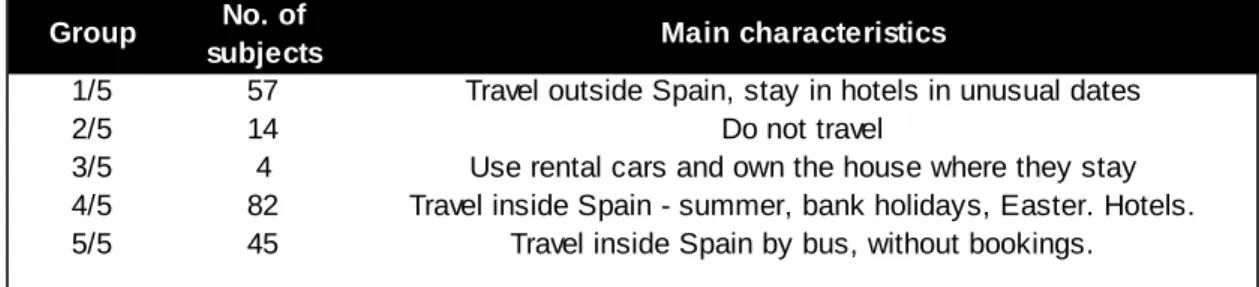
After analyzing all options, it was determined that the group including 5 classes would be the most relevant one in terms of tourism habits.
Group No. of subjects
1/5 57
2/5 14
3/5 4
4/5 82
5/5 45
Do not travel
Use rental cars and own the house where they stay Travel inside Spain - summer, bank holidays, Easter. Hotels.
Travel inside Spain by bus, without bookings.
Main characteristics
Travel outside Spain, stay in hotels in unusual dates
Table 4: Question set regarding tourism habits
After applying cluster analysis, this selection offers the best profile definition of tourism habits. This analysis sorts respondents by travel destination, type of accommodation and transportation. However, when applying the chi-square test,
30
group 3/5 -which was made up by 4 subjects- was removed because it was not considered to be relevant enough to draw conclusions.
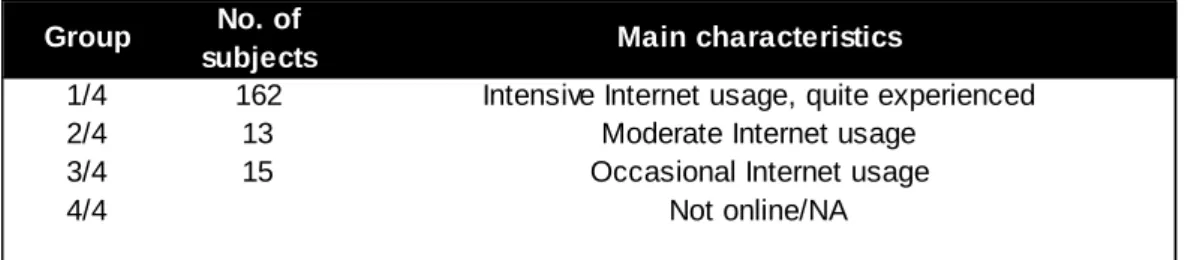
In questions regarding Internet usage, the most significant group included 4 classes:
Group No. of subjects
1/4 162
2/4 13
3/4 15
4/4
Occasional Internet usage Not online/NA Main characteristics
Intensive Internet usage, quite experienced Moderate Internet usage
Table 5: Question set regarding Internet usage
This selection includes 3 groups, which are defined by intensive (1/4), moderate (2/4) and occasional (3/4) usage of Internet. Users in group 4/4 do not use Internet regularly. When applying the test, the group of users who do not go online was removed, and groups 2 and 3 (moderate and occasional usage) were merged.
Finally, after cluster analysis, the 6 class group was the choice for the question set regarding tourism service online purchasing habits.
Group Nº of subjects
1/6 28
2/6 18
3/6 12
4/6 27
5/6 40
6/6 77
Does not use Internet Not applicable
Buys online- offline (brick & click) Only buys online (e-pure)
Main characterístics
Does not buy online. Afraid to provide personal information Does not buy online. Does not trust payment method
Table 6: Question set regarding tourism service online purchasing habits
In this case, the choice was the 6-class group because, after further reduction, the differentiation between e-pure Internet users-buyers (shops operating only online) and those who choose brick and mortar (online businesses with a physical shop) disappears. For the chi-square test, groups 1 and 2 (non-buyers) were merged, and so were groups 3 and 4.
31
2.2.3 Chi-square test
The chi-square test (χ2) is a non-parameter test. It allows us to examine the relationship or association between two qualitative variables which are presented only in pairs.
Data was first collected, then tabbed in contingency tables and finally results were obtained and interpreted. The final purpose is to measure the relationship between user profiles which took part in the survey on tourism habits, Internet usage and purchasing online tourism services, and their relationships with generic variables such as age, sex, place of living and level of studies. As we mentioned above, categories were merged in some specific cases - when a large number of cells had expected frequencies below 5, which would make the test void.
2.2.3.1 Profile relation with general variables
Next, the profiles which were generated in the cluster analysis (tourism habits, Internet usage and purchasing habits related to online tourism services) are associated with the variables we defined as general (sex, level of studies, population in the place of living).
Frequency tables
DEMOGRAPHICS
SEX 3 6.82 0.0777
MALE 37.21% 8.14% 37.21% 17.44%
FEMALE 22.52% 5.41% 45.05% 27.03%
LEVEL OF STUDIES 3 14.38 0.0024
BELOW UNIVERSITY 23.91% 19.57% 34.78% 21.74%
UNIVERSITY 39.26% 3.29% 43.42% 23.03%
POPULATION 3 20.76 0.0001
<100,000 43.55% 14.52% 24.19% 17.76%
>100,000 22.39% 3.73% 49.25% 24.63%
Tourism habits
1. Travel abroad /
Unusual dates 2. Do not travel DF X2
4. Travel in Spain / Usual dates /
Hotels
5. Travel in Spain / Travel by bus / No
bookings
p-value
Table 7: Chi-square test: General variables – Tourism habits
As Table 7 shows, the sex variable is not statistically significant with regards to the respondents' tourism habits (p-value=0.0777). However, we do find interesting relationships when we compare tourism behaviour and level of studies/size of the town or city where they live. The table shows that people with higher level of studies
32
are more willing to travel both inside Spain and abroad (p-value=0.024). The respondents living in large towns or cities usually travel inside Spain during summer, on bank holidays and at Easter. It can be stated with a 99% probability that a statistically significant relationship exists between tourism behaviour patterns and the number of inhabitants in their locality.
Frequency table
DEMOGRAPHICS
SEX 1 6.29 0.0121
MALE 77.78% 8.14%
FEMALE 90.83% 5.41%
LEVEL OF STUDIES 1 1.3 0.2537
BELOW UNIVERSITY 79.49% 20.51%
UNIVERSITY 86.75% 13.25%
POPULATION 1 3.51 0.0608
<100,000 78.18% 21.82%
>100,000 21.82% 11.28%
Internet usage
1. Intensive usage 2. Moderate,
occasional usage DF X2 p-value
Table 8: Chi-square test: General variables – Internet usage
The previous sample shows that both men (77.78%) and women (90.3%) intensely use Internet, either for studying or for working. After applying the chi-square test (p- value=0.0121), results allow us to say, with 95-99% probability, that there is a statistically significant relationship between the sex variable and Internet usage.
Regarding the level of studies (p-value=0.2537) and the size of the place of living (p- value=0.0608), we accept the null hypothesis and determine there is no statistical relationship with Internet usage.
33 Frequency table
DEMOGRAPHICS
SEX 3 2.47 0.48
MALE 27.27% 20.45% 18.18% 34.09%
FEMALE 19.47% 17.7% 21.24% 41.59%
LEVEL OF STUDIES 3 11.65 0.0087
BELOW UNIVERSITY 30.43% 32.61% 10.87% 26.09%
UNIVERSITY 20.51% 15.38% 22.44% 41.67%
POPULATION 3 7.26 0.064
<100,000 27.42% 27.42% 12.9% 32.26%
>100,000 19.57% 15.94% 23.19% 41.3%
5. Buy / Brick&click
shops
6. Buy / E-pure p-value
1 & 2 Do not buy in Internet
3 & 4 Do not use Internet,
N/A
DF X2
Table 9: Chi-square test: General variables – Internet purchasing habits
Table 9 shows no significant difference between men and women regarding purchasing habits related to tourism services. We accept the null hypothesis because p-value=0.48, and that shows there is no statistically significant relationship between the sex variable and profiles for online purchasing habits. Respondents who have attended university are the most common users in the purchasing profiles, both for online companies with physical shops (brick and click) and e-pure businesses. We accept the hypothesis as valid, since p-value=0.0087. Regarding the relationship between populations and online purchasing habits, we do find a larger number of buyers who live in cities with a population over 100,000 inhabitants. In this latter case, we can discard the hypothesis, since p-value=0.0640.
2.2.3.2 Relationship between profiles
34
% rows
% columns
50 7 57
87,72% 12,28%
31,45% 25,93%
2 3 5
40,00% 60,00%
1,26% 11,11%
72 9 81
88,89% 11,11%
45,28% 33,33%
35 8 43
81,40% 18,60%
22,01% 29,63%
Total in column 159 27 186
Chi-square = 0,0194
Table statistics 1. Travel abroad /
Unusual dates
2. Do not travel
4. Travel in Spain / Usual dates / Hotels
5. Travel in Spain / Travel by bus / No
bookings
Frequency table
1. Intensive Internet usage
2. Moderate,
ocassional usage Total in row
Table 10: Chi-square test: Tourism habits – Internet usage. Note: 25% of cells contain frequencies below 5. Because this impacts the test validity, such data will be ignored when making assessments
As the contingency table shows, there is a strong relationship between intensive Internet usage and tourism habits. Respondents who travel both abroad and in Spain (either using public transportation or with any degree of organization) are intensive Internet users. Only 12.6% of heavy users claim they do not travel. However, amongst those who access Internet moderately or occasionally, this percentage is 11.11%.
The chi-square test produces a p-value=0.0194, so we can state there is a statistically significant relationship between tourism habit profiles and Internet usage profiles.
35
% rows
% columns
33 13 46
71,74% 28,26%
20,37% 46,43%
24 3 27
88,89% 11,11%
14,81% 10,71%
33 7 40
82,50% 17,50%
20,37% 25,00%
72 5 77
93,51% 6,49%
44,44% 17,86%
Total in column 162 28 190
Chi-square= 0,0098
Frequency table 1. Intensive Internet
usage
2. Moderate,
ocassional usage Total in row
Table statistics 1 & 2 Do not buy in
Internet
3 & 4 Do not use Internet or N/A
5. Buy online / Brick&click
6. Buy online / E-pure
Table 11: Chi-square test: Online purchasing habits – Internet usage
The group which was made up of 12 subjects who do not use Internet was removed for this test. Among Internet users, we see how the intensive user profile prevails when matched with purchasing habits, particularly among intensive users who only buy online. Some 82.5% of people who buy from online companies with physical shops are intensive Internet users; however, the proportion rises to 93.51%
when it comes to users who only buy online.
What stands out among occasional Internet users is that 46.43% refuse to buy online because they are afraid to provide their personal information. Intensive Internet users are characterised by shopping mostly in Internet only portals (44.44%).
The chi-square test produced a p-value=0.0098, which confirms the statistically significant relationship between profiles for Internet usage and profiles for online purchasing habits.
36
% Filas
% Columnas
16 4 12 14 46
38,64% 8,70% 26,09% 30,43%
28,07% 28,57% 14,63% 31,11%
9 9 14 6 38
23,68% 23,68% 36,84% 15,79%
15,79% 64,29% 17,07% 13,33%
10 1 16 11 38
26,32% 2,63% 42,11% 28,95%
17,54% 7,14% 19,51% 24,44%
22 0 40 14 76
25,97% 0,00% 52,63% 18,42%
32,26% 0,00% 48,78% 31,11%
Total in column 57 14 82 45 198
Chi-square = 0,0003
1. Travel abroad /
Unusual dates 2. Do not travel 4. Travel in Spain / Usual dates / Hotels
1 & 2 Do not buy in Internet
3 & 4 Do not use Internet or N/A
Total in row
Table statistics
5. Travel in Spain / Travel by bus / No Frequency table
5. Buy online / Brick&click
6. Buy online / E-pure
Table 12: Chi-square test: Online purchasing habits – Tourism habits
52.63% of respondents who purchase from online-only (e-pure) stores travel in summer, Easter and bank holidays, and usually stay in hotels.
Most users who choose not to travel belong to groups which barely, if at all, visit Internet in order to find or book travels.
The chi-square test produced a p-value=0.0003 which confirms the statistically significant relationship (99%) between profiles for tourism habits and profiles for online purchasing habits.
3. CONCLUSIONS
• This study has been based on a highly segmented sample made up of young subjects, the majority of whom live in cities with a population of over 1 million inhabitants and have a high academic level. They are intensive Internet users with more than 4 years of experience, and spend between 4 and 10 hours a week online.
• Virtually all subjects have travelled during the last 12 months; the favourite destination was Spain (71.2%) and they travel mostly for leisure, pleasure or
37
holidays (80.7%). While they usually travel in summer, we also find high percentages of activity on bank holidays, Easter, weekends or Christmas. We find a trend to shorten summer holidays in order to be able to travel more times -shorter trips- during the rest of the year. The most used means of transport is by air (71.9%), followed by their own cars, train and bus.
• Respondents are heavy users of search engines when looking for information about their travels; however, as expert users, they also go directly to the sellers' web sites. They use price comparison tools - systems that let them visually compare offers - and listen to the advice of friends and relations.
• A high percentage of users (74.7%) claim they have purchased products at least once, mostly flights and hotel rooms, but also train or bus tickets. They usually close their purchases in companies that operate online-only (e-pure), although they also purchase at mixed businesses (brick and click).
• The average spending is remarkably higher in tourism packages and car rentals. When it comes to purchasing flights and bus tickets, customers tend to repeat purchases. The favourite method for payment is the credit card (93%). In fact, this method has replaced other traditional systems such as wire transfer, direct debit or payment in cash/cheque.
• Expert Internet users point out that convenience is the main reason why they close their purchases online. Internet allows them to search for information, see reviews, pick a destination, compare offers and close purchases in a one- stop shop.
• When it comes to making decisions, price is a relevant factor. Nearly 30% of respondents feel that Internet offers better prices than traditional channels.
• Most respondents say they are pleased with their online purchases.
Nevertheless, in order to increase repeated purchases, it would be necessary to provide more warranties for returns and changes, particularly in reduced price products. They also demand more security in payments, and lower prices than in traditional market channels.
• Among Internet users who do not purchase anything, half of respondents do not intend to purchase tourism services online in the future. However, 66.5%
claim they have made a purchase decision after checking the Internet. These
38
figures reinforce the fact that Internet has become an essential resource for tourism information.
• Hierarchy cluster analysis allowed us to process the large volume of data that was obtained through the questionnaire. This analysis also enabled us to reduce data by profiles through three sets of questions, in order to be able to work with more manageable groups. This procedure allowed us to apply the chi-square test in order to measure independence between two variables and thus establish relationships that would facilitate interpreting data and drawing valid conclusions for the survey.
• After analyzing results, we see that the user's sex does not condition tourism habits or online purchasing habits related to tourism services. We do find differences in Internet usage; most of moderate users are male, versus 61.1%
of female users who go online every day. This shows that women have not only reached men with regards to Internet usage; they are indeed more intensive Internet users.
• We can claim that the level of studies does impact tourism habits. People who have attended university travel more often, both inside Spain and abroad. This variable is also closely related to purchasing tourism services online and the level of studies; subjects with a higher level of studies buy more often online, both in e-pure and in brick & click companies. Cultural background is not a determining factor regarding Internet usage. It is, however, very important when it comes to picking a destination, the length of the travel and the means of transportation, and using Internet as a tool for purchasing tourism services.
• The size of the town where respondents live is not statistically relevant to Internet skills or the purchasing of tourism services. We do find different tourism habits though, and thus come to the conclusion that there is a higher proportion of respondents who do not travel and live in towns with a population below 100,000 inhabitants.
• There is a strong relationship between Internet usage and tourism habits. The respondents who travel both in Spain and abroad are also intensive Internet users. Only 1.26% of Internet users who go online very frequently say they have not travelled at all during the last twelve months.
39
• Experience in Internet usage is related to the purchasing of tourism services.
Eight out of ten respondents who buy in brick & click stores (i.e. online shops with physical presence) are intensive Internet users and this percentage goes up to 93.5% for e-pure business (i.e. shops which only have online presence).
• Tourism habits and online purchasing patterns are closely related. Nearly 50%
of respondents who travel inside Spain in the summer buy their trips through online travel agents. This figure drops to 25.97 for respondents who choose to travel abroad. Most users, who do not travel, belong to groups which barely, if at all, visit Internet in order to find or book trips.
References
AIMC – Asociación para la Investigación de Medios de comunicación. Navegantes en la red 2008.[online] 2009 [Consult. 29 Aug. 2011] Available at: http://www.aimc.es/- Navegantes-en-la-Red-.html
Beldona, S; Kline, S & Morrison, A. M. Utilitarian value in the Internet: Differences between broadband & narrowband users. Journal of Travel & Tourism Marketing, Nº 17, 2004, pp. 2–3, ISSN 1054-8408
Beldona, S., Morrison, A.M., & O´Leary, J. Online shopping motivations and pleasure products: a correspondence analysis. Tourism Management, Vol. 26, 4, 2005, pp.
561-570, ISSN 0261-5177
Bellman, S. Lohse, G.L, Johnson, E.J. Predictors of online buying behaviour.
Magazine Communications of the ACM, Vol. 42, 12, 1999, pp. 32-38, , ISSN 0001- 0782
Bonn, M. A., Furr, H. L., & Susskind, A. M. Using the Internet as a pleasure travel planning tool: An examination of the sociodemographic and behavioral characteristics among Internet users and nonusers. Journal of Hospitality & Tourism Research, Vol. 22, 3, 1998, pp. 303–317. ISSN 1096-3480.
40
Buhalis, D. eTourism: Information technology for strategic tourism management.
London, Pearson (Financial Times / Prentice-Hall), 2003, pp.25-28. ISBN 0582- 357403.
Buhalis, D., & Law, R. Progress in information technology and tourism management.
Tourism Management,Vol. 29, 4, 2008, pp. 609-623, ISSN 0261-5177.
Chau, P.Y.K., Cole, M., Massey, A.P., Montoya-Weiss, M. & O'Keefe, R.M. (2002).
Cultural differences in the online behavior of consumers. Communications of the ACM, Vol. 45, 10, 2002, ISSN 001-0782.
Figueroa, C. Las nuevas tecnologías en el sector turístico. In: Rodríguez J.M. y Alonso M.M. (coord.). Nuevas tendencias y retos en el sector turismo: un enfoque multidisciplinar. Madrid: Delta Publicaciones, 2008, pp. 97-121, ISBN 978-84-92453- 42-9.
Fleischer, A. and Felsenstein, D. Face-to-face or Cyberspace? Choosing the Internet as Intermediary in the Travel Market. Tourism Economics, Vol. 10, 3, 2004, pp. 345- 359, ISSN 1354-8166.
Furr, H. L., Bonn, M., & Haussman, A. A generational and geographic analysis of Internet travel-service usage. Tourism Analysis, Nº 6, 2002, pp. 139-147, ISSN 1083- 5423.
Graeupl, A. ‘Silver surfers’ and their online information search behaviour. In M. Hitz, M. Sigala, & J.Murphy (Eds.), Information and communication technologies in tourism. New York: Springer Wien, 2006, pp. 236–247, ISBN 978-3-211-30987-2.
Gretzel, U. Consumer Generated Content - Trends and Implications for Branding. E- Review of Tourism Research, Vol 4, 3, 2006, pp. 9-11, ISSN 1941-5842.
41
Gretzel, U., Yuan, Y., & Fesenmaier, D. R. Preparing for the New Economy:
Advertising Strategies and Change in Destination Marketing Organizations. Journal of Travel Research, Nº 39, 2000, pp. 146-156, ISSN 1350-5238.
Instituto de Estudios Turísticos. Familitur. Encuesta de Movimientos Turísticos de los Españoles. .[online] 2008 [Consult. 12 Feb. 2011] Available at:
http://www.iet.tourspain.es
Lang, T. The effect of the Internet on travel consumer purchasing behaviour and implications for travel agencies. Journal of Vacation Marketing, Vol. 6, 4, 2000, pp.
368-385, ISSN 1356-7667.
Luo, M., Feng, R. y Cai, L.A. Information Search Behavior and Tourist Characteristics: The Internet vis-à-vis Other Information Sources. In Mills J.E y Law, R. (Eds.). Handbook of Consumer Behavior, Tourism, and the Internet. Binghamton:
The Haworth Hospitality Press, 2004, pp. 15-25, ISBN 978-0789025999.
Middleton, V.T.C; Fyall, A.; Morgan, M. & Ranchold, A. Marketing in Travel and Tourism. Oxford, Elsevier Science, 2009, pp.246-248, ISBN 978-0-7506-8693-8.
Mills, J. & Law, R. Handbook of consumer behaviour, tourism and the Internet. New York, Harworth Hospitality Press, 2004, pp.3-15, ISBN 978-0-7890-2595-9
Morrison, A. M., Jing, S., O’Leary, J. T., & Lipping, A. C. Predicting usage of the Internet for travel bookings: An exploratory study. Information Technology & Tourism, Vol. 4, 1, 2001, pp. 15–30, ISSN 1098-3058.
O´Connor, P. Electronic information distribution in tourism and hospitality.
Wallingford: CAB, 1999, pp. 7-15, ISBN 0851992838
O,Connor, P., & Murphy, J. (2004). Research on information technology in the hospitality industry. Internacional Journal of Hospitality Management, Vol. 23, 5, 2004, pp. 473-484, ISSN 0278-4319.
42
Pan, B., & Fesenmaier, D.R. Online information search and trip planning process.
Annals of Tourism Research, Vol. 33, 3, 2006, pp. 809-832, ISSN 0160-7383.
Parasuraman, A. & Colby, C.L. Techno-ready marketing: how and why costumers adopt technology. New York: The Free Press, 2001, ISBN 0-684-86494-0
Park, C. W., Iyer, E.S. & Smith, D.C. The effects of situational factors on in store grocery shopping behaviour: The role of store environment and time avalaiblable for Sopping. Journal of Consumer Research, Nº 15, 1989, pp. 422-433, ISSN 0093- 5301.
Poon, A. Tourism, technology and competitive strategies. Oxford: CAB International, 1993, pp. 52-60, ISBN 0851987516.
Pudliner, B. A. Alternative literature and tourist experience: travel and tourist Weblogs. Journal of Tourism and Cultural Change, Vol. 5, 1, 2007, pp. 46–59, ISSN 1476-6825.
Red.es/ONTSI (2009) Estudio sobre Comercio Electrónico B2C (2008). Retrieved June 20, 2009, from red.es website: www.red.es/media/2008-10/1224586013979.pdf
Red.es/ONTSI (2010) Estudio sobre Comercio Electrónico B2C (2009). [online] 2010 [Consult. 26 Jun. 2011] Available at: http://www.ontsi.red.es/hogares- ciudadanos/articles/id/3945/estudio-b2c-2009.html
Reisinger, Y. Shopping in Tourism. In: Buhalis, D. y Costa, D. (Eds.). Tourism Business frontiers: Consumers, products and industry. Burlington, MA: Elsevier, 2006, pp. 127-137, ISBN 978-0750663779.
Reisinger, Y. International Tourism: Cultures and Behavior. Oxford: Elsevier, 2009, pp.119-125, ISBN 978-0750678971.
43
Rivera, J. El consumidor español del siglo XXI. In Ruiz de Maya, S. y Alonso, E.
(coords.), Experiencias y casos de comportamiento del consumidor. Madrid: ESIC Editorial, 2001, pp. 372-379, ISBN 978-8473562652.
Sheldon, P. Tourism, technology and competitive strategies. Oxford: CAB International, 1997, ISBN 0-85198-751-6.
Tufte, B., & Rasmussen, J. Children on the net—State of the art and future perspectives regarding Danish children’s use of the Internet. European Advances in Consumer Research, Nº 6, 2003, pp.142–146.
Tussyadiah, I., & Fesenmaier, D. R. Mediating tourist experiences: access to places via shared videos. Annals of Tourism Research, Vol. 36, 1, 2009, pp. 24–40.
UNCTAD (2001) El comercio electrónico y el turismo: nuevas perspectivas y retos para los países en desarrollo. [online] 2001 [Consult. 3 Dec. 2005] Available at:
http://www.unctad.org/sp/docs/c3em9d2.sp.pdf
Weber, K. & Roehl, W.S. Profiling people searching for and purchasing travel products on the World Wide Web. Journal of Travel Research, Vol. 37, 3, 1999, pp.
291-298.
Werthner, S. & Klein, S. ICT and the changing landscape of global tourism distribution. International Journal of Electronic Commerce and Business Media, Vol.
9, 4, 2001, pp. 256-262.
Article info: Received 16/10/12. Accepted 18/03/13. Refereed anonymously.