Finalmente, se estima el impacto del aula invertida en las tasas de deserción estudiantil. Se recomienda la implementación de la metodología de aula invertida en diseños mixtos para enfrentar los desafíos de la educación superior (Joseph & Nath, 2013; McLean, Attardi, Faden & Goldszmidt, 2016; Thai, De Weber & Valcke, 2017).

Resultados y Discusión
Satisfacción con el entorno híbrido versus 100% online
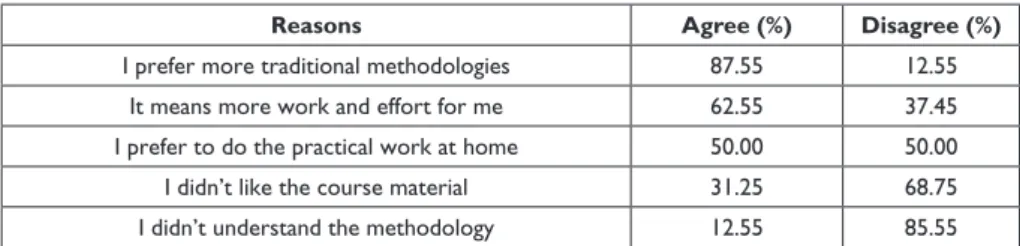
Como se puede observar en la Tabla III, los resultados obtenidos parecen poco concluyentes ya que muestran un bajo nivel de acuerdo con las razones expuestas en la encuesta para no preferir el entorno híbrido. Los resultados obtenidos sobre la posible preferencia del entorno híbrido también fueron ampliamente discutidos en el grupo focal de los estudiantes.

Satisfacción con la metodología flipped classroom
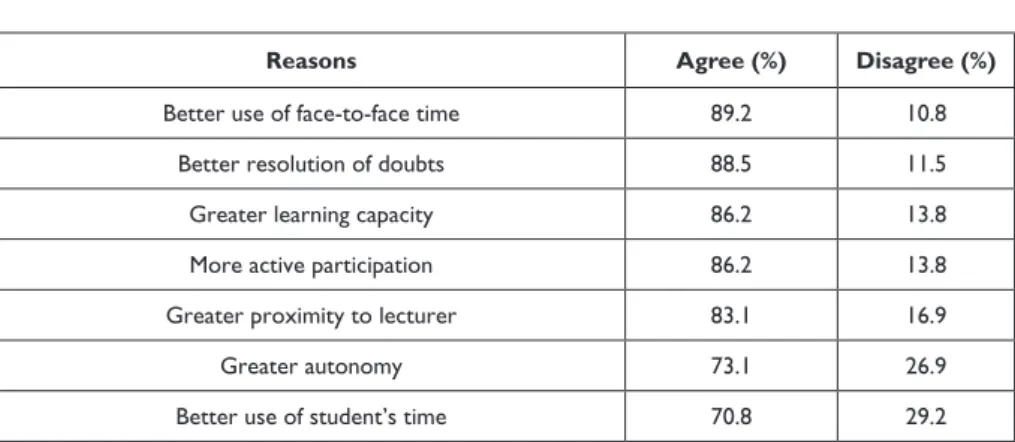
También se preguntó a los estudiantes sobre los beneficios que se podrían identificar al implementar el aula invertida en el salón de clases. Por tanto, el aula invertida preservaría esta mayor autonomía en el aprendizaje, permitiendo reforzar y consolidar los conocimientos en las sesiones presenciales.

Distribución del tiempo presencial y online en las asignaturas híbridas
Estos resultados también están respaldados por diversas investigaciones sobre la percepción de los estudiantes en el aula invertida (Awidi y Painter, 2019; Blair, 2016; Hernández Nanclares y Pérez Rodríguez, 2016), aunque nuestro estudio presenta la singularidad de la implementación de asignaturas híbridas que reducen el número de horas presenciales. Las opiniones generales expresadas en el grupo focal fueron en la misma línea de requerir un mayor número de horas presenciales, debido a una mayor dedicación a la materia y una mayor interacción con el docente y el resto de compañeros.
Resultados académicos en función del entorno de aprendizaje (híbrido y exclusivamente online)
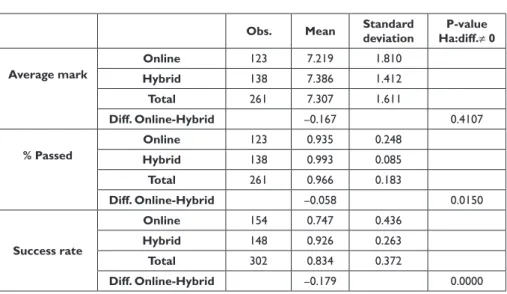
El segundo análisis realizado pretende valorar la existencia de diferencias estadísticamente significativas entre el porcentaje medio de alumnos que aprueban la asignatura, de nuevo en función del entorno educativo en el que se imparte la asignatura.Como se puede observar en la Tabla VII, el porcentaje de alumnos que aprueban la asignatura es significativamente mayor en el entorno híbrido que en el entorno exclusivamente online. En resumen, los resultados de este apartado ponen de manifiesto la existencia de diferencias estadísticamente significativas en el rendimiento de los alumnos en materia de aprobado/suspenso, aprobado/suspenso y abandono/no abandono.
Sin embargo, no existen diferencias estadísticamente significativas en la nota media de los alumnos según el entorno de aprendizaje del curso.

Conclusiones
Las instituciones de educación superior deben considerar la pertinencia de mantener las modalidades en línea en sus programas de estudio. Por todas estas razones, creemos que esta forma de enseñanza puede ayudar a las instituciones de educación superior a aumentar su propuesta de valor y así cerrar la brecha entre la industria y la educación. Finalmente, este estudio está limitado por la disponibilidad de datos de un solo año académico y los resultados académicos de una de las instituciones de educación superior analizadas, por lo que recomendamos repetir esta investigación en próximos años académicos y otras instituciones de educación superior para comparar los hallazgos obtenidos a lo largo del tiempo.
Para futuros estudios, sería conveniente agregar indicadores relevantes para las IES, como los costos y beneficios de los diseños mixtos con aula invertida y extender el estudio a un mayor número de IES.
Agradecimientos
Otro resultado relevante de nuestro estudio es que el éxito, medido por la superación de asignaturas, es significativamente mayor en las clases híbridas y que la tasa de abandono también es significativamente mayor en las clases exclusivamente online. En resumen, el estudio proporciona evidencia de que el aprendizaje combinado a través del aula invertida promueve el aprendizaje activo y la adquisición de habilidades blandas, como el trabajo en equipo y el trabajo independiente, y permite un mejor rendimiento de los estudiantes.
Bibliográficas
Percepción de los estudiantes acerca de la implementación de la modalidad educative blended-learning en la Educación Superior. The effects of flipped teaching on out-of-class study time, exam performance and student perceptions. University students' perceptions of the learning environment and academic outcomes: Implications for theory and practice.
A literature review of factors influencing e-learning and blended learning in relation to learning outcome, satisfaction and student engagement.
Las instituciones de educación superior (IES) están tratando de responder a esta demanda rediseñando y optimizando las experiencias de aprendizaje. El aprendizaje híbrido o combinado puede contribuir a lograr estos objetivos si se cuenta con las metodologías necesarias para desplegar todo su potencial. El propósito de este estudio es evaluar la efectividad de la instrucción en aula invertida híbrida, en términos de satisfacción y rendimiento de los estudiantes, en comparación con la instrucción 100% en línea.
Además, los estudios realizados en este tipo de aulas ofrecen mejores tasas de éxito y mejor retención en comparación con la instrucción totalmente en línea.
Introduction
The effective integration of both components in the learning experience is the distinguishing feature of hybrid teaching and what makes it more complex (Garrison & Kanuka, 2004). Second, the impact of this methodology on academic performance is analyzed, examining the differences between students' scores in the hybrid subjects taught in flipped classroom sessions and those obtained in the 100% online subjects. The results show a high level of student satisfaction with the hybrid environment and the flipped classroom methodology, better grades and lower dropouts in the courses using this type of classroom compared to 100% online groups.
The contributions of this study to teaching research are as follows: (i) to demonstrate the effectiveness of the flipped classroom methodology in hybrid learning compared to online teaching in terms of satisfaction and performance, (ii) to provide student perceptions that should be considered when designing hybrid settings with flipped classroom methodologies, and (iii) to provide higher education institutions with important indicators for making decisions about the choice of teaching modalities and methodologies in the courses they design their curricula.
Hybrid learning and the flipped classroom in higher education
DeLozier and Rhodes (2016) conducted a literature review on the flipped classroom and the diversity of existing foci. One of the main characteristics of the flipped classroom is the active participation and involvement of students in their own learning (Rotellar et al., 2016). Similarly, Uzunboylu and Karagozlu (2015) reached similar conclusions about the use of the flipped classroom in many areas of health sciences, actuarial science, English, and linear algebra.
The second part of the research task was aimed at evaluating the possible existence of statistically significant differences between students.
Results and Discussion
Note: The total number of respondents was 164, of which 110 studied in Madrid and 54 in Chicago. To do this, they compared the academic results of students who studied with hybrid resources to those achieved by students who studied the same course in a fully online format. For this second part of the analysis, only the groups at the Spanish center were used, as the US center did not have equivalent subjects with a 100% online approach, which hindered the comparison between the two groups.
Satisfaction with the hybrid setting versus 100% online
As Table III shows, the results obtained did not seem very convincing, as they show a diminished degree of agreement with the reasons given in the study for not preferring the hybrid setting. They only suggested that the reasons suggested are not reasons with sufficient weight for inference because the students do not prefer the hybrid learning environment compared to a 100% online environment. The results for preferences in the hybrid setting were also extensively discussed in the focus group of the students.
Most of the students interviewed preferred this format to an online-only format (“The hybrid environment combines the strengths and best of online and face-to-face, which is a good thing”).

Satisfaction with the flipped classroom methodology
Students were also asked about the advantages they could identify in implementing the flipped classroom approach in the classroom itself. Therefore, the flipped classroom would retain this increased autonomy in learning while using face-to-face sessions to reinforce and consolidate the knowledge gained. There, the main advantage of the flipped classroom methodology gathered from the comments of the participants was related to the option of better time management: dedicating face-to-face hours to more difficult tasks that require the presence of a teacher and using personal time, more autonomy, for simpler tasks.
The biggest difficulty in the flipped classroom is that of student accountability, especially in out-of-class work, which is essential if face-to-face time is to be used effectively (Bognar et al., 2019; He, Holton, Farkas & Warschauer, 2016; Touron & Santiago, 2015).
Distribution of face-to-face and online time in hybrid subjects
They also emphasized the importance of quality materials for the proper preparation of personal lessons ("Sometimes I had to look for information myself because I felt that something was missing, that I did not understand something that was taught to me theoretically. The teacher should have given you more complete and more specific material"). The general opinions of the focus continued with the same arguments that they require more personal hours, because they encourage greater dedication to the subject and offer better opportunities for interaction with the teacher and other classmates. Students who combined their studies with full-time employment stated that more personal time made it difficult to attend classes and also took time away from studying.
The discussions in the group interviews focused not only on the most appropriate ratio of hours between personal and online time, but also on the fact that students also want a more rational organization of the time dedicated to personal meetings.
Academic results depending on the learning environment (hybrid and exclusively online)
The second analysis aimed to evaluate the statistically significant differences between the average percentages of students who passed the subject, again depending on the learning environment in which the subject was taught. As Table VII shows, the percentage of students passing the course was significantly higher in the hybrid setting than in an online-only environment. More specifically, the average dropout rate in the hybrid learning environment was 6.8% compared to 20.1% in the purely online setting, making this difference again statistically significant at a 1% level.
However, no statistically significant differences were found in the average grade of students according to the learning environment used for the subject.
Conclusions
Results indicate that students show more satisfaction with mixed modalities than with 100% online approaches because of the potential for class work where doubts can be clarified and for active learning and participation. Another implication of the results of our study is the need to find an appropriate percentage of teaching hours in relation to the online hours and to redesign the time used for the practical application of the subject and to achieve a more efficient management of resources. In this regard, the students believed that it was essential to pay more attention to the quality of the materials for online learning.
Finally, one limitation of this study is the availability of data from one academic year alone, together with the fact that the academic results relate to only one of the two HEIs.
Acknowledgements
For future studies, it would be a good idea to add relevant indicators for the HEIs, such as the costs and benefits of mixed designs with flipped classrooms and extend the study to a larger number of HEIs. Flipped learning and online discussion in higher education teaching: smart pedagogy for technology-enhanced learning.