La vivienda social sustentable es un tema reciente en México, con esfuerzos tangibles que se remontan a 2007 con el lanzamiento piloto del programa INFONAVIT Hipoteca Verde. INIFAP Instituto Nacional de Investigaciones Forestales, Agrícolas y Pecuarias INVIES Instituto de Vivienda del Estado de San Luis Potosí. Instituto Estatal de Vivienda de San Luis Potosí) NAMA Acción Nacional de Mitigación Apropiada.
Introduction
- Problem Statement
- Justification
- Objective
- Specific Objectives
- Methodology
Sustainable social housing is one of the goals presented by former president Felipe Calderon to achieve this goal. This standard was published in the DOF on August 9, 2011 and defines standards for achieving energy efficiency in residential buildings by implementing insulation in the building envelope.

Social Housing in Mexico
Legal Framework
The first is dedicated to employees in the private sector, while the latter focuses on workers in the public sector. INFONAVIT: On April 21, 1972, the Law of the Institute of the National Housing Fund for Workers (LINFO) was issued as a solution to the housing problem through a three-way administration, integrated by the federal government, the business sector and the labor sector (Valencia Salcedo , 2013).
Sustainable Social Housing
- National Development Plan 2007-2012
- National Housing Program 2008-2012
- Green Mortgage (INFONAVIT)
- NAMA
- Scopes and limitations
Acclimatization Systems
- Psychrometric Chart
- Passive Systems
- Active Systems
- Hybrid Systems
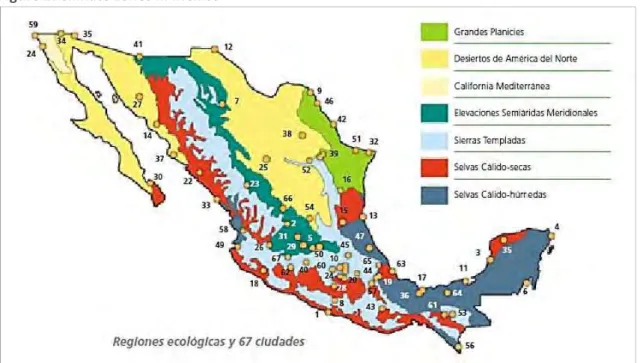
The first chapters seek to provide an overview of the social housing framework in Mexico, as well as the programs and standards related to sustainable social housing, the acclimatization systems commonly used to achieve comfort temperatures in a building, and the local context of the geographic location. The data collected will help to carry out simulations with specialized software on cooling and heating requirements as well as on the performance of the EAHE system.
Geographical Context of the City of San Luis Potosí
Solar Radiation
Solar radiation is the amount of solar energy received by a horizontal surface, although it can also be measured in vertical planes or facades, depending on their orientation (N, S, E and W). Solar radiation is measured in kWh/m2 and it is divided into a) direct solar radiation, or the rays that come directly from the sun (solar rays) and b) diffuse radiation, when the direction of the solar rays is modified by atmospheric density or other particles (sky radiation). It is directly responsible for the temperature of a given place, since the latitude determines the incidence of the sun's rays, being more perpendicular and more intense at latitudes near the equator and less intense at latitudes near the poles. It has many applications in everyday life, such as water heating, air heating and electricity production through solar panels.
Aguillón Robles (2007) states that an average of 6.3 kWh/m2 day is obtained in the territory of the city of San Luis Potosí. As can be seen in figure 21a, May records the greatest solar radiation with more than 200 kWh/m2, which, separated by 31 days, is in agreement with the data of Aguillón Robles (2007). On the other hand, December receives less solar radiation, with an average of 125 kWh/m2, or 4.03 kWh/m2 each day.
Temperature
Relative Humidity
Degree-Days in San Luis Potosí
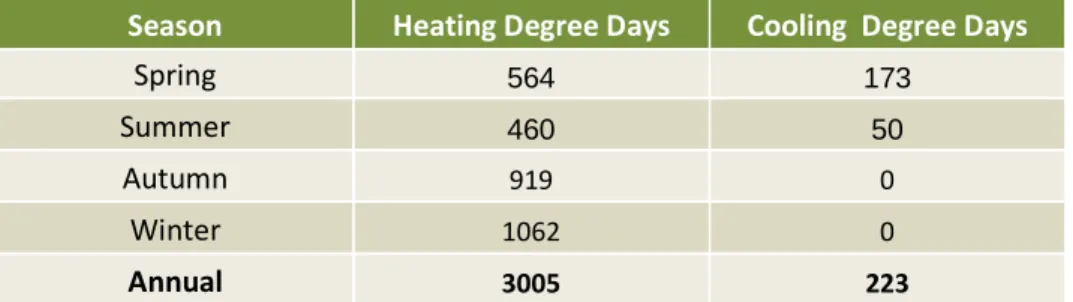
65 temperature, it counts as cooling degree days, and if it is below the minimum comfort temperature, it counts as heating degree days. Two days with 1°C below the minimum comfort zone represent 2 warming degree days, while one day with 2°C below also represents 2 warming degree days (McMullan, 1998). As can be seen, the city of San Luis Potosí requires heating strategies all year round with 3005 accumulated degree days, versus the 223 cooling degree days required only in spring and summer.
Sometimes the air temperature may be in the comfort zone, but the relative humidity may be too low or too high, causing a feeling of discomfort. These tables show that most discomforts are below the lowest comfortable temperature of 19°C, especially at night, between 8pm and 9am - even in the summer - while there are no harsh environments or breathlessness and dry heat at any time of the year.
Psychrometric Chart of the City of San Luis Potosí
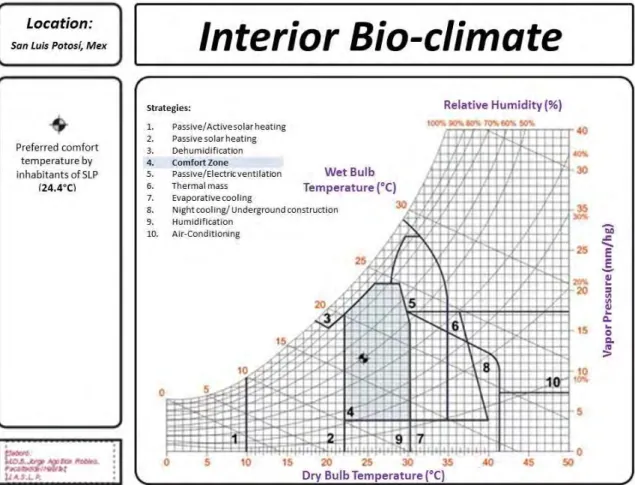
68 Aguillón Robles uses monthly average values, and the one obtained with the Weather Tool uses more detailed hourly values for each day of the year, it can be seen that both maps are consistent in the position of the data, showing the seasonal climate of San Luis defines Potosí between cool, moderate and hot-dry, depending on the season of the year. It is important to emphasize that active acclimatization strategies - such as air conditioning - are not essential to achieve thermal comfort in either case. As it can be seen in Figure 16 and Figure 25, climatic conditions of the city of San Luis Potosí do not require active systems such as air conditioning.
Instead, good ventilation systems and evaporative cooling are enough to achieve thermal comfort in hot periods. Comparison between Aguillón Robles and Ecotect's Weather Tool psychrometric chart for the city of San Luis Potosí.

Precipitation
70 into the city instead of filtering into the ground, causing flooding and severe damage to the city's infrastructure (COTAS, 2005).

Wind
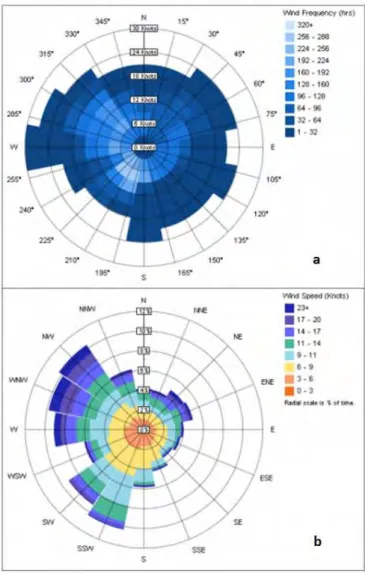
As it was mentioned before, knowing the direction of the prevailing winds can help determine the location of windows and - in this case - of the wind chimney, which will help increase the air flow in the interior of the house by sucking the interior air with Venturi effect. As Mermet (2005) and García Chávez & Fuentes Freixanet (1995) confirm, natural ventilation is improved when the inlet window and the prevailing wind direction create a 45° angle. This means that for the specific case of the city of San Luis Potosí, the best location for inlet windows is on the north facade, in an E-W axis.
Soil types
As stated in Chapter 3.2, the use of natural ventilation in architecture has many benefits. It is a useful strategy to achieve adequate levels of indoor air quality to create healthy conditions for the occupants of a building, and it can also be used to achieve passive acclimatization of indoor spaces, achieving comfort temperatures and levels acceptable moisture. As García Chávez & Fuentes Freixanet (1995) state, a good wind control allows the cooling of a building through natural ventilation air flow, its heating through thermo-convective processes, the increase of humidity through evaporative cooling or dehumidification through condensation.
Nevertheless, the random behavior of wind creates problems to properly implement natural ventilation in an architectural project (Mermet, 2005). On the other hand, under some climatic conditions, the implementation of natural ventilation in a building can increase its energy consumption, due to the necessity to be heated, cooled or just circulated (Autodesk, 2013). The advantage of integrating a passive strategy such as an EAHE is that the energy transfer from the air and the ground not only helps to pre-cool the air in hot seasons, but it can also pre-heat it in cold seasons .
Therefore, "air can be passed through buried ducts and thus used to cool or heat incoming fresh ventilation air" (Brown & DeKay, 2001).
Bioclimatic Environment of San Luis Potosí
To control and utilize natural ventilation from outside: Natural ventilation should be avoided in cold seasons to prevent heat loss (see Table 13). To improve humidification: In warm seasons, natural ventilation can be improved with humidification, allowing air to flow through wet elements or even water fountains. As this research project focuses on an acclimatization/ventilation system for social housing, the requirements for natural ventilation and humidification are highlighted in each table.
These tables provide an overview of the specific time in each season when the EAHE should be turned on or remain off, or even enhanced with a humidification device to meet acclimatization requirements, as well as the wind direction and speed recorded throughout the year, which can help infer wind behavior on the housing unit. It is important to mention that depending on the weather conditions, the 230W fan can also be switched on or off. If the sky is clear, solar radiation will induce air suction by the solar chimney, avoiding the use of the fan.
On the other hand, if the turbidity does not allow the proper operation of the solar chimney, the fan must be turned on to supply air to the required spaces of the house.

Design and implementation of an EAHE system
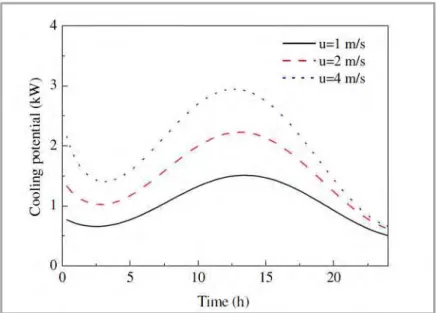
If an air speed of 2 m/s is taken into account (see Figure 33), the total length of the system should be 40 meters. 85 pipe on the temperature of the surrounding ground is limited to a distance of twice the diameter”. It should not be placed too close to dense vegetation to avoid aspiration of CO2 from the plants (Dubois Petroff, 2009) and with a minimum height of 1 meter to avoid pollutants located within the first 30 cm above the ground (Loyau, 2005). .
In this case, the correct choice of material is influenced by the state of health. The thermal performance of an EAHE is strongly influenced by the temperature of the site's soil. The characteristics of the soil showed that it was sandy loam, with medium-sized rocks.
It is possible that debris from the wreck affected the thermocouple measurements.
Integration of the EAHE to a Popular Social Housing Unit
In this way, the air vents can be extended to the second floor to take advantage of the EAHE airflow. In this case, the limits of the comfortable temperature in the city of San Luis Potosí were taken into account; therefore EAHE would start working above 27 °C and below 19 °C. These results show that cooling the house should be prioritized, especially from May to September.
The use of the EAHE combined with the solar chimney has a great potential to satisfy the cooling demand. As for the material of the chimney, it is important to use solid, rigid materials that can withstand the elements and the wind speed. The advantage of an EAHE over other passive acclimatization systems is that it provides cooling and heating, depending on the season of the year.
Experimentation on different configurations of the EAHE such as diameter, length, materials to determine the best solution for the specified climate. If the site is donated by the INVIES, the EAHE with the best characteristics can be implemented and combined with the solar chimney to prove the performance of the hybrid system. Further studies on the implementation of the system in other climatic regions of the country.