
The decay of the stops and fragmentation is simulated with Pythia 6 generator, assuming 100% branching fraction in either the t χ0 or b χ+ final state. Now we need to figure out the best final state to continue the search.
Event Selection
Isolation is defined as a scalar pT sum of all additional activity in a cone of R=0.3 around the lepton and must be 15% of the lepton pT and less than 5 GeV. A trigger threshold of pT > 60 GeV/c is applied to the leading jet in the QCD events.
Optimization
W boson selection
- Electrons
To measure the signal yield, we choose to fit the E/T distribution in the electron channel and the M T distribution in the muon channel, where M T = p. This function can be understood as describing fluctuations of the missing transverse moment vector around zero due to measurement error; the resolution term, 0 + 1 E/T, is increased by E/T to account for tails in the E/T measurement. As can be seen from the MT distributions, the semileptonic t¯t background events are mainly populated in the region with MT < 150 GeV.
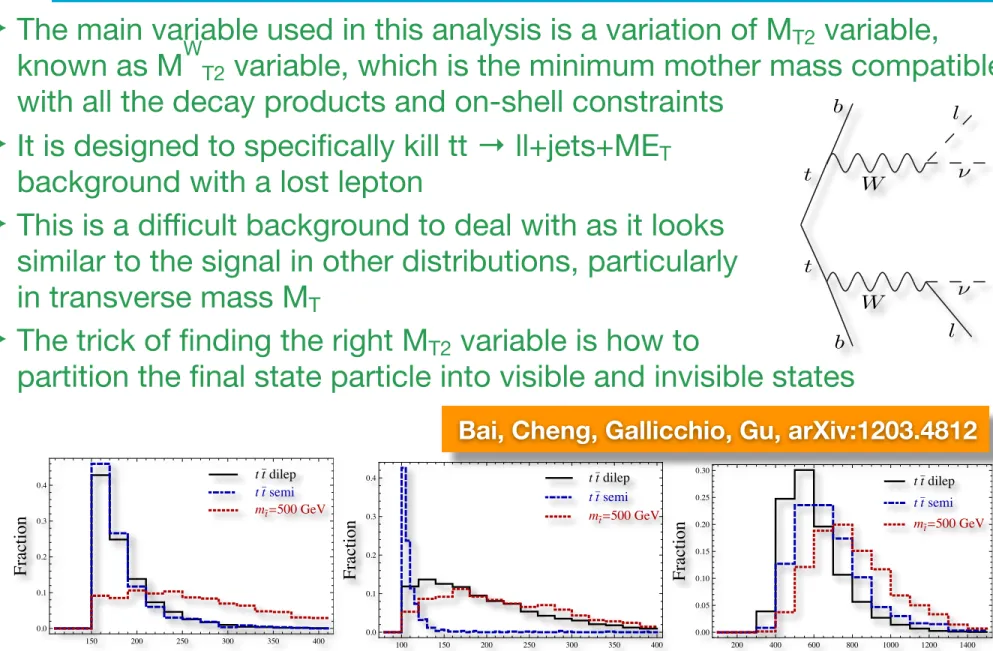
On the other hand, cuts to ETmiss and meff could be used to significantly reduce this background, although this is still the biggest contagion when looking for immediate production stops. The MT2 is bounded from above by the mass of the parent particles in the decay chains if the assumed mass for the daughter particles is equal to (or less than) their actual mass. Below we define three MT2-type variables with background endpoints approximately at the top mass.
Interpreted in the original MT2 context, this assumes a "missing op-cap W" at each end of the expiration chain. The events with no compatible top mass below 500 GeV are placed in the last bin.
Signal region definition
- BDT signal regions
- Cut-based signal regions
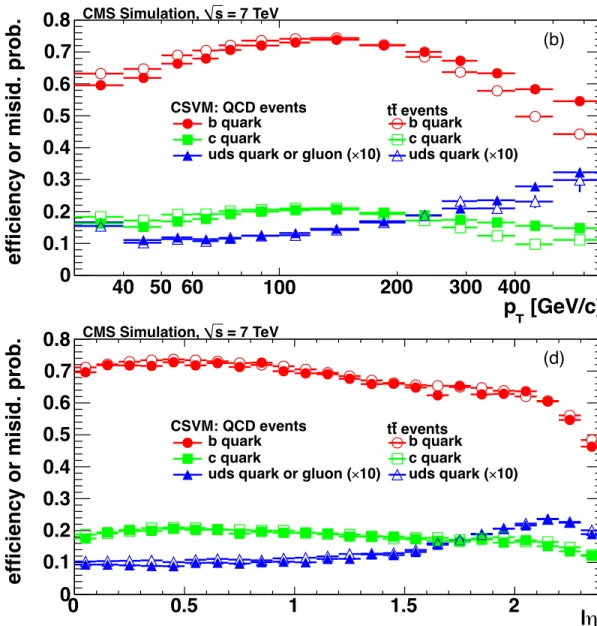
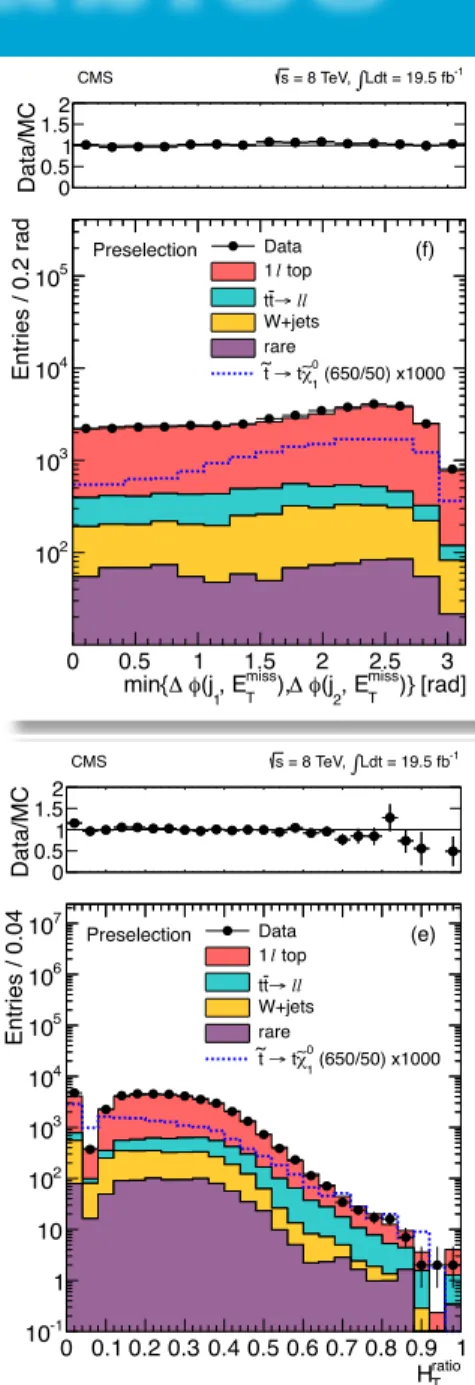
As a result, the pT spectrum of the bottom quarks is heavier for signal than for background events in most of the signal parameter space. HT ratio defined as the ratio of the scalar sum of pT of jets in the same hemisphere than the MET vector to the total scalar sum of all jet pT (HT). Conversely, the b-jet is softer for t → t+χ0 events in the 3-body region of the parameter space than for the tt background.
In fact, at each stage, the branch that will increase the quality of the separation the most is chosen as the next branch to split. The renormalized sum of all results, possibly weighted, is the final result of the event. For those familiar with ANNs, applying this result is the same as applying the ANN value to a specific event.
It only depends on the order according to the variable, not on the value of the variable. Both categories include the requirement that the azimuthal angle difference between the two leading beams and the EmissT vector exceeds 0.8 radians, in addition to the requirement that the value of the hadronic peak c2 be less than 5.
ISR/FSR
An uncertainty of 7%, based on efficiency studies for t-lepton identification in data and simulation, applies to events with a hadronic t-lepton in accepting the hadronic t-lepton veto. MC background prediction comparing nominal sample POWHEG results with those obtained using MADGRAPH and MC@NLO, varying the MADGRAPH scale parameters for renormalization and factorization, and the scale for matrix element and parton shower matching, top. and down by a factor of two, and changing the top-quark mass in the range 178.5 to 166.5 GeV. Since the resulting background predictions are stable within the systematic uncertainties discussed above, we do not estimate an additional uncertainty from the tt MC stability tests.
The uncertainty of the W + jet background prediction is dominated by the uncertainty from the tail-to-peak ratio, as determined by data/MC comparisons in the CR-0b control region. The main uncertainty about the one-top-quark lepton background arises from the difference in tail-to-top ratios for W + jets and one-top-quark lepton events. The decomposition of this total uncertainty into its individual components is also shown.
As mentioned in Section 3 , we normalize their rates to the corresponding calculations of the NLO cross section [ 31 , 32 ]. We assign a conservative overall uncertainty of 50% to account for the missing higher order terms as well as the possible mismodeling of their kinematic properties (see for example the discussion of Ref. [31]).
8 Results
Results
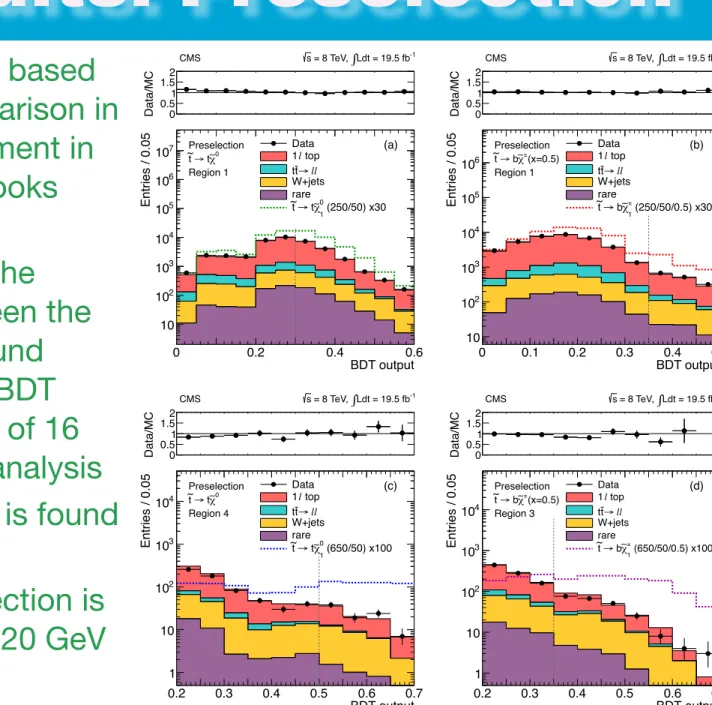
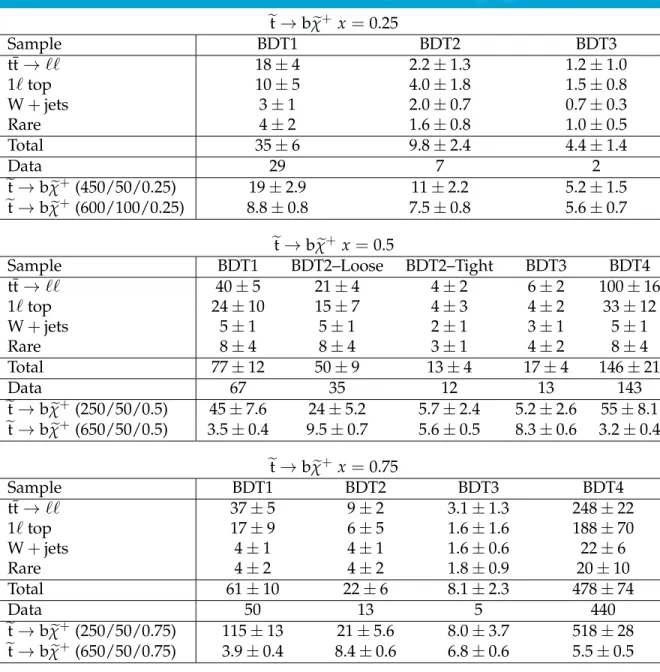
After adjustments, based on the comparison of data/MC in CR, the agreement in the signal region appears good. Events in the signal regions are further resolved by searching for MT > 120 GeV and applying the BDT requirements as indicated by the vertical dashed lines. The third largest background consists of a variety of SM processes with small cross sections, including tt events produced with respect to one vector boson (ttW, ttZ, ttg), two (WW, WZ, ZZ) and three (WWW, WWZ , WZZ, ZZZ) weak vector bosons and one-top quark production in the tW channel.
The background multijet contribution is negligible in signal regions due to the requirement of a high isolated lepton, large MTs, large etmiss and a jet labeled B. The first and second numbers in parentheses indicate the masses of the top- squark and neutralino, respectively, at GeV. The interpretation of the results in the context of top-squark pair production models is presented in Section 9 .
For each signal region, the individual background contributions, total background and observed yields are indicated. The first and second numbers in brackets indicate the top-quark and neutralino masses in GeV, respectively.
9 Interpretation
The results of the search are interpreted in the context of models of top quarter pair production. As discussed in Section 3, we consider separately two possible decay modes of the top squark,. These uncertainties are 3% for the trigger efficiency and a combined 5% for the lepton identification and isolation efficiency, where we also take into account additional uncertainties in the modeling of the lepton isolation due to the differences in the hadronic activity in Z.
The uncertainty in the efficiency of tagging bottom quark jets results in an uncertainty in the acceptance that depends on the model details but is typically less than 1%. The larger uncertainties correspond to models where the difference between the masses of the top squark and the LSP is small. The modeling of ISR in MADGRAPH is investigated by comparing the predicted and measured pT spectra of the system recoiling against the ISR jets in Z+jets, tt and WZ events.
Predictions from the MC signal samples are weighted to account for this difference, by a factor of 0.8-1.0, depending on the PT of the system they recover against ISR aircraft, and the deviation of this weight from 1 is taken as a systematic uncertainty. Upper bounds on the cross section for high-square pair production are calculated separately for each SR, including the acceptance and efficiency uncertainties discussed above, using the LHC-style CLS criterion [63–65] .
Interpretation
Signal regions summary
The BDT SRs provide the primary result as the BDT method has better expected sensitivity. The expected number of background events in the SRs varies between approx. 4 and 1600 (see section 8).
5 Background estimation methodology
To summarize, this research uses two complementary approaches: one an intercept-based approach and the other a multivariate BDT method.
Fine Points
Observed (top right) Observed (top left). model tce01 for the case of unpolarized, right-handed and left-handed top quarks. The results are based on the assumption that the search does not accept top-squark pair events if one of the top-squarks decays in a different mode.
10 Summary
Acknowledgements
Observed (top right) Observed (top left). t c e01 model for the case of unpolarized, right-handed and left-handed top quarks. We have performed a search for direct pair production of top squarks in a final state consisting of a single isolated lepton, jets, large missing transverse momentum, and large transverse mass. The signal regions are defined by the output requirements of the BDT multivariate discriminator and by the requirements of several kinematic discriminants.
The observed yields in the signal regions agree with the predicted backgrounds within the estimated uncertainties. The results are interpreted in the context of models for top-squark pair production and decay. The analysis probes top squarks with masses up to about 650 GeV and significantly limits the allowed parameter space for natural SUSY scenarios.
We thank Ian Low for help with polarization problems in top squark decay and Jiayin Gu for help implementing the code for the variables in Ref. Momentum of χ0 is reduced in the 'compressed' region ➞ reduced source of MET, which is the main discriminator from background.

Next Steps
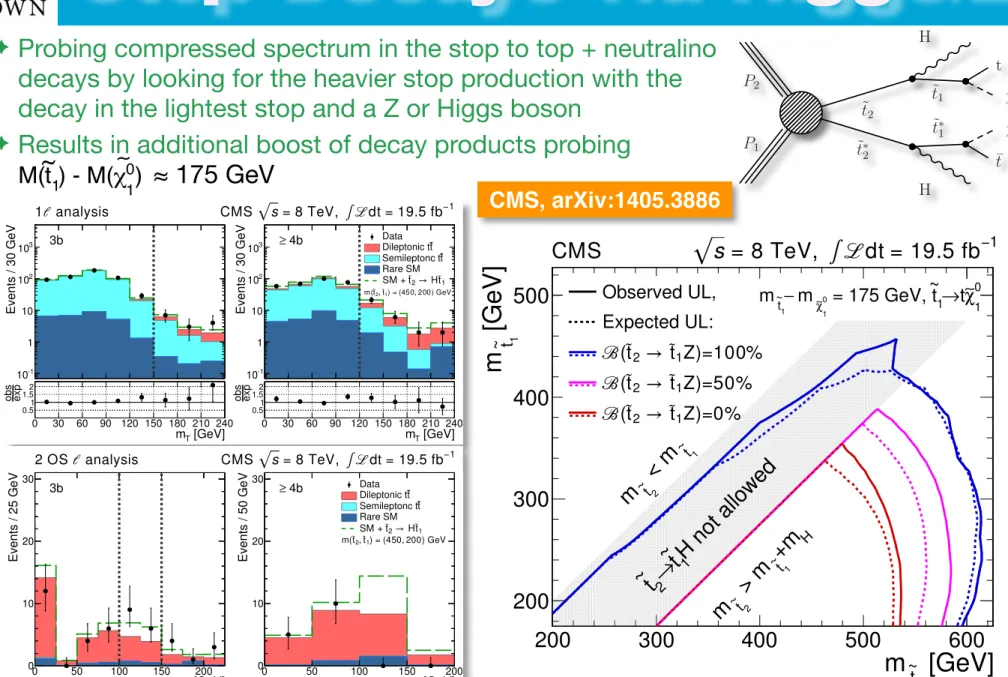
Probing compressed spectrum in stop to peak + neutralino decay by looking for the heavier stop production with the decay in the lightest stop and a Z or Higgs boson. Majumdar, "Cancellation of quadratically divergent mass corrections in globally supersymmetric spontaneously broken gauge theories", Nucl. The semileptonic tt and dileptonic tt components represent simulated events characterized by the presence of one or two W bosons decaying to e,µort.
The yield of the tt-simulated samples is adjusted such that the total SM prediction is normalized to the data in the samples obtained by inverting the SR requirements. The distribution for the model2!Het1wheremet2 =450 GeV andmet1 =200 GeV is shown on top of the backgrounds. The uncertainties in the background predictions are derived for the total yields in the signal regions and are listed in Table 2.
Unfortunately, the search came up empty-handed, but strict limits were placed on stopping production and extensive coverage was provided. The analysis will remain a flagship SUSY search in Run 2 and will result in a discovery or significant limitations of the very “natural” SUSY capability.
Thank You!