Preparación y propiedades de películas antioxidantes a base de polietileno adicionado al extracto de flor de caléndula (Tagetes erecta) y su aplicación en la estabilidad oxidativa del aceite de soja. El objetivo de este trabajo fue desarrollar contenedores de activos antioxidantes con astaxantina procedente del extracto de flor de caléndula (Tagetes erecta), evaluar su efecto sobre la estabilidad oxidativa del aceite de soja y determinar la difusión de astaxantina y carotenoides totales frente a simulantes alimentarios y el mismo aceite. El efecto de la temperatura sobre la difusión de carotenoides en las películas de BDM siguió un modelo tipo Arrhenius con una energía de activación de 53,66 kJ/mol.
En la fase 1 del proyecto se elaboraron películas monocapa de polietileno de baja densidad con diferentes concentraciones de extracto de flor de caléndula. En la fase 3 del estudio se cuantificó la migración de carotenoides totales presentes en ambas películas. En la fase 1 se encontró que las películas tuvieron un efecto positivo sobre la estabilidad oxidativa del aceite de soja.
En la etapa 1 se encontró que el color impartido por los carotenoides en películas monocapa y bicapa se deterioraba durante el almacenamiento debido al efecto de la luz. Como resultado, cada vez son más las investigaciones sobre el uso de antioxidantes naturales como una alternativa válida en la protección de los alimentos. En la mayoría de los casos, esta tasa está controlada por el proceso de difusión.
Calcular el efecto del envase activo antioxidante sobre la estabilidad oxidativa de aceite de soya
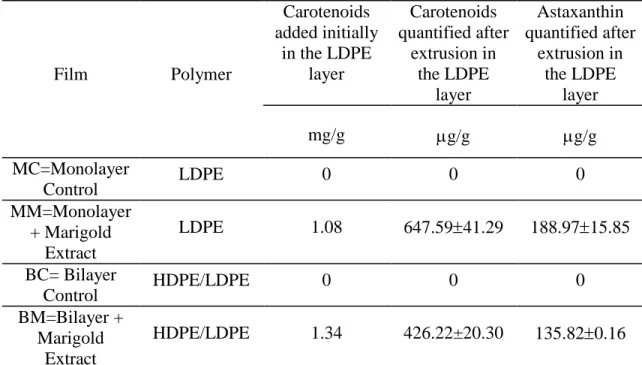
LDPE film added with 3.59% of the extract in the LDPE layer and the corresponding two control films without the addition of the extract. Spectroscopic, optical and mechanical properties of the films were affected by the addition of the marigold extract. A second batch of LDPE without addition of the extract was extruded under the same conditions to be used as the control (MCfilm).
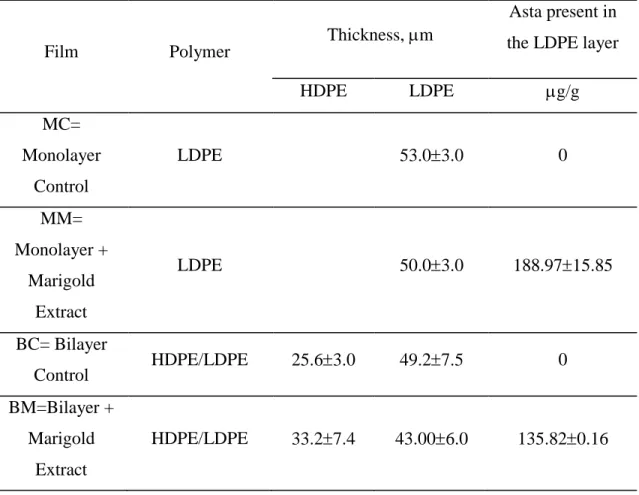
In the case of a two-layer film, a microscope (Olympus BX51, Center Valley, PA, USA) was used to measure the thickness of each layer. The color parameters of the CIELAB uniform color space and the brightness (L), redness (a*), and yellowness (b*) of the films were measured with a colorimeter (CR-300; Konica Minolta, Mexico City, Mexico). In order to observe the oxidation behavior and the effect of the films added to the marigold extract at a lower temperature (25 °C) and at the light intensity used in the dye degradation experiment (697-1945 lx), an additional stability experiment of soybean oil was carried out with the oil in bags from monolayer films.
Chromatograms of marigold extracts and film extracts show a peak at 7.75 minutes, which is consistent with the retention time of the astaxanthin standard. The concentration of astaxanthin in the MM film was 36.02% of the astaxanthin that was initially added. Torres-Arreolaet al.31 reported a loss of 43.4% of BHT during the processing of LDPE supplemented with 4% of antioxidant.
The marigold extract spectrum shows the absorption bands for the methylene stretches cm1), methylene bending (1461 cm1), carbonyl bond stretching in acylglycerols (1744 cm1) and C-CO stretching of aliphatic esters bending (1162 cm1). IR spectra of marigold extract (ME), two-layer marigold film (BM), monolayer marigold film (MM), double-layer control film (BC) and monolayer control film (MC). They therefore show an orange color, even though part of the marigold extract was degraded during the process.
Finally, regarding lightness, the addition of the marigold extract caused a decrease in the lightness (L*) of the films due to the absorption of part of the incident light, but all colors of the films were bright. Stabilization of astaxanthin in edible oils and its use as an antioxidant.Journal of the Science of Food and Agriculture.
Estudiar la migración de astaxantina desde películas activas hacia simulantes de alimentos grasos
Difusión de astaxantina natural desde películas activas de polietileno a un simulante alimentario graso.
Determinar el efecto de la temperatura en la migración de astaxantina
Introduction
Antioxidant-active packaging may be able to prevent or slow down the oxidation of easily oxidizable food components. This approach requires deliberate incorporation of antioxidants into packaging materials and further migration of antioxidants into the food. Migration is the interaction between food and packaging, which consists in transferring components from the packaging materials to the food.
It is a molecular diffusion process described by Fick's second law, and there are two basic parameters derived from diffusion. The first is the diffusion coefficient (D), which determines how quickly the migrant (antioxidant, in this case) is diffused. The second is the partition coefficient (Kp.s), which determines how much antioxidant is distributed when migration reaches equilibrium between the packaging and food or simulant (Castle, 2007).
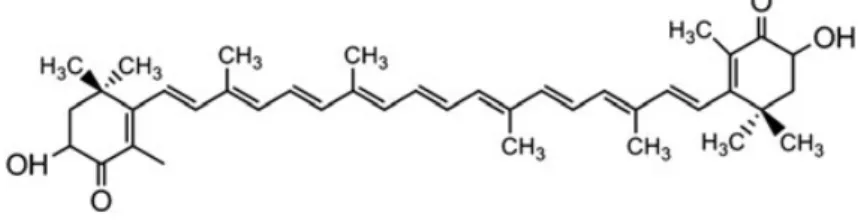
Many reports on antioxidant active packaging have focused on the migration of synthetic antioxidants such as butylated hydroxytoluene (BHT) and butylated hydroxyanisole (BHA) (Huang & Weng, 1998; Soto-Cantú et al., 2008; Tawfik &. Huyghebaert, 1999; Torres-Arreola, Soto-Valdez, Peralta, Cárdenas-López, & Ezquerra-Brauer, 2007; Wessling, Nielsen, & Giacin, 2001). This antioxidant is a carotenoid and can be obtained from natural sources such as algae, yeast, crustacean by-products and flowers. The antioxidant activity of Asta (3, 3′-dihydroxy-β, β′-carotene-4, 4′-dione; Figure 1) depends on its ability to quench singlet oxygen and scavenge free radicals.
There are many publications describing the antioxidant properties of Asta and its benefits for human health (Fassett & Coombes, 2011; Higuera-Ciapara, Félix-Valenzuela, & Goycolea, 2006; Hussein, Sankawa, Goto, Matsumoto, & Watanabe, 2006; Yuan, Peng, Yin and Wang, 2011). The antioxidant activity of Asta in vegetable oils shows that it can be used as a natural antioxidant for food either by direct or indirect addition from the package. These zones have free spaces where small molecules (e.g. additives) can be integrated into the material for subsequent release.
To our knowledge, there are no literature reports describing how Asta migrates from any packaging material to food or food simulants. The present work aims to study the migration of Asta from monolayer and coextruded films, including polyethylene of different densities, to 95% ethanol at different temperatures and to evaluate the effects of temperature on the migration of Asta.
Materials and methods
- RESULTS
- CONCLUSIONS
- ACKNOWLEDGMENTS
- REFERENCES
Standard solutions of Asta in acetone at concentrations between 0.25 and 12 µg ml-1 were used to create a calibration curve. The release of Asta was achieved by completely immersing the films in the food simulant. Standard solutions of Asta in 95% ethanol (from 0.25 to 8 g ml-1) were used to produce a calibration curve.
Therefore, the release of Asta was slower at 30 °C, although it was faster at 40 °C, when compared to the diffusion of other antioxidants. However, LDPE was less crystalline and contained more amorphous regions, allowing less restricted diffusion of Asta at a higher rate. Consequently, coextrusion of HDPE and LDPE layers promoted a more gradual release of Asta into the simulant.
This behavior may be a consequence of the prior diffusion of Asta into the HDPE layer. The values obtained for the diffusion of Asta from the MM and BM films in ethanol at 40 °C are lower than the reported values, confirming that the larger migrants have lower diffusion coefficients. The diffusion of Asta in the MM films was more affected by temperature than that in the BM films, because the D values in the second case were very similar within the tested range.
Values for the α, partition (Kp,s) and diffusion (D) coefficients for the diffusion of Asta from MM and BM films in 95% ethanol at different temperatures. The graphs show the concentration of Asta released by weight of the LDPE layer on the MM films (µg g-1) versus time (h). The graphs show the concentration of Asta released by weight of the LDPE layer on the BM films (µg g-1) versus time (h).
Diffusion of Asta from MM (circles) and BM (squares) films in 95% ethanol at different temperatures according to Fick's second law. Activation energy (Ea) for diffusion of Asta from MM and BM films into 95% ethanol.
Estudiar la migración de astaxantina desde películas activas hacia simulantes de alimentos grasos
Determinar el efecto de la temperatura en la migración de astaxantina
La adición de TiO2 tuvo un efecto positivo sobre el control de la fotodegradación de la astaxantina y el color de las películas. La migración de astaxantina y todos los carotenoides presentes en las películas tuvo un efecto positivo en el control de la oxidación lipídica del aceite de soja. También se evaluó el efecto antioxidante de las películas sobre la estabilidad oxidativa del aceite de soja.
Finalmente, se estudió la migración de carotenoides presentes en las películas hacia el aceite de soja. Para determinar el efecto de la temperatura sobre la difusión de carotenoides de las películas al aceite de soja, se calculó Ea utilizando la ecuación de difusión de Arrhenius. Inicialmente, se añadió un 2,19 % de extracto de flor de caléndula a las películas en la capa interna de HDPE.
La Figura 4 muestra la degradación de Asta en las películas de BE y BDE debido al efecto de la luz. De los carotenoides que no fueron degradados, una parte pudo haber migrado al aceite de soja y otra permaneció en las películas. Por lo tanto, las películas añadidas únicamente con aceite de soja protegido con TiO2 eran más que aquellas a las que se añadía únicamente extracto de flor de caléndula.
La Figura 6 muestra la liberación de carotenoides de películas de BDE en aceite de soja a diferentes temperaturas. Cambios en el índice de peróxido del aceite de soja envasado en películas BC, BE, BDC y BDE. Difusión de carotenoides de películas de BDE en aceite de soja a diferentes temperaturas según la segunda ley de Fick.
Energía de activación (Ea) para la difusión de carotenoides de películas de BDE al aceite de soja en un rango de temperatura de 10 a 40 °C. Sin embargo, las películas tuvieron un efecto positivo en el control de la oxidación de lípidos del aceite de soja almacenado bajo iluminación. Las películas mono y bicapa liberaron astaxantina al 95% de etanol y carotenoides totales al aceite de soja.
La temperatura tuvo un efecto moderado sobre la distribución de astaxantina y carotenoides en películas realizadas según un modelo tipo Arrhenius.