The questionnaire was also used as evaluation criteria to examine the theoretical value of the INDF with problem-solving material. The physical presentation of the problem-solving philosophy to materials design was placed in the Industrial Need Detections Format (INDF), which is the focus of this investigation, designed by the researcher.
Problem definition
Therefore, most English teachers prefer to skip it and continue to work in a traditional way of teaching, also omitting material evaluation processes. This actual situation represents a great challenge for English teachers at UTs to assume as it would involve going beyond traditional teaching style.
General Objective
In many cases, English teachers lack knowledge about other learning and teaching materials; For example, in problem-solving material related to English Specific Purposes (ESP), Robinson (1991) comments on “the use of study cases is a proven method for introducing future professionals to the job demands of business, medicine, law and engineering” (p.50). On the other hand, English teachers might also ignore the great value of material assessment in daily lessons. Dickins & Germaine (1992) define that Evaluation “can provide a wealth of information to use for the future direction of classroom practice, for course planning, and for the management of learning tasks and students” (p.3) and this activity should be considered as part of educational practice.
Justification
As a social contribution, this study can also help English teachers to be aware of the relevance of including; firstly material evaluation in language classrooms and secondly to consider problem solving material as a learning teaching material. Third, this research can encourage English teachers to take on a new challenge to become more innovative in English teaching classrooms and try to cover TSU students' specific needs and help them be more competitive in the outside world and in their work environment.
Research Question
LITERATURE REVIEW
Materials Evaluation
- Material evaluation overview
- Process of Evaluation
- Evaluation criteria of materials
- Checklist of materials evaluation
- Feedback and learners´ opinion in materials evaluation
On the other hand, another purpose of evaluating materials is to consider other aspects about what should be evaluated in classroom materials, for example, Moore's (1980) model (cited in Robinson, 1991) considers this. Several questions must be asked to determine the criteria for evaluating materials; Dudley-Evans and St.
English for Specific Purposes (ESP)
- Target Situation Analysis (TSA)
- Needs Analysis
- General English teacher turned into ESP teacher
- Selection of ESP materials
Thus, the need is understood as the specific necessity of the required language including work work situations. Evaluation of current materials can serve as a teaching-learning tool to develop ESP materials and conduct a needs analysis in industrial work contexts. The transformation of English teachers into ESP teachers means achieving success in the language area of the specialty subject by using specific methodologies and adapting and designing ESP materials as well as carrying out an assessment that constantly matches the needs of the students.
ESP teacher qualities described by Robinson (1991) claim that "one of the first requirements appears to be flexibility and a willingness to try new approaches and methods" (p.96).
Problem- solving overview
According to this author, problem-solving skills are thinking skills that help students use their knowledge in a flexible and adaptable way to solve problems by using problem-solving cases in the classroom. A different view is suggested by Baiocco (1998), who believes that “problem-solving processes shape students into autonomous learners” (p. 170); using this strategy, students can see, collect, and interpret a problem; then appreciate and make a plan; as well as building, executing and checking the alternatives to solve an industrial work situation. Complementing this, Lesh and Doerr (2003) argue that “solutions typically involve several modeling cycles and predictions are gradually refined and developed” (p.31); this means training students in objective predictions, using their previous experiences with the problem, and adding new strategies to improve students' interpretation when faced with a challenging situation involving problem-solving cases in the classroom and in industry are analyzed.
This concept is defined by the opinion of Heller & Hollabaugh (1992) and Mazur (1996) (cited in Duch, 2007), who state that "developing material through effective problem solving and analytical skills develops critical thinking and logical reasoning skills" (p. 48) . .
METHODOLOGY
- Setting
- Participants
- Data collection Instrument
- Analysis Procedure
In addition, interviewing students with oral experience working and studying simultaneously contributed to the enrichment of the problem-solving cases that resulted in the design of the INDF. In this particular TSU the students deal with the INDF materials with some difficulties due to their language limitations which made it much more complicated when it comes to presenting the problem solving materials during the English class. Approximately 80 TSU students from the mechatronics and maintenance systems program participated to create problem-solving cases submitted to the INDF from 2011 and 2013.
After completing their subject-specialty projects, on the last day of the course, TSU students were asked to answer the questionnaire to assess the validity and functionality of the INDF (Appendix A) with the problem-solving cases used in the classroom as part of their English language learning.
FINDINGS
Section 1. Practice of Technical Vocabulary
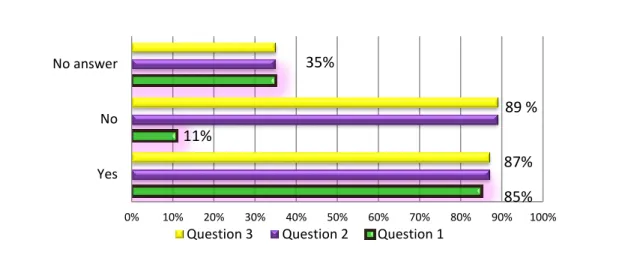
In this part of the chapter, questions one, two and three had STU students evaluate the INDF materials in relation to the effectiveness of the physical design of the INDF when describing problem-solving examples in English. The above results show that 89% of the students practiced technical vocabulary in the INDF when they analyzed problem-solving examples on the field of industrial maintenance and filled the INDF with problem-solving examples. They also felt that they practiced technical vocabulary and proposed a solution to a problem-solving example during class.
Therefore, it was important to consider the data from the graphs to determine any changes in the INDF.
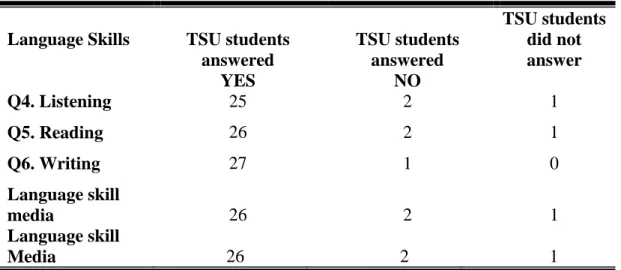
So, it can be said that although listening was practiced according to less than half of the group, those who said "yes" gave a high score to this skill, it also seems to be beneficial for them to improve their language skills . In contrast to listening was reading, which was rated number seven by fifteen TSU students. It can be noted that more than half of the group thought that they practiced on a smaller scale.
As mentioned in chapter two and three and one of the reasons why TSU students did not practice reading as they expected is shown in figure 2.
Listening
The exhibited results from graphs that only considered maximum values showed that thirteen students rated listening skills thinking with number eight. Less than half agreed that they had practiced this skill; however, it was acceptable to them.
Reading
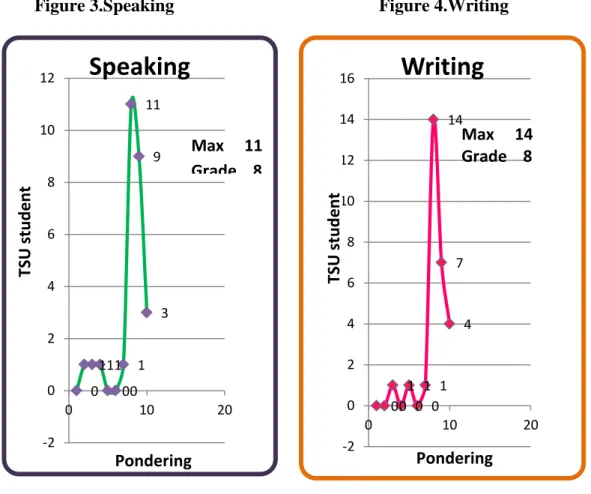
Nevertheless, certain decisions must be made to find suitable listening strategies to achieve success in the whole group. Again, data analysis is useful in thinking about different alternatives to help TSU students improve language proficiency using the INDF. With reference to speaking and writing skills, both were reflected with number eight, but some variations are seen in the graphs.
Eleven TSU students agreed to speak, and fourteen of them agreed to practice writing skills in INDF.
Speaking
However, they felt compelled to read because in many cases they received some knowledge to provide a solution to the problem solving issue they were analyzing in the INDF, so they preferred to trust their previous experience and spend more plenty of time to analyze possible solutions and complement. in INDF or practice dialogues for group oral presentations.
Writing
Section 2. Evaluations of the effectiveness of the Industrial Needs Detection Format (INDF) to improve speaking skills for oral presentation in
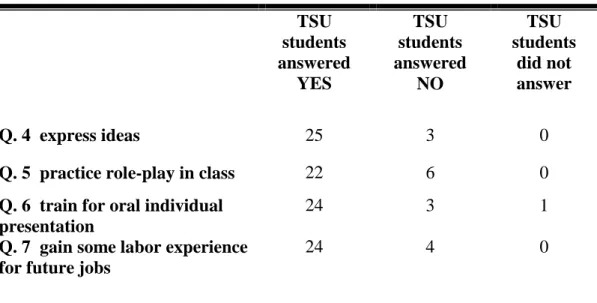
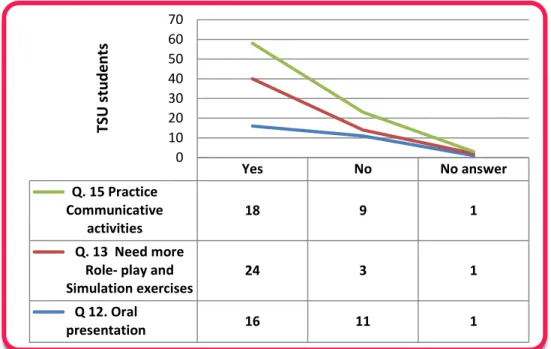
The second aspect of material evaluation is the INDF effectiveness in training TSU students to improve speaking skills with problem-solving material for their final oral presentation in teams. With this in mind, data analysis from questions four to seven will be exposed in Table 2 and high scores will only be considered for this study, as these results below involved almost the entire group tested in this project and the results derived positive responses. The first key point to evaluate is the fact of helping TSU students express their ideas in front of others; to this effect twenty-five of them said "yes."
- Section 4. Industrial Repository
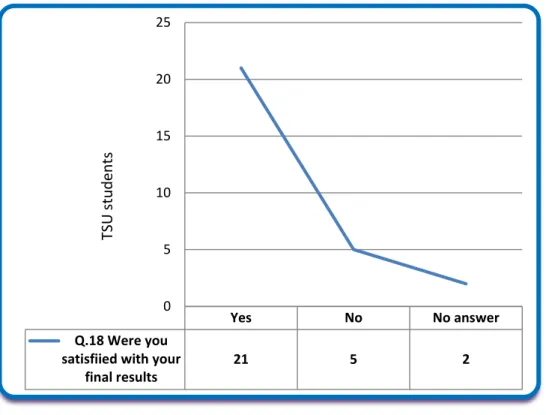
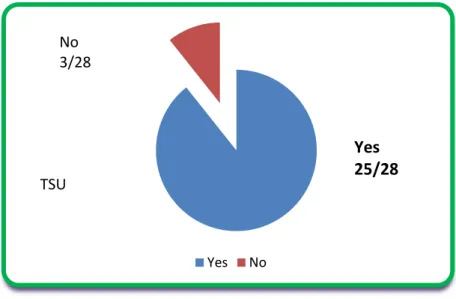
On the other hand, to point to question seven, twenty-four TSU students answered “yes.” The INDF with problem-solving materials helped them gain some work experience for their future jobs. Question fifteen shows that the majority of TSU students also needed to practice more communication activities using the INDF with problem-solving cases to be well prepared before their oral presentations. Around Figure 7 above, it can be expressed that most TSU students were satisfied with their final results after working in teams in implementing their own problem-solving materials using the INDF for their individual oral presentations, which took place at the end of the lesson. the course.
At the same time, and despite the lack of speaking preparation, including time constraints, TSU students were satisfied with their final results after working in groups using INDF with problem-solving materials as implementing their own examples from the assigned local company.
Industrial Repository to teach Technical vocabulary
Then the INDF evaluation is useful to think of as a simulator of an industrial depot, but in this particular case used for academic purposes to develop TSU students' ESP skills using technical vocabulary in working contexts of the local industry. In this particular case of Figures 7 and 8, it can be concluded that INDF with problem-solving materials can form an industrial repository as a learning tool for. Finally, TSU students concluded that INDF can be considered as an industrial repository that can be used as learning for other students as a teaching tool for English teachers.
All final results are highly valuable to support the evaluation of the INDF that can help TSU students to develop ESP skills at the Universidad Tecnológica with problem solving material in a compulsory English course.
CONCLUSIONS
Conclusions
Then, the INDF with problem-solving materials may need to be improved to select appropriate speaking strategies to enable TSU students to deal with the English language in a fluent manner. The last fact from the findings chapter is to consider INDF as an industrial repository to be used for academic purposes to share with future students. Similarly, the response was positive from TSU students given the results in section three of the questionnaire and indicated that students were satisfied with practicing ESP skills using the INDF materials.
Needs analysis has helped a lot in determining the needs of TSU students from their current actual situation to implement the INDF as a classroom material.
Limitations of the study
The principles of ESP have contributed to the establishment of a basis for the evaluation of materials in relation to the design of materials with examples of problem solving.
Directions for Further Research
The power of problem-based learning: a practical guide to teaching undergraduate courses in any discipline. The effect of keyword method and dictionary method instruction on ESP vocabulary learning.
APPENDIX A. Industrial Needs Detection (INDF)
Practice of Technical Vocabulary
Industrial Needs Detection Format evaluation
- Listening skill with technical vocabulary in context? Yes No Ranking from 1 to10 _____________
- Reading skill with technical vocabulary in context? Yes No Ranking from 1 to10 _____________
- Writing skill with technical vocabulary in context? Yes No Ranking from 1 to10 _____________
- Speaking skill with technical vocabulary in context? Yes No Ranking from 1 to10 _____________
Oral Presentation