BENEMÉRITA UNIVERSIDAD AUTÓNOMA DE PUEBLA
Facultad de Lenguas
Influence of the experiences that motivated participants to learn English language (a case study)
A thesis submitted to the Faculty of Languages for the degree of
Licenciatura en Lenguas Modernas
By:
Talía Aguilar Terrones
Thesis Director:
Mtro. Roberto Criollo Avendaño
February, 2016
- 1 -
- 2 -
Acknowledgements
First and foremost, I express my gratitude to God for the blessing, strength and inspiration in letting me give Him this gift. Without Him, I would not have accomplished this final project.
I am grateful to my first teachers, my dad Rafael J. Aguilar Vázquez, and my mom María de Lourdes Pilar Terrones González; thanks for being my best advisors, and for providing me love, values, and unconditional support.
To my siblings Karla, Gemma, Jesús Manuel and Dafne, my challengers.
To my grandmother María Sara González Palos for all her loving prayers.
To my aunt María Concepción Cecilia Terrones González, as much as to my uncle Jaime Leandro Espinoza y López for their confidence.
To Feliciano, who sat me down and talked to me through it.
To Gaby, my little prince.
To all those who were there and left.
- 3 -
Table of Contents
CHAPTER I: INTRODUCTION ... - 6 -
1.1 Introduction ... - 6 -
1.2 Purpose of the study ... - 7 -
1.3 Sub-questions ... - 7 -
1.4 Relevant research questions ... - 8 -
1.5 Definition of terms ... - 8 -
1.6 Significance of the study ... - 10 -
1.7 Research content ... - 10 -
CHAPTER II: LITERATURE REVIEW ... - 11 -
2.1 The student as a whole person ... - 11 -
2.2 Apathy ... - 12 -
2.3 Motivation ... - 12 -
2.3.1 Intrinsic Motivation ... - 13 -
2.3.2 Extrinsic motivation ... - 14 -
2.3.3 Integrative motivation ... - 15 -
2.3.4 Instrumental motivation ... - 15 -
2.4 Theoretical approaches to motivation ... - 16 -
2.4.1 Psychoanalytic approach to motivation ... - 16 -
2.4.2 Behavioral approach to motivation ... - 17 -
2.4.3 Humanistic approach to motivation ... - 18 -
2.4.4 Cognitive approach to motivation ... - 18 -
2.5 Theories of motivation ... - 19 -
2.5.1 Theory of human motivation, Abraham Maslow ... - 19 -
- 4 -
2.5.1.1 The 'physiological' needs ... - 20 -
2.5.1.2 The safety needs ... - 20 -
2.5.1.3 The social needs. ... - 20 -
2.5.1.4 The esteem needs ... - 21 -
2.5.1.5 The need for self-actualization ... - 21 -
2.5.2 Locke’s goal-setting theory ... - 22 -
2.5.2.1 Basics of the goal setting theory ... - 22 -
2.5.3 Vroom’s expectancy theory ... - 22 -
2.5.3.1 The basics of the expectancy theory ... - 22 -
2.5.4 Adam’s equity theory ... - 23 -
2.5.4.1 Basics of the equity theory ... - 23 -
2.6.1 Howard Gardner and his multiple intelligence theory ... - 23 -
2.6.1.2 Logical Mathematical Intelligence ... - 24 -
2.6.1.3 Spatial Intelligence ... - 24 -
2.6.1.4 Musical Intelligence ... - 24 -
2.6.1.5 Bodily-kinaesthetic intelligence ... - 25 -
2.6.1.6 Naturalist intelligence ... - 25 -
2.6.1.7 Intrapersonal intelligence ... - 25 -
2.6.2 Stephen Krashen's Theory of Second Language Acquisition ... - 27 -
2.7 Teacher´s role ... - 28 -
2.8 Conclusion ... - 29 -
CHAPTER III: METHODOLOGY ... - 30 -
3.1 Subjects ... - 30 -
3.2 Instruments ... - 30 -
3.3 Data Collection Procedures ... - 30 -
- 5 -
3.4 Conclusion ... - 31 -
CHAPTER IV: DISCUSSION OF THE RESULTS ... - 32 -
4.1 Sub questions. ... - 32 -
4.2 Transcription of the key research questions ... - 34 -
4.2.1 Transcription, analysis of the results ... - 43 -
CHAPTER V: CONCLUSIONS AND RECOMMENDATIONS ... - 45 -
5.1 General conclusions ... - 45 -
5.2 Limitations of the study ... - 45 -
5.3 Suggestions for further research ... - 46 -
5.4 Recommendations for learners ... - 46 -
5.5 Recommendations for teachers ... - 47 -
REFERENCES ... - 48 -
Appendix A ... - 51 -
Appendix B ... - 67 -
- 6 -
CHAPTER I: INTRODUCTION
1.1 Introduction
This research focuses on the motivating factors which influenced participants to learn a foreign language. As it is widely believed being motivated to learn is one of the key factors which determine whether or not a learning process will be successful. Rather than blindly follow the textbooks and curriculum and push foreign language upon learners, a teacher should know what the students' interests are and why they decided to learn a foreign language. Of course, knowledge about students' desires and needs should always be important for teachers because learning a second language might be for a student an incomparable, enriching and/or a rewarding experience, but in contrast it can also be an unbelievable stressful experience, the opposite of what is intended. Then, the work of Larsen–Freeman and Long (1991) is important in order for “Teachers to pay particular attention on motivation and use of their knowledge about student's attitudes towards their English learning interests.”
It is essential to know which factors provoked students’ desire for learning English language. According to Jossey-Bass, “motivation is a conceptual framework for analyzing the interaction between learning processes and environment, "referring to it as “a concrete thing in which you set into motion the steps in order to obtain language."
Motivation has been a major area for research into individual differences. This is frequently used to describe why a person does something or what causes people to act, but it involves more than that; for example, students´ factors may influence the rate and ease in which a
- 7 -
student acquires new competencies, stress and other unanticipated changes during the learning process.
Different factors can influence students’ motivation for doing something; learning English language is not the exception. Motivation during the process of Second Language Acquisition got much more attention since the pioneering works of Gardner and Lambert (1972). Both distinguished the varieties among it, and how you can discriminate different factors.
The type of motivation students developed affected their learning process. However, it would be interesting to discover the advantages and disadvantages of being motivated during the English language acquisition process and how to improve certain students’
English Language experiences, to make those practices easier.
1.2 Purpose of the study
The purpose of this study is to find out specific factors that affected students’ motivation, so they decided to learn or continue learning English language.
1.3 Sub-questions
1. What is your profession?
2. Gender?
3. Marital Status?
4. How old are you?
5. What kind of English course have you taken?
- 8 -
6. How long has your English learning language process been?
7. What English language level do you belong to?
8. What were your goals when you started learning English as a foreign language?
1.4 Relevant research questions
1. During your English as a foreign language learning process, were there specific factors or experiences that demotivated you in order to continue working on it? If yes, describe.
2. During your English as a foreign language learning process, were there specific factors or experiences that motivated you in order to continue working on it? If yes, describe.
1.5 Definition of terms
Ability: “Natural aptitude or acquired proficiency, the quality or state of being able; especially physical, mental, or legal power to perform; one of many different characteristics which can be independent of each other” (Thompson, 2001, p 90)
Affective Filter: a “filter” is what “operates to modify how much information a learner acquires in their second language through affective outcomes”. (Brown 1994: 54)
Apathy: “An absence or suppression of emotion, feeling, concern or passion. It is an indifference to things generally found to be exciting or moving” (Gelder, Michael, Richard Mayou, & Philip Cowen)
Attitude: “It is a relatively enduring organization of beliefs, feelings, and behavioral tendencies towards socially significant objects, groups, events or symbols."(Hogg &
Vaughan, 2005, p. 150).
- 9 -
Demotivation: “Make someone less eager to work or study (Oxford" (Oxford University Press, 2014.)
Experience: “The effect upon the judgment or feelings produced by any event, whether witnessed or participated in; personal and direct impressions as contrasted with description or fancies; personal acquaintance; actual enjoyment or suffering”(Antrim, 1991, p. 99)
Extrinsic Motivation: “It is a construct that pertains whenever an activity is done in order to attain some separable outcome" (Deci & Ryan, 1985, p.155).
Intrinsic Motivation: “It remains an important construct, reflecting the natural human propensity to learn and assimilate" (Ryan & Deci, 2000, p. 67).
Instrumental motivation: “Learning a language for a career goal or another practical reason" (Cook 1996: 96).
Integrative motivation: “Learning a language in order to take part in the culture of this people" (Cook 1996: 96).
Learning: “A process that requires grammatical analysis and practice where the focus is on the form of communication. (Brown 1994: 9)
Motivation: From the Latin form “movere” which means “to move”. It is the psychological feature that arouses an organism to act towards a desired goal; the reason for the action; that which gives purpose or direction to behavior.” (Ryan& Deci, 2000, p. 67)
Performance: “An individual’s use of a language, i.e. what a speaker actually says, including hesitations, false starts, and errors. (De Gaspé, 2012, p. 117)
- 10 - 1.6 Significance of the study
There is always the possibility that teachers or students cannot become aware of how relevant is to be motivated while learning a language, consequently, teachers face increasing teaching –learning process demands, and students reflect on their own difficulties and their ways to succeed. Thus, this research focuses on becoming aware of how students’ motivation favors English learning process to keep them working it out in order to improve their performance to reach a successful knowledge level to move beyond.
1.7 Research content
It is significant to analyse what factors were the ones that provoked students’ desire for learning English Language as well as how those factors arouse them to do it making English teachers aware of its importance placing motivation as an objective to achieve regardless of their age or content area going beyond being simply appreciative of students’
performance.
- 11 -
CHAPTER II: LITERATURE REVIEW
Researchers have been interested not only on factors which influence people to produce their mother tongue at different stages, but also on how important certain factors, new ones or not, may affect students’ desire for learning a foreign language. Then, to find out and differentiate these factors among a variety of data is a hard work. Motivation, everyday living, affection, abilities, teacher´s performances, etc. are part of it.
2.1 The student as a whole person
“The whole student is more than a combination of cognitive-emotional dimensions. The whole student is more than the dimensions of student life that are reflected in departments and programs that make up student affairs. The whole student is more than a schema that intertwines these dimensions like DNA. The whole student is much deeper and richer than the sum of his or her parts”. De Gaspé (2012, p.15)
A common perspective in students affairs and services proposes that “teachers usually forget to educate the whole student” Brown S. and Attardo S. (2000). The notion of the
“whole student” has its history along the field. The importance of developing a student as a whole person, in contrast to training his or her intellect alone, involves different perspectives implying the teachers’ and students’.
- 12 - 2.2 Apathy
The modern use of the term "apathy" started during World War I when soldiers returned after experiencing the horrors of warfare. People returning from such factors often find that nothing seemed to matter in comparison to whatever they experienced.
All the people neither respond expressively to positive or negative factors. In severe apathy, the person may lack motivation to take care of his or her basic needs. This sudden shift in attitude can be confusing and difficult to understand by others. This type of situational apathy is normal, but talking about academic issues, it may become difficult to treat in students when teachers do not care about it. Nevertheless, there are various forms to prevent and avoid lack of interest in the field of education and social interaction which may affect a students and / or teachers.
2.3 Motivation
“Motivation is the psychological feature that arouses an organism to act towards a desired goal; the reason for the action; that which gives purpose or direction to behavior.” M.
Richard, Deci L. Edward (2000). Drillings and O´Neil Jr. (2000) defined motivation as “the varieties that play a significant role in performance at all stages. They influence the rate and the ease with which individuals acquire new competencies, the quality of inference that can be made from testing trainee achievement, the likelihood that the individual will actually use trained skills in the target context and the resistance of knowledge and skills to degradation under conditions of stress and other unanticipated changes in any situation.”
It is seen how different authors’ points of view on reference to motivation stay on a psychological feature that may be affected by factors which address differently to everyone.
- 13 -
To address motivation on students and teachers' contexts as a way of being distinct for each one, promotes the development of certain characteristics, various types of behavior and relations with society and their contexts. Understanding this we can continue with the following important aspect, intrinsic motivation.
2.3.1 Intrinsic Motivation
According to Drillings and O´Neil Jr. (2000) “motivational variables play a relevant role in performance at all stages.” Students have individual differences, boundary of conditions and needs; it roots intrinsic motivation into a development or dismay, particularly because of the outcomes achieved. During a foreign language learning process, individual differences are conceived as a result of “more interest, excitement, confidence, enhanced performance, persistence, creativity, self-esteem and general well-being.” Ryan
& Deci (1996)
“Students who take a personal interest in their own learning improvement motion are able to retain information and show more interest in taking that information to the next step.”
McLaughlin, B. (1986)
Ryan and Deci (2000:68), and Pintrich and Schunk (2002:67) maintain that managers who are intrinsically motivated do not need any extrinsic awards and incentives because they are leaded and managed on their own rewarding. Such managers find leading and managing enjoyable, fulfilling and inspiring.
Although people commonly conceptualize intrinsic motivation as feelings, attitude and thoughts, boundaries of conditions come to be another interesting factor; its relevance is, in fact, the truly distinguishing feature of an approach based on a general solution to the
- 14 -
problem of learning and the significant role played. Boundaries of conditions are surely the fragile relationship between need, achievement and performance. Students’ needs are a phenomenon through the more realistic part of intrinsic motivation where “…no external rewards are required to incite the intrinsically motivated person into action. The reward is the behavior itself…” De Charms (1968). So, there can be no doubt that intrinsic motivation can help determine the path of a student's future and has an extremely encouraging consequence on the achievement of students.
Since each student assumes a specific goal that provides satisfaction independently of the activity itself. Then, actions may sometimes be valued for their sake, and may be sustained by external inducement. Moving to the following question, why do some students chase academic learning for its own, while others are motivated by external factors?
2.3.2 Extrinsic motivation
“Extrinsic motivation refers to motivation that comes from outside an individual. The motivating factors are external or separable outcomes. These rewards provide satisfaction and pleasure that the task itself may not provide” Deci & Ryan (1985). Extrinsic motivation is when people are persuaded by external factors; it drives people to do things for tangible rewards or pressures, rather than for the fun of it. Studying should be intrinsically rewarding. Conversely, it is believed that it is not the case of students, making it one of the most common missing facts of the foreign language learning process.
Studying can be, and often is, extrinsically rewarding; meaning that learning results in getting a better grade, or in not being penalized for not doing it. Dealing with internal and
- 15 -
external motivators might confuse the purpose of learning a second language. In effect, extrinsic motivators can change a pleasure into work.
2.3.3 Integrative motivation
The most influential approach has been due to Robert Gardner, who originally distinguished between two motivational orientations, integrative and instrumental.
Learners, who are integrative motivated, want to learn the language because they want to familiarize the people who speak that language. They are also interested in the culture associated to it. Integrative motivated learners may have significant other interests, such as a boyfriend or girlfriend or family members who speak the language.
Language learners typically have a particularly strong integrative motivation. Several studies have found that “language learners who are integrative motivated are more prosperous than those who are instrumentally motivated. It is likely that integrative motivated language learners are more successful because their motivation is stronger than instrumentally motivated students.” Gardner & Lambert (1972)
2.3.4 Instrumental motivation
“It regards language as a potential tool which may simply be useful” Gardner & Lambert (1972). Gardner has researched this orientation distinction extensively, and developed complex social-psychological models to account for data, in a wide range of situations, as well as an assessment procedure. He expresses that people have many different reasons for studying a foreign language; sometimes people study a language for practical reasons while other times, people have a special affinity for the particular language and its culture.
Language teachers are often very aware of the career advantages that language proficiency
- 16 -
can bring, but to many language learners not. “Studying the language is only an abstract undertaking required for an academic degree.” Gardner, R. C. and Lambert, W. E. (1972)
Learners under Instrumental motivation want to learn a language because of a practical reason such as getting a salary bonus or getting into college. Many college language learners have a clear active motivation for language learning: “They want to fulfill a college language requirement! Integrative motivated learners want to learn the language so that they can better understand and get to know the people who speak that language.” Gardner, R. C. and Lambert, W. E. (1972)
2.4 Theoretical approaches to motivation
Although the following approaches seek to explain the complex phenomenon of motivation from different perspectives, they are neither mutually exclusive nor contradictory. Each concentrates on the specific factors that constitute motivation.
2.4.1 Psychoanalytic approach to motivation
“The basic tenet of the approach is that “a man is a psychic being whose behavior is determined by the contents at the two levels of consciousness; the conscious and the unconscious mind. The conscious mind contains thoughts, feelings, wishes and factors, which can be readily accessed and used.” This approach is represented by, Josef Brauer (1842 -1925), Sigmund Freud (1856 - 1939), Alfred Adler (1870 - 1937), and Erik Erikson (1902 - 1980) among other theorists. It basically represents a small portion of one’s consciousness.
In contrast, “the unconscious mind accounts for the greater portion of one’s motivation and contains the person’s forbidden drives (sex and aggression), and the memories of events
- 17 -
and wishes which cause pain and guilt in the individual and cannot be recalled to the conscious mind with ease because they cause uncomfortable feelings; such negative factors are repressed in the unconscious mind”. In this case, the individual may try to recall such an experience, but this would only be accomplished with much effort. Concerning the actual process of motivation as determined in the unconscious mind, the theory maintains that there is an ongoing psychological conflict between the forbidden drives, repressed memories, wishes and factors with the moral codes of the society. In other words, the irrational and forbidden drives which demand immediate satisfaction are always in constant conflict with the norms and expectations of the society, which are imprinted on the superego, that have the power to punish the individual by causing pain and guilt feelings.
Since this occurs in the unconscious mind, this suggests that the individual has no control over his or her motivation.”
2.4.2 Behavioral approach to motivation
This school of thought, amongst other theorists, includes IP Pavlov (1849 - 1936), BW Watson (1878 - 1958), EL Thorndike (1874 - 1949) and BF Skinner (1904 -1990).
According to this perspective, also called the reinforcement approach, human motivation is determined by external factors like incentives and rewards; not the consciousness (thoughts and feelings) as postulated by psychoanalysts. Behaviourists regard man as a passive being who depends on environmental stimuli (incentives and rewards) in order to learn a particular response (behaviour). According to Kreitner and Kinicki (2001:466), an incentive is an attractive object or event that can be used to encourage and motivate particular positive behavior, whereas a reward, while also an attractive object or event, can be used to compensate a particular positive behavior.
- 18 - 2.4.3 Humanistic approach to motivation
This school of thought, amongst other theorists, includes Gordon Allport (1897 - 1967), Douglas M McGregor (1906 - 1964), Abraham H Maslow (1908 - 1970), David McClelland (1917 - 1998) and Frederick Herzberg (1923 - 2000). According to this perspective, motivation is caused by two basic intrinsic factors; the gratification of unsatisfied needs as well as the desire or wish to realize one’s potentials and talents.
Concerning the latter intrinsic factor, humanist theorists such as Gurt Goldstein (1939), Abraham Maslow (1954) and Carl Rogers (1961) use the concept of ‘self-actualization’
which, according to Reber and Reber (2001:659), represents the tendency to grow to a higher level of psychological growth and self-fulfillment. In contrast to both the psychoanalytic and behaviouristic approaches which view behavior as largely determined by unconscious processes and environmental stimuli respectively, a humanistic perspective instead suggests that men are naturally endowed with the capacity to make decisions about his or her live and to control of his or her behavior. In fact, men are perceived as an active, unique and responsible being in charge of his or her future through self-actualization process (Boeree, 2006:6; Graham & Messler, 2004:196). In pursuit of self-actualization, men always make use of their abilities, competencies and capabilities to the maximum.
This is the main determinant of motivated behavior in term of humanistic approach.
2.4.4 Cognitive approach to motivation
This school of thought includes amongst other theorists, Edwin Locke (1938- ), Victor Vroom (1932- ), John Stacey Adams, Julian Rotter (1916 -1985) and Albert Bandura (1925- ). A cognitive perspective seeks to explain how our thoughts influence our day-to- day motivation. Uncomfortable with the idea that motivation is shaped completely by
- 19 -
environmental consequences (the behaviorist approach) and unconscious forces (the psychoanalytic approach), the cognitive motivation theorists contend that motivation is a function of perceptions, beliefs, attitudes, expectations, values, needs and other mental cognitions. According to this perspective, man is viewed as a rational and thinking being that consciously uses his or her thought processes to evaluate, interpret, understand and make future decisions regarding challenges and events as being posed by their environmental conditions. Motivation is therefore viewed as the result of rational and conscious choices among alternative courses of action, which result with the increased persistence, creativity, determination and resilience.
2.5 Theories of motivation
This theories state that motivation is generated and sustained by cognitions; a class of abstract and unobservable mental activities which include but not limited to the following:
values, needs, beliefs, expectancies, perceptions, attitudes and intentions, goals, outcomes and interests (Davis & Wilson, 2000:350; Yamaguchi, 2002:324). Simply put, individuals who embrace and apply these theories develop self-motivated behavior.
However, cognitions alone are not sufficient to generate and sustain self-motivated behavior, they need to be moderated by other factors such as personal abilities, feedback or organization support in order to keep one motivated. (Locke & Latham, 2002:707;
Diefendorff & Lord, 2003:371; Locke & Latham, 2006:709).
2.5.1 Theory of human motivation, Abraham Maslow
It was 1943 when Abraham Maslow first introduced the concept of “pyramid of needs”
based on his theory of human motivation. It suggests that people are motivated to fulfill
- 20 -
basic needs before moving to higher needs. The present paper is an attempt to present theory to be considered for forward research.
2.5.1.1 The 'physiological' needs
The needs that are usually taken as the starting point for motivation theory. They are the so- called physiological drives. (Breathing, food, water, sex, sleep, homeostasis, excretion)
2.5.1.2 The safety needs
If the physiological needs are relatively well gratified, there emerges a new set of needs, which we may categorize roughly as the safety needs. All that has been said of the physiological needs is equally true, although in lesser degree of desires and the organism may equally well be wholly dominated by them. (Security of body, of employment, of resources, of morality, of the family, of health, of property)
2.5.1.3 The social needs.
In our society the upsetting of these needs is more commonly found as love, affection and belongingness, and their possible expression in sexuality, is generally looked upon with
- 21 -
unsureness customarily hedged about many restrictions and inhibitions. (Friendship, family, sexual intimacy.)
2.5.1.4 The esteem needs
All people (with a few pathological exceptions) have a need or desire for a stable, firmly based, (usually) high evaluation of themselves, for self-respect, or self-esteem, and for the esteem of others. By firmly based self-esteem, it is meant that which is soundly based upon real capacity, achievement and respect from others. These needs may be classified into two subsidiary sets. These are, first, the desire for strength, for achievement, for adequacy, for confidence in the face of the world, and for independence and freedom. Secondly, we have what [p. 382] we may call the desire for reputation or prestige (defining it as respect or esteem from other people), recognition, attention, importance or appreciation. These needs have been relatively stressed by Alfred Adler and his followers, and have been relatively neglected by Freud and the psychoanalysts. (Self-esteem, confidence, achievement, respect of others, respect by other)
2.5.1.5 The need for self-actualization
This term, first coined by Kurt Goldstein, is being used in this paper in a much more specific and limited fashion. It refers to the desire for self-fulfillment, namely, to the tendency for him to become actualized in what he is potentially capable of. This tendency might be phrased as the desire to become more and more what one is, to become everything that one is capable of becoming. These needs will start to take form, and of course would vary greatly from person to person. (Morality, creativity, spontaneity, problem solving, lack of prejudice, acceptance of facts)
- 22 - 2.5.2 Locke’s goal-setting theory
According to the theory developed by Edwin Locke in 1968, motivation (performance of a task) is a process which comprises three steps: goal core, performance and job satisfaction, determined by the way goals have been set in the workplace, goal specificity and goal difficulty (Locke & Latham, 2006:265). Basically, it indicates how goals influence motivation through goal mechanisms such as effort, persistence, direction, etc.
2.5.2.1 Basics of the goal setting theory
According to Locke and Latham (2002:709), it is an object or outcome to aim for and a standard for judging personal satisfaction. In addition, Brown, Jones and Leigh (2005:973) and Kreitner and Kinicki (2001:234) substantiate that the concept of a ‘goal’ is similar in meaning to the concepts of ‘purpose,’ ‘intent,’ ‘objective,’ a ‘performance standard’ ‘work norm’ or a ‘task.’
2.5.3 Vroom’s expectancy theory
The theory developed by Victor Vroom in 1964, hypothesizes that human motivation (performance of a task) is primarily determined by valence, coupled with the combination of two core factors: expectancy and instrumentality (Locke & Latham, 2002)
2.5.3.1 The basics of the expectancy theory
In this theory, perception (attitudes and beliefs) plays a central role because it emphasizes the cognitive ability to anticipate the likely consequences of behavior (Kreitner & Kinicki, 2001:228). Also, Painter (2000:3) declares that “… individuals are motivated to engage in a particular behavior when they value the outcome of the task and they believe that performing such a task will produce the desired result.”
- 23 - 2.5.4 Adam’s equity theory
According to John Stacey Adams (1963, as cited by Chindanya, 2002:52; Kreitner &
Kinicki, 2001:223; Yamaguchi, 2002:325), motivation is determined by an individual’s perception of fairness or unfairness in the awarding of rewards compared to what others have received. This theory is premised on the fact that inequity (perceived unfairness) causes psychological discomfort, which in turn, motivates the taking of the corrective action; whereas equity (perceived fairness) causes the psychological comfort (Kreitner &
Kinicki, 2001:223).
2.5.4.1 Basics of the equity theory
As illustrated in the Table below, the perception of fairness (equity) or unfairness (inequity) in relation to others plays a crucial role in influencing the motivated behavior of principals within the education system. In short, the theory suggests that a person’s motivation arises out of his or her simple desire to be treated fairly (Yamaguchi, 2002:324). The theory is based on a ratio consisting of inputs to outputs/outcomes compared to those of others.
2.6 Language acquisition theories
Research on how exactly learners acquire a new language spans a number of different areas.
2.6.1 Howard Gardner and his multiple intelligence theory
The theory of multiple intelligence, developed by psychologist Howard Gardner in the late 1970’s and early 1980’s, suggests that individuals possess eight or more intelligences.
Individuals appeal on these intelligences, separately, to create products and solve problems that are relevant to the societies in which they live (Gardner, 1983, 1993, 1999, 2006b,
- 24 -
2006c). The eight identified intelligences include linguistic intelligence, logical- mathematical intelligence, spatial intelligence, musical intelligence, bodily-kinaesthetic intelligence, naturalistic intelligence, interpersonal intelligence, and intrapersonal intelligence (Gardner, 1999).
2.6.1.1 Linguistic Intelligence
According to Gardner (1883), linguistic intelligence involves the knowing which comes through language; through reading, writing, and speaking. It involves understanding the order and meaning of words in both speech and writing and how to properly use the language. It involves understanding the sociocultural nuances of a language, including idioms, plays on words, and linguistically-based humor.
2.6.1.2 Logical Mathematical Intelligence
It uses numbers, math, and logic to find and understand the various patterns that occur in our lives: thought patterns, number patterns, visual patterns, color patters, and so on. It begins with concrete patterns in the real world but gets increasingly abstract as we try to understand relationships of the patterns we have seen.
2.6.1.3 Spatial Intelligence
It represents the knowing that occurs through the shapes, images, patterns, designs, and textures we see with our external eyes, but also includes all of the images we are able to conjure inside our heads.
2.6.1.4 Musical Intelligence
It is the knowing that happens through sound and vibration. In the original research on the theory of multiple intelligences this intelligence was called musical-rhythmic intelligence.
- 25 -
However, it is not limited to music and rhythm so it is also called auditory-vibrational, for it deals with the whole realm of sound, tones, beats, and vibrational patterns as well as music.
2.6.1.5 Bodily-kinaesthetic intelligence
It happens through physical movement and through the knowing of our physical body. The body “knows” many things that are not necessarily known by the conscious, logical mind, such as how to ride a bike, how to parallel park a car, dance the waltz, catch a thrown object, maintain balance while walking, and where the keys are on a computer keyboard.
2.6.1.6 Naturalist intelligence
It involves the full range of knowing that occurs in and through our encounters with the natural world including our recognition, appreciation, and understanding of the natural environment. It involves such capacities as species discernment, communion with the natural world and its phenomena, and the ability to recognize and classify various flora and fauna.
2.6.1.7 Intrapersonal intelligence
The heart of this intelligence is our human self-reflective ability by which we can step outside of ourselves and think about our own lives. This is the introspective intelligence. It involves our uniquely propensity to want to know the meaning, the purpose, and significance of things. It involves our awareness of the inner world of the self, emotions, values, beliefs, and our various quests for genuine spirituality.
- 26 - 2.6.1.8 Interpersonal Intelligence
People who have strong interpersonal intelligence are good understanding and interacting with other people. These individuals are skilled at assessing the emotions, motivations, desires, and intentions of those around them and benefit from being able to see things from others point of view.
According to Gardner’s analysis, only two intelligences — linguistic and logical mathematical — have been valued and tested for in modern secular schools; it is useful to think of that language-logic combination as “academic” or “scholarly intelligence”.
In conceiving of intelligence as multiple rather than unitary in nature, the theory of multiple intelligences, or (hereafter) MI theory, represents a departure from traditional conceptions of intelligence first formulated in the early twentieth century, measured today by IQ tests, and studied in great detail by Piaget (1950, 1952) and other cognitively oriented psychologists.
Multiple intelligences theory asserts that individuals who demonstrate a particular aptitude in intelligence will not necessarily demonstrate a comparable aptitude in intelligence (Gardner, 2006). For example, an individual may possess a profile of intelligences that is high in spatial intelligence but moderate or low in interpersonal intelligence or vice versa.
This conception of intelligence as multiple rather than singular forms the primary distinction between MI theory and the conception of intelligence that dominates Western psychological theory and much of common discourse. A second key distinction concerns the origins of intelligence. While some contemporary scholars have asserted that intelligence is influenced by environmental factors (Diamond & Hopson, 1998; Lucas,
- 27 -
Morley, & Cole, 1998; Neisser et al, 1996 Nisbet 2008), many proponents of the concept of general intelligence conceive of intelligence as an innate trait with which one is born and which one can therefore do little to change (Eysenck, 1994; Herrnstein & Murray, 1994;
Jensen, 1980, 1998). In contrast, MI theory conceives of intelligence as a combination of heritable potentials and skills that can be developed in diverse ways through relevant factors (Gardner, 1983). For example, one individual might be born with a high intellectual potential in the bodily-kinaesthetic sphere that allows him or her to master the intricate steps of a ballet performance with relative ease. For another individual, achieving similar expertise in the domain of ballet requires many additional hours of study and practice. Both individuals are capable of becoming strong performers - experts - in a domain that draws on their bodily-kinaesthetic intelligence; however, the pathways along which they travel in order to become strong performers may well differ quantitatively (in terms of speed) and perhaps qualitatively (in terms of process).”
2.6.2 Stephen Krashen's Theory of Second Language Acquisition
According to Krashen's Theory, language acquisition does not require extensive use of conscious grammatical rules, and does not require tedious drill. Acquisition requires meaningful interactions in the target language – natural communication - in which speakers are concerned not with the form of their utterances but with the messages they are conveying and understanding.
The best methods are therefore those that supply 'comprehensible input' in low anxiety situations, containing messages that students really want to hear. These methods do not force early production in the second language, but allow students to produce when they are
- 28 -
'ready', recognizing that improvement comes from supplying communicative and comprehensible input, and not from forcing and correcting production. In the real world, conversations with sympathetic native speakers who are willing to help the acquirer understand are very helpful. The principles and practices of this new approach have been published in "The Natural Approach" (Krashen and Terrell, 1983).
2.7 Teacher´s role
The student as a whole person should be seen as a mix of factors, thoughts, opinions, feelings, contexts, knowledge, etc. recognizing the decisions and sacrifices that were made or are still being done to achieve knowledge. The “student as a whole person” then, is also more than education. I believe it is necessary to focus on the students’ experiences and desires, and how they are impacted by their everyday interaction with setting.
Most researchers worldwide are in consensus that motivating and inspiring learners and educators is critical in ensuring school visions(Chindanya, 2002:124; Davidson, 2007:159;
Hoy, 2008:495; Ofoegbu, 2004:3; Van Deventer & Kruger, 2003:251). From the USA, Hoy (2008:495) stresses that motivated and inspired educators are more likely to increase confidence in learners and, guarantee success during a language acquisition process.
Considering Brown’s (2011) opinion, it is important that teachers take into account what “a student as a whole” means, considering that people merely mean by learning just being in a classroom. Motivation to learn a second language and to behave well is a largely contingent on interest. If a teacher´s teaching can harness the curiosity of students, he or she can also elicit a willingness of students to learn and behave. Interest satisfying teaching motivates
- 29 -
students far more effectively than coercing them into tasks they consider irrelevant and boring.
2.8 Conclusion
In effective and successful second language learning acquisition processes, motivated educators and learners tend to be more committed, hardworking and loyal to their goals and receive greater satisfaction. Based on the above, learners need to be motivated and inspired educators to realize about their vision.
For teachers and students: I want my children to understand the world, but not just because the world is fascinating and the human mind is curious. I want them to understand it so that they will be positioned to make it a better place. Knowledge is not the same as morality, but we need to understand if we are to avoid past mistakes and move in productive directions. An important part of that understanding is knowing who we are and what we can do... Ultimately, we must synthesize our understandings for ourselves. The performance of understanding that, try the matter we carry out as human beings in an imperfect world which we can affect for good or for ill. Howard Gardner (1999, p.180-181)
- 30 -
CHAPTER III: METHODOLOGY
This chapter provides information about the methodology followed during the research development, general information about the subjects and their relation with English language, a description about the instruments used to question participants and a view on data collection procedures in order to have a better understanding of the results obtained.
3.1 Subjects
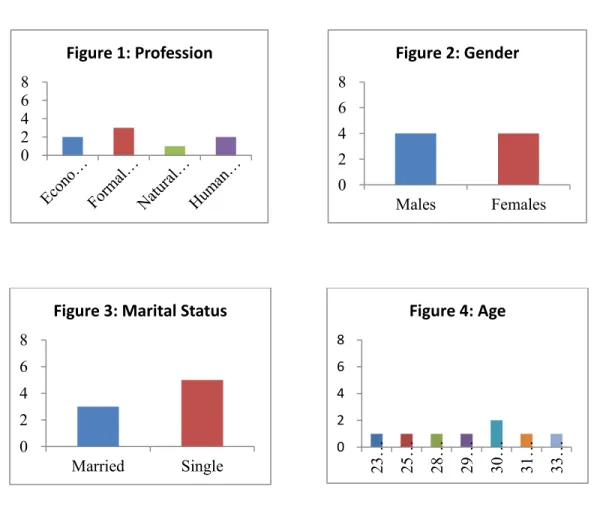
Data was collected from eight participants; four men and four women. Participants were all drawn from different professions at Puebla, Mexico. The participants learning English process ranged between nine months to three years, being from 23 to 33 years old; the marital status of three of them was married while the other five were single. All of them were an average of A1 to B1 English level. The participants will be referred to by numbered participants to adhere privacy.
3.2 Instruments
The instruments applied to obtain the necessary information were a research about the English learning – teaching area, getting used to definitions and perspectives from different authors, and a semi-structured interview based on knowing participants background and factors that motivated them to learn English as a foreign language. The survey, which original version was written in Spanish language, can be found in Appendix A.
3.3 Data Collection Procedures
The methodology mentioned above, which original version was written in Spanish language to have a complete comprehension and freedom in answering, was based on
- 31 -
interviews made to obtain participants’ background information for exploring and analyzing transcendental information that could determine or not success among them. The basic way to gather information was to carry out participants’ answers and compare contexts considered influential when learning a foreign language learning process.
3.4 Conclusion
This chapter included all the aspects followed to develop the research, and how the information was managed to get a clear understanding. It also included general information about the subjects as well as procedures followed to achieve the objective of the research.
- 32 -
CHAPTER IV: DISCUSSION OF THE RESULTS
In this chapter, the results obtained will be presented as bar graphs for the sub-questions, as well as a transcription for the key research questions.
4.1 Sub questions.
The statements in figure 1 show participants’ professional area. Two of them belong to the economics / administrative field, while three more to the formal studies field. Only one participant is professionalized in natural studies and finally, the last two have their place in the human sciences field. Also, we can see the inherent gender balance in the research; this element was very important to reach equivalent results during the research.
0 2 4 6 8
Figure 1: Profession
0 2 4 6 8
Males Females Figure 2: Gender
0 2 4 6 8
Married Single Figure 3: Marital Status
0 2 4 6 8
23… 25… 28… 29… 30… 31… 33…
Figure 4: Age
- 33 -
In figure number 3, we can see that three participants are already married despite the fact that the rest of them are still single. Participants’ marital status may take responsibility as an important factor, either motivation or demotivating. Finally, the participants’ age range states among 23 to 33 years old.
In these statements it is possible to observe that participants have taken a variety of English courses during different periods of time. It reflects that they have tasted different performances and teaching learning methodologies trying to achieve an assortment of goals; even that, in accordance to what is shown in figure 7, those courses have not fulfilled the participants ways of learning so that they have not reach a high English level yet.
02 46 8
Individua l Class… General Englis… Exam Prepar… Academi c… Part-time Englis…
Figure 5: What kind of English courses have you taken?
02 46 8
Less than a year One year One year and a half Two years Three years More than…
Figure 6: How long have you been learning English?
0 2 4 6 8
A1 A2 B1 B2 C1 C2
Figure 7: What English language level have you got?
0 5
Achievi ng a… Travelli ng Meetin g… Profess ional… Persona l…
Figure 8: What were your goals when you started to learn English?
- 34 - 4.2 Transcription of the key research questions
Line N°
/ P.
Transcription Answers Analysis
001 R.
002 003 004 005 006
During your English as a foreign language learning process, were there specific factors which demotivated you in order to continue learning it? If yes, describe.
Q.1
007 P.1 008 009 010 011
“Lo que más me ha desmotivado en todos aspectos para aprender el idioma ha sido el poco profesionalismo de muchos maestros.”
Participants think that the specific factors which demotivated them in order to continue learning English were teachers’ lack of professionalism, feeling uncomfortable and demotivated for producing English language because of others reaction, teachers didn’t plan classes according to our needs, teachers
- 35 - 012 P. 2
013 014 015 016 017 018 019 020 021 022 023 024 025
“Cuando estudiaba la secundaria tenía clases de inglés. Durante el curso nos enseñaron frases para saludar, y decidí comenzarlas a practicar con personas que me parecían extranjeras hasta que un día me acerque a un hombre con dichas características, le empecé a hablar en inglés , él se enojó muchísimo y me contestó sólo groserías. La mala forma en que me trató me hizo sentir muy incómodo y sin ganas de practicar el idioma otra vez.
were not interested on teaching students anything new, a non-well developed professional evaluation criterion, financial impossibility to afford an English course, English teachers’ rotation during one scholar course, teacher’s behavior during a class.
Teachers’ lack of professionalism Participant 1 thinks that the specific factor which demotivated her in order to continue learning English was lack of professionalism from teachers.
P.1: “Lo que más me ha desmotivado en todos aspectos para aprender el idioma ha sido el poco profesionalismo de muchos maestros.”
Feeling uncomfortable and
demotivated for producing English language because of others reaction.
Participant 2 thinks that the specific factor which demotivated him in order to continue learning English was a sad feeling and unwillingness to produce English language because of others reaction.
026 P. 3 027 028 029 030
“Los profesores no se preocuparon porque avanzáramos de nivel. Sus clases no eran realmente preparadas de acuerdo a nuestras necesidades.”
031 P. 4 032 033
“Desde la primaria hasta la universidad, y en general todos los maestros me desmotivaron ya
- 36 - 034
035 036 037 038
que no tuve uno al que en verdad le importara enseñar algo nuevo, hasta que me inscribí a cursos específicos para aprender el idioma.”
P.2: “La mala forma en que me trató me hizo sentir muy incómodo y sin ganas de practicar el idioma otra vez.”
Teachers didn’t plan classes according to students’ needs.
Participant 3 thinks that the specific factor which demotivated him in order to continue learning English was that teachers didn’t plan classes according to students’ needs.
P.3: “Los profesores no se preocuparon porque avanzáramos de nivel. Sus clases no eran realmente preparadas de acuerdo a nuestras necesidades.”
Teachers were not interested on teaching anything new.
Participant 4 thinks that the specific factor which demotivated him in order to continue learning English was that teachers were not interested on teaching students anything new.
P.4: “Todos los maestros me desmotivaron ya que no tuve uno al que en verdad le importara enseñar algo nuevo.”
039 P.5 040 041 042 043 044 045 046 047 048 049
“The most remarkable factor which demotivated me was a non- well developed evaluation criterion. It seemed that it was a tool used for proving you were not a professional skill worker, instead of a tool created to help you to improve your English level or teaching performance; so, it pushed me off to do my best when I needed skill recognition.”
050 P. 6 051 052 053 054
“The main factor which demotivated me for not studying English early was a financial impossibility to afford an English course when I was a young family member.”
- 37 - 055 P. 7
056 057 058 059 060 061 062 063
“Lo que me desmotivo muchísimo fue la rotación de profesores de Inglés que hubo cuando estudiaba el bachillerato, tuvimos tres distintos en un solo ciclo por lo que no avanzamos ni aprendimos lo que debíamos. Me estresó mucho el no poder entenderles ni aprender y eso me fastidió.”
Non-well developed professional evaluation criterion.
P.5 thinks that the specific factor which demotivated him in order to continue learning English was a non-well developed professional evaluation criterion.
P.5: “The most remarkable factor which demotivated me was a non-well developed professional evaluation criterion.”
Financial impossibility to afford an English course.
P.6 thinks that the specific factor which demotivated her in order to continue learning English was a financial impossibility to afford an English course.
P.6: “The main factor which demotivated me for not studying English early was a financial impossibility to afford an English course.”
Teachers’ rotation during just one scholar course.
P.7 thinks that the specific factor that demotivated her in order to continue learning English was an English teachers’ rotation 064 P.8
065 066 067 068 069 070 071 072 073 074 075 076 077
“Cuando estaba en la universidad, durante una clase de inglés una profesora quiso aplicar una actividad con la que estresó muchísimo a una compañera al grado que ella abandonó el curso.
Yo tampoco comprendía que era lo que quería que se hiciera y ella continuó presionando. La forma de actuar de la profesora durante la clase me desmotivó a tal grado que preferí también abandonar el curso por miedo a que se repitiera esa situación.”
- 38 -
during just one scholar course.
P.7: “Lo que me desmotivo muchísimo fue la rotación de profesores de Inglés durante solo un ciclo escolar.”
Teacher’s behavior during a class.
P.8 thinks that the specific factor which demotivated her in order to continue learning English was a teacher’s behavior during a class.”
P.8: “La forma de actuar de la profesora durante la clase me desmotivó.”
078 R.
079 080 081 082
“During your English as a foreign language learning process, were there specific factors which motivated you in order to continue learning it? If yes, describe.”
Q.2
083 P.1 084 085 086
“En mi experiencia profesional lo que más me motivo fue el acceso que se obtiene a la información técnica gracias al idioma.”
Participants think that the specific factors which motivated them in order to continue learning English were the access to technical information thanks to the language, desire to
- 39 - 087 P.2
088 089 090
“Las ganas de conocer sobre otras culturas a través de la convivencia con personas de diferentes países.”
know about other cultures through sharing with people from other countries, a well-paid job, a 100% English course scholarship, a particular feeling and a especial desire for learning that language raised in my mind, media is better in English, realized that Knowing English opens many opportunities either for professional or personal growth, realizing how English language opens wide doors as you never imagined before.
Access to technical information thanks to the language.
P.1 thinks that the specific factor which motivated her in order to continue learning English was the access obtained to technical information thanks to the language.
P.1: "Lo que más me motivo fue el acceso que se obtiene a la información técnica gracias al idioma.”
Willingness to explore other cultures through sharing with people from other countries.
091 P.3 092 093 094 095 096 097
“Al leer los perfiles de ofertas laborales, me pedían 80 % de conocimiento de inglés. Fue entonces que la idea de obtener un trabajo económicamente bien remunerado me motivo a aprender el idioma.”
098 P.4 099 100 101 102 103 104 105 106 107 108
“En la empresa que trabajo actualmente hay mucha competencia profesional y para aspirar a un mejor puesto ya no es suficiente una carrera, también piden inglés o alemán. Tiempo después, mi jefa me dio la noticia de que era acreedor a una beca al 100% para estudiar inglés, y creo que no hay mayor motivación que esta para aprender inglés.”
109 P.5 “I remember when I was in junior
- 40 - 110
111 112 113 114 115 116 117 118 119
highschool level. Once, I presented in English. I liked very much the way I did it. Then, I realized how much a particular feeling and an especial desire for learning that language raised in mind. It was the explosive factor which motivated me to learn English. I kept that feeling in my mind until I did it.”
P.2 thinks that the specific factor which motivated him in order to continue learning English was a desire to know about other cultures through sharing with people from other countries.
P.2: “Las ganas de conocer sobre otras culturas a través de la convivencia con personas de diferentes países.”
Well-paid job.
P.3 thinks that the specific factor which motivated him in order to continue learning English was a well-paid job.
P.3: “Obtener un trabajo económicamente bien remunerado me motivo a aprender el idioma.”
A 100% English course scholarship.
P.4 thinks that the specific factor which motivated him in order to continue learning English was a 100% English course scholarship.
120 P.6 121 122 123 124 125
“The main motivator that led me to study English occurred when I realized that media is better in English, for people all around the world, so I decided to learn the language.”
126 P.7 127 128 129 130 131 132
“The main reason which motivated me to study English occurred when, surfing in the net searching for specific purposes, I realized that Knowing English offers you many good opportunities either for
- 41 -
133 professional or personal growth.” P.4: “Una beca al 100% para estudiar inglés, creo que no hay mayor motivación que esta para aprender inglés.”
A particular feeling and a special desire for learning that language raised in my mind.
P.5 thinks that the specific factor which motivated him in order to continue learning English was a particular feeling and a especial desire for learning that language.
P.5: “A particular feeling and a special desire for learning that language raised in mind. It was the explosive factor which motivated me to learn English.”
Media is better in English.
P.6 thinks that the specific factor which motivated her in order to continue learning English was that she realized that media is better in English.
P.6: “I realized that media is better in English.”
134 P.8 135 136 137 138 139 140 141 142 143 144 145 146 147
“Una ocasión, mientras viajaba con mi familia, encontramos a unos extranjeros perdidos, quisimos ayudarlos pero fue complicado por la diferencia de idiomas. Todo resultó bien y agradecidos por el favor que les hicimos, nos dieron sus tarjetas de presentación. Uno de ellos resultó ser miembro activo de la ONU.
Lo que me motivó fue darme cuenta de cómo el idioma Inglés te abre puertas tan grandes como nunca las habías imaginado.”
- 42 -
Knowing English offers you many good opportunities either for professional or personal growth.
P.7 thinks that the specific factor which motivated her in order to continue learning English was that she realized how Knowing English offers you many good opportunities either for professional or personal growth.
P.7: I realized that Knowing English opens many opportunities either for professional or personal growth.”
How English language opens wide doors as you never imagined before.
P.8 thinks that the specific factor which motivated her in order to continue learning English was realizing how English language opens wide doors as you never imagined before.
P.8: “Lo que me motivó fue darme cuenta de cómo el idioma Inglés te abre puertas tan grandes como nunca las habías imaginado.”
- 43 - 4.2.1 Transcription, analysis of the results
The study used the interpretative approach, to collect and analyze participants’ subjective, but accurate accounts of their views, feelings, perceptions and experiences regarding the factors they had found motivating or demotivating. The findings about the specific factors which demotivated participants when learning English as a foreign language indicate that their motivation was influenced by teachers who reached a watershed in their learning processes.
In contrast, participants were also asked about what specific factors motivated them in order to continue learning English. The results were varying, from “access to technical information achievement thanks to the language”, to “a desire to learn about other cultures
- 44 -
through sharing with people from other countries.” Meanwhile, other participants were motivated because of the possibility to obtain a well-paid job or a 100% English course scholarship. This goes not alone with the idea to keep “a particular feeling and an especial desire for learning that language” in mind. Finally, some others think that media is better in English realizing that it opens many opportunities either for professional or personal growth.
- 45 -
CHAPTER V: CONCLUSIONS AND RECOMMENDATIONS
This chapter concludes the research. It provides a summary of it, and also highlights recommendations emanating from this study. Lastly, it makes some recommendations for further research together with mentioning some limitations, which the researcher experienced in the course of the investigation. The researcher does not claim that the research product presented in this thesis is the final word, but does believe that something worthwhile was achieved by conducting this research.
5.1 General conclusions
The objective of this study was to find out the specific factors that affected students’
motivation, so that they decided to learn or continue learning English. The following conclusions are derived from the study discussed in in chapter IV regarding the major factors constituting research findings which draw a picture of the motivation of participants at a particular point in time, that is, the period during which the study was conducted.
5.2 Limitations of the study
As shown in section 5.1, the purpose of the research has been attained. However, the following limitations and practical challenges were acknowledged:
The results of the investigation cannot necessarily be generalized to suit other participants either all teachers.
The participants were all professionals and the findings are limited to this context.
Some more participants were needed by the fact that some of the sampled participants had difficulties to word specifically what they were asked at first time.