It is against the backdrop of this imminent threat that foreign aid came to the forefront of US foreign policy as a potential counter-terrorism tool (Windsor 2003). Although combating terrorism through foreign aid continues to resonate in policy circles, the scholarly community is more skeptical of this policy given the scant empirical evidence linking poverty to terrorism (e.g., Krueger and Maleckova 2003; Krueger 2007). We argue that it is premature to conclude that foreign aid is not an effective counterterrorism tool.
Drawing on insights from the recent literature on foreign aid and terrorism, we highlight an alternative causal pathway through which foreign aid can reduce the frequency of terrorist attacks in aid-recipient countries. We assume that foreign aid aimed at promoting democracy, i.e. good governance and assistance to civil society, reduces terrorism by improving "political conditions" a. First, it shows that foreign aid can be used to achieve foreign policy goals beyond economic growth and democracy promotion: it can be an effective tool in the fight against terrorism.
Second, this article identifies an overlooked channel through which foreign aid can reduce the frequency of terrorism in aid-recipient countries. 4 A number of researchers find a positive correlation between low socio-economic development and the occurrence of terrorism (e.g. Blomberg and Hess 2008, Burgoon 2006). Democracy assistance programs also contribute to democratic governance by strengthening a country's legal institutions and the rule of law.
In summary, we expect that foreign aid earmarked for democracy promotion will reduce the frequency of terrorist attacks in aid-recipient countries by improving poor political conditions, such as weak political institutions, low levels of civil liberties, and weak rule of law, which affect both participation in terrorism and the ability of terrorist organizations to function.
Research Design, Empirical Models and Findings Data and Methods
It is likely that the number of terrorist incidents in the immediate past influences the number of current incidents (Li and Schaub 2004; Li 2005). The coefficients estimate the log difference in the expected number of terrorist attacks as predicted by an explanatory variable. The first striking element of the data is the large number of total terrorist attacks in the sample.
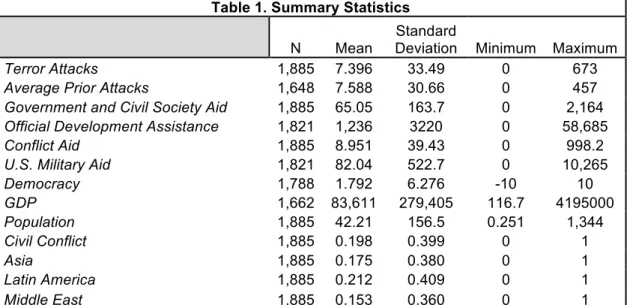
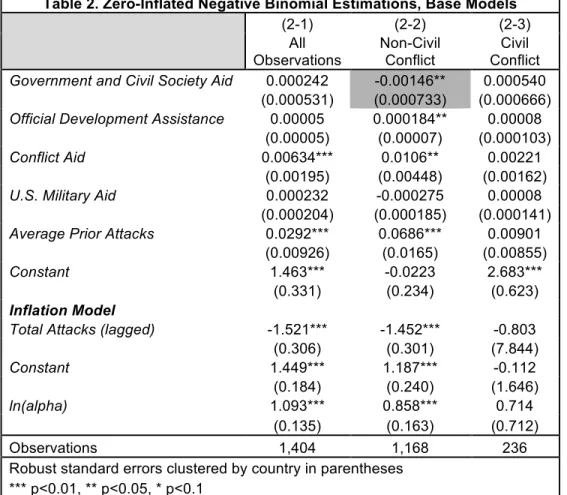
As shown in Table 1, the maximum number of terrorist attacks in a single year in the sample is 673, while the average is. We calculate the risk of terrorism in the zero-inflated negative binomial model using a lagged value of Total Attacks in the first-stage inflation equation to distinguish between zeros in the period of observation. The first stage, that is, inflation model, estimates the probability that a zero in the second stage is an "excess" zero, or not an outcome generated by the variables included on the right-hand side of the model which does not predict terrorism.
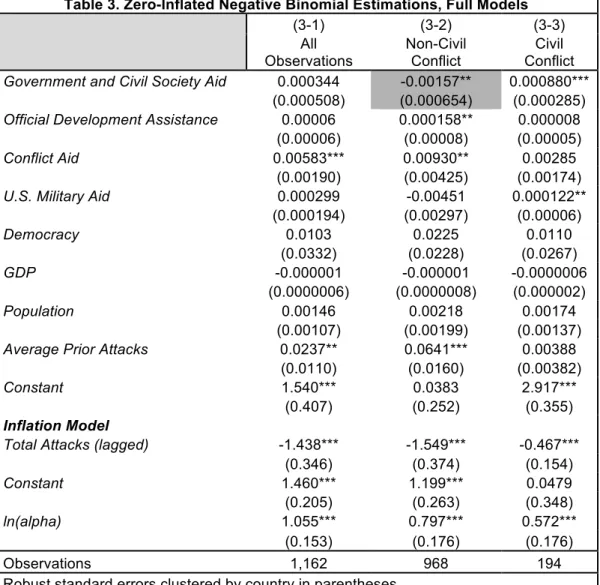
The second stage assesses the impact of the explanatory variables on the number of terrorist attacks after excess zeros have been controlled for in the first stage. As before, aid to democracy is insignificant in the pooled sample (Model 3-1), but negative and statistically significant at the 5% level in countries without ongoing civil conflict (Model 3-2). The underlying risk of terrorism is therefore quite small, meaning that even small decreases in the likelihood of an attack can be significant.
The first problem concerns the construction of the zero-inflated negative binomial estimator, while the second concerns possible endogeneity in the relationship between terrorism and aid flows. With regard to the zero-inflated negative binomial model, the results obtained in the second phase are admittedly sensitive to the construction of the inflation model in the first phase. In the second stage, the dependent variable is the number of positive (non-zero) attacks, which is regressed on the explanatory variables plus the inverse Mills ratio.
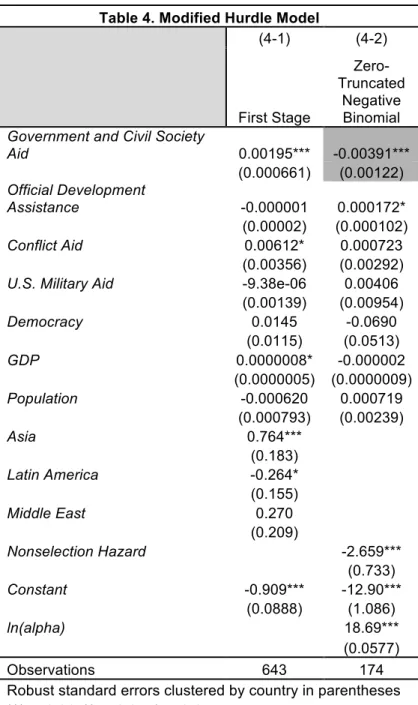
The coefficient in the second stage therefore represents the relationship between aid flows and terrorist attacks which controls for a possibly endogenous relationship between aid distribution and terrorism. We therefore adopt a hybrid approach, where we use a dichotomous measure of terrorist attacks in the first stage, predict and store the generated non-selection hazard and include it as a regressor in a second stage of the zero-truncated negative binomial regression. Second, because we use our aid measures in the creation of the nonselection hazard in the first stage, the second stage equation then estimates the impact of aid flows on the number of terrorist attacks that already accounted for its impact on the underlying probability of an attack
In the first stage, Government and Civil Society Support is positively and statistically significantly associated with the likelihood of experiencing a terrorist event, which is consistent with our endogenous concerns. However, in the second stage, which estimates the positive number of Total Attacks when the number is greater than zero, the estimated effect of aid to democracy is negative and statistically significant.30 The incidence rate ratio shows a decrease in the number of attacks by 0.4%. , conditional on other factors in the model.
Conclusion
To further assess the robustness of our main result, we included regional dummies in the model specification from model 2-2, and their inclusion did not affect the results. However, further tests confirmed that the estimated coefficient in the fixed-effects model was not statistically different from the results obtained in the original model. A potential question we plan to investigate is whether the identity of aid donors makes a difference in the effectiveness of democracy aid in reducing the risk of terrorism.
We are particularly interested in knowing whether foreign aid from the United States is more or less effective in improving the political conditions of a country and thus reducing support for terrorism than aid from the European or other donors. We suspect that aid from the United States may have a stronger backlash from the citizens of the aid-receiving countries than aid from other donors. Another interesting angle we would like to explore is whether the type of aid delivery channels used by donors, i.e. government-to-government or government-to-non-state actors, affects the effectiveness of democracy aid in providing security benefits to aid - receiving countries.
The recent literature suggests that aid delivered by NGOs can be more effective than aid given directly to governments of recipient countries (Dietrich 2011; Radalet 2004). In this paper, we have not made any distinction between different types of domestic terrorist incidents. We assumed that poor political conditions affect all types of terrorism in the same way.
It would be worth considering the differences between different types of terrorist attacks when examining the effectiveness of foreign aid as a counter-terrorism measure. We leave these questions and tasks to future work and tentatively conclude that foreign aid can be used to reduce the risk of domestic terrorism in countries not involved in active civil wars. On Welfare and Terror: Social Welfare Policy and the Political-Economic Roots of Terrorism” Journal of Conflict Resolution 50:176-203.
Sponsoring Democracy: The United States and Democracy Aid to the Developing World International Studies Quarterly 55:47-69. No Conflict Conflict No Conflict Conflict No Conflict Conflict No Conflict Conflict No Conflict Conflict No Conflict Conflict No Conflict Conflict No Conflict Conflict No Conflict Conflict No Conflict Conflict No Conflict Conflict.