PLEASE SCROLL DOWN FOR ARTICLE On: 10 September 2010
Access details: Access Details: [subscription number 918399920]
Publisher Routledge
Informa Ltd Registered in England and Wales Registered Number: 1072954 Registered office: Mortimer House, 37- 41 Mortimer Street, London W1T 3JH, UK
Review of Political Economy
Publication details, including instructions for authors and subscription information:
http://www.informaworld.com/smpp/title~content=t713444532
Gender, Distribution, and Balance of Payments Constrained Growth in Developing Countries
Stephanie Seguinoa
a Department of Economics, University of Vermont, Burlington, VT, USA Online publication date: 23 July 2010
To cite this Article Seguino, Stephanie(2010) 'Gender, Distribution, and Balance of Payments Constrained Growth in Developing Countries', Review of Political Economy, 22: 3, 373 — 404
To link to this Article: DOI: 10.1080/09538259.2010.491285 URL: http://dx.doi.org/10.1080/09538259.2010.491285
Full terms and conditions of use: http://www.informaworld.com/terms-and-conditions-of-access.pdf This article may be used for research, teaching and private study purposes. Any substantial or systematic reproduction, re-distribution, re-selling, loan or sub-licensing, systematic supply or distribution in any form to anyone is expressly forbidden.
The publisher does not give any warranty express or implied or make any representation that the contents will be complete or accurate or up to date. The accuracy of any instructions, formulae and drug doses should be independently verified with primary sources. The publisher shall not be liable for any loss, actions, claims, proceedings, demand or costs or damages whatsoever or howsoever caused arising directly or indirectly in connection with or arising out of the use of this material.
Gender, Distribution, and Balance of Payments Constrained Growth in Developing Countries
STEPHANIE SEGUINO
Department of Economics, University of Vermont, Burlington, VT, USA
ABSTRACT An unresolved debate in the development literature concerns the impact of gender equality on economic growth. Previous studies have found that the effect varies, depending on the measure of equality (wages or capabilities). This paper expands that discussion by considering both the short and long run, evaluating the effects of gender equality in two types of economies—semi-industrialized economies (SIEs) and low- income agricultural economies (LIAEs). Further, it incorporates gender effects on the balance of payments constraint to growth. The results suggest that gender wage and capabilities equality work in opposite directions in SIEs and in the same (positive) direction in LIAEs. In the long-run analysis, government macroeconomic management policies are shown to be necessary in order to ratify movements towards gender equality.
1. Introduction
A resurgent interest in how distribution affects macroeconomic outcomes is in evi- dence in policy circles and academia. If a motivation was needed to stimulate exploration of this issue, the global economic slowdown since the 1970s and the sharp increase in income inequality within and between countries provided it. One driving force of this research agenda is the attempt to understand the economy-wide effects of stratification. What is the direction of those effects, and what policies are required to produce a win-win strategy—equity with rising living standards?
A synthesis of endogenous growth theory and the new political economy research addresses these issues, emphasizing the impact of inequality on long- run productivity growth.1Post-Keynesian macroeconomists have taken a different tack, calling attention to the role of the class distribution of income in influencing short-run outcomes, with implications for the longer run. They have also revived Volume 22, Number 3, 373 – 404, July 2010
Correspondence Address: Stephanie Seguino, Department of Economics, University of Vermont, 340 Old Mill, Burlington, VT 05405, USA. Email: [email protected]
1For a summary of this rich literature, see Aghion & Howitt (1997) and Aghionet al.
(1999).
ISSN 0953-8259 print/ISSN 1465-3982 online/10/030373– 32#2010 Taylor & Francis DOI: 10.1080/09538259.2010.491285
Downloaded By: [Fac De Economia Div Est] At: 19:07 10 September 2010
pre-Solow growth-theoretic concerns with the interdependence of aggregate supply and demand.2More recently, the degree of gender inequality has surfaced as a distributional variable of interest. This body of research constitutes part of a new subfield of macroeconomics that explores the relationship between macro- economic outcomes and gender inequality, development, and economic growth.3 Here, too, research advances fall into two categories—post-Keynesian approaches that incorporate demand-side forces and balance of payments constraints, and mainstream and some feminist approaches that have a supply-side focus.
In the former category, the key distributional variable has been the gender wage gap, and an important feature of these models is the universal tendency towards gendered job segregation (Anker, 1998), although the division of labor is understood to vary with a country’s economic structure and production mix. In semi-industrialized economies, female workers are concentrated in tradables indus- tries, producing primarily labor-intensive price- and income-elastic manufactured goods (Standing, 1989, 1999).4Conversely, male workers are disproportionately employed in domestic goods production and in capital-intensive export industries.
Higher female wages have been found to negatively affect the balance of payments and short-run growth (Blecker & Seguino, 2002; Seguino, 2000a, 2000b).
In agricultural economies, gendered job segregation takes a different form:
women perform the bulk of labor in subsistence production, providing for the family’s food needs, while men dominate in cash crop and extractive commodity export production (Arndt & Tarp, 2000; Darity, 1995; Warner & Campbell, 2000).5This research finds that gender inequality in access to productive resources in agricultural economies hurts agricultural productivity (Udry, 1996).
Scholarly work on the long-run growth effects of gender equality focuses on capabilities as the measure of gender equality, especially education.6 Supply-side models tend to be built on theoretical frameworks with micro-level foundations, in particular empirical research on intrahousehold resource allocation. A fairly
2The work of Kalecki (1954) and Steindl (1952) on the role of income distribution was followed by a later generation of economists, including Blecker (1989, 1996, 2002), Dutt (1984, 1990) and Taylor (1991) who incorporated the role of economic openness into their analyses. Cornwall (1972), Leo´n-Ledesma & Thirlwall (2000), Palley (1996, 2002, 2003), Setterfield (2002), and Thirlwall (1979) incorporate the role of aggregate demand in influencing the ‘natural’ or potential rate of growth.
3Examples of published research in this area include Blecker & Seguino (2002), Braun- stein (2000), Cagatay & Olzer (1995), Darity (1995), Erturk & Cagatay (1995), Erturk
& Darity (2000), Floro & Seguino (2002), Fontana & Wood (2000), Seguino (2000a, 2000b), and Seguino & Floro (2003).
4Significant numbers are employed in the services sector, especially in informal sector jobs that often serve as residual employment. The gender and macroeconomics literature has emphasized manufacturing sector employment, however, because it serves as a leading sector and engine of growth in the development process.
5This is a stylized fact with some country-specific variation. For example, in a number of sub-Saharan economies, women are now producing non-traditional export crops. Still, revenues from these comprise a relatively small share of total export crop earnings.
6See Hill & King (1995), Klasen (2002) and Knowleset al.(2002).
Downloaded By: [Fac De Economia Div Est] At: 19:07 10 September 2010
consistent finding is that due to gender differences in consumption preferences, increases in women’s capabilities and their control over income and other resources improve outcomes for children (Blumberg, 1988; Haddadet al., 1997). By impli- cation, the quality of the future labor supply is enhanced, stimulating long-run growth.
The effect of inefficiencies stemming from occupational segregation and job discrimination has also been explored. A broad finding in this literature is that long-run productivity growth is negatively affected by labor market and educational resource misallocation (excess investment in, or employment of, under-qualified males with qualified females overlooked).
This brief discussion underscores that efforts to increase gender equality produce contradictory pressures on growth, and this may account for what appear to be conflicting results in the empirical literature on the role of gender—that gender inequality is either a stimulus to or a drag on economic growth. This paper illuminates the various pathways by which gender affects macroeconomic outcomes, paying particular attention to the differential effects of two measures of gender inequality—access to and control over resources, measured as wages (and where relevant, resources used in agricultural production) versus capabilities, measured as education. The role that economic structure plays in influencing the relationship between macroeconomic outcomes and gender equality in the short and long run is considered by comparing the cases of semi-industrialized economies (SIEs) and low-income agriculturally dependent economies (LIAEs). To carry out this task, I first explore short-run demand-side effects, relying on the stylized facts that emerge from the empirical literature to identify the impact of greater gender equality on the components of aggregate demand. In the subsequent section, I adapt a simple long-run model of endogenous growth to integrate the impact of aggregate demand, gender, and the balance of payments (BP) constraint. The long-run model draws on post-Keynesian work that incorporates supply-side considerations into long-run demand-led growth theory (Palley, 1996, 2002, 2003; Setterfield, 2006).
The aim is not to uncover universal tendencies that gender equality might display in influencing macroeconomic outcomes. Such a goal would be too ambi- tious. Economies, after all, differ in terms of structure and institutional context; it is unrealistic to believe that ubiquitous laws govern the interaction of gender and macroeconomic outcomes. Data limitations also constrain our efforts. The goal, more modestly, is to contribute to a typology of the pathways by which gender affects the macroeconomy with tendencies identified based on the empirical literature on SIEs and LIAEs.
Anticipating the results, critical factors that influence how gender affects short- and long-run growth are the sectoral nature of job segregation and the struc- ture of the economy. The impact also crucially depends on whether one is relying on education or wages as a measure of inequality. Gender wage inequality tends to relax theBP constraint in SIEs but exacerbate it in LIAEs both in the short and long run. Conversely, educational inequality slows growth in both SIEs and LIAEs. A cautionary note emerges from the SIE analysis: however desirable gender equality, efforts to promote this goal can run into macroeconomic roadblocks, although government policies could attenuate potentially negative effects. This underscores the need for policies aimed at promoting both gender
Downloaded By: [Fac De Economia Div Est] At: 19:07 10 September 2010
and class equality to recognize the feedback loops between distribution and macroeconomic outcomes.
2. Gender and Growth: The Short Run
The conceptual approach and assumptions employed in this paper draw from a stylized reading of the empirical results emerging from the gender and growth literature. As noted, two broad kinds of gender inequality are emphasized:
access to and control over resources, measured as wages (in agricultural economies, access to credit, technology, and agricultural inputs are also salient) and capabilities, in particular, education.7The channels by which these two categories of variables operate on macroeconomic outcomes are not identical, an issue taken up later.
One reason for this is the different time frames in which their effects are transmitted.
Changes in wages have more rapid impacts on prices and output in the short run.
By contrast, capabilities variables like education that improve labor productivity are likely to exert an impact only with a lag, and in the case of effects on children, a very long lag.
To begin, it is useful to underscore three key features of gendered economic outcomes. The first is that women on average have less access to and control over material resources than men. Whether we measure this as wages, income, wealth or as women’s share of credit or landholdings, women on average fare worse than men.
Second, a sharp gender division of labor persists, with women performing the largest share of unpaid labor (housework; care for children, the sick, and elderly).
Within the productive sphere, jobs are also gendered. Women are more frequently found in insecure, low-wage jobs while men are concentrated in higher income jobs with more security and benefits. While gender job segregation is everywhere apparent, it varies by country and especially by economic structure. The gendered distribution of jobs is a major factor influencing gender inequality in income and wages.
Third, gender inequality in educational attainment is apparent, although not universally so. In numerous countries, female educational attainment exceeds male educational attainment at some levels (Barro & Lee, 2000). Further, most studies find that wage gaps between women and men cannot be fully explained by education and other productivity-related characteristics. They are at least par- tially due to discrimination (Weichselbaumer & Winter-Ebmer, 2003).8Similarly, women’s employment opportunities and thus wages are circumscribed by gender
7For extensive summaries of this research, see Berik & Rodgers (2008), Braunstein (2008), Fontana & Rodgers (2005), and Stotsky (2006). The restricted set of gender indi- cators employed in this paper reflects the emphasis in the literature. These variables are amenable to policy intervention, and can serve to leverage change in other measures of well-being, for example, leisure time, life expectancy, fertility, labor force participation, and maternal mortality rates.
8Country studies that use Blinder-Oaxaca style decompositions to assess the portion of gender wage differentials due to discrimination are too numerous to exhaustively
Downloaded By: [Fac De Economia Div Est] At: 19:07 10 September 2010
norms and stereotypes.9 Thus, not all inequality can be reduced to insufficient educational investments in females to enhance their skills; wage and income gaps exist between similarly qualified women and men.
What then are the implications of this set of phenomena in SIEs and LIAEs in the short run, taking into consideration the different structures of these economies?
In particular, what is the impact on macroeconomic aggregates—investment, exports, imports, saving, and consumption?
2.1. SIEs and Gender Wage Equality in the Short Run
Several stylized characteristics of SIE structure are salient to our analysis. First, semi-industrialized economies produce manufactured goods requiring limited technological know-how. In their efforts to raise productivity and move up the industrial ladder, SIEs rely heavily on imported intermediate inputs and capital goods, making import demand price inelastic. SIEs thus face balance of payments constraints to growth, stemming from import dependence. Exports play an impor- tant role not only in stimulating current demand, but also in providing the foreign exchange for technological imports that accelerate productivity growth. In many SIEs, the market for non-tradable goods tends to be oligopolistic, so pricing can be modeled as a fixed mark-up over prime unit costs, reflecting the degree of mon- opoly power in that sector. Labor-intensive export goods, in contrast, tend to be homogeneous and face strong competition; so, while pricing can be modeled as a mark-up over unit costs, that mark-up is flexible and responds to changes in external competitiveness.
As noted, women are concentrated in labor-intensive export manufacturing industries in SIEs with wages significantly below men’s.10 These low wages contribute to low unit labor costs.11 Wage gaps cannot be fully explained by
inventory here. For some developing country examples, see Birdsall & Behrman (1991), Behrman & Zhang (1995), Horton (1996), and Psacharopoulos & Tzannatos (1992).
9The individual’s choice of occupation may be free of pressure or it may be influenced by gender norms and stereotypes. Transgression of gender norms carries social costs, causing some women to opt for otherwise low-paid occupations that are nevertheless in line with ‘female’ qualities. I construe this as the outcome of a gender stratified system that circumscribes women’s job choices.
10For a detailed discussion of gendered employment and wage differentials in SIEs, see Seguino (2000b).
11Mainstream economists have argued that gender wage gaps due to job segregation are short-lived and should narrow as demand for female labor rises. Global evidence is mixed, however. Some confirmation that gaps are closing has been found, due in part to narrowing educational gaps. But for some developing countries, the discriminatory portion of gender wage gaps is increasing (Oostendorp, 2009; Weichselbaumer &
Winter-Ebmer, 2003). Upward pressure on female wages varies, depending on counter- vailing pressures. For example, the mobility of firms in which women are employed can hold down wage growth in those industries (Braunstein, 2006; Gopinath & Chen, 2003; Seguino, 2007). Further, as female wage pressures increase, firms may respond
Downloaded By: [Fac De Economia Div Est] At: 19:07 10 September 2010
educational differences that ostensibly lead to labor productivity differences between women and men. Apart from the fact that one’s labor productivity is in large part determined by production technology rather than the individual’s educational level, it is worth noting that SIE gender educational gaps are not as pronounced as in LIAEs. In 1999, for example, the ratio of female to male total years of educational attainment for those 15 and over averaged 92% in SIEs as compared to 65% in LIAEs.12
Export manufacturing firms in SIEs, due to limited sunk capital costs and investments in training, tend to be mobile, making these firms more likely to relo- cate in response to increases in local production costs. Further, because labor- intensive export goods tend to be relatively homogeneous, export demand is price elastic. This suggests that higher female wages will have a negative impact on both investment and exports in SIEs (Berik, 2000, 2008; Braunstein, 2000, 2006; Busse & Spielmann, 2006; Osterreich, 2007; Seguino, 1997).13
What of the impact of greater gender equality on aggregate saving rates? Is there any reason to expect that women and men differ in their saving propensities, such that a redistribution will affect aggregate saving rates? Seguino & Floro (2003) estimate the effect of greater gender equality (measured as relative female/male wages) on aggregate saving in SIEs, controlling for a number of standard variables.14 Their results suggest that a higher female share of wage income contributes to an increase in the aggregate saving rate in SIEs. This result may reflect a ‘life cycle’ effect, related to the age composition of female workers in the sample of countries investigated. In some SIEs, export factory workers are comprised largely of young unmarried women, many of whom save, sending portions of their income home to parents who later employ the funds for sons’ education (Greenhalgh, 1985; Wolf, 1992). This may explain both the positive effect on saving of a redistribution to women workers in SIEs and why this result may not hold for countries with a different age demographic of female workers.
by shifting to informal work arrangements such as occurred after the Asian financial crisis (Balakrishnan, 2002).
12Though gender educational gaps were wider in previous decades in both SIEs and LIAEs, greater gender equality in education in the sample of current-day SIEs was evident even in 1960, with a ratio of 74% as compared to 40% in LIAEs. The data used to calculate these ratios are from Barro & Lee (2000).
13This is not meant to suggest that labor-intensive exporting firms are attracted solely by low wages since other factors influence investment location decisions. But there is evi- dence that firm mobility shapes the flexibility of investment response to costs. That is, we can expect a larger effect of higher wages on outward investment in labor-intensive industries than those that are capital-intensive.
14For two theoretical models of the gender and savings relationship, see Floro & Seguino (2002). One is an individual saving behavior model of non-pooled income households and the second is a Nash bargaining model for pooled-income households. The former high- lights the possibility of gender differences in saving rates, due to gender-differentiated income risks. The latter explores the effects of a shift in the distribution of income between women and men on intrahousehold bargaining and thus household saving rates.
Downloaded By: [Fac De Economia Div Est] At: 19:07 10 September 2010
With regard to gender differences in the propensity to import, there does not appear to be any empirical work as yet that identifies such effects. Absent hard data, we make some inferences based on the empirical intrahousehold bargaining literature. That body of work finds that women and men have differing consump- tion preferences, with women tending to spend a larger share of income on basic goods, such as food, health care, and education. Conversely, men tend to spend a larger share of income on luxury goods (Agarwal, 1997; Blumberg, 1988; Dwyer
& Bruce, 1988; Haddadet al., 1997; Hoddinott & Haddad, 1995). This evidence is surprisingly consistent across economies of different structures and levels of development. Whether men’s consumption propensity for luxury goods is also more import-intensive is not yet empirically established. It may be, as men’s luxury goods increasingly comprise electronics such as cell phones, televisions, and DVD players in addition to gambling, cigarettes, and alcohol.
Two points about this summary of gender effects on short-run outcomes require emphasis. No reference is made to short-run effects of capabilities equality; impacts on labor productivity and thus unit labor costs are expected only in the medium to long term. Second, we forgo the claim that efficiency wage effects in female-dominated industries exist to such an extent that higher female wages cause unit labor costs to fall. Why? Efficiency wages are generally employed in tasks where monitoring and supervision are not feasible mechan- isms for inducing effort on the job, such as in skill-intensive production and professional jobs. Monitoring and supervision are more effective in female- dominated labor-intensive industries, with the result that efficiency wages in effect are not ‘needed’ to induce effort. Instead, the threat of job loss induces effort, made easier by the fact that women’s job opportunities tend to be more limited than men’s.15
2.2. Comparative Statics of Gender Equality in SIEs
To evaluate the effect of greater gender equality on output and employment in the short run, I utilize the condition for macroeconomic equilibrium in an open
15Even if there were room for efficiency wages to affect productivity in labor-intensive export industries that are female-dominated, firm mobility makes it hard to realize such gains. Labor-intensive firms can relocate to lower wage sites with relative ease if local wages rise, or buyers in the global commodity chain can source from a lower-wage country. In other words, for efficiency wage gains to provide a solution to the conflict between wages, employment, and growth in SIEs, a different institutional context than currently exists is required. South Korea provides an example of an institutional context in which efficiency wages could be made operable. Higher female wages in South Korea had a less negative effect on export growth than in other SIEs. This may have been due to the fact that higher wages there produced strong efficiency wage effects that were made possible by the limited mobility of firms. That is, firm immobility per- mitted positive productivity effects to emerge as female wages rose, whereas in a context of mobile capital, firm threats to relocate hold wages down, or if wages do rise, firms relocate before productivity effects can be observed (Seguino, 2000c, 2007).
Downloaded By: [Fac De Economia Div Est] At: 19:07 10 September 2010
economy as a heuristic device to organize our thinking:
I+X=S+eZ (1)
where I is investment spending, X is exports, S is aggregate saving, e is the exchange rate, assumed for simplicity to equal 1 throughout this paper, andZ is the value of imports in foreign currency terms. All variables are expressed in nominal terms. For simplicity in this section, we assume a balanced budget so as to focus on private sector adjustments. Note that equation (1) represents the equality of injections and leakages. Any disturbance to equilibrium that causes injections to exceed leakages implies a demand-side stimulus to output and an expansion of employment. Such an outcome, should the disturbance be a measure of gender wage equality, could be labeled ‘gender cooperative’—an improvement in women’s well-being also potentially benefits men by raising employment. Conversely, a disturbance that leads to greater gender wage equality but results in an economic contraction could be labeled ‘gender conflictive.’16
The gender variable of interest in the short run is nominal wages. The degree of gender wage equality is measured as the ratio of female-to-male wages:
j=0, wF
wM
,1
where wF and wM are average nominal female and male wages, respectively.
Women’s limited bargaining power in labor markets and segregation in export sector jobs can contribute to patterns of gender wage inequality and discriminatory treatment. In particular, female relative wages are held down by the ‘crowding’
of women into a limited number of job slots compared to men and industrial segregation, with women concentrated in industries where firms are mobile and labor-intensive. The latter is equivalent to a selection distortion problem, whereby due to employment barriers in skill-intensive industries, some women’s skills are underutilized. Gender wage gaps may also be due to women’s lower reservation wages (compared to men’s) as a result of more limited income alternatives.
Three cases stand out: women in female-headed households; daughters sent out to work; and women who, due to care responsibilities or constrained mobility, undertake home work (Balakrishnan, 2002; Braunstein, 2000; Greenhalgh, 1985;
Hsiung, 1996).
Our strategy will be to sign the derivatives of the variables in equation (1) with respect to a reduction in gender wage inequality via a rise in the nominal
16‘Gender conflictive’ refers to the fact that a higher female wage not only results in a redistribution from firms to women but also a higher ratio of female to male wages.
This is a conflictive outcome if it also results in lower male employment, should higher female wages trigger an economic contraction. This could of course also harm women’s wage bill since women’s employment would also likely decline. So, a hike in female wages under these conditions would, if anything, be a very partial victory for women’s economic well-being relative to men’s. Note that even without a decline in male employ- ment and output, men may resist higher female wages, as it could lead to a loss of male power in the household and other domains. For an in-depth discussion of this issue, see Braunstein (2008) and Seguino (2008).
Downloaded By: [Fac De Economia Div Est] At: 19:07 10 September 2010
female wage. Several policy strategies can push up female wages: an increase in the minimum wage, anti-wage discrimination legislation and enforcement, and other policies that raise women’s bargaining power vis-a`-vis employers.17Policies that lead to lower male wages (or capabilities) could also induce greater gender equality. However, this route to gender equality is strategically and developmen- tally undesirable, and we therefore hold constant male wages, access to resources, and capabilities. Now, consider the impact of greater gender equality on macro- economic aggregates.
Investment. A key variable is the profit rate, which is simply an accounting relationship:
r= R
K = R
Y Y
K (2)
whereris the profit rate,Ris total profits,Kis the capital stock, andYis national income. The termRYis the profit share of income, andKYis equivalent to the capacity utilization rate. Investment, a positive function of the profit rate,
I =I(r) (3)
therefore depends positively on the profit share of income and the rate of capacity utilization.
The profit share of income can be derived from the national income identity:
1=R
Y+uF+uM (4)
whereuFanduMare the female and male labor shares of income, respectively, and uF =wFnF
Y ,uM=wMnM
Y (5)
andnFandnMare female and male employment. Using equations (4) and (5), the profit rate can be rewritten:
r=Y −wFnF−wMnM
K , (2′)
17Enforcing the right of workers to organize could disproportionately benefit female pro- duction workers in export processing zones. Governments might also engage in trade agreements that provide incentives for firms to adhere to labor standards (Berik &
Rodgers, 2009). Alternatively, governments may enforce anti-discrimination legislation to reduce selection distortion in labor markets, raising both women’s wages (since they are often excluded from higher paid jobs) and efficiency. Esteve-Volart (2000) provides empirical evidence of a positive impact on growth in a long-run framework. Because it would take time for government to implement such a directive, this issue is relevant to the long-run framework discussed in the next section.
Downloaded By: [Fac De Economia Div Est] At: 19:07 10 September 2010
implying that increases in female wages negatively affect investment or:
dI dwF =∂I
∂r
−nF
K
,0.
The responsiveness of investment to changes in profits (the profitability effect) depends on the mobility of the firms that employ women. It will be larger in the labor-intensive export sector in SIEs, where firms have greater flexibility to relocate in response to local cost increases.
Exports. Higher female wages will also induce a decline in export demand in SIEs,ceteris paribus. Export demand is:
X=A eP∗x Px
c
W1 (6)
whereAis a constant,Px∗is the foreign currency price of competing export products from other countries, 0,c,1is the price elasticity of demand for exports,Wis the level of world income, and 1 is the (foreign) income elasticity of demand.18 The export price equation, assuming export industries employ only women and simplifying to exclude intermediate input costs, can be written as:
PX =t[wFb] (7)
wherePXis the domestic price of exports,t.1 is the mark-up over unit costs in the export sector,19andbis the labor coefficient.20It is clear from equations (6) and (7) that higher female wages negatively affect export demand.21 Given the negative effect of female wages on both investment and exports and ignoring for the moment the effects of government spending, higher female wages reduce injec- tions.22Now consider the effect of gender on leakages.
18A multiplicative specification of the export function facilitates conversion to growth rates in the long-run growth models in the following section.
19For a gendered macro model with a flexible mark-up in the export sector, see Blecker &
Seguino (2002). The model developed here drops that complication, however useful, in order to maintain a degree of simplicity that facilitates comparison between SIEs and LIAEs. Note that a flexible mark-up, sensitive to international competition, would imply that higher female wages squeeze profits and thus investment, in addition to redu- cing demand for exports. That implies that the magnitude of the negative effect of higher female wages in SIEs on aggregate demand is moderated by the reliance on a fixed mark- up in this paper.
20The labor coefficient is the inverse of labor productivity. For SIEs, labor productivity is assumed to be exogenous in the short run. In Section III, the economy-wide productivity growth rate is endogenized.
21Note also that a fall in female wages and currency devaluation have analogous effects on export demand.
22In Blecker & Seguino (2002), investment goods are both produced domestically and imported, and export goods are produced with imported intermediates. Both are useful complications of the model, but I drop them here in order to simplify the results. If the investment and export functions were modeled to include imported intermediate and
Downloaded By: [Fac De Economia Div Est] At: 19:07 10 September 2010
Saving. Turn first to aggregate savingSin equation (1). A simple reduced form saving function can be written as follows:
S=S(Y,wF) (8)
whereYis income.23Based on the empirical literature for SIEs (e.g., Seguino &
Floro, 2003):
∂S
∂wF
.0,
ceteris paribus. That is, a higher female wage leverages a higher household saving rate.
Imports. The price of import-competing goods has a positive effect on imports.
Import-competing goods production does not demonstrate the same pattern of gender segregation as export industries; the gender make-up of the labor force varies by industry. Taking this into consideration, the import-competing goods price equation is given as:
Pz=m[rwF+ (1−r)wM]b (9) wherePZis the price of import-competing goods,m.1 is the mark-up over prime unit costs in the import-competing goods sector,ris the female share of employ- ment in that sector and, again,bis the labor coefficient, the time it takes to produce one unit of output. Note that for SIEs, we make the simplifying assumption that b ¼ bx ¼ bZ.Incorporating gender effects, the standard import function can be modified as follows:
Z =B PZ
eP∗Z h
wM
wF
v
Ys (10)
whereBis a constant,PZ∗is the foreign price of imports,his the price elasticity of imports,v is the elasticity of imports with respect to the gender distribution of income, proxied by the male-to-female wage ratio, andsis the income elasticity of import demand.
The first term in brackets on the right-hand side of equation (10) captures the positive cost effect of higher female wages on import demand: an increase in female wages raises the price of import-competing goods PZ and thus
capital goods, any disturbance that reduced (stimulated) investment or export demand would have a negative (positive) effect on the import bill, proportionate to the share of imports in investment or exports. This implies that negative demand-side effects of higher female wages would be attenuated by the resulting reduced demand for imports, as both investment and exports fall. I am grateful to an anonymous referee for this point.
23The male wage is not included as an argument in the saving function, given our focus on changes only in the female wage. For simplicity, other factors influencing aggregate saving are also omitted.
Downloaded By: [Fac De Economia Div Est] At: 19:07 10 September 2010
importsZ. The second term represents the effect of a gender redistribution on con- sumption and thus imports. In signing the consumption effect, we are guided by inferences drawn from the intrahousehold bargaining literature, which finds that women spend a larger share of income on basic goods and services such as food, health care, and education that tend to be domestically produced. Men’s luxury good consumption may be more import-intensive in very poor LIAEs, but in SIEs, which do produce some consumer goods including electronics, gender differences in the propensity to import may be very small. For simplicity, for SIEs the consumption effect is assumed to be zero (v≈0), although we retain the assumption of a positive cost effect.
From equation (1) and the preceding analysis, the impact of higher female wages on macroeconomic aggregates is likely to be as follows:
dI+dX ,dS+dZ
(−) (−) (+) (+) (11)
whered(.) is the total change in the variable with respect to an increase in gender wage equality.24 In equation (11), an increase in female wages is likely to be contractionary, with leakages exceeding injections. This net effect is attributable to gender segregation, with women in industries where capital is mobile and exports are price elastic, resulting in a large negative effect of higher female wages on investment and exports.25 Note that the saving effect is likely to be small, whatever its sign, and combined with the import effect, is not sufficient to outweigh the negative investment and export effects.
24Differentiating equation (1) with respect toYandwF, we obtain:
dY dwF =
∂I
∂r nF
K + ∂S
∂wF+ c wF
X+ hmrb Pz
Z I
K
∂I
∂Y−∂S
∂Y−s YZ
,0.
The denominator is assumed negative for stability (the response of savings to changes inY must be stronger than investment, and imports make the negative response stronger. The numerator is unambiguously positive). Recall that the consumption effect in SIEs is assumed negligible (v ≈ 0) due to lack of empirical evidence to the contrary. Were v . 0 (reflecting a decline in import demand as female wages rise), the numerator would be less negative, flattening the slope of theIScurve. It is unlikely, however, that the consumption effect would be strong enough to make the numerator positive, given the stronger depressing effects of higher female wages on investment and exports.
25One might argue that the negative export effect is time-specific, and likely to be less rel- evant as countries become less dependent on exports to stimulate aggregate demand.
Countries will nevertheless require export earnings to purchase imported intermediates essential for domestic production and technology upgrading. As such, the gender-export relation is likely to be germane for some time to come in developing countries.
Downloaded By: [Fac De Economia Div Est] At: 19:07 10 September 2010
It is clear that greater gender wage equality worsens the balance of payments where theBPequilibrium is written as:
X =Z. (12)
With higher female wages, exports decline and the trade balance deteriorates.
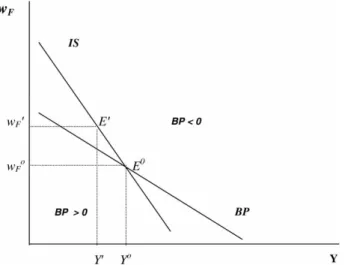
Figure 1 represents the SIE case in the short run. The negatively sloped female wage-output curve serves as a modified IS function, reflecting the total effect on output of an increase in female wages, shown in equation (11). Each point along that curve represents macroeconomic equilibrium. TheBPconstraint is downward sloping,26 and is flatter than theIScurve, consistent with the price elasticity of export demand. The region above and to the right of theBPfunction represents a balance of payments deficit and conversely, below and to the left, BPsurplus.
Observe the impact of an increase in female wages fromwFo
towF′. Because investment and exports are likely to fall and saving and imports rise,Y declines from Y0 to Y′. Equilibrium output and female wages shifts fromEo to E′. Even if the IS curve is steeply sloped (implying female wage increases do not have a strong negative effect on output and employment), the economy moves to a trade imbalance.
The negative effect of gender wage equality on the balance of payments, output, and employment is unlikely to be a transitory problem that can easily be elided. Aggregate demand shocks can knock a country off its ‘normal’ long-run
Figure 1.Gender wage effects on output and the balance of payments in the short run: the case of SIEs
26The slope of theBPfunction is:
dY
dwF =−cX− hmrb
Pz
Z
s
YZ ,0.
Downloaded By: [Fac De Economia Div Est] At: 19:07 10 September 2010
growth path, belying the view of some growth theorists that such shocks (deter- mined by supply-side factors) result only in transitory departures from trend normal output growth (Dutt & Ros, 2007).27 Thus, even if in the long run, gender wage equality could produce positive supply-side effects on the quality of the labor force, in the short run, it might induce shocks that drive economies off their long-run paths.
2.3. LIAEs and Gender Wage and Resource Equality in the Short Run In LIAEs, the variables presumed to have short-run effects on output, in addition to wages, are several measures of women’s access to resources such as credit, technical assistance, and agricultural inputs. Women’s wages are assumed to come from off-farm labor activities. Increases in female access to resources are due to higher wages and/or government expenditures and credit targeting.
Whatever the source, increased access to resources is assumed to have a positive effect on agricultural productivity (discussed in greater detail below) with conse- quent price effects. Capabilities variables, especially education, are posited to impact on productivity with a lag, as in SIEs, and so are not considered in this short-run analysis.
For this analysis, I take the example of Sub-Saharan Africa (SSA). LIAEs in SSA are characterized by small manufacturing sectors; agriculture comprises the largest share of value-added in GDP. Exports tend to be extractive commodities and agricultural cash crops (such as coffee and cocoa), with prices determined by global supply conditions. Further, while import demand for capital goods is rigid, food imports (that are also domestically produced) are somewhat price elastic.28
In many SSA economies, men specialize in cash crops and non-tradables goods production (e.g., telecommunications, water, construction). Women are the main providers of the family’s food supply, and may also work on men’s cash crop plots, for wages or as unpaid labor. Many women supplement their income in the informal sector as petty traders or off-farm wage laborers. New research finds that women’s waged employment in rural areas is more extensive than previously understood, with many of the poorest rural workers dependent on agricultural wages (Senderet al., 2005).29 This is consistent with Reardon’s
27Hysteresis effects in labor markets, increasing returns, and balance of payments constraints explain the failure to return to trend growth after a demand-side shock.
28Over the last 30 years, population growth has exceeded the growth of agricultural pro- duction with the result that in a number of SSA countries, food as a share of imports is relatively constant or rising, and lies between 12 – 20% for most SSA countries (World Bank, 2006).
29That study also found that wage rates rise with farm/plantation size and vary by crop.
Although large farms are more likely to pay wages in line with the statutory minimum, many workers in the survey did not actually receive the minimum. Following a global pattern, women are more concentrated in more precarious, poorly paid jobs, in particular jobs paid by the task in cash or in kind, as compared to more secure jobs paid by the month.
Downloaded By: [Fac De Economia Div Est] At: 19:07 10 September 2010
(1997) findings that the share of non-farm income in total income in SSA ranges from a low of 15% in Mozambique in 1991 to a high of 93% in Namibia in 1992 – 93.
Unlike SIEs, the LIAE export sector is male-dominated. An expanding non- traditional agricultural export (NTAE) sector is changing that, however. The NTAE sector produces specialty crops of fruits and vegetables (e.g., snow peas, baby broccoli, and cut flowers), with women comprising as much as 90% of the workforce.30 Nevertheless, the share of NTAEs in exports continues to be quite small.
In contrast to SIEs, the import bill is likely to fall in LIAEs in response to greater female access to resources and higher wages. Numerous studies find that a redistribution of productive resources to women farmers increases agricultural productivity and output (Blackden & Bhanu, 1999). For example, in Burkina Faso, it was found that shifting resources from men’s to women’s crops could increase output 10 – 20% (Udry et al., 1995), and in Zambia by 15% (Saito, 1994). Similar impacts have been reported for Kenya and Ghana (Blackden &
Bhanu, 1999; Saito, 1994). These are linked to distortion effects whereby women’s activities are under-resourced, given the marginal productivity of female plots relative to men’s plots.
Further, Blumberg (1992) finds that when agricultural extension services are extended to women, their yields rise. Rates of adoption of new technologies are gendered, with lower rates for women linked to their lack of complementary resources (Doss, 2001, 2006). Greater resource equality could stimulate technol- ogy adoption and thus agricultural productivity. Such an effect would spur food production, driving down domestic food prices, and reduce reliance on food imports.
An indirect effect of women’s increased access to resources is the effect on female labor allocation. Women’s control over time-use decisions depends in part on their bargaining power in the household. Under some circumstances, men may compel women to provide labor on male cash crop fields. Insofar as higher female wages and bargaining power offer women the leverage to negotiate for more time to spend on their own subsistence crop production, domestic food production rises with consequent price effects that lower import demand.
In addition to the ‘production’ effect (in contrast to the cost effect in SIEs) of greater female access to resources that dampens import demand, a consumption effect further lowers the import bill. This is because, as noted, higher female wages or access to other resources increases female bargaining power in the household, shifting consumption to basic goods away from luxury goods, some of which are imported. Again, as in the case of SIEs, we do not have direct empiri- cal evidence on the consumption effect; it is simply deduced from micro-level
30The garment industry in SSA, as elsewhere, also relied heavily on female labor, but has precipitously declined with the advent of trade liberalization and the arrival of cheaper Asian imports (an exception being Mauritius, which has continued to thrive as an exporter of garments).
Downloaded By: [Fac De Economia Div Est] At: 19:07 10 September 2010
analysis of household consumption patterns, coupled with our knowledge of the production structure of LIAEs.
What about gender and saving in SSA? Some evidence suggests that increases in female income stimulate saving. For example, Rotating Savings and Credit Associations (ROSCAs), with women the majority of participants, are purported to increase household savings (Anderson & Baland, 2001). In contrast, a study using Kenyan household-level data (Kiringai, 2004) finds that female-headed households have the highest spending multipliers with expenditures concentrated on food. Such contradictory evidence makes it difficult to generalize about gender impacts on saving in LIAEs and so we assume no correlation.
2.4. Comparative Statics of Greater Gender Equality in LIAEs
For LIAEs, I rely again on the macroeconomic equilibrium condition in an open economy, equation (1), as a heuristic device. We consider the effect of an increase in wages and improvement in women’s access to resources, both of which stimu- late agricultural production. Higher wages could be induced by policy changes similar to those identified for SIEs. Access to technical assistance and inputs is achieved through increases in government expenditures. Credit access might be expanded by central bank requirements that some percentage of bank loans is dedicated to small farmers. Two caveats are noted. Due to the way that wages and access to resources are modeled, the direction of macroeconomic effects of these two variables is identical in the analysis that follows. For that reason,wF
should be interpreted as referring to both measures. Second, government spending on technical assistance and subsidies for inputs is an important mechanism to promote gender equality in agriculture. Due to constraints on public spending, however, I assume that such expenditures must come about through cuts in other areas of public budgets so that again, we have a balanced budget.
Investment. I introduce a modified investment function with gender-segregated labor to reflect the stylized facts of many developing countries, particularly of Sub-Saharan Africa. In addition to export crop production, men are concentrated in waged work in the ‘modern’ sector of the economy (capital-intensive industries such as telecommunications, infrastructure, and mining). Women are primarily employed in the ‘traditional’ sector of the economy. Their time is divided between subsistence production, self-employment, and off-farm agricultural waged labor with a fixed component assigned to unpaid labor on male crops.31
31For simplicity, we hold constant women’s unpaid labor time on male family member’s cash crops, under the assumption that gender norms and customs fully determine the level of unpaid labor time. In practice, off-farm earnings could increase women’s bargaining power, permitting them to reduce time spent on male crops or obtain reimbursement for their labor time. This would have implications for the distribution of income between men and women, and/or on export cash crop prices (the latter point is addressed in the export discussion). This important complication is ignored here in order to focus on the effect of female wages on food production and thus imports.
Downloaded By: [Fac De Economia Div Est] At: 19:07 10 September 2010
We assume, in accordance with surplus labor models, that women’s off-farm wages are equivalent to earnings they could obtain from self-employment, and that higher female wages provide resources for investment in on-farm subsis- tence production. Similarly, increases in female access to production credit, tech- nical assistance and agricultural inputs stimulate investment in the traditional sector. Of course, women have competing demands for their additional income—school fees, health services, and clothing for children (Verma, 2001);
the positive effect on agricultural investment will depend on the extent of those demands.
Reflecting these considerations, the assumption of complete gender segre- gation implies the profit share of income is divided between firms and male workers:
1=R
Y+wMnM
Y , (13)
and the profit rate in LIAEs is:
r =Y−wMnM
K . (14)
The dual sector LIAE investment function can be expressed as:
I =aIM(r) + (1−a)IT(wF) (15) whereIis total investment,IMandITrepresent nominal investment in the modern and traditional sectors, respectively, and ais a weight representing the share of modern sector investment in total investment. It is clear from equation (15) that an increase in female wages raises total investment:
dI dwF
= (1−a)∂IT
∂wF
.0.
Exports. The derivative of exports with respect to female wages is negative (equations (6) and (7)) but the size is likely to be small due to the limited role of NTAEs in exports—and certainly much smaller than in SIEs. Export cash crop production costs may also be negatively affected if women’s increased access to resources improves their household bargaining power, allowing them to reduce their labor allocation to men’s cash crops or demand higher wages. I hypothesize that the effect on commodity exports is modest since their prices tend to be supply determined rather than input determined. Based on this limited evidence, I posit a small negative effect on exports of greater gender equality in wages and other resources.
Saving. The evidence is far from clear-cut on the effect of increased gender wages and resource equality on aggregate saving in LIAEs. As a result, we assume the net effect is close to zero.
Downloaded By: [Fac De Economia Div Est] At: 19:07 10 September 2010
Imports. There are two gender effects on imports. The first is exerted via the price of import-competing goods (the first term on the right in equation (10), dubbed the productivity effect). The second is the consumption effect, the following term in equation (10). Turning first to the productivity effect, we posit that an increase in gender equality in access to wages and especially resources has a positive effect on agricultural productivity, increasing supply and lowering the price of domesti- cally produced food crops. There also may be a nutrition-induced efficiency wage effect on women’s agricultural labor productivity (Leibenstein, 1957).32Postulating that only women are employed in this sector for simplicity, the price of LIAE import-competing goods can be expressed as:
Pz =m[wFb(wF)] (16) wherem .1 is the profit mark-up over unit costs in the import-competing goods sector, and:
∂b
∂wF
,0.
Higher female wages that increase demand for domestic food will place upward pressure on food prices. Given country-specific differences in elasticities of production and demand, we assume for simplicity that the net effect of higher female wages on domestic food prices is negative. This implies the productivity effect (the labor coefficient falls) dominates the cost effect of higher female wages such that:
dPz
dwF
,0.
The net productivity effect of greater gender equality is a decline in imports as domestic food prices fall.
The consumption effect (an increase in female income and bargaining power that reduces demand for imported luxuries as women’s influence over consump- tion patterns in the household increases) contributes to a substitution effect in favor of domestic goods and away from imports, further lowering the import bill. Note that LIAEs differ from SIEs in that the effect of gender equality on the price of import-competing goods and consumption work in the same direction.
Based on this analysis, and substituting equations (6) through (8), (10), (15), and (16) into equation (1), we hypothesize that the net effect of greater wage and resource equality in LIAEs on output is positive:
dI+dX .dS+dZ.
(+) (−) (−) (17)
32Leibenstein (1957) proposed a nutrition-based efficiency wage model for developing countries, in contrast to motivation-based models that have been advanced for developed economies. Simply put, higher wages raise nutritional levels of very poor workers, gener- ating higher productivity on the job.
Downloaded By: [Fac De Economia Div Est] At: 19:07 10 September 2010
As the inequality in equation (17) suggests, a redistribution to women will stimu- late investment and modestly reduce exports, although both effects are likely to be small and work in opposite directions. As a result, injections can be assumed to be roughly constant, and although we cannot infer any effects on saving, imports are likely to fall. The size of that effect may be large enough to produce an economic expansion, stimulating employment in the short run.33 Focusing on the balance of payments in equation (12), a redistribution to women in SSA is likely to improve the trade balance.
Based on this analysis, Figure 2 shows positively and steeply slopedISand BP curves, reflecting the hypothesized positive effect of greater gender equality on each. Gender effects are strongest on BP, making this curve flatter than the ISfunction.34 We represent improvement in women’s income, via higher wages and increased access to resources, withwF.
Starting from an initial equilibrium at the intersection of the IS and BP curves at E0, a redistribution to women raises gender equality from wFo
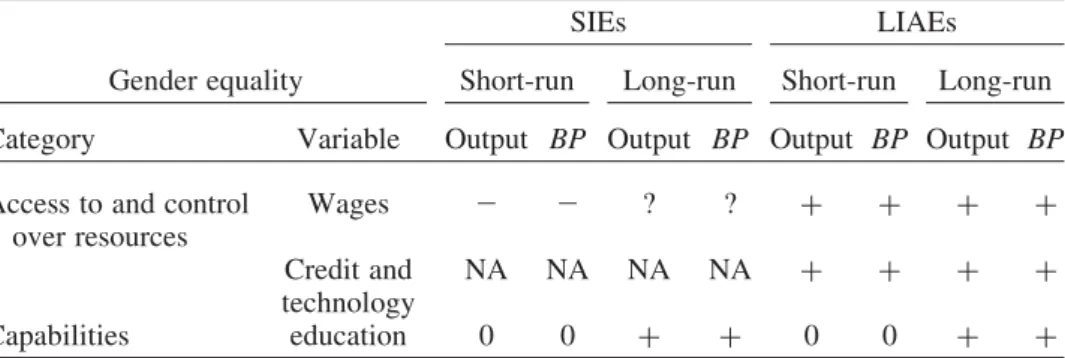
to wF′. This produces a demand-side stimulus (leakages fall), andYrises fromYoto Y′. PointE′ represents the new higher level of output consistent with an increase in gender equality and a trade surplus. This comparative static analysis implies a win-win outcome of greater gender equality in contrast to SIEs. (Table A1 summarizes short-run effects of gender equality on growth in SIEs and LIAEs.)
33Differentiating equation (1) with respect toYandwFyields:
dY
dwF =−(1−a)∂IT
∂wF+ c wF
X+ hz PZ− v
wF
Z a
K
∂IM
∂Y −∂S
∂Y−s YZ
.0
wherez=pmZ
b+wF∂w∂b
F ,0. In the numerator, the first term is clearly negative. The second term is positive but small (0 , c , 1), given the concentration of men in export production in LIAEs. The last term in the numerator in brackets is unambiguously negative, reflecting the inverse effect of higher female wages on import demand.
Efficiency wage (resource) effects raise food production, lowering domestic food prices and thus the import bill, and a redistribution to women shifts consumption to domestically produced goods away from imports. On net, then, the numerator is likely to be negative in LIAEs. As in the SIE case, the denominator is assumed negative for stability. As a result, the slope of theIScurve is positive.
34The derivative ofYwith respect towFin equation (12), theBPconstraint, is:
dY
dwF=− c
wFX− hz Pz− v
wF
Z s
YZ
.0.
The numerator is positive since the import bill falls more than exports with higher female wages. As a result, theBPfunction in LIAEs as modeled here is positively sloped.
Downloaded By: [Fac De Economia Div Est] At: 19:07 10 September 2010
3. Gender and Long-Run Growth
A growing body of research identifies the pathways by which gender matters for long-run growth. Perhaps the most consistent finding in the literature is that gender equality stimulates long-run productivity growth, via the effect on the quality of the future labor supply. Elson (1995), Folbre (1994), and others note that tra- ditional growth models treat human resources as non-produced factors of pro- duction. The production of labor, however, requires significant investments in material resources and unpaid caring labor, with the latter primarily provided by women. Greater gender equality in capabilities (e.g., education), income, and thus bargaining power in the household have been found to have a positive effect on both time and resources invested in children, with subsequent beneficial effects on long-run productivity growth.
Gender inequality in wages also indirectly affects growth via its effect on labor force participation rates and fertility. Cavalcanti & Tavares (2007) model the long-run growth effect of labor market discrimination, positing that the resulting gender wage gap lowers the opportunity cost of unpaid home work and children. Female labor force participation rates are lower, as a result, contri- buting to a decline in average labor productivity due to selection distortion: the quality of the labor pool is reduced with less qualified males hired in place of more qualified women. With higher fertility, household expenditures per capita rise. Aggregate saving falls along with capital-labor ratios and growth (Galor &
Weil, 1996). The combined effects of gender wage gaps on labor force partici- pation, fertility, and saving result in productivity decline.
Generally, empirical models that evaluate the long-run effects of gender inequality adopt the neoclassical/endogenous growth model framework (Dollar
& Gatti, 1999; Klasen, 2002; Knowles et al., 2002), emphasizing the supply side. With few exceptions, demand-side problems and balance of payments
Figure 2.Gender wage and resource effects on output and the balance of payments in the short run:
the case of LIAEs
Downloaded By: [Fac De Economia Div Est] At: 19:07 10 September 2010
constraints on growth are not considered.35Further, the empirical results rely on differing measures of gender equality (wages versus education) and arrive at divergent conclusions as to the relationship between gender equality and growth. Klasen (2002) and Knowles et al. (2002) regress GDP growth on gender gaps in education and a set of conditioning variables, and find a negative effect of educational inequality on per capita growth in the long run. The logic is again based on a selection distortion argument. Educating more males than females will lower average educational quality, if boys and girls have equal aptitudes.
Other studies find that inequality is a stimulus to growth even in the longer run (Braunstein, 2000; Hsiung, 1996; Seguino, 2000a, 2000b). Using the edu- cation-adjusted wage gap as the gender variable, Seguino (2000b) investigates these issues for SIEs and finds that lower female wages fuel investment and exports, the latter generating the foreign exchange to purchase technology- intensive imports that raise long-run productivity. In a more complicated story, Greenhalgh (1985) argues that low wages for females were a stimulus to male educational attainment in Taiwan, propelling growth but reinforcing the existing educational gap.36
The finding that gender educational equality stimulates growth while wage equality has the reverse effect at first glance appears contradictory. A plausible reconciliation is that greater educational equality raises women’s productivity.
But substantial social and economic pressures, including the mobility of firms that employ women, hold down female wage growth (Seguino, 2006, 2007). Con- sequently, increases in women’s educational attainment may not lead to higher wages due to women’s lack of bargaining power in the jobs they hold. This pro- duces a stimulus to profits and thus investment, and/or a decline in export prices, but only in SIEs.37 (Table A1 summarizes the hypothesized long-run effects of female income and capabilities equality in both SIEs and LIAEs.)
An approach that incorporates both of these insights (the negative demand effect of greater gender wage equality and the beneficial effect of capabilities equality on long-run growth in both SIEs and LIAEs) is clearly warranted. The
35Exceptions include Blecker & Seguino (2002), Braunstein (2000), Erturk & Cagatay (1995), Erturk & Darity (2000), and Seguino (2000a, 2000b).
36Briefly, Taiwanese parents have relied on children for security in old age, facilitated by social norms of filial piety and indebtedness. Daughters receive lower educational invest- ments than sons, and are expected to pay their parental debts by beginning work at a young age, and remitting a large share of their factory earnings to parents. This stems from the expectation that daughters, upon marriage, are bonded to the husband’s family, ending any income stream to parents. Parents use their daughters’ wage remittances to finance their sons’ educations, with sons later relied on to support parents in old age. This family system results in wide educational gaps between girls and boys, reducing women’s ability to save in the future.
37Evidence for the failure of gender gaps to narrow apace with the closure of educational gaps has shown up in a number of studies on SIEs, which find an increase in the discrimi- natory portion of the wage gap, including in China and Vietnam (Maurer-Fazio et al., 1999; Liu, 2004).
Downloaded By: [Fac De Economia Div Est] At: 19:07 10 September 2010
next section develops a long-run growth model that tracks the effects of greater gender equality in both women’s access to resources andcapabilities (the latter which had been held constant in the short run). The model holds economic struc- ture constant. While that might seem to be an important omission, the purpose here is to shed light on the contradictory effects of gender in a given structural environment. A useful extension of the model presented here would be to include variables that facilitate structural change.
3.1. A Simple Model with Endogenous Productivity Growth
I construct a simple growth model, drawing on Palley (2002) and Setterfield (2006). I begin with a reduced-form Solow equation; but, as the reader will see, it is modified to incorporate demand-side effects. In particular, the growth of potential output is endogenously determined by the growth rate of demand.
The long-run growth model is comprised of seven equations. Holding con- stant male wages, exchange rates, foreign prices and foreign income in order to focus on gender:
x= −cpx (18)
z=hpz−vwF+sg (19)
px+x=z (20)
px =pz=wF−b (21)
yP=l+b (22)
b=f0+f1g+f2Q′H (23)
g(wF) =yP (24)
where lower-case letters indicate rates of change. Export growth, equation (18), is derived from equations (6) and (7), and import growth, equation (19), from equations (9) and (10). Equation (20) is the dynamicBPconstraint.38Equation (21) is the growth rate of export and import prices, assumed for simplicity to change at the same rate. The growth rate of potential output,yP, is shown in equation (22) as a posi- tive function of the growth rates of the labor force, l, and productivity, b. Productivity growth (equation (23)) is a positive function of the growth of (demand-induced) output g and the quality of the labor supply (human capital), with H a vector of inputs that increase the efficiency of human capital, Q′ a vector of coefficients on those inputs, and f0 representing autonomous technical
38We ignore here the potential for higher interest rates to offset current account deficits by attracting capital inflows, since developing countries with a persistent current account deficit may be perceived as a strong credit risk, making such imbalances unsustainable in a long-run framework.
Downloaded By: [Fac De Economia Div Est] At: 19:07 10 September 2010