
We are also committed to protecting the voting share of the poorest in the IMF.” And the current formula points in the wrong direction if the goal is to prevent a reduction in the quotas of the IMF's poorest members. The original Bretton Woods concept of the IMF was to create an intergovernmental lending intermediary.
The right side of Figure 1 shows the current status of quota shares (proposed since the April 2008 agreement) for the five countries' IMF quotas. A satisfactory formula is a broad measure of the relative importance of individual IMF countries in global politics, the economy, and the financial system. At the beginning of the IMF's history, management shares were decided for purely political reasons.
The increase in the ratio of the financial superstructure to the real sector superstructure probably cannot continue without limit as development continues. In the history of quota formulas to date, the formula has never included shares in world population as one of the allocation level variables. Appendix A contains an analysis of the arguments for and against including a population variable in the formula.
Several aspects of the current quota formula are regrettable and are likely to be reviewed. We are also committed to protecting the voting rights of the poorest in the IMF.” Quota share increases for the beneficiary dynamic members do not result significantly from reductions in the quota share of the advanced and higher income members.
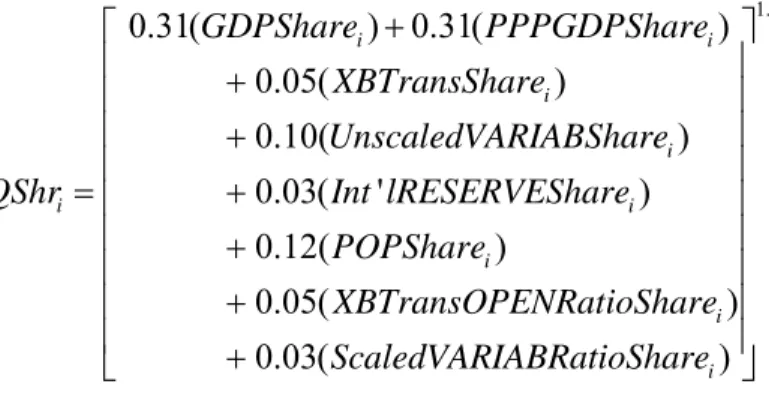
The compression factor in the current formula, by reducing the shares of the largest IMF members relative to what they would otherwise be, softens the awkwardness somewhat. The poor results of the current odds formula can be attributed in part to the weights attached to its variables. Another shortcoming is that the gross flows of cross-border transactions and the global shares in the total sum of these gross flows are an inadequate measure of the openness of the current accounts of economies.
A comparable problem exists with an unscaled definition of the variability of cross-border transactions (regardless of whether the transactions are trade in goods, trade in goods and services, or both current account and capital account transactions). 21 Note 9 in the Annex to the Report of the Quota Formula Review Group chaired by Richard Cooper (IMF, 2000) examines intra-European trade data. And they more than "protect" – they significantly increase – the quota shares of the IMF's poorest members.
External Review of Quota Formulas: Reports to the IMF Executive Board from the Quota Formula Review Group.
Appendix A
Population as a Variable in a Quota Formula
The text of this essay argues that variable selection for a quota formula should not focus narrowly on member countries' "contributions" and "needs" to the IMF's intergovernmental lending-intermediation operations. Rather, the formula should emphasize variables related to relative status in the broadly conceived world economy, consistent with shifts in the IMF's core functions away from lending operations toward important new activities such as multilateral surveillance and monitoring. A rather broad view of the functions of the IMF today and in the future invalidates the argument that the use of population as a variable is inconsistent with the functions of the IMF as a financial institution.
Gross output as measured usually depends on the number of people in the country (strictly, the number involved in the measured economic activity) and the "productivity" of those people. In other words, a nation's share of world GDP is the product of its share of world population and the ratio of the country's productivity (measured by national GDP per capita) to world average productivity (world GDP per capita). . If every nation in the world had productivity equal to the world average productivity, the ratio of.
Weighting voting shares in the IMF exclusively by population percentages would completely ignore national differences in productivity and the resulting international differences in output and wealth. But, in fact, the implicit principle would be to count every individual in the world, not as a whole person, but rather to weigh each person by the relative productivity of the nation in which they reside (in other words, by how much output per per capita produced in their country relative to the average output produced by all individuals in all nations). A key feature of the 1789 constitution in the United States was the so-called sectional compromise between the slave and antislavery states that each slave would count as three-fifths of a person to him.
Nevertheless, within these nations today there exists a widespread acceptance of the principle that the relative voting power of domestic jurisdictions in national political institutions should depend on the number of persons resident in the jurisdictions.28. When judging the current relativities between the two, one inevitably asks whether it seems appropriate that the US should have a quota share in the IMF 10 times that of Brazil, when the US has 12 times the production and output per capita. population 7-1/2 times greater, but population only 1-1/2 times greater. But it is surely an extreme position, highly unlikely to achieve thoughtful agreement in the world community as a whole, that management shares should be determined by, in accordance with population shares, a weight of exactly zero when shares of world production are taken into account.
If we look forward fifty or a hundred years, we must then assume that voting rights in international institutions – including specifically international financial institutions such as the IMF – will still depend primarily on the relative wealth of nations, giving little or no weight to the number of people living in the nations independent of national riches. According to a modest weighting of population shares in the formula, in the short term it will marginally contribute to increasing government shares for many individual developing countries and for developing countries as a whole. The world in the first decades of the twenty-first century is certainly not ready to be governed by international institutions that emphasize this principle.
Appendix B
The Structure of Formulas for IMF Governance Shares
Exports and imports could be combined into a cross-border trade variable that is the average of exports and imports or the sum of the two. Preferably, a particular level share variable should reflect characteristics that are identifiably different from other level share variables. Ratio share variables, like level share variables, should capture something significant about the relative positions of individual members in the world economy and financial system.
The ratio value for an individual member is actually calibrated against. The unadjusted measure of variability in cross-border trade and capital flow transactions is 12 times higher for India than for Costa Rica, but the ratio of this variability to GDP in Costa Rica is 3.3 times greater than the corresponding value of the ratio for India. For example, the broader concept of member states' "vulnerability" to shocks originating outside their borders may depend on both trade and financial openness ratios and cross-border transaction variability ratios, all of which exhibit significant correlations with each other.
Ideally, if openness and vulnerability variables are to be included in a quota formula, they should be included as ratio-share rather than level-share variables. 31 Recall the example highlighted in the text of the paper: the correlation coefficient between member states' shares of world border trade and shares of world market prices GDP is the high value of 0.91. For a particular member of, the Ashare variable is defined as its value of the nominal or inflation-adjusted size of A as a fraction of the corresponding global total for A.
For an individual member, the level share part of the overall quota formula is then given by:. where α , β and γ are positive parameter values assigned as the weights associated with the variables. Each parameter has a value bounded by zero and unity.32 These characteristics of the structure of a formula are now generally accepted. If the formula is to include a number of level share variables other than three, the number and values of the parameter weights must of course be changed accordingly.).
For an individual member, the part of the general formula involving the split ratio variables is then given by: where as before λ and μ are the positive parameter weights with values limited to zero and one. The weights of the parameters in each of the included variables, uniform in all member countries, determine the relative importance of the variables in the formula. As part of the April 2008 IMF reform agreement, the number of core votes per member was tripled, and an amendment to the IMF's Articles of Agreement was adopted that sets the aggregate of core votes at a constant agreed share of power. total voting (not, as before, an absolute number of votes). 34.