
The generations of the charged leptons are identical copies of each other with respect to their electroweak couplings. An iron flux return located outside the coil is instrumented to identify KL0 and muons (KLM). Since there are several hundred known B decay channels, the task of reconstructing one of the two B mesons in the case may not always succeed.
These multivariate techniques are in principle capable of accounting for correlations between the variables. An example of the separation effect of this output variable for one of the classification tasks used can be seen in fig. 2(b), the purity, defined as the number of signal events divided by the total number of events in a network output bin , is a linear function of the NeuroBayes output.
Comparison of the m2miss and |p∗ℓ| distributions of the D(∗)ℓ samples (data points) with the projections of the isospin unconstrained fit results (stacked colored distributions). The area above the dotted line of the background component corresponds to the BB background and the area below corresponds to the continuum. The |p∗ℓ| distributions show the signal enriched region with m2miss ≥ 1 GeV2, excluding most normalization events in these samples.
This may account for some of the observed excess at 1 < m2mis < 2 GeV2 in Fig.
Cross-feed Constraints
The peak at m2miss = 0 in the background component is due to charge cross-feed events. B → D∗∗(τ−/ℓ−)ν branching fractions: As mentioned above, the sharp peak in the m2miss distribution of the D(∗)π0ℓ samples limits contributions from B → D(∗)πℓν decays. Events with additional unreconstructed particles contribute to the tail of the m2miss distribution and are therefore more difficult to separate from other background and signal events.
Unmeasured B → D∗∗(→ D(∗)ππ)ℓνℓ decays: To assess the impact of other potential B → D∗∗ℓ−νℓ contributions, we modify the standard fit by adding an extra component . Of the four contributions listed in Table VI, the three-body decays of the D∗∗ states with L = 1 give the best agreement in the fits to the D(∗)π0ℓ samples. For this decay chain, the m2miss distribution has a long tail due to an extra undetected pion.
TAU PRODUCTION PROPERTIES
2016) 047, JHEP 04 (2017) 142
Uncertainties shown are the squared sum of statistical and systematic uncertainties and include the uncertainty on B0. The first uncertainty is statistical, the second is systematic, and the third is due to the uncertainty at B0.
Strategy
R K*º determined as double ratio to reduce systematic effects
Bremsstrahlung − I
Part-Reco Background − I
0.006 ± 0.045, where the first uncertainty is statistical and the second
The dual relationship means that only efficiency differences due to kinematics can affect the result.
Trigger
Cross-Checks − I
Cross-Checks − II
CERN Seminar
Cross-Checks − III
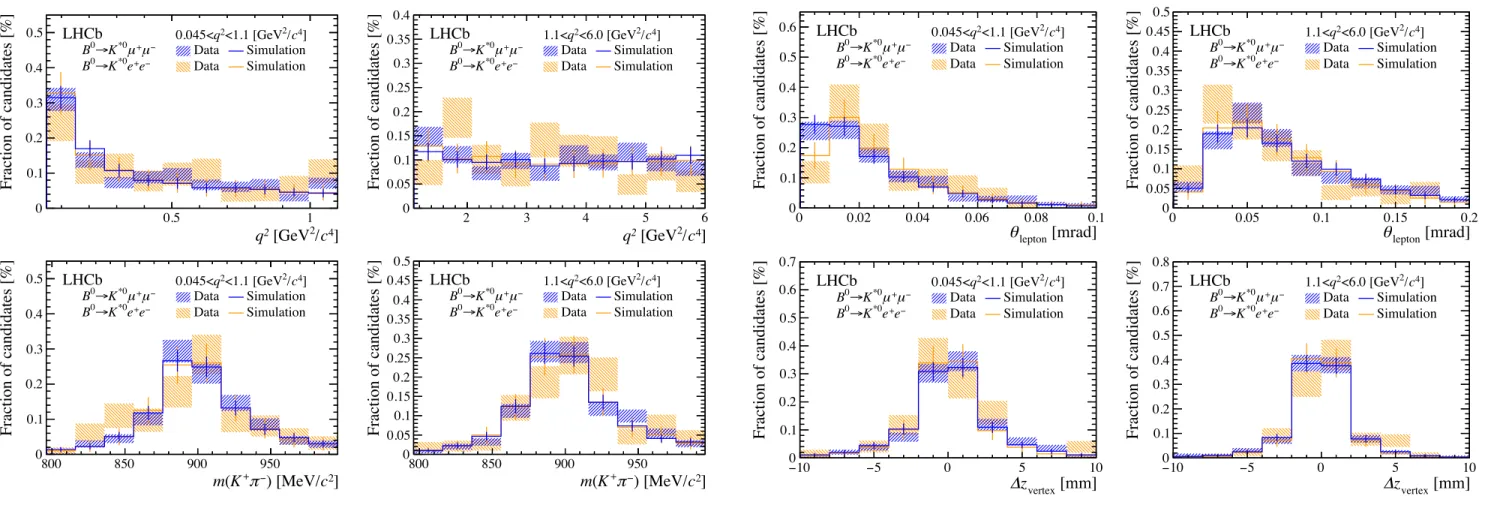
From top to bottom: q2, the invariant mass K+⇡, m(K+⇡ ), the opening angle between two leptons, ✓lepton and the projection along the radius axis of the distance between the K+⇡ and `+` vertices, zvertex. Firing efficiency: for hardware igniters, corrections in the simulation are determined using different control samples and the difference in the result is assigned as a systematic uncertainty; for software trigger, corrections in simula-. From top to bottom: q2, the invariant mass K+⇡, m(K+⇡ ), the opening angle between two leptons, ✓lepton and the projection along the radius axis of the distance between the K+⇡ and `+` vertices, zvertex.
The dashed line is the signal PDF, the shaded shapes are the background PDFs, and the solid line is the full PDF.
Part-Reco Background − II
Fit Results – ee
Leakage due to brem tail of
FQUPO VOJWFSTBMJUZ UFTU
IBMMFOHJOH BOBMZTJT EVF UP CSFNTTUSBIMVOH
JHSBUJPO PG FWFOUT NPEFMFE CZ .$
PSSFDU GPS CSFNTTUSBIMVOH
4FF NPSF EFUBJMT JO 3BGBFMT BOE .BSUJOPT UBMLT
1IZT 3FW -FUU
Results − II
Results − I
All branched muonic fractions b—>sll tend to be below the SM prediction. The differential branching fraction of the Bs0→ φµ+µ− decay, superimposed on the SM predictions [4,5] indicated by the blue shaded boxes. The selection requirements present a time dependence of the decay efficiencies, which, due to the significant lifetime difference in the Bs0 system [39], may affect the measured branching fraction [40].
When the Wilson coefficients are changed, the size of the effect is found to be at most 1.6%, which is taken as the systematic uncertainty. The statistical uncertainty due to the limited size of the simulated signal samples leads to a systematic uncertainty of 1.9%. The systematic uncertainties due to the parameterization of the mass shapes are evaluated using pseudo-experiments.
For parameterization of the combinatorial background, the nominal exponential function is compared with a linear mass model. The systematic uncertainties due to the modeling of the signal and background mass shape are 2.1% and 1.6%, respectively. Finally, the uncertainty on the branching fraction of the decay J/ψ →µ+µ− constitutes a systematic uncertainty of 0.6%.
For the total branching fraction of the signal decay, the uncertainty on the branching fraction of the normalization channel is the dominant systematic uncertainty at the level. The uncertainties shown are the squared sum of the statistical and systematic uncertainties and include the uncertainty of B0!J/K⇤0 and J/. Assuming that the description in terms of contact interactions holds, we translate the best fit values of the Wilson coefficients to a generic NP scale.
K⇤`+` angular observers can help identify the chiral structure of lepton streams. The compatibility of the low-q2 result with respect to the SM prediction(s) is 2.2–2.4 standard deviations. The consistency of the result in central q2 with respect to the SM prediction(s) is 2.4–2.5 standard deviations.
The observable S1c corresponds to the longitudinal polarization fraction of the K⇤0 meson and is therefore more commonly referred to as FL, me. The definition of Pi0 observers differences from that of Ref. 24], but is consistent with the notation used in the LHCb analysis of Ref.
![FIG. 6. Standard-Model di↵erential branching fraction (gray band) for B ! Kµ + µ decay (left) and B ! K ⌧ + ⌧ (right), where B denotes the isospin average, using the Fermilab/MILC form factors [62]](https://thumb-us.123doks.com/thumbv2/123dok_es/12471755.0/30.1536.54.1507.551.931/standard-erential-branching-fraction-denotes-isospin-average-fermilab.webp)