Impact of time-of-day and chronotype on neuromuscular performance in semi-professional female volleyball players.
Julio Martín-López 1, Milan Sedliak 2, David Valadés 3, Alejandro Muñoz 1, Jorge Buffet 4, Ricardo García-Oviedo 4, Manuel Rodríguez-Aragón 4, Alberto Pérez-López 3, Álvaro López-Samanes 4.
1 Exercise Physiology Group, School of Sports Sciences, Faculty of Health Sciences, Universidad Francisco de Vitoria, Madrid, Spain.
2 Department of Biological and Medical Sciences, Faculty of Physical Education and Sport, Comenius University in Bratislava, Bratislava, Slovakia.
3 Universidad de Alcalá, Facultad de Medicina y Ciencias de la Salud, Departamento de Ciencias Biomédicas, Área de Educación Física y Deportiva, Madrid, España.
4 Exercise Physiology Group, School of Physiotherapy, Faculty of Health Sciences, Universidad Francisco de Vitoria, Madrid, Spain.
Corresponding author:
Alberto Pérez-López
Universidad de Alcalá, Facultad de Medicina y Ciencias de la Salud, Departamento de Ciencias Biomédicas, Área de Educación Física y Deportiva, Madrid, España.
E-mail: [email protected]
ABSTRACT
This study aimed to determine if time-of-day could influence physical volleyball performance in females and to explore the relationship between chronotype and volleyball-specific performance. Fifteen young female athletes participated in a randomized counter-balanced trial, performing a neuromuscular test battery in the morning (9:00 h) and the evening (19:00 h), consisted of volleyball standing spike, straight leg raise, dynamic balance, vertical jump, modified agility T-test and isometric handgrip tests. Chronotype was determined by the morningness-eveningness questionnaire. Compared to the morning, an increased performance was found in the standing spike (4.5%, p=0.002, ES=0.59), straight leg raise test (dominant-limb) (6.5%, p=0.012, ES=0.40), dynamic balance (non-dominant-limb) (5.0%, p=0.010, ES=0.57) and modified T-test (2.1%, p=0.049, ES=0.45) performance in the evening; while no statistical differences were reported in vertical jump tests or isometric handgrip strength.
Moreover, no associations were found between chronotype and neuromuscular performance (r=-0.368-0.435, p=0.052-0.439). Time-of-day affected spike ball velocity, flexibility in the dominant-limb, dynamic balance in the non-dominant-limb and agility tests. However, no association was reported among these improvements and the chronotype. Therefore, although the chronotype may not play critical role in volleyball-specific performance, evening training/matches schedules could benefit performance in semi-professional female volleyball players.
Keywords: chronobiology, team sports, women, physical performance,volleyball.
INTRODUCTION
Circadian rhythms refer to the biological variations that occur in the human body during approximately 24-hours cycles being regulated by the central pacemaker (i.e., suprachiasmatic nuclei) (Atkinson & Reilly, 1996). These time-of-day differences are influenced by several mechanisms such as external (i.e., environmental factors), psychobiological (i.e., lifestyle), internal (i.e., adjustment to time zone), and chronobiological factors (i.e., expression of circadian rhythmicity in an individual) (Reilly & Waterhouse, 2009; Vitale & Weydahl, 2017; Douglas, Hesketh et al., 2021).
These cyclical variations influence some physiological mechanisms such as body temperature (Refinetti & Menaker, 1992), glucose/lipid metabolism (Kumar Jha, Challet et al., 2015) or hormones regulation (i.e., cortisol, melatonin) (Selmaoui & Touitou, 2003), which affect the molecular clock in skeletal muscle (Schroder & Esser, 2013) influencing muscle contraction potentially by causing a reduction in maximal force production (Andrews, Zhang et al., 2010; Chtourou, Driss et al., 2012). Thus, different time-of-day schedules may alter neuromuscular performance in humans (Chtourou & Souissi, 2012).
In humans, resistance and short-duration maximal exercise performance are influenced by diurnal fluctuations in metabolism, observing peak of performance at the evening (i.e., 16:00-20:00 h) compared to morning schedules (i.e., 6:00-10:00 h) (Zarrouk, Chtourou et al., 2012; Pallares, Lopez-Samanes et al., 2014; Grgic, Lazinica et al., 2019; Mirizio, Nunes et al., 2020) and effect that seem to occur locally in skeletal muscle nor affecting neural structures (Sedliak, Finni et al., 2008). Nonetheless, active warm-ups with or without music, exposures to warm and humid environments, fasting conditions or prolonged training periods at morning hours seem to minimize these time-of-day differences in muscle force
and power production (Mirizio, Nunes et al., 2020). This time-of-day effect on muscle strength and power production has been mostly investigated in male athletes, with residual evidence performing in team-sports female athletes (Mhenni, Michalsik et al., 2017).
In addition, chronotype is the expression of circadian rhythmicity and reflects predisposition towards morningness or eveningness, reporting differences between individual or team-sports disciplines (Lastella, Roach et al., 2016). Chronotype is defined by three categories: morning type, evening type, or neither type; that indicates the time of that day at which several psychophysiological variables reach their peaks (Vitale & Weydahl, 2017). These peaks in psychophysiological variables have been shown to affect sports performance (Zarrouk, Chtourou et al., 2012; Vitale &
Weydahl, 2017); thus chronotype categorization should be considered to determine the optimal time for training and competition in sports athletes (Vitale & Weydahl, 2017).
Volleyball is an intermittent sport characterized by short-duration maximal and explosive movements (i.e., jumps, blocks) developed during continuous defensive or offensive actions (Sattler, Sekulic et al., 2012). The number of on-court players (i.e., six players) and the limited dimension of the court (9 x 18 m) determine that elite volleyball players possess a combination of excellent physical, technical and tactical skills (Sheppard, Cronin et al., 2008; Lidor & Ziv, 2010). Besides anthropometric demands in volleyball (Grgantov, Katic et al., 2006), high values of upper/lower strength/power and agility (Paz, Gabbett et al., 2017), jumping capacity (Sattler, Hadzic et al., 2015), flexibility (Lee, Etnyre et al., 1989) and balance (Eylen, Daglioglu et al., 2017) are critical for volleyball success.
The impact of time-of-day variances in volleyball performance was previously investigated in male players (Rai & Tiwari, 2015), no reporting time-of-day differences in several physical parameters. However, no studies have explored morning-evening performance in female volleyball players and limited evidence has been presented about the association between chronotype and female team-sports performance (Lastella, Miller et al., 2021). Thus, the aim of this investigation was to determine the effect of time-of-day and chronotype on neuromuscular performance in semi- professional volleyball female players. It is hypothesized that despite the neuromuscular performance and time-of-day variability previously reported in female team sports (e.g. handball) (Mhenni, Michalsik et al., 2017), time-of-day will affect strength and power production of semi- professional female volleyball players. It is hypothesized a higher performance would be found in the evening compared to the morning trial, and that improvement would be related to the chronotype of the female volleyball players.
METHODS Participants
Fifteen female volleyball players of the Superliga 2 (Second Spanish National Division League) participated in this study (age 22.3 ± 7.2 years, height 1.72 ± 0.04 m, body mass 64.5 ± 5.9 kg, body mass index 21.9 ± 1.9, volleyball experience 12.0 ± 6.6 years and training per week 6.9 ± 1.2 hours). Semi-professional female volleyball players between 16 and 40 years old who routinely train (> 5 h/week), compete in both the morning (~9:00 hours) and evening (~19:00 hours) and were able to perform their maximum effort in trials were eligible for inclusion. Exclusion criteria
were: (a) impossibility of being tested due to previous upper/lower limbs injuries, (b) experiencing lower limb muscle soreness at time of the testing session, (c) taking any medication, (d) consuming stimulants during the 48h before the trial (e.g. caffeine, tea). Nine participants were tested during the follicular phase of their menstrual cycle, and six were tested during the luteal phase according to a mobile application (Mycalendar; Period Tracker, Singapore) that identifies main events occurring during the menstruation cycle (de Jonge, 2003). The players and parents/guardians (5 participants were under 18 years old) were informed of all experimental procedures and informed consent was completed before participation. The study was approved by the Francisco de Vitoria Bioethics Commission University (13/2021), which complied with the recommendations of the Declaration of Helsinki.
Experimental design
A randomized and counter-balance design was used in this investigation. The required sample size was obtained by an effect size of 0.78 in Cohen’s d units (statistical power of 80% with type I error set at 5%) and also considering the members of the volleyball team. Female volleyball players performed the same neuromuscular test battery on two occasions in the morning at 9.00 h and the evening at 19:00 h. The time-of-day order was randomized for each participant. These two times of the day (9:00 h and 19:00 h) were chosen according to the reported habitual training session (19:00 h) and competition schedules (9:00-10:00 h and 19:00 h). Before testing, participants underwent one familiarisation session with the experimental test battery to prevent bias from progressive learning 3 days before the first day of the study at 19:00 h according to the time-of-day selected in our study and female participants realized all the tests included in the neuromuscular battery. To ensure standardisation of the
measurements, all tests were completed at the same volleyball court, where participants used to train and compete, using the same testing devices, handled by the same researcher, in the same order. During the 3 sessions, the air temperature was 6.6 ± 0.5 °C and relative humidity was 45 ± 3%
measured with a portable weather station (Meteorological Station, Küken, Spain). The temperature conditions were determined by the Spanish COVID-19 policy in sports centers which stipulates that a constant airflow renovation must be accomplished in the building facilitated by the opening of all windows.
Experimental protocol
During the 24 h before testing, volleyball players abstained from any strenuous activity and were encouraged to refrain from all dietary sources of caffeine, alcohol, and stimulants 48 h before the experimental trials (Mora-Rodriguez, Pallares et al., 2015). During the familiarization session, participants completed the Horne–Ostberg Morningness–Eveningness personality questionnaire (Horne & Ostberg, 1976) to assess their chronotype. The night before the morning testing session, participants ingested an easily digestible meal with a total energy intake of 759 kcal (50% carbohydrates, 30% fats and 20% proteins) at 21:00 h. Before morning trials, at 7.00 am participants ingested a standardised breakfast of 453 kcal (53% carbohydrates, 42% fats and 5% proteins) and for the evening testing sessions, participants ingested a menu of 639 kcal (35%
carbohydrates, 42% fat and 23% proteins) at 13:00-hours. Athletes were encouraged to sleep 7 to 9 hours the night before trials (Fullagar, Skorski et al., 2015; Charest & Grandner, 2020).
The day of the trial, the participants arrived at their habitual training facility at 8.30h (morning session) or 18:30h (evening session). Upon arrival, body composition was assessed by electric bioimpedance (Tanita 901, Tanita Corp., Tokyo, Japan) and tympanic temperature was evaluated in triplicate using a portable thermometer (Thermoscan 6520, Braun, Germany). Besides, hydration status was analysed using urine specific gravity (Master-s28M, Atago Company, Tokyo, Japan), before instructing participants to drink 500 mL of water 1h before the trial to ensure euhydration status (< 1.020) (Osterberg, Horswill et al., 2009).
After initial tests, a 20 minutes standardized warm-up was performed. The warm-up protocol consisted of 5 minutes of continuous running, followed by upper- and lower-body dynamic stretching and specific volleyball exercises (Perez-Lopez & Valades, 2013; Perez-Lopez, Salinero et al., 2015).
Then, participants underwent a battery of neuromuscular tests consisting of standing and jumping spike test, straight leg raise test, modified star excursion balance, vertical jumps tests (squat jump, countermovement and spike jump), isometric handgrip strength and modified agility T-test (Figure 1). Finally, during the 30 minutes after the neuromuscular test battery finalization, rating of perceived exertion (RPE) scale (0-10) was determined based on the methodology previously described (Foster, Florhaug et al., 2001).
Standing spike test
Standing spike test was performed according to the protocol previously described (Palao & Valades, 2009b; 2016). In brief, in the standing spike test, female players hit the ball with maximal strength toward a target zone (1.5 x 1.5 m). Player self-tossed the ball and they spiked without jumping or moving their feet of the ground. A researcher was located laterally to the player to monitor the execution of both tests. If any execution aspect
was incorrect, the test was repeated (e.g., not hitting the ball directly toward the target area). The same ball was used during the trial (Molten V5M5000) and in the target zone a Stalker Solo 2 Radar Gun (Applied Concepsts, Texas, USA) was situated to measure ball velocity. Ball pressure, and radar orientation and calibration were monitored on each test. Each player had three trials and the maximum speed reached in the test was recorded (Palao & Valades, 2009a).
Straight Leg Raise Test
Passive hip flexion range of motion (ROM) values with the knee extended were evaluated with the Straight Leg Elevation test such as previously described (Moreno-Perez, Hernandez-Davo et al., 2021). Participants made two maximum passive attempts for the dominant and non-dominant leg, when the difference between one attempt and another was greater than 5%, a third attempt was made, selecting the highest value of the two attempts whose results were similar for further statistical analysis (Moreno-Perez, Hernandez-Davo et al., 2021). A unilevel inclinometer ISOMED (Portland, OR, USA) with a telescopic was used for the measurements and the inclinometer was placed approximately on the external malleolus and the distal arm was aligned parallel to an imaginary bisecting line of the extremity (Lopez-Samanes, Del Coso et al., 2021).
Dynamic balance
Dynamic balance was assessed using the OctoBalance device (OctoBalance, Check your Motion, Albacete, Spain), a modified version of the Star Excursion Balance Test (SEBT) measuring in 3 distinct directions of anterior, posteromedial and posterolateral on both the dominant and non- dominant limbs. The measurement system is based on an extending measuring tape, magnetized in each direction to an octagon‐shaped platform.
Each trial consisted of pushing the marked point, situated at the top of the measuring tape, with the toes as far as possible in the designated direction (Gonzalo-Skok, Serna et al., 2015). Subjects were allowed at least 3 practice trials in the anterior, posteromedial and posterolateral directions before recording the best of 3 formal trials in each plane. The maximal reach distance was recorded where the most distal part of the foot was reached based on the measurement device.
Countermovement jump, squat jump and maximal spike jump test
Participants performed three maximal vertical jumps of repetitions of a countermovement jump, squat jump and spike jump with 45 seconds of passive recovery between repetitions. Countermovement jump and squat jump were performed according to standard methodology (Bosco, Luhtanen et al., 1983), while for spike jump, a basic spike technique consisted of 2 approach steps, jump and land was used. For the three test, maximal jump height was recorder using an infrared jump system (Optojump, Microgate, Italy).
Isometric handgrip strength
Participants performed a isometric handgrip strength test with 0 degrees of shoulders flexion, 0 degrees of elbow flexion and the forearm and hand in a neutral position, as previously reported in other studies (Lopez-Samanes, Moreno-Perez et al., 2017). Two maximum isometric voluntary contractions were measured from the dominant and non-dominant hand using a calibrated handgrip dynamometer (Takei 5101, Tokyo, Japan). The highest value out of two attempts was recorded as the maximum voluntary handgrip strength.
Modified Agility T-test
The agility T-test required female players to move through a modified T-shape circuit to simulate the fast movements performed in volleyball (e.g., digs or receptions) (Sassi, Dardouri et al., 2009). Participants began the test with both of their feet behind the starting point and sprinted forward to cone B and touched its base with the right hand, facing forward and without crossing feet, they shuffled to the left to cone C and touched its base with the left hand. Then, participants shuffled to the right to cone D and touched its base with the right hand. They shuffled back to the left to cone B and touched its base. Finally, female players ran backward as quickly as possible and returned to line A. The best performance out of two repetitions separated by a 2 minutes recovery period was recorded for subsequent analysis (Munoz, Lopez-Samanes et al., 2020). Time to complete the T-shape circuit was measured using two electronic time sensors (Microgate, Polifemo Radio Light, Italia) set 1 m above the surface and positioned 3 m apart facing each other on either side of the starting line. Participants began each test 1 m behind the starting line, and the timer started when they passed the first gate.
Morningness-eveningness questionnaire
The morningness-eveningness questionnaire (Horne & Ostberg, 1976) was used to determine the participants’ chronotype (morning, intermediate or evening). The questionnaire consists of 19 questions and yields scores ranging from 16 to 96, with lower scores indicating participants’
preference toward evening activities and higher scores indicating participants’ toward morning activities. Chronotype scores were determined using the Horne and Ostberg classification system (16-41 = evening type; 42-58 = intermediate type; 59-86 = morning type)
Statistical analysis
Data are presented as means and standard deviations. Shapiro–Wilk test was used to assess the normal distribution of data. All variables presented a normal distribution in the test (p < 0.05), hence, differences between experimental condition (morning vs. evening) were assessed using a paired t-test. Linear regression analysis was used to examine the relationship between performance variables and the morningness-eveningness questionnaire. The significance level was set at p ≤ 0.05. Cohen’s formula for effect size (ES) was used and the results were based on the following criteria: trivial (0–0.19), small (0.20–0.49), medium (0.50–0.79) and large (0.80 and greater) (Cohen, 1992).. All the statistical analyses were done using the SPSS software version 26 (SPSS Inc., Chicago, IL, USA).
RESULTS
Environmental temperature, Tympanic temperature, Urinary specific gravity and rate of perceived exertion
Tympanic temperature was significant elevated by 1.2% in the evening versus morning trial (35.9 ± 0.5 vs. 36.3 ± 0.3 °C respectively; p = 0.006;
ES = 1.00). Therefore, similarly hydration status measured by urinary specific gravity (1.017 ± 0.01 vs 1.018 ± 0.01, p = 0.697; ES = 0.07) and rate of perceived exertion values 4.1 ± 1.5 vs 4.1 ± 1.6 points (p = 0.818; ES = 0.03) were reported between morning and evening conditions.
Morningness-eveningness questionnaire.
Regarding the participants’ chronotype assessed by the Morningness-eveningness questionnaire, nine participants (60%) scored as “intermediate type”, five participants (33.3%) as evening type and one participant (6.6%) as morning type.
Standing spike, straight leg raise test and star excursion balance test
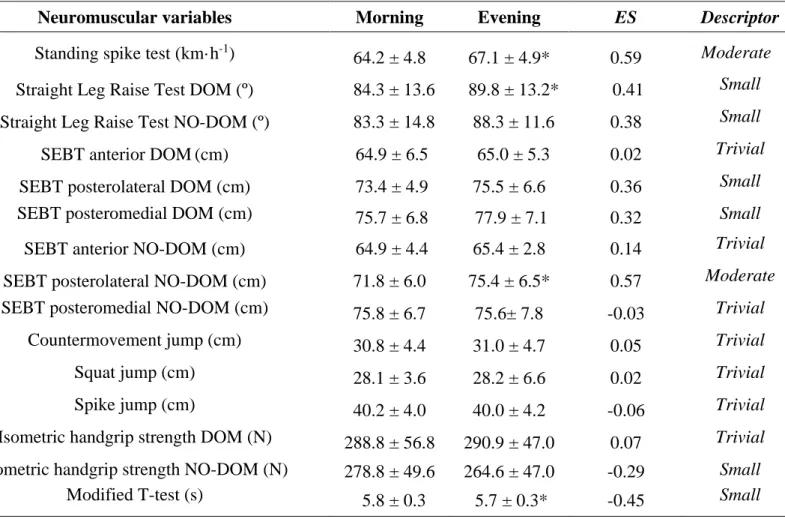
In the standing spike test, maximal ball velocity was significantly higher in the evening compared to the morning session (4.5 ± 4.4%, p = 0.002, ES = 0.59). Besides, we found statistically significant differences in the straight leg raise test in the dominant limb during the evening session compared to the morning session (6.5 ± 9.4 %, p = 0.012, ES = 0.41), but not in the non-dominant limb (6.1 ± 16.1%, p = 0.091; ES = 0.38) (Table 1). Moreover, no statistically significant differences in the SEBT morning vs evening were found dominant limb in the anterior direction (0.2%, p
= 0.929, ES = 0.02), posterolateral (2.9%, p = 0.605, ES = 0.36) and posteromedial (3.0%, p = 0.233, ES = 0.32). Finally, when comparing the evening vs morning session, statistically significant differences were found in the SEBT posterolateral direction of the non-dominant limb (5.0%, p = 0.010, ES = 0.57) but not in the anterior (0.8%, p = 0.063, ES = 0.14) or the posteromedial (-0.3% p = 0.831, ES = 0.03) (Table 1).
Countermovement jump, squat jump test and maximal spike jump tests
No statistically significant differences were found in countermovement jump test (0.7%, p = 0.621, ES = 0.05), squat jump (0.4%, p = 0.756, ES = 0.02) and maximal spike jump test (-0.6%, p = 0.610, ES = 0.11) when comparing evening versus morning sessions (Table 1).
Isometric handgrip strength and Modified T-test.
Comparing morning and evening trials, there were no statistical differences for the maximal isometric handgrip strength in the dominant hand (1.4
± 15.0 %, p = 0.714, ES = 0.07) and non-dominant hand (-5.1 ±10.0 %, p = 0.095, ES = 0.29). Finally, the time required to complete the modified T-test in the evening was 2.1 ± 3.9% lower comparing morning (p = 0.049, ES = 0.45) (Table 1).
Correlations
None of the correlations between morningness-eveningness questionnaire scores and the time-of-day related differences in the neuromuscular battery tests reached statistical significance: spike test (r = 0.043; p = 0.439), straight leg raise test dominant (r = -0.066; p = 0.407) and non- dominant (r = 0.365; p = 0.090), dynamic balance dominant (i.e., anterior, posteromedial and posterolateral) (r = 0.184-0.435; p = 0.052-0.254) and non-dominant (r = 0.055-0.178; p = 0.262-0.421), countermovement jump (r =-0.368; p = 0.088), squat jump (r = -0.264; p = 0.171), spike jump test (r = 0.316, p = 0.125), isometric handgrip strength dominant (r = -0.008; p = 0.384) and non-dominant (r = 0.310, p = 0.095) and T-test (r = -0.030, p =0.357).
DISCUSSION
The aim of this study was to assess the effect of two different time-of-day schedules (9:00 vs 19.00 hours) on short-duration maximal physical performances, which could be determinant for the physical volleyball performance and to determine. Secondly, to assess if individual chronotype is associated with sports performance in semi-professional volleyball female players. Our findings showed higher neuromuscular performance in standing spike test, flexibility, dynamic balance and agility performance (ranging from 2.1-6.5%) in the evening versus morning session, while no difference was reported in vertical jump capacity and isometric handgrip strength.
Compared to the morning, moderate improvements in the evening were observed in the standing spike test (4.5%). To our knowledge, no study has examined the time-of-day effect on this particular but essential aspect of volleyball performance that is particularly important for hitters
volleyball players (Duncan, Woodfield et al., 2006). However, our data are in agreement with previous studies in other intermittent sports that have reported similar improvements evening versus morning in specific hitting tests (4.0-5.4%) of different sport modalities that involve overhead strokes such as serve velocity in tennis (Lopez-Samanes, Moreno-Perez et al., 2017) or throwing velocity in handball (Mhenni, Michalsik et al., 2017).
Vertical jump height is another important factor related to volleyball performance success, involved in some specific movement patterns in defensive (i.e., block jumps) or offensive actions (Sattler, Sekulic et al., 2012). In addition, it has been reported that volleyball players realized a mean of 37-88 jumps per training session depending on volleyball playing role (Garcia-de-Alcaraz, Ramirez-Campillo et al., 2020), thus, establishing the effects that time-of-day provoked in jump capacity could be relevant for volleyball performance. According to our data, no time- of-day effects were reported in jump capacity in the different tests selected for this study (e.g., countermovement jump, squat jump and maximal spike jump test) (0.4-0.7%) that is in agreement with previous studies performed in female team-sports athletes (i.e., handball) in best jump performance (i.e., countermovement jump) (Mhenni, Michalsik et al., 2017). However, our data are controversial with other studies in team or individual male sports that reported improvements in jump capacity in the evening compared with the morning conditions (i.e., 4.5-9.8%) (Lopez- Samanes, Moreno-Perez et al., 2017; Pavlovic, Stojiljkovic et al., 2018). Thus, players’ sex, competition level or experience could be some of the variables that explain the lack of statistically significant effects caused by the two time-of-day protocols used in female semi-professional volleyball players.
An adequate range-of-motion (Panoutsakopoulos, Kotzamanidou et al., 2021) and dynamic balance (Hudson, Garrison et al., 2016) in the lower limbs is essential in volleyball performance due to the continuous jumps, landings, hits and multidirectional movements that volleyball players realized during training and competitions. Previous data have reported statistically significant time-of-day effects on flexibility values in the evening versus morning conditions in the straight leg raise test (Gifford, 1987) that are in agreement with the data reported in the dominant (6.5%) and a tendency in the non-dominant limb (6.1%). Limited literature has explored the effect of time-of-day on dynamic balance, especially in team sports athletes. In this case, we only found statistical time-of-day differences in the no dominant limb in a posterolateral direction (5.0%), not reporting differences in the anterior (0.3-0.8%). In addition, no statistical differences in the dominant limb were reported (0.2-3.0%). Our results agree with previous studies in the literature that established that time-of-day had a minimal effect on dynamic balance in athletes (Heinbaugh, Smith et al., 2015).
Our study reported no time-of-day effects in isometric handgrip strength in dominant and non-dominant limbs (1.4-5.2%). These findings agree with previous studies that did not report statistical differences in Olympic combat athletes or competitive tennis players (Pallares, Martinez- Abellan et al., 2016; Lopez-Samanes, Moreno-Perez et al., 2017), but in contrast to the differences observed in male handball athletes (Mhenni, Michalsik et al., 2017). This differences between studies could be attributed to contrasting participants involved and isometric handgrip protocols used.
Agility has been related to volleyball performance, during game actions, volleyball players need to realize quick forward/backward movements and continuous change of direction (Paz, Gabbett et al., 2017). According to our findings, the time-of-day effect on agility performance with statistically significant differences in the evening compared to the morning session (-2.1%). Our data agree with previous studies reported in male/female team sports athletes that found lower times in different agility tests in the evening than morning conditions (i.e., soccer and handball) (Reilly, Atkinson et al., 2007; Mhenni, Michalsik et al., 2017; Pavlovic, Stojiljkovic et al., 2018). Thus, agility performance seems to be influenced by time-of-day showing better performance in the evening compared morning conditions.
Morningness and evening questionnaire is a commonly used for detecting morningness, intermediate and eveningness chronotypes. However, our data reported no significant correlations with neuromuscular performance parameters measured in semi-professional female volleyball players.
In addition, our results agree with previous literature studies in other intermittent sports that reported no significant relationship chronotypes and neuromuscular performance (Lopez-Samanes, Moreno-Perez et al., 2017). Besides limited number of participants, another possible explanation may stem from the fact, that questionnaires used for chronotype detection aim rather for sleep and psychological factors that for maximum physical performance. Indeed, the study of Kuusmaa et al. (2015) identified the high morning performance types, the high evening performance types and the neutral types who showed significantly different diurnal rhythms in force production, irrespective of their actual chronotype. Therefore, the questionnaires designed to determine the chronotype may not always be sensitive enough to determine the "morningness" or "eveningness" in maximal neuromuscular performance (Kuusmaa, Sedliak et al., 2015). Finally, although some previous studies have reported that chronotype could
influence the RPE scores to submaximal physical test (e.g., self-pace walking, submaximal cycle test) performed in the morning (Vitale, Calogiuri et al., 2013; Kunorozva, Roden et al., 2014), according to our data RPE values could not influence in maximal physical task (i.e., spike test, modified T-test) in semi-professional female volleyball athletes.
Aside from its strengths, the current investigation has several limitations that should be discussed to enhance its applicability to real sports contexts. First, we only studied the effect of time-of-day and chronotype in semi-professional female volleyball players. Second, we only tested two times (9:00 and 19:00 h) of the whole circadian rhythm spectrum and maybe the differences in performance could be larger if other times of day are included (i.e., 06:00 and 14:00 h). Third, although the sample size recruited (N=15) was based on power calculation and the number of athletes that formed a semi-professional volleyball team, future studies should involve a large number of female athletes with similar training routines to corroborate the results obtained in this study.
CONCLUSION
Time-of-day affected spike ball velocity, flexibility in the dominant-limb, dynamic balance in the non-dominant-limb and agility tests, observing a higher performance in the evening compared to the morning trial. However, no association was reported among these improvements and the chronotype. Therefore, although the chronotype may not play critical role in volleyball-specific performance, evening training/matches schedules could maximize physical performance in semi-professional female volleyball players.
ACKNOWLEDGMENTS
The authors wish to thank the female volleyball players who participated in this study for their invaluable contribution to the study.
FUNDING
This study was funded by Universidad Francisco de Vitoria and Banco Santander via grants (UFV2022-19).
REFERENCES
Andrews JL, Zhang X, McCarthy JJ, McDearmon EL, Hornberger TA, Russell B, Campbell KS, Arbogast S, Reid MB, Walker JR, Hogenesch JB, Takahashi JS, Esser KA. (2010). CLOCK and BMAL1 regulate MyoD and are necessary for maintenance of skeletal muscle
phenotype and function. Proc Natl Acad Sci U S A. 107:19090-19095.
Atkinson G, Reilly T. (1996). Circadian variation in sports performance. Sports medicine. 21:292-312.
Bosco C, Luhtanen P, Komi PV. (1983). A simple method for measurement of mechanical power in jumping. European journal of applied physiology and occupational physiology. 50:273-282.
Cohen J. (1992). A power primer. Psychological bulletin. 112:155-159.
Charest J, Grandner MA. (2020). Sleep and Athletic Performance: Impacts on Physical Performance, Mental Performance, Injury Risk and Recovery, and Mental Health. Sleep medicine clinics. 15:41-57.
Chtourou H, Driss T, Souissi S, Gam A, Chaouachi A, Souissi N. (2012). The effect of strength training at the same time of the day on the diurnal fluctuations of muscular anaerobic performances. Journal of strength and conditioning research. 26:217-225.
Chtourou H, Souissi N. (2012). The effect of training at a specific time of day: a review. Journal of strength and conditioning research. 26:1984- 2005.
Douglas CM, Hesketh SJ, Esser KA. (2021). Time of Day and Muscle Strength: A Circadian Output? Physiology. 36:44-51.
Duncan MJ, Woodfield L, al-Nakeeb Y. (2006). Anthropometric and physiological characteristics of junior elite volleyball players. British journal of sports medicine. 40:649-651; discussion 651.
Eylen M, Daglioglu O, Gucenmez E. (2017). The Effects of Different Strength Training on Static and Dynamic Balance Ability of Volleyball Players. Journal of Education and Training Studies. 5.
Foster C, Florhaug JA, Franklin J, Gottschall L, Hrovatin LA, Parker S, Doleshal P, Dodge C. (2001). A new approach to monitoring exercise training. Journal of strength and conditioning research. 15:109-115.
Fullagar HH, Skorski S, Duffield R, Hammes D, Coutts AJ, Meyer T. (2015). Sleep and athletic performance: the effects of sleep loss on exercise performance, and physiological and cognitive responses to exercise. Sports medicine. 45:161-186.
Garcia-de-Alcaraz A, Ramirez-Campillo R, Rivera-Rodriguez M, Romero-Moraleda B. (2020). Analysis of jump load during a volleyball season in terms of player role. Journal of science and medicine in sport. 23:973-978.
Gifford LS. (1987). Circadian variation in human flexibility and grip strength. The Australian journal of physiotherapy. 33:3-9.
Gonzalo-Skok O, Serna J, Rhea MR, Marin PJ. (2015). Relationships between Functional Movement Tests and Performance Tests in Young Elite Male Basketball Players. International journal of sports physical therapy. 10:628-638.
Grgantov Z, Katic R, Jankovic V. (2006). Morphological characteristics, technical and situation efficacy of young female volleyball players.
Collegium antropologicum. 30:87-96.
Grgic J, Lazinica B, Garofolini A, Schoenfeld BJ, Saner NJ, Mikulic P. (2019). The effects of time of day-specific resistance training on adaptations in skeletal muscle hypertrophy and muscle strength: A systematic review and meta-analysis. Chronobiology international.
36:449-460.
Heinbaugh EM, Smith DT, Zhu Q, Wilson MA, Dai B. (2015). The effect of time-of-day on static and dynamic balance in recreational athletes.
Sports biomechanics. 14:361-373.
Horne JA, Ostberg O. (1976). A self-assessment questionnaire to determine morningness-eveningness in human circadian rhythms. International journal of chronobiology. 4:97-110.
Hudson C, Garrison JC, Pollard K. (2016). Y-balance normative data for female collegiate volleyball players. Physical therapy in sport : official journal of the Association of Chartered Physiotherapists in Sports Medicine. 22:61-65.
Kumar Jha P, Challet E, Kalsbeek A. (2015). Circadian rhythms in glucose and lipid metabolism in nocturnal and diurnal mammals. Molecular and cellular endocrinology. 418 Pt 1:74-88.
Kunorozva L, Roden LC, Rae DE. (2014). Perception of effort in morning-type cyclists is lower when exercising in the morning. Journal of sports sciences. 32:917-925.
Kuusmaa M, Sedliak M, Hakkinen K. (2015). Effects of time-of-day on neuromuscular function in untrained men: Specific responses of high morning performers and high evening performers. Chronobiology international. 32:1115-1124.
Lastella M, Miller DJ, Quilelli M, Roberts S, Aisbett B, Condo D. (2021). The Impact of Chronotype on the Sleep and Training Responses of Elite Female Australian Footballers. Clocks & sleep. 3:528-535.
Lastella M, Roach GD, Halson SL, Sargent C. (2016). The Chronotype of Elite Athletes. Journal of human kinetics. 54:219-225.
Lee EJ, Etnyre BR, Poindexter HB, Sokol DL, Toon TJ. (1989). Flexibility characteristics of elite female and male volleyball players. The Journal of sports medicine and physical fitness. 29:49-51.
Lidor R, Ziv G. (2010). Physical and physiological attributes of female volleyball players--a review. Journal of strength and conditioning research. 24:1963-1973.
Lopez-Samanes A, Del Coso J, Hernandez-Davo JL, Moreno-Perez D, Romero-Rodriguez D, Madruga-Parera M, Munoz A, Moreno-Perez V.
(2021). Acute effects of dynamic versus foam rolling warm-up strategies on physical performance in elite tennis players. Biology of Sport. 38:595-601.
Lopez-Samanes A, Moreno-Perez D, Mate-Munoz JL, Dominguez R, Pallares JG, Mora-Rodriguez R, Ortega JF. (2017). Circadian rhythm effect on physical tennis performance in trained male players. Journal of sports sciences. 35:2121-2128.
Mhenni T, Michalsik LB, Mejri MA, Yousfi N, Chaouachi A, Souissi N, Chamari K. (2017). Morning-evening difference of team-handball- related short-term maximal physical performances in female team handball players. Journal of sports sciences. 35:912-920.
Mirizio GG, Nunes RSM, Vargas DA, Foster C, Vieira E. (2020). Time-of-Day Effects on Short-Duration Maximal Exercise Performance.
Scientific reports. 10:9485.
Mora-Rodriguez R, Pallares JG, Lopez-Gullon JM, Lopez-Samanes A, Fernandez-Elias VE, Ortega JF. (2015). Improvements on neuromuscular performance with caffeine ingestion depend on the time-of-day. Journal of science and medicine in sport. 18:338-342.
Moreno-Perez V, Hernandez-Davo JL, Nakamura F, Lopez-Samanes A, Jimenez-Reyes P, Fernandez-Fernandez J, Behm DG. (2021). Post- activation performance enhancement of dynamic stretching and heavy load warm-up strategies in elite tennis players. Journal of back and musculoskeletal rehabilitation. 34:413-423.
Munoz A, Lopez-Samanes A, Perez-Lopez A, Aguilar-Navarro M, Moreno-Heredero B, Rivilla-Garcia J, Gonzalez-Frutos P, Pino-Ortega J, Morencos E, Del Coso J. (2020). Effects of Caffeine Ingestion on Physical Performance in Elite Women Handball Players: A
Randomized, Controlled Study. International journal of sports physiology and performance. 15:1406-1413.
Osterberg KL, Horswill CA, Baker LB. (2009). Pregame urine specific gravity and fluid intake by National Basketball Association players during competition. Journal of athletic training. 44:53-57.
Palao J, Valades D. (2009a). Testing Protocol for Monitoring Spike and Serve Speed in Volleyball. Strength and Conditioning Journal. 31:47-51.
Palao JM, Valades D. (2009b). Testing Protocol for Monitoring Spike and Serve Speed in Volleyball. Strength Cond J. 31:47-51.
Palao JM, Valades D. (2016). Validity of the standing and jump spike tests for monitoring female volleyball players of different levels of competition. Int J Perf Anal Spor. 16:1102-1108.
Pallares J, Lopez-Samanes A, Moreno J, Fernández.Elías V, Ortega J, Mora-Rodríguez R. (2014). Circadian rhythm effects on neuromuscular and sprint swimming performance. Biological Rhythm Research. 45:51-60.
Pallares JG, Martinez-Abellan A, Lopez-Gullon JM, Moran-Navarro R, De la Cruz-Sanchez E, Mora-Rodriguez R. (2016). Muscle contraction velocity, strength and power output changes following different degrees of hypohydration in competitive olympic combat sports. Journal of the International Society of Sports Nutrition. 13:10.
Panoutsakopoulos V, Kotzamanidou MC, Papaiakovou G, Kollias IA. (2021). The Ankle Joint Range of Motion and Its Effect on Squat Jump Performance with and without Arm Swing in Adolescent Female Volleyball Players. Journal of functional morphology and kinesiology.
6.
Pavlovic L, Stojiljkovic N, Aksovic N, Stojanovic E, Valdevit Z, Scanlan AT, Milanovic ZP. (2018). Diurnal Variations in Physical Performance: Are there Morning-to-Evening Differences in Elite Male Handball Players? Journal of human kinetics. 63:117-126.
Paz GA, Gabbett TJ, Maia MF, Santana H, Miranda H, Lima V. (2017). Physical performance and positional differences among young female volleyball players. The Journal of sports medicine and physical fitness. 57:1282-1289.
Perez-Lopez A, Salinero JJ, Abian-Vicen J, Valades D, Lara B, Hernandez C, Areces F, Gonzalez C, Del Coso J. (2015). Caffeinated energy drinks improve volleyball performance in elite female players. Medicine and science in sports and exercise. 47:850-856.
Perez-Lopez A, Valades D. (2013). Physiological Basis of Volleyball Warm-Up: Practical Proposal. Cultura, Ciencia y Deporte. 8:31-40.
Rai V, Tiwari L. (2015). Diurnal variation on the performance of selected motor fitness components of volleyball players. International Journal of Physical Education, Sports and Health.86-88.
Refinetti R, Menaker M. (1992). The circadian rhythm of body temperature. Physiology & behavior. 51:613-637.
Reilly T, Atkinson G, Edwards B, Waterhouse J, Farrelly K, Fairhurst E. (2007). Diurnal variation in temperature, mental and physical performance, and tasks specifically related to football (soccer). Chronobiology international. 24:507-519.
Reilly T, Waterhouse J. (2009). Sports performance: is there evidence that the body clock plays a role? European journal of applied physiology.
106:321-332.
Sassi RH, Dardouri W, Yahmed MH, Gmada N, Mahfoudhi ME, Gharbi Z. (2009). Relative and absolute reliability of a modified agility T-test and its relationship with vertical jump and straight sprint. Journal of strength and conditioning research. 23:1644-1651.
Sattler T, Hadzic V, Dervisevic E, Markovic G. (2015). Vertical jump performance of professional male and female volleyball players: effects of playing position and competition level. Journal of strength and conditioning research. 29:1486-1493.
Sattler T, Sekulic D, Hadzic V, Uljevic O, Dervisevic E. (2012). Vertical jumping tests in volleyball: reliability, validity, and playing-position specifics. Journal of strength and conditioning research. 26:1532-1538.
Schroder EA, Esser KA. (2013). Circadian rhythms, skeletal muscle molecular clocks, and exercise. Exercise and sport sciences reviews. 41:224- 229.
Sedliak M, Finni T, Peltonen J, Hakkinen K. (2008). Effect of time-of-day-specific strength training on maximum strength and EMG activity of the leg extensors in men. Journal of sports sciences. 26:1005-1014.
Selmaoui B, Touitou Y. (2003). Reproducibility of the circadian rhythms of serum cortisol and melatonin in healthy subjects: a study of three different 24-h cycles over six weeks. Life sciences. 73:3339-3349.
Sheppard JM, Cronin JB, Gabbett TJ, McGuigan MR, Etxebarria N, Newton RU. (2008). Relative importance of strength, power, and anthropometric measures to jump performance of elite volleyball players. Journal of strength and conditioning research. 22:758-765.
Vitale JA, Calogiuri G, Weydahl A. (2013). Influence of chronotype on responses to a standardized, self-paced walking task in the morning vs afternoon: a pilot study. Perceptual and motor skills. 116:1020-1028.
Vitale JA, Weydahl A. (2017). Chronotype, Physical Activity, and Sport Performance: A Systematic Review. Sports medicine. 47:1859-1868.
Zarrouk N, Chtourou H, Rebai H, Hammouda O, Souissi N, Dogui M, Hug F. (2012). Time of day effects on repeated sprint ability. International journal of sports medicine. 33:975-980.
TABLES AND FIGURES
Table 1: Neuromuscular performance differences between morning and evening protocols in semi-professional female volleyball players.
Figure 1. Experimental design
Table 1. Neuromuscular performance differences between morning and evening protocols in semi-professional volleyball players.
Neuromuscular variables Morning Evening ES Descriptor Standing spike test (km·h-1) 64.2 ± 4.8 67.1 ± 4.9* 0.59 Moderate Straight Leg Raise Test DOM (º) 84.3 ± 13.6 89.8 ± 13.2* 0.41 Small Straight Leg Raise Test NO-DOM (º) 83.3 ± 14.8 88.3 ± 11.6 0.38 Small SEBT anterior DOM(cm) 64.9 ± 6.5 65.0 ± 5.3 0.02 Trivial SEBT posterolateral DOM (cm) 73.4 ± 4.9 75.5 ± 6.6 0.36 Small SEBT posteromedial DOM (cm) 75.7 ± 6.8 77.9 ± 7.1 0.32 Small
SEBT anterior NO-DOM (cm) 64.9 ± 4.4 65.4 ± 2.8 0.14 Trivial
SEBT posterolateral NO-DOM (cm) 71.8 ± 6.0 75.4 ± 6.5* 0.57 Moderate SEBT posteromedial NO-DOM (cm) 75.8 ± 6.7 75.6± 7.8 -0.03 Trivial
Countermovement jump (cm) 30.8 ± 4.4 31.0 ± 4.7 0.05 Trivial
Squat jump (cm) 28.1 ± 3.6 28.2 ± 6.6 0.02 Trivial
Spike jump (cm) 40.2 ± 4.0 40.0 ± 4.2 -0.06 Trivial
Isometric handgrip strength DOM (N) 288.8 ± 56.8 290.9 ± 47.0 0.07 Trivial Isometric handgrip strength NO-DOM (N) 278.8 ± 49.6 264.6 ± 47.0 -0.29 Small
Modified T-test (s) 5.8 ± 0.3 5.7 ± 0.3* -0.45 Small
Abbreviations: DOM =dominant; NO-DOM = non-dominant; ES= Effect size; SEBT = Star Excursion Balance Test; º = degrees; cm = centimeters; N=newtons; * = statistically significant compared to morning session