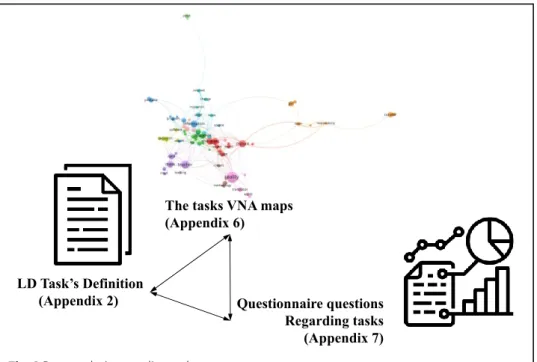
This particular case uses what is called "the students' declared performance", which allows a more complex perspective of the learning activity that takes place during a course, which helps to better understand how it actually happens. Is VNA a proper analysis strategy to clearly understand different aspects of the declared performance of the participants. All those elements of each task (detailed for each task in Appendix 2) are content of the course.
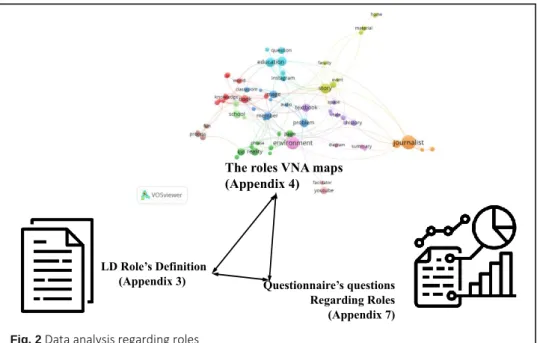
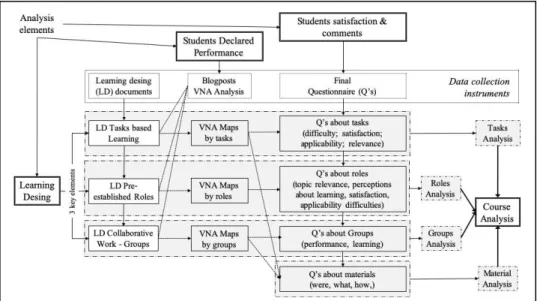
The definition of subject roles and the competencies included in each of them are detailed in Appendix 3. As mentioned, the data related to the roles were obtained from the definition of roles in the lesson plan prepared by the teacher, the stated performance of the roles . through blog posts and students' perceptions of roles (questionnaire) (the data collection instruments that were included in this analysis are shown in Figure 2). Data about the tasks were obtained from the description of the task features (topic, artifact, development and presentation strategy, formats) in the lesson design by the teacher, the stated performance of the tasks through blog posts and the students.
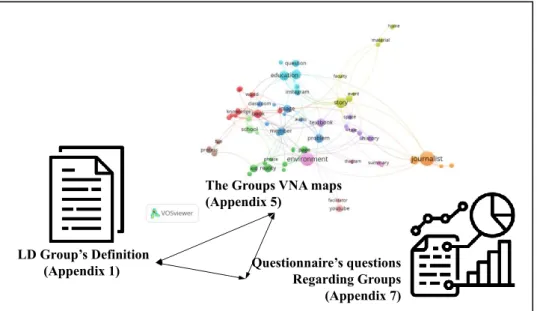
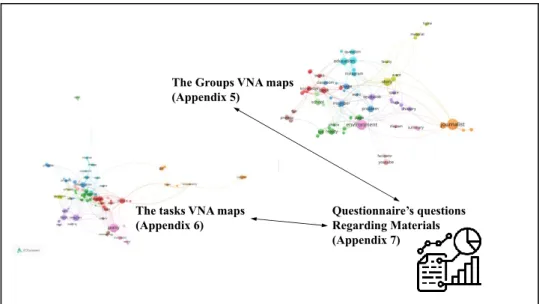
Data about the groups were obtained from the teacher's description of the group conditions in the lesson plan, the stated performance of the groups through blog posts, and the students' perceptions of the course work – a section referring to group work. (questionnaire) (see how the information is triangulated in Figure 4). Data regarding material aspects were obtained from stated performance of assignments and groups through blog posts and students' perceptions of material aspects of the course (questionnaire) (see Figure 5). However, "school" as a space appeared in some tasks and groups as part of the topic addressed, but not as that of the students.
It also appeared in the stated performance of the four groups and as part of the presentation strategy in some tasks.
Discussions and conclusion
Group characteristics
If we want to characterize the type of approach to collaborative learning that has been generalized in the subject work, the formal model of collaborative learning was chosen (Johnson et al., 2014). This model of participation theoretically follows a certain structured time path that responds to some prior guidance from the teacher. In this model, aspects such as task and positive interdependence are explained by the teacher.
The teacher takes a key role by asking, clarifying and analyzing the processes of monitoring the work of the group, but not directly monitoring it. The main evaluator of the results is the teacher and, by giving feedback, the teacher tries to facilitate the processes of change and improvement within the groups. Moreover, in the case of this course, the approach also responds to a strategy of cooperative core groups.
Thus, we speak of stable groups that work together throughout the process, although the participants' activity includes dynamics in interaction with participants from other groups, especially in the presentation of the artifacts of the tasks (see Appendix 2). Collaboration in this course – group work – is not only desirable but necessary as it is intended to address complex knowledge in the context of the classroom with a teacher-student ratio of around 1:80 and where the only way to expect larger assignments is through collective work. But the idea of achieving that all groups have a leading role in the class, that there are explicit and frequent interactions between the groups, and that they can receive weekly feedback from the teacher, has led us to choose a model for working in large groups.
This means having a ratio of a maximum of 10 work groups per class (at a rate of between 6 and 9 members per group). The groups' activity is not only reflected in the work presented in class (see appendix 2), but also in the course's so-called "performance e-portfolio". It is a public blog that aims for a weekly interaction with the content and activity of the groups.
This portfolio aims to collect group activity around tasks and, in addition, each team member must collect his or her task completions on a weekly basis in the performance role corresponding to him or her in each case (see Appendix 3 ). This is a portfolio that should serve not only to show the groups' reflection, but also to serve as a field notebook to help them make subsequent decisions about each of the parts of that work, the processes they carry out to develop it and, of course, how it can be. Also, during the course, the importance of some of the elements of the portfolio as reference material in the future beyond the completion of the course itself is emphasized.
Learning tasks in detail
Groups will lead a pre-designed activity of each of the topics and will develop an original one for each of them. Project-based learning They will present the learning design, including examples of the final artefacts included in the activities. Students will create a fair with one stand-by group in the Faculty Hall and present their ideas to colleagues and teachers from other groups.
A reflection on which of the expressed PLE elements would be included in the different parts of the PLE. Students will interview the teacher, present their PLE, and create a roadmap for improving that person's PLE. Pechakucha Large Group Pechakucha session and collective reflection on the main areas of PLE that can be improved.
They will also curate and organize an exhibition using criteria that they will share using their blogs. Based on their feedback and work, selecting tasks to include and creating a website. After the presentation, the teacher asks at least 2 questions to each member about the development of the e-portfolio and their decision-making process.
Pre-established work roles definition
Analyst The analyst is responsible for leading the final task reflection and the weekly performance evaluation of team members. At the end of each week, each analyst must include this assessment (numerical and qualitative) in an online ad hoc questionnaire. In addition to this task, the analyst is responsible for producing the team's weekly reflection, which should include comments on what they have learned both in the course content and in group work, as well as in becoming a teacher.
This role is modeled after the role of “analyst” described in some of the works mentioned in Strijbos and De Laat (2010) and is designed as one of the most important roles in the work. Not for nothing, the role is tasked with doing job reflection, paying attention to the work that all the other roles are doing, looking at what aspects they approached, reflecting on how they worked and colluding with their colleagues. to reflect on what they have learned. Ultimately, he or she is in charge of explaining and agreeing on the team's process of reflection and metacognition.
Star This role is responsible for presenting the final product of the weekly assignments to all members of the class, paying attention to the specific requirements in each assignment. It should be emphasized that despite the fact that all members of the team should participate in the implementation of the task, the star shows a greater interest from week to week.
VNA maps by roles
VNA maps by groups
VNA maps by task
Conceptual
TPACK
Comic life
Under the
Fair project
My PLE
Other’s PLE
The dark
Final
Final questionnaire items
I have many friends in class, I feel very close to them. How would you describe. Do you think the experience you gained in this course will improve the way you learn in the future? Do you read documents (watch .. recommended videos or presentations) to do the activities.
For each tool, indicate how important it was to the development of the course (for you). Tools (with each tool there is one full element with a full set of options .). For each DEVICE, indicate how important it was to the development of the course (to you).
Devices (with each device there is one full element with the full . set of options). Both authors participated in the design and implementation of the study, analysis of the results, and writing of the manuscript. This study was partially supported by the project PID2020-113101RB-I00 “Codiseño de itinerarias personales de aprendizaje en entornos conectatos en educacion superior”, funded under the State R&D&I program aimed at the challenges of society, from the State Plan for Scientific and Technical Research and Innovation 2017-2020 of the Spanish Ministry of Science and Innovation.
Linda Castañeda acknowledges the support of the Fundación Séneca, Stays of Researchers from the Region of Murcia in International Centers 2018. Due to the nature of this research, participants of the case study did not consent to their data being shared publicly, therefore supporting data are not available not. Learning analytics for learning design: A systematic literature review of analytics-driven design to improve learning.
A Bibliometric review of the Journal Eurasia Journal of Mathematics, Science and Technology Education between 2012 and 2017.